
Two patios can sit 400 yards apart in Settles Bridge and have completely different lifespans — because one sits on a FEMA Zone AE lot and the other doesn’t. The base build that lasts 30 years on a dry Laurel Springs lot will fail inside five on a flood-zone parcel. Suwanee homeowners keep finding this out the hard way.
If your back property line drops toward the Chattahoochee, or you’re in one of the older Settles Bridge cul-de-sacs, or you watched FEMA update your flood map after the 2015 LOMR revisions, this article is written for your parcel specifically. It isn’t a generic paver patio post. It’s the spec we build to when a Gwinnett County permit reviewer pulls the elevation certificate and we know the finished grade of the patio has to sit inside a survey window.
A standard Primetime paver patio on a dry Suwanee lot runs $14–$18/sqft installed. The same patio on a flood-zone lot — engineer-stamped drainage, elevated base, check-valve tie-ins, flood-resistant polymeric, storage protocol for furniture — runs $18–$26/sqft. That $4–$8 delta is not upcharge. It’s the difference between a patio that survives 30 years in a flood corridor and one that heaves, migrates, and pumps silt into the joints after the first backflow event.
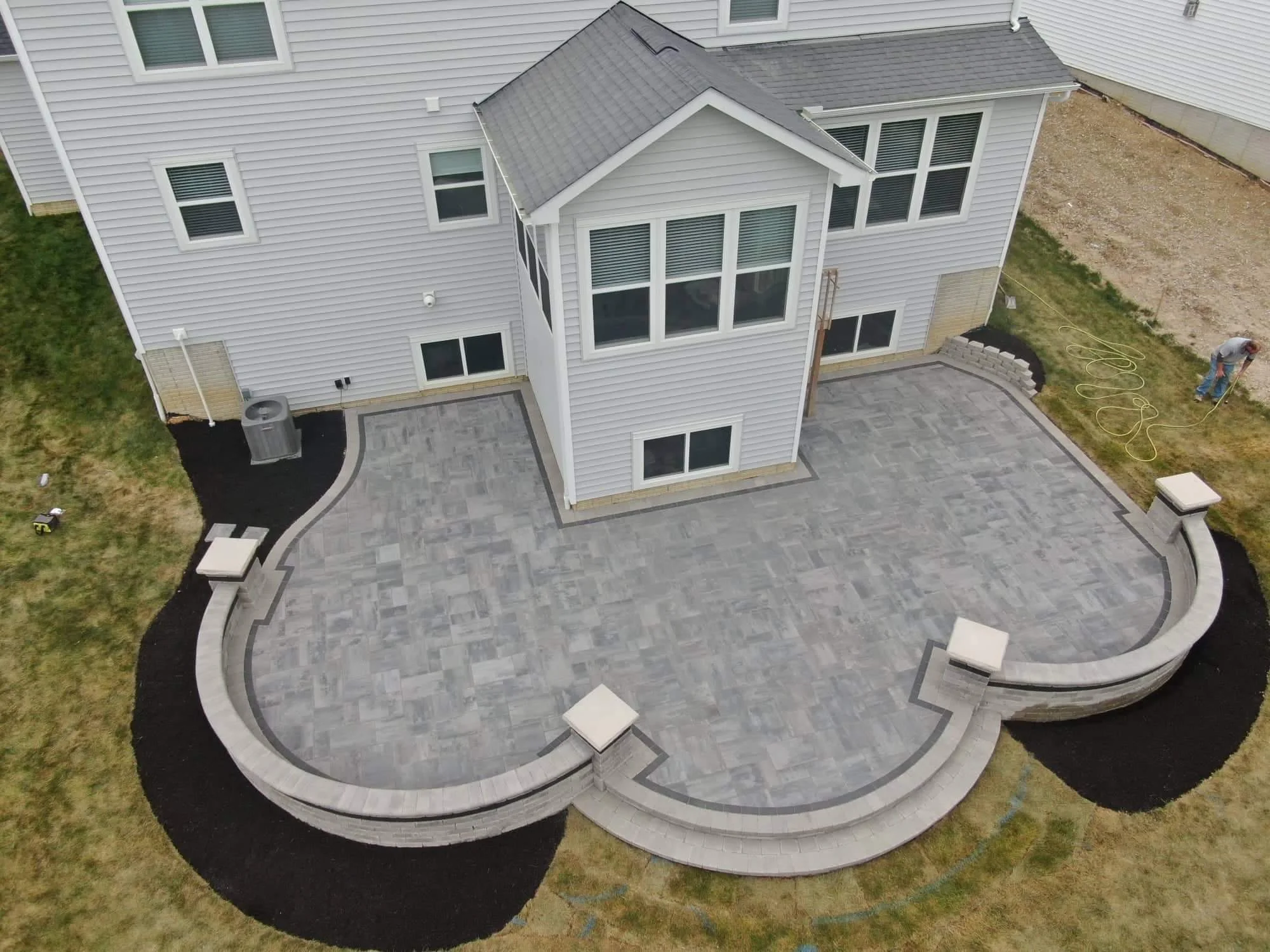
1. Why Suwanee Is a Different Paver Spec Than Dacula or Grayson
Suwanee sits at roughly 1,063 ft elevation with the Chattahoochee River forming the southwest border of the city. That river is the hinge of this entire conversation. Three things change when you get within a mile of the floodplain:
- The FEMA flood maps reclassify sections of Settles Bridge and parts of lower Laurel Springs as Zone AE — the 1% annual-chance flood boundary. A paver base built to a standard 6″ compacted GAB on a Zone AE lot is a short-term patio.
- The soil shifts from pure Cecil-series Piedmont clay to a sandy-loam/clay interbed that looks better-drained on paper, but actually transports fines more aggressively during a rising-water event. Joint sand migration is the failure mode.
- The permit reviewer at the Gwinnett Dept. of Planning & Development (446 W. Crogan St., Lawrenceville) wants an engineer-stamped drainage plan before the patio permit gets a signature. No stamp, no permit, no legal patio.
Build the wrong spec in the wrong neighborhood and the patio punishes you. Build the right spec — the one we describe below — and it outlasts the composite deck, the outdoor kitchen, and most of the plantings.
The $4–$8/sqft flood delta: base upgrade, drainage tie-in, polymeric selection, storage hardware. We price it line-by-line so Suwanee homeowners see what the money is actually doing — it’s not a “flood fee.”
2. Pre-Design: The Elevation Certificate and the Survey Window
Every Suwanee flood-zone patio starts in the same place — with an elevation certificate. If your lot is Zone AE and you already have one from a refinance, a construction loan, or a prior pool permit, we use it. If you don’t, expect $475–$650 for a licensed Georgia surveyor to pull the base flood elevation (BFE) for your parcel, set control points at the finished patio corners, and shoot relative grade.
That certificate tells us two things that dictate the entire patio. First, it tells us how many inches above existing grade the patio must sit to be legally compliant with Gwinnett’s freeboard requirement (typically BFE + 1 ft, sometimes + 2 ft inside Laurel Springs’ HOA overlay). Second, it gives us the survey window — the elevation band the finished surface has to sit inside so the reviewer stamps the permit.
A dry-lot patio in Village Grove has a 3″ tolerance on finished grade. A Zone AE patio in Settles Bridge has something closer to a half-inch window. That changes how we cut, how we set string lines, and how much laser work runs in the install phase.
3. The Elevated Base — 12 Inches Instead of 6
Here is where flood-zone spec starts diverging hard from a standard build. On a typical Suwanee dry-lot patio we excavate to 8″ below finished grade, compact the subgrade, lay 6″ of GAB #57 base, and compact in two 3″ lifts to 95% Proctor.

On a Zone AE lot we excavate to 14″ below finished grade, add a layer of Mirafi 500X geotextile at subgrade, lay 12″ of GAB #57 base compacted in four 3″ lifts, and set a 1″ bedding layer of ASTM C33 concrete sand. The geotextile separates subgrade fines from the base stone so the base doesn’t silt up during a submersion event. The extra six inches of base gives the system enough structural mass to resist the uplift pressure that comes with saturated Piedmont soils during a rising-water condition.
We compact with a 3,400-lb reversible plate compactor — not a standard 2,000-lb unit. The extra mass drives the base to 98% Proctor, which is what the stamped drainage plan calls for on every flood-zone build we’ve done in the last four years.
Base numbers — flood vs. dry: Dry lot = 6″ GAB, 2 lifts, 95% Proctor, 2,000-lb compactor. Zone AE = 12″ GAB, 4 lifts, 98% Proctor, 3,400-lb compactor, geotextile separator.
4. Check-Valve Drainage and the Tie-In Detail That Protects Your Foundation
A standard patio drains on surface slope — ¼” per foot away from the house, sheet-flow to lawn. That works every day of the year on a dry Suwanee lot. It fails catastrophically on a flood-zone lot during a backflow event, because water doesn’t just run off the patio — it also comes up through the joints from below, and runs back toward the house through any 4″ PVC tied to the storm system.
Our flood-zone drainage spec has four pieces. First, a SDR-35 4″ perimeter drain at the low side of the patio, bedded in #57 stone wrapped in 8 oz non-woven geotextile. Second, a 6″ linear trough drain across the house-side edge, set flush with the pavers, carrying sheet water away before it hits the joint pattern. Third, a one-way check valve on the tie-in to the existing storm lateral — a Campbell Model CVS or equivalent, rated for the pipe size, inspected and flow-tested before backfill. Fourth, a cleanout tee at the check valve and another at the low corner, so the homeowner can rod the line without tearing up pavers.
The check valve is the single most important piece of hardware on the entire build. It’s the difference between a patio that experiences a flood event once and a patio that pumps river water and silt back into the joint sand every time the Chattahoochee crests.

5. Paver Selection — Why Large-Format Is the Wrong Answer in Zone AE
Large-format 24×24 pavers are beautiful. They photograph well, they read luxury, they move fast on install. On a dry-lot Suwanee patio in Laurel Springs or The River Club, a Techo-Bloc Blu Grande or Aberdeen large-format is the right call — and we build dozens of those every year.
On a flood-zone lot, large-format is the wrong answer. Here’s why. When water rises up through a base and exits through the joints, the load on each joint is a function of joint length. A 24×24 paver has four times the joint length of a 6×6 paver. Four times more joint length means four times more water trying to lift four times more polymeric sand per unit of paver weight. Large-format pavers in flood zones walk. We’ve pulled them up — on jobs we didn’t build — and seen full inches of lateral migration after a single flood season.
For Zone AE parcels we specify Belgard Mega-Lafitt or Techo-Bloc Blu 60 in a random 3-piece bond. Smaller individual pavers, more joints, more interlock, less lift vulnerability per paver. The pattern reads slightly more traditional than a large-format modular — most clients don’t care once they see the crack-free install still sitting flat in year 20.
6. Flood-Resistant Polymeric and the Sand Spec That Actually Survives
Polymeric sand is the category name. Inside that category there are three different chemistries that behave differently underwater. Most paver contractors use whatever the supply house stocked that morning. On a Suwanee flood-zone build, the wrong polymeric is the failure point in year two.
We spec one of three products on Zone AE jobs: Techniseal RG+, Alliance Gator Maxx G2, or SRW VersaLok PolySand HP. All three are rated for “saturated conditions” — meaning the binder remains chemically bonded when submerged for more than 24 hours. Standard polymeric (including most big-box offerings) starts dissolving around the 12-hour mark. On a flood-zone lot that’s an annual joint failure.
We also install the polymeric in two passes, not one. First pass goes in dry, swept, worked with a plate compactor fitted with a urethane pad, then misted to activation point — not soaked. Second pass, 48 hours later, fills the settling that happens after the first activation and locks the top surface of the joint.

Polymeric numbers: Saturated-rated polymeric adds ~$0.85/sqft over standard. On a 900 sqft patio that’s $765 — about 1.5% of the total build. It pays for itself the first time the river crests.
7. The Laurel Springs Architectural Review Wrinkle
If the lot is inside Laurel Springs, the spec conversation doesn’t stop at Gwinnett County permitting. The Laurel Springs HOA architectural review committee is one of the strictest in Gwinnett. Typical turnaround is 3–4 weeks on a complete submittal, longer if anything triggers a revision.
They require detailed plans, elevation view, material samples (actual pavers, not catalog photos), color-matched soldier course samples if you’re building with a border band, and a planting plan showing how the patio integrates with existing landscape. The committee also reviews the outdoor kitchen, if there is one, for gas line routing and hood vent compliance with the community design standards.
On Zone AE lots inside Laurel Springs — there are a handful — the HOA review runs concurrent with the county engineering review. We submit both packages the same week, which saves about 10 working days versus sequential submission. The HOA will not approve a plan that hasn’t been drainage-stamped, and the county won’t stamp a plan that hasn’t been HOA-approved, so the submittals have to be sequenced carefully.
8. Post-Build Furniture, Storage, and the 30-Year Maintenance Rhythm
The last piece of a flood-zone Suwanee patio spec isn’t on the installed surface — it’s what lives on top of it, and where that equipment goes when the river rises.
On a dry lot we tell clients: leave the deck furniture out, cover it in winter, re-cushion every five years. On a Zone AE lot we tell them the opposite. Permanent and temporary storage protocols become part of the spec. Permanent pieces — column piers, built-in seat walls, masonry fire pits, outdoor kitchens — get built with full masonry cores (not veneer on wood substrate) and mortared caps, so they shed water and don’t delaminate during submersion.

Temporary pieces — deck furniture, umbrellas, grill equipment, planters — need a storage plan. We work with clients on elevated storage: a shed with a finished floor 12″ above grade, an attached garage bay with a raised plinth, or a conditioned basement room if the house is a hillside walkout. The goal is a defined protocol: when the National Weather Service posts a flood watch for the Chattahoochee gauge at Norcross, everything on the patio goes up in a 2-hour window.
Annual maintenance on a flood-zone patio looks like this: joint sand top-off every 18–24 months (standard is every 36 on a dry lot), check-valve inspection and flow-test each spring, cleanout rod-out each fall, and a full pressure-wash + reseal every 4 years instead of 6. Extra labor, more money, longer life. The 30-year number in the title isn’t a marketing promise — it’s what this spec actually delivers, and it’s what we’ve watched the early-2010s flood-zone builds of ours hit.

Peachtree Industrial Blvd (Hwy 141) handles the equipment delivery for most of our Suwanee builds — a 3,400-lb compactor, a mini-ex, a dump of 12 tons of base stone, and a stock load of pavers need a staging corridor with overhead clearance. Settles Bridge Rd and Old Peachtree have that. McGinnis Ferry narrows closer to the River Club gate and needs a smaller staging layout. Jackson EMC’s 240V service on the street simplifies pavilion lighting and outdoor kitchen power tie-ins — no Georgia Power coordination for the bulk of Suwanee, which usually saves 7–10 working days on the electrical side.

If you’re sitting on a Zone AE lot in Settles Bridge, or a lower-elevation parcel in Laurel Springs, or anywhere within a mile of the Chattahoochee, the patio you build matters for 30 years. The base, the drainage, the polymeric, and the storage plan are the four pieces that decide which side of that 30-year line you land on. A standard-spec build will look identical on day one. In year seven the joints tell the truth.
That’s the Primetime Suwanee spec. Engineer-stamped, HOA-approved, river-tested, and priced at $18–$26/sqft for exactly the reasons laid out above. There is no shortcut. There is no dry-lot workaround. There’s just the spec, and the patio that’s still flat in 2055.
Flood-zone paver patio builds across 20+ cities within 30 miles of Winder, GA
If your Suwanee lot sits in FEMA Zone AE or anywhere near the Chattahoochee floodplain, the spec changes — base depth, drainage hardware, polymeric chemistry, storage plan. We build to the 30-year standard every time.