
The first Windward pool I walked onto this spring was built in 1996 — a textbook 8×40 rectangle with an 8.5-foot deep end, original white plaster going lace-veined at the steps, and a diving board the homeowner had quietly stopped letting the grandkids use. The shell was healthier than anyone guessed. Almost everything attached to it was done.
That house sits off Windward Parkway, inside the original Windward development — one of the densest 1990s pool clusters in North Fulton. If you drive those streets with a trained eye, you can spot the vintage from the road: same white coping bullnose, same 1-inch waterline tile, same aluminum diving stand bolted into the deck. The builder who put most of them in the ground worked from a repeating template between 1993 and 1999, and that template aged in ways that are now predictable down to the month.
We’ve walked more than 40 of these pools over the last three years, and the pattern is so consistent it’s almost funny. Same waterline tile lifting on the north wall. Same hairline plaster checking radiating out of the corner step. Same squat equipment pad tucked against the house with the same Sta-Rite pump on the same mechanical timer. If one of those pools is yours, you are not looking at a snowflake problem — you are looking at a well-documented remodel.
This post is a forensic walk through what we find when we open one of these pools up. What the original builder nailed. What fails on a schedule. What today’s HOA, insurance carrier, and code inspector will no longer tolerate. And what a realistic full-scope remodel costs in 2026 dollars for a homeowner sitting on a 30-year-old Windward rectangle.
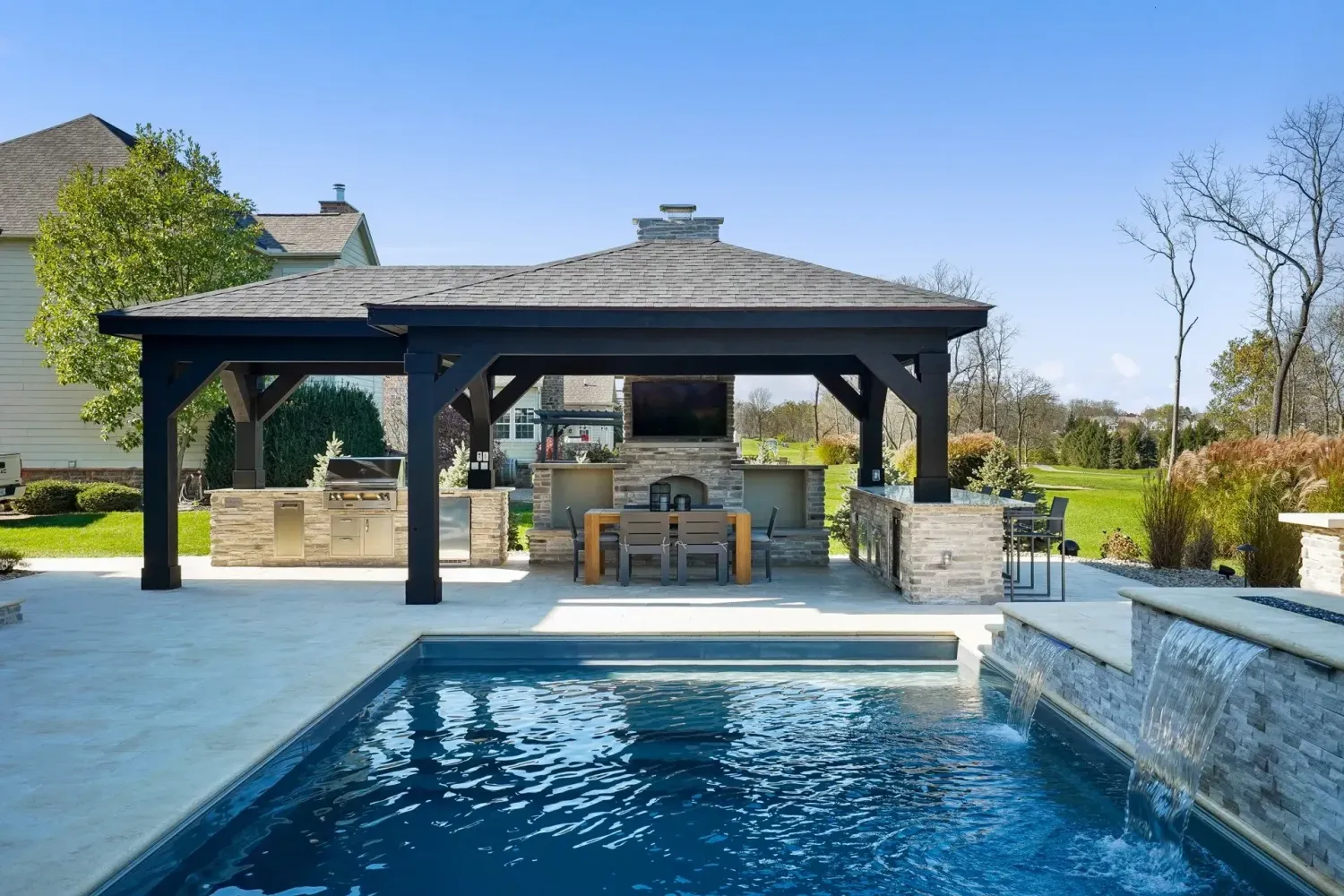
1. What the Windward Builder Got Right — The Shell and Bond Beam
Before we get to the list of things that need to go, give the original builder credit where credit is earned. The single most expensive component of any pool — the shell — is the component that has aged best on these jobs.
Almost every Windward pool we’ve opened shows 10-inch gunite walls and a bond beam tied with #4 rebar on 12-inch centers. That’s heavier than code minimum, and it’s heavier than what a lot of Atlanta volume builders were shooting in the same decade. Thirty years in Cecil-series Piedmont red clay — a soil with moderately high shrink-swell behavior — is a real structural test. We’ve pressure-washed down to bare gunite on dozens of these pools and found no structural cracks at all. Cosmetic craze-cracks in the plaster, yes. Through-wall cracks in the shell, no.
The reason this matters is that the shell is the one component you cannot meaningfully remodel. If it’s compromised, you are not remodeling — you are demolishing and rebuilding, and that conversation starts at a number three to four times higher. On Windward pools, we almost never have to have that conversation.
Two other things the original builder got right: skimmer placement and main drain orientation. The skimmers sit on the long leeward wall relative to prevailing southwest summer wind — exactly where you want them for surface debris collection. The dual main drains at the deep end are code-compliant for anti-entrapment long before VGB 2008 made it mandatory. You don’t have to move any of that during a remodel, which saves real money. Cutting and re-plumbing main drain lines on an established pool can add $6,000 to $9,000 to scope, and on Windward pools you simply don’t have to.
The plumbing runs are the third quiet win. Original Windward pools were plumbed in Schedule 40 PVC, and the suction and return lines buried under the deck have held up without collapse or root intrusion. When we pressure-test those lines at the start of a remodel, they generally pass on the first try. That is not a given on 30-year-old plumbing.
Shell inspection before you sign a remodel contract: Insist on a dye test and a visual inspection after the first 48 hours of drain-down. If the shell has held water for 30 years and shows no structural cracks once dry, you are remodeling a pool. If it hasn’t, you may be rebuilding one — and that is a very different number.
2. Waterline Tile — Why It Fails at Year 18 Like Clockwork
The 1990s Windward builder used a 1-inch square ceramic waterline tile set in Portland-based thinset, with a mortar bed over the bond beam. That combination worked fine for about two decades. It does not work for three.
The failure mode is always the same. Alpharetta sits in USDA Zone 8a and averages around 20 freeze events per year. Pool water at the tile line gets to roughly 40°F on the coldest January nights, while the air sitting against the exposed face of the tile drops into the high teens. Water wicks into the grout, freezes, expands, and cycles. Do that 400-plus times and the thinset bond fails. The tile doesn’t crack — it pops off in sheets, usually first on the north-facing long wall where sun exposure is lowest and the tile never gets a chance to dry out between freeze events.
The second contributor is the coping joint above the tile. The original expansion joint between coping and deck fills with silicone that fatigues, cracks, and admits water behind the tile from above. You end up with freeze-thaw attacking from two directions at once. The tile never had a chance to make it to year 30.
Every Windward pool I’ve remodeled has needed full waterline tile replacement. The standard we spec is a 6×6 porcelain waterline with an epoxy-modified setting bed and elastomeric flexible grout at the tile-to-coping joint. Epoxy-modified thinset resists water intrusion at the bond line — exactly where the original system failed. It costs about 2.4x what standard thinset costs per square foot, and lasts about 2.5x as long. On a 30-year ownership horizon, that math is obvious.
One more waterline-level decision: glass tile accents. Many homeowners on these remodels want a 4-inch band of iridescent glass tile, either full perimeter or on the two short walls only. It reads as a real upgrade, but spec the glass tile on an elastomeric setting bed specifically — the epoxy-modified thinset we use for porcelain is too rigid for glass, and the glass tiles will micro-crack. Different material, different thinset. Your remodel contractor should know the difference.
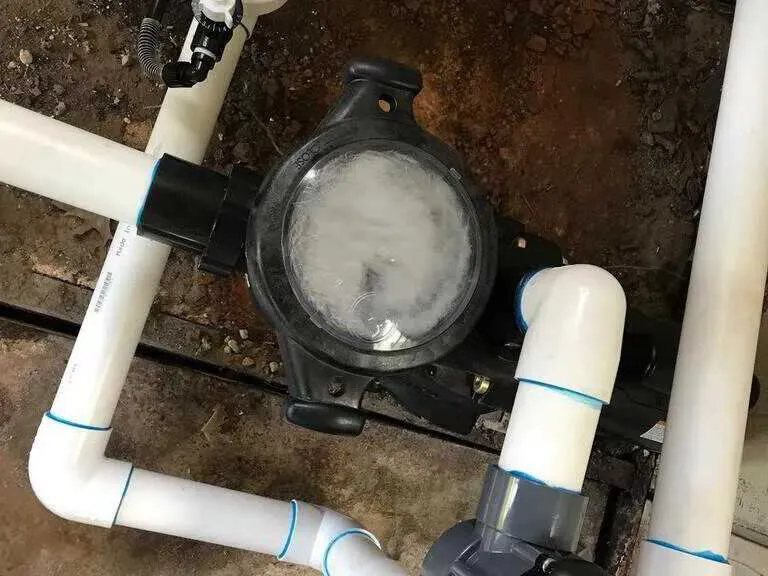
3. Plaster — The 12-to-15 Year Clock and Why Pebble Tec Changes It
White marcite plaster, done correctly, will give you 12 to 15 years of service life in North Fulton water chemistry before it needs a full resurface. That’s a real number, not a marketing number. The original Windward builder used a standard 3/8-inch white marcite and the homeowners we talk to have typically resurfaced once already, somewhere around year 14 or 15. If you’ve only resurfaced once on a 1996 pool, you are due.
The tell-tale signs of marcite at end-of-life are specific. The surface develops a chalky feel underwater — your fingertips come up with a white residue. The plaster shows lace-cracking on the corner steps. Stains darken at the same rate regardless of water chemistry because the surface has gone porous. When you hit all three at once, you are not looking at a patch repair.
The upgrade path is not another round of marcite. It’s an aggregate finish — the most common spec we write for Windward remodels is Pebble Tec Classic in a mid-tone gray or Caribbean blue. The pebbles distribute thermal stress differently across the surface, and realistic service life goes from 14 years to 22 to 28 years. The cost delta between a third-round marcite resurface and a Pebble Tec conversion is roughly $4,800 to $7,500 on an 8×40 rectangle. Over a 25-year horizon, Pebble Tec is cheaper per year. The homeowners who regret their choice are the ones who went with marcite again because it was the cheapest line item, then saw lace-cracking by year 10. Buying the same product twice in 15 years is not a bargain.
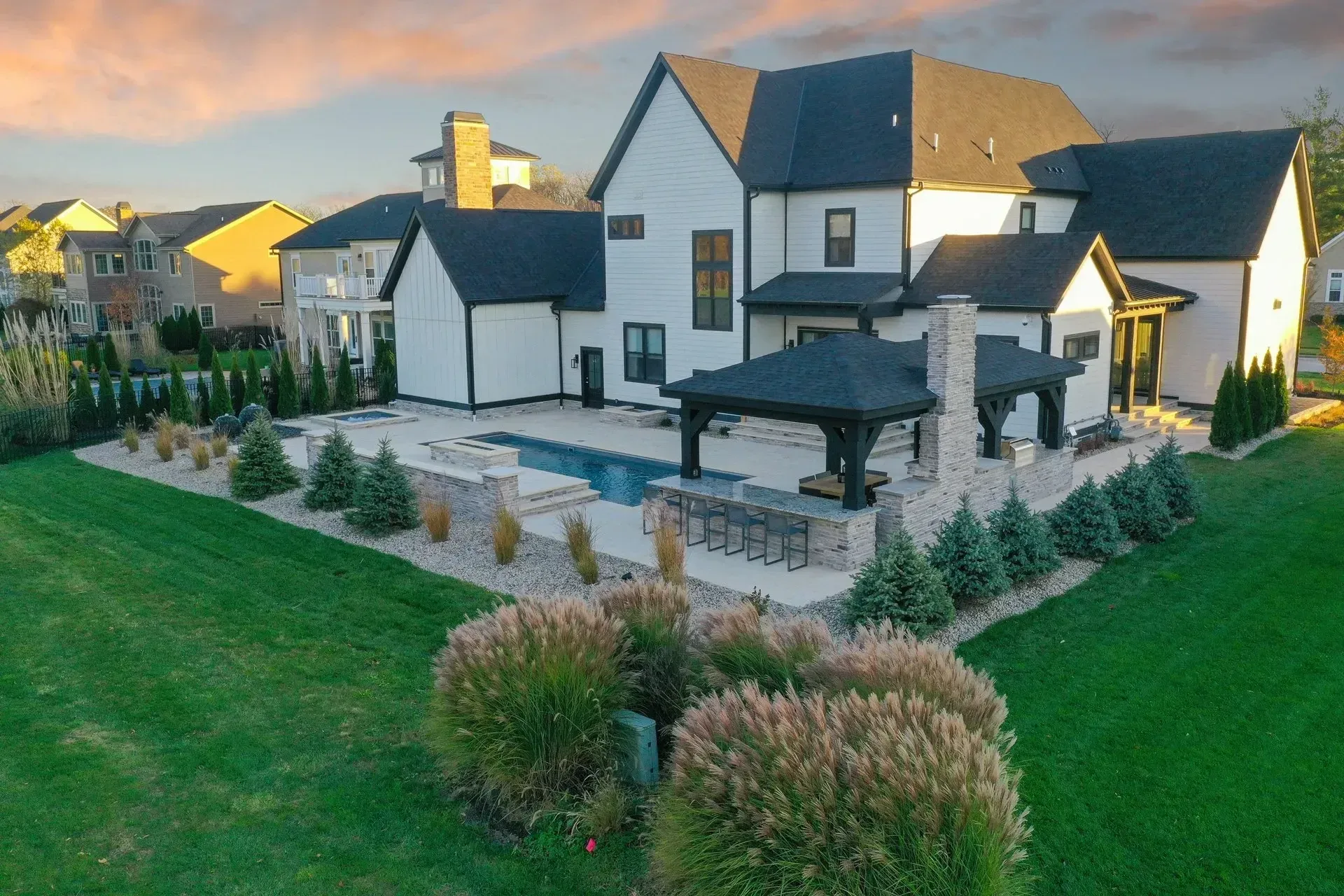
4. The Diving Board Problem — HOA, Insurance, and Physics
Every original Windward pool came with a diving board. Nobody installs them anymore, and there are three separate reasons converging on that fact at once.
First, the Windward Residential Association — like Country Club of the South, White Columns, and most of the North Fulton established HOAs — requires architectural review board approval for any new diving board installation. Approval is, in practice, not given. Second, most major homeowners’ insurance carriers will either refuse to write a policy on a property with an active diving board or surcharge the liability portion enough that the homeowner makes their own decision to remove it. We’ve seen premium increases of $800 to $1,200 per year from the diving-board disclosure alone.
Third — and nobody likes talking about this one — an 8.5-foot deep end is marginal for residential diving by the standards adopted after the ANSI/APSP-5 2011 update. The original builder built to the standard of that era. The standard changed. To bring the pool into current compliance, you would need to deepen the deep end — jackhammering the bottom, re-steeling, re-shooting gunite, re-plastering. That job costs more than most homeowners spend on the entire rest of the remodel combined, and at the end of it the HOA still won’t approve the board.
The fix on Windward remodels is almost universal: the diving board comes out, the aluminum stand gets cut off at the deck, anchors get filled with hydraulic cement and re-decked, and the homeowner gets a tanning ledge built into the shallow-end wall. A 6×12 tanning ledge at 9 inches of water depth is the most-requested replacement feature. It adds usable swim-up surface, reads as a luxury feature on resale, and stops the insurance company’s annual letter.
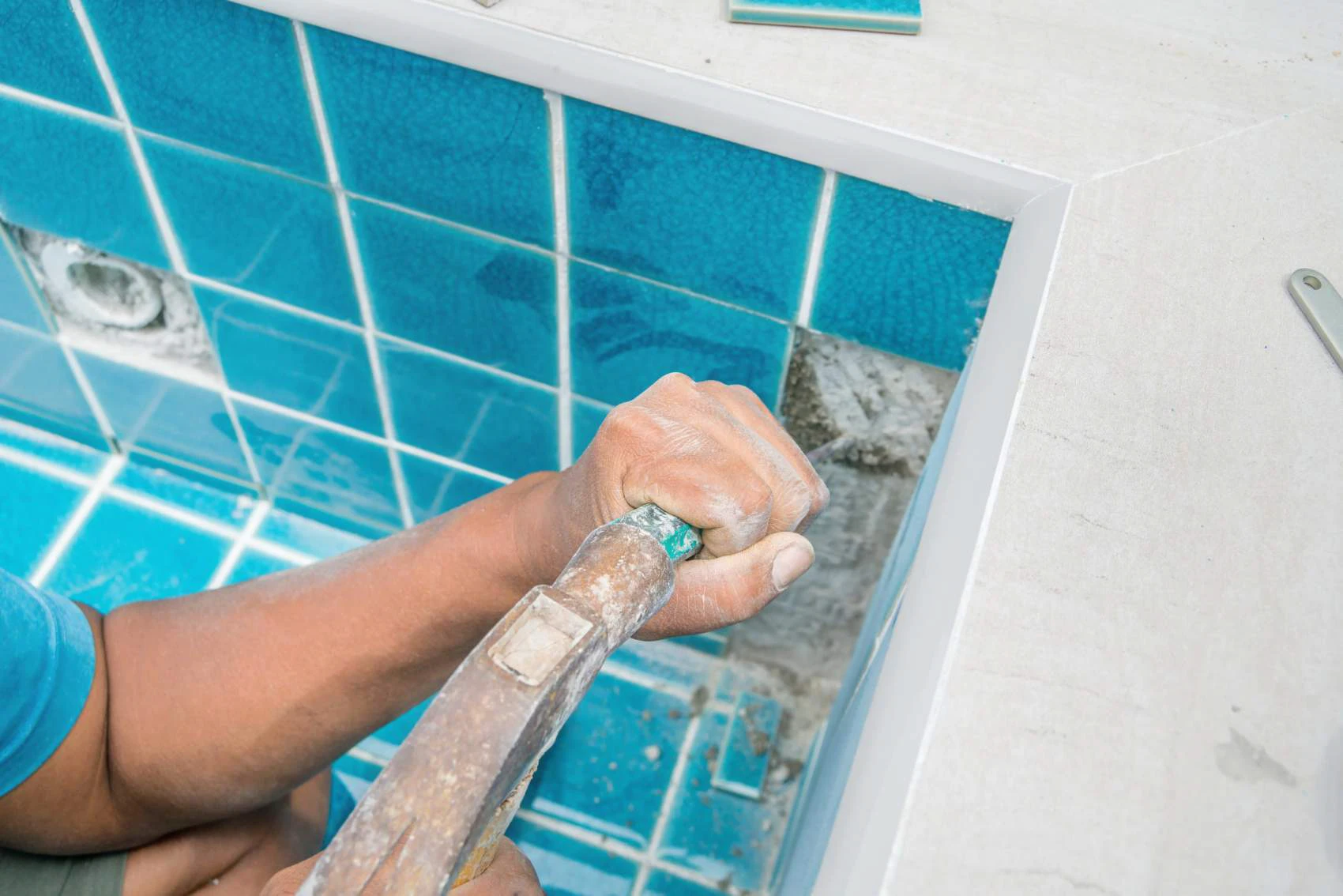
5. Equipment Pad — Single-Speed Sta-Rite to Variable-Speed Flow
The equipment pad on an original Windward pool is almost always a Sta-Rite Dura-Glas single-speed 1.5 HP pump, a Hayward DE filter of 48 or 60 sq ft, and an automatic chlorinator feeder plumbed inline. That setup ran well in its era. It runs inefficiently now, and as of Georgia Power’s 2021 residential rate schedule, the monthly power bill to keep it running 8 hours a day in peak summer is real money — we’ve seen homeowners paying $140 to $180 per month in July and August just on pool circulation.
The Department of Energy’s July 2021 pump efficiency rule effectively ended new single-speed pool pump sales above 0.711 total horsepower. The current standard on our Windward remodels is the Pentair IntelliFlo3 VSF, priced in the $2,050 to $2,400 range installed, with $720 to $1,080 annual energy savings against the original Sta-Rite. Payback lands between month 20 and month 30. Past that, every subsequent dollar of electricity savings is net savings.
The filter is the second equipment-pad decision. The original DE filter works, but DE powder is messy and backwashing correctly is a task most homeowners skip. We usually upgrade to a cartridge filter — a Pentair Clean and Clear Plus 520 handles an 8×40 comfortably and swaps cartridges once every 2 to 3 years. Third is sanitation: a salt chlorine generator (Pentair IntelliChlor IC40) runs an extra $1,800 to $2,400, eliminates chlorine tab handling, and gives the water a noticeably softer feel. About 60 percent of our Windward customers go salt.
Homeowners inside the original Windward subdivision are typically served by Georgia Power. If you’re in the far north end of Alpharetta or the Milton border belt, you may be on Sawnee EMC, and their inspection calendar differs enough to matter for scheduling. Your remodel contractor should know which utility feeds your equipment pad before cutting over new circuitry — not after. We’ve seen remodels on the Sawnee side delayed two weeks because the original estimate assumed Georgia Power lead times, and a two-week delay in October cascades into a pool that doesn’t refill until January.
The last equipment-pad consideration is heater strategy. If you’re adding a heater, a gas heater (Pentair MasterTemp 400) is the baseline. For spa-pool combos, a gas heater for rapid spa warm-up paired with a heat pump for pool maintenance is the right spec. Straight gas is the answer for families who use the pool May through September; a heat pump is the answer for families who want April-through-October comfort in a climate averaging 20 freeze events per year.
6. Lighting, Automation, and the Things That Weren’t Even Invented in 1996
The original Windward pool was built with a single 500-watt incandescent pool light in a niche on the deep-end wall. Incandescent. Five hundred watts. Bulbs cost about $110 to replace, the fixture was rated for roughly 1,000 hours before the seal degraded, and the light output was dim and yellow. Half the pre-remodel walk-throughs we conduct feature a pool light that hasn’t worked in years because the maintenance rhythm just stopped.
The baseline remodel spec in 2026 is a Pentair IntelliBrite 5G LED color-changing fixture drawing 42 watts, rated for 30,000 hours, with a 10-year warranty on the driver. The delta on your monthly electric bill is measurable. The delta on how the pool looks at 9pm in August is transformative. On the Windward pools we’ve remodeled in the last three years, LED upgrade has been 100% of the order sheet.
Automation is the second new line item. The original pool had a mechanical time clock bolted to the equipment pad wall. Today’s standard is a Pentair IntelliCenter panel with a phone app, heater integration, light scheduling, and chlorinator control. That’s a $2,400 to $3,600 line item. Homeowners who have used IntelliCenter for six months universally describe it as the single best upgrade of the entire remodel — not the plaster, not the tile. The app. The ability to warm the spa from the office, or turn on color-changing lights before dinner guests arrive.
7. The Realistic Windward Remodel Scope and What It Costs in 2026
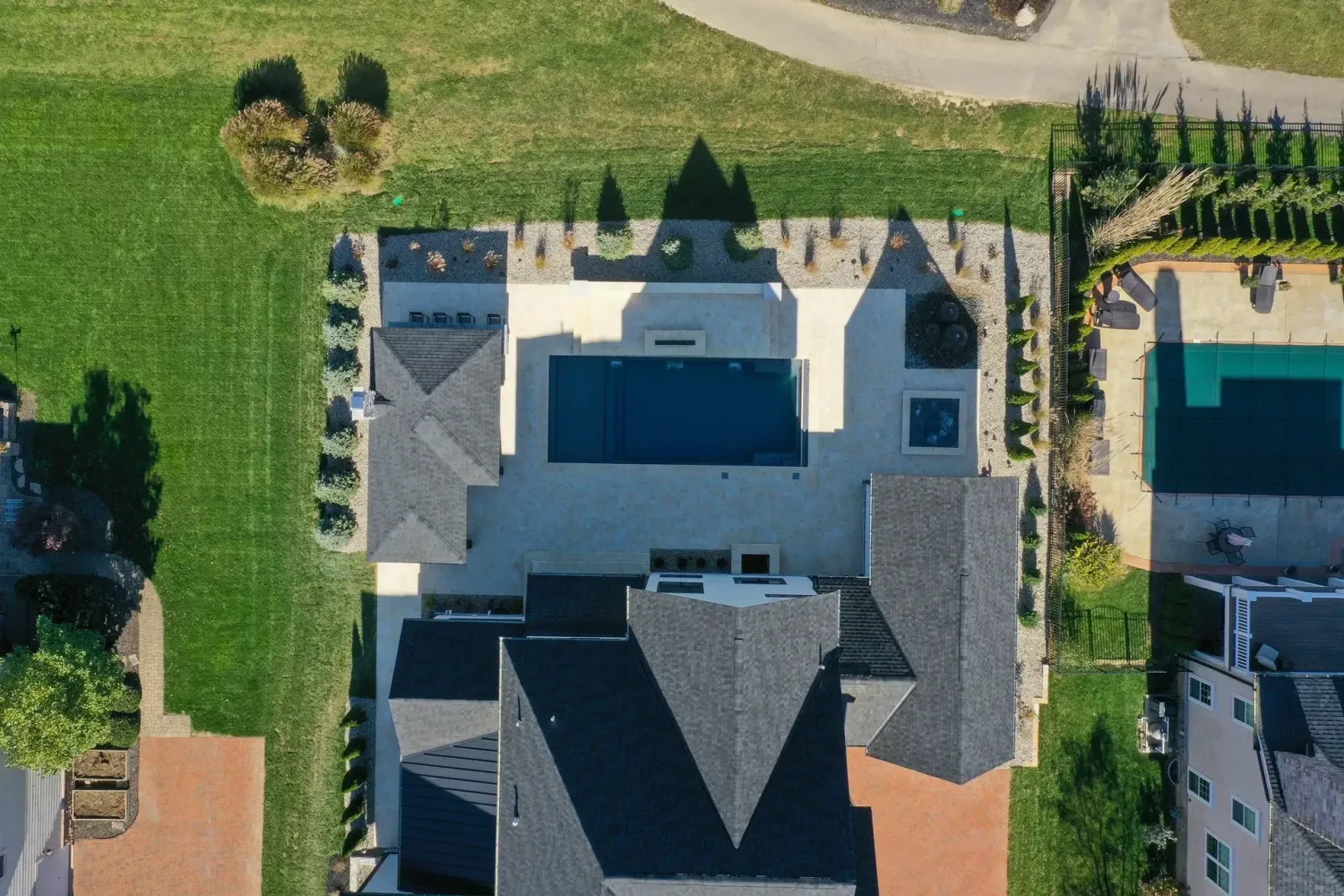
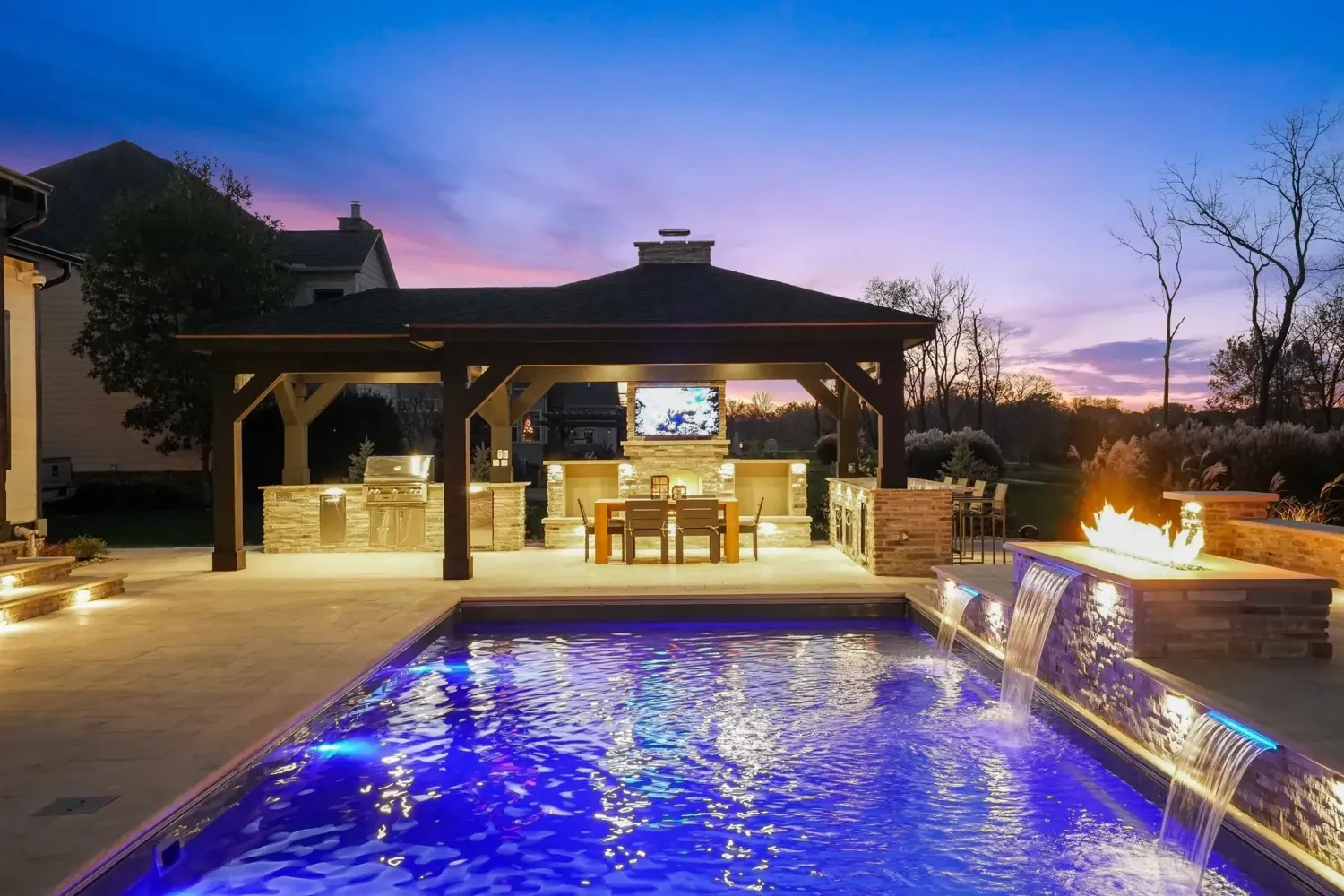
Here is what a full-scope 1990s Windward remodel actually looks like on a typical 8×40 rectangle with 8.5-foot deep end, in 2026 dollars, with permits pulled through Alpharetta Community Development at 2 Park Plaza rather than through Fulton County unincorporated:
- Full drain, pressure wash, and shell inspection — baseline work, no structural repair assumed
- Waterline tile replacement with 6×6 porcelain and epoxy-modified setting bed
- Pebble Tec Classic interior resurface, full tear-out of old marcite
- Diving board removal, deck patch, hydraulic cement fill of anchor points
- New tanning ledge in the shallow end (6×12 at 9 inches of water)
- Pentair IntelliFlo3 VSF pump, new cartridge filter, salt chlorine generator
- Pentair IntelliBrite 5G LED fixture replacing the 500-watt incandescent
- IntelliCenter automation panel with phone app control
- Optional: travertine coping and deck refresh — broomed concrete out, travertine in
Run that full list and you are looking at $54,000 to $84,000 depending on deck scope, automation depth, and whether you add a heater. That sounds like a lot. Set it against the original build cost — a 1996 Windward pool was typically contracted at $82,000 to $88,000 in the dollars of that era, which is roughly $165,000 to $180,000 in 2026 dollars — and the math reads differently. You’re paying somewhere between a third and a half of replacement cost to take a pool that has already proven its shell for 30 years and extend it another 25 to 30.
The phasing question comes up on almost every estimate. Tile, plaster, and diving board removal have to happen in a single drained-pool window because they all require a dry shell. Equipment pad, LED conversion, and automation panel can be phased separately; those jobs happen wet. Deck and coping work is its own phase. The worst phasing decision is homeowners who do the equipment pad first, then a year later discover they also need tile and plaster — now they’re paying two mobilization fees and two water-fill cycles instead of one. If you know a full remodel is coming within 18 months, bundle it.
Timeline on a full-scope job runs 4 to 6 weeks from drain to refill, weather dependent. Most of our Windward remodels target an October drain date and an early-December refill, which winterizes the pool with the new interior already in place and ready for a fresh spring start. Homeowners who try to remodel in April-May often end up with a first usable weekend that pushes into July, which defeats the purpose. Plan your calendar backward from the month you want to swim.
Permit note for Alpharetta in-city addresses: Zip codes 30004, 30005, 30009, and 30022 that fall inside city limits route permitting through City of Alpharetta Community Development, not Fulton County. The in-city review is typically faster and the inspectors know the Windward and Country Club of the South subdivisions by name. Make sure your contractor files in the right jurisdiction — a mis-filed permit costs two weeks and a re-submission fee.
One more piece homeowners usually don’t think about until we bring it up: the subdivision’s Architectural Review Board. Windward, Country Club of the South, White Columns, and Hutchinson Farm all run strict ARB processes, and most want color, tile, and coping samples before they’ll approve a scope that changes visible materials. Plan for 3 to 4 weeks of ARB review before a shovel moves. Run ARB and city permitting in parallel, not in sequence.
Why Technology Relocations Are Driving This Remodel Wave
There’s a second dynamic under every Windward remodel conversation right now. Alpharetta sits at the center of a corporate-HQ corridor — Microsoft, CDW, and a dense cluster of tech and fintech offices along North Point Parkway and the Avalon-adjacent stretch of Old Milton. Homeowners buying into these 1990s subdivisions in 2024 and 2025 are tech-corridor relocation buyers, inheriting pools their realtors described as “updated” that haven’t been touched in 15 years.
The remodel calendar you’re reading matches those buyers’ real situation. They didn’t build the pool. They inherited it at closing. They’re sitting down with us on a Saturday morning asking the two right questions: what is still structurally good, and what has to go. The answer almost always looks like the list above.
If you own a 1990s Windward rectangle — or a Country Club of the South pool, or a Hutchinson Farm pool, or any of the other 1993-to-2005 Alpharetta HOA builds — the shell is probably the piece you don’t need to worry about. The tile, plaster, diving board, and equipment pad tell you where you are on the clock. If you want to know exactly where your pool sits, we can walk it with you and write an honest line-item estimate.
Pool Remodeling across 20+ cities within 30 miles of Winder, GA
From 1990s Windward rectangles to Country Club of the South custom shells, we remodel pools the way the original builder would have if they had another 30 years of data to work from.