
On Milton estate lots north of Birmingham Crossroads, the average outdoor-kitchen build we quote lands between $92,000 and $128,000 — and the $110K number is not a retail price. It’s the line where the appliance stack, the stacked-stone base, and the wood-fired pizza oven stop competing for the same dollar.
This is a line-by-line breakdown of the specification we build for The Manor Golf Club, Crooked Creek, Cogburn Estates, and the rural AG-1 parcels along Freemanville Road. No aspirational pricing. No “starting at” disclaimers. The invoice you’d see at closeout on a build that passes Milton Community Development structural review and holds up under twenty-two freeze events per winter.
Seven components. Seven numbers. One contingency line that almost every client eventually needs. If you’re planning an outdoor kitchen in a 30004, 30075, or 30076 zip code and you’ve been told $60K is “a nice build,” this is the specification that gets you past the point where nice becomes necessary.
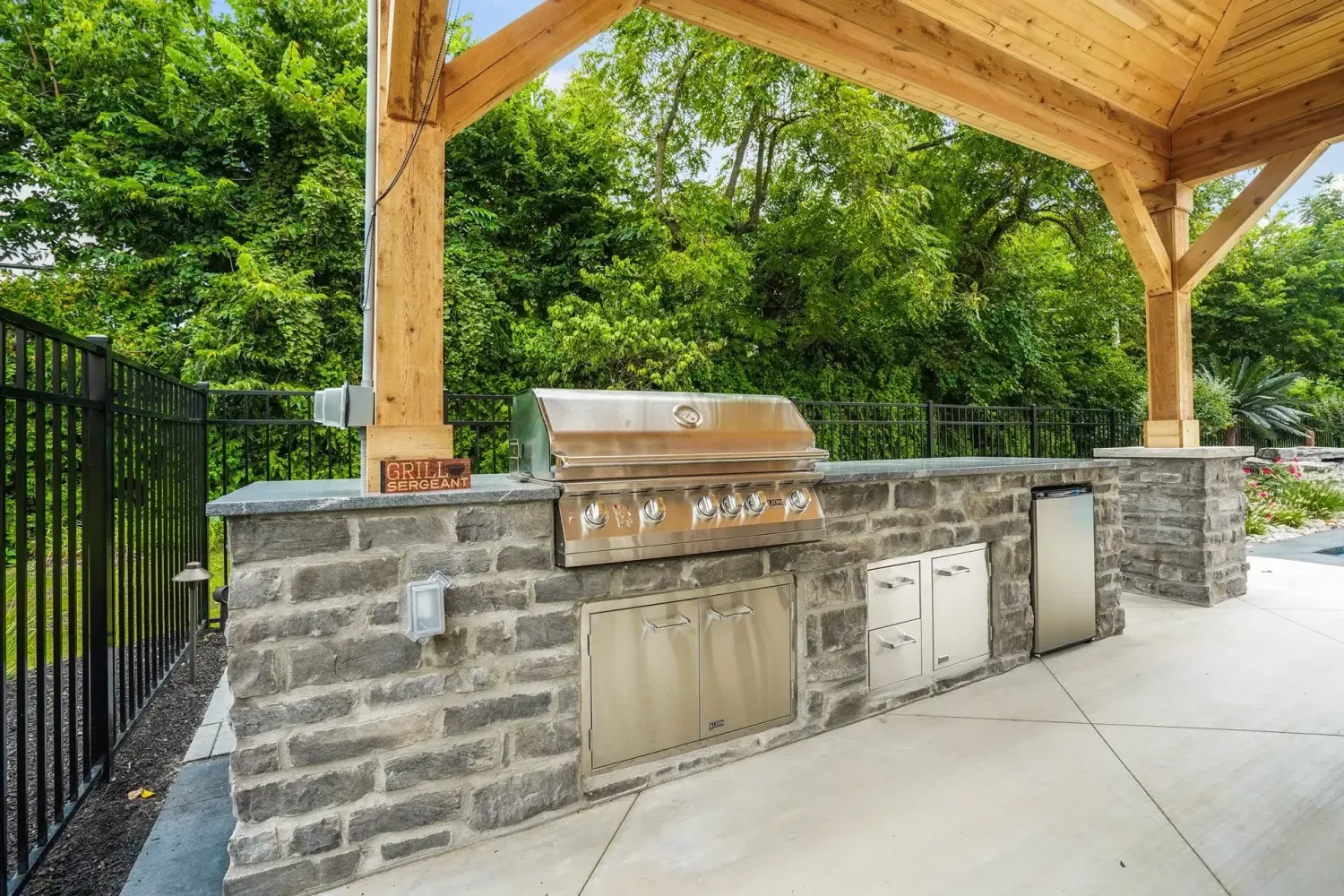
1. The Base — Stacked Stone + Quartzite Counter ($28,000)
The kitchen body is the single largest line in the build, and it’s the one homeowners most consistently underestimate. A concrete masonry unit (CMU) core wrapped in full-dimension stacked stone, capped with a three-centimeter quartzite slab, is not a veneer treatment you add after. It’s structural. The grill cutouts, the refrigerator rough, the gas penetrations, the electrical stubs — all of it gets located before the first stone course goes up.
On Milton estate lots, we specify Tennessee fieldstone or Pennsylvania bluestone stack over a poured concrete footing sized for the frost line (24 inches below grade in USDA Zone 8a). The quartzite counter runs $85–$120 per square foot supplied and installed, and a 14-foot L-shape or U-shape kitchen carries 36–42 square feet of counter alone. That’s $3,800–$5,000 just in stone you walk on top of.
The $28,000 line covers: CMU core and footing, waterproofing membrane behind the stone, 180–220 square feet of stacked-stone veneer, a full three-centimeter quartzite counter with mitered drop-edges, and all grill-island cutouts. It does not cover the appliances dropped into it.
Milton footing spec: Kitchen island footings on rural AG-1 parcels with saprolite shelves get drilled piers to refusal when the excavator hits weathered granite. Adds $1,800–$3,400 depending on depth. This is not contingency — it’s common enough on Freemanville and Hopewell Road builds that we quote it as a line item.
2. The Primary Grill — Lynx L42 or Kalamazoo K-Series ($16,000)
The grill is not the most expensive single appliance in the build, but it’s the one clients research the hardest and change their minds about most often. Two specifications, two price bands, two different approaches to the next fifteen years.
The Lynx L42 is a 42-inch, four-burner, built-in with a rotisserie and infrared sear zone. Supplied and installed with the ProSear burner, hood, and natural-gas conversion, it runs $9,800–$11,200. Reliable, serviceable, parts available through every regional dealer in metro Atlanta. It’s the default spec on nine out of ten Milton kitchens we deliver.
The Kalamazoo K750HT — the hybrid gas/charcoal/wood model — runs $16,000–$22,000 supplied and installed. You buy it for one reason: you want to burn wood under your steak on a Tuesday. It’s not a status purchase. It’s a flavor purchase, and on a 1,150-foot-elevation Milton lot where the owners are already running a Big Green Egg, it’s the grill that justifies the whole outdoor kitchen over just expanding the existing setup.
The $16,000 line in this spec is built around the mid-Kalamazoo or the top-spec Lynx Sedona package. Either one clears the threshold where the grill stops being the kitchen’s weakest component.
3. The Egg + Side-Burner Module ($6,000)
Milton clients coming from a decade of backyard smoking almost never let us delete the kamado. The Big Green Egg XL (or a Kamado Joe Classic III) gets built into its own island cutout beside the primary grill, with a stainless side-burner module for sauces, sides, and the inevitable cast-iron searing work that the primary grill can’t do simultaneously with the main protein.
Supplied and installed with the nest, the heat-resistant surround, and the side burner, this module runs $5,400–$6,800. It’s a small line relative to the rest of the kitchen, but it’s the component that changes how the kitchen gets used from week one. A primary grill alone turns the kitchen into a grilling station. Adding the kamado turns it into a cooking platform — two proteins, two temperatures, two smoke profiles, simultaneously.
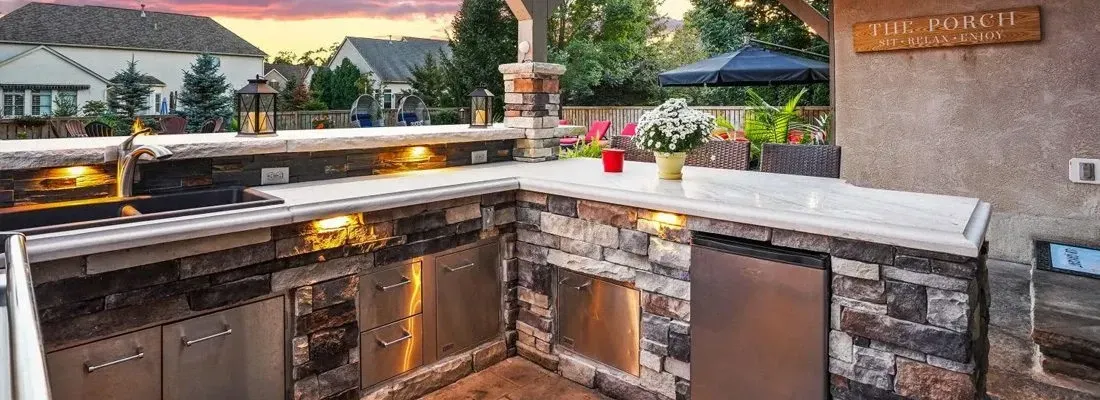
4. The Alfa 4 Pizze Wood-Fired Pizza Oven ($7,000)
This is the Milton signature line. On Cogburn Estates and Crooked Creek builds, the pizza oven is the component that differentiates an outdoor kitchen from an outdoor cooking station. We default-spec the Alfa 4 Pizze — an Italian-built, wood-and-gas hybrid that reaches 900°F in 25–30 minutes from cold and holds temperature through a six-pizza dinner without touching the fuel again.
Supplied with the steel base, the insulated dome, the internal gas burner, and the oak fuel starter pack, the 4 Pizze lands at $6,800–$7,400. Installed on a dedicated stacked-stone base (separate from the primary kitchen island to manage the heat load and the clearance), the delivered cost to the client is $7,000 on the nose.
The fuel itself is free on most Milton estate lots. Pine is abundant but wrong — you want seasoned oak, and Milton’s rural AG-1 zoning means most estate parcels have enough standing white oak, water oak, or red oak to supply a pizza oven for a decade with routine property maintenance. That’s a detail we flag on the initial site walk: we want to see the oak stand before we spec the oven.
5. Cold Storage + Ice — Perlick, Scotsman, Stainless Sink ($10,000)
Five components, one integrated cold-and-water zone: a Perlick HP24RS 24-inch outdoor refrigerator, a Scotsman Brilliance CU50GA gourmet ice machine, a deep stainless prep sink with a commercial-grade pull-down faucet, a waste-bin drawer, and the drain plumbing that feeds the house septic or sewer line.
The Perlick runs $3,600–$4,200 installed. It’s the industry benchmark for outdoor refrigeration — stainless interior, front-breathing compressor, UL-rated for exterior use with ambient operation down to 28°F. The Scotsman ice machine is $2,800–$3,400. The sink, faucet, drain, and waste drawer total $2,200–$2,800.
Ten thousand dollars for cold storage feels heavy until you’ve hosted twenty-two people in August at 92°F and watched the line at the indoor refrigerator kill the flow of the evening. On a Milton estate with 1,100 feet of elevation, afternoon shade drops to the kitchen early, but the thermal load on the appliances still demands outdoor-rated cold storage — the residential-grade units most contractors try to sub in will fail inside four summers.
6. The Labor Stack — Framing + Stone Veneer + Mechanical Rough-In ($33,000)
This is the line homeowners hear as a single number and that a contractor sees as three distinct crews running in sequence. Kitchen framing labor (CMU block, rebar, concrete cap, waterproofing): $8,400–$10,200. Stacked-stone veneer installation: $11,800–$14,200. Gas line run from the house manifold, plumbing rough-in from the nearest drain stack, electrical rough including dedicated 20-amp circuits for the refrigerator, ice machine, and the lighting: $4,600–$6,400.
Stacked over twenty-two business days with three crews, the labor line is $33,000 on a $110K build. It is the number that moves most on a Milton site — rural parcel gas runs from the meter can exceed 180 feet, and the Milton Community Development permit (10–14 business day turnaround) requires sealed plans for any gas appliance over 75,000 BTU, which the pizza oven, grill, and side burner combined always trigger.
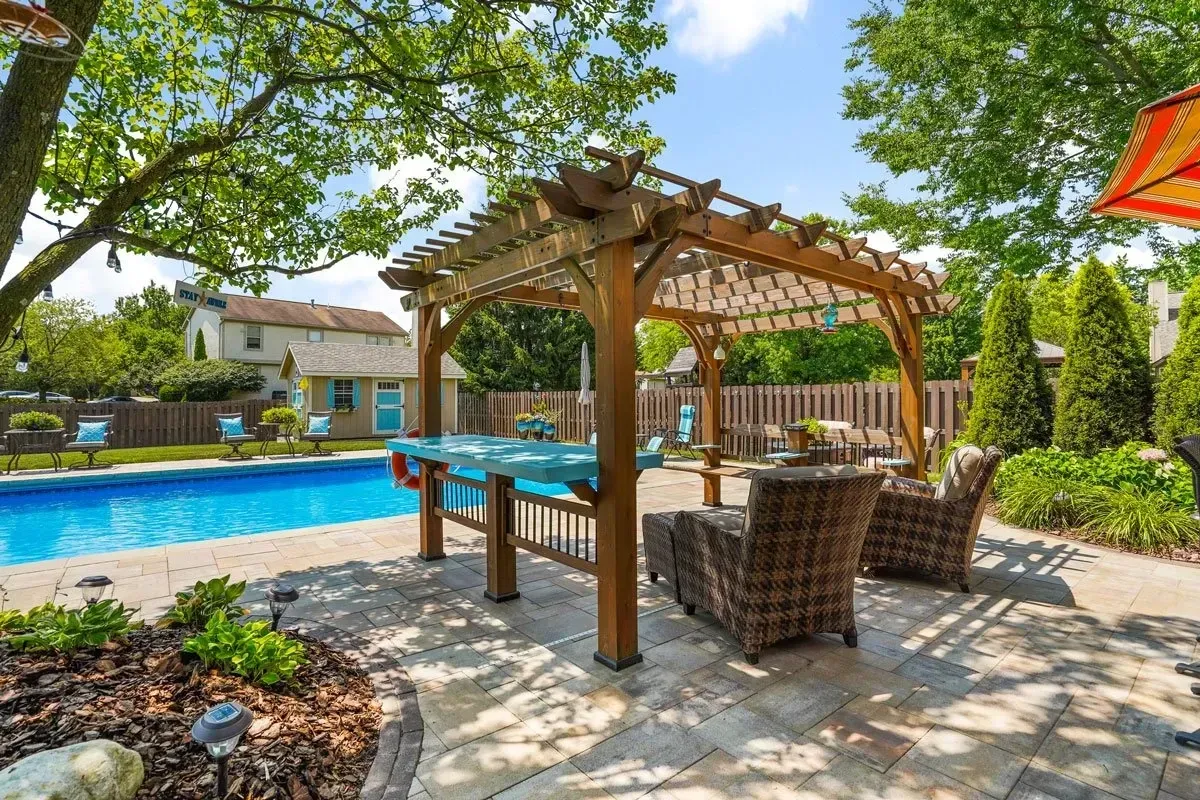
7. Travertine Deck, Lighting, Utilities, Contingency ($20,000)
The last line is the one that makes the first six lines functional. Three-hundred-twenty square feet of ivory travertine (French pattern, tumbled and filled) around the kitchen perimeter at $38 per square foot installed: $12,000. Low-voltage lighting — task lights over the grill, under-counter strip lighting on the prep surfaces, two overhead pendants off the pergola, and perimeter path lights: $6,000. Final gas trim-out, plumbing connection, appliance commissioning, and the 7% contingency line every estate build absolutely needs: $8,000.
The travertine extends past the kitchen footprint by eight to ten feet in every direction — this is not a $12K line that saves money by shrinking. On a Milton estate lot with 6–14 foot grade drops between the back door and the pool deck, the travertine around the kitchen is also the retaining and transition surface that ties the kitchen into the overall hardscape program. Shrink it, and you end up with a kitchen floating in a sea of mulch.
The contingency is not optional: On Milton estate builds, the 7% contingency covers the drilled-pier upgrade when saprolite shows up, the 25–75 foot creek-buffer setback adjustment near Cooper Sandy Creek or Chicken Creek tributaries, and the one appliance that always ships damaged. Three builds out of four use some portion of it. The fourth build uses all of it.
Why Milton Changes the Specification (And the Budget)
A $110,000 outdoor kitchen is not a Milton-only number — you can build the same specification in Johns Creek, Alpharetta, or Sandy Springs. But Milton’s AG-1 zoning minimums (1–3+ acre lots), its equestrian preservation ordinance, its stricter-but-faster Community Development permitting (10–14 business days versus Fulton County’s 18–24), and the 6–14 foot grade changes across estate lots combine to produce a specific kind of kitchen build: larger footprint, heavier hardscape integration, more ambitious appliance stack, and a higher ceiling for wood-fired elements because the lots support the fuel.
The Manor Golf Club builds add a fourth variable: the architectural review committee. Plans submitted for outdoor kitchens in The Manor clear committee review in four to five weeks — not fast, but predictable. The committee looks hardest at roof lines, overhead structures (pergolas and pavilions), and any appliance that produces visible smoke. The pizza oven passes on wood specification; the grill passes on the enclosed hood. We’ve never seen a compliant specification rejected at The Manor, but we’ve seen five-month delays on non-compliant ones.
On the rural side — Freemanville Road, Hopewell Road, and Potters Road estates — the constraint shifts. Creek-buffer setbacks (25 to 75 feet from named tributaries like Cooper Sandy Creek and Chicken Creek) drive where the kitchen can physically sit on the lot. Topography drives how it ties into the pool deck. And the saprolite shelves beneath Cecil clay change what the footings cost to install. A build that prices at $96K in Crooked Creek prices at $114K on a Freemanville parcel with a 12-foot grade drop and a drilled-pier footing requirement.
What $110K Does Not Cover — And What It Replaces
To be clear about the scope boundary: $110K builds the kitchen itself to the exact specification above. It does not cover the pergola over the kitchen ($22K–$38K in cedar with stainless tension hardware), the separate pavilion or pavilion roof ($45K–$95K), the pool deck the travertine eventually ties into, or the outdoor audio-video zone most Milton estate clients add within eighteen months.
What $110K does replace is the decade of upgrade cycles that a $55K kitchen spawns. Homeowners who try to build the same platform for half the money almost always spend the back half on rebuilds — the residential-grade refrigerator fails in year three, the basic stainless grill rusts through the hood in year five, the pressure-treated framing on a stick-built island warps and opens stone joints by year four, and the budget pizza oven (concrete or pre-fab metal) cracks inside two winters of Milton freeze events.
The $110K spec is a fifteen-to-twenty-year platform. The $55K spec is a five-year platform that needs a $70K second round. Adding those together — in current dollars, not inflation-adjusted future dollars — is how the math actually works.
The Line-by-Line Summary
A clean recap for clients who want to hand this number to an accountant, a spouse, or a design review committee and have it hold up:
- Stacked-stone base + quartzite counter: $28,000
- Primary grill (Lynx L42 or Kalamazoo K-series): $16,000
- Big Green Egg XL + side-burner module: $6,000
- Alfa 4 Pizze wood-fired pizza oven: $7,000
- Perlick refrigerator + Scotsman ice + stainless sink zone: $10,000
- Labor stack (framing + stone veneer + mechanical): $22,000
- 320 sq ft travertine deck: $12,000
- Lighting + electrical trim: $6,000
- Gas + plumbing rough-in + final tie-in: $5,000
- Contingency reserve (7%): $8,000
Total: $120,000 at the line-item ceiling; $110,000 at the median mid-point of each range. Clients who cut hard at quote time can land at $96K. Clients who upgrade the grill to the hybrid Kalamazoo and add a second refrigerator for the pizza-oven zone land at $128K. The $110K number sits dead-center of what we actually invoice on an estate Milton build.
Estate outdoor kitchens across 20+ cities within 30 miles of Winder, GA
When the specification gets to seven appliances, a stacked-stone base, and a 320-square-foot travertine deck, you stop shopping contractors and start interviewing the one firm that’s already built that platform on a Milton AG-1 lot.