
Most Clarkston pool owners use their backyard for roughly half the hours they could, because the moment the sun drops behind the tree line, the yard goes dark except for one glowing rectangle of water. On the lighting packages we’ve priced across DeKalb County, the fixtures themselves are only about 38 percent of the final number. The rest is transformers, wire, controls, and the planning that makes it all behave like one system.
This post walks through one real-scope Clarkston project from the first night walk to the final inspection. It’s a composite of our Lake Capri-area lighting work, with numbers rounded and homeowner details left out. You’ll see how we sized the transformers, why the yard ended up with nine zones instead of three, which fixtures went where, and exactly where every dollar landed. If you’re weighing a lighting upgrade for an older pool here in the 30021 zip code, this is the budget conversation you should be having before anyone digs a trench.
Buy pool, hardscape, and landscape lighting separately and you get three switches, three color temperatures, and three timers that drift apart by August. Design them as one system and the yard changes character with a single button. That’s what “resort-level” actually means.
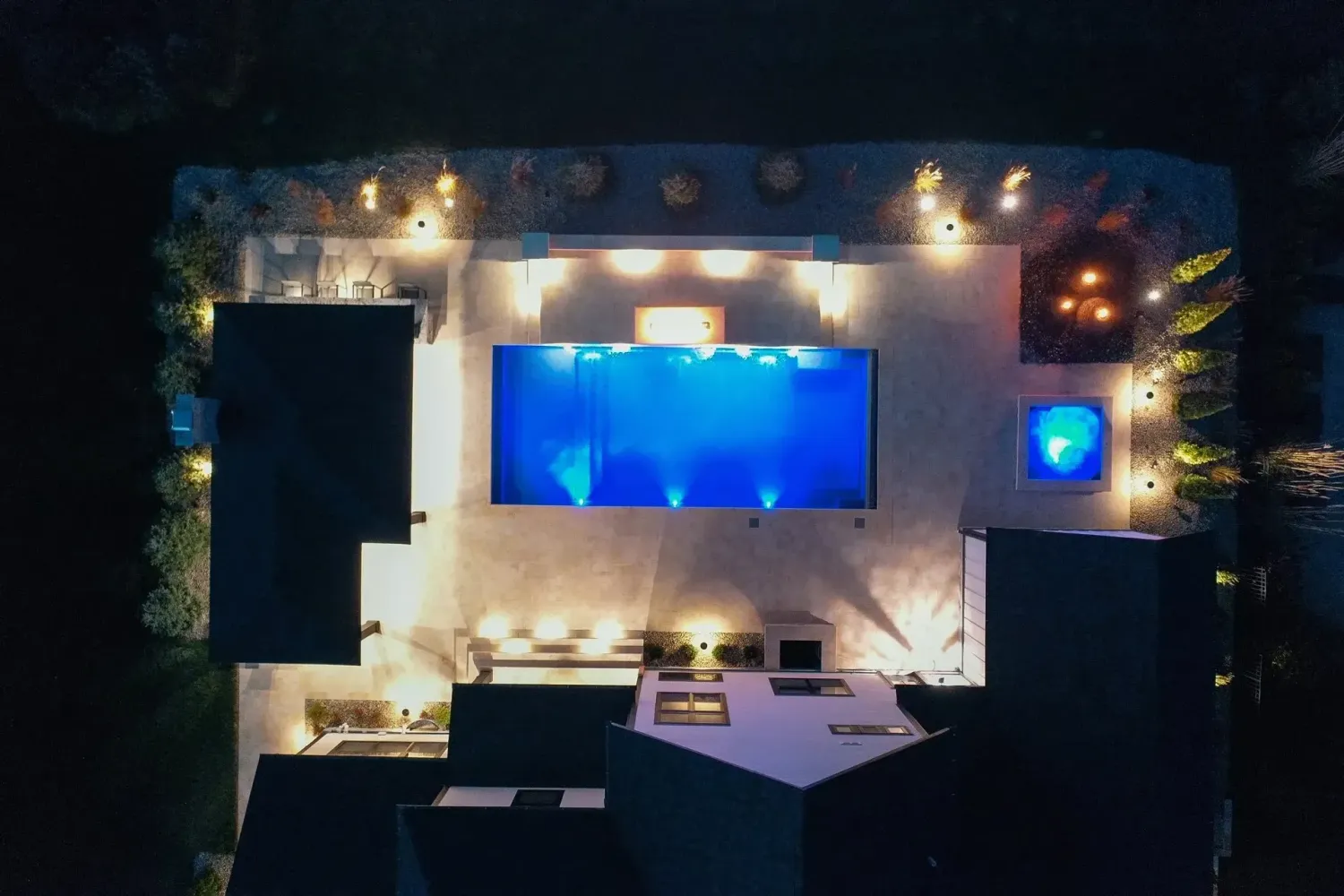
The Project: A 1971 Pool, a Dark Backyard, and One Question
The homeowners had a 16-by-36-foot gunite rectangle poured in 1971, like a lot of the original-era pools around Lake Capri and the Idlewood side of Clarkston. The pool had already been through a resurfacing and a new travertine deck a few years earlier. What it had never had was a lighting plan. There was one original 120-volt incandescent niche light in the deep end, a pair of floodlights screwed to the back of the house, and nothing else across a lot that dropped about six feet from the patio to a tree-lined creek edge feeding toward Pole Bridge Creek.
Their question was simple: “What would it cost to make this look like a hotel at night?” The honest answer was that it depended on three decisions they hadn’t made yet. How many distinct areas did they want to light? How much control did they want? And how much of the existing electrical could be trusted?
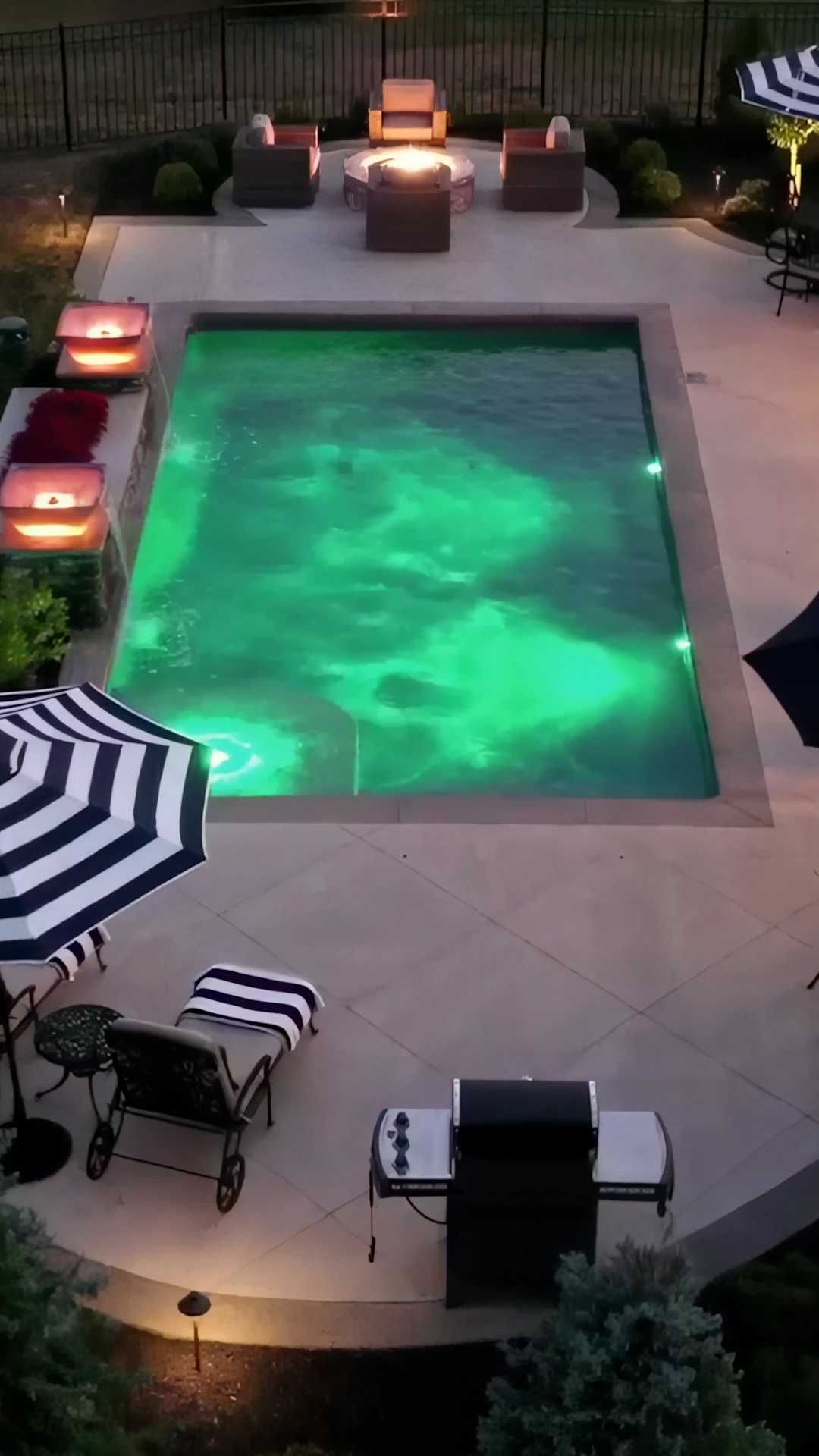
The backyard had five areas worth lighting on their own:
- The pool itself, including a raised ledgestone wall on one side with two sheer-descent scuppers
- The travertine deck and its three sets of steps
- A gas firepit lounge set on a wood-look plank paver patio
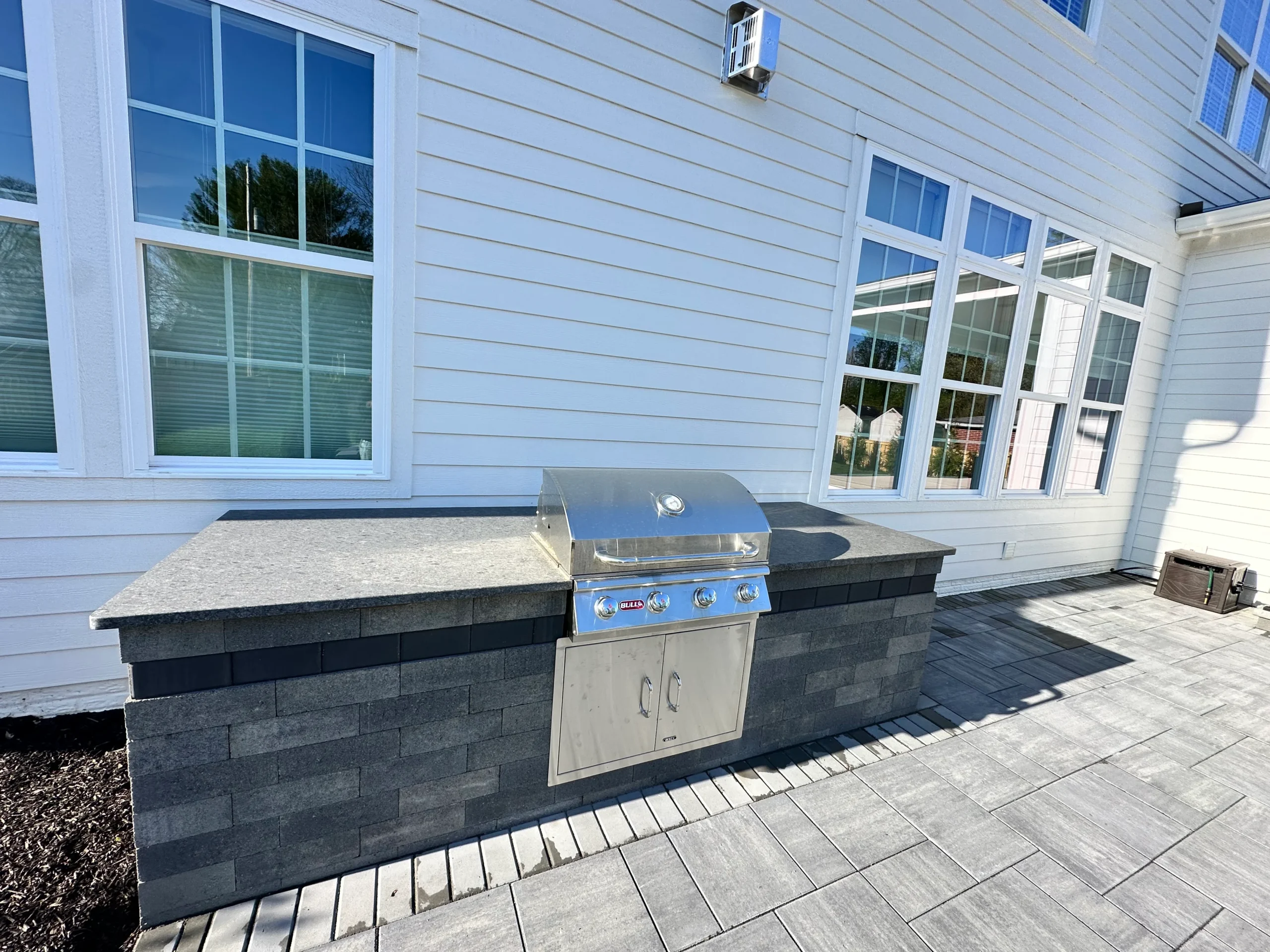
- A compact outdoor kitchen against the house
- The slope down to the tree line, with two mature white oaks and a row of arborvitae along the side fence
That last area matters more than people expect. Many Clarkston backyards back up to greenway corridors or creek tributaries under heavy canopy. Without light on the trees, the pool floats in a black void. With it, the yard feels twice as big after dark.
We started with a night walk, moving battery test fixtures around the yard while the homeowners watched from the kitchen. That hour settled more than a week of emails would have: no stadium-lit house, but glowing oaks, visible scuppers, and safe steps.
Step One: The Load Calculation and Transformer Sizing
Low-voltage landscape lighting runs on 12 volts, supplied by a transformer that steps down household current. Sizing that transformer is where most do-it-yourself systems go wrong, and where cheap bids cut corners you can’t see until year two.
Here’s how we did the math on this yard. The plan called for 34 landscape fixtures and 26 hardscape fixtures. The landscape fixtures averaged about 5.5 watts each. The hardscape fixtures, mostly under-cap and step lights, averaged about 3 watts. That’s roughly 187 watts plus 78 watts, or 265 watts of LED load.
But transformers aren’t sized on watts. They’re sized on VA, or volt-amps, and LED drivers pull more VA than their wattage suggests. We use a 1.3 multiplier as a working rule, which put the real load near 345 VA. Then we apply the rule every good lighting installer follows: never load a transformer past 80 percent of its rated capacity. Heat kills transformers, and a unit running at 95 percent in a Clarkston July, when highs sit in the low 90s and the air is thick with humidity off the creek corridors, doesn’t last.
The sizing math on this project: 265 W of LED load × 1.3 VA factor ≈ 345 VA. Split across two 300 W stainless multi-tap transformers, each unit runs near 58 percent of capacity, well under the 80 percent ceiling, with room for 15 to 20 more fixtures later.
Ask any bidder for their VA total and their percent-loaded figure per transformer. If they can’t give you both, they didn’t calculate them.
Why two transformers instead of one larger unit? Voltage drop. On a 12-volt system, every foot of wire bleeds voltage, and a fixture 140 feet out on undersized wire might see 9.5 volts and glow visibly dimmer than one 20 feet away. On a long, downhill lot, one central transformer means uneven light.
So we split the yard geographically. One transformer mounted near the equipment pad fed the pool wall, deck steps, and kitchen. The second, mounted on a post near the firepit patio, fed the slope, the oaks, and the arborvitae. Both were multi-tap units with 12-, 13-, 14-, and 15-volt outputs, so longer runs could start on a higher tap and land at the fixture close to 11.5 volts. We ran 10-gauge cable on the long runs and used hub wiring, where several fixtures connect at a single central junction, instead of daisy-chaining them down a line.
The pool lights are a separate animal. Underwater luminaires fall under NEC §680.23, and the 12-volt pool LEDs got their own dedicated 300-watt pool and spa transformer. They never share a circuit with the landscape system.
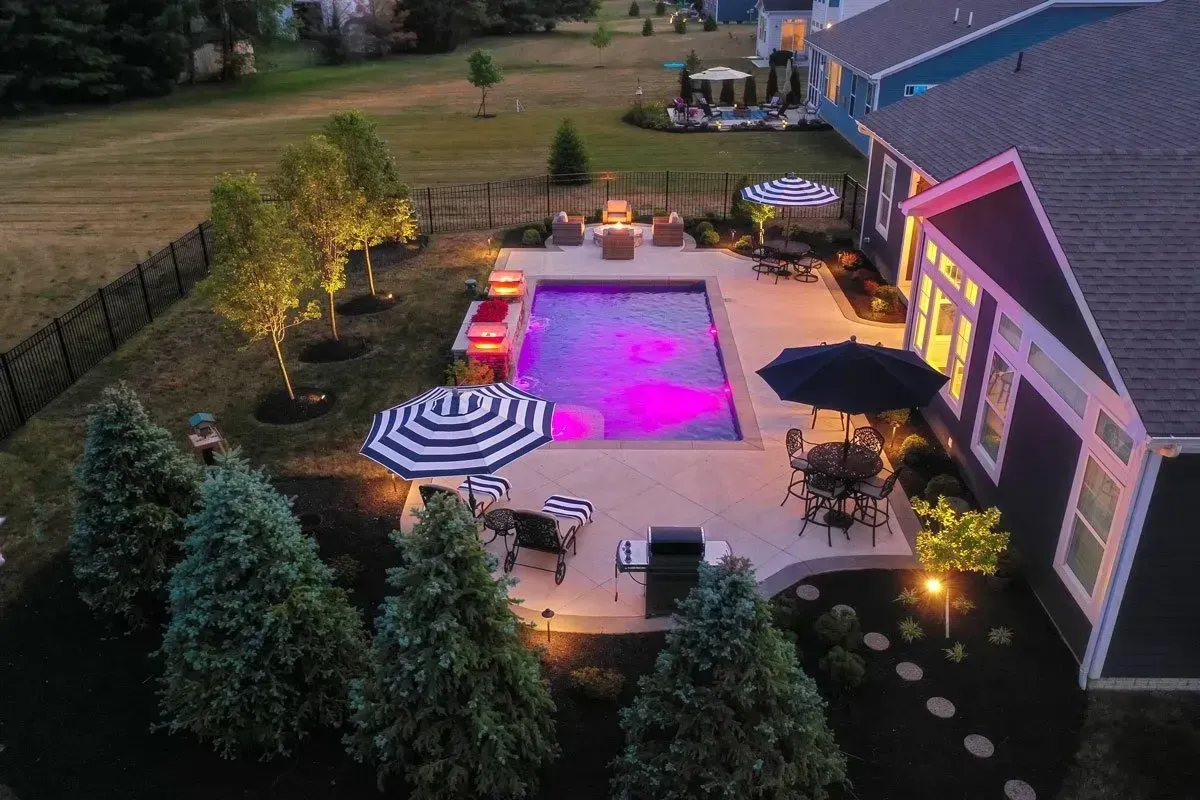
Zoning the Yard: Why This Project Ended Up With Nine Circuits
A zone is a group of fixtures that switch and dim together. The fewer zones you have, the cheaper the install. The more zones you have, the more ways the yard can look. This is the single biggest lever on a resort-level lighting budget, and it’s where a design conversation pays for itself.
The first draft had three zones: pool, hardscape, landscape. It would have worked, but it would have forced an all-or-nothing choice. You couldn’t light the firepit lounge for a quiet evening without also lighting the kitchen, the steps, and the whole slope. After the night walk, the final plan landed on nine zones:
- Pool LEDs — three color-changing underwater lights on their own relay
- Pool wall and scuppers — under-cap lights along the ledgestone wall and two small spots aimed at the sheer descents
- Deck steps — six recessed step lights, always on at dusk for safety
- Firepit patio — low under-cap lights on the seat wall and two path lights
- Outdoor kitchen — under-counter lights and one task downlight over the grill
- Path lighting — the walk from the patio down the slope
- Tree moonlighting — downlights mounted high in the two white oaks
- Perimeter uplighting — the arborvitae row and the side fence
- House wall grazing — soft wash on the rear elevation, replacing the old floodlights
Zones 3 and 9 run on astronomical timers that track sunset through the year. Everything else sits under scene control, which we’ll cover below. That split matters. Safety lighting should never depend on someone remembering to press a button.
Each added zone costs something real. On this project, splitting a zone out added roughly $180 to $320 per zone in extra wire runs, a controller channel, and labor. Going from three zones to nine added a little over $1,500. The homeowners called it the best money in the whole proposal, because it’s the difference between a lit yard and a yard with moods.
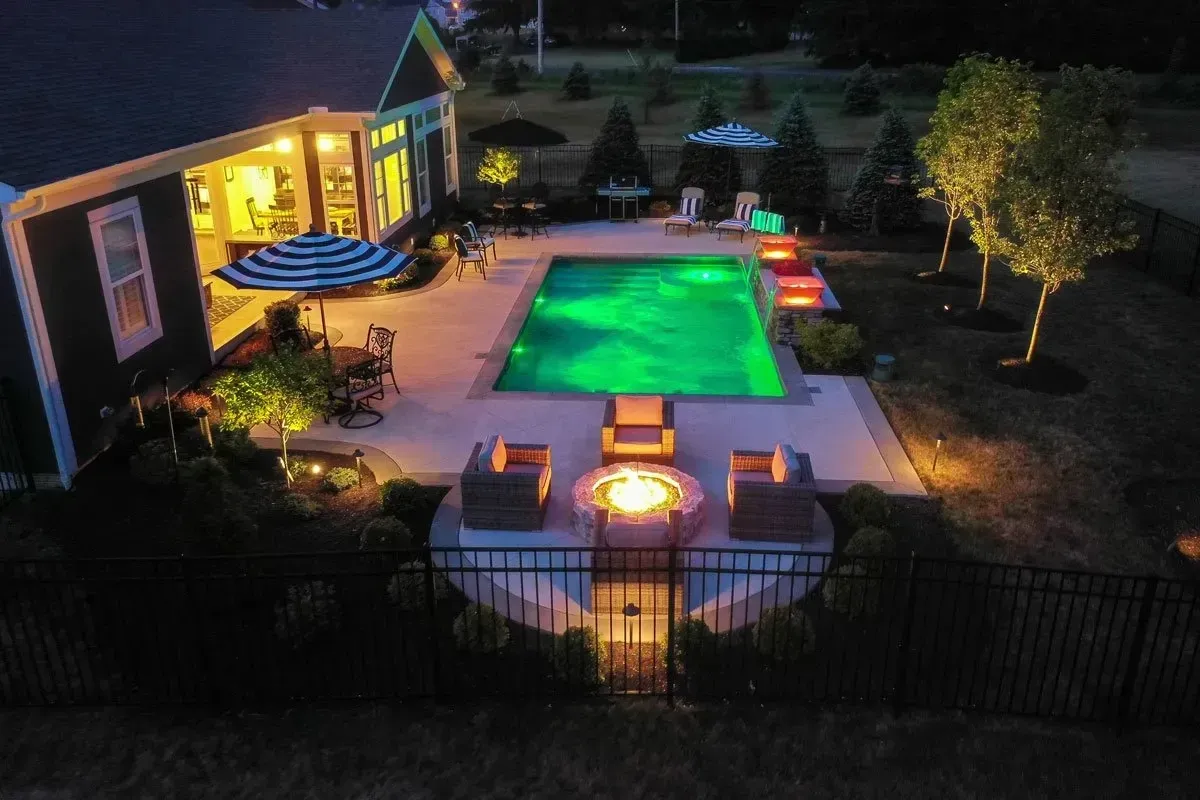
Fixture Selection: What Went in the Water, on the Walls, and in the Trees
Fixture choice decides whether the system looks good in year one and whether it still works in year ten. Clarkston’s conditions push toward specific decisions: high humidity, heavy tree canopy that drops debris, 8 to 14 freeze events per winter, and DeKalb County water that runs harder than Gwinnett’s.
In the water
The original 1971 niche light was a 120-volt incandescent fixture, the kind installed before modern bonding rules. We don’t retrofit an LED into a niche like that until the niche, the conduit, and the bonding have been checked. On this pool, the original niche was corroded and the bonding didn’t meet current code, so we replaced it and added two new niches along the long walls. That’s why the pool line item below is higher than a simple bulb swap.
For the lights themselves, the three major options in Metro Atlanta are Pentair IntelliBrite 5G, Hayward ColorLogic, and Jandy Infinite WaterColors. All three are 12-volt color LEDs with preset shows, and all three perform well. The deciding factor is almost always which automation system is already on the pad or planned, because each brand plays best with its own controller. This pool already had a Pentair pump and filter, so we stayed in that family.
One Clarkston-specific note: DeKalb County water tends to test around 110 to 140 ppm calcium hardness. If the water chemistry isn’t balanced, scale builds on the LED lens and the light turns hazy and dim within a couple of seasons. The fix isn’t a better light. It’s keeping the saturation index in check and wiping the lens during regular service.
On the hardscape
The ledgestone wall got 18 LED under-cap lights tucked beneath the coping, which wash the stone face and throw its texture into relief. We added six recessed step lights and two small directional spots aimed at the scuppers, so the falling sheets of water catch light instead of disappearing. All hardscape fixtures were solid brass or marine-grade bronze. Powder-coated aluminum is cheaper, but in a humid creek-side yard its finish chalks and pits within a few years.
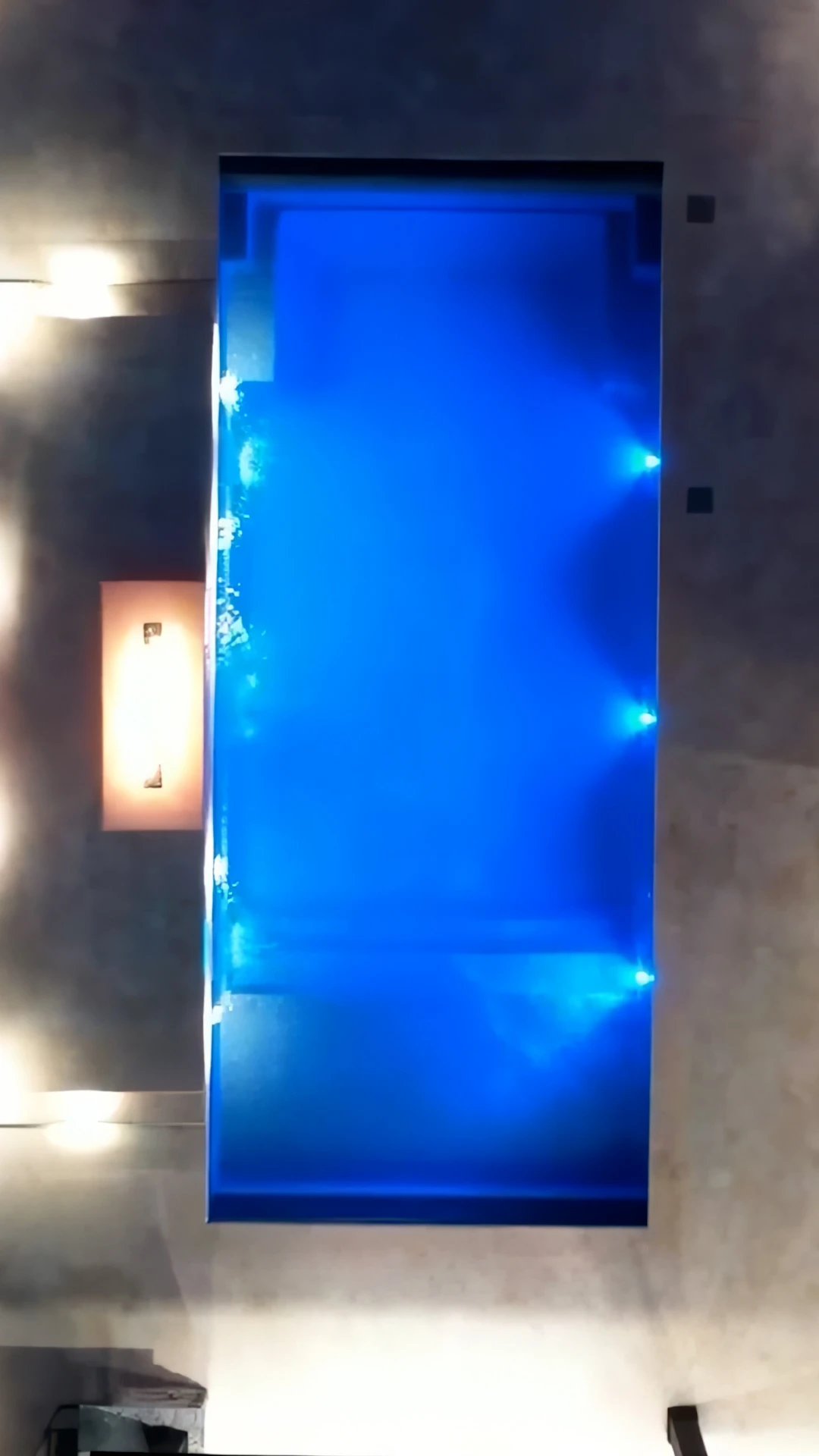
In the landscape
The 34 landscape fixtures broke down into 14 uplights, 8 path lights, 6 downlights mounted in the oaks, and 6 wall-wash fixtures for the house. We specified integrated LED fixtures with a warm 2700K color temperature for everything except the tree downlights, which ran at 4000K to mimic cool moonlight filtering through the branches. Mixing color temperatures on purpose is a designer’s trick. Mixing them by accident is what makes cheap systems look patchy.
For landscape brands, FX Luminaire, Kichler, and Volt all show up regularly on quality Metro Atlanta installs. FX Luminaire has the edge when you want zoning and dimming built into the fixtures and controller. Kichler offers a strong mid-range. Volt sells direct and offers solid brass fixtures with good warranties at a lower price. We compare brands on the job’s needs, not on loyalty to one maker.
Mounting tree downlights 25 to 30 feet up a white oak takes a climber and stainless straps that allow for trunk growth. It’s slow work, and it produces the best effect in the yard: branch shadows dappled across the travertine and water.
The Integration Layer: One Controller, Four Scenes
This is where three lighting systems become one. The pool automation and the landscape controller have to talk to each other, or at least be driven from the same app, so a single command can set the whole yard.
On this project, we upgraded the pool equipment pad to a Pentair automation panel with added relays for the pool lights and the kitchen circuit. The landscape side ran through an FX Luminaire Luxor controller, which handled zoning and dimming on the two low-voltage transformers. Both were tied together through the homeowners’ phone, and we programmed four scenes:
- Dinner: kitchen at full, firepit patio at 70 percent, trees at 50 percent, pool in soft white, path lights on
- Swim: pool in bright blue, pool wall and scuppers full, steps on, trees at 40 percent, house wash off
- Party: pool on a slow color show, all landscape zones up, scupper spots full, kitchen on
- Late: pool off, steps and house wash on, trees at 20 percent for a quiet view from the bedroom window
Hayward OmniLogic and Jandy iAquaLink can do the same job with their own ecosystems. The right choice depends on what’s on your pad and how much you want to replace. What matters is that one person, in one place, controls the whole yard.
The Real Cost Breakdown
Here’s where the money went on this Clarkston project. These are 2026 Metro Atlanta numbers for a renovation lighting package on an existing pool, not a new build.
- Night walk, design, and photometric layout: $850
- Pool LEDs — three 12-volt color LEDs plus a dedicated 300-watt pool transformer: $4,150
- Niche replacement and bonding upgrades on the 1971 shell: $2,300
- Hardscape lighting — 26 fixtures (18 under-cap, 6 step, 2 scupper spots) at about $195 each installed: $5,070
- Landscape lighting — 34 fixtures, including the climbed tree mounts, at about $220 each installed: $7,480
- Two 300 W stainless multi-tap transformers, mounted and wired: $1,900
- Controls — automation panel upgrade, relays, and landscape controller: $3,450
- Line-voltage electrical — two new 20-amp GFCI circuits and about 140 feet of trenched conduit: $2,680
- DeKalb County electrical permit and inspections: $350
Total: $28,230 for 63 fixtures across nine zones.
Strip out installation labor and the fixtures themselves come to roughly $10,800, the 38 percent figure from the top of this post. Everything else makes those fixtures last and work together.
Where Clarkston adds cost: Permits for residential pool and electrical work go through DeKalb County Planning & Sustainability at 178 Sams St. in Decatur, not the City of Clarkston. Plan on 3 to 4 weeks for turnaround, compared with 10 to 14 days in Gwinnett.
Original-era pools add the niche and bonding line item almost every time. Budget $1,500 to $3,000 for it on any pool built before the mid-1980s.
The trench work deserves a note too. Code requires low-voltage landscape cable to be buried at least 6 inches deep, and a 120-volt GFCI-protected residential circuit at least 12 inches, per NEC Table 300.5. Those depths never reach the decomposed granite that shows up 4 to 8 feet down on lots near Stone Mountain. They do run through dense Piedmont clay and old tree roots, though, and on a canopy lot that means hand digging near the oaks to protect the root zones. That adds labor hours you won’t see on a flat lot in a newer subdivision.
Operating cost is the pleasant surprise. The full system draws roughly 450 watts with everything on. At about five hours a night, that’s around 820 kilowatt-hours a year, which works out to roughly $120 a year on a typical Georgia Power residential rate. The old incandescent niche light and two floodlights used nearly as much on their own.

What We’d Change, and What Clarkston Homeowners Should Budget
Every finished project teaches something. On this one, two lessons stood out.
First, we’d pre-wire more. The homeowners asked about adding lights to a future pergola six months later. Because the transformers had headroom, the wiring was easy. But we’d have saved them a second trench if we’d laid an empty conduit sleeve under the travertine during the original work. Sleeves cost pennies during construction and hundreds afterward.
Second, freeze protection belongs in the spec. With 8 to 14 freeze events a winter, fixtures sitting in low spots can trap water in their housings. We now specify fixtures with drain paths and set uplights on a gravel base, not bare soil, on every Clarkston slope.
Budget ranges for Clarkston lighting packages
Not every yard needs nine zones and climbed tree mounts. Here’s how the tiers usually break out for existing pools in Clarkston and nearby DeKalb neighborhoods like Toney Valley, Brockett, and Edinburgh:
- Pool-focused upgrade ($6,000 to $10,000): Two or three color LEDs, niche and bonding work, a pool transformer, and 10 to 15 hardscape lights on one or two zones.
- Integrated mid-range ($14,000 to $20,000): Pool LEDs plus 30 to 45 hardscape and landscape fixtures, four to six zones, one transformer, and basic app control.
- Resort-level system ($24,000 to $38,000): Full integration, seven to ten zones, multiple transformers, tree mounts, scene programming, and brass or bronze fixtures throughout.
Where you land depends mostly on how many zones you want and how much electrical work the pool needs first. The fixtures are the easy part.
Five questions to ask any lighting bidder
- What’s the total VA load, and what percent is each transformer loaded?
- How many zones, and which ones run on timers versus scenes?
- What wire gauge and wiring method (hub or daisy-chain) are you using on the long runs?
- What fixture material, and what’s the warranty on the fixture and the LED?
- Who pulls the DeKalb County permit, and is the bonding being checked on the existing pool?
A contractor who answers all five clearly has done this before.
If your Clarkston pool is still lit by one old niche fixture and a pair of floodlights, you’re not far from a very different backyard. The pool is already there. The hardscape is already there. The trees are already there. A well-designed lighting system just lets you see all of it after dark, and use it for twice as many hours every summer.
Pool and landscape lighting across 20+ cities from our home base in Winder, GA
Every Clarkston lighting plan starts with a night walk and a VA load calculation, so the pool, hardscape, and landscape lights run as one system instead of three.