
Every few months a Clarkston homeowner asks us to put a new incandescent bulb back in the old pool light, because the old light “always looked warmer” and the LED fixtures they saw online look like a nightclub. We understand the instinct. We also won’t do it anymore. The argument for incandescent comes down to niche size and wattage, and on both counts it lost years ago. A 500-watt lamp turns most of what it draws into heat, and it does that inside a sealed metal niche under water.
This isn’t a style preference and it isn’t a sales push. Clarkston is a renovation market. The pools we work on in Lake Capri, Idlewood and along the Brockett Road corridor are often 35 to 50 years old. They still have their original wet niches, original conduit and bonding that was installed long before today’s equipotential rules. When one of those lights fails, the homeowner isn’t choosing a light bulb. They’re choosing whether to keep a 1970s electrical design running for another decade.
Here is the technical case: what a pool light actually puts into the water, how color behaves once it passes through eight feet of it, what it takes to fit a modern fixture into a niche poured during the Nixon administration, and the electricity and lifespan numbers that settle the question.
Lumens, Watts and the Niche: The Physics Incandescent Can’t Win
Start with the number people misread most. Wattage tells you how much power a fixture pulls, not how much light it makes. An incandescent or quartz-halogen pool lamp turns only a small share of its power into visible light. The rest comes off as heat. At best, a halogen lamp puts out roughly 15 to 20 lumens per watt. A good LED pool fixture, measured at the fixture and not the bare chip, commonly lands somewhere between 60 and 100 lumens per watt depending on the model and color mode. That gap is the whole argument in one line: an LED fixture drawing a tenth of the power can match, and often beat, the usable light of the old lamp.
“Usable” matters here. An incandescent lamp throws light in every direction, and a lot of it hits the back of the niche, the reflector and the sides of the housing before it finds the lens. LED fixtures are built around directional emitters and optics that aim light out through the lens and across the pool. So the LED puts more of its light where you actually see it.
Why the niche is the real problem
A wet-niche pool light sits in a metal or plastic forming shell cast into the pool wall. Water surrounds the fixture, and that water is the only thing cooling a lamp that runs hot enough to burn skin in open air. Usually that works. Then the water level drops below the skimmer during a dry August, or the autofill fails, or someone drains the pool and flips the wrong switch. A high-wattage incandescent lamp that runs dry heats the lens and gasket quickly. We’ve pulled fixtures in Clarkston with lenses cracked from thermal shock and gaskets baked hard as a hockey puck. Once the gasket fails, water gets into a housing that has 120 volts running through it.
An LED fixture runs much cooler at the lens. Manufacturers still tell you not to run most of them out of water for long, and we follow those instructions to the letter. But a gasket sitting against a 40-watt heat load ages very differently from one sitting against 500 watts. That difference shows up as years of extra seal life, and the seal is the part keeping water away from the wiring.
The rule we build around: Under NEC §680.23, a wall-mounted underwater light has to sit with the top of its lens at least 18 inches below normal water level unless the fixture is listed for shallower mounting. Old Clarkston pools don’t always meet that. It’s one of the first things we measure before any retrofit, because it decides whether the old niche can be reused at all.
Heat also costs you water chemistry
DeKalb County water runs about 110 to 140 ppm calcium hardness before you add a thing, which is harder than a lot of Gwinnett water. Calcium scale forms faster on hot surfaces. A hot incandescent lens is exactly that kind of surface, and it collects a white crust that cuts light output a little more every season. A cooler LED lens still needs cleaning in hard water, but it scales far more slowly. So an old light that “isn’t as bright as it used to be” is often part lamp age and part mineral buildup on the glass.
Color Rendering Underwater: Where the “Warm Light” Argument Falls Apart
The strongest case for incandescent is color, so let’s take it seriously. On paper, incandescent light has near-perfect color rendering. Its color rendering index is close to 100 because it’s a continuous-spectrum source. Many LED pool fixtures in white mode land somewhere in the 70s or 80s.
Water absorbs the red end of the spectrum first, and it does that steadily over distance. Light from an incandescent lamp is heavy in red and orange. Send that through several feet of water and it loses the part it had the most of. What’s left looks yellow-green against white or light-gray plaster. That’s the “old pool” color many Clarkston homeowners remember, and it isn’t a rich, warm glow.
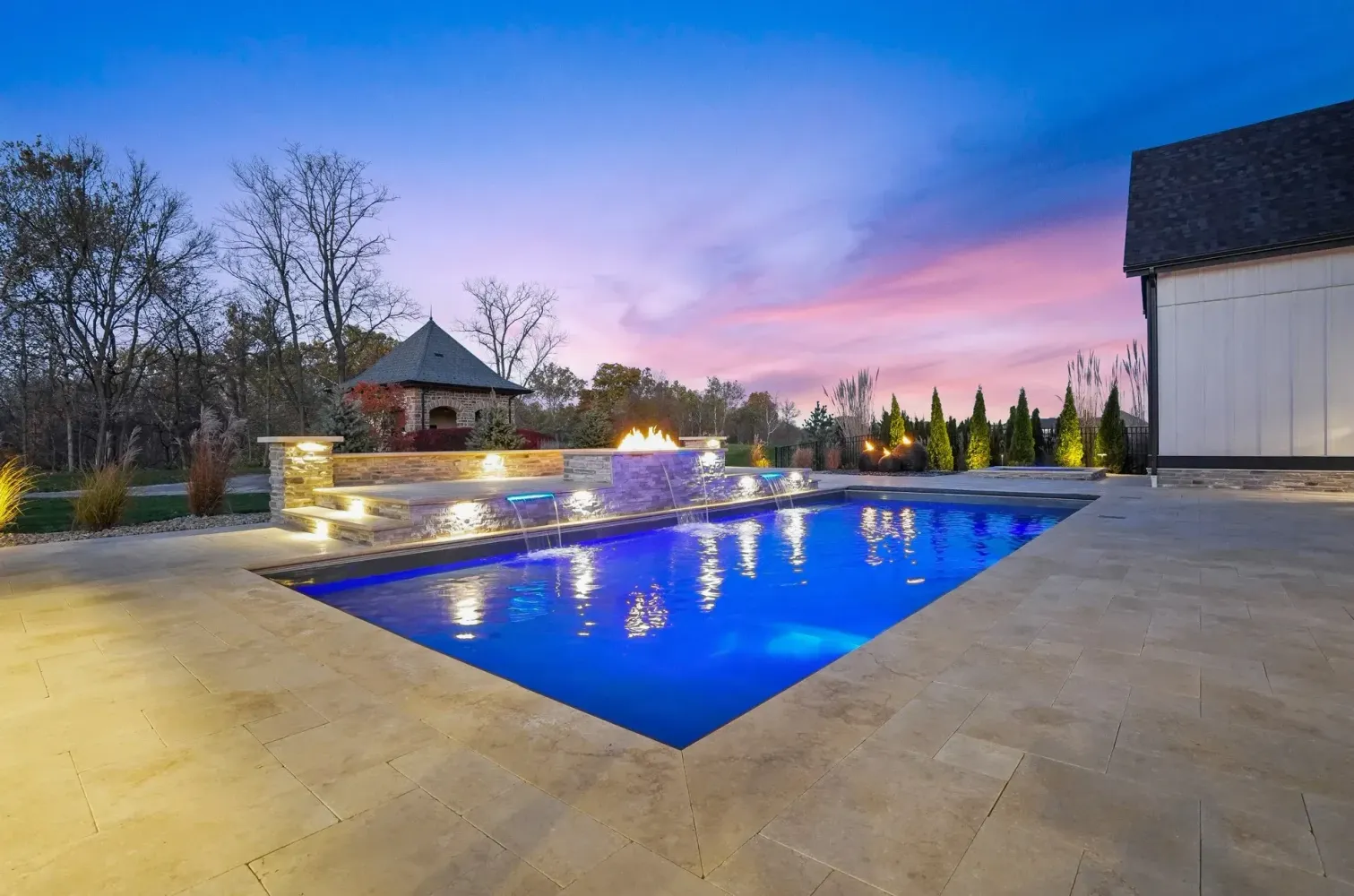
Cooler white and blue light moves through water with much less loss. That’s why a cool-white or blue LED makes the water look clear and deep instead of murky. It’s also why the photos in this post read as sharp royal blue from the deck to the far wall. The high CRI score of incandescent measures something that barely survives under water.
What the fixture choices actually look like
We install and service the major lines and compare them on the job, not on brand loyalty. Pentair IntelliBrite 5G, Hayward ColorLogic and Jandy’s WaterColors family all offer color-changing and white models in full-size and spa sizes. The practical differences come down to four things:
- Automation fit. Each brand’s lights work best with its own controller: Pentair with IntelliCenter or EasyTouch, Hayward with OmniLogic, Jandy with iAquaLink. Mixing brands works, but you may lose synced color shows.
- Niche compatibility. Each line is built to fit its own niches and, with the correct adapter, many other full-size niches. Old Clarkston pools often have niches from companies that no longer exist, so we confirm the fit before we order.
- Voltage. Every major line comes in 12-volt and 120-volt versions. That choice matters more on an old pool than any color feature (more on that below).
- Cord length. Replacement fixtures ship with a set cord length. It has to reach the deck junction box with enough slack to lift the light onto the deck for service.
Put the warmth on land
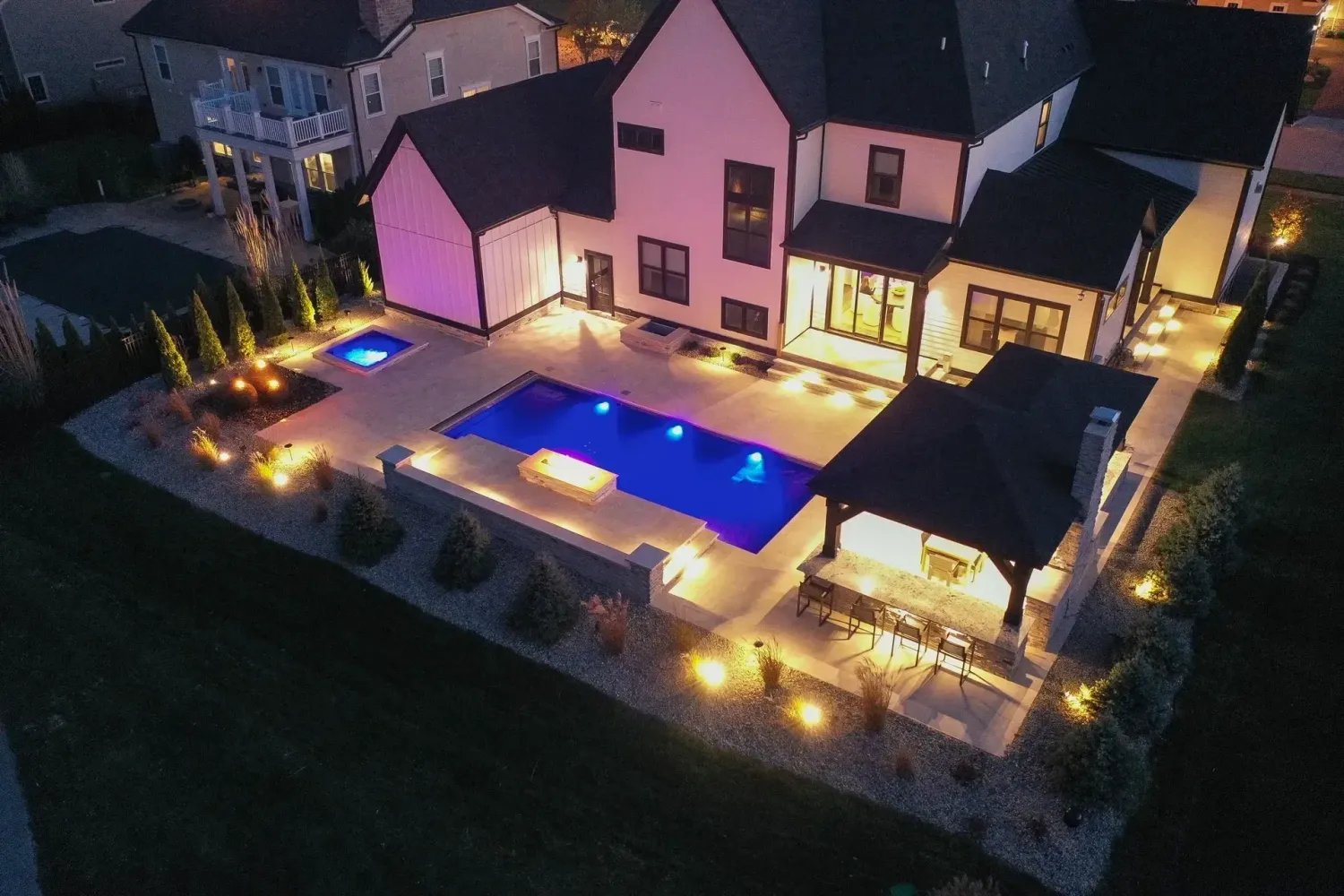
This is how we answer the “I want it warmer” request. Keep the water cool and clear, then add warm tones around it: path lights, bollards, uplights on trees and a covered pavilion lit from inside. The aerial shot above shows the result. You get the contrast people really want from warm light, without a yellow-green pool.
This matters even more in Clarkston than in newer suburbs. Plenty of backyards here back up to tree-covered creek corridors along Pole Bridge Creek and the South Fork of Peachtree Creek, or to DeKalb greenway land. Those lots get very dark at night. A single bright, badly aimed fixture creates glare and spills light into the trees. Several lower-output LEDs aimed along the length of the pool give you even coverage without turning the back of the yard into a spotlight.
Retrofitting an Old Clarkston Niche: Cord, Conduit, Bonding and the 12-Volt Question
This is where most of the real work happens. Swapping the fixture takes minutes. Finding out whether the path behind the fixture can safely carry power for another 20 years is the job. On a Lake Capri pool built in the 1960s, we assume nothing until we’ve checked it.
Step one: can the new cord get through?
A wet-niche light gets its power through a cord that runs from the fixture, through a conduit, to a junction box on the deck. To replace the fixture, we tie a pull line to the old cord, pull it out, and use that line to pull the new cord through. On a newer pool with PVC conduit this is routine. On a 45-year-old pool, the conduit may be brass or copper that has corroded inside. It may have crushed where deck slabs moved, or filled with silt. We’ve seen old conduit bent where a deck section settled several inches.
If the cord pulls cleanly, the retrofit stays simple. If it snags, we stop. Forcing a cord through damaged conduit strips the jacket, and a damaged jacket under water is the failure you’re trying to avoid. Then the options are running new conduit, which usually means cutting and replacing a section of deck, or in some cases choosing a fixture designed for a different mounting method.
Step two: the deck box and the distances
Old pools often have a junction box that’s too close to the water, too low, or corroded shut. Current code requires a deck box for a wet-niche light to sit at least 4 inches above the deck and at least 8 inches above the maximum water level. It also has to sit at least 4 feet from the inside wall of the pool unless a fence or wall separates them. Clarkston’s humidity, driven by the low elevation, tree canopy and creek corridors, is hard on old boxes. Many that we open have corroded terminals and green crust on the bonding lug.
Step three: bonding and GFCI protection
A lot of the original-era pools in 30021 were built before the equipotential bonding rules in NEC §680.26 took their current form. The bonding wire may be undersized, broken where the deck was replaced, or missing at the niche. A light retrofit gives us a reason to test it, and we do. A 120-volt underwater light must also be protected by a GFCI. Many old pool circuits have none, or have one that has been tripping for years and got replaced with a standard breaker. That’s the most dangerous thing we find on old pads.
Step four: 12 volts or 120 volts?
On old Clarkston pools we lean hard toward 12-volt fixtures. They run on a listed pool and spa safety transformer at the equipment pad, which sits below the low-voltage contact limit the code uses for underwater equipment. If an old niche, cord or bond ever fails, a 12-volt system is a much safer failure than a 120-volt one. The trade-off is a transformer typically in the $250 to $450 range, plus a slightly larger wire size for long runs. On a pool with unknown conduit and questionable bonding, that’s inexpensive insurance.
DeKalb permitting, not Clarkston: A straight fixture swap on an existing circuit is maintenance. Once the job adds a new circuit, transformer or junction box, it becomes an electrical permit through DeKalb County Planning & Sustainability on Sams Street in Decatur. The City of Clarkston doesn’t handle residential pool permits. Plan on three to four weeks for approval, which is slower than the 10 to 14 days we typically see in Gwinnett.
The Electrical and Lifespan Math, Line by Line
Here’s the calculation we do for homeowners at the equipment pad. We use round numbers, and your actual electric rate from Georgia Power will vary with your plan and the season.
Operating cost
Take one 500-watt incandescent lamp running four hours a night, every night. That’s 2 kilowatt-hours per night, or about 730 kWh a year. At a residential rate somewhere around 14 to 15 cents per kWh, that one light costs roughly $100 to $110 a year. Nearly all of that money becomes heat in your pool wall.
A 40-watt LED on the same schedule uses about 58 kWh a year, or roughly $8 to $9. Savings on one light come to about $95 a year. Many of the older Clarkston pools we see have two lights in the main pool and one in an attached spa. On a two-light pool, the savings are close to $200 a year, and that’s before you run the lights longer.
Lamp life and service calls
This part of the math surprises people most. Incandescent and halogen pool lamps are generally rated for somewhere around 1,000 to 2,500 hours. At four hours a night year-round, that’s one to two seasons. LED pool fixtures are commonly rated for tens of thousands of hours, and in our experience they last many years under normal use.
A replacement lamp costs very little. Replacing it doesn’t. Relamping an underwater light correctly means shutting off the circuit, pulling the fixture to the deck, opening the housing, replacing the lamp and gasket, resealing it and testing it before it goes back in. A proper service call runs around $150 to $250, and a cracked lens or failed seal costs more. Do that every year or two for a decade and you’ve spent more than an LED retrofit cost, and you still have a hot lamp in an old niche.
Typical retrofit ranges we quote in Clarkston: Around $900 to $1,800 per light when the niche passes inspection and the cord pulls cleanly, including the fixture, gasket, deck box inspection and testing. Add the transformer if you’re converting to 12 volts. When the conduit is collapsed and part of the deck has to come out, the price moves into a different conversation. We show you that before we start.
The ten-year view
Put the pieces together for a two-light Lake Capri pool. On incandescent, you pay around $2,000 in electricity over ten years, plus five to ten service calls for lamps and seals, plus the risk of a hot lens in an aging niche. On LED, you pay the retrofit once, spend a small fraction of that on electricity, clean the lenses as part of normal maintenance, and swap a fixture maybe once in that span. In most cases, the LED system pays for itself inside that decade and is safer every day of it. When a customer still asks for incandescent, that’s the math we show them.
When incandescent is still in the ground
We don’t pull working lights just to make a point. If your old light still works, your GFCI trips when you test it, and the lens is clean and dry inside, you have time to plan. Set the upgrade for the next time the pool is drained for other work, such as a replaster or a tile repair. With the pool empty, we can inspect the niche, test the bond, pull the cord and set the new fixture in one visit. What we won’t do is put another 500-watt lamp into a 45-year-old niche and walk away.
If you’re in Idlewood, Brockett, Lake Capri or anywhere else between I-285 and Stone Mountain Park, the process is the same. We test the circuit and the bond, check the cord and conduit, measure the niche depth, and give you a written scope with a clear line between fixture replacement and anything bigger.
Pool lighting upgrades across 20+ cities within 30 miles of Winder, GA
We test the circuit, the bonding and the conduit before we recommend a fixture, so your new LED light goes into a niche that can safely power it for years.