
A homeowner off Brockett Road spreads two patio quotes across her kitchen table. Same square footage, same paver, same base spec. One drawing has a crisp rectangle bolted to the back of her 1968 ranch. The other has a sweeping arc that bends around the old water oak and settles into the lawn. The curved version is $1,900 higher, and her first question is the right one: what exactly am I paying for?
The answer is not “design fee” and it is not padding. It comes down to three physical facts about concrete pavers: every unit that crosses a curved line has to be cut by hand, a share of those cuts become scrap, and the edge restraint that holds the whole field together will not follow an arc without extra hardware and extra labor. Those facts show up on the jobsite as saw hours, pallet overage, and spike count. We will walk through each one with real numbers.
Then we will cover what the quote cannot show: why that finished curve is what makes a patio read as designed rather than poured. On Clarkston’s long, flat-faced 1960s and 1970s ranches, that difference is worth more than it costs.
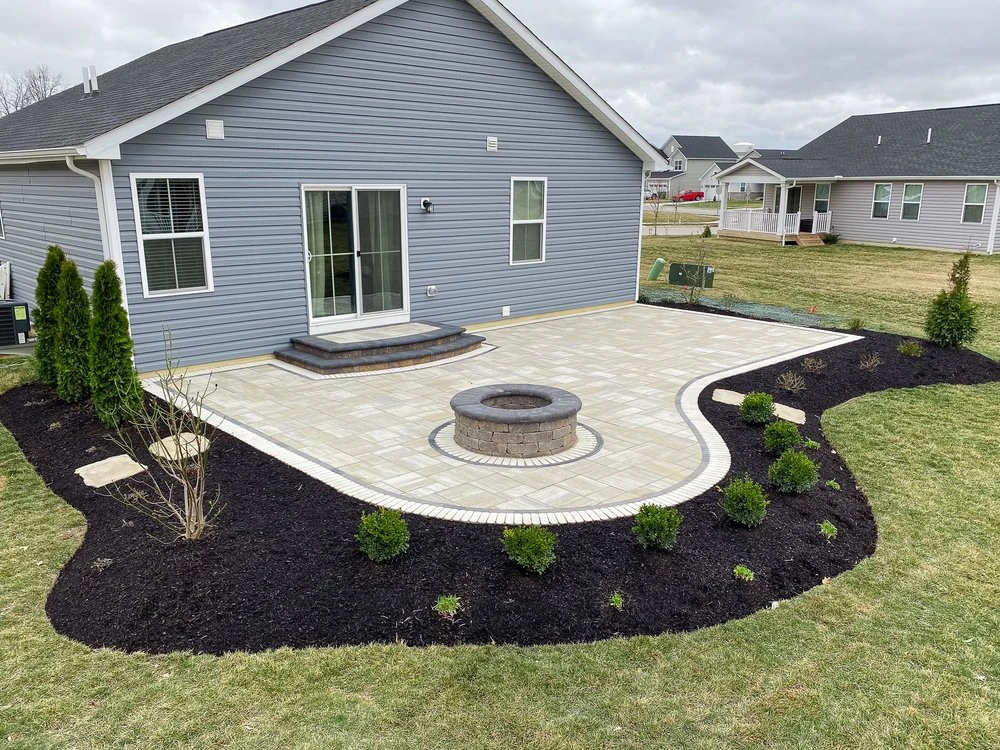
The Geometry: Why a Curve Turns Every Edge Paver Into a Custom Piece
Start with a rectangle. A paver field is a grid of repeating modules. When the patio edge runs parallel to that grid, the layout crew can often size the patio so the edge lands on a full unit or a clean half. A 6×9 rectangular paver laid in running bond along a straight 30-foot edge might need a cut on every other course, and each cut is the same cut. Repetition is what makes straight edges fast.
Now bend that edge. A curve crosses the paver grid at a constantly changing angle. Near the top of an arc the line runs almost parallel to the courses; a few feet along, it slices across them at 30 degrees, then 60. No two edge cuts share the same angle or the same length. Every unit touching the line is a one-off, and it has to be marked in place, pulled, cut, and reset.
The count adds up faster than homeowners expect. Take a quarter-circle edge with a 16-foot radius. The arc length is about 25 feet (2 × π × 16, divided by 4). Laid in 45-degree herringbone, a field of 6×9 units presents a new paver to that line roughly every 4 to 5 inches. That is 60 to 75 individual cuts on one quarter-circle, before you count the soldier border outside it. A straight 25-foot edge in the same pattern still needs cuts, because herringbone always does, but they repeat at two angles, and a good operator batches them.
Tighter radius, harder math
Radius matters as much as length. A broad, lazy curve with a 20- or 25-foot radius behaves almost like a series of straight segments. Drop to a 6-foot radius, the kind you see around a fire pit or a tight planting bed, and the angle changes so quickly that each cut is steep and each offcut is a sliver. Below about a 4-foot radius, rectangular soldier units stop fitting at all without being tapered, which we cover in section five.
This is also why we lay out curves the old-fashioned way before a single paver moves. A pin at the center point, a string set to the radius, and marking paint swung in an arc give a true circle segment. Freehand curves drawn with a garden hose look fine on day one and show wobbles once the soldier course goes down, because a soldier course is merciless about bad geometry.
Quick geometry check: Arc length = radius × angle in radians. A half-circle patio edge with a 12-foot radius runs about 37.7 linear feet. That footage, not the patio square footage, is what drives the cutting labor on a curved design.
Blade Time: What the Extra Saw Hours Actually Buy
Cutting is where the money goes. On a curved edge, the crew typically lays the field past the painted line first, then scribes the true curve across the top of the laid units. This “overlay and cut” method keeps the joint pattern intact right up to the edge, which is what you want. The tradeoff is that every unit crossing the line gets marked, lifted, cut, and dropped back in, one at a time.
Realistic pace on that work is 1.5 to 3 minutes per piece once you include marking, lifting, the cut itself, edge cleanup, and the reset. A cut-off saw such as a Stihl TS 420 with a segmented diamond blade does the heavy work; a wet table saw handles the steep, precise angles where a handheld blade would chip the face. Multiply 70 cuts by 2 minutes and one quarter-circle edge eats more than two hours of a skilled operator’s day. A kidney-shaped patio with 90 linear feet of curve can add a full crew day compared with the same footprint in straight lines.
Wet cutting is not optional
Concrete pavers contain crystalline silica. OSHA’s construction silica standard, 29 CFR 1926.1153, calls for integrated water delivery on handheld masonry saws for outdoor cutting, which means water, slurry, and cleanup on every cut. On a curved job, that cleanup is continuous rather than batched, and it adds real time. Diamond blades wear faster too, because short, angled cuts load the segments unevenly.
What those hours buy is a clean, consistent edge where the joint width at the cut matches the joint width in the field, a curve that holds its radius from start to finish instead of flattening in the middle, and cut pieces large enough to stay locked in the field for decades. That last point brings us to waste.
Cut Waste and the One-Third Rule
Every radius cut produces two pieces: the part that stays in the field and the offcut. On a straight edge, offcuts are often the right shape to use somewhere else along the same line. On a curve, the offcut is usually a wedge or triangle with an angle that fits nowhere. Nearly all of it goes in the dumpster.
There is a second, bigger source of waste that has nothing to do with offcuts. Standard installation practice holds that no cut piece at an edge should be smaller than roughly one-third of a full unit. A sliver of paver has almost no surface area locking it to its neighbors and very little weight bearing on the bedding sand. Under foot traffic and a few freeze-thaw cycles, slivers rock, sink, and pop loose. Clarkston sees 8 to 14 freeze events in a typical winter, milder than the north suburbs but more than enough to find a weak edge.
To honor that rule on a curve, the installer often pulls the last two units instead of one and cuts a larger piece to span the gap, or swaps in a half unit so the final cut stays big. Both approaches burn material. Where a straight patio might carry a 5 percent overage on the pallet order, a curved design in herringbone typically needs 10 to 15 percent overage, and tight fire-pit radii can push that higher.
Why pattern choice changes the waste
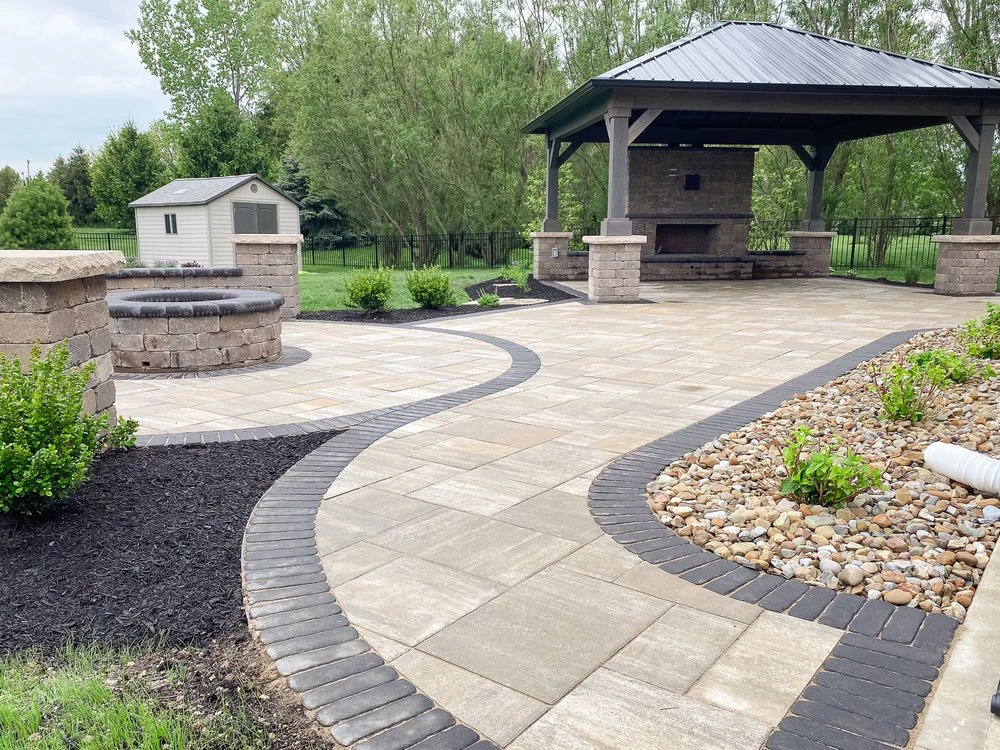
A random or multi-size pattern, like the cream tumbled layout around the fire pit pictured above, absorbs a curve gracefully because the eye already expects variation at the joints. Herringbone gives the strongest interlock, but it produces the most unique cuts along a curve. Running bond sits in between. When we specify a curved patio, we weigh pattern, radius, and waste together, not separately.
Circle kits with tapered units help on a round fire-pit pad, but the seam where a circle meets the field still gets cut piece by piece. Belgard, Pavestone, Unilock, and Techo-Bloc all offer shapes that behave differently on curves, and the right choice depends on the look you want, not on a brand logo.
Edge Restraint That Will Not Follow a Curve on Its Own
An interlocking paver patio is a flexible pavement. It stays tight only because something at the perimeter stops the units from creeping outward. That perimeter hardware is the edge restraint, and it is the third reason curves cost more.
Standard rigid plastic and aluminum restraints come in straight sections that will not bend around a radius. To follow a curve, the crew either uses a notched or flexible version, which costs more per foot, or cuts relief notches in straight stock by hand. Either way, a curved restraint needs more anchoring. Where straight runs are commonly spiked about every 24 inches, curves generally call for spikes every 12 inches or closer, because a bent section wants to spring back toward straight. Those spikes have to seat into compacted base, not into the soft soil at the edge.
The base has to curve too
Restraint is only as good as what it sits on. The compacted aggregate base should extend past the finished paver edge by at least the depth of the base itself, so the spikes land in stone rather than native soil. On a straight patio, that over-dig is a simple offset line. On a curve, it is a second arc that has to be excavated, filled, and compacted with a plate compactor that does not love working a tight radius. Base quantity goes up, too, because a curved perimeter is longer than the rectangle it replaces.
On tighter radii, and anywhere a mower or kids will hit the edge, we often skip plastic entirely and use a troweled concrete toe: a haunch of concrete placed against the outside of the soldier course and down onto the base. Concrete follows any curve you draw, it does not spring back, and it cannot be lifted out by a frost-heaved spike. It costs more, it takes an extra step, and it disappears under sod or mulch when you are finished. On the older lots near Lake Capri and Idlewood, where topsoil is thin after decades of mowing and the clay below swells and shrinks with every wet-dry swing, that extra step earns its keep.
Curve premium, in real numbers: On our Clarkston-area quotes, a curved border typically adds roughly $18 to $30 per linear foot of curve over the same edge built straight, covering saw time, overage, flexible or concrete restraint, and the extra base. A 400-square-foot patio with 70 feet of curved edge usually lands $1,300 to $2,100 above its rectangular twin.
Soldier Courses on a Radius: Keystone Cuts and Joint Width
The soldier course is the border row of pavers, usually set with the long side perpendicular to the edge. On a curved patio it is the part everyone looks at, and where the most skilled cutting happens.
Picture rectangular bricks standing side by side around the outside of a circle. The inner corners touch, but the outer corners fan apart, leaving a wedge-shaped gap between every pair. On a broad radius, those gaps are small enough to fill with joint sand and still look intentional. As the radius tightens, the gaps grow. Paver joints are generally held in the range of about 1/16 to 3/16 of an inch. Past that, jointing sand does not hold, and the border starts to look loose.
The fix is the keystone cut. Each soldier unit is tapered slightly on both long sides to match the radius, exactly like the stones in an arch. Every border unit gets two cuts instead of zero. On a tight fire-pit ring or a small-radius bed edge, that can mean well over a hundred tapered pieces, each one sized to keep the joint consistent from inside to outside.
Where the soldier meets the field
The inside face of the soldier course is where the field cuts land, and that seam is the true test of a curved patio. If the field cuts are sloppy, the border will show it, because a clean dark soldier course next to ragged field joints looks worse than no border at all. When you see a charcoal border tracing a curve with even joints the whole way around, like the one in the photo above, you are looking at hours of careful work on both sides of one line. Double-course borders add weight on large patios, but they double the tapered cutting on a curve.
Why the Finished Curve Reads as Designed, Not Poured
A rectangular slab glued to the back of a house is a surface. A curved patio is a place.
Curves follow how people actually move and sit
People do not walk in right angles. They cut corners, drift toward the view, and gather in circles. Look at the Adirondack chairs in the photo above: four of them naturally form a semicircle around the fire pit. A curved seat wall simply builds that arc into stone. A conversation area roughly 10 to 12 feet across keeps everyone within easy talking distance, and a curved edge frames that circle instead of leaving chairs floating on a rectangle with dead corners nobody uses. Where the patio meets the lawn, an arc that sweeps out and back feels like part of the yard, while a straight edge that stops abruptly at the grass looks like the job ran out of money.
Curves soften Clarkston’s rectangular houses
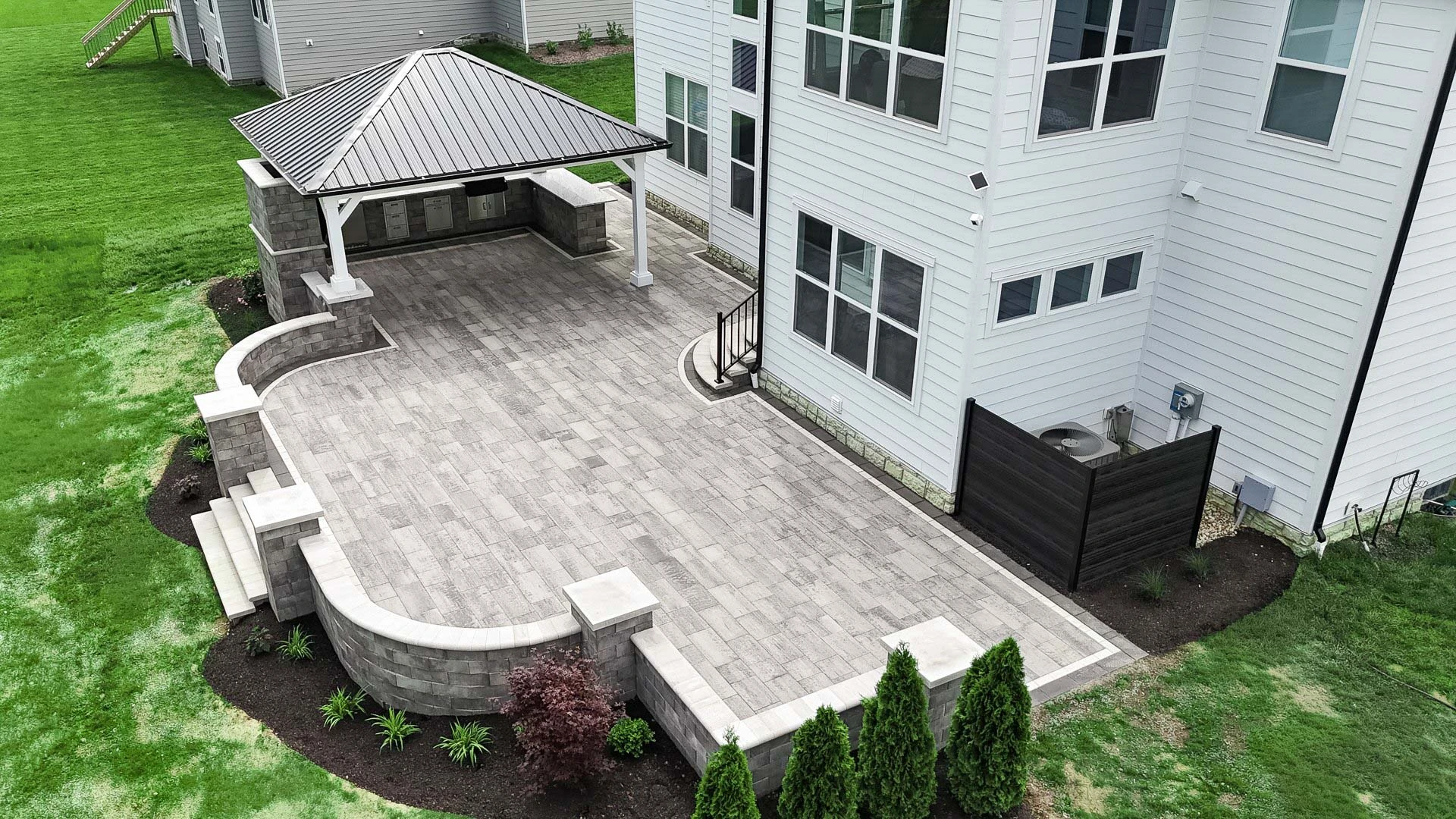
Clarkston’s housing stock is heavy on 1960s through 1980s ranch and split-level homes with long, flat rear elevations. Idlewood, Brockett, Hambrick, and the streets off Indian Creek Drive are full of them. Swing a curve off that straight wall and you create contrast, the same way a landscape architect sets a curving bed against a straight fence. The aerial at the top of this post shows it: a curved apron wrapping the back of a two-section house turns hard corners into one continuous shape.
Many backyards here also run up against tree-canopied creek corridors like South Fork Peachtree Creek and Pole Bridge Creek, or against mature oaks planted when the subdivisions were new. A curved edge can bend around a tree’s root zone rather than cutting through it. A common arborist rule of thumb protects about one foot of radius for every inch of trunk diameter, so a 24-inch oak wants roughly a 24-foot radius left alone. A patio that arcs away from that zone keeps the tree healthy and looks deliberate doing it. For lots near a stream, the state’s 25-foot buffer and DeKalb’s own stream buffer rules both apply, and DeKalb County Planning & Sustainability on Sams Street in Decatur has the final word on what can be disturbed.
When straight lines are the right call
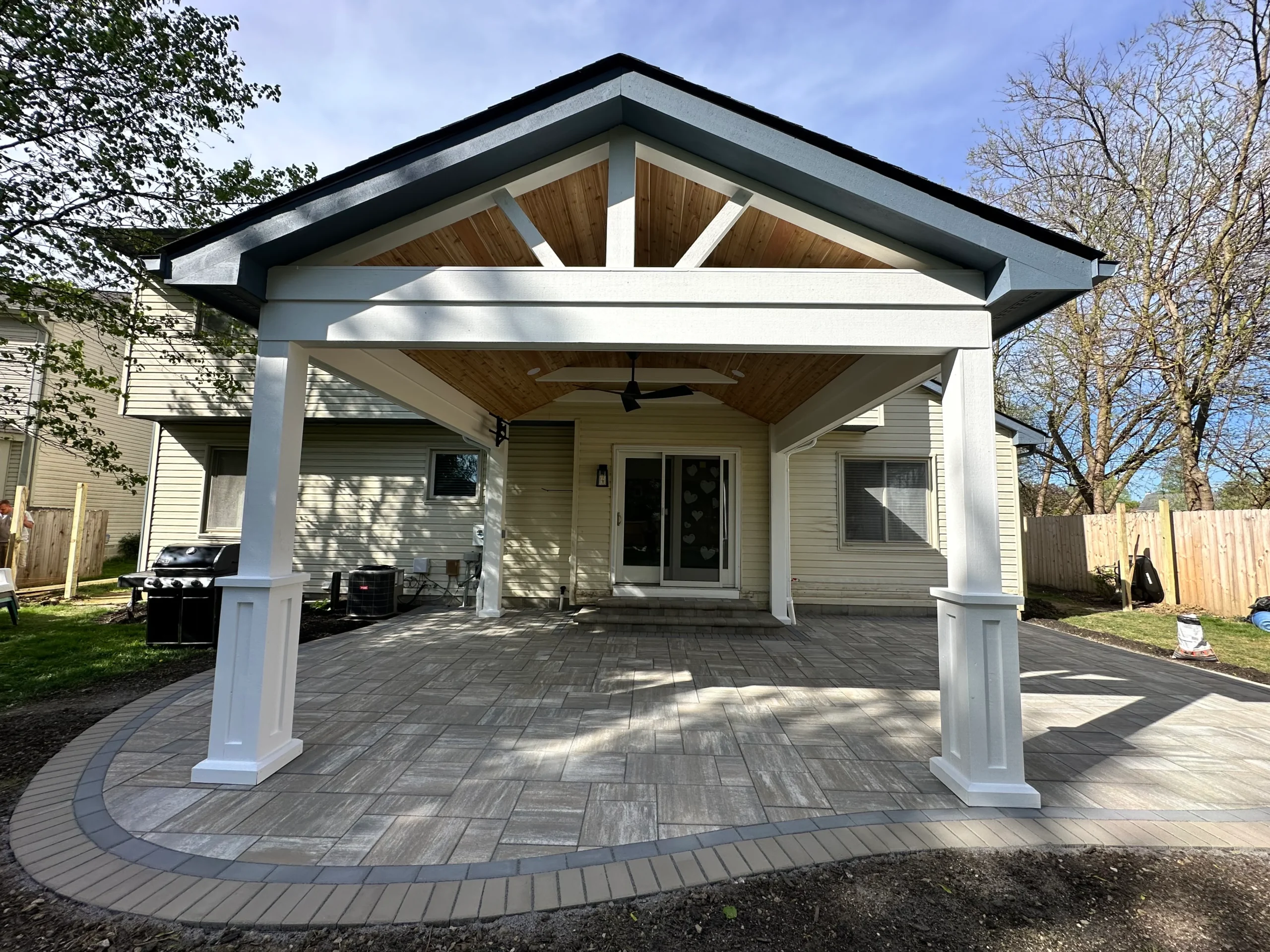
Curves are not always the answer, and a contractor who puts an arc on everything is not designing either. Under a roofed structure, like the gable pavilion shown above, the patio should usually square up with the columns and the roofline. The smart move is often a hybrid: straight lines where the patio meets architecture, curves where it meets landscape.
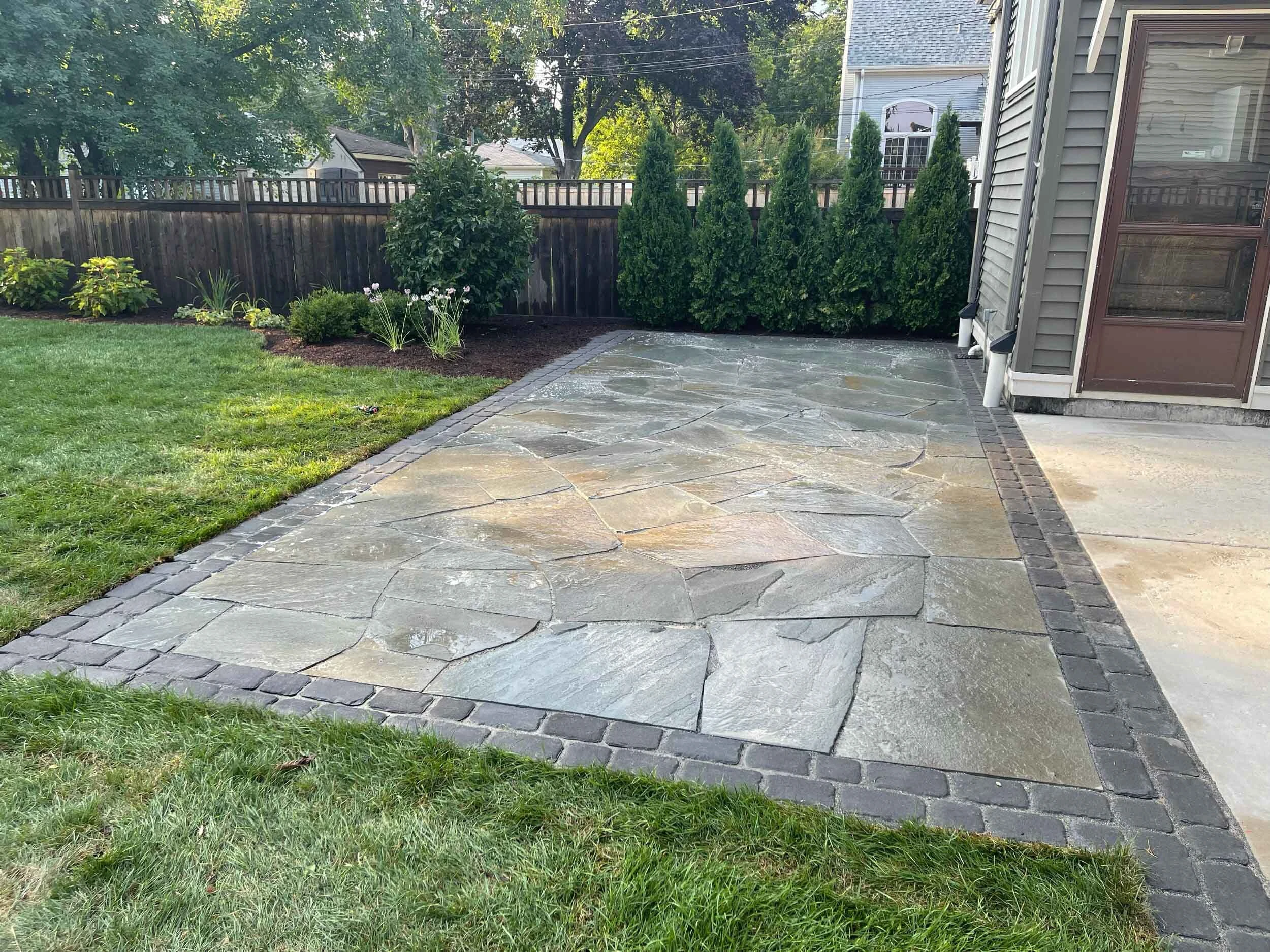
Material changes the math as well. Irregular flagstone already carries organic movement in every joint, so a straight brick border around it looks crisp rather than rigid. The patio below pairs irregular bluestone with a double-course charcoal brick soldier border along the house, and it works because the stone supplies the softness the straight line does not.
How to judge a curved-patio quote
If you are comparing bids for a curved patio in 30021, ask each contractor four direct questions. How will you lay out the radius: string and center pin, or a hose? What edge restraint will you use on the curves, and how far apart are the spikes? Will the soldier course be keystone-cut, and what joint width are you holding? What overage are you ordering? A contractor who quotes a curved patio at the same price as a rectangle is either absorbing the cost this time or planning to skip one of those steps.
The Brockett Road homeowner chose the curve. Her extra $1,900 went into about a day and a half of saw time, a fuller pallet order, concrete toe restraint on the tightest arc, and a keystone-cut charcoal border. What she got back is a patio that looks drawn for her house, not ordered by the square foot. That is the difference between a patio that was designed and one that was simply installed.
Curved paver patios across 20+ cities from our Winder, GA home base
Primetime Pools GA lays out every radius from a true center point, keystone-cuts the soldier course, and locks the curve with restraint built to hold through Georgia freeze-thaw winters.