
DeKalb County tap water runs roughly 110 to 140 ppm calcium carbonate, noticeably harder than the ~80 ppm most Gwinnett pools start with. That gap sounds small on a lab sheet. On a Clarkston equipment pad, it decides which component you pay to replace first, and how soon.
Most equipment failures we diagnose in 30021 are not random. They follow a sequence. Fill water arrives already carrying calcium, a Georgia summer at 90 to 94°F evaporates inches of water a week, the top-off hose adds more calcium, and the concentration climbs every season the pool is never partially drained. By the third summer, a pool that started at 140 ppm can test at 400 to 500 ppm calcium hardness. At that point the scale doesn’t coat everything evenly. It goes after the hottest surfaces, the surfaces with electrical current running across them, and the parts that have to move against a seal. That’s the order of failure, and it is predictable enough that we can usually tell a homeowner in Lake Capri or Idlewood what is going to break next before it does.
Below are the mistakes that speed that sequence up, in the order hard water kills components: heat exchanger, salt cell, pump seal, automation valves. For each, you get the service life we see in Clarkston water, the failure cost, and what genuinely extends it. Most pools here sit behind 1960s to 1980s ranches, so many pads are 35 to 50 years old and have been patched and re-plumbed several times.
Mistake #1: Treating the Heater as the Last Thing That Could Fail
Homeowners assume the heater is the toughest box on the pad. It’s the most expensive, it runs the fewest hours, and in a Zone 8a climate it may only fire from March to May and again in October. So it gets ignored. In hard water, that’s backwards. The heat exchanger is almost always the first major component to go.
Here’s why. Calcium carbonate is one of the few minerals that becomes less soluble as water gets hotter. Water passing across the inside of a gas heater’s copper or cupronickel exchanger tubes heats sharply at the tube wall, and that is exactly where calcium drops out of solution and bonds. A thin layer of scale acts as insulation. The burner keeps firing to hit setpoint, the tube walls run hotter, more scale forms, and the cycle compounds. Eventually you see one of three things: the heater short-cycles on the high-limit switch, it starts making a rumbling or kettle-boiling sound, or a tube splits and the heater leaks from the bottom of the cabinet.
Typical service life in Clarkston water
A heater like a Pentair MasterTemp, Hayward H-Series, or Raypak can reasonably run 10 to 12 years in well-balanced, softer water. On the older DeKalb pads we service where calcium hardness has been allowed to drift past 400 ppm, the exchanger commonly fails somewhere around year 5 to 8. Heat pumps fare somewhat better because their titanium exchangers resist corrosion, but they still lose efficiency when scale insulates the coil, and a scaled heat pump draws more from your Georgia Power bill to deliver the same temperature rise.
The failure cost is what makes this the one to watch. A heat exchanger replacement, where it’s still worth doing, typically runs $1,200 to $2,200 in parts and labor. On an older unit, that repair often doesn’t make sense against a full replacement at $3,500 to $5,500 installed. Replacing a gas heater generally involves a DeKalb County mechanical and gas permit through Planning & Sustainability at 178 Sams St. in Decatur, and DeKalb’s turnaround runs slower than Gwinnett’s, often 3 to 4 weeks. If the heater dies in March, you may be into May before the new one fires.
What actually extends it
- Keep the water balanced, not just sanitized. A Langelier Saturation Index between −0.3 and 0.0 keeps calcium off the tube wall.
- Maintain proper flow. A dirty filter or too-slow pump setting raises tube-wall temperatures.
- Inspect the exchanger at spring start-up. Early scale can often be descaled before it becomes a split tube.
Mistake #2: Cleaning the Salt Cell on a Calendar Instead of by Scale
The salt cell is the second casualty, and on saltwater pools it’s frequently the first one owners notice. A chlorine generator works by passing current across a stack of titanium plates coated with ruthenium or iridium. Electrolysis raises the pH right at the plate surface, and high local pH is exactly the condition calcium needs to precipitate. In soft water, a cell collects a light white crust. In Clarkston water that’s been topped off for three summers, it builds scale that bridges the gap between plates.
The mistake is cleaning it by the calendar. In July, with evaporation and top-offs pushing calcium up, the cell may need a look every four to six weeks. In December it may need nothing. Owners who clean too often with over-strong acid strip the plate coating, which kills the cell faster than the scale would have.
Typical service life in Clarkston water
A cell like a Hayward TurboCell T-15 or Pentair IntelliChlor IC40 is generally rated in operating hours rather than years, and many manufacturers point to a range in the neighborhood of 10,000 hours under proper conditions. In practice, in DeKalb County’s harder water with high calcium readings, we see these cells lasting 3 to 5 years instead of 5 to 7. Replacement cells typically run $700 to $1,100 depending on the model and size.
What actually extends it
- Inspect monthly in peak season. If scale bridges the plates, clean it. If not, leave it alone.
- Soak briefly in diluted acid at the manufacturer’s ratio, only until fizzing stops.
- Watch pH drift. Salt pools push pH up; letting it sit at 7.9 or 8.0 makes plate scaling far worse.
Mistake #3: Ignoring a Slow Weep Under the Pump
The pump shaft seal is third in line, and it gives more warning than any other component. Owners just don’t read the warning. A mechanical shaft seal is two precision faces, typically a ceramic ring and a carbon ring, spinning against each other with a thin film of water between them. Hard water deposits calcium crystals on those faces. The crystals act like grit. The faces score, the film breaks down, and the seal starts to weep.
That slow drip under the pump looks harmless. It isn’t. Water tracking down the back of the motor housing reaches the rear bearing, and once the bearing corrodes, you hear it: a high whine or grinding that gets louder over a few weeks. A seal replacement caught early is a modest service call. A seal that’s been ignored until the bearings are gone often means a new motor, and on a variable-speed pump that can be the bulk of the pump’s cost.
Typical service life in Clarkston water
In balanced water, a shaft seal commonly lasts 4 to 6 years. In high-calcium water, we routinely see weeping by year 2 to 4. A seal replacement usually runs $250 to $450 as a service call. A replacement motor on a variable-speed pump, or a whole new Pentair IntelliFlo3 or comparable Hayward or Jandy unit, can run well past $1,500 installed.
On older Clarkston pads there’s one more wrinkle. A pump swap on a pad built before modern equipotential bonding requirements under NEC §680.26 often means bringing the bonding up to date: a continuous copper bonding conductor tied to the pump motor lug and other metal components. Many of the 1970s pads we open in Toney Valley and along Brockett Rd have bonding that is missing, broken, or was never run in the first place. That’s a safety correction, not an upsell, and it should be part of any pump replacement quote.
What actually extends it
- Look under the pump every time you empty the basket. Any moisture at the seal plate means schedule service.
- Never run the pump dry. Losing prime cooks a scored seal in minutes.
- Run variable-speed pumps slower for longer, while still meeting heater and cell minimum flow.
The Clarkston failure order, at a glance: 1) heater heat exchanger, typically 5–8 years in high-calcium water; 2) salt cell, 3–5 years; 3) pump shaft seal, 2–4 years to first weep (it goes first by calendar, but it’s the cheapest fix and it announces itself); 4) automation valve actuators and multiport valves, 5–7 years.
Balanced water and a partial drain every few seasons can push each of these toward the top of its manufacturer range.
Mistake #4: Letting Valve Actuators Grind Against Scale
Fourth are the automation valves and the multiport valve, the parts that route water to the spa, the water features, the cleaner line, or backwash. They fail quietly, and owners usually discover it when a spa won’t fill or a waterfall won’t shut off.
A three-way valve like a Jandy Neverlube or a Pentair diverter uses a rotating diverter sealed with rubber against the valve body. An automation actuator turns that diverter on a schedule. When calcium builds up on the diverter and valve body, the actuator has to work harder to rotate it. The motor strains, the internal gears strip, or the limit cams stop landing where they should. Meanwhile, the rubber seal on the diverter hardens and leaks by, so water bypasses to lines that are supposed to be closed.
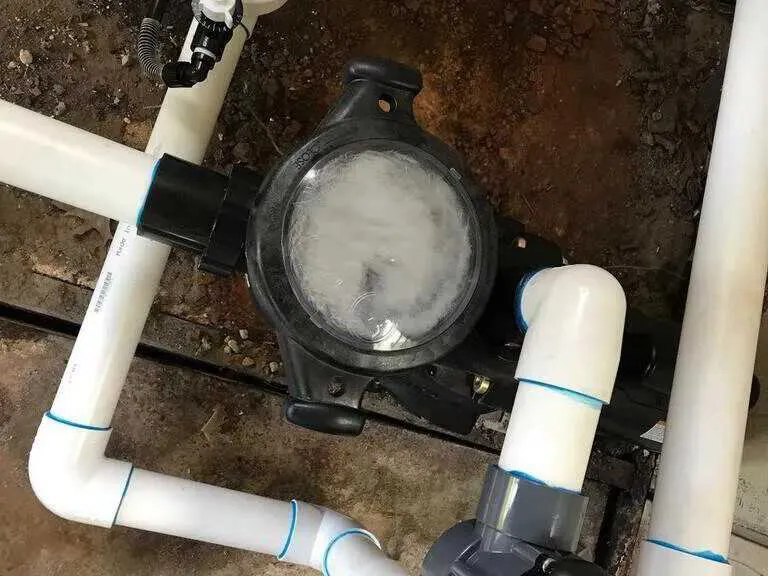
Multiport valves suffer the same way. Scale collects around the spider gasket, the gasket tears when the handle turns, and the filter starts short-circuiting or pushing residue into the returns. The clouded sight glass pictured above is a common companion to that failure.
Typical service life in Clarkston water
Actuators and diverter valves commonly last 8 to 10 years in softer water. In high-calcium water we see actuators straining and seals leaking by around year 5 to 7. Actuators and multiport swaps typically run $250 to $450 each. The real cost is downstream: a heater starved of flow while a stuck valve goes unnoticed.
What actually extends it
- Lubricate diverter o-rings with a silicone-based pool lubricant, never petroleum products.
- Shut the pump off before turning a multiport handle. Turning under pressure tears spider gaskets.
- Cycle rarely used valves monthly so scale can’t lock the diverter.
Mistake #5: Chasing pH and Chlorine While Calcium Climbs Unchecked
Every failure above traces back to the same root, and it’s the mistake nearly every owner makes: testing only chlorine and pH. Test strips make those two numbers easy. Calcium hardness, total alkalinity, and water temperature get ignored, and those are the numbers that determine whether water deposits scale.
The water chemistry concept that matters here is the Langelier Saturation Index, or LSI. It combines pH, temperature, calcium hardness, total alkalinity, and total dissolved solids into one figure. Positive LSI means the water is oversaturated and will drop calcium onto surfaces. Negative LSI means the water is hungry and will pull calcium out of plaster and grout. Target a range close to zero, slightly negative for pools with a heater or salt cell.
Clarkston makes this harder than it looks. Summer water in the upper 80s pushes LSI positive on its own, and ~52 inches of annual rain dilutes alkalinity and stabilizer along with calcium, so owners overcorrect. Swinging water is harder on equipment than steady water.
What actually extends everything
- Test calcium hardness at least monthly with a drop-based kit, not a strip. Strips are unreliable at the high end of the range.
- Target 200 to 400 ppm calcium hardness for plaster pools. When readings climb past that, don’t try to chemical your way out. Drain partially and refill.
- Plan a partial drain and refill every 2 to 3 seasons. Replacing a third of the water with 110 to 140 ppm fill water is the most effective way to pull calcium back down. Schedule it for spring or fall; avoid draining during peak heat or when groundwater is high after heavy rain.
- Add a scale inhibitor (sequestrant) in pools with heaters and salt cells. It doesn’t replace balance, but it buys margin.
- Ask about reverse-osmosis treatment when calcium has run away. Mobile RO pulls hardness down without fully draining an old shell, which carries real risk after heavy rain raises groundwater.
Mistake #6: Forgetting the Parts Nobody Lists on the Equipment Pad
The four components above are the expensive ones. But hard water also wears down a set of smaller parts that owners rarely connect to water chemistry, and a few of them can quietly drag the big four down with them.
Booster pumps and pressure-side cleaners
A pressure-side cleaner like a Polaris 280 typically runs on a dedicated booster pump, and that pump has its own shaft seal facing the same calcium-scored failure as the main pump. The cleaner itself suffers too: scale builds in the thrust jets and the backup valve, the cleaner loses drive, and owners assume it’s worn out when it’s often just clogged with mineral deposits. Soaking the head and jets in a mild descaling solution restores many units. The booster pump seal, meanwhile, deserves the same under-the-pump check you give the main pump.
Waterline tile and the autofill
The white crust along a waterline is calcium, left behind as water evaporates. The hero photo at the top of this post shows the hands-on version of that fight: a gloved hand working a sponge along blue mosaic waterline tile beside the ladder. Scale there is cosmetic at first. Left long enough, it roughens the grout and gives algae a foothold. Clarkston’s 8 to 14 freeze events a year add another stress: water that gets into cracked grout or thinset at the waterline freezes, expands, and loosens tile. Keeping the waterline scale-free keeps the grout sealed, which keeps freeze damage off the table.
Autofill valves are the hidden culprit behind much of that crust. A float valve that sticks open constantly adds hard fill water, driving calcium up faster than evaporation alone would. If your calcium hardness climbs unusually fast, check the autofill before you blame anything else.
LED lights and water features

LED lights don’t fail from calcium directly, but scale on the lens cuts output and crusts the fixture ring, making the light harder to pull for service. Water features take a heavier hit. Bubblers and scuppers have narrow openings, and calcium builds right at the orifice as water evaporates. A bubbler that threw a clean column starts spitting sideways within a couple of seasons.

The fix for features is simple and rarely done: pull the eyeballs or nozzles once or twice a season and soak them in a descaling solution. It takes an hour and keeps the feature performing like the day it was installed.
Mistake #7: Replacing Parts Without Changing the Water That Broke Them
The last mistake is the most expensive one, and it’s the one we see most on Clarkston renovation calls. A heater fails, the owner replaces it, and the new heater goes into the same water that killed the old one. Three years later, the same call comes in. Parts are not the problem. The water is.
When we take on an equipment replacement, the water gets addressed at the same time. That’s not a sales tactic. It’s the difference between a $4,500 heater that lasts 5 years and one that lasts 12. On a 35- to 50-year-old pool, it’s also the moment to look at the pad as a system: whether the original copper plumbing is still in service and showing pinhole corrosion, whether the bonding meets current code, whether the main drain covers meet the Virginia Graeme Baker (VGB) Act standards, and whether the pump is correctly sized for the heater and salt cell it has to feed.
A realistic replacement plan for a hard-water pad
- Test fully and calculate LSI.
- Bring the water into range before new equipment goes in.
- Replace in order of failure risk. An 8-year-old heater and a 4-year-old cell belong in the same 12- to 18-month budget.
- Update the pad while it’s open: unions on every component, bonding to current code.
Permits factor into timing. Gas heater replacements typically need a DeKalb County permit, and since residential pool permitting for Clarkston runs through DeKalb County Planning & Sustainability rather than the city, plan for DeKalb’s 3- to 4-week turnaround. If your heater is showing early warning signs in January, start the conversation then. Waiting until it fails in April puts your first warm swim in June.
Pools in Lake Capri, Idlewood, Hambrick, and the Sycamore Drive corridor were largely built in the same era with similar layouts, so the failure patterns are consistent. A pad inspection before anything breaks is the cheapest repair you’ll ever buy. Fix the water, then fix the parts, in the order hard water will take them.
Pool repairs across 20+ cities from our home base in Winder, GA
Every Clarkston equipment call starts with a full water test and LSI calculation, so the heater, salt cell, pump, or valve we replace goes into water that won’t wear it out on the same schedule as the last one.