
Is that crack in your Clarkston pool a hairline in the plaster, or the shell telling you it moved? Should you patch it, stitch it, or stop spending money on it altogether? Those are three different questions, and each has a measurable answer. A crack wider than 1/8 inch that grows over one winter is a different animal from a spiderweb you can’t catch a fingernail on.
Q: Why does this question come up so often in Clarkston?
Because Clarkston is a renovation market, not a new-build market. The pools behind the ranch and split-level homes in Lake Capri, Idlewood, Toney Valley, and along the Brockett Rd corridor were mostly shot or poured between the mid-1960s and the mid-1980s. That puts them at 35 to 50 years old. Concrete that old tells you what it’s doing one crack at a time. Read it before you write a check.
Q: Can’t a pool tech just look at it and tell me?
Sometimes. More often, a quick look produces a guess, and guesses are expensive in both directions. Call a structural crack cosmetic and you’ll plaster over a moving shell that splits your new finish by spring. Call a cosmetic crack structural and someone sells you a $30,000 fix for a $600 problem. A real diagnosis uses four inputs: orientation, width, depth, and movement over time.
Q: Is every crack around a pool a shell crack?
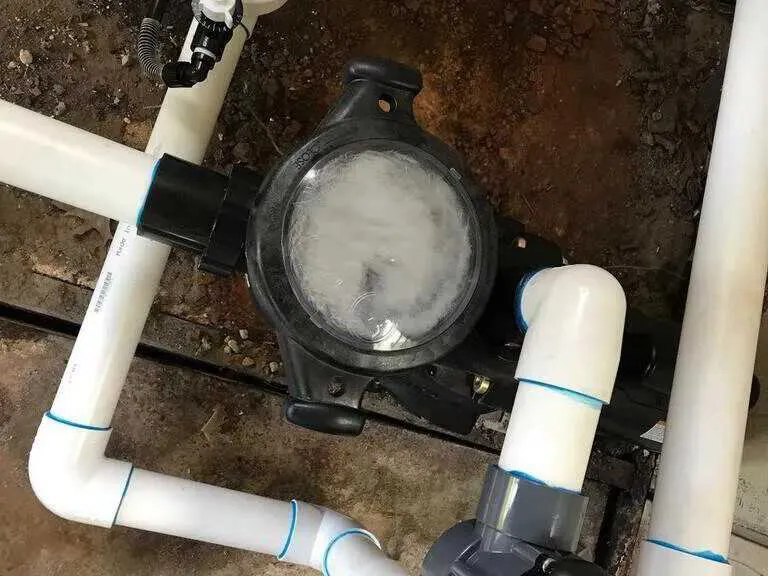
No, and that’s the first thing to rule out. Water loss that looks like a cracked shell often comes from somewhere else in the system. We’ve traced “cracked pool” calls to split valve housings and failed return fittings. Before anyone talks about the shell, the plumbing and equipment get cleared.
Reading the Crack: Orientation, Width, and Depth
Concrete cracks for a reason, and the reason leaves a signature. The pattern a crack draws across your pool tells you more than any single measurement.
Map cracking and checking (almost always cosmetic)
A fine, random web of lines across the plaster, sometimes called crazing or checking, is a surface-finish problem. It comes from the plaster drying too fast at startup, a water-to-cement ratio that ran wet, or decades of aggressive water chemistry. These cracks live in the top 1/16 to 1/8 inch of plaster. They don’t pass through to the gunite, they don’t leak, and they don’t grow in a meaningful way.
Clarkston has its own accelerant here. DeKalb County water runs harder than its neighbor to the north, somewhere around 110 to 140 ppm calcium hardness compared with roughly 80 ppm on the Gwinnett side. Hard fill water that isn’t balanced with the Langelier Saturation Index in mind either scales the surface or, when an owner overcorrects with acid, etches it. Etched plaster shows its old check cracks more clearly.
Straight, isolated cracks running floor to wall
A single crack that travels in a mostly straight line, often starting in the floor and climbing a wall, deserves attention. Straight cracks follow stress. In older shells they typically trace a zone where the rebar was light, where the gunite was applied in two sessions and formed a cold joint, or where the shell spans a soft spot in the subgrade. Orientation matters:
- Vertical wall cracks near the midpoint of a long wall usually point to shrinkage or thermal stress. They can be structural if wide, but often stabilize.
- Diagonal cracks radiating from corners, steps, and benches point to settlement. One part of the shell moved relative to another.
- Horizontal cracks just below the tile line or along the cove (where wall meets floor) suggest the bond beam or the floor is rotating, often from soil pressure behind the wall or water pressure beneath the floor.
- A crack across the floor near the main drain is the one we worry about most, because it often traces back to hydrostatic lift.
Width and offset
Width is where opinion turns into data. We use a plastic crack-width comparator card and log every reading. Our working thresholds:
- Under 1/32 inch: hairline. Treat as a surface issue unless it’s leaking.
- 1/32 to 1/8 inch: watch zone. Could be either. Needs movement monitoring before anyone quotes a fix.
- Over 1/8 inch, or any offset: structural until proven otherwise. If one side of the crack sits higher than the other, even by a hair, the shell has displaced, and that’s no longer a finish problem.
Depth: sounding and dye
A crack that lives only in the plaster sounds solid when you tap the surface beside it. Plaster that has delaminated from the gunite sounds hollow, a dull “thock” you can hear with a rubber mallet. Then we use dye. A syringe of leak-detection dye released beside the crack with the pump off tells you whether water is being drawn through it. If the dye gets pulled into the line, the crack passes through the shell. If it drifts away, the crack is either shallow or sealed at depth.
The quick field triage: Hairline, random, solid-sounding, and no dye draw = cosmetic. Straight, wider than 1/8 inch, offset, hollow-sounding, or pulling dye = structural until monitoring proves otherwise.
The Waterline Tells You What the Shell Is Doing
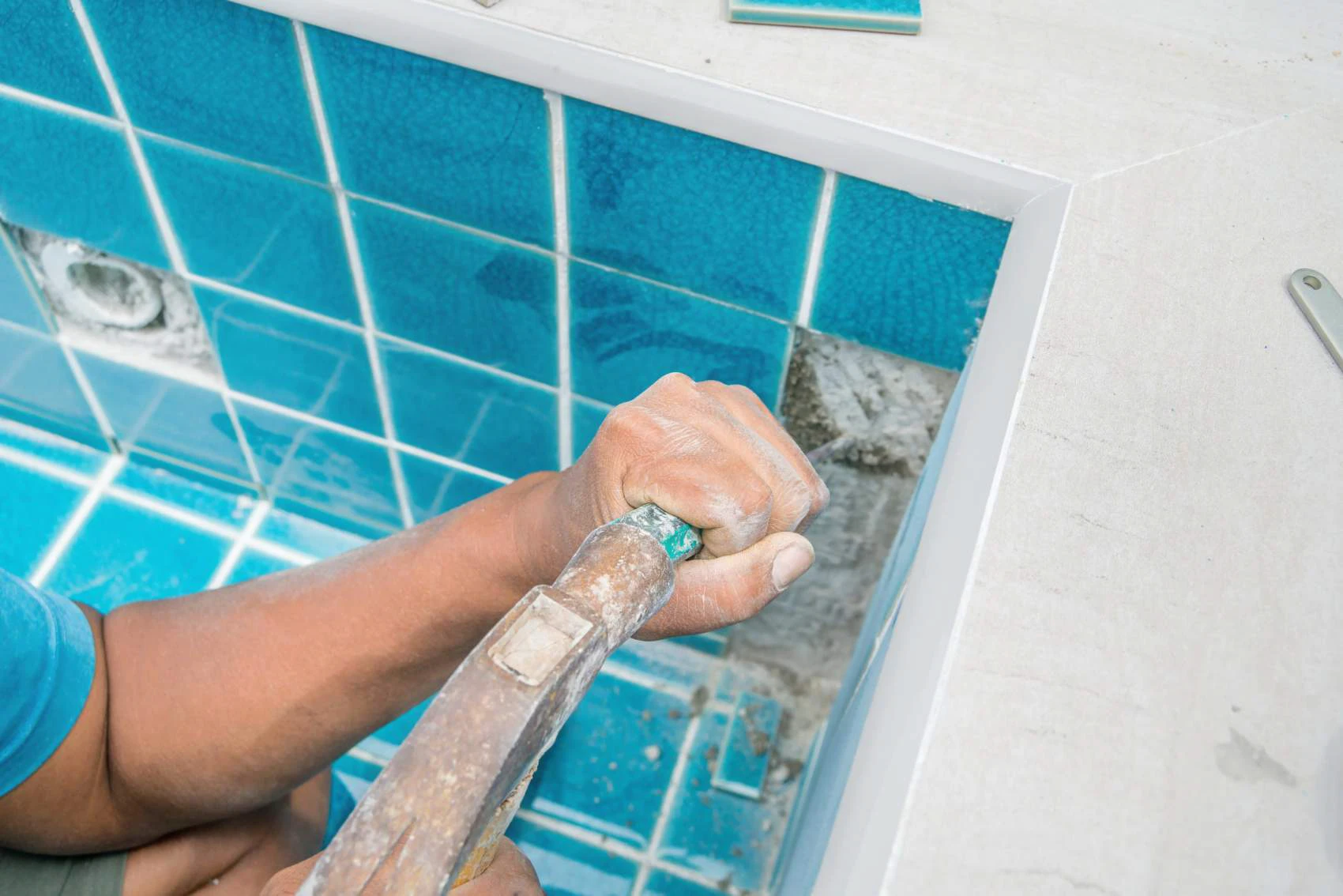
If you only have time to inspect one part of an older pool, inspect the tile line. The waterline sits at the top of the wall, right under the bond beam, and it’s where the shell’s movement shows first. Tile is rigid, grout is brittle, and both crack the moment the structure behind them moves.
Tile cracks that line up with shell cracks
When a crack runs straight through a tile, then through the grout joint below, and continues into the plaster, you’re looking at one continuous fracture from the bond beam down. That’s a structural signature. A crack that stays in the grout and never enters the tile face, or a single tile that popped while its neighbors held, is usually a bond failure, not a shell failure.
Freeze-thaw and thinset
Clarkston sees roughly 8 to 14 freeze events per winter. Milder than Hall County, but at the waterline it’s enough. Water gets behind loose tile, freezes, expands about 9 percent, and pries the tile further off the wall. Original 1970s tile was often set in unmodified mortar never rated for that exposure. When we reset waterline tile, we specify a polymer-modified thinset meeting ANSI A118.4 or better, back-buttered for full coverage, so there’s no void for water to collect in.
Here’s the diagnostic twist. A pool with widespread hollow tile and random cracked pieces all around the perimeter usually has a thinset and freeze problem. A pool with cracked tile concentrated in one run, lined up with a crack in the wall below, has a structural problem that happens to show up in the tile. Same symptom, two completely different repairs.
Movement Over a Season: The Test That Settles the Argument
Orientation and width get you most of the way. Movement over time finishes the diagnosis. A crack that’s the same width in April as it was in October is a dormant crack. A crack that opens in winter and closes in summer is a working crack. A crack that gets wider every time you look is an active structural failure. Each of those calls for a different repair, and you can’t tell them apart in a single visit.
How we monitor
On any crack in the watch zone, we install a two-piece tell-tale crack monitor across the crack above the waterline, or mark gauge points with a scribed line and measure with a digital caliper below it. We photograph each point with a scale reference and log readings at set intervals, typically every four to six weeks, across at least one full cool-season swing. For a Clarkston pool, that means watching through the stretch from November into March, when the freeze cycles and soil moisture both peak.
What the readings mean
- No measurable change: dormant. The shell settled years ago and stopped. This crack is a candidate for a rigid repair.
- Opens and closes in a cycle: working. Temperature and moisture drive it back and forth. A rigid repair will crack beside itself. This needs a flexible approach or a stitched one.
- Grows steadily, especially with offset: active. Something under or behind the shell is still moving. No crack repair solves this until the cause is fixed.
Why the ground under Clarkston matters
Clarkston sits on older Piedmont terrain east of I-285, and the soil story shapes what the monitors show. The Cecil-series red clay here swells when wet and shrinks when dry, and the older 1960s and 1970s lots often have thin topsoil after decades of mowing. That clay pushes on walls seasonally, which produces working cracks. Closer to Stone Mountain, excavations commonly hit decomposed granite at 4 to 8 feet, which drains and supports differently than the clay above it. A shell that sits partly on clay and partly on weathered granite can settle unevenly, and that shows up as diagonal cracks off the deep end.
Then there’s water. Many Clarkston backyards back up to creek tributaries like Pole Bridge Creek and South Fork Peachtree Creek, or to DeKalb greenway corridors under heavy tree canopy. With about 52 inches of rain a year, groundwater around those pools can rise well above the floor of the shell after a wet week. That’s the setup for hydrostatic pressure.
Don’t drain it to “get a better look”: An older pool with a suspect floor crack, a creek behind the fence, and a wet week in the forecast is exactly the pool that can lift out of the ground when emptied. Draining is a controlled procedure with the groundwater checked first, not a weekend decision.
Stitch and Epoxy vs. the Full Hydrostatic Remedy
Once you know whether a crack is cosmetic, dormant, working, or active, the repair choice mostly makes itself. Here’s what each method actually does and where it belongs.
Cosmetic: plaster patch or cut-and-fill
For surface cracks, the crack is routed out into a clean V or U profile, primed with a bonding agent, and filled with a plaster or polymer patch matched as closely as the existing finish allows. On an old surface, color matching is rarely perfect. Budget roughly $300 to $800 per area. This fixes appearance and keeps the crack from trapping dirt. It does nothing structural, and it shouldn’t be sold as though it does.
Dormant structural: epoxy injection
A crack that passes through the shell but has stopped moving is a good candidate for a low-viscosity structural epoxy injection. Surface ports are set along the crack, the face is sealed, and the epoxy is pumped from the lowest port upward until it appears at the next one. Products in the class of Sikadur-35 Hi-Mod LV are designed to wick into fine fractures and bond the concrete back together at a strength higher than the concrete itself. The key word is dormant. Epoxy is rigid, and a rigid bond on a working crack just moves the break an inch to one side.
Working structural: stitching (staples) plus epoxy
For a crack that opens and closes, or one that shows minor offset but has stabilized, the repair is a stitched one. The crack is routed, then slots are cut across it at intervals, typically every 8 to 12 inches, and steel stitching staples or carbon-fiber stitches are set into those slots in structural epoxy. The staples hold the two sides together so the crack can’t keep working, and the epoxy bonds everything into one piece. The pool often needs a new finish afterward.
Expect a stitched repair to run about $1,200 to $3,500 per crack depending on length and access, before any resurfacing. It’s the correct fix for a lot of older Clarkston shells. It’s the wrong fix for a shell that’s still moving.
Active structural: the full hydrostatic remedy
A crack that keeps growing, especially a floor crack near the main drain on a lot with high groundwater, isn’t a crack problem. It’s a water problem that happens to be cracking your concrete. The full remedy addresses the pressure first:
- Hydrostatic relief valve. Many older pools have one in the main drain sump, often corroded shut or missing. A working valve lets groundwater into the pool before it can lift the floor.
- Well point or perimeter drainage. A sump or perforated drain set below the floor lowers the water table around the shell so pressure never builds.
- Structural shell repair. Only after the water is controlled do you stitch, overlay with new gunite, or in the worst cases, rebuild sections of the floor.
- Drain cover update. While the floor is open, a pre-VGB drain setup gets brought up to the Virginia Graeme Baker Act standard, because there’s no reason to close up a 1970s single drain again.
A full hydrostatic remedy with shell work commonly lands between $15,000 and $45,000, and a floor rebuild can go higher. It also triggers a permit. In Clarkston, residential pool permits run through DeKalb County Planning & Sustainability at 178 Sams St. in Decatur, not the City of Clarkston, and DeKalb’s turnaround typically runs 3 to 4 weeks compared with 10 to 14 days in Gwinnett.
Don’t forget the bonding grid: Cutting into an old shell often exposes rusted rebar, and on pre-1990s pools the equipotential bonding frequently predates today’s NEC §680.26 requirements. When structural work opens the shell, bonding continuity gets tested and corrected before anything is closed up.
Which Repairs Are Worth the Money, and Which Aren’t
A correct diagnosis is only half the value. The other half is knowing when a repair makes financial sense on a 40-year-old pool behind a home valued somewhere between $260,000 and $520,000. Here’s how we’d spend the money if it were ours.
Worth it
- Stitching a dormant or working crack on an otherwise sound shell. If the rest of the shell sounds solid and the monitors are quiet elsewhere, a few thousand dollars buys decades.
- Restoring the hydrostatic relief valve and drainage on a creek-side lot. This is the cheapest insurance you’ll ever buy for a pool near Pole Bridge Creek or South Fork Peachtree Creek.
- Resetting waterline tile in modified thinset with proper expansion joints above. This stops freeze damage from compounding each winter.
Throwing money away
- Epoxy on a working crack. It will fail next to itself within a season or two.
- Resurfacing over an active crack. New plaster over a moving shell simply reproduces the crack in your new finish, and often voids the finish warranty.
- Any structural repair on a shell with widespread hollow areas, multiple active cracks, and corroded steel. At that point you’re repairing a pool that needs to be rebuilt, and the smarter spend is a new shell inside or in place of the old one.
The decision rule we use
Add up the cost of the structural repairs, the drainage work, and the resurface that has to follow. If that total passes roughly 40 percent of what a comparable new shell would cost, and the pool also needs new plumbing and equipment, we’ll put both numbers in front of you side by side. Sometimes repair wins by a mile. Sometimes it doesn’t. Either way, you decide with real numbers.
Insist on a written report that labels each crack cosmetic, dormant, working, or active. When every crack has a label and a matching repair, you can compare bids fairly and spot anyone proposing a rigid fix for a moving problem. Clarkston’s older pools have plenty of good years left in them. The ones that get those years are the ones repaired for the right reason.
Pool crack diagnosis and repair across 20+ cities within 30 miles of Winder, GA
Every crack we inspect gets measured, dye-tested, and monitored before we recommend a fix, so your repair budget goes toward the actual cause, whether that’s a plaster patch, a stitched shell, or a groundwater problem.