
You opened the pool in April, filled it to mid-skimmer, and by the following weekend the water was sitting an inch and a half lower. Now you’re asking the only question that matters: is that the sun, or is that a leak? In Clarkston, where so many backyard pools were poured in the 1960s and 1970s, the honest answer takes about 72 hours of structured testing — not a guess over the fence.
Spring is when water loss shows up, because spring is when homeowners start watching the waterline again. Nobody checked the level in January. Then the cover comes off, the pump starts its first long cycle, and the water drops. Some of that drop is normal. Some of it is a failing gasket, a cracked return line, a skimmer that pulled away from the shell during a winter freeze, or an autofill quietly masking all of the above.
Each cause leaves a different fingerprint. The job is to run the tests in the right order so each result rules something out. That’s how we work leaks in Lake Capri, Idlewood, Brockett, and the rest of 30021 — and here’s the sequence, what each test proves, and what each verdict costs.
The Four Suspects: Evaporation, Plumbing, Structure, and Autofill
Every spring water-loss case comes down to one of four causes, or two at once. The pattern of the drop is already evidence.
Suspect 1: Evaporation
Evaporation is the innocent explanation, and it’s more aggressive in spring than people expect. A dry, breezy April afternoon pulls more water off a pool than a muggy July day, because the air is thirsty and the wind strips the moist layer off the surface. In DeKalb County, spring evaporation commonly runs 1/8 to 1/4 inch per day, and a pool with a spa spillover, a sheer descent, or a bubbler running all day can lose more.
Signature: the loss is steady, tracks the weather, slows on cloudy or humid days, and doesn’t change whether the pump is on or off. It never stops at a specific height on the wall.
Suspect 2: Plumbing
Plumbing leaks live in the pipes between the pool and the equipment pad, and in the equipment itself. On a Clarkston pool built in 1968, that can mean original copper return lines under a deck for more than 50 years.
Signature: the rate of loss changes depending on whether the pump is running.
Suspect 3: Structure
Structural leaks come through the shell itself: a crack in the gunite, a separation where the skimmer body meets the wall, a failed light niche, or water escaping behind waterline tile where the thinset has let go. Clarkston sees 8 to 14 freeze events a winter — milder than the north-Atlanta suburbs, but enough to wedge water behind tile and into hairline cracks, freeze it, and open the gap a little more each cycle.
Signature: the water level drops, then stops at a specific height and holds there. That height is the leak.
Suspect 4: The Autofill
The autofill hides evidence. A working float valve replaces lost water automatically, so a leaking pool can look perfectly full while the water bill climbs.
Signature: the pool level looks stable, but the DeKalb County Water & Sewer bill doesn’t.
Why Clarkston Pools Are Prime Suspects
Clarkston is a renovation market, not a new-build market. Drive the side streets off Brockett Road, Indian Creek Drive, or the Sycamore Drive corridor and you’ll find ranch and split-level homes from the 1960s through the 1980s, many with the original in-ground pool still in the backyard. Those pools are now 35 to 50 years old. That age changes the odds on every suspect above.
Original-era pools here commonly have copper plumbing instead of PVC, single main drains that predate modern anti-entrapment rules, equipment that was never bonded the way today’s code expects, and waterline tile set in thinset that has survived four or five decades of freezes. None of those is automatically a leak. But each one is a place where a leak is more likely to start, and more likely to show up in spring after the winter has worked on it.
That’s also why the testing order matters more here than in a newer subdivision. On a five-year-old pool, the first suspect worth ruling out is usually a loose fitting. On a 1970s pool in Lake Capri, you could plausibly have two leaks and an autofill hiding both, which is why we never stop at the first thing we find.
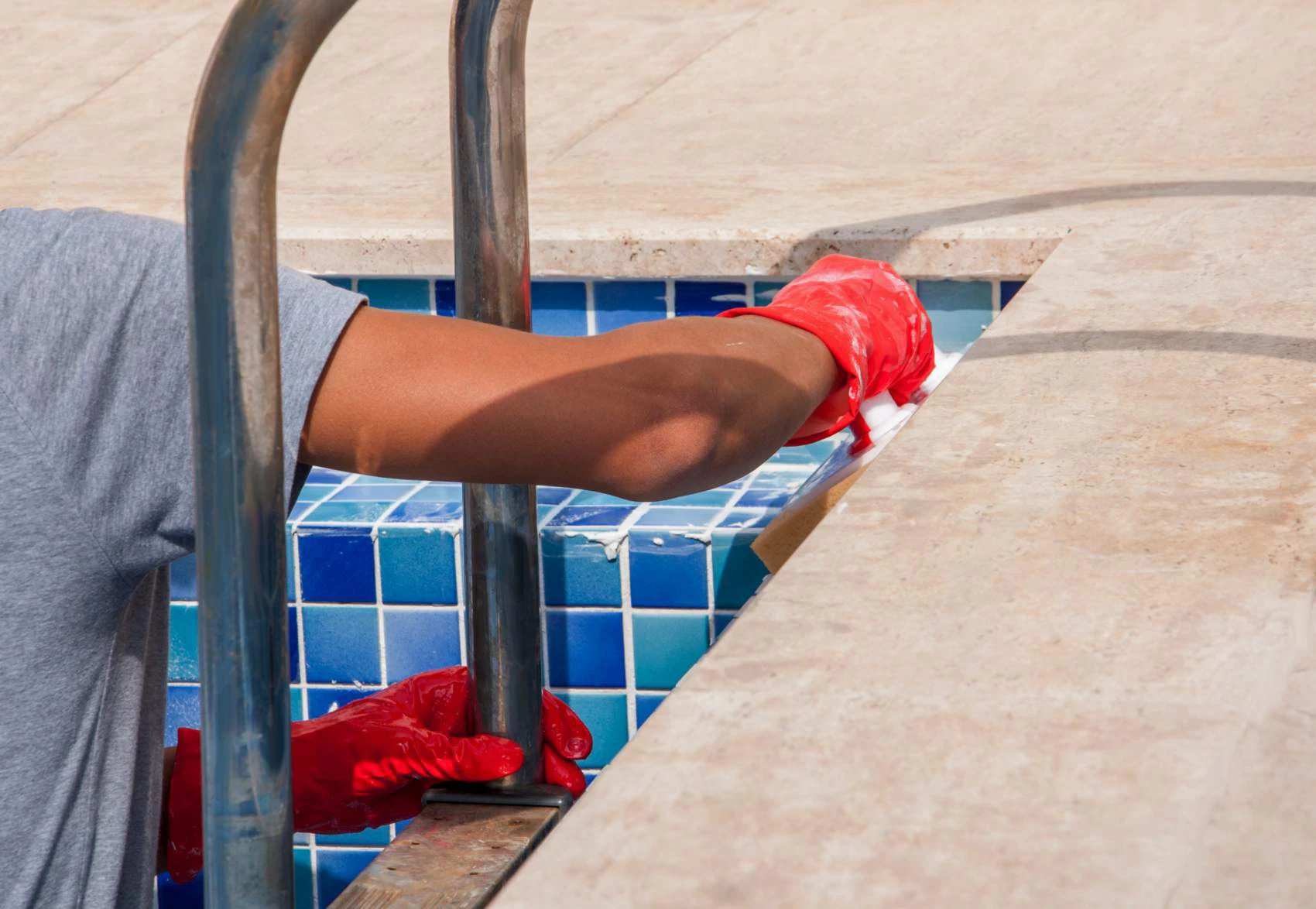
One Clarkston-specific wrinkle before we start testing: DeKalb water runs harder than Gwinnett’s, around 110–140 ppm calcium carbonate versus roughly 80 ppm. That hardness leaves a white scale band on the waterline tile that makes it hard to tell where the water was last week. Clean the tile line before you measure.
Step One: The Bucket Test — Ruling Out Evaporation
The bucket test is free, takes 24 hours, and answers the first question — is this more than evaporation? — with numbers instead of opinions. Done right, it also tells you which side of the plumbing to suspect.
How to Run It
- Fill the pool to its normal operating level, middle of the skimmer opening.
- Set a 5-gallon bucket on the first or second step, weighted with a brick.
- Fill the bucket with pool water to match the pool level outside.
- Mark both levels — inside the bucket and on its outside wall.
- Shut off the autofill. A running autofill makes the test worthless.
- Run the pump on its normal schedule for 24 hours. No swimming, backwashing, or adding water.
How to Read It
The bucket loses water only to evaporation. The pool loses water to evaporation plus anything else.
- Both drops match: evaporation. Suspects 2 and 3 are ruled out for now — go check the autofill.
- The pool out-dropped the bucket by more than 1/8 inch: you have a leak. Keep going.
Now repeat the test for 24 hours with the pump off. This split saves money on diagnostics:
- More loss with the pump running: pressure side — return lines, filter, heater, or multiport valve.
- More loss with the pump off: suction side — skimmer or main drain line. Running, the vacuum pulls air in through the break; off, water drains out.
- Same either way: probably the shell — a crack, fitting, light niche, or tile line. Go to the dye test.
What an inch actually costs: on a 16×32 pool — a common size in Lake Capri and other 1960s Clarkston subdivisions — one inch of water is about 320 gallons. A leak losing an inch a day is close to 10,000 gallons a month, on top of the chemicals you pour in to treat all that new water.
If the pool out-drops the bucket by only a hair, run the test a second time on a different day. A windy afternoon, a heavy swim day, or a spring shower that tops up the pool and the bucket unevenly can skew a single result. Two matching tests are evidence. One is a hint.
While the test runs, walk to the equipment pad — the cheapest leaks live there. The tell-tale case: water flowing out of the backwash line while the multiport valve sits on “Filter.” The spider gasket is worn, and the pool drains to the yard every time the pump runs. On older pads sitting on bare dirt, that loss soaks in and never shows as a puddle.
Step Two: The Dye Test — Finding Where the Water Leaves
If the bucket test says leak and the pattern points to the shell, the dye test finds the exit.
First, Let the Pool Tell You the Height
With the autofill off, let the level fall and note where it stops. It’s the most useful free clue in leak detection:
- Bottom of the skimmer opening: the skimmer throat, body, or skimmer-to-shell joint.
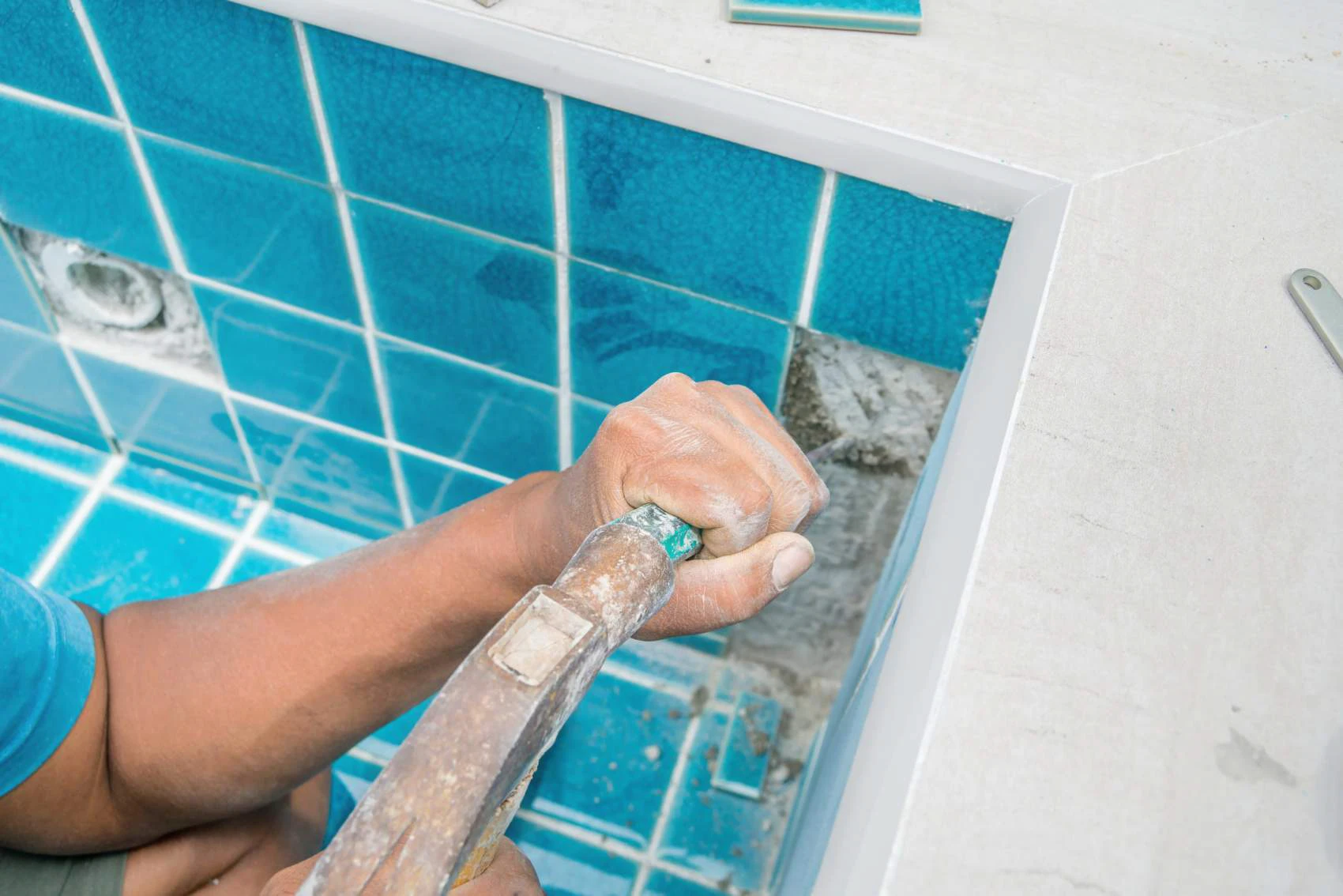
- At or just below the tile line: behind the tile, where freeze-thaw has cracked the thinset.
- At the pool light: the light niche, usually through its conduit.
- Doesn’t stop: main drain, floor crack, or buried pipe. That’s a job for pressure testing.
How to Run the Dye Test
Turn the pump off and wait 15 minutes for still water. With goggles and a syringe of leak-detection dye, squeeze a small puff an inch from each suspect spot. If the dye hangs and spreads, no leak. If it gets pulled into a gap and disappears, you’ve found an exit.
Order: skimmer throat and seam, return fittings, light niche, step corners, visible cracks, tile line, main drain cover. If the level stopped at a specific height, start there.
What a Positive Dye Test Rules Out
A positive result doesn’t prove it’s the only leak. On a 45-year-old pool, we’ve found a pulled skimmer and a failing return line on the same job. After the repair, rerun the bucket test. If the pool still out-drops the bucket, move to pressure testing.
Many Clarkston backyards carry 4 to 10 feet of grade change, and older pools were cut into the slope. Settlement cracks and skimmer separation show up first on the downhill wall, where the backfill moved. Dye-test that wall first.
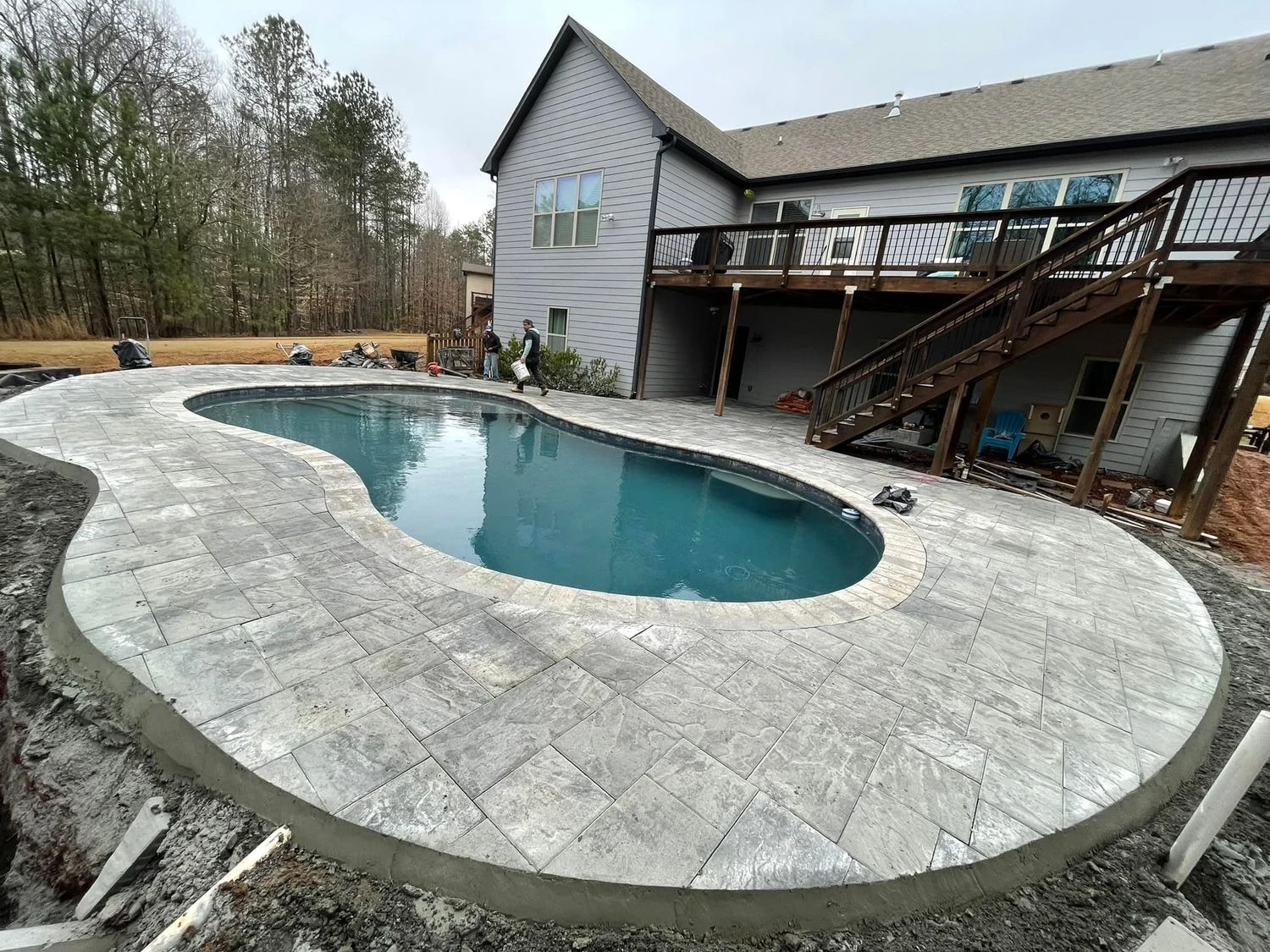
Step Three: Pressure Testing the Lines Under a 40-Year-Old Deck
When the bucket test points to plumbing and every fitting dyes clean, the leak is underground. DIY ends here — and a good contractor earns the fee by not tearing up your deck to go looking.
How a Pressure Test Works
Each line is plugged at the pool and fitted with a gauge at the equipment pad, then pressurized, typically to about 20 psi and held for 15 minutes. A line that holds is sound. A line that bleeds down has a break between the plugs. Skimmer, main drain, and each return loop are tested separately, so the result names the exact pipe.
Finding the Break Without Demolition
Next, acoustic listening equipment picks up the hiss of pressurized air escaping underground, through concrete or pavers, to mark a spot within a foot or two. One small patch, not the whole deck.
Clarkston makes this harder. Original copper lines fail by pinhole corrosion — quieter than a clean PVC crack. Cecil-series clay muffles sound, and near the Stone Mountain pluton, decomposed granite at 4 to 8 feet down carries it differently. A good tech listens along the whole run.
Don’t drain the pool to “find the leak”: Clarkston groundwater peaks in spring, with 52 inches of rain a year keeping the clay saturated. An empty gunite shell can float or crack from hydrostatic pressure. Test with the pool full.
Why These Leaks Surface in April
A joint weeping in October gets opened further by January’s freeze-thaw movement. When the pump starts long spring cycles, pressure finally pushes enough water through to show at the waterline. The leak didn’t start in spring — it just got big enough to notice.
If a failed line is 50-year-old copper, replace the whole run; one pinhole means more are coming. If it’s an old single main drain, that’s the time to talk about a VGB-compliant drain cover — or abandoning the line if the pool circulates well without it.
The Autofill: The Suspect That Hides Its Own Evidence
The autofill sits last on the diagnostic path, but it can confuse every other test. It fails three ways.
Failure Mode 1: It Masks a Real Leak
A healthy float valve, like a Jandy Levolor, adds water when the level drops. When the pool is leaking, the level never moves — the only symptom is the water bill. If your DeKalb bill jumped year over year and the pool is the only new variable, shut the autofill off and run the bucket test.
Failure Mode 2: It Sticks Open
DeKalb’s harder water builds scale on the valve seat. When it can’t close, the pool overfills and spills out the overflow. Easy to spot: the level is above normal.
Failure Mode 3: The Supply Line Leaks
The buried, pressurized fill line leaks around the clock. The pool looks normal, but a patch of lawn stays soft after dry weather.
How to test it: turn off every fixture and close the autofill valve; the meter’s low-flow indicator should sit still. Open the autofill valve with the pool full. If the indicator spins, the leak is in the fill line or valve.
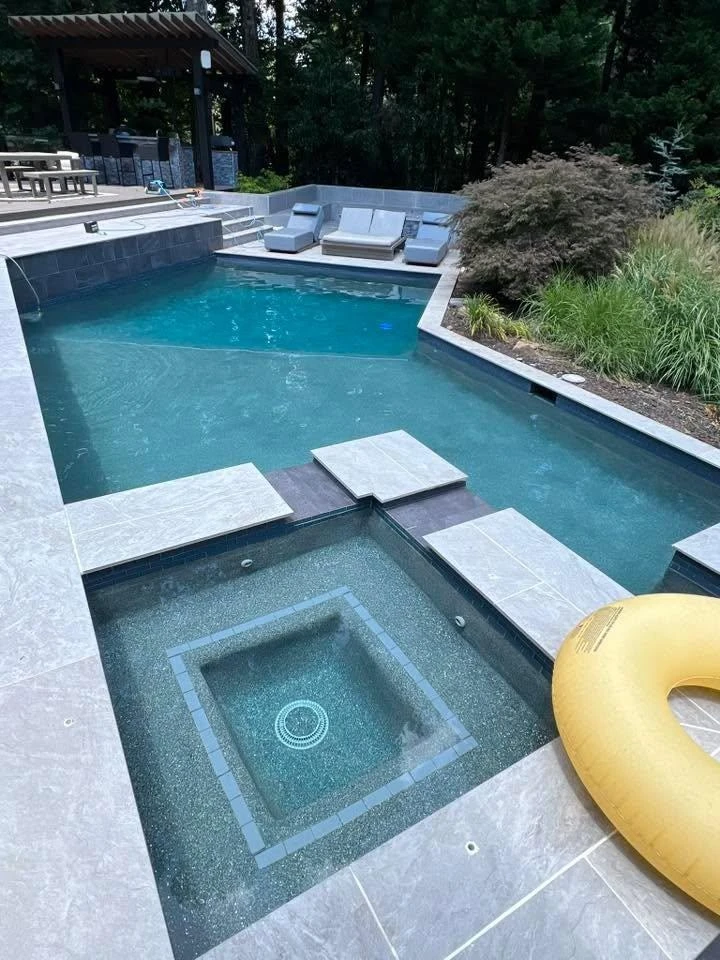
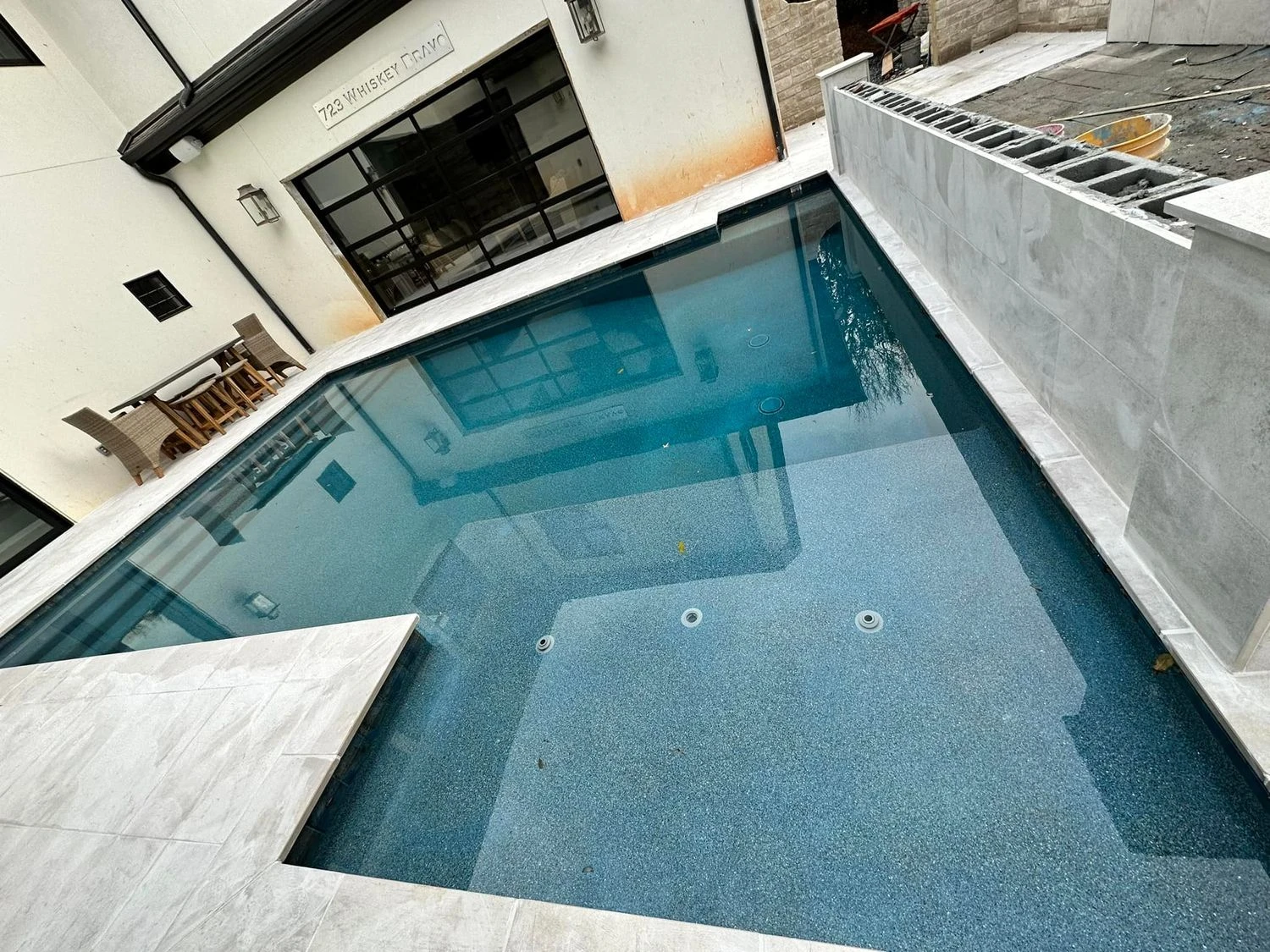
A note on features like the one above. A spa spillover exposes a thin sheet of falling water to the air, and a shallow tanning ledge warms faster than the deep end. Both add evaporation. Run the bucket test with water features on the same schedule you normally use. Otherwise, you’ll compare a quiet test day to a normal operating day and blame a leak for what’s really just the spillover doing its job.
The same logic applies to spas. An attached spa that shares plumbing with the pool adds its own set of lines, valves, and a spillover edge to the suspect list. If the pool loses more water when the spa is in use, test the spa lines on their own before anyone touches the pool plumbing.
What Each Verdict Costs to Fix in Clarkston
Once testing is done, the repair is usually clear. Treat these as planning ranges, not quotes.
Verdict: Evaporation
No repair. Put water features on a timer and use a solar cover — a good one can cut evaporation by more than half.
Verdict: Equipment Pad Leak
The best news you can get. A worn spider gasket, cracked pump lid, or split union is usually a same-day fix. A replacement multiport valve typically runs $250–$600 installed. While we’re there, we check bonding against NEC §680 — many pre-1990 Clarkston pools were never built to it.
Verdict: Skimmer or Tile Line
A skimmer throat crack can often be sealed with underwater epoxy for a few hundred dollars. A skimmer separated from the shell means cutting it out and rebuilding the bond beam and coping around a new one. Tile-line leaks mean resetting tile over freeze-rated, polymer-modified thinset and a waterproofing membrane. With 8 to 14 freezes a year, that spec is the whole repair.
Verdict: Underground Plumbing
Acoustic location keeps it contained: cut a small section, fix the pipe, patch. Failed copper is often better replaced end to end, rerouted to avoid demolition. Pavers lift and reset cleanly; a poured-concrete patch will show.
Verdict: Shell Crack or Structural Failure
Cracks get opened, stapled or injected, and patched. If a 40- or 50-year-old shell shows a larger pattern, a broader plan — and a permit — may follow. Clarkston residential pool permits go through DeKalb County Planning & Sustainability on Sams Street in Decatur, not the city, and take three to four weeks. Plan for that if you want the pool back by Memorial Day.
Our testing order, in one line: clean the tile line → shut off the autofill → bucket test pump-on → bucket test pump-off → note where the level stops → dye test from that height → pressure test each line → acoustic locate → repair → bucket test again to confirm.
That last step matters most. A repair is not finished when the patch cures. It’s finished when the bucket and the pool drop at the same rate for 24 hours. We don’t close a leak job in Clarkston, or anywhere in our service area, until that number matches.
Skipping the order is how homeowners end up paying twice. A contractor who cuts the deck before running a pressure test is guessing with a saw. A contractor who reseals the skimmer and leaves without a follow-up bucket test may have fixed one leak and missed the second. Ask any repair company how they diagnose before you let them quote the fix. The answer tells you most of what you need to know.
If your pool dropped more than a quarter inch a day this spring, don’t wait for summer to make it worse. Run the bucket test this weekend. If the pool out-drops the bucket, bring in someone who tests before they cut.
Pool repairs across 20+ Metro Atlanta cities from our Winder, GA home base
Every leak job we take starts with the bucket, the dye, and the gauge — so the repair targets the one pipe or seam that failed, and your deck stays in one piece.