
The average Clarkston hardscape project we quoted in 2025 came in at $32,400 — but the range was $9,800 to $164,000, and that range is where most homeowners get blindsided. The number on a hardscape bid isn’t a mystery once you understand what’s actually driving it. Five variables decide your price, in this order, every time. Here’s how to walk a project from “I want a patio” to a real number you can defend before you ever sign.
Vague pricing is how bad hardscape projects happen. A homeowner gets three bids — $14,000, $27,000, $41,000 — and assumes the middle one is honest. It might be. Or it might be the same as the cheap one with a bigger margin. Or it might be missing the same line items the cheap one is missing. Without a framework for how a hardscape project actually gets priced, you can’t tell the difference between a contractor who’s scoping carefully and one who’s hoping you won’t ask questions.
This framework is the one we use on every Clarkston site walk. Five steps, in order. By the end you’ll have a number that’s accurate within about 12% of the final contract — close enough to budget, negotiate, and recognize a lowball when you see one.
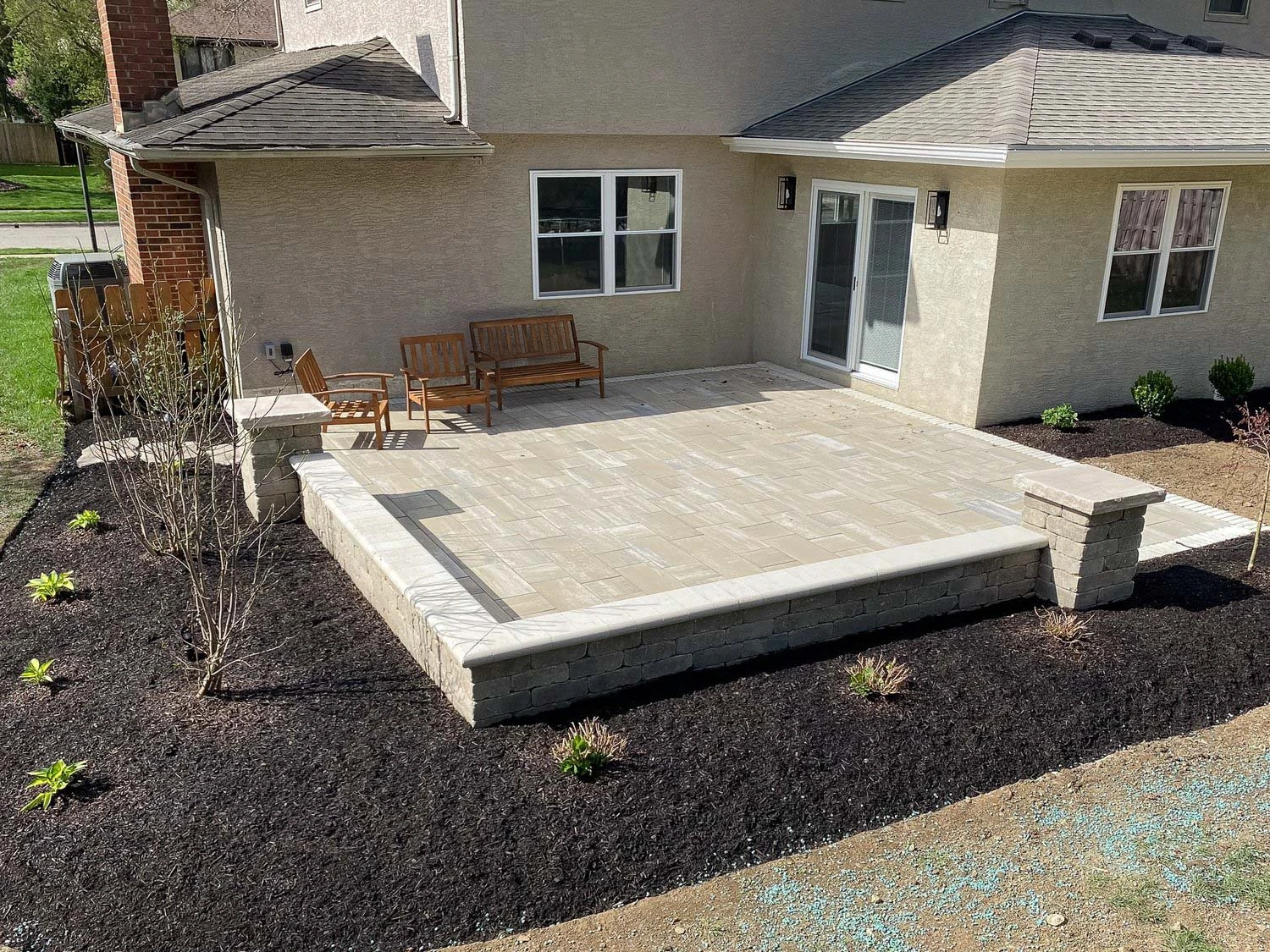
Step 1 — Define Your Square Footage Before Anything Else
Square footage is the single biggest cost driver in any hardscape project, and it’s the variable most homeowners underestimate. A “small patio” sketched on the back of a napkin almost always grows by 30–50% by the time it’s drawn to scale, because the napkin version doesn’t account for furniture clearance, traffic flow, or the relationship between the patio and the door it serves.
Functional minimums we use as a baseline on Clarkston backyards:
- 4-chair bistro setting: 120 sq ft minimum, 160 sq ft comfortable
- 6-seat dining table + chairs pulled out: 220 sq ft minimum, 280 sq ft comfortable
- Outdoor sectional + coffee table: 260 sq ft minimum, 340 sq ft comfortable
- Dining zone + lounge zone separated: 480–620 sq ft
- Full entertaining patio with grill, dining, lounge, fire feature: 720–1,100 sq ft
Clarkston’s typical residential lot runs 0.20 to 0.45 acres, which means the average usable backyard footprint sits between 1,800 and 4,200 sq ft after the house, side setbacks, and required tree-canopy preservation come out. That envelope shapes what’s reasonable. A 280 sq ft patio on a 1990s Brockett lot reads correctly proportioned. A 1,100 sq ft patio on the same lot eats the entire yard.
Measure your intended footprint with a tape and stakes before you call a contractor. The number you walk in with sets the entire conversation. If you don’t know your number, the bid you get will inflate or deflate based on what the contractor thinks you can afford rather than what you actually need.
One nuance specific to Clarkston: the older 1960s-1980s housing stock around Idlewood, Lake Capri, and the Sycamore Drive corridor was built before backyard entertaining was a design priority. Original back doors open onto 8×10 concrete stoops with no relationship to the yard beyond. That means almost every hardscape project here is a true new install rather than a replacement of a like-sized predecessor — and that changes both the scope and the permit conversation. New impervious surface over 500 sq ft triggers a DeKalb stormwater review on some lots, which is a 1–2 week add to the timeline and a $180–$420 review fee.
Step 2 — Choose Your Material Tier (and What Each Tier Buys You)
Once square footage is locked, the next variable is material — and material is where Clarkston bids spread the most. Three tiers cover roughly 95% of the residential market here. The price-per-square-foot range below is fully installed, including base prep, edge restraint, and joint sand for pavers, or a properly placed broom-finish slab for concrete.
The temptation is to read those numbers and assume Tier 1 is “the budget option.” It’s only the budget option on day one. On day 4,000, a Tier 1 concrete slab on Clarkston’s Cecil clay shrink-swell profile is cracked across at least three control joints and stained from a decade of pollen and oxidation. A Tier 2 paver field at the same address still looks identical to the day it was set, minus a polymeric sand top-up every 6–8 years. The lifetime cost-per-year math almost always favors Tier 2 over Tier 1.
Where Tier 3 earns its premium is on visible front-of-house installs, pool decks where heat-reflectivity and slip-resistance matter, and properties where the home’s finish level genuinely demands it. On a 1965 Idlewood ranch, a $68/sq ft Techo-Bloc patio is overbuilt. On a 2020 infill build in the Brockett corridor, it reads correctly.
One material caveat for Clarkston specifically: stamped and stained decorative concrete still gets quoted occasionally at $18–$28 per sq ft, and on paper it looks like Tier 1.5. In practice it’s the worst-aging hardscape material we work with in DeKalb’s freeze-thaw window. The color coat erodes inside 5–7 years, the sealer needs reapplication every 2 years to prevent UV bleaching, and the underlying slab still cracks on Cecil clay just like a plain broom-finish would. We do not recommend it, and we have never quoted it for a Clarkston project that wasn’t a direct request from the homeowner with full disclosure of how it ages.
Step 3 — Account for Site Conditions Clarkston Specifically Demands
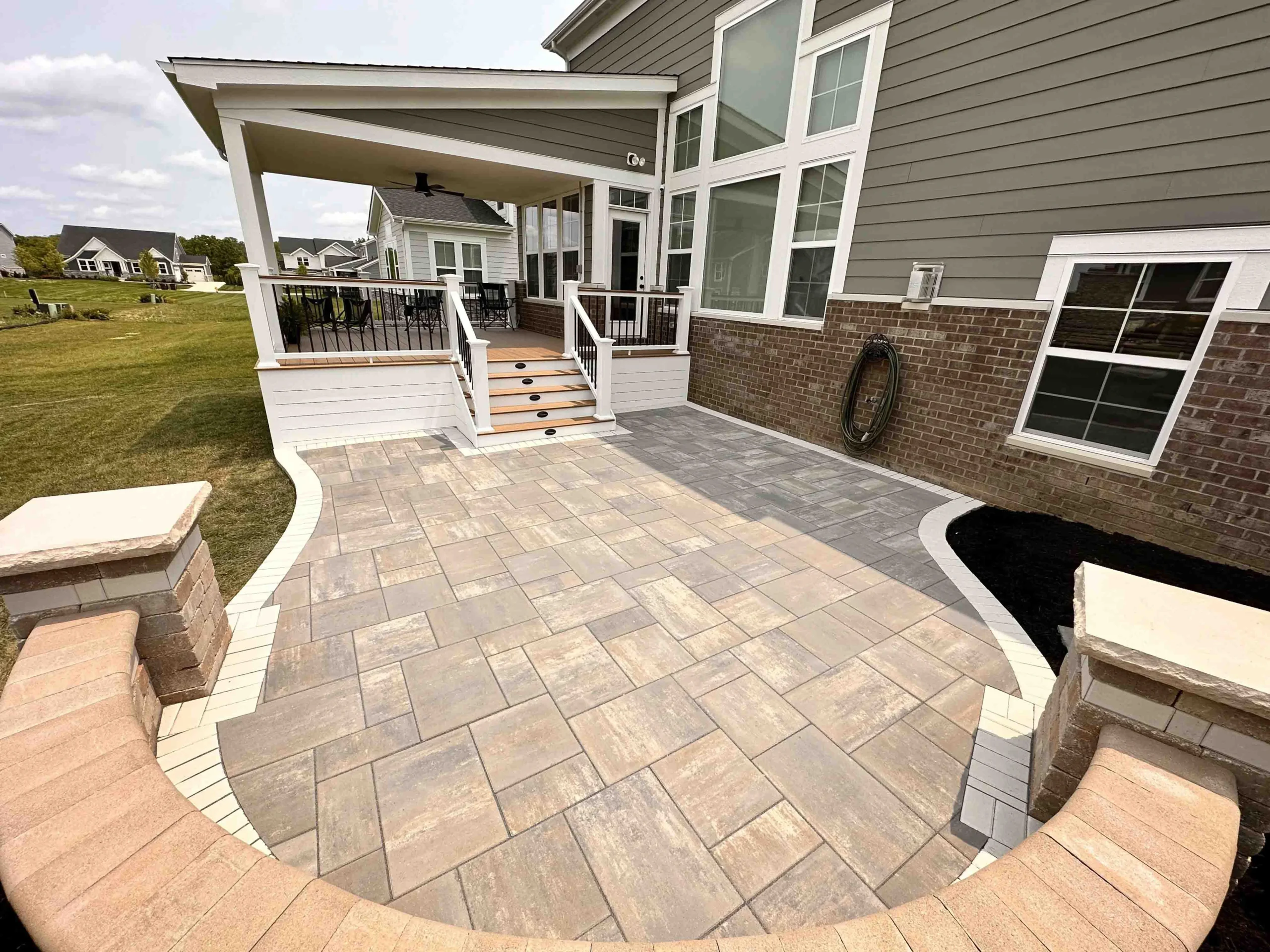
This is the step that separates Atlanta-south markets from DeKalb County, and it’s where lowball bids fall apart. Clarkston sits on Cecil-series Piedmont red clay with documented shrink-swell behavior — the soil expands when wet, contracts when dry, and moves enough every season to telegraph that movement up through anything sitting on top of it. Atlanta-south markets like Newnan or Fayetteville don’t have the same freeze-thaw frequency we get here either: 8–14 freeze events per winter in DeKalb, each one a stress cycle on any improperly-bedded paver field.
What that means in dollars: base depth is not optional, it is not negotiable, and it is the single line item where dishonest contractors cut to win bids.
Lowball-bid warning for Clarkston clay: if a paver bid comes in at $19/sq ft installed, the contractor is almost certainly planning to skimp the base — either a 4-inch compacted base instead of the 8-inch compacted open-graded base Cecil clay requires, or no geotextile separator at all. Both shortcuts produce a patio that looks correct at handoff and starts heaving inside 18 months. The cost of cutting from 8″ to 4″ is roughly $3.50/sq ft. The cost of repairing the resulting failure two years later is the original project price all over again, plus tear-out.
The site conditions that typically add cost on a Clarkston project, in order of frequency:
- Soft or organic-rich subgrade requiring excavation 4–6 inches below the planned base, then backfill with compactable aggregate: adds $4–$8/sq ft
- Grade change requiring fill, cut, or step transitions (common on 1970s-1980s Clarkston lots with 4–10 ft yard drops): adds $6–$14/sq ft on affected areas
- Tree-root navigation — Clarkston’s mature oak/poplar canopy means roots show up in 60%+ of excavations and have to be carefully cut or routed around (adds $800–$3,400 to a project)
- Decomposed granite at depth on lots near the Stone Mountain pluton — when crews hit it at 4–8 ft, hand excavation or air-spade work adds $1,200–$4,800
- Drainage corrections — French drains, surface drains, downspout reroutes, or grading swales that have to be installed before any hardscape can sit (this category alone runs $1,800–$11,000)
Permit add: DeKalb County retains jurisdiction over residential hardscape permits in Clarkston, not the city itself. Their current turnaround is 3–4 weeks versus the 10–14 days you’d get in Gwinnett. Bake that into your schedule and into the holding cost of any deposit you put down.
Soil testing is the other line item homeowners skip and regret. A simple Proctor test on the planned excavation area runs $280–$480 and tells you whether the subgrade will hold a compacted base or whether 4 inches of underlying clay need to come out first. On the projects where we run the test and find soft subgrade, we save the homeowner the $4,800–$11,000 it would have cost to fix a heaved patio in year two. The test pays for itself the first time it catches a problem — and on Clarkston’s older lots, it catches one roughly 35% of the time.
Step 4 — Add the Structural Elements That Change the Math
A flat patio on a flat yard is the simplest hardscape job that exists, and almost nothing in Clarkston is a flat patio on a flat yard. The structural add-ons below are where projects move from $20,000 to $60,000 and where the bid spread between contractors gets widest. Price each one independently.
Retaining walls
Anything over 4 ft in finished height requires an engineered design and permit in DeKalb. Below 4 ft, it’s still a real structural element that needs proper drainage backfill, geogrid reinforcement on long runs, and either a segmental block system (Belgard Celtik, Techo-Bloc Mini-Creta) or natural stone. Installed pricing runs $48–$92 per face-foot for SRW systems and $110–$180 per face-foot for full-bed stone veneer over a CMU core.
Grading and excavation
Beyond the base-prep grading already in the per-sqft number, any project requiring significant cut-and-fill ($/cubic-yard work) lands between $78–$140 per cubic yard moved on-site and up to $240 per cubic yard hauled off. Hauling is where Clarkston gets expensive: there’s no convenient fill dump inside the I-285 perimeter, so excess material rides 18–25 miles to find a legal home.
Drainage systems
French drains: $32–$58 per linear foot installed with sock-wrapped 4″ perforated pipe, washed #57 stone, and geotextile sleeve. Surface channel drains (NDS Spee-D or equivalent): $58–$105 per linear foot. Catch basins: $320–$680 each including tie-in. A typical Clarkston backyard with one drainage problem adds $1,800–$4,400 to the project; a yard with serious water-management issues can add $9,000+.
Steps, stairs, and grade transitions
Hardscape steps in matching paver material run $280–$520 per riser, or $120–$220 per linear foot of tread on simple grade transitions. Natural stone steps (Pennsylvania bluestone slabs) jump to $420–$780 per riser. A 4-step transition between a patio and a lower lawn is a $1,400–$3,200 line item that homeowners routinely forget to budget.
Seating walls and fire features
Freestanding seating walls (typical 18″ finished height, capped): $165–$290 per linear foot. A code-compliant gas fire pit with a propane or natural-gas tie-in, key valve, and ignition system: $4,800–$11,400. A wood-burning fire pit built into a seating wall: $2,400–$4,800.
Step 5 — Build the Final Number: 4 Real Clarkston Scope Examples
Run all four steps together and you get a real-world Clarkston number. Below are four scopes we quoted in the past year, with the math broken out. None are the same project at different sizes — each represents a different combination of square footage, material tier, and site conditions, which is why the per-square-foot equivalents vary so widely.
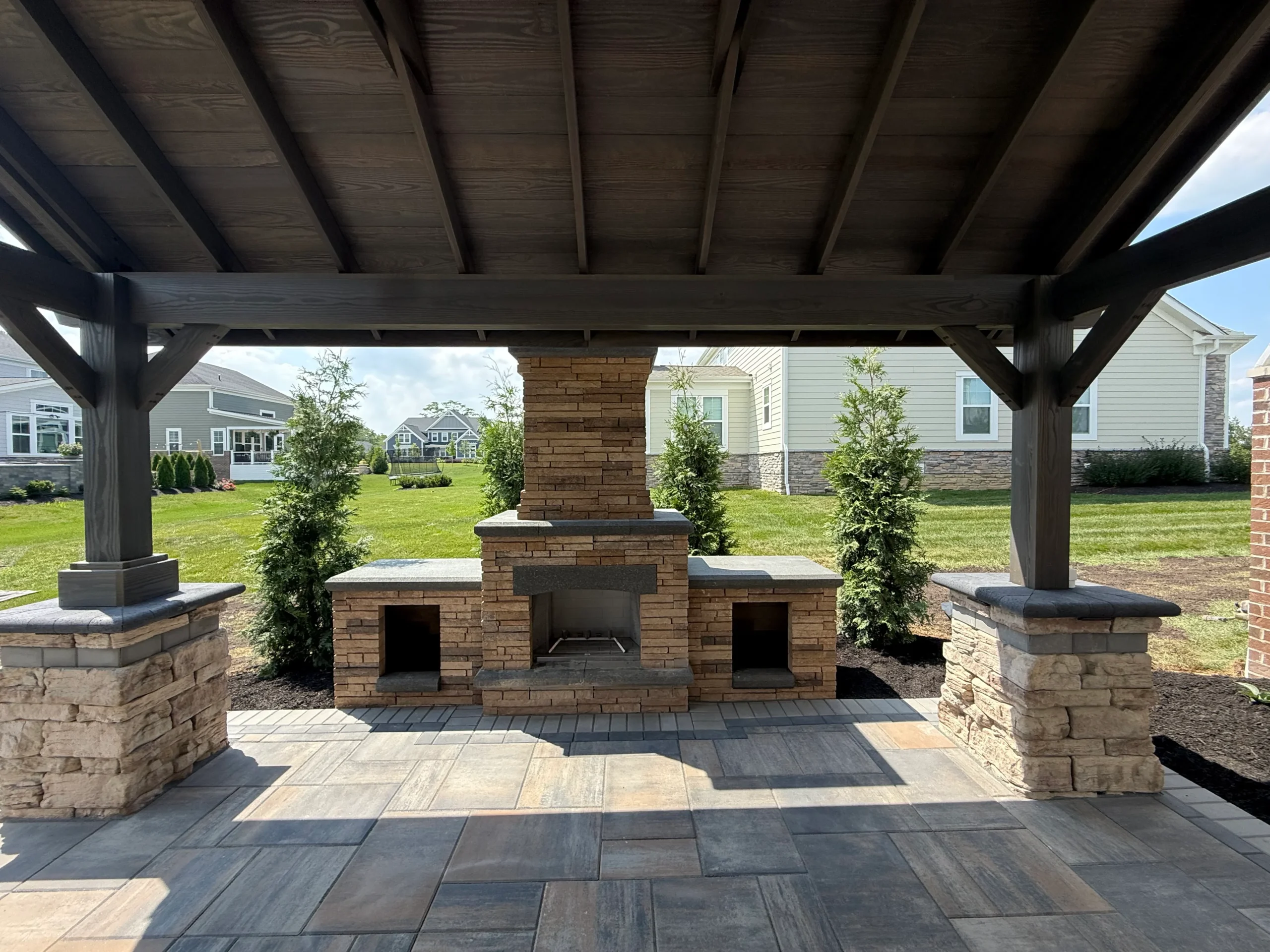
Scope A — Brockett ranch, simple replacement (260 sq ft)
Existing concrete patio cracked across three joints. Homeowner wanted a clean, durable replacement at the back door — no expansion, no add-ons. Tier 2 paver (Pavestone Plaza Stone), full-depth tear-out of existing slab, 6-inch compacted base on the stable subgrade, polymeric joint sand, no grading work required. Final: $9,800 ($37/sq ft equivalent, slightly elevated because the small footprint absorbs fixed mobilization costs).
Scope B — Idlewood 1970s split-level, dining + lounge upgrade (520 sq ft)
Homeowner wanted a dedicated dining zone and a separate lounge area, separated by a low seating wall. Tier 2 paver (Belgard Holland in tumbled earth blend), 8-inch open-graded base, geotextile separator, 38 linear feet of 18″ seating wall capped in matching tumbled units, one minor grade correction (16 cubic yards of cut, retained on-site). DeKalb permit included. Final: $28,400 ($55/sq ft equivalent when seating wall amortized into patio sqft).
Scope C — Sycamore Drive 1980s house, full backyard rebuild (820 sq ft)
Failing concrete patio, no drainage, water pooling against the foundation. Project: full tear-out, French drain along the up-slope side, regraded subgrade with 4 yards of imported structural fill, 8-inch compacted base, Tier 3 paver field (Techo-Bloc Blu 60 in Onyx Black), 62 linear feet of 24″ seating wall, 4 paver steps transitioning down to lower lawn, a 48″ round gas fire pit, gas line tie-in from the existing meter. Final: $61,200 ($74/sq ft on the paver field with all add-ons amortized in).
Scope D — Edinburgh 2020 infill build, full estate-scale outdoor living (1,420 sq ft)
New-construction owner finishing the backyard. Tier 3 mix of Belgard Mega-Arbel in Bella for the main field and 4″ thick travertine on the elevated lounge platform. 156 linear feet of dry-stack stone-veneer retaining wall with engineered drainage backfill (engineered design and DeKalb permit included), 11 cubic yards of haul-off, 4-step grand entry transition, two seating walls (one with integrated bench lighting), full outdoor kitchen counter run (44 linear feet, owner supplying appliances), 280 linear feet of low-voltage path lighting on a separate circuit, and a 7-zone surface drainage system tying into an existing storm tie-in. Final: $164,000. Per-sqft-equivalent breaks down meaningfully only inside each scope component — the wall alone was $26,800, the outdoor kitchen counter run was $19,400, the lighting package was $7,200.
Contract spec to demand on every Clarkston hardscape: the base depth, base material, and joint material all written into the contract by name. The exact language to look for — or to ask for if it’s missing — is: “8-inch compacted open-graded base (ASTM #57 stone), compacted in 2-inch lifts, with non-woven geotextile separator beneath the base layer. Joints to be filled with polymeric sand and activated per manufacturer spec.” If a contractor won’t put that in writing, they’re planning not to do it.
One more pattern worth naming: contractor mobilization costs in DeKalb run higher than they do in the suburbs north and east. Equipment trucking from Winder to Clarkston runs roughly 40 miles depending on the lot, and on smaller projects (under 300 sq ft) that fixed cost gets absorbed into a higher per-sqft number — which is why Scope A above came in at $37/sq ft on a Tier 2 paver when the same material on a larger field reads closer to $28/sq ft. Small projects in Clarkston aren’t cheaper just because they’re small; the math doesn’t scale linearly on either end.
The honest read on hardscape pricing in Clarkston: most projects land between $24,000 and $52,000, the cheap outliers are real but rare (small simple replacements only), and the high outliers are also real but reflect 1,000+ sq ft of premium material plus structural retaining and outdoor-kitchen integration. Anything quoted dramatically below the typical range for your scope is either a different scope than you asked for, or a project that’s going to need to be redone inside 36 months. Pricing transparency up front is how good projects get built. Vague pricing is how bad ones happen.
Hardscape design and construction across 20+ cities within 30 miles of Winder, GA
Every Clarkston hardscape bid we write itemizes base depth, drainage, grading, and material spec by name — so you know exactly what you’re paying for, and exactly where a competing bid is cutting to undercut us.