
A Country Club of the South homeowner hired us last spring after two contractors had already bounced their ARB submittal — once for an equipment enclosure that showed from the neighbor’s second-floor guest room, and once for a coping color the ARB flagged as “reading too cool against the existing travertine pool deck.” We pulled the package together in nine working days, submitted the morning after the April board meeting, and cleared the review in a single pass. This is a walk-through of what made that package different.
Two Alpharetta neighborhoods run the strictest residential pool reviews in North Fulton: Windward and Country Club of the South. Both boards meet roughly every two weeks. Both will cheerfully hold a project in limbo for 6 to 10 weeks if the submittal comes in thin. And both — in our tracked data across 40+ submittals — kick back roughly 45% of first-pass packages, almost always over three specific issues: color palette, equipment visibility, or setback interpretation.
We’ve been doing custom pool construction across Alpharetta long enough to have the template for each board memorized. This post is the Alpharetta-specific field guide we give clients before a single shovel hits the Cecil red clay. If you’re building in 30004, 30005, 30009, or 30022 and your subdivision has an Architectural Review Board, read this before you sign a design contract with anyone.
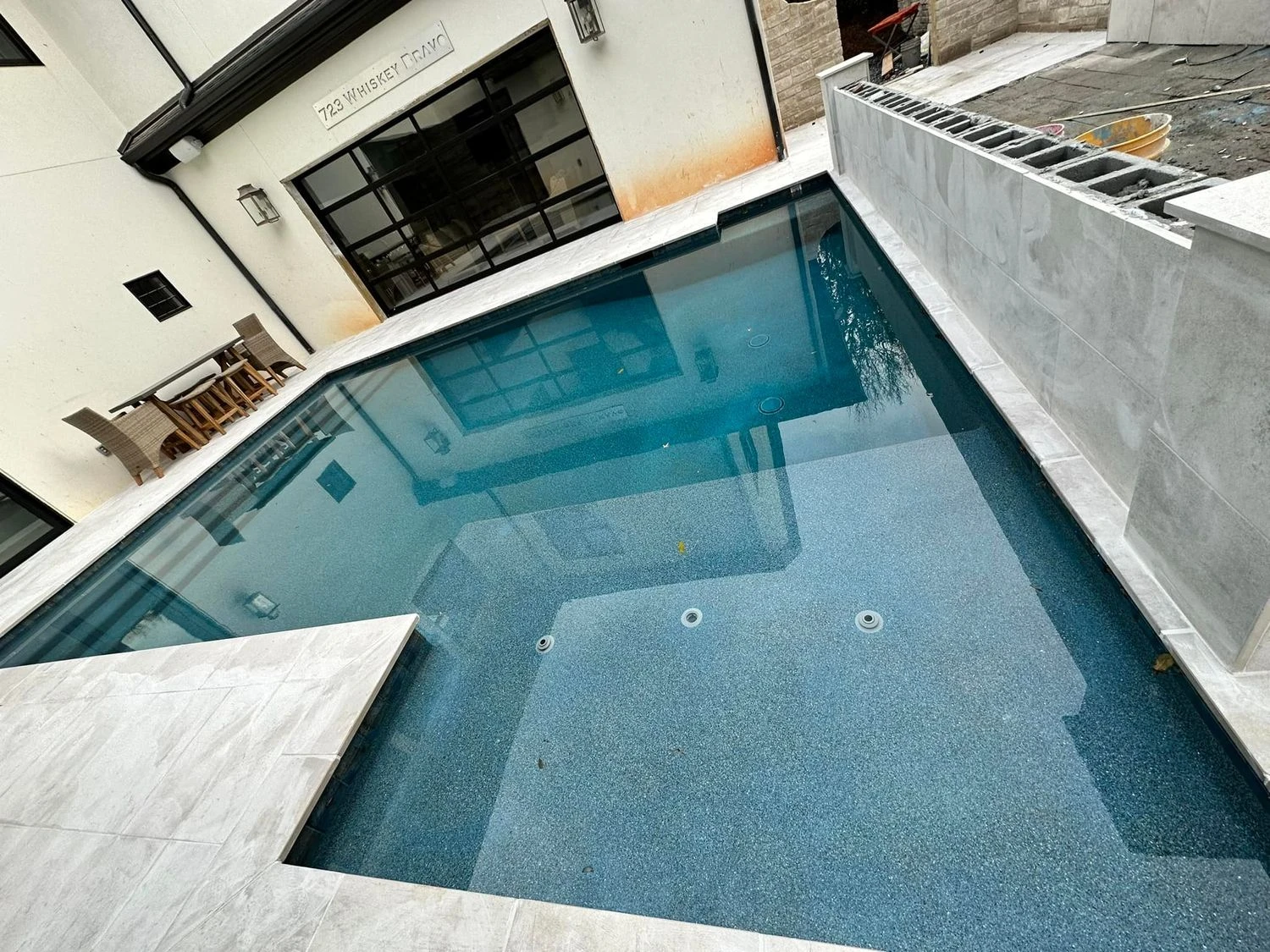
1. The Two ARBs Run Different Playbooks — Know Which One You’re In
Homeowners in Windward and Country Club of the South sometimes lump the two boards together because they’re both gated, both affluent, both North Fulton. They are not the same review. Windward is primarily document-driven. CCOS is primarily rendering-driven. If you walk into the wrong board with the wrong package type, you will be sent home.
Windward’s Architectural Review Committee wants a site plan at 1″ = 20′, 2D elevations of every vertical structure visible from any adjacent lot, physical material samples (not photos), and a fence/gate detail that proves your color selection matches the covenant’s approved browns and greens. Black metal fencing? Allowed in limited conditions. Vinyl? Not a chance. The Windward covenant is old enough that it still enumerates approved paint colors by Sherwin-Williams number for wood structures.
Country Club of the South runs a heavier package. The ARB there expects a 3D rendering of the finished scene from at least two neighbor-side perspectives, a plant palette that includes a minimum of five native species tying the new installation into the existing landscape, a physical stone sample board (not digital), an equipment enclosure elevation with exact screening dimensions, and — the detail that catches most contractors flat-footed — a photometric lighting plan showing lumens, fixture type, beam angle, and shielding at the lot lines.
If your contractor has never built in CCOS before, ask how they handle photometrics. “We’ll put landscape lights around the pool” is not an answer. The correct answer names the fixture manufacturer, the wattage, the shielding type, and the foot-candle reading at the property line.
Windward vs Country Club of the South — package difference at a glance: Windward wants documentation. CCOS wants visualization. Windward will accept 2D elevations with well-drawn material callouts. CCOS wants the board to see exactly what they’ll see from the neighbor’s master bedroom window. Build your package to the board, not to a generic “pool ARB submittal” template.
2. The 3-4 Week Review Calendar — Miss It and You Lose a Month
Both boards meet on a two-week cycle, and both publish their meeting calendars to homeowners via the community management office. Windward’s ARC currently meets on the 2nd and 4th Tuesday of each month. Country Club of the South’s ARB meets on alternating Thursdays. Submittals are due the Friday before the meeting.
The subtle trap: a “3-4 week review” doesn’t mean you submit and hear back in 3-4 weeks. It means your package sits for up to two weeks waiting for the next board meeting, then the board takes roughly 10-14 business days to issue a formal approval letter. If you miss the Friday cutoff by a single day, your project just picked up another full cycle. We’ve seen homeowners lose an entire build season because their designer submitted on a Monday instead of a Friday.
Our protocol at Primetime Pools is simple. We submit the morning after the HOA’s monthly board meeting — not the ARB meeting, the general board meeting — because that’s when we can be certain the community manager’s inbox is cleared of general-business emails and our package will be logged as the next-in-line item. If we’re submitting to CCOS, we hand-deliver the physical sample board the same morning the digital package arrives. The community manager will remember the contractor who walked in with a stone board under their arm. That matters when your package is borderline.
3. The Three Reasons First-Pass Packages Get Kicked — And How to Pre-Empt Each
Across the 40-some ARB submittals we’ve tracked in Alpharetta over the last six years, first-pass rejections cluster into three buckets. Every homeowner who asks us “why did the board say no?” is being told one of these three things in more polite language.
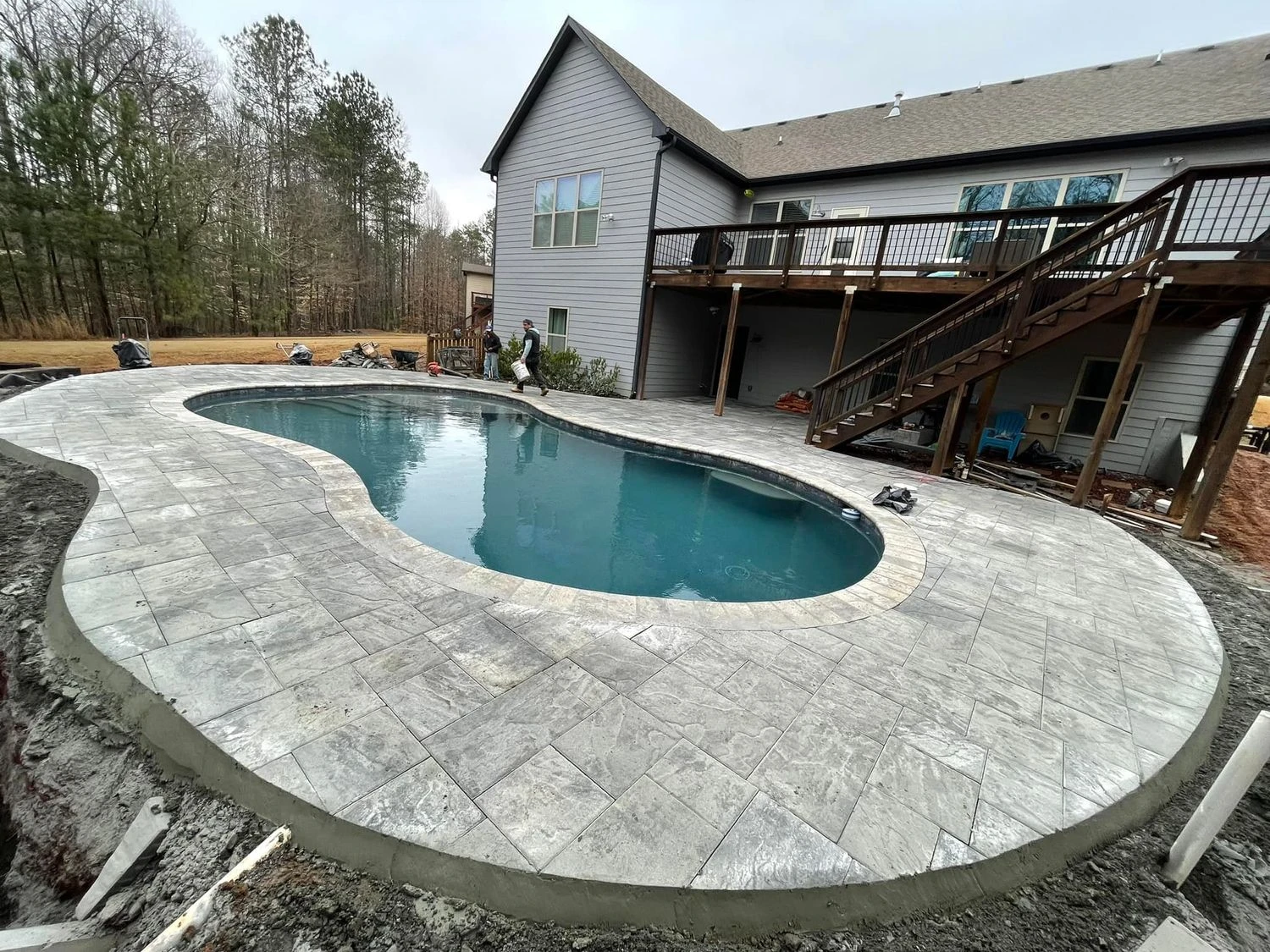
Rejection #1: Color palette drift. Windward’s covenant specifies approved hardscape colors in warm neutrals — creams, tans, soft browns, occasional warm grays. A homeowner who falls in love with a cool-toned French gray travertine from their Cumming design center visit will get flagged. The ARB reads cool gray as “commercial” or “too contemporary” and the package gets sent back for a revised material schedule. CCOS is more forgiving on cool tones but still expects the new palette to read as harmonious with the existing home’s masonry.
The fix: we pull the three dominant exterior colors off the existing house — the roof, the trim, and the primary cladding — and build the pool palette inside a ±2-step range of those tones on the Benjamin Moore Historical Collection. Not because the ARB demands Benjamin Moore, but because the Historical Collection gives you a known reference the board recognizes. It’s how we explain color without arguing color.
Rejection #2: Equipment visibility. The pool pad — pumps, heater, filter, automation panel, gas manifold — is the single item most contractors underestimate. In tight CCOS lots where houses sit 25-35 feet off the side property line, the pool pad must be screened from the neighboring house, not just from the street. We’ve seen packages rejected because the ARB member who walked the lot noticed the heater’s exhaust would vent into the neighbor’s screened porch.
The fix: we draw the pool pad in section, not just plan view, and we include a photograph of a similar enclosure we’ve built in the neighborhood. The ARB is trying to imagine what it’ll look like. Give them the image. Never ask a board to imagine something abstract and then expect them to approve it.
Rejection #3: Setback interpretation. Alpharetta’s pool setback ordinance is 10 feet from any rear or side property line for the pool structure itself, but the covenant in both Windward and CCOS is stricter — typically 15 feet for pool water and 20 feet for any vertical structure like a raised spa wall or equipment enclosure. Contractors who work mostly in unincorporated Fulton County sometimes apply the county number and miss the covenant overlay.
The fix: we submit a site plan showing all three setback lines — city code (10′), covenant water (15′), covenant vertical structure (20′) — and we label each one by source. When the board sees you’ve already read their covenant, they stop reading your package adversarially.
4. The Windward Package — Line-by-Line
Here’s the exact assembly order we use for a Windward submittal, refined over the last decade. Every item has a purpose; none are padding.
Cover sheet. Homeowner name, lot number, street address, project summary in three sentences, contractor contact, date of submission. Single page. The community manager staples this to the top.
Site plan at 1″ = 20′. North arrow, property lines with setback overlays, existing structures, proposed pool and hardscape footprint, equipment location, proposed fence route with gate locations, drainage arrows showing positive flow away from all foundations and lot lines. We typically deliver this as a 24″×36″ sheet plus a letter-size reduction for the board packet.
2D elevations. Every vertical structure — pool coping line, any raised wall, the spa if applicable, the fence, the gate, the equipment screening. Drawn from the neighbor-side view, not the street view. Windward’s committee specifically asks for the neighbor perspective.
Material schedule. A one-page sheet listing every visible material: deck, coping, pool interior, fence, screening material, planting. Each line carries a manufacturer, a product name, and a color. Example: “Deck: Techo-Bloc Blu Grande, Greyed Nickel color, 6×9 format.”
Physical samples. Stone/paver samples mounted on a 16×20 foam board with labels that match the material schedule. Windward will not accept a photo of a sample. It must be the physical product.
Fence and gate detail. Drawn at 1/2″ = 1′-0″ scale, showing post dimensions, picket spacing, cap detail, color swatch. The covenant lists approved pole and picket colors — we include the covenant page number as a reference citation on the drawing.
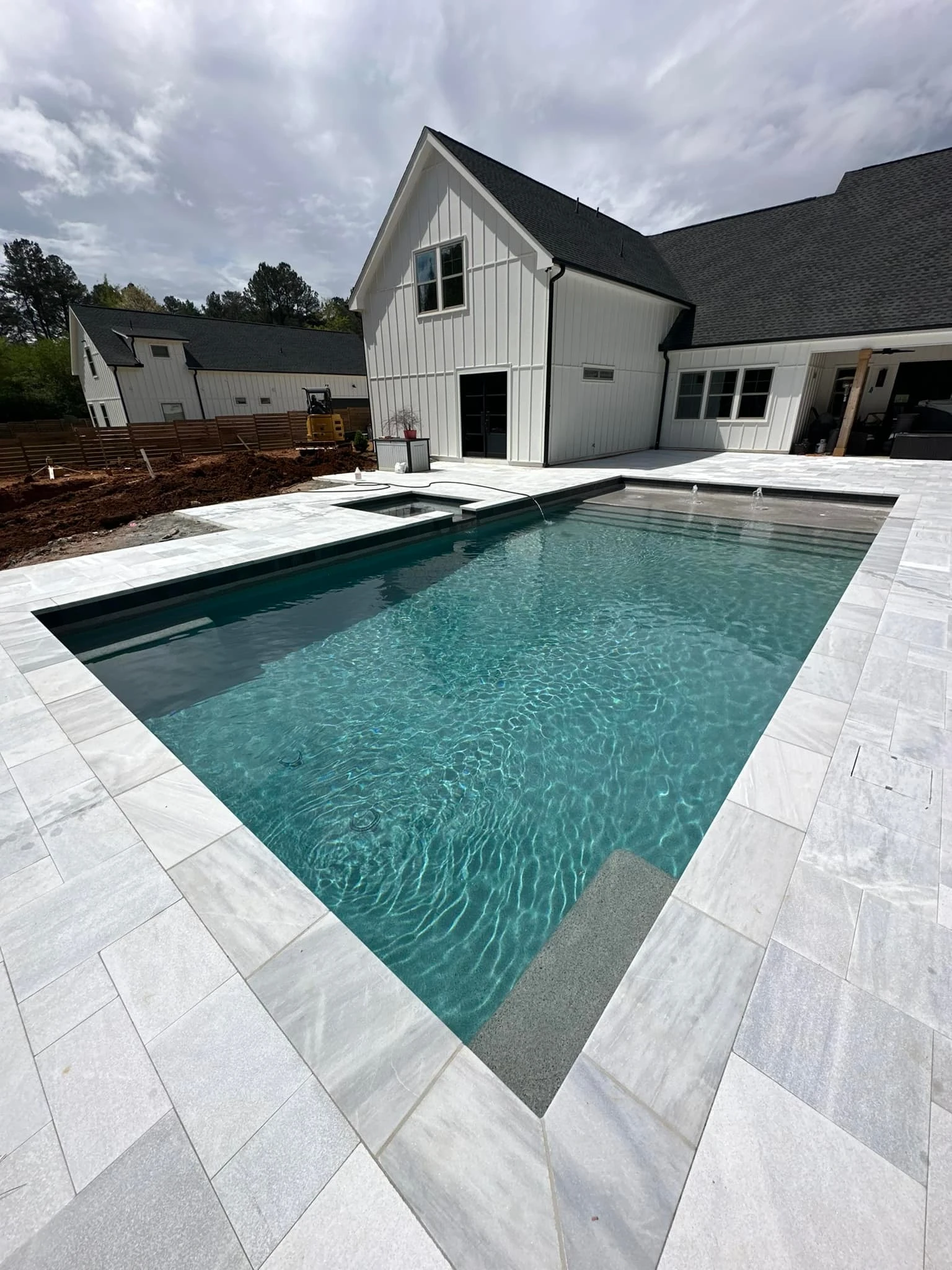
5. The Country Club of the South Package — Where the Work Doubles
CCOS adds four major elements on top of everything Windward requires. Budget for 40 to 60 additional design hours versus a typical Windward submittal. This is not a place to cheap out on design — a $2,500 savings on rendering work will cost you a $40,000 build-season delay if the package is rejected.
3D rendering from at least two perspectives. One rendering from the front neighbor’s yard looking in. One from the rear neighbor if there is one, or from the golf course if the lot backs to the course. The ARB wants to see the project in context, not isolated on a white background. We use SketchUp with V-Ray at roughly 2,000 pixel resolution — enough to read clearly when printed on 11×17 but not so heavy that the community manager’s email rejects it.
Plant palette with five native species minimum. CCOS’s ARB is increasingly focused on supporting native pollinators and reducing turf water consumption. Native species that survive Alpharetta’s Zone 8a summers and the ~20 annual freeze events include Itea virginica (sweetspire), Hydrangea quercifolia (oakleaf hydrangea), Muhlenbergia capillaris (pink muhly), Ilex vomitoria (yaupon holly), and Clethra alnifolia (summersweet). We list botanical name, common name, mature size, and placement on the site plan.
Equipment enclosure elevation with exact screening dimensions. For CCOS, we draw the enclosure in plan, section, and 3D. The section view specifically shows the top of the tallest piece of equipment (usually the heater flue) relative to the top of the enclosure screening. The board wants to confirm nothing peeks over the screening line from any angle.
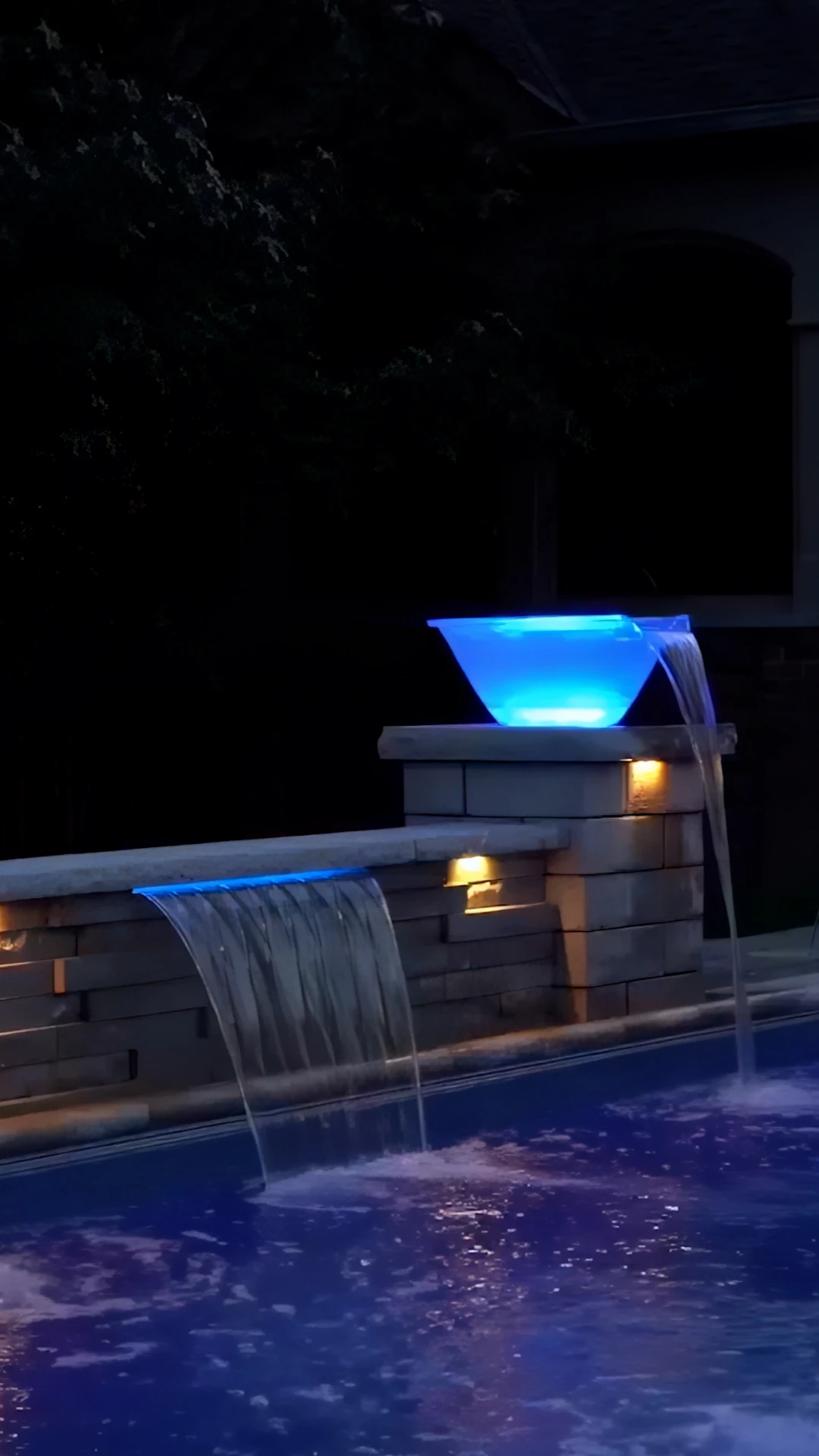
Photometric lighting plan. Fixture schedule with manufacturer, model number, lumens, color temperature, and beam angle. Plan-view showing fixture locations, and a foot-candle overlay at the property line demonstrating spill-over stays under the covenant’s threshold (typically 0.1 foot-candles at the lot line, though some CCOS sub-areas are stricter). We pull photometric data directly from the manufacturer IES files and drop them into AGi32.
Plant palette spec sheet — native core for Alpharetta pool surrounds:
Itea virginica ‘Henry’s Garnet’ (sweetspire) · Hydrangea quercifolia (oakleaf hydrangea) · Muhlenbergia capillaris (pink muhly grass) · Ilex vomitoria ‘Schillings’ (dwarf yaupon holly) · Clethra alnifolia ‘Ruby Spice’ (summersweet). All five survive Zone 8a, handle the Cecil clay topography of the GA-400 corridor, and are accepted by every North Fulton ARB we’ve submitted to.
6. Timing the Submission — The Morning-After-Board-Meeting Rule
The last factor separating successful packages from rejected ones isn’t technical. It’s timing. We submit the morning after the HOA’s monthly board meeting — not the ARB meeting, the general board meeting. Here’s why that works.
The community manager runs both boards’ administrative work. The morning after a general board meeting is the one time each month when their inbox is mostly empty of homeowner complaints, vendor invoices, and landscape committee forwards. A package that arrives at 8:15 AM on that day is logged into the ARB queue before anything else. A package that arrives three days later is behind 14 other items and won’t hit the next ARB agenda — it gets bumped to the meeting after that.
We also hand-deliver the physical sample board the same morning. The walk-in creates a memory for the community manager, and the board members later ask them, “What’s the story on the Lot 42 pool submittal?” — and because the manager physically handled the sample board, they have a story to tell.
Alpharetta’s in-city permitting (via the Community Development office at 2 Park Plaza) runs on a different calendar than the covenant ARB, and in-city runs faster than Fulton County unincorporated. We typically submit the city building permit two weeks after we submit the ARB package. If the ARB comes back with requested revisions, we revise both the board package and the city submittal before the city’s plan review even picks the project up. This lets us avoid the double-revision trap where a contractor alters the plan for the ARB and forgets to update the city drawings.
One more timing detail specific to Alpharetta: Georgia Power service drop coordination. Most of Alpharetta sits inside Georgia Power territory, but a narrow band along the northern border — the Alpharetta/Milton line near Hopewell — falls into Sawnee EMC‘s footprint. Each utility runs a different inspection calendar. Georgia Power currently averages 10-14 business days for a new service drop; Sawnee EMC averages 18-22. If your project lands on the Sawnee side and nobody catches it early, you’ve just added 3 weeks to your schedule. We verify utility territory on every site walk before the contract is even signed.
One last note on where Alpharetta is different. The tech-corridor relocation wave — Microsoft’s new campus, CDW’s regional footprint, and the broader GA-400 corporate HQ cluster — has pushed custom-pool demand in Alpharetta to levels we haven’t seen before. Buyers relocating from Seattle, Boston, and Chicago arrive with budgets, timelines, and a total unfamiliarity with the Piedmont Cecil red clay soils and the ARB culture. We spend the first meeting with every relocation client walking them through what a submittal actually entails before we ever price a pool. The Avalon luxury townhome pocket has also created a dense cluster of custom-pool demand on small, constrained lots — most of which sit inside a cottage-court HOA with its own miniature ARB requirements that mirror CCOS at a smaller scale.

The homeowners we help are rarely surprised by the pool construction. They’re surprised by how much is decided before construction begins. If the package is complete, the ARB meeting is 20 minutes long and the approval arrives the following Tuesday. If the package is thin, you’ll sit through 10 weeks of back-and-forth, and the board’s memory of you will shape every future submission you make in that neighborhood. Build the package like it matters — because in Windward and Country Club of the South, it’s the single most important document in the entire project.
Custom Pool Construction across 20+ cities within 30 miles of Winder, GA
Every Alpharetta pool we build clears its ARB package on the first pass because the package is purpose-built for Windward, Country Club of the South, or the in-city Community Development review — not a generic template reused from another city.