
Which retaining wall material actually belongs on a 1,270-ft elevation lot in Dawson County? The short answer depends on three things a Dacula estimator would never think to ask: how much saprolite the excavator hits at four feet, how the water actually moves down the slope, and whether the homeowner wants the wall to look like it came with the mountain or came off a truck from GA-400.
We get this question almost every week on lots in Foxcreek, Riverbend, and Chestatee. A homeowner has a grade problem — a pool shelf sliding toward the woods, a driveway pinching into the hillside, a back patio that drops off eight feet to a septic field — and they’ve gotten bids for three wildly different walls. A boulder wall at $80 to $140 per square foot of face. A segmental block wall at $32 to $48. And a poured concrete wall somewhere in the middle at $42 to $68. All three estimators call themselves experts. All three quotes are roughly defensible. And none of them explain why the number is what it is on this specific lot.
That’s what this post is. Not a generic material overview — a Dawsonville-specific decision framework built around the one thing that actually differs from Gwinnett County work: the ground under your feet is weathered granite and saprolite, not Piedmont red clay. That single fact changes the drainage math, the anchor depth, the aesthetic options, and the budget on every wall we build north of Cumming.
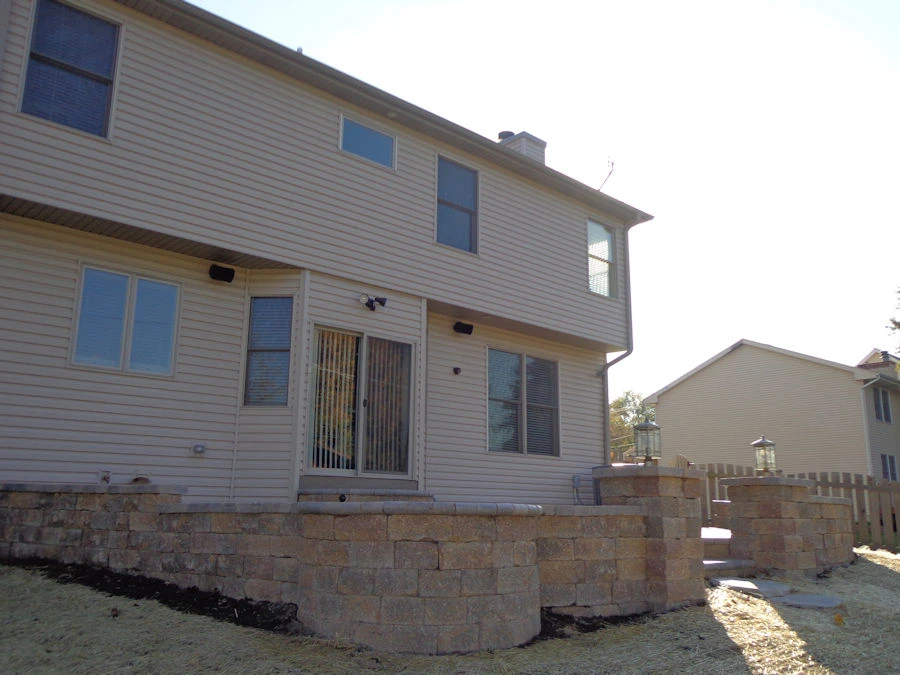
Why Dawsonville Changes the Wall Math — Saprolite, Rock, and 30 Freeze Events
Before anyone picks a material, we have to talk about what’s actually below the lawn. Dawsonville sits in the North Georgia foothills at roughly 1,270 feet — the highest-elevation city in our service area. That altitude, plus the transition zone between the Piedmont plateau and the Blue Ridge escarpment, gives us a soil profile that almost no Atlanta-metro contractor is trained to handle correctly.
At typical excavation depth — two to six feet — we aren’t cutting into the sticky red Cecil-series clay that defines work in Dacula or Snellville. We’re cutting into stony residuum: thinner topsoil over weathered granite, saprolite pockets that crumble in your hand but sit on solid rock a foot below, and occasional parent-rock ledges that stop an excavator dead. On a Dawson County pool or retaining wall dig, we plan for blast charges at roughly $8 to $14 per cubic yard premium above standard excavation. That’s not a scare tactic — it’s a real line item on real invoices.
That geology cuts two ways for retaining walls. The good news: bearing capacity on weathered granite is excellent. A properly footed wall isn’t going to settle the way it does on some of the softer alluvial bottoms near the Etowah. The bad news: drainage isn’t the uniform sheet flow you see on a clay lot. Water moves along rock seams, pools behind surprise ledges, and exits the slope in concentrated springs after heavy rain. Combine that with Dawsonville’s 30 freeze events per year — versus roughly 20 in Dacula — and the freeze-thaw stress on any wall is roughly 50% higher than what Atlanta-metro material datasheets assume.
Every material we discuss below gets judged against those three facts: rocky subsoil, concentrated drainage, and aggressive freeze-thaw. If a wall type doesn’t respect all three, it fails — usually in year 7 to 12, which is long after the original contractor has moved on.
There’s a fourth factor worth naming before we move on: access. Dawsonville lots in Foxcreek, Riverbend, and along the upper Etowah tend to be one-half to two-plus acres with significant grade change, mature hardwoods within 15 feet of the work, and driveways that weren’t designed to hold a tandem-axle boulder truck. We routinely budget extra staging time and sometimes a mini-excavator swap for lots where a full-size CAT 320 can’t make the turn up the drive. None of that shows up on a cheap estimate. All of it shows up in the field.
Dawsonville permit note: Retaining walls over 4 feet of exposed face (measured bottom of footing to top of wall) require an engineered design stamped by a Georgia-licensed PE and a permit through the Dawson County Department of Planning & Development, 25 Justice Way. Walls under 4 feet that don’t surcharge a structure can often be built without a stamp — but we engineer them anyway when they carry pool decks, driveways, or septic fields.
Boulder Walls — Why Mountain Lots Get the Premium Option
Boulder walls are the most expensive material we install, running $80 to $140 per square foot of face depending on stone sourcing and courses. That price scares people on first read. Then they see what it looks like on a Riverbend lot with 200-year-old hardwoods behind it and a mountain ridge in the distance — and they stop arguing.
A boulder wall isn’t a wall in the engineered sense. It’s a mass-gravity retaining system. Individual stones weighing 2,000 to 8,000 pounds are placed by machine with the center of mass tipping slightly back into the hill, each course stepped back from the one below. No mortar, no geogrid, no footing in the conventional sense — the wall holds because the stones are heavier than the soil they’re resisting. When it’s done right, water passes through the gaps instead of building pressure behind the face. That’s why boulder walls handle Dawsonville’s concentrated drainage better than any other option: they leak on purpose.
The aesthetic is the other reason they earn the premium on mountain lots. We source rounded granite and moss rock locally — often from quarries off Hwy 53 toward Dawson Forest — which means the wall actually matches the parent material visible in your cut face. On a 1,270-ft elevation lot surrounded by hardwoods and native granite outcroppings, that local-stone match is the difference between a wall that reads as landscape and a wall that reads as construction.
Where boulder falls apart is on two conditions. First, a wall over 8 feet of exposed face that’s required to hold back a structural load — a pool deck, a driveway edge with live traffic — usually needs engineered reinforcement that boulder walls can’t provide alone. Second, on a tight urban-style lot where the wall has to be perfectly straight and within two inches of a property line, you can’t get a boulder wall to that kind of geometric precision. For everything else on a sloped Dawsonville lot, boulder is the right answer more often than most estimators admit.
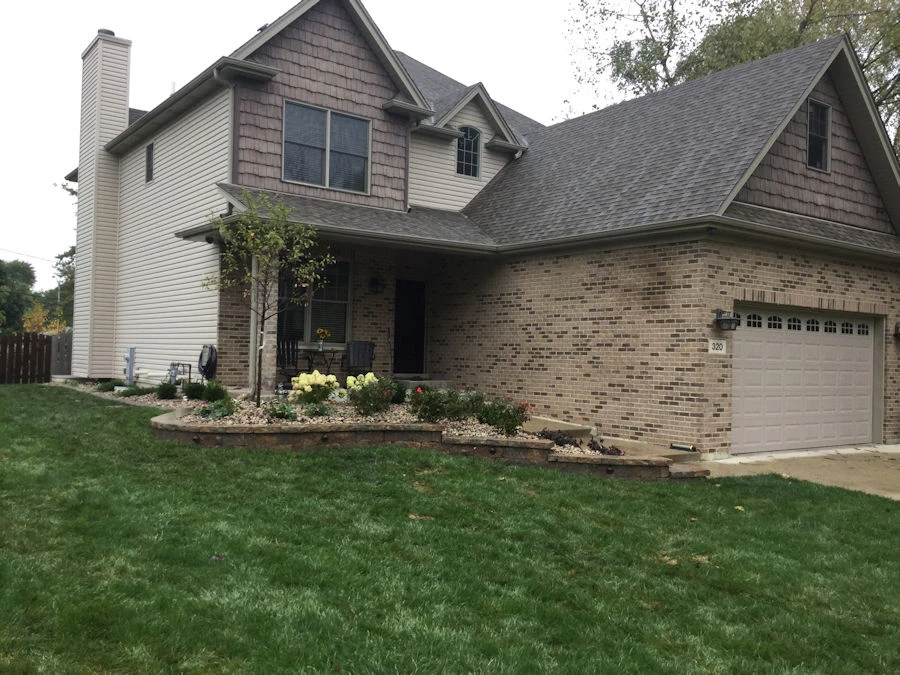
When boulder is the right call
- Lots with concentrated spring flow or seasonal seeps (common near the Etowah River Club and in low-lying sections of Foxcreek)
- Naturalistic designs that step down to a wooded rear yard rather than ending at a fence line
- Walls between 3 and 7 feet of exposed face where aesthetic matters as much as function
- Properties where the surrounding geology already shows granite outcropping — the wall has to belong visually
- Homeowners who’d rather pay once for a 50-year wall than twice for two 20-year walls
When boulder is the wrong call
- Walls over 8 feet of exposed face carrying structural load (pool decks, driveways with truck traffic)
- Straight architectural walls tight to a property line or next to a formal modern home
- Tight budgets where the aesthetic premium can’t be justified
- Lots where crane access is blocked and the 8,000-lb stones can’t physically reach the work
One more point on sourcing: we don’t pick stones off a single pallet. On a 40-foot boulder wall we’ll typically work from three to five pallets of assorted sizes — face stones at 1,500 to 3,500 pounds for the visible courses, heavier 5,000-to-8,000-pound anchor stones at the base, and smaller tied-back chinking stones for gap control. That blend is what makes a finished boulder wall read as random and natural. A wall built from uniformly sized stones reads as engineered and looks wrong on a wooded Dawson County lot, no matter how expensive the stone was.
Segmental Block — The Engineered Workhorse That Still Wants a Cap
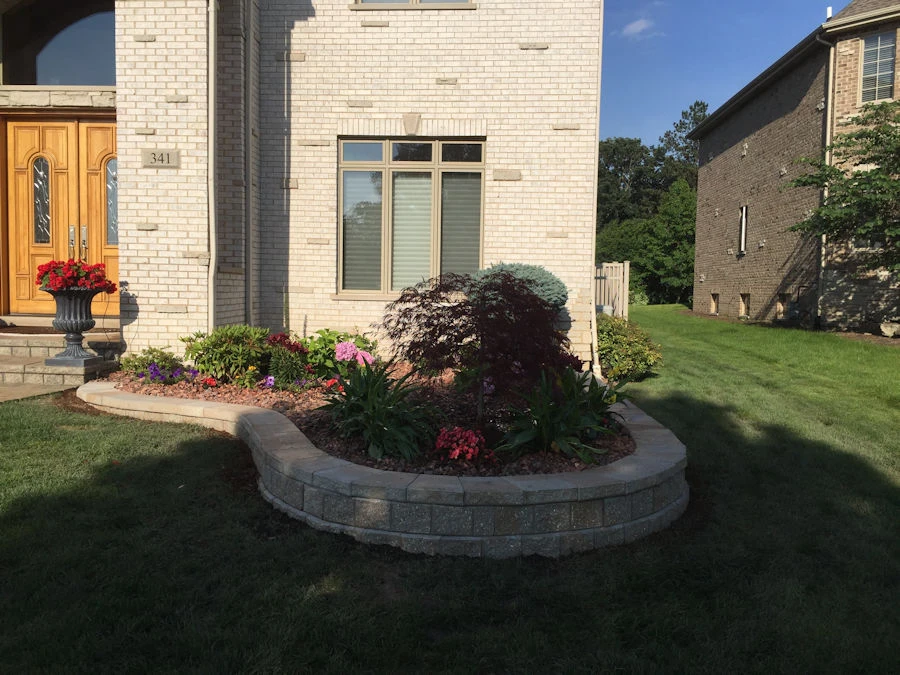
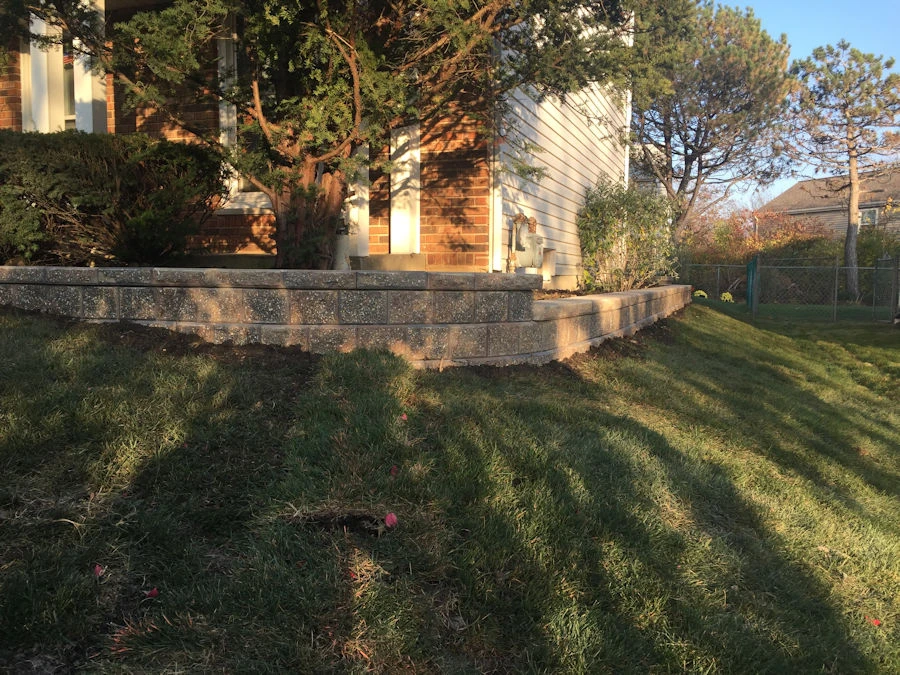
Segmental block is the most common material we install, and for straight engineered runs it’s the right answer. Techo-Bloc, Allan Block, and Versa-Lok all produce units we spec regularly, with Techo-Bloc and Allan Block carrying the bulk of our Dawson County projects. Face prices run $32 to $48 per square foot installed, which puts it at roughly a third of the cost of boulder for a similar exposed face.
What segmental block buys you is precision. The face goes up perfectly plumb, perfectly straight (or to a designed curve), courses line up to the inch, and the wall meets code at any engineered height with appropriate geogrid reinforcement behind it. On an Applewood new-build or a Kensington Ridge custom home where the architecture is clean and modern, segmental block matches the design intent better than any natural material could.
The engineering is where homeowners get confused about price. A 3-foot wall is mostly block. A 6-foot wall is block plus two to three courses of geogrid extended 5 to 8 feet into the slope behind the face. A tiered wall climbing 12 feet up a Dawsonville hillside is a system — geogrid at multiple elevations, a properly compacted crushed-stone backfill, drain tile running the full length of the base, and a surcharge analysis if anything structural sits within the wall’s active failure wedge. Two walls at the same face price can be wildly different products underneath.
The Dawsonville-specific wrinkle — backfill, not block
Here’s where we push back on most segmental block estimates homeowners hand us for second opinions. The wall face is rarely the failure point. The failure point is the backfill. A clay backfill on a Piedmont lot can marginally survive neglect because clay holds together. A saprolite backfill on a Dawson County lot can’t — when saturated, saprolite turns to a sandy slurry that puts pressure against the wall and migrates through any drain gap you haven’t properly geotextile-wrapped.
On every segmental wall we install in Dawsonville, we import #57 stone for the full drainage chimney, wrap the rear drainage zone in a non-woven geotextile filter fabric, and run a 4-inch perforated drain tile to daylight. That spec runs the per-face cost toward the top of the $32–$48 range. On a flatter Dacula install we might run to the bottom of it. Same wall, different county, different backfill spec — and the second number is the one that matters in year 10.
One more spec detail worth naming: on freeze-aggressive lots, we default to Techo-Bloc units rated for Canadian winters rather than the more common southern-market units. Block that was formulated for zone 8 gets surface spalling from 30 freeze-thaw cycles a year faster than block formulated for zone 5 — we’ve personally replaced faces on a Mountain Laurel install where the previous contractor saved $1.80 per block on unit selection and the homeowner paid $9,200 to repair the face in year 9. The right block costs pennies more. Using it is the easiest decision on the job.
Allan Block tiered system pricing check: A three-tier Allan Block system on a 12-foot grade change, with geogrid at each tier and #57 drainage chimneys full-height, runs roughly $44 to $52 per face square foot across the total exposed face. On a 30-foot run that’s a $16K to $19K wall system — and in Dawsonville terrain that system still reads as the budget-conscious choice next to boulder.
Poured Concrete — Where the Money Makes Sense
Poured concrete sits in the middle of the price band at $42 to $68 per square foot of face, and most homeowners misjudge where it belongs. It’s not a cheap alternative to block. It’s not a budget alternative to boulder. Poured concrete is the right answer in exactly two conditions on a Dawsonville lot: walls over 8 feet of exposed face carrying heavy surcharge, and wet-prone sites where groundwater is actively moving through the slope and a leaky mass-gravity system would be fighting the grade every season.
Structurally, a poured wall is a different product than block or boulder. It’s a vertical structural member — reinforced with rebar at specified spacing, footed below the frost line on engineered bearing, and designed as a monolithic unit that resists lateral earth pressure through its own bending strength. A 10-foot poured wall carrying a pool deck on a steep Chestatee lot will use roughly #5 rebar at 12 inches on center each way, a 12-inch wall thickness at the base tapering to 8 inches at the top, and a footing extending 2 feet past the heel. That’s a serious piece of infrastructure and it’s priced accordingly.
Where poured concrete wins is when the cost of a wall failure would dwarf the savings of a cheaper option. A wall holding up a $250K pool installation, a three-car driveway turnaround, or a finished walkout basement isn’t the place to save $15 per face square foot. It’s the place to put the Cadillac system in and stop thinking about it for 50 years.
The aesthetic problem — and how to solve it
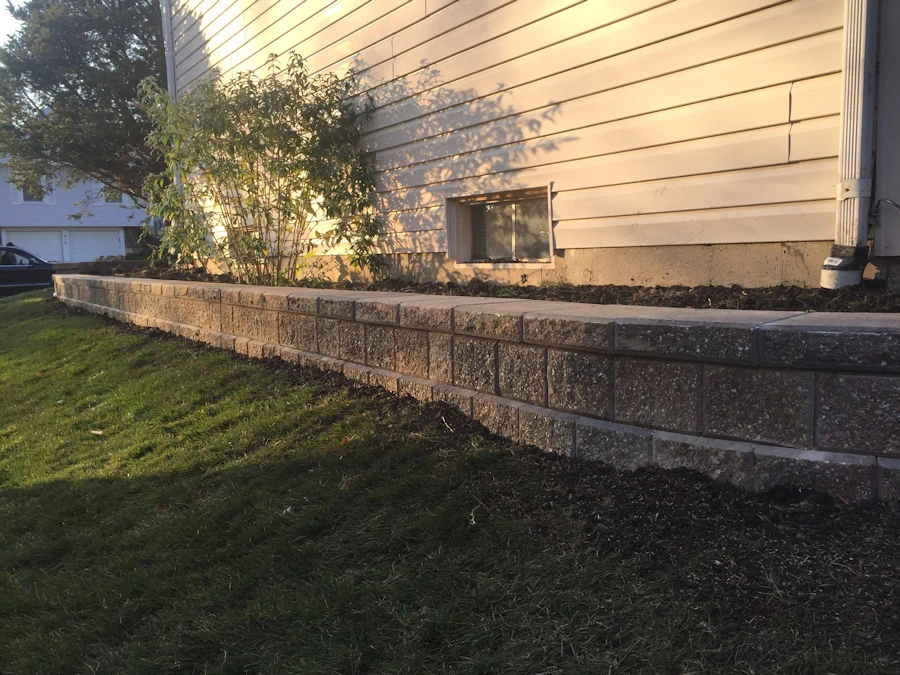
The honest objection to poured concrete on a mountain lot is that it looks wrong. A bare formed-concrete face in the middle of hardwood foothills reads as institutional, not residential. We solve that three ways, ranked by what we actually build in Dawsonville:
- Natural stone veneer applied to the exposed face — $18 to $34 per square foot on top of the structural wall cost, but the result reads as a stacked-stone wall from ten feet away and carries the engineering of a poured wall underneath.
- Board-formed finish — forming the concrete against rough-sawn lumber before the pour, which transfers a wood-grain texture to the face. It’s a modern-architectural look that fits newer builds in Kensington Ridge better than a rustic veneer would.
- Integral-color and acid etch — tinting the mix at the plant and etching the cured face to expose aggregate. Cheapest of the three, but on a naturalistic mountain lot it still reads as concrete.
On most of the pool-deck-structural walls we’ve built off Hwy 53, option one wins. The homeowner gets the 50-year wall under a face that matches the parent granite visible in the cut slope fifteen feet away.
Two execution details we watch on every poured wall: the pour sequence and the weep system. Pouring a tall wall in a single lift on a 50°F Dawsonville March morning is asking for cold joints and honeycomb. We stage the pour, vibrate each lift aggressively, and keep the next lift wet-on-wet when the grade and access allow. And we install weep holes at 6 to 8 feet on center through the base course, backed by a #57 chimney on the hill side, so any water that does build up behind the wall has a relief path. A poured wall without weeps is a dam, not a retaining wall — and on a saprolite lot, the difference shows up in about five winters.
Matching the Material to the Dawsonville Topography
Here’s how we run the decision on a walk-through, in order. This is the same sequence every estimator on the Primetime field team follows when a Dawsonville homeowner asks which wall to build.
Step one — map the water. Walk the slope after a heavy rain. Note where water concentrates, where it’s moving through gravel seams, and whether the cut face shows active seepage. If the slope is moving concentrated water, boulder becomes the strong default — the material is designed to leak. If the slope is dry or sheet-draining uniformly, block or poured concrete both work cleanly.
Step two — measure the exposed face. Under 4 feet: segmental block is almost always the right economic answer. 4 to 8 feet: all three materials compete, decision comes down to aesthetic and drainage. Over 8 feet with surcharge: poured concrete, full stop, unless the boulder wall is engineered to a level almost nobody locally specs correctly.
Step three — check the surroundings. Is the adjacent architecture formal and precise (Applewood brick traditionals, Kensington Ridge contemporary builds)? Segmental block or veneered poured concrete. Is it a naturalistic lot with hardwood canopy and visible granite outcropping (Riverbend, lower Chestatee, Big Canoe periphery)? Boulder wins on sight alone.
Step four — pull the excavator test pits. Before we finalize any bid we dig two or three test pits to parent rock depth. That tells us whether the excavation will hit blast-required ledge, whether saprolite is shallow enough to be a drainage headache, and where the footing actually has to seat. That test-pit work costs about $400 to $900 per site and it has saved us — and more importantly, our homeowners — from roughly a dozen mid-project material changes in the last three years.
A quick decision matrix
- Under 4 ft, dry slope, suburban aesthetic → Segmental block with paver cap ($32–$40/face sqft)
- 4–7 ft, wet or concentrated drainage, naturalistic lot → Boulder, locally sourced ($80–$120/face sqft)
- 4–8 ft, formal architecture, dry slope → Segmental block with geogrid ($38–$48/face sqft)
- Over 8 ft with pool or driveway surcharge → Poured concrete with natural stone veneer ($60–$102/face sqft all-in)
- Any wall on a slope with active rock blast or spring flow → Test pits before bid, not after
Amicalola EMC service drop note: If any retaining wall crosses or sits near an overhead power service drop on an Amicalola EMC-served lot, we coordinate setback and clearance with the utility before excavation. That call is free and it’s been the difference between a one-day and a two-week delay on roughly half the mountain-lot jobs we run.
The reason we lay all three materials on the table rather than leading with one is that the honest answer changes lot by lot. A boulder wall on the wrong lot is a waste of $40,000. A block wall on the wrong lot is a drainage disaster in year 8. Poured concrete where it isn’t needed is an architectural mistake you can’t easily hide. The material doesn’t rank — the match does.
And on a Dawsonville lot — 1,270 feet of elevation, rocky residuum, 30-freeze-event winters, concentrated mountain-pattern rain — the match demands more thought than anywhere else in our service area. That’s the job. Pick the wall that belongs on your specific slope, not the one that showed up cheapest in three quotes.
What a Primetime Dawsonville wall estimate actually covers
Because we get asked this a lot on second-opinion walk-throughs: a Primetime wall estimate for a Dawson County project itemizes the excavation and rock-blast allowance separately from the wall material, calls out the geogrid reinforcement spec by manufacturer and course count, lists the drainage chimney volume in cubic yards of imported #57 stone, names the filter fabric manufacturer and weight class, and specifies the drain tile daylight terminus on the site plan. If your current bid doesn’t itemize those six things, you don’t have a comparable quote — you have three numbers. And three numbers are never what the wall costs. They’re what the lowest of the three contractors hopes it will cost before the first bucket of saprolite comes out of the hole.
We’re not trying to make wall selection complicated. We’re trying to match the material to the lot. In ZIP 30534, with everything the Dawson County Department of Planning & Development requires on an engineered wall and everything the mountain adds on top of that, the decision usually resolves cleanly once we’ve walked the slope and dug the test pits. Boulder for naturalistic wet lots. Block for engineered dry runs. Poured concrete for the structurally serious work. The right wall is already picked before the bid goes out — we just have to see the ground first.
Retaining wall installation across 20+ cities within 30 miles of Winder, GA
Mountain-lot work in Dawsonville, Cumming, and the GA-400 corridor — plus the engineered walls, pool decks, and hardscape that hold them up. Every slope gets the test pits before the bid.