
The homeowner in Vickery wanted a pool that disappeared into the Sawnee Mountain haze — not a pool you looked at, but a pool you looked through. What he ended up with, after a nine-month build that included a PE-stamped retaining wall, a 110%-of-weir-flow catch basin, and four hydraulic do-overs on the weir lip, is the kind of engineered illusion that justifies every dollar on the contract.
A vanishing edge — sometimes called an infinity edge or negative edge — is not a design flourish. It is a hydraulic system disguised as a horizon. Water runs across a razor-level weir wall, falls three to five feet into a hidden catch basin, and is returned to the main pool by a dedicated booster pump at a precisely matched flow rate. Get any one number wrong and the illusion collapses: the water sheets unevenly, the weir shows waterline scale, the trough boils audibly, or the pump short-cycles itself into an early grave.
Cumming is one of the only places in the northeast Atlanta metro where this detail actually earns its price. The reason is geography. The subdivisions north of Hwy 20 — the 1,500-foot ridgelines above Lake Lanier — sit high enough that a west-facing weir edge reads against open sky and lake haze instead of a neighbor’s fence. Build the same pool in a flat Snellville backyard and you’re staring at a $200,000 spillway into somebody’s shed roof. Build it in Windermere or St. Marlo on a lot that drops six feet toward a drainage tributary and the horizon does the design work for you.
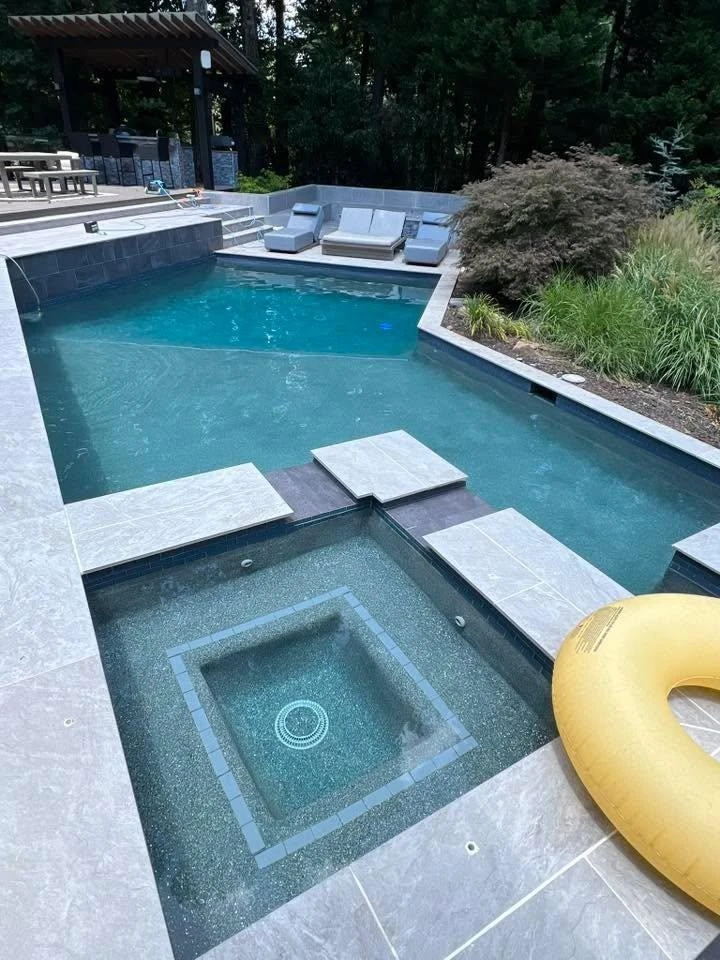
Why Cumming’s Topography Is Unusually Kind to Vanishing Edges
Forsyth County is the fastest-growing county in Georgia. The housing stock reflects it — 2000-to-2015 subdivisions dense around GA-400 exits 13 through 17, and newer 2018-plus luxury tracts climbing the ridges north of Hwy 20 toward Sawnee Mountain Preserve. The 1,963-foot summit of Sawnee anchors the regional skyline, and the gently rolling Piedmont foothills feed dozens of tributaries into Big Creek and, ultimately, Lake Lanier.
What this means for pool design: a surprising number of Cumming backyards carry a 3 to 8 foot grade drop from the house side to the rear property line. A flat Atlanta-area pool builder sees that slope as a problem — more excavation, bigger retaining walls, higher cost. A vanishing-edge builder sees the opposite. The slope is the reason the edge works. You need the grade to hide the catch basin, and you need the sight line across the weir to open onto something worth seeing — trees, sky, a reservoir, a distant ridge.
In Vickery and Hampton Park, the west-facing lots typically frame the Lake Lanier corridor. In Windermere and Polo Fields, the edge reads against golf-course fairways. In Haw Creek and Mashburn Plantation, we have done edges that look directly at wooded ravines — a quieter frame, but just as effective when the morning fog rolls in. The common thread: the edge never reads against another house. That is the rule we refuse to break.
Lot qualification benchmark: A vanishing edge is worth engineering only when the weir sightline opens onto a tree canopy, a water body, or a property line that drops more than 15 feet below the pool deck within 60 feet of the weir. Anything less and the illusion flattens.
The Weir Wall: Why 1/8 of an Inch Ruins a $225,000 Pool
The weir wall is the edge itself — the precision-finished top of the wall that water sheets across. In our standard Cumming spec, that wall is 32 feet long on a rectangular pool and runs between a 16-foot and 20-foot width. It has to be level, as in actually level, across its entire length. The tolerance we hold on a Primetime Pools GA build is ±1/16 inch across 32 feet. Anywhere above 1/8 inch and the visual failure is brutal — the film of water thins on the high side and thickens on the low side, and once a client notices it, they cannot un-see it.
Why is this so hard? Three reasons. First, Piedmont red clay (Cecil series dominates Forsyth County soils) is a reactive substrate — it swells when wet, shrinks when dry, and pushes concrete walls around across a full year’s freeze-thaw cycle. USDA Zone 8a delivers roughly 22 freeze events per year around Cumming, each one a tiny expansion-contraction pulse through the wall footing. Second, the weir wall itself holds back roughly 60 gallons per minute of constantly moving water when the pool is running — so it has to act structurally as a dam while photographically reading as a knife edge. Third, the finish material — usually a mitered-corner cast-stone or a precision-cut travertine — has its own manufacturing tolerance that stacks on top of the structural tolerance.
Our build sequence for a Cumming weir wall looks like this: footing poured on compacted #57 stone over engineered clay subgrade, rebar cage tied with a 10-inch-thick wall, concrete vibrated in 18-inch lifts, and a dry-pack top course leveled with a rotary laser against two reference pins set on opposite ends of the pool. The laser check gets repeated after the concrete cures for seven days, because clay subgrade does not give you a final reading on day one. Then, and only then, does the cast-stone or travertine edge cap go down.
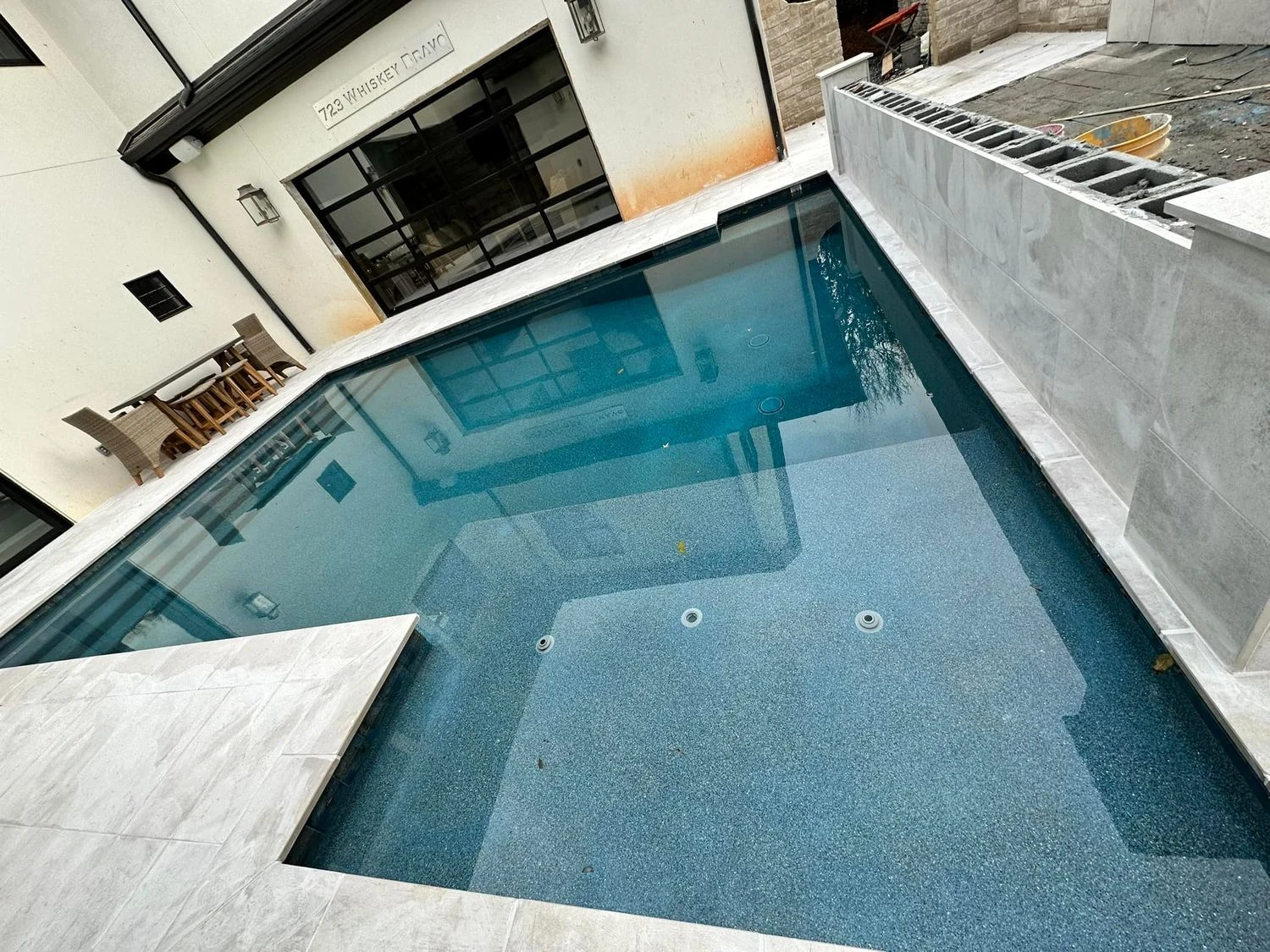
The Catch Basin: Sized for 110% of Weir Flow, Never Less
The catch basin (also called the trough, the gutter, or the reservoir) sits below and behind the weir wall. Its job is to receive every gallon that spills across the edge, hold a reserve for pump priming, and compensate for water displacement when a family of six jumps into the main pool at the same time. Undersize it and the trough runs empty, the booster pump cavitates, and the weir effect stops mid-afternoon. Oversize it and you are pouring money into buried concrete for no visual return.
The rule we hold is straightforward: the catch basin has to accept 110% of peak weir flow plus the displacement volume of every person in the pool at design load. For the standard 32-foot Cumming weir, that works out to roughly 60 GPM of weir flow, a 20-gallon displacement reserve per swimmer at a 6-person design load, and a 15-gallon surge buffer. In practice that becomes a trough roughly 3 feet deep, 18 to 24 inches wide, running the full length of the weir — plus an enlarged collection sump at one end where the suction line leaves for the booster pump.
The math is also what dictates the booster pump. We spec a Pentair IntelliFlo3 VSF variable-speed pump, dedicated to the vanishing-edge loop — never shared with the main pool circulation, never shared with a spa, never shared with a water feature. A dedicated pump lets the homeowner dial the weir sheet from a whisper at breakfast to a full hotel-lobby cascade for a Saturday dinner party, without touching the main filtration. The IntelliFlo3 pulls the same wattage at partial flow as a single-speed pump pulls at a third of the output, which matters in Cumming because Sawnee EMC’s residential rate structure rewards variable-speed draw during shoulder seasons.
Cumming project-sizing reference: 32-ft weir · 60 GPM design flow · 3-ft deep catch basin · IntelliFlo3 VSF dedicated booster · 240V service from Sawnee EMC. This is the baseline spec we hold on every Vickery, Windermere, and Polo Fields ridgeline build.
Forsyth County Permit Reality: The PE Stamp Nobody Warns You About
This is the detail that catches builders and homeowners off guard. Forsyth County’s Department of Planning and Community Development at 110 E. Main Street in downtown Cumming requires a licensed Professional Engineer stamp on any pool wall more than 4 feet tall that also retains water load. A vanishing-edge weir wall meets both criteria — it is almost always taller than 4 feet from footing to deck, and it retains water as a functional dam on the downhill side. That PE stamp runs somewhere between $2,800 and $4,500 depending on the engineer, the site’s geotechnical complexity, and whether the wall also serves as a soil-retaining structure for the catch basin excavation.
We factor it into every ridgeline quote from the first conversation. The client who finds out about the PE stamp at permit submittal time, six weeks into a build, is the client who posts a one-star review. The client who hears it on the first walkthrough calls it “part of doing it right.”
The second permit reality is HOA architectural review. St. Marlo, Polo Fields, The Collection at Forsyth, Lake Windward — every high-end Cumming community has an architectural review board with a written pool policy. Most boards run a 2-to-3-week turnaround on pool plans, but several require a second submittal if the initial package lacks elevation views of the weir wall from the neighbor-facing side. We draft every Cumming pool submission with a neighbor-view elevation included by default. It saves two weeks.
Third reality: Sawnee EMC service. A dedicated booster pump on a vanishing-edge loop almost always pushes the residential service above the threshold for a 200-amp panel. Several of the older Cumming subdivisions were built with 150-amp main panels that will not comfortably carry a pool load plus a booster pump plus a heater plus the rest of the house. We run a pre-construction load calculation with the homeowner’s electrician, and roughly one in three Cumming builds triggers a main-panel upgrade. Budget $2,200 to $3,600 for that upgrade if your home predates 2008.
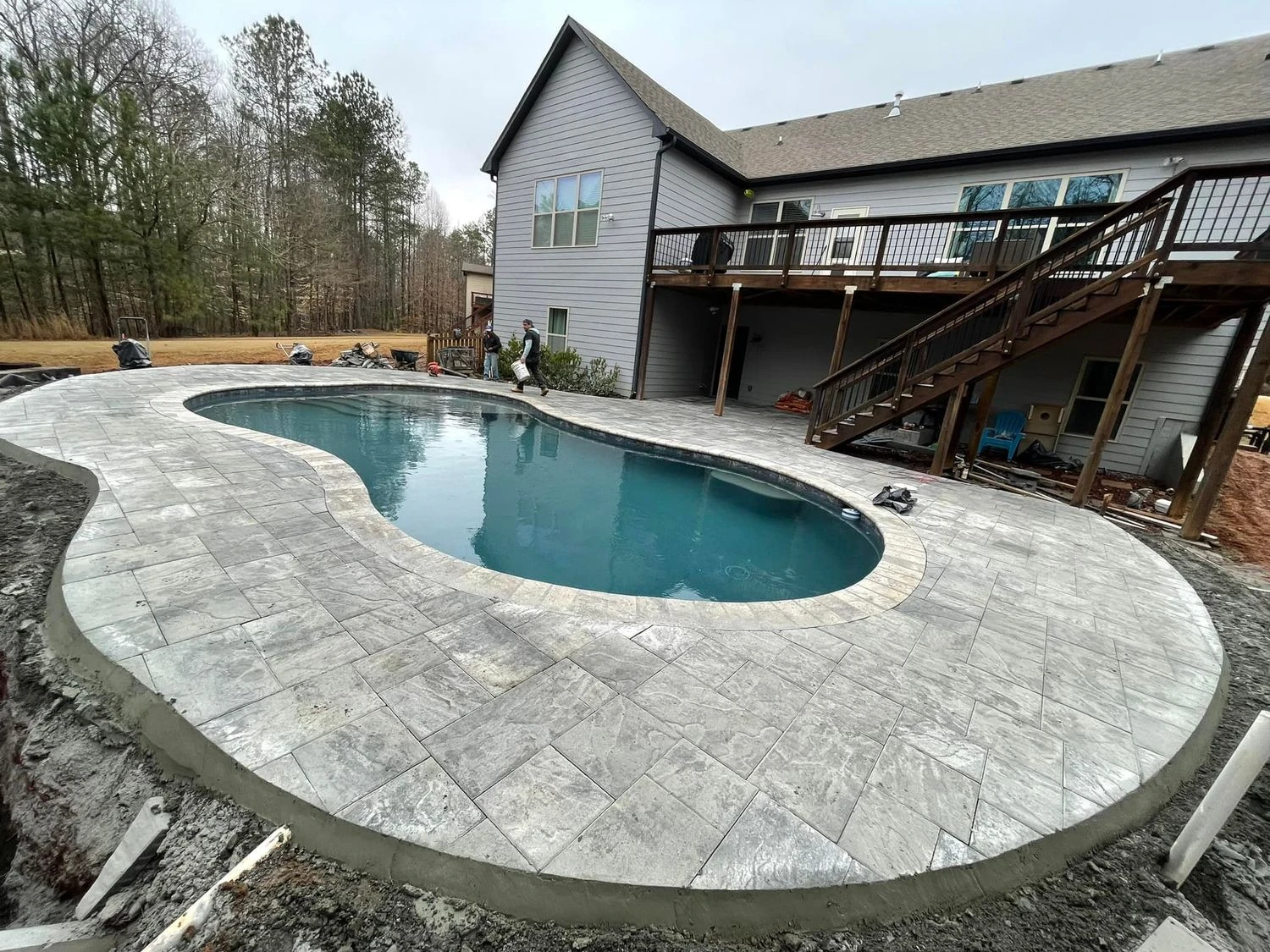
The View-Frame Math: What Actually Makes the Horizon Read “Infinite”
Standing at the house side of the pool, looking toward the weir, the water has to meet the background without a visible terminating line. This is an eye-height problem, not just a deck-height problem. We design around a 5-foot-5-inch observer standing 24 feet back from the weir — roughly where most homeowners position their primary seating group on the upper deck. From that sightline, the geometry that has to work is: the weir lip elevation + 1/16 inch of water film has to be lower than the nearest line of background foliage or lake.
In practice, on a Vickery lot with a 7-foot grade drop, that means the weir deck lands roughly 4 feet 2 inches below the house-side deck. On a shallower 3-foot-drop lot in Hampton Park, we sometimes have to build up the house-side deck to hold the geometry — adding a 2-step rise with cast-stone risers to preserve the observer sightline. Clients call that a “view patio.” We call it math.
The second variable is the background itself. Sawnee Mountain, the Lake Lanier corridor, and the wooded ravines west of Windermere each read differently under Cumming’s summer humidity. The ~52 inches of annual rainfall and Lake Lanier’s proximity push humidity 4 to 7 points above Dacula and Grayson averages on a typical July afternoon. That humidity softens the horizon — which is good for the illusion, because a too-sharp background line competes with the weir edge. Morning fog off Lanier, when it runs through mid-autumn, gives the pool its most dramatic hour of the day.
We photograph every completed vanishing-edge build three times: morning first light, mid-afternoon, and 45 minutes before sunset. The afternoon shoot almost never flatters the edge. The morning and evening shoots are where the engineering earns its money.
Lake Lanier humidity and why the weir edge stains first
The weir lip sees the highest evaporation rate of any surface in the pool. Water thins to roughly 1/16 inch of film as it crosses the edge, the surface-to-volume ratio spikes, and whatever is dissolved in the water concentrates on the lip as the film evaporates. On a typical Cumming summer day — 89 to 94 degrees, high humidity from Lake Lanier’s 38,000-acre surface area pushing evaporative load higher than in drier parts of the northeast metro — the weir edge will show the first sign of any chemistry imbalance before the main pool interior does.
Calcium hardness is the usual culprit. Cumming’s municipal water supply, delivered through the Forsyth County Water and Sewer Department, runs 60 to 90 ppm calcium on the average draw — soft to moderately soft. Evaporation concentrates that calcium at the weir, and if saturation index drifts positive, a white scale band forms at the exact water line. Left alone for a summer, the scale turns into a permanent etch on cast stone or a dull gray film on travertine.
Our startup protocol on every Cumming vanishing-edge pool includes a 60-day follow-up service visit — included in the price — where we chemically rebalance the pool, brush the weir edge specifically, and hand off a monthly maintenance calendar to either the homeowner or their pool service. The weir is the first place any service tech should look on a ridgeline pool. If it’s dull, the water is out of balance. If it’s sharp, the pool is dialed in.
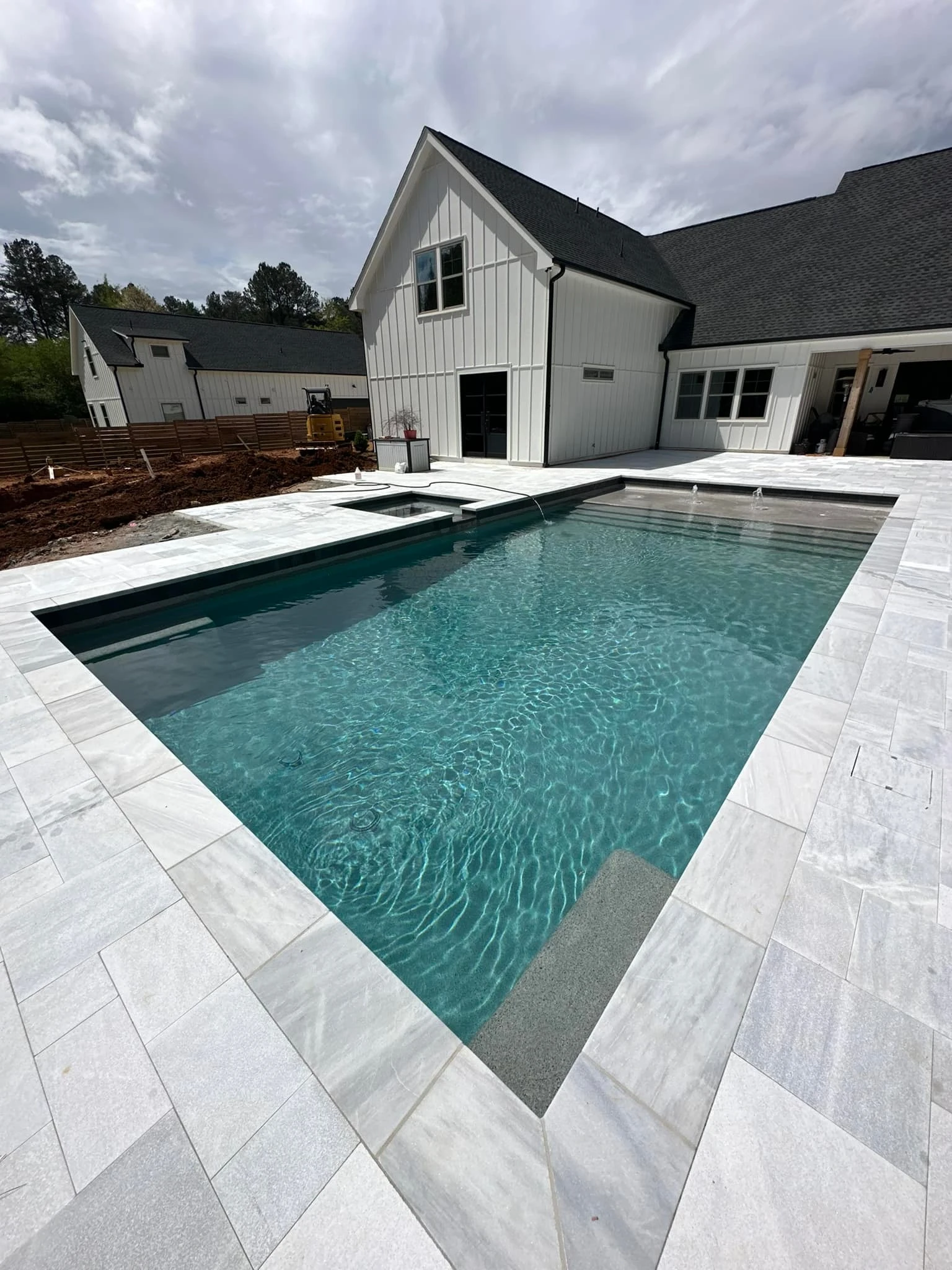
Lighting the Edge: LED Choreography That Does Not Fight the Horizon
The mistake amateur designers make with vanishing-edge lighting is treating it like a main-pool lighting plan. It is not. A vanishing edge needs lighting that gives the weir sheet a glow without washing out the background horizon the edge is meant to frame. We use a layered approach on every Cumming ridgeline build.
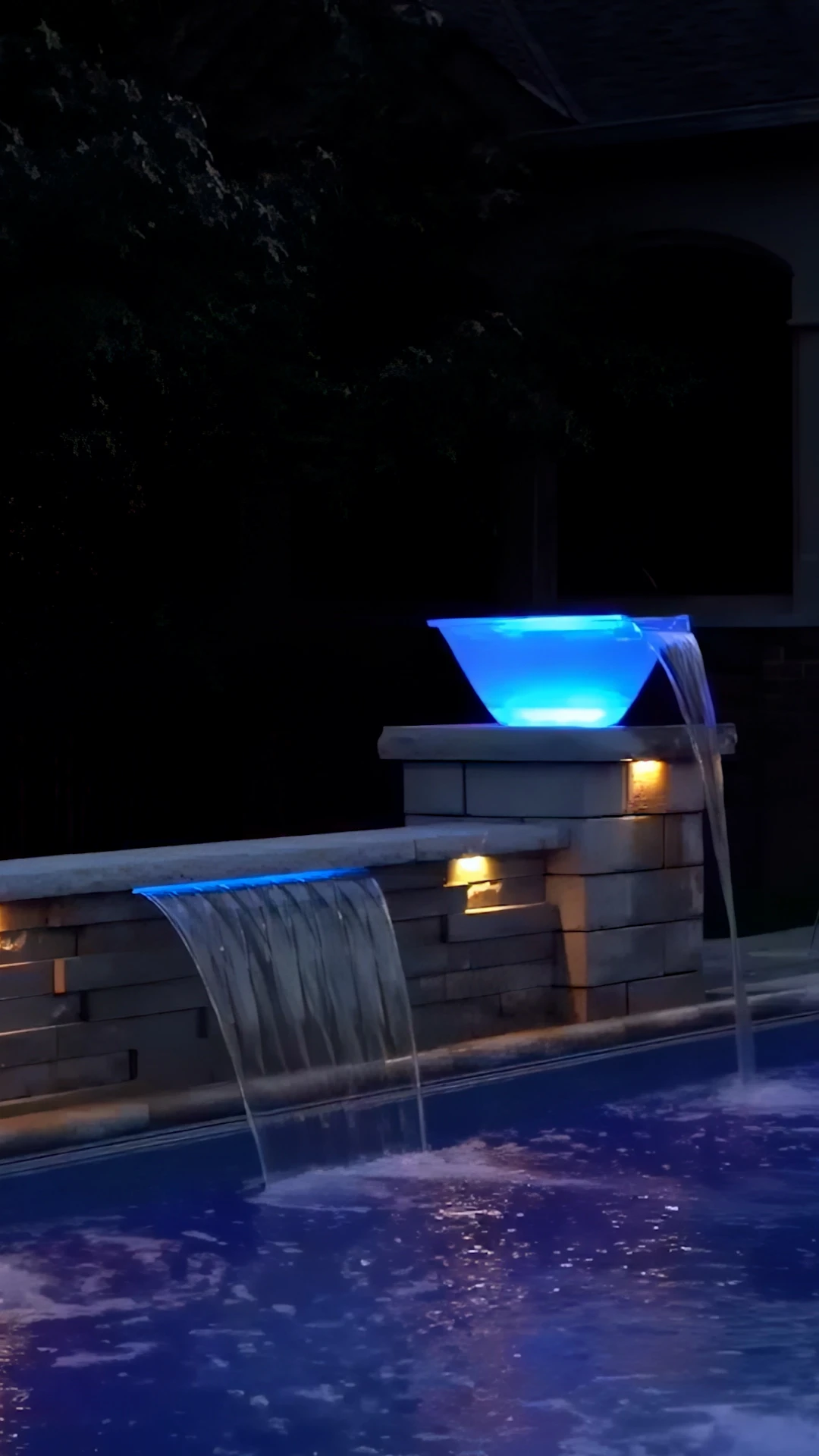
Layer one is the main pool LED — Pentair IntelliBrite 5G color-changing lights, usually three to five of them depending on pool volume, set into the far wall so they light the pool body but not the weir itself. Layer two is a hidden LED strip recessed under the weir coping on the downhill side, washing the weir wall exterior with a warm-white or soft-blue glow that catches the falling water sheet from below. Layer three is uplights on the natural background — never floodlights, always low-lumen, narrow-beam fixtures placed in the landscape bed 12 to 18 feet past the weir, aimed at a specific tree, rock formation, or pergola corner. Layer four, optional, is a pair of warm-white pathlights on the catch-basin deck for safety and rhythm, never aimed at the water.
The goal of the four-layer scheme: the eye should read the pool, then the weir’s falling film, then the background beyond the weir as three distinct visual planes, each softly lit, none of them competing. Overlight any one plane and the illusion cracks. A dialed-in Vickery or Windermere lighting setup reads exactly like a layered theatrical set — because that’s what it is.
Investment Range, Schedule, and What Actually Drives Cost
Our current Cumming-specific pricing for a full vanishing-edge build, including the PE-stamped weir wall, the catch basin, the dedicated IntelliFlo3 VSF booster, layered LED lighting, precision cast-stone or French-pattern travertine edge finish, and Forsyth County permitting, sits between $185,000 and $265,000 on top of a comparable non-vanishing rectangle or geometric pool of the same square footage. That is a premium, not a full project cost — the base pool, deck, and landscaping carry their own line items.
What moves a quote within that range:
- Weir length. A 24-foot weir on a plunge-style pool comes in at the bottom of the range. A 40-foot weir on an entertainer’s pool sits at the top. Every additional foot of weir is roughly $4,800 to $6,200 in material and labor, depending on finish.
- Grade drop. A lot with a natural 6-to-8-foot drop reduces retaining-wall scope. A lot with only a 3-foot drop requires us to either build up the house-side deck or deepen the catch basin excavation — both add cost.
- Cecil clay condition. Wet-season excavation into Cumming’s dominant Cecil-series clay costs roughly 18% more than dry-season excavation because of dewatering and spoil management. We schedule vanishing-edge starts for May through September when possible.
- HOA review rounds. A first-round approval in St. Marlo or Polo Fields is standard. A second round, usually triggered by a weir-wall elevation question, delays the project by 8 to 12 working days.
- Service panel upgrades. If your Cumming home predates 2008 and runs a 150-amp main, add $2,200 to $3,600 for the panel swap before any pool wiring can be pulled.
Build time is the other variable clients underestimate. A flat-lot rectangular pool in Forsyth County finishes in roughly 14 to 18 weeks start to startup. A full vanishing-edge build on a Vickery or Windermere ridgeline typically runs 26 to 34 weeks, including permit cycles, PE review, HOA approval, and the extended curing period we insist on for the weir wall. Homeowners who plan a spring splash-in for the family need to sign a contract by the previous August. We do not rush the weir.
Cumming-ridgeline rule of thumb: Contract in August, permit in September–October, excavate in November, shell and weir wall over winter with extended cure, finish and deck in early spring, startup by Memorial Day weekend. This is the schedule we’ve built against 22 annual freeze events and Forsyth County permit cycles across dozens of projects.
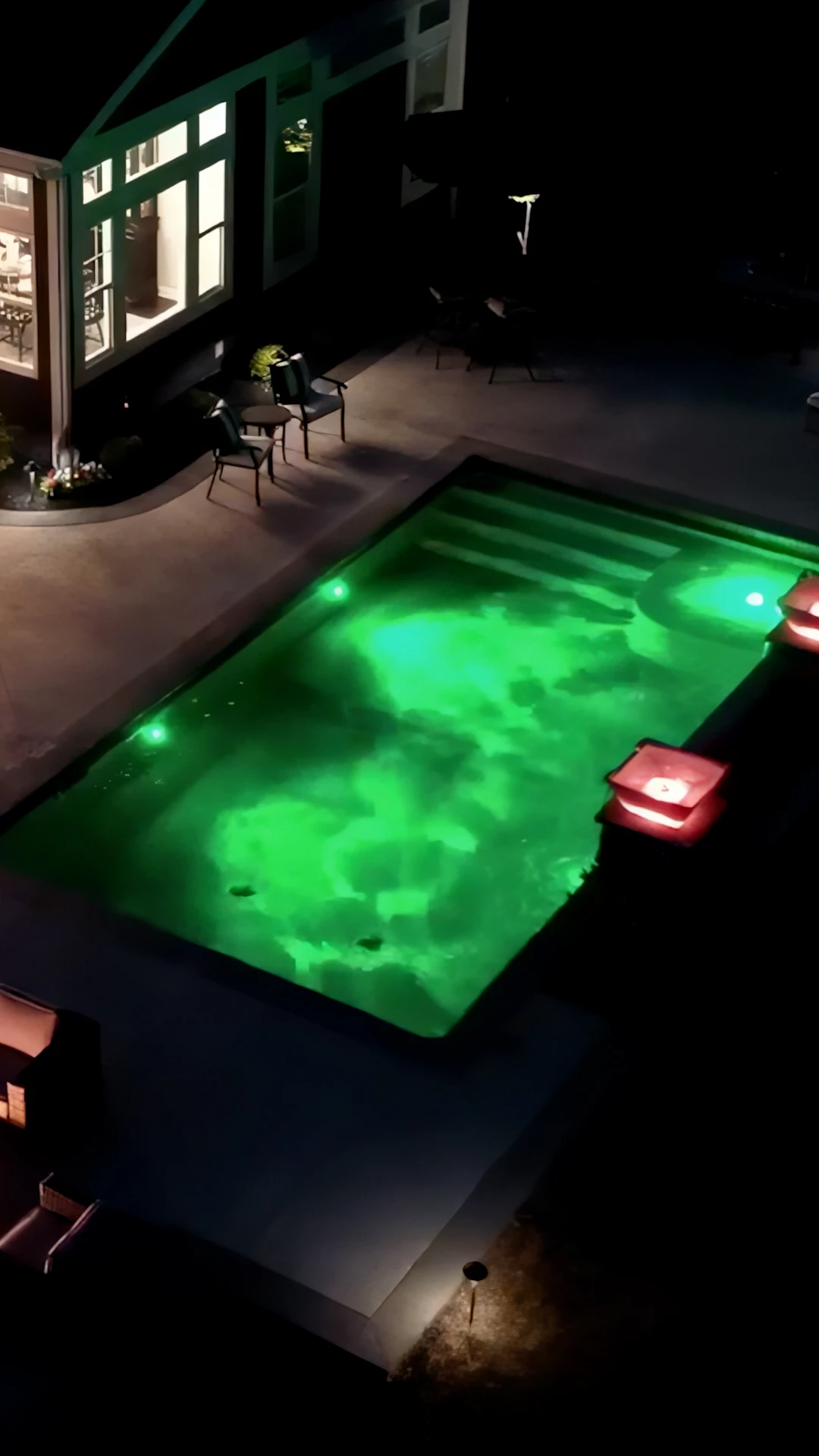
Custom vanishing-edge pool construction across 20+ cities within 30 miles of Winder, GA
If your Cumming lot drops toward Lake Lanier, Sawnee Mountain, or a wooded ravine, Primetime Pools GA will walk the property, read the grade, and tell you honestly whether a vanishing edge earns its price on your site.