
It was a Tuesday in late July, about 2:15 in the afternoon, at a home off Windward Parkway. The father met us by the side gate, barefoot, and before he said hello he walked four steps onto his charcoal-paver deck, winced, and hopped sideways onto the grass. “This,” he said, pointing down, “is why you’re here.”
His three-year-old had burned the pads of her feet the weekend before. Not blistered — but enough that she cried, and enough that the family had turned the pool into an adults-only zone until the sun dropped past the tree line around 7 PM. The pool was eighteen months old. The deck was charcoal Techo-Bloc Blu 60 in Greyed Nickel, a beautiful product in the showroom, selected from a sample board under fluorescent light in February. In July sun, at the time of day a family actually uses a pool, the surface was measuring 134°F with an infrared thermometer. That is not a typo and that is not an outlier. That is Alpharetta summer on the wrong-colored deck.
We came out to quote replacing the coping and the field tile with cream travertine. Before we pulled a single paver, we did what we now call the hot-foot test on every pool deck consultation we run between June and September in Fulton County. It takes ninety seconds and it changes the conversation more than any sample board ever will. This piece walks through what we learned on that job, what the physics actually are, what each deck material does when the sun climbs above ninety degrees, and why we have moved almost all of our new-build pool-deck specs in the Alpharetta tech corridor toward cream and light-tan travertine.

The Hot-Foot Test — Ninety Seconds That Settle the Deck Argument
Here is the test. Go to your deck — or a sample you are considering — between 1:30 PM and 3:30 PM on a clear day in July or August. Take a pitcher and pour about a cup of 80°F pool water onto the surface in a small puddle. Start a timer.
Cream or light-tan travertine will evaporate that puddle in roughly 90 seconds. Light-gray concrete pavers will evaporate it in about 60 seconds. Charcoal or dark-gray pavers will evaporate it in 45 seconds or less. On that Windward job, we clocked the existing charcoal deck at 42 seconds. The cream travertine sample we had brought with us — sitting on the same deck, in the same sun, for the same forty minutes beforehand — evaporated its puddle in 94 seconds and measured 109°F where the paver next to it measured 134°F.
That is a 25°F gap, in the same yard, at the same time of day, with the same sun angle. Not a lab test. Not a manufacturer brochure. A bucket of pool water and a cheap infrared thermometer on the homeowner’s own deck. The father ran upstairs, brought his daughter down, and had her touch both surfaces. She walked on the travertine. She would not step on the paver.
The test, in writing: On a clear 90°F+ afternoon, pour a cup of pool water on the candidate surface at 2 PM. Measure surface temp with an IR gun. Cream travertine: expect 106–112°F. Light-gray concrete paver: 118–126°F. Charcoal paver: 128–138°F. Third-degree burn threshold on soft skin: 118°F after 10 minutes, 131°F in about 30 seconds.
Why does this work so consistently? Three reasons: albedo (how much light the surface reflects versus absorbs), thermal mass (how much heat the material stores), and surface porosity (how much surface area is available to shed heat through evaporation and convection). Cream travertine wins on all three. A dark sealed paver loses on all three.
Travertine — What It Actually Is and Why Alpharetta Sun Doesn’t Cook It
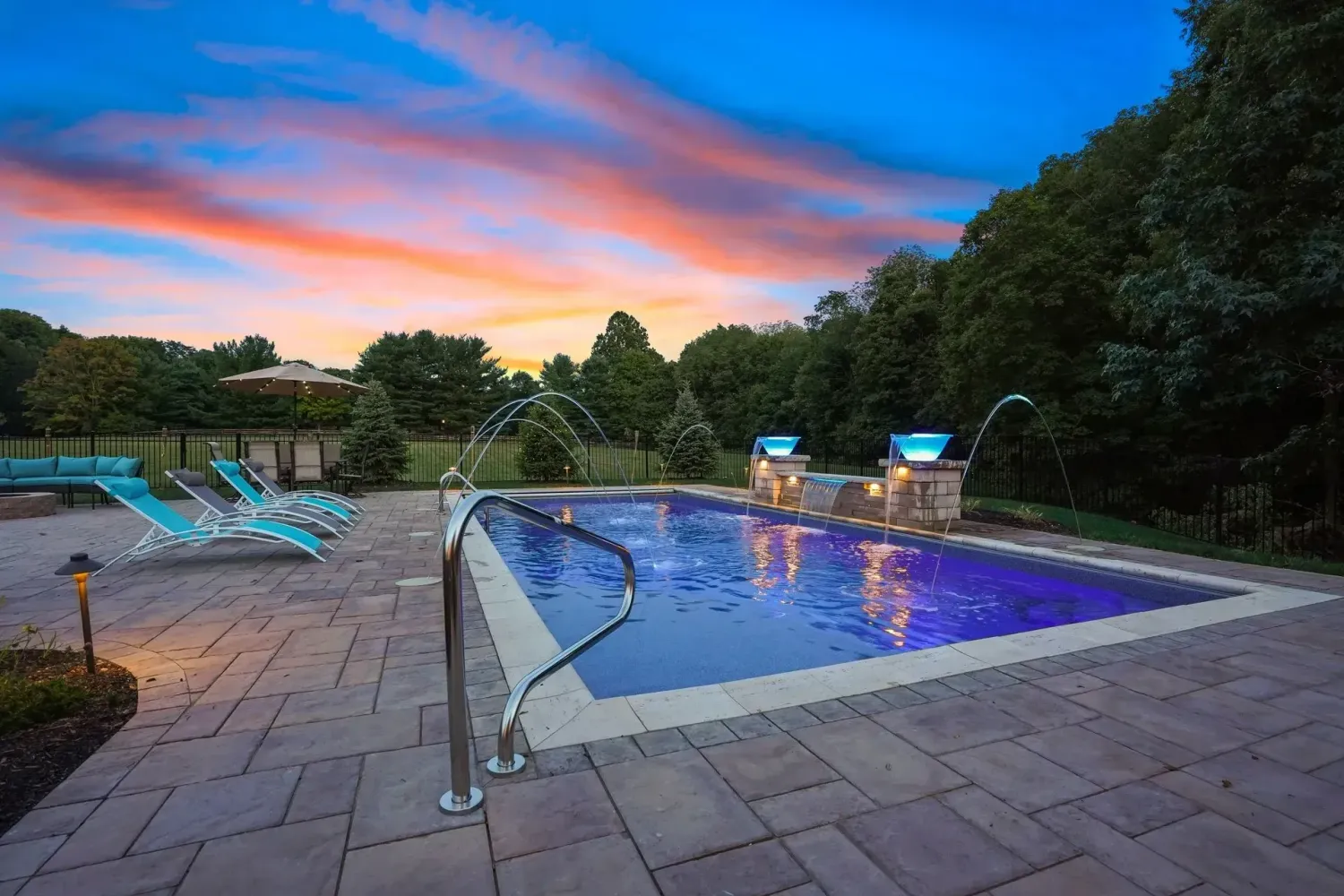
Travertine is a sedimentary limestone formed by mineral-rich hot springs. The stone we spec most often on Alpharetta decks is Turkish Ivory / Classic Select in a 6cm French pattern or a 12″×24″ standard format. It comes in a naturally honed or tumbled finish — never polished for pool decks, because polished travertine in a wet environment is a liability.
The color range we recommend for heat performance sits in the ivory-to-walnut band: RAL values roughly in the 9001–1013 cream family. Albedo on honed cream travertine measures around 0.62 to 0.68. Translation: the stone reflects about 65% of incoming solar radiation back into the sky. Charcoal concrete paver albedo sits around 0.12. That is the single biggest reason the surface stays cool — most of the sun’s energy never becomes heat in the stone in the first place.
The second reason is the stone’s natural pore structure. Travertine is full of microscopic voids. Those voids hold a film of water after a rain or a pool splash, and as that water evaporates it pulls heat out of the stone the same way sweat cools your skin. This is evaporative cooling, and it runs for an hour or more after a rinse. A sealed concrete paver has no pore structure available for this — the sealer closed it.
The third reason is thermal mass. Travertine at 1.25″ to 2″ thickness (typical for a pool deck) stores less heat per square foot than an equivalent concrete paver because its density is lower, around 2.4 g/cc versus 2.6 for high-density concrete. Less mass, less stored heat, faster cool-down once the sun starts to drop.
Concrete Pavers — Why the Dark Ones Burn and the Light Ones Still Disappoint
We install concrete pavers all the time. Techo-Bloc, Belgard, Unilock — we are certified with the first two and have built hundreds of paver patios and driveways across Country Club of the South, Hutchinson Farm, and the Avalon-adjacent townhome tracts. The product is excellent. The color choice on pool decks, specifically, is where buyers get hurt.
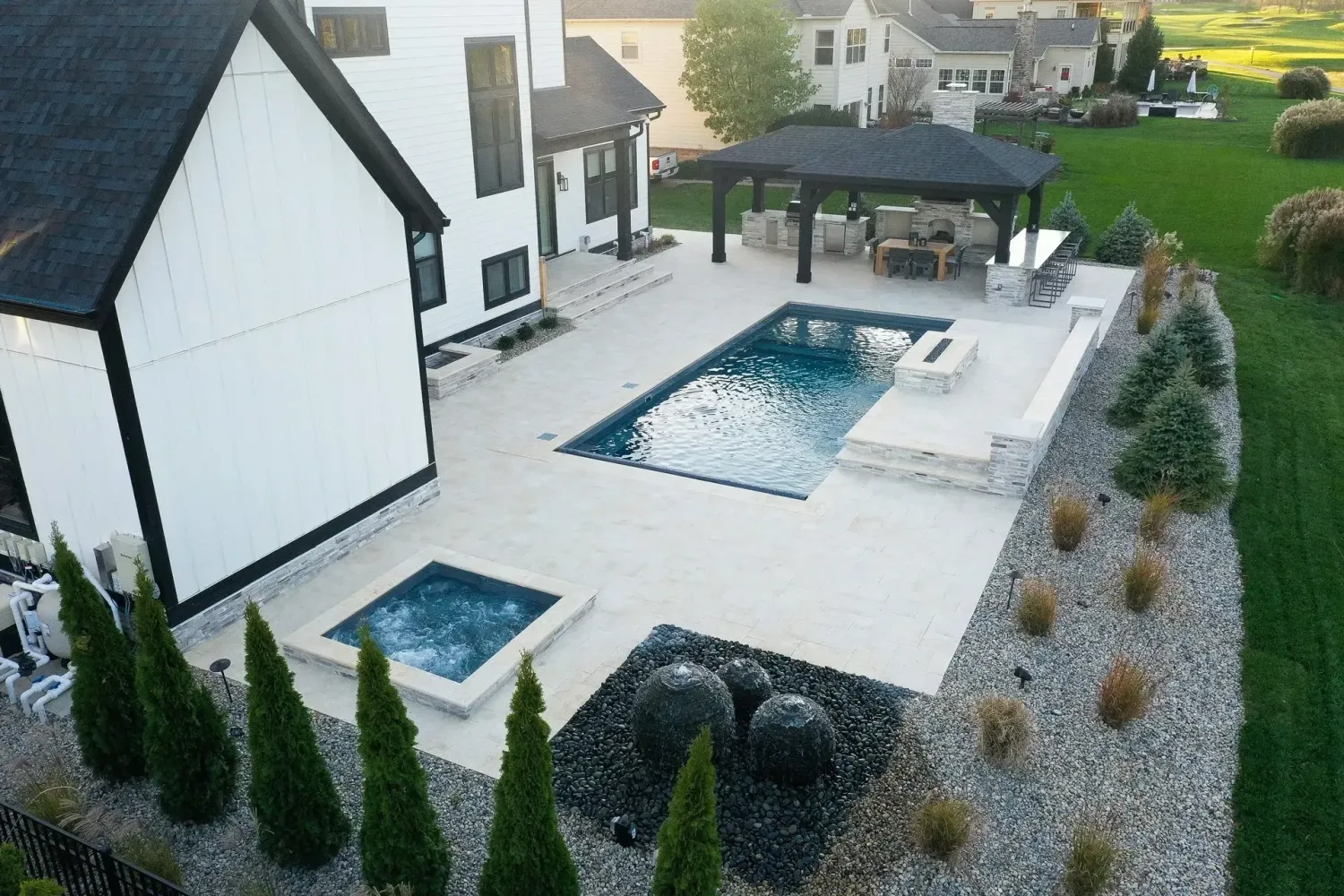
A charcoal-toned paver like Blu 60 in Greyed Nickel, Shadow Black, or Onyx Black will measure 128°F to 138°F at 2 PM in July in Alpharetta. We have logged this on four different jobs. That is objectively too hot for bare feet — you cannot stand on it for more than about eight seconds before your body tells you to move. Kids do not have the patience or sensitivity to manage that. They step, they burn, the pool goes adults-only.
A light-gray paver (Ash, Sandlewood, Shale Grey) does better — typically 116°F to 124°F — but it still runs 12°F to 18°F hotter than cream travertine in the same sun. That is the gap. Light gray concrete is walkable but uncomfortable; cream travertine is comfortable.
The other concrete-paver issue specific to Alpharetta is what sealers do to heat. A wet-look acrylic sealer (popular because it darkens the stone and pops the color) drops albedo by another 0.05 to 0.08 and seals off any pore cooling. If the builder tells you the deck “needs to be sealed for stain resistance and color hold,” ask what the sealed surface temp will measure at 2 PM. If they cannot answer, bring a thermometer to the sample board meeting.
Flagstone, Bluestone, and Poured Concrete — The Also-Rans
For completeness, here is how the other common deck materials perform on an Alpharetta July afternoon.
Tennessee crab-orchard flagstone in the tan-and-pink natural range runs 110°F to 118°F — close to travertine, actually, because the albedo is similar. The problem is installation cost and grout-line maintenance. Irregular flagstone on a mortar bed runs $28 to $38 per square foot installed in the current Fulton County labor market. Travertine on a standard sand-and-polymeric-joint install runs $22 to $28. Flagstone is beautiful and cool, but the price and the ongoing grout repointing make it a lifestyle choice, not a default.
Pennsylvania bluestone in its natural blue-gray color is colder-looking but thermally worse than you would expect — it reads 120°F to 128°F at 2 PM because the blue-gray tone absorbs more visible light than a cream stone does. It is also slippery when wet in a honed/thermal finish. We recommend bluestone for patios, not for primary pool decks in zip code 30005 or 30009.
Poured broom-finish concrete is the original pool deck material and it still has a place — cheap, monolithic, minimal joints. A standard light-gray pour measures 118°F to 126°F on a July afternoon. White or cream-integral-color concrete can drop that to 112°F to 118°F, but you lose the natural variegation that makes travertine visually calm. Poured concrete also cracks. Not sometimes, always — control joints manage where, not whether. On Piedmont red soil in Alpharetta, with its moderately high shrink-swell behavior, concrete slab cracks at control joints within three to five Georgia summers. Travertine on a flexible polymeric-sand setting bed absorbs that soil movement without cracking.
What This Costs in Alpharetta — The Honest Premium
The travertine premium over standard concrete pavers in the current Alpharetta market is $12 to $18 per square foot installed. On a typical 900-square-foot pool deck (roughly what you see on a quarter-acre lot in Ashebrooke or Haynes Manor), that is an $11,000 to $16,000 delta between a charcoal-paver deck and an imported Turkish cream travertine deck. On a 1,400-square-foot deck common in Country Club of the South or White Columns, the delta is $17,000 to $25,000.
We do not sugarcoat that number. It is real money. What we tell homeowners is that the premium buys three things a cheaper deck cannot give you: barefoot comfort from 10 AM to 6 PM, no thermal stress on small children and pets, and a stone surface that ages into patina rather than fading. The travertine we installed on a Deerfield pool in 2018 looks better today, at year seven, than it did the day we finished it. The charcoal-paver decks we installed the same summer have all sealed-bleached in the corners facing south and west, and two of those homeowners have since called us back to overlay travertine on top.
Real numbers, real jobs: 900 sq ft pool deck in Alpharetta, 2026 pricing. Charcoal concrete paver: $22–$26/sqft installed. Light gray concrete paver: $23–$28/sqft. Cream travertine (Turkish Ivory Classic Select, 6cm French pattern): $34–$42/sqft installed including base prep, drainage, and coping.
One more cost note: the City of Alpharetta Community Development office at 2 Park Plaza handles pool and deck permits for in-city properties, which moves faster than the unincorporated Fulton County process — typically 2 to 3 weeks versus 4 to 6. If you are in Windward or Country Club of the South, you also have an ARB (architectural review board) review of 3 to 4 weeks stacked in front of the city permit. We build that into every project timeline.
The Install That Makes or Breaks It — Base, Drainage, and Coping
A cream travertine deck installed wrong will still burn you. Not from heat — from frustration. Settling, heaving, joint separation, efflorescence, pop-outs. Alpharetta’s Cecil-series Piedmont soils move seasonally. A 20-freeze-event winter followed by our wet spring rains cycles the base through enough expansion and contraction that a weak install shows in year two.
Here is the short version of how we build a travertine deck meant to last 30 years in Alpharetta climate.
Excavation and base: 10 to 12 inches total depth below final grade. Bottom 6 to 8 inches is compacted #57 open-graded stone placed over a non-woven geotextile fabric separator. This is the drainage layer — critical in Piedmont clay because the stone aquifer lets water move laterally away from the pool shell and the deck subgrade. Skip this layer and you trap water under the deck, which freezes and heaves in January.
Setting bed: 1 inch of ASTM C33 washed concrete sand, screeded flat. Not stone dust. Not sand-and-cement mortar. Washed sand because it drains and because it lets the travertine float with seasonal ground movement without cracking.
Joints: Polymeric sand rated for pool environments — we use SRW Super Sand or equivalent. Polymeric sand hardens with water activation, locks the joints against weed growth, and stays flexible enough to move with the stone.
Coping: Full-bullnose travertine coping, 12″×24″ or 12″×12″, set on a mortar bed and grouted at the pool shell only. The coping mortar is the one rigid connection — everything else is flexible. This lets the deck breathe thermally without torquing the pool shell.
Slope: 1/8 inch per foot away from the pool (about 1% grade). Not 1/4 inch, which feels like a ramp. Not flat, which ponds. One-eighth. On Alpharetta’s 3 to 6 ft grade change across a typical backyard, we build the deck as a series of planes with subtle grade transitions rather than one forced slope.
The Georgia Power service drop and panel location on the pool-equipment pad matters too, because the trench line for power from house to equipment often crosses the deck envelope. On Alpharetta homes served by Sawnee EMC along the northern Milton border, the inspection calendar runs on a different schedule — we coordinate trench inspections before anything goes under the deck. Get that wrong and you are tearing up new travertine in week four.
The Hot-Foot Reality — Five Years After Install, What Clients Say
We went back to a 2021 travertine install on a home in Cambridge Parks last summer to take photos for this post. The homeowner — a relocated Microsoft engineer who moved from Seattle to the Avalon tech corridor — has three kids, ages 5, 8, and 11 under the pool-opening cycle now. We asked her the one-question survey we ask every five-year-old install: what would you change?
“Nothing about the deck,” she said. “The only thing I’d change is I would have built the pool bigger.” That is the answer we want. That is the answer that says the surface-temp decision was right.
Across our 2019-to-2021 travertine installs in Alpharetta — roughly forty pool decks in Windward, Deerfield, Hutchinson Farm, White Columns, and Haynes Manor — the five-year post-install satisfaction driver that comes up in every conversation is the same: the deck is comfortable. The kids use the pool. The adults walk barefoot from the house to the water at any hour. Nobody is hopping sideways onto the grass.
The tech-corridor relocation buyers we work with — Microsoft, CDW, and the other corporate-HQ families settling near Avalon and Deerfield — tend to be data-driven. They will ask for thermal reflectance numbers, ASTM slip coefficients, and freeze-thaw cycle data before they sign. We have all of that in writing. But the single number that moves the decision every time is the one they can measure themselves with a $30 infrared thermometer at 2 PM on a Saturday in July: 109°F versus 134°F. Twenty-five degrees. The difference between a pool you use and a pool you admire from the air-conditioning.
That is the hot-foot test. Run it on every deck you are considering before you sign. If the builder will not sit through it with you, that is the answer right there.
A quick note on alternatives we don’t recommend for Alpharetta pool decks
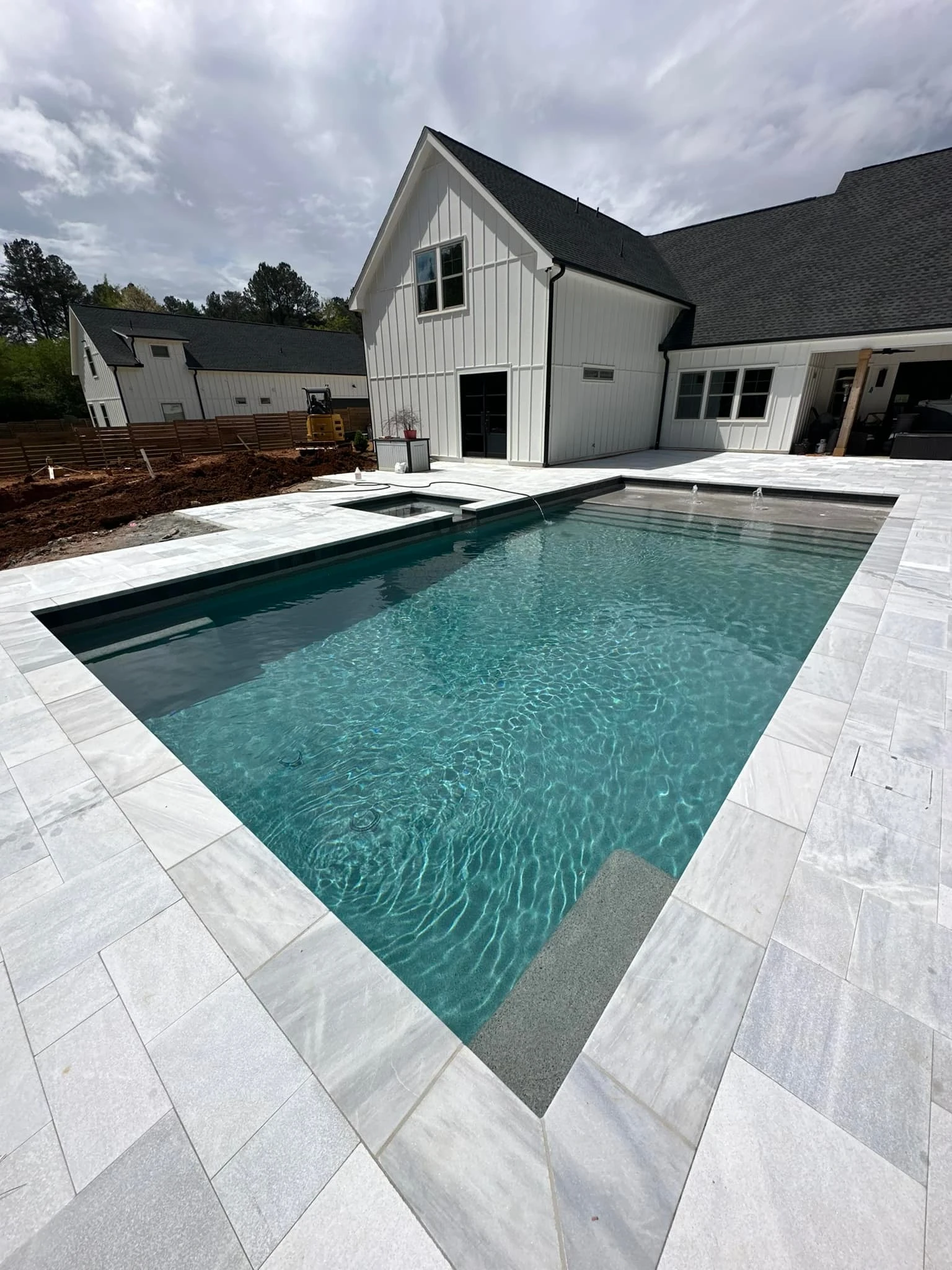
Porcelain pavers in a 2cm pedestal-set format work well thermally (cream porcelain runs 108°F to 114°F) but the 2cm thickness is fragile at pool-coping edges and chips on impact. Porcelain belongs on rooftop decks, not at the waterline. Composite decking at the pool edge traps heat at the substructure and delaminates with chlorinated splash. Kool-deck spray-on texture chalks and releases the color coat by year four in USDA Zone 8a freeze cycles. We will not install it under warranty.

Pavers are not banned from our Alpharetta builds. They are excellent for the driveway, the walkway, the fire-pit lounge, the side yard — anywhere that is not the primary 10-foot barefoot zone around the pool water. The distinction is use, not material. Charcoal pavers on a shaded front walkway never see 2 PM sun and never burn anyone. Put them at the pool edge in full sun and the same stone becomes a liability.
How to Spec a Travertine Deck Contract That Actually Protects You
Three things we put in writing on every Alpharetta travertine deck contract. Use these as a checklist when you review any quote.
1. Stone source and grade in writing. “Turkish Ivory Classic Select travertine, 6cm French pattern, tumbled edge, honed surface, sourced from [mill/quarry name].” Not “cream travertine” or “imported stone.” The grade and source matter because B-grade travertine has more filled pockets and chips at the coping edge within two freeze cycles.
2. Base specification in writing. “10-inch total excavation depth, 6-inch compacted #57 stone over non-woven geotextile separator, 1-inch ASTM C33 washed sand setting bed.” If the contractor will not put base depth and material in the contract, they are planning to skimp and you will not catch it until year three.
3. Deck warranty separated from pool warranty. Pool shell warranty and deck warranty are different insurance regimes. A reputable pool contractor carries a 10-year structural warranty on the shell and a 3 to 5 year workmanship warranty on the deck install, stated separately. If both warranties are lumped together, read the exclusions carefully — you often lose deck coverage the first time any shell work happens.
Alpharetta’s permit process, the ARB timelines in Windward and Country Club of the South, the utility coordination between Georgia Power and Sawnee EMC, the soil behavior of Cecil-series Piedmont clay — all of that shapes how we sequence a build. But the material decision at the deck surface is the one that decides whether your family uses the pool for ten summers or whether the pool becomes the thing you paid for and then avoided until 7 PM. Cream travertine, correctly installed over a real base, solves that problem. Everything else is a compromise with your feet.
Travertine pool decks across 20+ cities within 30 miles of Winder, GA
If you want to run the hot-foot test on your own deck or a sample before you sign anything, we will bring the thermometer, the travertine sample, and the pitcher. Ninety seconds, your backyard, your decision.