
The homeowners stood on the sloped rear lawn of their Foxcreek property at 1,270 feet of elevation, pointed at three different spots, and said the same sentence three different ways: “We want a fire over there for cooking, a fire over there for talking, and a fire over there for reading.” That sentence became a 1,400 sqft backyard retreat — three distinct fire zones, one gas manifold, one pavilion, one carefully-plotted traffic loop — and the answer to a question almost no Atlanta-metro pool builder gets asked: when does more than one fire feature actually make sense?
For most clients, one fire element is the right answer. A single well-built gas firepit, or one outdoor fireplace anchored into a pavilion wall, covers 95% of how people actually use a backyard. It’s when the lot is big enough, the grade change is real, and the family entertains in three separate modes — cooking, conversing, retreating — that a three-zone build stops being excess and starts being the thing that makes the backyard work. Dawsonville lots, with their half-acre-to-two-acre footprints and their serious topography, are one of the few places in the Primetime service area where the math works often enough to talk about.
This project sits just off Dawson Forest Road (Hwy 53), about twelve minutes from Atlanta Motorsports Park and eighteen from Amicalola Falls. The rear yard falls roughly seven vertical feet from the back door to the tree line — a drop we split across three graded terraces and used as the organizing spine of the design. The budget add for the three-zone strategy, on top of the base patio and pavilion, landed at $48,400. Here’s how it was sized, plumbed, and sequenced — and the cases where you should stop at one fire feature instead.
Why Three Zones, and When One Is Still the Right Answer
The reason to zone a backyard by fire type isn’t decorative — it’s behavioral. Cooking fire and conversation fire fight each other. A 48-inch wood-burning firepit roaring at grill temperature throws too much radiant heat for someone trying to read a book seven feet away. A small 24-inch gas bowl set on low flame disappears when six people are standing around a cocktail table trying to hear each other. Put them in the same footprint and both zones compromise. Put them 20 feet apart on different grade lines, and each becomes what it was designed to be.
That logic only pays off on certain properties. Below roughly 1,000 sqft of usable flat outdoor space, a three-zone build crowds the seating and kills the traffic flow. On a dead-level lot with no visual separation, the three zones read as one confused patio. And under a $180K total outdoor living budget, the incremental $38K–$58K for the extra two fire zones usually pulls dollars away from something the family will use more — a cover, a kitchen, a pool upgrade. We turned down two Dawsonville clients in the last eighteen months because the math didn’t work for them; both ended up with a single fireplace under a pavilion and zero regrets.
The Foxcreek property was different. The lot ran 1.4 acres. The main level had already been cleared for a future pool in phase two, which pulled the terrace footprint out to 1,400 sqft. The owners had three adult kids with spouses — so “entertaining” meant eight to twelve people regularly, not four. And the grade change (seven vertical feet back-to-tree-line) created three natural elevations that were going to cost money to terrace anyway. Zoning by fire function piggybacked on grading we were already doing.
Three-zone-worthy indicators: at least 1,200 sqft of buildable outdoor footprint, total outdoor-living budget of $180K+, family entertains groups of 8+ regularly, at least 4 ft of natural grade change across the yard, and a lot over half an acre. Miss two of these and the single-feature approach wins.
Zone 1: The Cooking Firepit Near the Kitchen Door
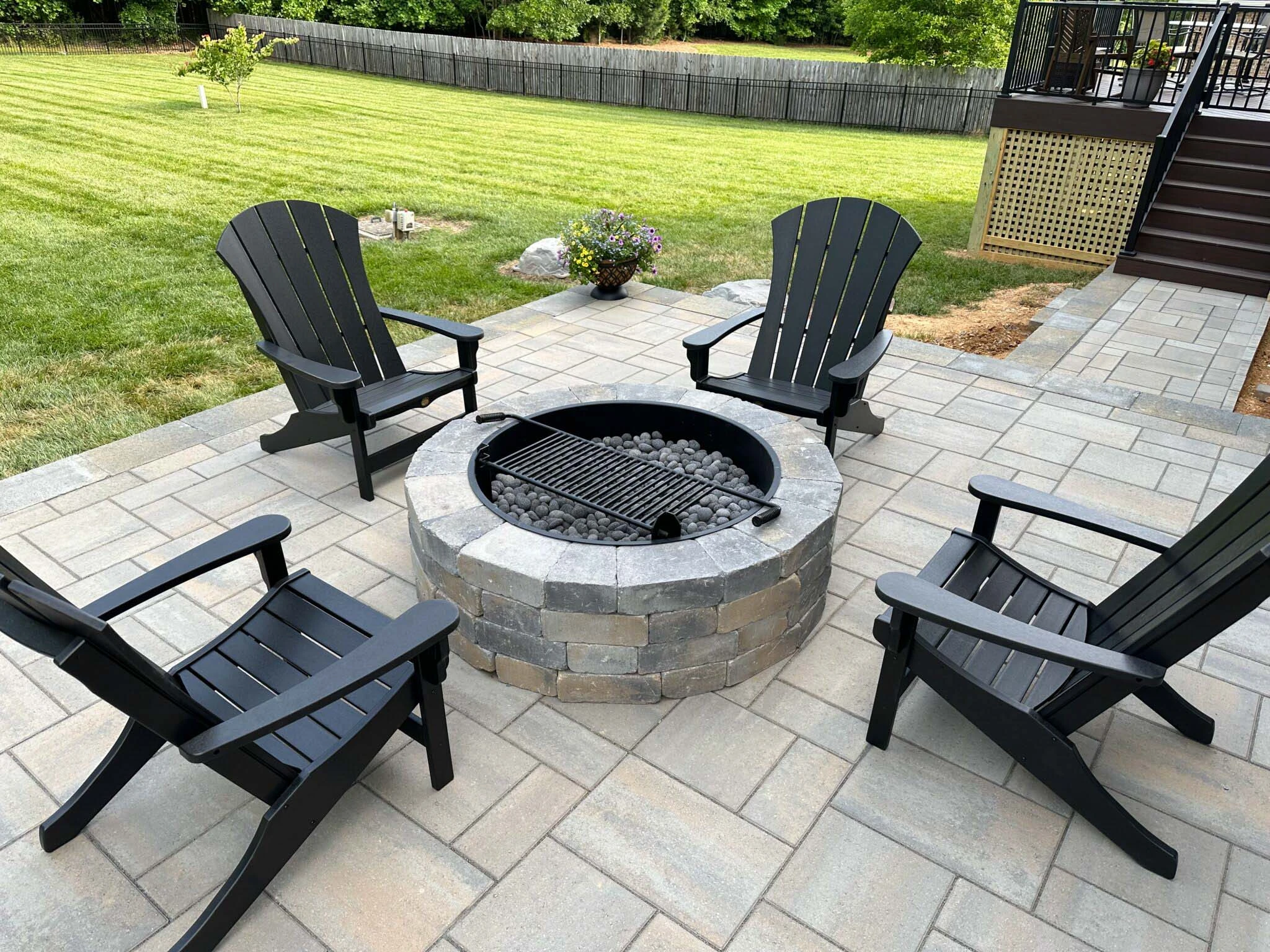
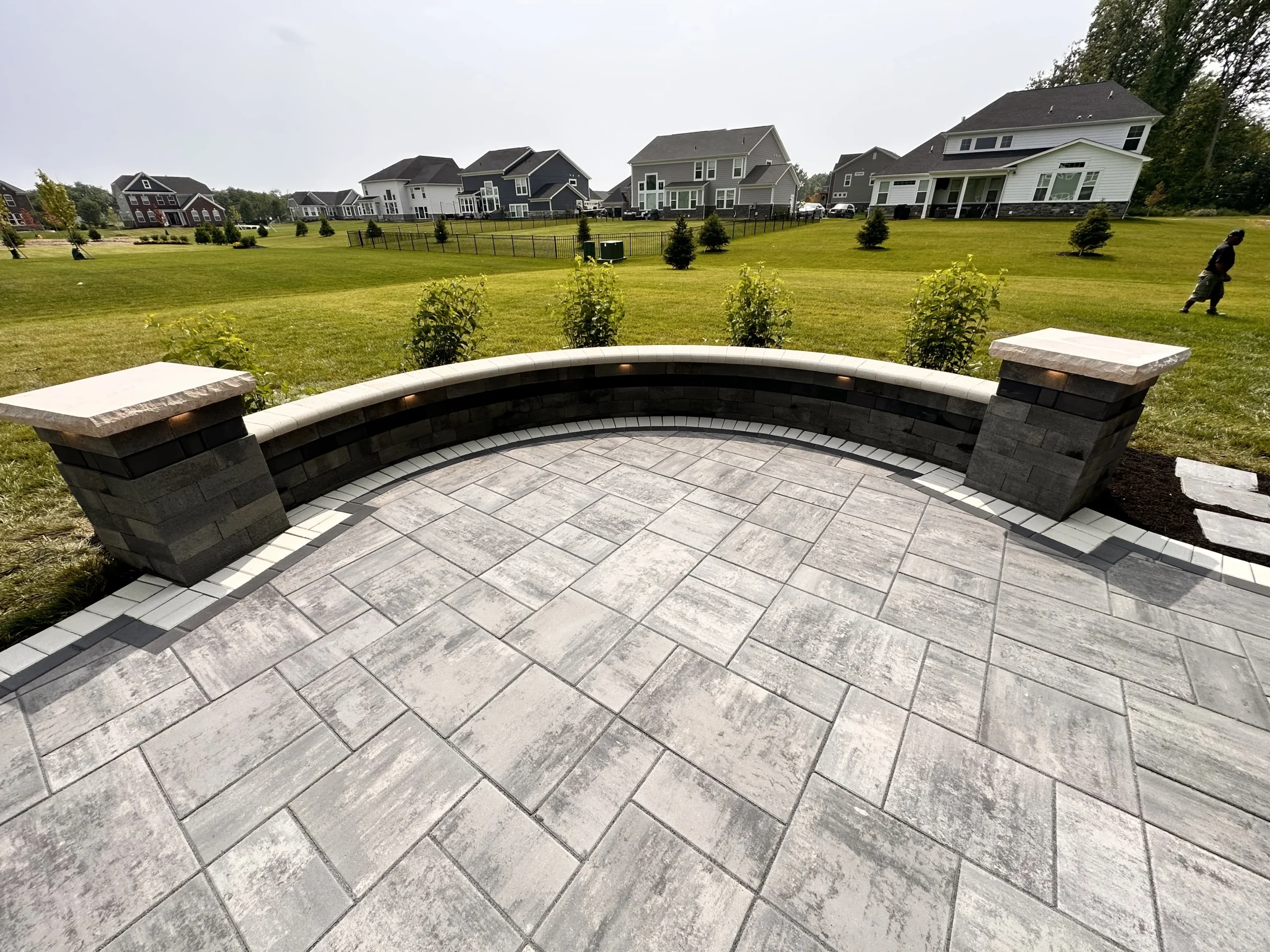
The highest terrace sits directly off the back kitchen door — a 22 ft by 24 ft paver pad in Belgard Holland Stone running bond, bordered with a soldier course in the darker charcoal tone. The cooking firepit is a 48-inch inner-diameter wood-burning build, 16 inches tall, full masonry with a 304 stainless steel insert, and a smoke-colored Pennsylvania bluestone cap. It sits six feet off the pavilion’s south column and nine feet from the kitchen door.
Why wood here instead of gas? The family cooks on it. Cast iron over coals, foil-packet meals, skewers. Wood fire produces the coal bed and the flavor that a gas burner can’t replicate. The tradeoff is heat output — at full burn this firepit puts out roughly 50,000 BTU equivalent, which is why it had to be the zone farthest from any seating that would sit for more than fifteen minutes. Circulation around it is open on four sides, with cooking stools (not lounge chairs) around three sides and a prep counter built into the pavilion column on the fourth.
The ash drop pulls down through a cast iron grate into a concealed masonry ash box with a steel access door at grade level on the downslope side. On a Dawsonville lot with rockier subsoil — we hit weathered granite at 34 inches during excavation for the firepit footing — the ash box actually saved us vertical digging. We stepped the box into the natural rock shelf instead of fighting to excavate deeper than we needed. This is one of the small Dawsonville advantages nobody markets: when the rock is right there, you build into it instead of around it.
Zone 2: The Conversation Ring 18 Feet Off the Pavilion
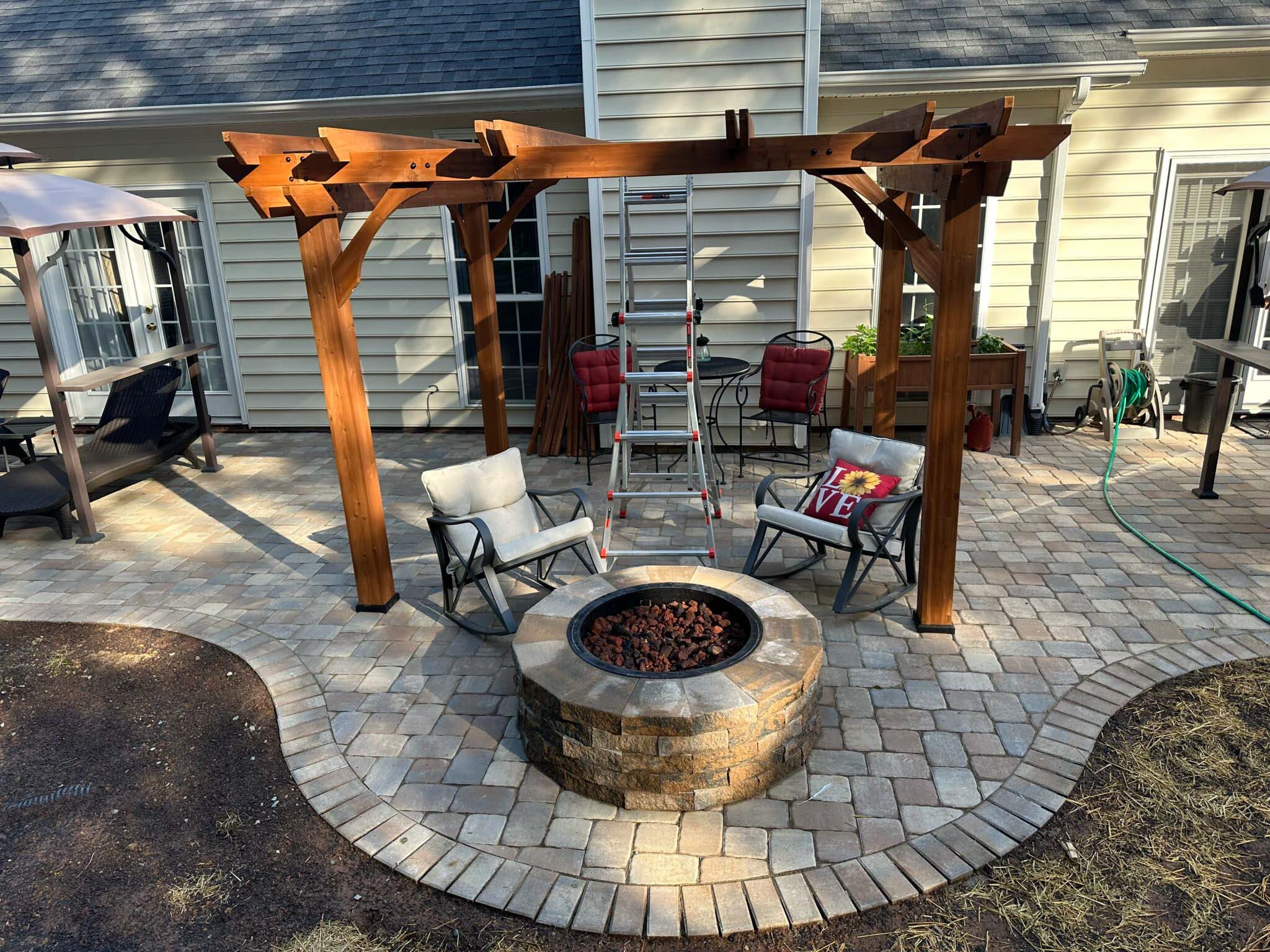
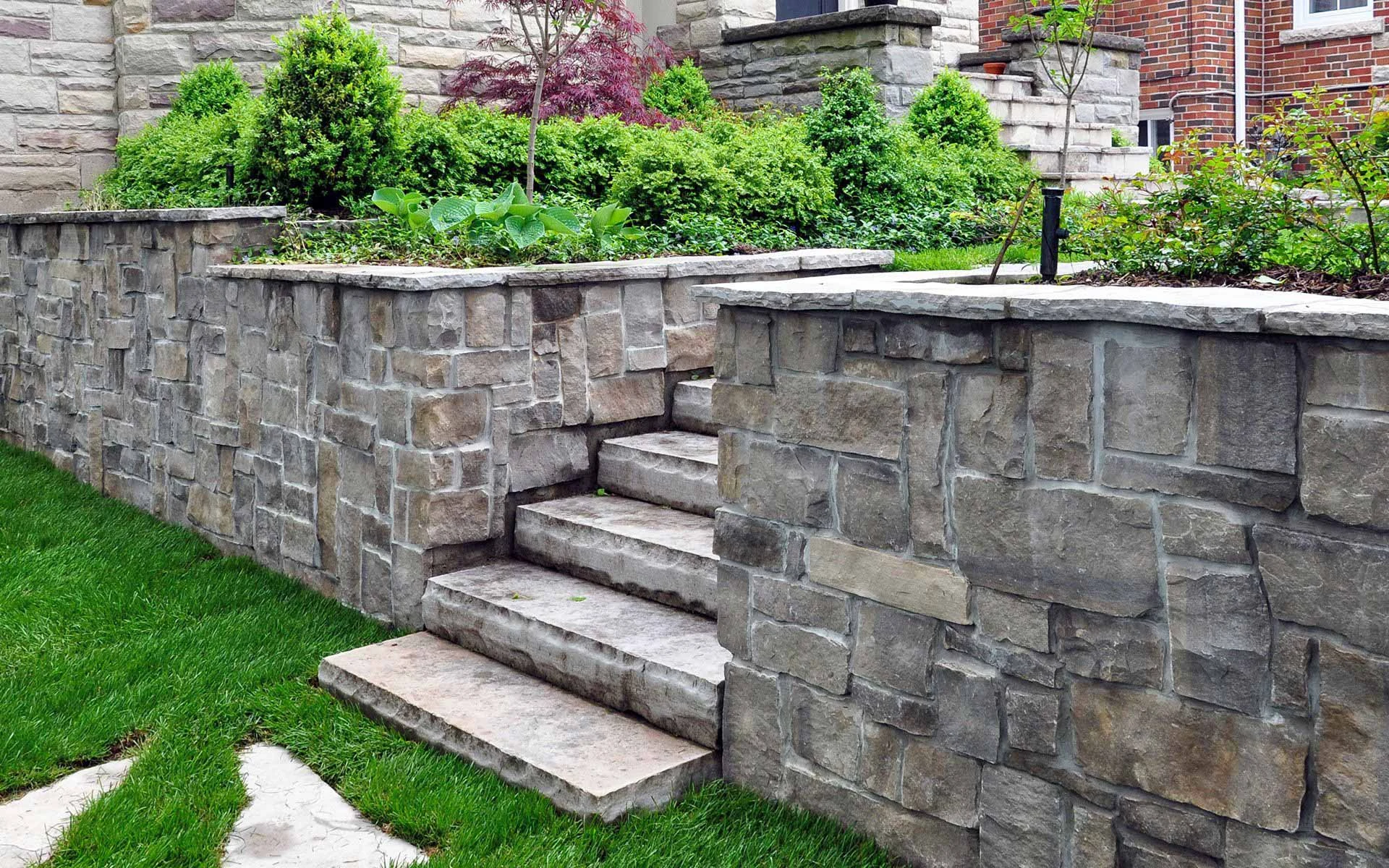
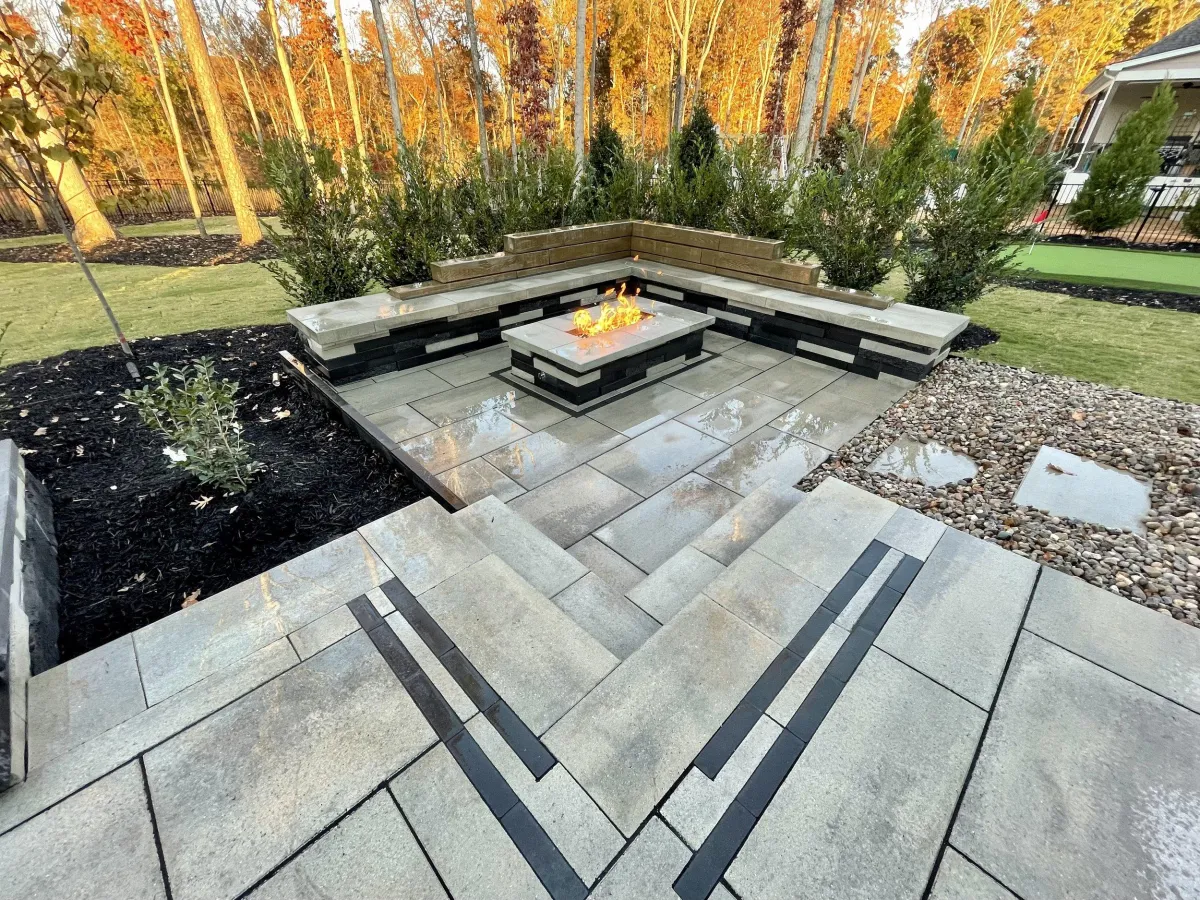
Eighteen feet from the pavilion’s outer edge, down one 6-inch step onto the middle terrace, sits the conversation fire ring. This one is gas — a 36-inch inner-diameter ring with a stainless H-burner rated at 90,000 BTU on high, but almost always run at about 40% for ambient conversation flame. The surround is drystack Tennessee fieldstone to tie into the north-Georgia mountain character of the site. Inside the ring: black lava rock, no glass (glass reads too modern for this particular design vocabulary).
The spacing — 18 feet — wasn’t arbitrary. It’s the minimum distance at which the cooking firepit’s radiant heat and smoke cone stops interfering with seated guests at the gas ring. We know this from building the same pair of features at closer spacings (14 ft, 16 ft) on earlier projects and watching guests drift away on windy nights. Eighteen feet, with a 6-inch grade step between them, creates a real visual and thermal separation without reading as two disconnected patios.
Seating here is four fixed Adirondack-style chairs in powder-coated aluminum (the family didn’t want to move cushions in and out), angled in a loose horseshoe with the pavilion behind them and the tree line in front. Side tables between each pair. An Amicalola EMC service drop feeds low-voltage LED uplights on two oak trees at the yard’s edge, throwing just enough silhouette light to keep the far ground from reading as a black wall. The gas line for this ring is a dedicated 3/4-inch branch off the central manifold, sized for the H-burner’s peak load.
Zone 3: The Reading Nook Gas Bowl at the Tree Line
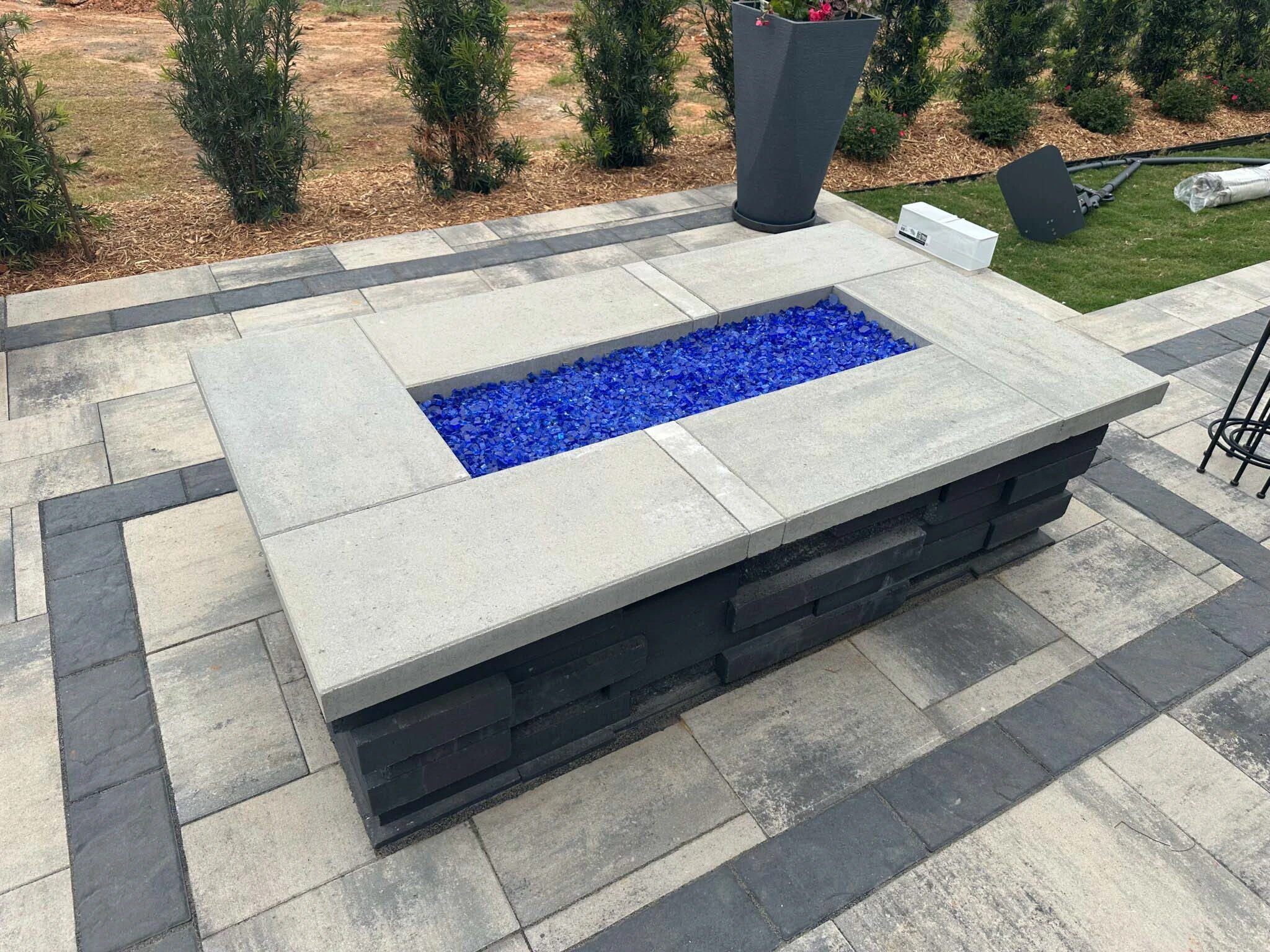
Down a second 6-inch step, 34 feet from the pavilion and 16 feet from the conversation ring, sits the quietest zone. A single 30-inch diameter gas fire bowl — concrete cast in a warm tan tone, set on a small 8×8 paver landing carved into the downslope edge of the yard. One lounge chair. One ottoman. One small round side table for a book and a drink. That’s the whole zone.
The bowl runs on a dedicated 1/2-inch gas line with a manual shutoff key at grade and a thermocouple safety. Flame output is 60,000 BTU max but dialed to roughly 25% for this use case — the objective is warmth and visual focus at arm’s length, not a fire you see from across the yard. The homeowner uses it almost exclusively on weekend mornings with coffee, and weekday evenings after dinner for about twenty minutes at a time. Her husband uses it maybe four times a year. That’s the honest utilization profile, and at $8,900 installed (bowl + plumbing branch + paver landing + chair), it was the zone they almost cut and now use more than either other fire feature combined.
This is the lesson we drill into three-zone clients before we price the job: the zone you’ll end up using most is almost never the zone you expected to use most. Plan for that surprise by keeping the smallest zone functional and comfortable on its own, without the other two active. If the reading nook only works when the pavilion is lit and the conversation ring is burning, it’s not a zone — it’s a spillover seat.
The Pavilion Anchor — Where Everything Converges
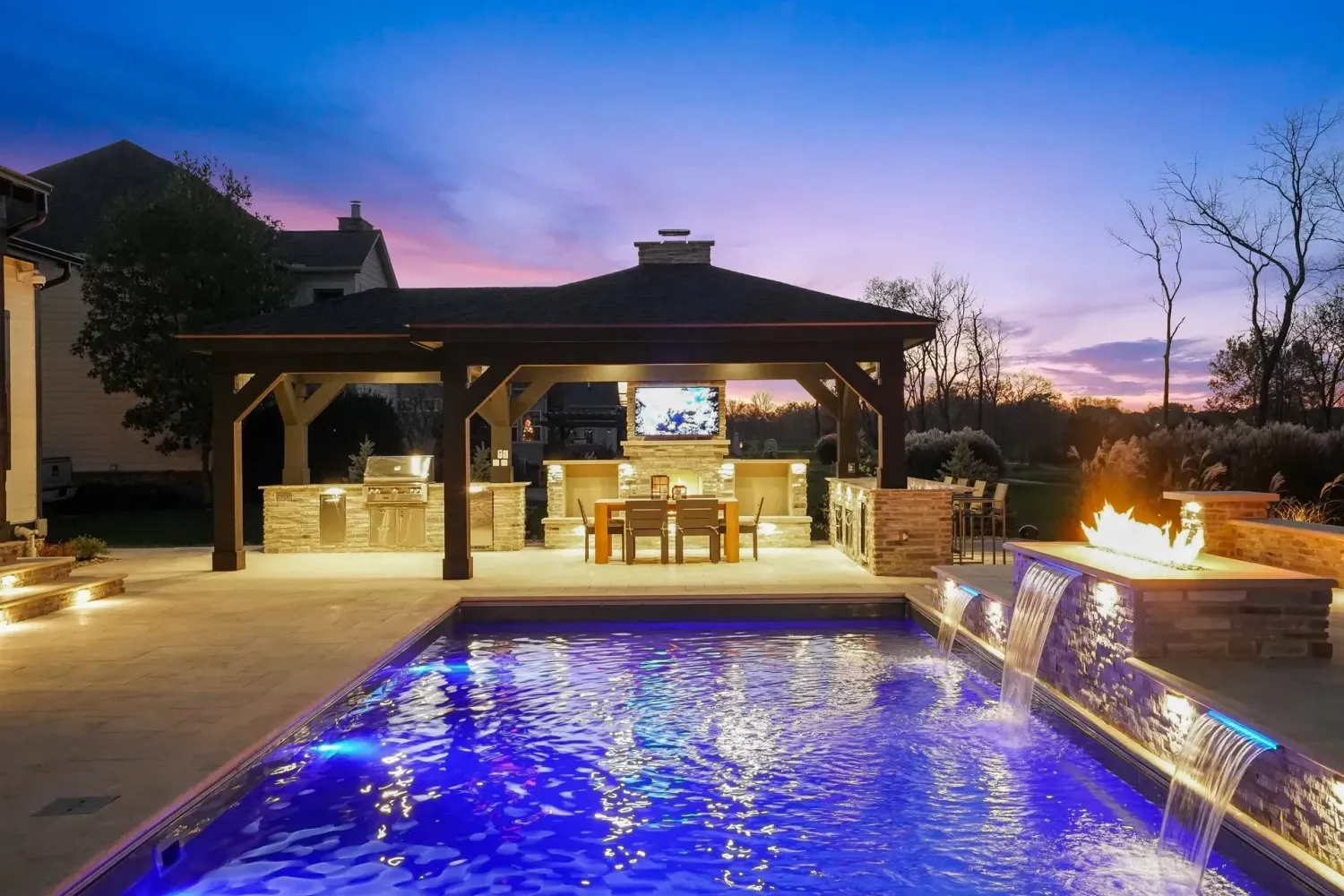
The pavilion is the structural anchor that makes the three-zone strategy legible. It’s a 20 ft by 16 ft gable-roof structure in stained cedar with standing-seam metal roofing in dark bronze, open on three sides, closed on the north side with a full outdoor fireplace. That fireplace — which is technically a fourth fire feature but functions as architecture rather than a zone — runs on gas with a ceramic log set, 65,000 BTU, and it’s the feature that anchors the cold-weather version of the backyard. When the outside temperature drops below about 48°F, the outer zones become uncomfortable regardless of fire output, and the whole party pulls under the pavilion around the fireplace.
At Dawsonville’s elevation, that temperature gets hit roughly 30 freeze events per year — ten more than Dacula, and a real design variable. A single-zone Dawsonville project with only an outdoor firepit (no covered fireplace) loses about six weeks of use in the shoulder seasons that a pavilioned property keeps. For this family, the pavilion fireplace extended the usable outdoor-living calendar from roughly mid-March through late November, with short winter-weekend pockets in between. The three outer zones, plus the pavilion anchor, gave them what they called “a summer, a fall, and a winter backyard” from the same patio.
Sight lines were planned on a scaled site plan before any concrete was poured. From the pavilion’s lounge zone, you can see all three outer fire features simultaneously — a fact that matters for supervision when grandkids are in the yard, and for presence when the host is “in” one zone but tracking conversation in another. From the reading nook at the tree line, you can see the conversation ring but not the cooking firepit (the grade step and a planted Cryptomeria buffer intentionally block that view). From the conversation ring, you can see both the pavilion and the reading nook. That triangulated visibility was drawn, argued, revised, and signed off before we broke ground.
Gas Manifold Sizing and the Amicalola EMC Service Drop
The plumbing is the part that surprises clients. Running gas to three separate fire features plus a pavilion fireplace isn’t three independent runs from the meter — it’s one central manifold with sized branch runs. Miss the math and one or more features starves on high load.
Total peak BTU load for this project, if every gas feature were running at max simultaneously: pavilion fireplace 65,000 + conversation ring 90,000 + reading nook bowl 60,000 + future outdoor kitchen allowance 120,000 = 335,000 BTU. The existing house gas meter was rated at 250,000 BTU. The utility — Atlanta Gas Light, in this case, not the electric EMC — needed to upgrade to a 425,000 BTU meter with a new regulator, priced at $1,850 including trench restoration. That upgrade is mandatory the moment you cross the original meter’s rating; we flag it at the proposal stage so it never shows up as a surprise change order.
The manifold itself is a 1-1/4 inch black iron header buried three feet deep along the back wall of the pavilion footer, with four branch tees in 3/4-inch and one in 1/2-inch. Each branch has an accessible quarter-turn shutoff inside the pavilion mechanical chase, so any single feature can be serviced without cutting gas to the others. The pressure test was held at 10 psi for two hours before backfill, per Dawson County inspection protocol, and documented with photos for the final permit closeout.
Electrical came off an Amicalola EMC service drop we pulled to a dedicated sub-panel in the pavilion chase — 100 amps, enough to handle current ceiling fans and LED lighting plus a future outdoor kitchen with a 240-volt appliance circuit. One budget line people miss: at this elevation and lot size, the EMC drop itself ran $2,400 beyond the sub-panel install, because the nearest transformer was 240 feet from the pavilion location and they added a new pole.
Dawson County permit path: All fire-feature work requires mechanical and gas permits from Dawson County Dept. of Planning & Development at 25 Justice Way. Inspections for gas pressure test, footing depth, and final. Plan 2–3 weeks from submission to inspection slot during peak spring schedule.
Excavation on Saprolite: Why Dawsonville Digs Different
Most of the Primetime service area sits on Piedmont clay — firm, workable, predictable. Dawsonville is where that changes. At 1,270 feet of elevation the subsoil is thinner topsoil over stony residuum — weathered granite and saprolite that shows up at typical excavation depths of 2 to 6 feet. For this project’s pavilion footer (36 inches deep), cooking firepit footer (42 inches), and gas trench (36 inches), we hit partial rock on every one of the three deep holes.
Partial rock means jackhammer work, sometimes blast charges. On this project we used compressed-air hammers on two of the three rock pockets and added one small shaped charge — a $680 line item — for a single stubborn outcrop at the firepit location. That’s still cheap compared to some Dawsonville-adjacent jobs where we’ve priced $8 to $14 per cubic yard rock-blast premium on top of standard excavation. A typical Dacula or Snellville dig doesn’t see a dollar of that.
The upside: once you’re past the rock, the drainage is better than Piedmont clay. Water moves through weathered granite and saprolite faster, which means the patio sub-base needs less perimeter drainage than we’d spec for a Gwinnett County job. We pulled 6 cubic yards of Georgia no. 57 stone for the base and skipped the French drain loop we would have run on a comparable Dacula build. Net cost of the rock premium minus the drainage savings on this project: about $2,100 extra than an equivalent Piedmont-soil build. Material matters, but it matters less than people expect if you design around it.
The Real Cost Breakdown, and When to Cut a Zone
The clean number people want is the bottom-line add for the three-zone strategy. Here’s what the $48,400 on top of the base hardscape and pavilion actually paid for:
- Zone 1 cooking firepit (full masonry, 48-inch, stainless insert, bluestone cap, ash drop, rock-blast allowance): $14,200
- Zone 2 conversation gas ring (36-inch, Tennessee fieldstone surround, H-burner, lava rock, dedicated gas branch): $11,800
- Zone 3 reading nook gas bowl (30-inch concrete bowl, paver landing, gas branch, shutoff key): $8,900
- Gas manifold + meter upgrade + trenching + pressure test + permits: $6,400
- Amicalola EMC service drop + sub-panel: $4,600
- Incremental grading, terracing, retaining detail beyond baseline: $2,500
That $48,400 is the all-in delta for the zone strategy on top of a $94,000 pavilion-and-patio base. Total project came in at $142,400. Against comparable single-fireplace-under-pavilion builds we’ve completed in Dawsonville at $96K–$108K, the three-zone premium is roughly $38K–$46K — right in the $38K–$58K range we quote up front. The $58K ceiling hits on projects with more complex grading, a larger pavilion, or an outdoor kitchen integration. The $38K floor is a leaner version of this same build on flatter ground.
If you have to cut a zone, cut the conversation ring first. It’s the biggest budget line that doesn’t have a distinctive use case — the pavilion lounge with the gas fireplace covers conversation fine in most weather. The cooking firepit is functionally irreplaceable if the family actually cooks over fire. The reading nook, despite being the smallest ticket, delivers the highest utilization per dollar because one person uses it four or five days a week. Cut the middle zone, save $11,800, keep the other two, and you’ve built a smarter version of the same idea.
Dawsonville’s combination of elevation, rock, freeze count, and lot size is the reason this build pencils out here in a way it rarely does closer to Atlanta. The 30 freeze events per year make the pavilion anchor earn its keep. The rocky subsoil and weathered-granite subgrade make terracing a feature rather than a cost explosion. The 1/2-acre-plus lots give the 20-foot spacings room to breathe. The nearby GA-400 corridor means equipment and material trucks actually reach the site without a surcharge. Take any one of those four variables away and the math gets wobbly fast — which is why we don’t propose this strategy on smaller lots, flatter ground, or warmer microclimates without talking the client out of it first.
If you’re considering a backyard retreat at this scale in Dawson County, Big Canoe, Cumming, Gainesville, or the broader Northeast Atlanta footprint, the right first conversation isn’t about fire features. It’s about whether your lot, your entertaining pattern, your budget, and your shoulder-season calendar line up with a zoning strategy in the first place. Most of the time they don’t, and one great fire feature wins. When they do — when all four variables align — the three-zone retreat becomes the most-used room in the house.
Fire pits, fireplaces & full outdoor retreats across 20+ cities within 30 miles of Winder, GA
From single-feature gas bowls in Lilburn to three-zone pavilion retreats in Dawsonville’s North Georgia foothills, Primetime Pools GA designs and builds outdoor fire features engineered around your lot, your climate, and the way your family actually entertains.