
It’s a Tuesday afternoon in late July off Johnson Ferry Road, the concrete saw has been running since 7 a.m., and a Cobb County homeowner in Indian Hills is watching a wall of charcoal clouds stack up over Kennesaw Mountain. In forty-five minutes the crew will tarp the base, run for the trailers, and a pour originally scheduled for Wednesday will get pushed to Friday — and then into the following Tuesday when the saturated subgrade fails a density test.
That scene is the entire reason this blog exists. Marietta sits in the heart of Cobb County, inside a weather corridor that averages 9 thunderstorm days in July and 8 in August. Pool coping, patio pours, retaining-wall bases, and travertine sets all have one thing in common: they cannot be executed in the rain, and the subgrade cannot be executed on the rain. Seventeen potential build-halt days across a 62-day calendar stretch is not a scheduling inconvenience. It is a structural scheduling reality, and it dictates whether your hardscape finishes on time or drifts through autumn tailgates, Thanksgiving, and half of football season.
This post is a chronological field guide — week by week, decision by decision — for timing a Marietta hardscape build around the county’s real storm calendar. We’ll compare a July-start project to an October-start project on the same scope, show exactly where the 4.5-week delta comes from, and tell you when the fall/winter labor premium pays for itself three times over. We’re writing it specifically for Marietta because the interaction between Cobb’s topography, the Kennesaw Mountain ridge, the Piedmont clay subgrade, and the county permit office creates a scheduling equation unique to this city. A Johns Creek build or a Cumming build has different inputs. This one has its own.
If you’re reading this in February and eyeing a June party, the most honest thing we can tell you is that the storm calendar has already made the decision for you. Read on, and we’ll show you exactly why.
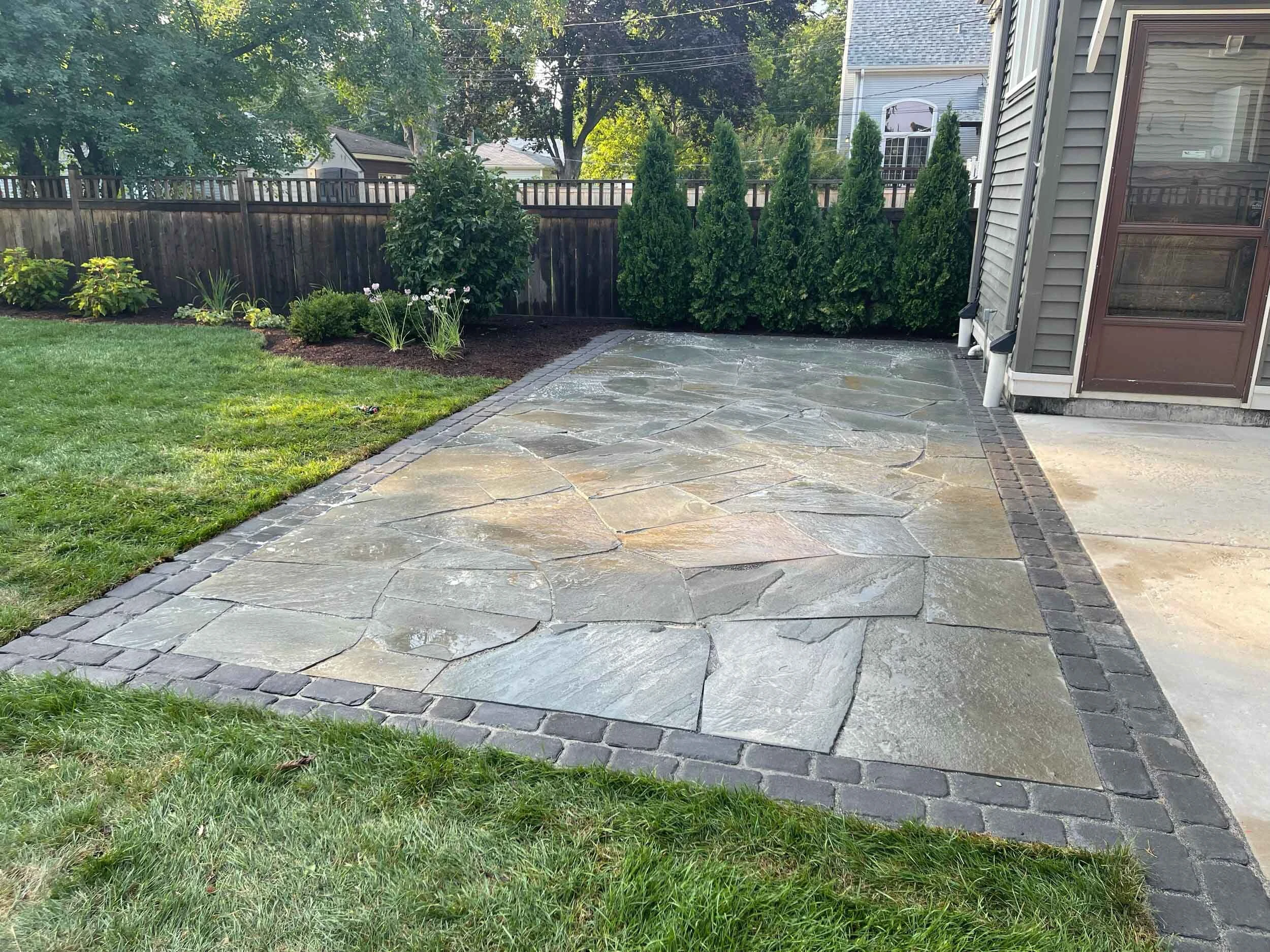
Week Zero: Reading the Cobb County Storm Calendar Before You Sign
Before a shovel touches the yard, we open the NOAA Atlanta/Peachtree City WFO climatology table and the homeowner’s calendar at the same time. Marietta sits at roughly 1,118 ft elevation with Kennesaw Mountain rising to 1,808 ft on the northern boundary, and that ridge line does real work on summer weather. Warm, moisture-heavy air from the Gulf rides up the mountain, cools, and dumps — which is why Cobb’s afternoon storm totals often run heavier than what forecasters call for the broader Metro Atlanta grid.
The usable numbers for planning: Marietta averages roughly 52 inches of rain per year, and roughly 35% of that falls in the June-through-September window. July alone averages 9 thunderstorm days. August, 8. That’s two out of every seven calendar days where crews either can’t pour, can’t compact, or can’t safely run a concrete saw on a wet slab. For a job that has 18 dry-weather work days scheduled inside a 62-day window, losing 17 of them to storms is mathematically brutal.
We’d rather tell you this at contract signing than discover it together in August. So week zero is when we run the math publicly — not behind closed doors — and show you what a summer buffer actually looks like on your specific scope.
Cobb County summer reality: 9 thunderstorm days in July + 8 in August = 17 potential build-halt days across 62 calendar days. We add a 25% schedule buffer to any Marietta hardscape that pours between June 1 and September 15.
Weeks 1–2: Permit Timing at 1150 Powder Springs Street
Cobb County Community Development at 1150 Powder Springs Street, Marietta handles the land-disturbance and structural permits that most hardscape projects above 500 sq ft or with retaining walls over 4 ft will trigger. The counter is fast by Metro Atlanta standards — typical turnarounds are 5 to 12 business days when drawings are clean — but here’s the catch: your permit clock is deterministic while your build clock is weather-dependent.
A homeowner in Burnt Hickory who submits on June 2 and receives stamped plans on June 14 has done everything right. But if crew mobilization lands on June 18 and the next week’s forecast shows three rain days out of five, the first swing of a pick mattock has already been delayed. That’s why we line up permit submission to land 2 to 3 weeks before the target mobilization — not the other way around. You want the permit sitting in hand, waiting, while we watch the 10-day forecast for a dry window.
For Atlanta Country Club and other HOA-heavy neighborhoods, architectural review adds 2 to 4 additional weeks on top of the county process. That’s another reason summer starts go sideways: HOA approval arrives in June, permit in mid-June, and the build gets a green light the same week the first mesoscale convective system rolls through.
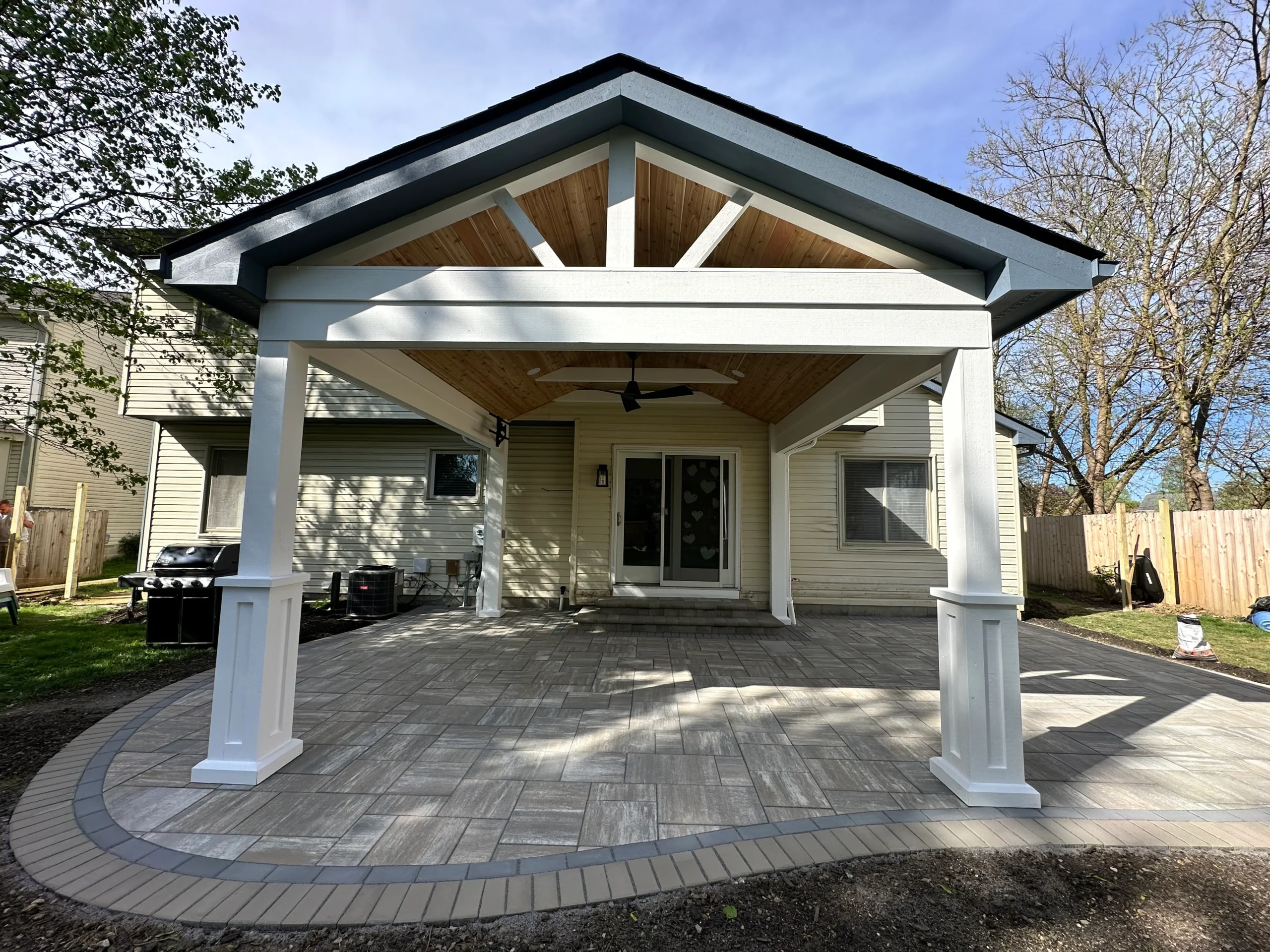
Weeks 2–3: Grading and the East Cobb Clay Problem
Marietta backyards sit on the Cecil series Piedmont clay that dominates the northern metro. Cecil clay has one personality in dry conditions — firm, diggable, predictable — and a completely different personality at 60% or higher moisture content, where it turns to greased putty that won’t hold compaction and won’t pass a density test. Many East Cobb neighborhoods have slightly better-draining sandy-loam pockets, but “slightly better” still means “useless in a downpour.”
Grading is the single stage where summer rain punishes you hardest. Once you’ve opened the subgrade and exposed clay to sky, a single 1.5-inch afternoon storm can add 3 to 5 days of drying time before the base can be cut, benched, or compacted again. We’ve had Walton Woods jobs where the grader left on a Thursday, a 2.3-inch storm hit Friday night, and the soil didn’t dry back to spec until the following Wednesday — five lost days on one afternoon’s weather.
Typical Marietta backyards have 3 to 6 ft of grade change from house to rear lot line. On a dry-weather build, that grade gets benched, cut, or stepped in 2 to 4 working days. On a storm-interrupted build, the same work stretches across two weeks because the crew has to keep retarping, pumping, and rebenching the same surface.
Weeks 3–4: Base, Compaction, and the Density-Test Trap
After grade, a proper paver or travertine hardscape gets a compacted aggregate base — typically 6 inches of GAB (graded aggregate base) for patios, 8 to 10 inches for driveway-rated and outdoor kitchen pads, all placed in 2-inch lifts. Each lift gets a 5,000-lb plate compactor pass until density targets hit 95% Modified Proctor or better. The work is fast when conditions cooperate — a 600-sq-ft patio base hits compaction spec in about a day and a half.
What kills summer schedules is the moisture envelope for compaction. GAB compacts properly between roughly 4% and 8% moisture content. A pop-up thunderstorm that drops a half inch on an exposed base pushes moisture to 12% or 14%. Now the compactor either pumps the aggregate, fractures the fines, or bounces without achieving density. The fix is to pull the wet lift, replace it with dry stone, and start over — every single time.
In fall builds we almost never have to pull a lift. In July and August builds we plan for it. That’s the 25% buffer line-itemed into your estimate.
Moisture threshold for GAB compaction: 4–8% is the target envelope. A half-inch afternoon storm can push exposed base to 14% moisture in 20 minutes — making the prior day’s work a re-do, not a foundation.
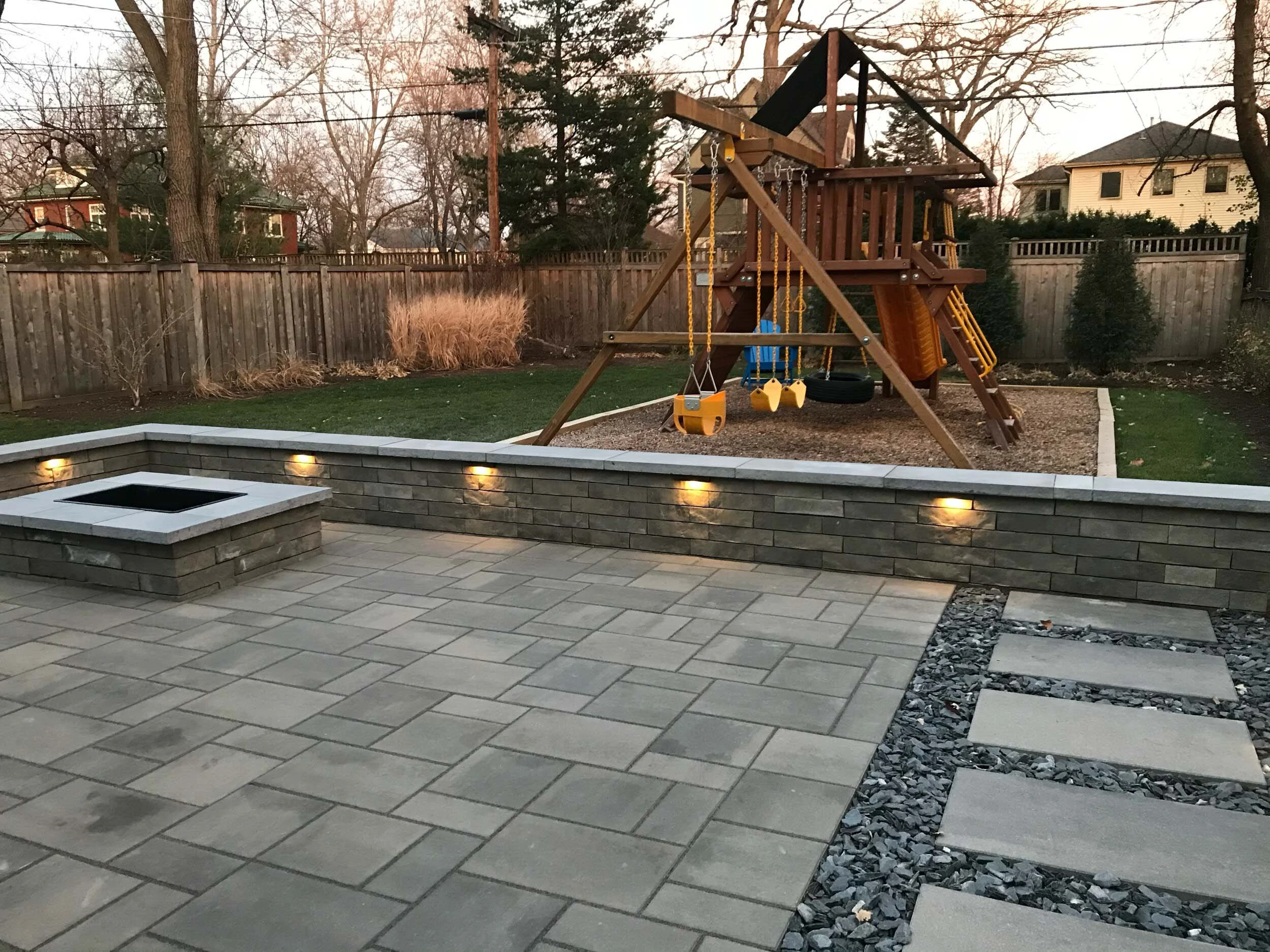
Weeks 4–5: Concrete Pours and the 48-Hour Forecast Rule
Ready-mix concrete in Marietta comes from plants on Cobb Parkway (Hwy 41) and along the I-75 corridor, and turnaround from batch to placement is tight — usually under 45 minutes from plant to pad. That logistical efficiency becomes a liability in summer because a pour scheduled for 9 a.m. on Tuesday can’t be canceled at 10 p.m. Monday when the forecast shifts. The ready-mix dispatcher needs 24 hours minimum, often 48.
Our internal rule: we do not pour if the NWS forecast shows 40% or higher probability of precipitation in the 48-hour window following the pour. Fresh concrete’s early-age surface is vulnerable for the first 4 to 6 hours (scour from rain impact), and proper curing continues for 7 days. A storm at hour 3 turns a $4,800 patio pad into a crater-pitted surface that needs grinding or replacement.
July and August in Marietta regularly stack 3-day forecasts where every day hits 50% POP. That’s not a forecast — that’s a postponement. Fall builds see those stretches maybe once a month. Winter, almost never.
Weeks 5–7: Pavers, Stone, and the Setting Bed Timeline
Once base passes density and any concrete has cured, setting begins. Techo-Bloc, Belgard, and full-thickness travertine all go down on 1 inch of screeded sand or a 1/2-inch mortar bed depending on application. This stage is more forgiving than the grading and base stages — a light rain on set pavers isn’t fatal, just annoying — but heavy rain washes joint sand out of freshly swept joints before polymeric activation, which means re-sweeping and re-activating the whole field.
A 600-sq-ft travertine patio in Marietta Country Club sets in about 4 to 5 working days under normal conditions. Same patio, started mid-July, commonly stretches to 7 or 8 days because of storm breaks — even when no single storm damages the work. The cumulative effect of tarping, untarping, resweeping, and rescheduling the polymeric sand activation (which needs 24 dry hours post-wetting) burns a full week.
For retaining walls — block, natural stone, or segmental — the story is the same. The wall itself handles rain. The base it sits on doesn’t. We’ve rebuilt too many 30-inch garden walls in Seven Oaks where the prior contractor set block on wet clay and the wall settled 2 inches in year one. Timing is why we avoid that.
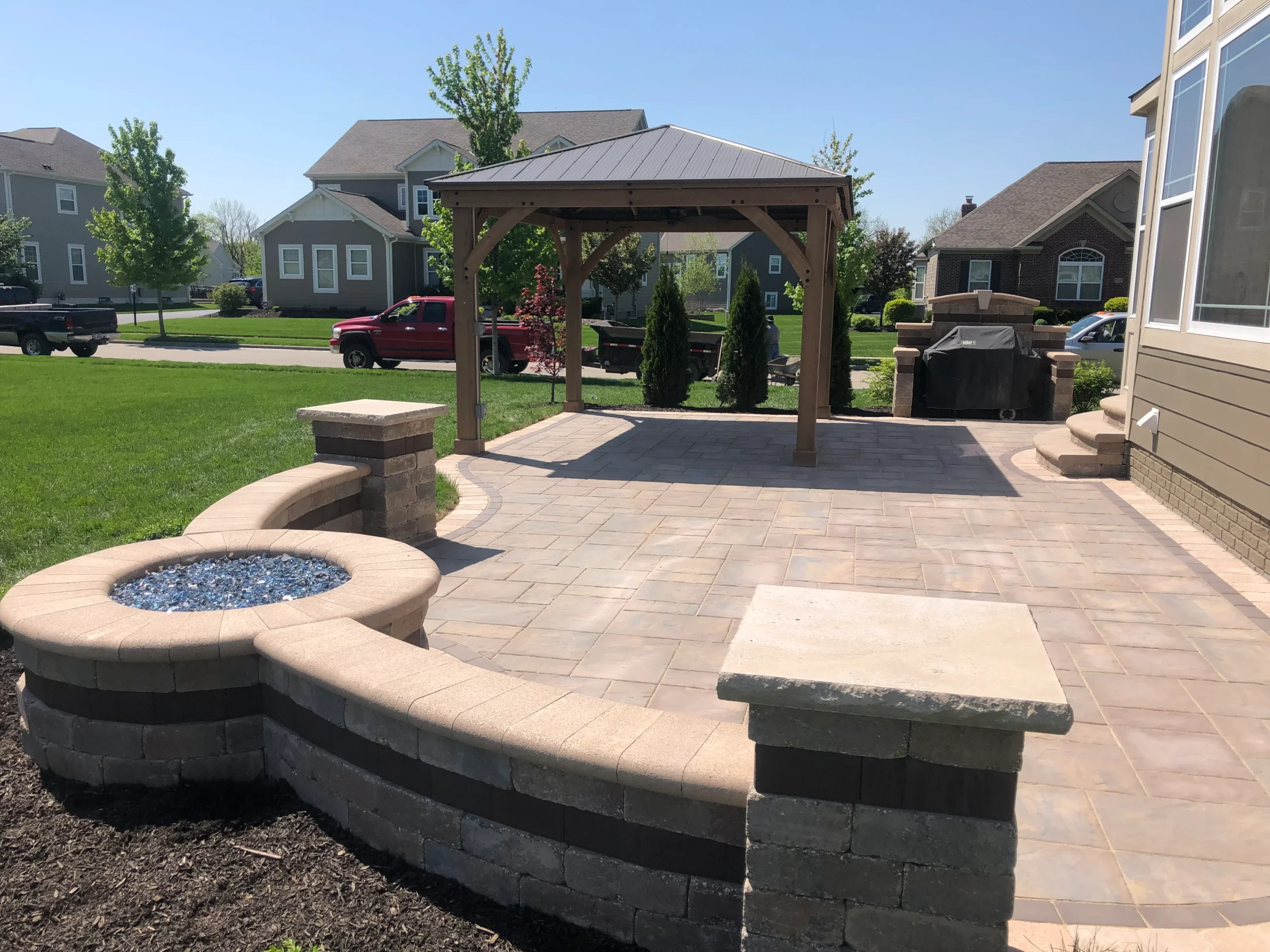
Weeks 7–10: Outdoor Kitchens, Cobb EMC Service, and the Punch List Nobody Mentions
Structural hardscape is only half the job for most Marietta clients. The other half — outdoor kitchens, pergolas, landscape lighting, fire features — brings electrical coordination into the timeline. And here’s the Marietta-specific wrinkle: depending on where in the city you sit, your utility is either Cobb EMC (the member-owned electric cooperative) or Marietta Power for residences inside the incorporated city limits.
Both utilities will schedule a 240V service upgrade visit if your existing panel can’t handle a new 40A or 50A outdoor kitchen circuit plus a 20A pergola lighting load. Cobb EMC’s residential service call lead time varies but typically lands in the 10 to 20 business day range. Summer storms drive line crews to emergency restoration work, which stretches non-emergency service calls further. We’ve had August projects wait 3 weeks for a scheduled meter swap that would have taken 5 days in November.
If your build includes electrical, we sequence the utility request to go in at the same time as the permit — week zero. That way Cobb EMC or Marietta Power has your ticket on the board before the storm season stress-tests their schedule.
Finish work — sealing, joint sand activation, touch-up grading, landscape backfill — runs during the final weeks. For any build wrapping in October and November, the secondary issue is Marietta’s mature East Cobb tree canopy. Parts of Indian Hills, Sope Creek, and the older sections of Chestnut Hill sit under 60 to 80-year-old oak and tulip poplar. Leaf fall runs mid-October through mid-November and puts above-average leaf load on skimmer baskets, pool decks, and newly sealed pavers.
This isn’t a reason to avoid fall builds — it’s a reason to sequence the final seal 2 weeks after the heaviest leaf drop, not before. Sealing a patio on November 1 means a leaf-stained patio on November 15. Sealing on November 22 means a clean finish that carries through winter.
On summer builds, by contrast, the punch list gets interrupted over and over by afternoon storms. A final polymeric sand activation is a 30-minute job in October. In August, it’s often a three-attempt project because the activation window keeps getting rained out.
We also use the final 2 weeks for a full drainage walkthrough. Marietta’s rolling Piedmont terrain means nearly every property handles runoff differently — a backyard in Brookstone that drains west along the lot line, a Chestnut Hill yard with two distinct collection points, a Sope Creek build where 3 feet of grade change pushes water toward the house if grade isn’t held. We walk the finished hardscape, simulate a 1-inch rain event with a hose, and watch where water actually goes. Any pooling within 3 feet of the house or the pool coping gets addressed before we leave the site. This is the step most crews skip. It’s also the step that prevents $2,400 callback work in year two.
Summer vs. Fall: A Real Marietta Project Comparison
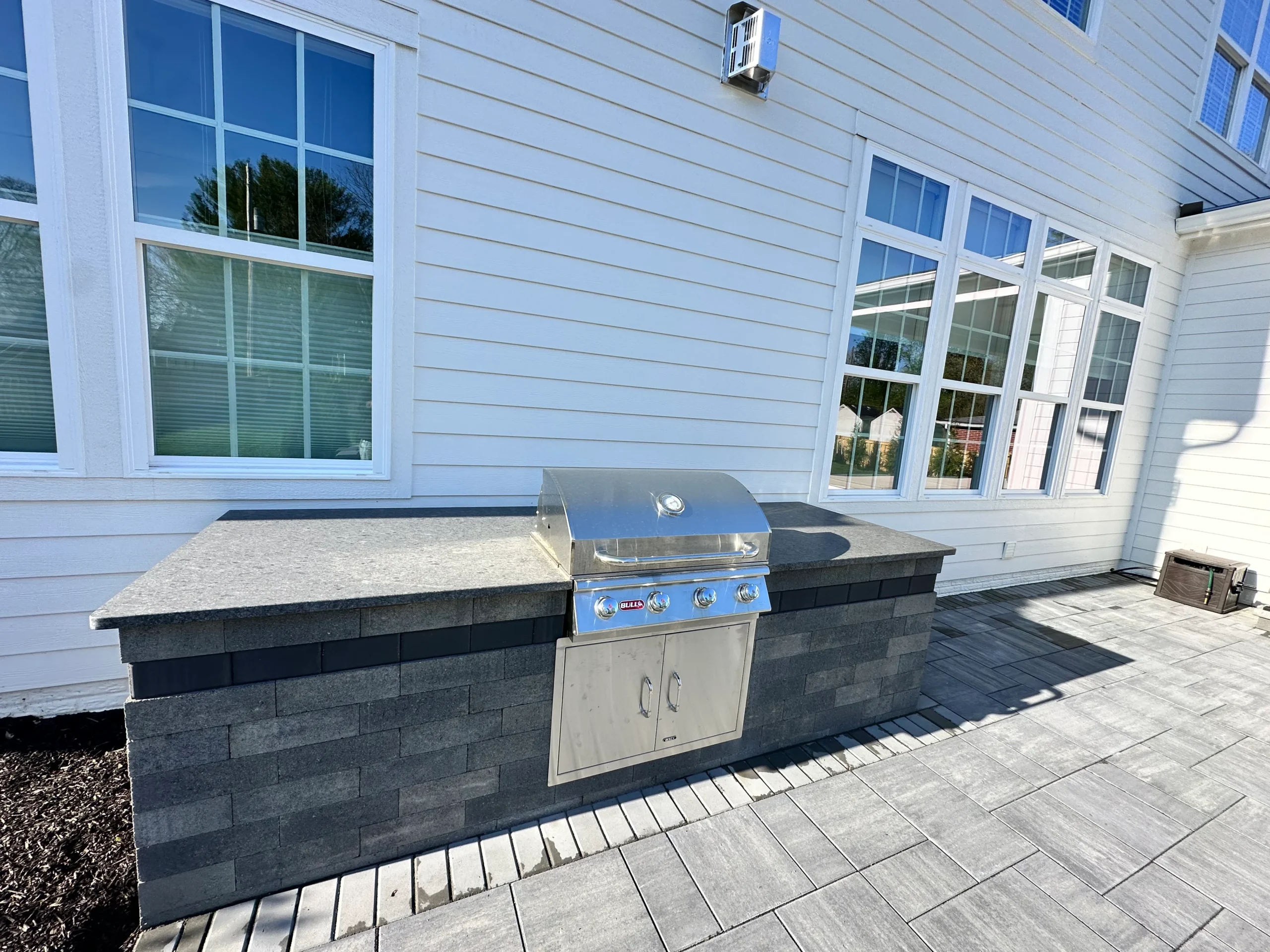
Here’s the side-by-side we walk Marietta homeowners through at contract signing. Same scope: 650-sq-ft travertine patio, 28 linear ft of segmental retaining wall, 12 ft outdoor kitchen with Cobb EMC 240V pull, one 12×14 cedar pergola. Same crew. Same materials. Only the start date changes.
Project A — July 8 start in Indian Hills: Permit received June 20. Mobilization July 8. Grading completed July 12, then 2.1 inches of rain July 13–14 forced a 4-day dry-out. Base completed July 22 (2 lift re-dos). Concrete pad pour rescheduled three times before landing on July 30. Travertine set August 4–12 (storm-interrupted). Wall and outdoor kitchen August 15–September 1. Punch list closed September 18. Total duration: 10 weeks 2 days.
Sixty-two work days elapsed. Seventeen of them lost or interrupted by weather.
Project B — October 6 start in Marietta Country Club: Permit received September 22. Mobilization October 6. Grading completed October 9. Base completed October 14 (no re-dos). Concrete pad pour October 17. Travertine set October 20–24. Wall and outdoor kitchen October 27–November 6. Punch list closed November 14. Total duration: 5 weeks 5 days.
Thirty-nine work days elapsed. Zero lost to weather.
The delta: 4.5 weeks of homeowner life reclaimed. Project B’s labor costs ran about 15% higher on the quote — a common fall/winter premium because crews are in demand and holiday scheduling compresses — but Project A’s storm delays consumed equipment rental days, extra trips, and material re-ordering that erased that premium and then some. Final paid cost on Project B came in roughly 6% below Project A on the same scope.
On-time completion rate by start season (Primetime Pools GA internal, Cobb County projects, last 3 seasons):
Summer starts (June 1 – Sept 15): 72% on-time
Fall/Winter starts (Oct 1 – Feb 28): 95% on-time
How to Choose Your Start Date
We don’t tell every Marietta client to wait until October. Some have graduation parties, some have wedding rentals, some inherited a pool deck that collapsed in May and can’t wait 5 months. Here’s the actual decision framework we use.
If your event is late May or before: Start in January or February. Cold-weather mortar and concrete protocols add minor cost but the storm calendar is quiet. You’ll finish by late April with margin to spare.
If your event is mid-summer (June through Labor Day): Start the previous October or November. Fall builds hit 95% on-time completion, and you’ll have 6+ months of use before the event. Do not start in March hoping to finish by June — you’ll land your pour window squarely in April’s second storm peak.
If your event is fall or early winter: Start in February, March, or very early April. Avoid the mid-April-to-late-May secondary storm pattern if you can.
If you must start in summer: Accept the 25% schedule buffer, line-item it, and expect the crew to burn extra days. The work will still be done right — we don’t cut corners on compaction or pour conditions to hit a date — but the calendar will move.
For zip codes 30060, 30062, 30064, 30066, 30067, and 30068, this decision tree applies uniformly. Elevation and soil vary block to block, but the Cobb County storm calendar doesn’t care about your subdivision.
Hardscape Design and Construction across 20+ cities within 30 miles of Winder, GA
Every Marietta build is scheduled around the real Cobb County storm calendar, not the optimistic one. If your start date matters, let’s put it on the right week — not the right month.