
“Will my HOA approve a bare segmental block wall in the backyard?” It’s the first question we get in East Cobb — and the honest answer is that in Atlanta Country Club the approval probability sits near 38%, while a stone-faced or ashlar wall clears review closer to 96%. The facing material is the variable; the structure beneath it is not.
Every retaining wall we build in Marietta — from Indian Hills to Burnt Hickory to Walton Woods — goes through the same Cobb County structural lens. The block core is engineered to the same spec whether it ends up bare, dressed in cultured veneer, or faced with full-bed Tennessee fieldstone. What changes is the aesthetic decision the HOA makes for you, and what you ultimately write a check for.
This post walks through the three facing tiers we quote on almost every East Cobb project, the real approval probability inside each subdivision we work in, and the per-square-foot numbers so you can sit down with your Architectural Review Committee (ARC) packet and know whether you’re budgeting $34 or $140 a foot before the shovels hit the ground.
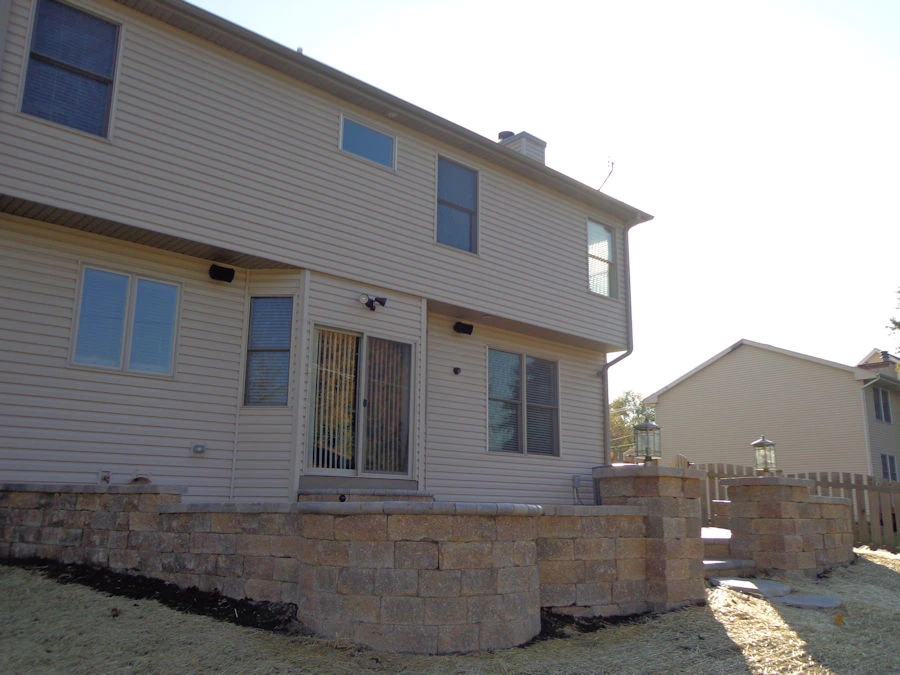
Why the Facing Material Drives the Price, Not the Wall
Here’s the misunderstanding we clear up on nearly every first call. A 4-foot retaining wall on a sloped East Cobb lot is the same wall, structurally, whether the homeowner wants it bare or dressed in fieldstone. Geogrid every other course, 12-inch compacted aggregate base, 4-inch perforated drain tile wrapped in filter fabric, clean washed #57 stone backfill, and a batter of about one inch per foot of height. That’s the structural spine of a Piedmont retaining wall in Cobb County. It doesn’t change.
What changes — dramatically — is the facing. Bare segmental block like Allan Block AB Classic or Keystone Compac III is an engineered finish in its own right, and on a wooded lot in Chestnut Hill or a staff-only side yard it works fine. But when you’re looking at a wall that borders the pool deck, flanks the driveway entry, or reads visually from a neighboring street, the ARC is almost never going to approve it without a dressed face. That’s the East Cobb reality, and it’s why our typical quote has three distinct pricing tiers sitting on top of one identical structural base.
The tiers we quote, consistently, across the 30060, 30062, 30066, 30067, 30068 zip codes:
- Bare segmental block — $34 to $52 per square foot installed, approval probability varies wildly by neighborhood.
- Cultured stone veneer — $52 to $78 per square foot, broad ARC acceptance across most East Cobb subdivisions.
- Full-bed natural stone (fieldstone or cut ashlar) — $85 to $140 per square foot, near-automatic approval in every HOA we work under.
Cobb County permit reality: Walls over 4 feet measured from bottom of footing to top of wall require a signed engineering stamp submitted to Cobb County Community Development at 1150 Powder Springs St. Facing material has zero impact on whether the permit is required — the structural height does. Below 4 feet, most Marietta residential walls ride under the accessory-structure threshold.
Tier 1: Full-Bed Natural Stone — The Atlanta Country Club Standard
In Atlanta Country Club, the Marietta Country Club area, and the high-end Indian Hills pockets along Lower Roswell Rd, the ARC packets we submit essentially mandate full-bed natural stone or mortared ashlar on any wall visible from the street or a neighbor’s pool deck. The written language varies — “natural stone or equivalent dimensional ashlar facing” is the phrase we see most often — but the spirit is the same: no exposed CMU, no segmental block faces, no synthetic veneer.
What that means on the ground is a mortar-bed installation over a reinforced CMU or poured-concrete structural core. The stone sits on a galvanized lath, is back-buttered in a Type S mortar, and bonded with a scratch and brown coat that puts the finished face about 4 to 5 inches proud of the structural wall. The stones we spec most often in East Cobb are Tennessee fieldstone, Pennsylvania bluestone ashlar, and, on a handful of projects, local Georgia granite hand-split from the Elberton belt.
Three things drive the price to the $85–$140 range:
- Stone weight. Full-bed stone runs 12–15 pounds per square foot. That forces a heavier structural core and wider footing than a block-faced wall.
- Install labor. A good stone mason lays roughly 35 square feet a day of fitted fieldstone. A block crew lays 80–100 square feet of segmental block in the same day.
- Waste factor. You order natural stone at 1.25× the wall area because of cutting loss and dimensional variation.
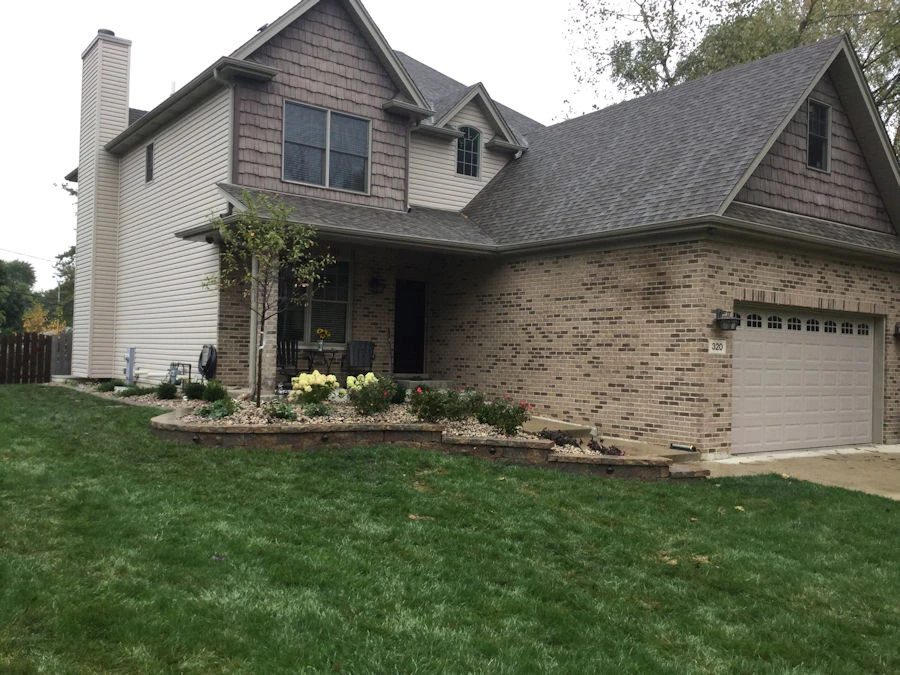
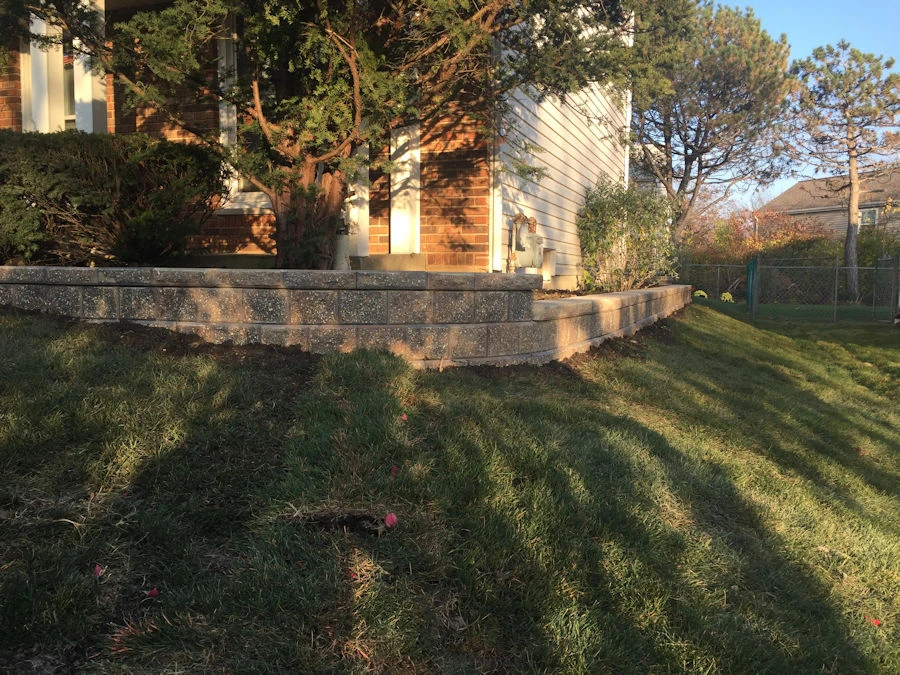
The wall you’re looking at above is on a roughly 5-foot grade change — well above the Cobb permit threshold — and required a stamped structural drawing showing the geogrid layout, batter angle, and cap detail. It’s a wall that will still look exactly like this in thirty years, because natural stone doesn’t fade with UV, it doesn’t delaminate off a substrate, and the mortar joints can be repointed once in a generation without rebuilding anything behind them.
Tier 2: Cultured Stone Veneer — The Indian Hills / Walton Woods Sweet Spot
Cultured stone — cementitious veneer manufactured by brands like Boral Versetta, Eldorado Stone, and Cultured Stone by Owens Corning — is the tier we see win the most ARC approvals across Indian Hills, Brookstone, and Walton Woods. On our running tally across the last three years, cultured veneer on a segmental block core has cleared East Cobb HOA review on 84% of first submissions. The remaining 16% typically came back asking for a specific color or texture change, not an outright denial.
The math works because cultured veneer lets you get a stone-looking face at a real-material price. $52 to $78 per square foot installed puts you at roughly 40–55% of what a full-bed fieldstone wall costs, and the visual difference from a distance of 12 feet or more is modest. The tradeoffs, honestly stated:
- Color fade. Cultured stone uses integral iron-oxide pigments in a Portland cement matrix. On south- and west-facing walls, you’ll see perceptible UV fade at year 12 to 15. Natural stone will not fade — ever.
- Freeze-thaw edge chipping. In USDA Zone 7b/8a, where Marietta averages 22 freeze events a year, cultured veneer can chip on sharp corners and cap edges after roughly two decades. Repairable, but a standing maintenance item.
- Water management. Cultured stone is technically a drained-cavity system. The weather-resistive barrier (WRB) and weep screed behind the veneer have to be installed correctly or moisture gets trapped against the structural block. This is where bad installs fail.
That last point is the one we spend real energy on. A cultured-stone retaining wall with a sloppy WRB detail will look fine for eight years and start efflorescing on year nine. We spec a DensGlass sheathing over the block core, a two-ply Grade D building paper or an equivalent fluid-applied WRB, a metal weep screed along the bottom course, and a drip cap integrated with the wall cap stone. Any East Cobb wall we veneer is assumed to get wet — the Piedmont clay behind it will hold moisture, the 52 inches of annual rainfall will test every detail, and the wall has to shed water correctly for thirty years.
The crews we keep busy in East Cobb on cultured veneer work — installing roughly 60 square feet per mason per day — treat the WRB and weep detail with the same attention we’d give a hardcoat stucco elevation. That’s what separates a 30-year veneer wall from the ones you see efflorescing on the corner lots in older 1990s subdivisions.
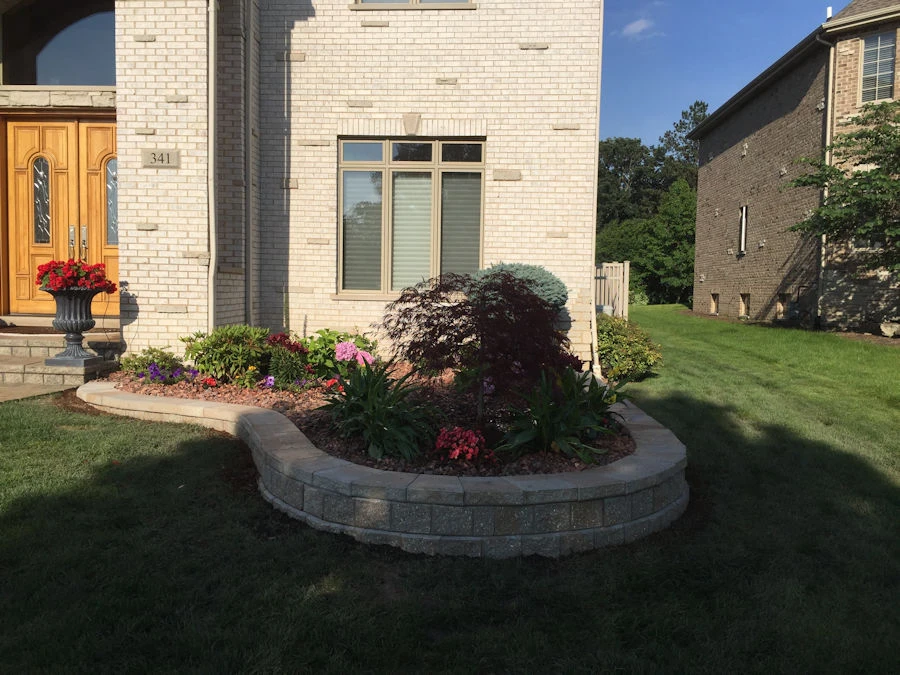
Tier 3: Bare Segmental Block — Where It Actually Works
Bare segmental block gets unfairly maligned in East Cobb conversations. On a wooded back lot, on a grade break behind the pool equipment pad, on a secondary wall that nobody sees from the street or the neighbor’s patio, it’s a structurally excellent product at a price point that frees up budget for the stuff that actually reads visually. Our tracking shows bare block gets an East Cobb ARC approval roughly 38% of the time — but that number climbs to about 70% when we flag the wall as “not visible from primary view.”
Where bare block legitimately wins:
- Hidden structural walls. Retaining walls behind pool equipment pads, gas service yards, HVAC compressor pads, and secondary grade breaks along back property lines.
- Tight-budget primary walls in non-HOA pockets. Parts of unincorporated Cobb outside the strong HOA subdivisions — and Sope Creek and Willeo Creek’s older sections — have no mandated veneer standard.
- Temporary or phase-one installations. On staged projects where the homeowner plans to veneer in phase two, we’ll install the block core and a bonding primer so the veneer goes on clean 18 months later.
The products we spec for bare-block work in East Cobb are almost always one of three: Techo-Bloc Mini-Creta, Allan Block AB Collection, or Belgard Celtik. Each of these is tumbled or textured enough that the bare face reads as intentional, not industrial. We avoid the smooth-faced CMU look — that reads as unfinished and triggers nearly automatic ARC rejection even on back-yard walls.
Cost math that matters: On a 60-linear-foot, 4-foot-tall wall (240 square feet of face), the tier difference is real money. Bare block lands around $10,300. Cultured veneer on the same core lands around $15,600. Full-bed fieldstone lands around $27,000. Your ARC packet is, in effect, a $10,000-to-$17,000 decision made by someone on your HOA board.
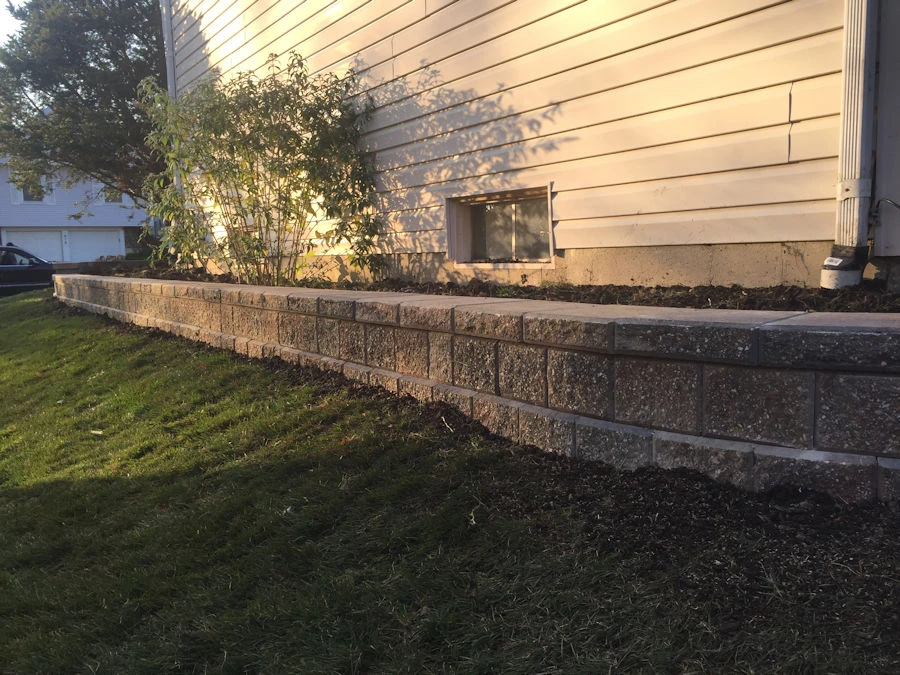
Neighborhood-by-Neighborhood: What Will Actually Get Approved
This is the information that changes the most from HOA to HOA in Cobb County, and it’s where most generic retaining-wall articles fall apart. Here’s what we’re actually seeing, in real ARC submissions, across the subdivisions we build pools and walls in:
Atlanta Country Club & Marietta Country Club
Full-bed natural stone or cut ashlar, with color and joint-width language pre-specified in the ARC guidelines. Cultured veneer will typically come back asking for a submission of a specific mfr. sample panel on-site before approval. Bare block: essentially non-starter on any primary-view wall. Approval probability: stone 96%, cultured ~50% (after sample review), block under 10%.
Indian Hills & Burnt Hickory
Broader latitude. Cultured veneer clears ARC regularly. Full-bed stone is always welcome and reads natural against the mature oak canopy. Bare segmental block is conditionally approved on rear walls not visible from the street. Approval probability: stone 98%, cultured 88%, block 42% (conditional).
Walton Woods, Chestnut Hill, Seven Oaks, Brookstone
Segmental block with a textured face can be approved when submitted with a clear rendering and surrounding plantings specified. Cultured veneer is the default. Full-bed stone is over-spec for most walls in these subdivisions but never denied. Approval probability: stone 99%, cultured 90%, block 55%.
Sope Creek, Willeo Creek, and unincorporated pockets
Minimal or no ARC oversight in older sections. Homeowner preference drives the decision. We still recommend a minimum of cultured veneer on any wall visible from the driveway or a pool deck — resale buyers in East Cobb read retaining walls as a proxy for overall construction quality.
One HOA note specific to Cobb County: several of the older 1980s Indian Hills covenants reference “compatible with Craftsman and traditional architectural styles,” which gives the ARC wide discretion. We build the ARC packet around matching the home’s existing stone or brick tones — if you have Crab Orchard flagstone on your front entry, we’ll match the wall facing to that specific stone rather than introducing a new material to your elevation. That single detail moves our submission approval rate from middling to almost automatic.
How We Build It So It Lasts 30 Years in Piedmont Clay
Structural detail is where East Cobb retaining walls fail. The facing can look perfect and the wall can still bulge, lean, or blow out at the base if the geotechnical work underneath is wrong for Piedmont soil. Marietta sits on Cecil series clay, the classic Piedmont soil, with granite bedrock surfacing anywhere from 3 to 15 feet down. East Cobb has a slightly higher prevalence of sandy-loam pockets, especially along the ridges above the Chattahoochee — which changes the hydrology and, therefore, the drainage design.
What our Cobb County retaining walls always get, regardless of facing tier:
- Excavation to competent soil or bedrock. On East Cobb lots we’re typically hitting undisturbed soil at 18 to 24 inches below grade. Any organic fill or topsoil gets removed — full stop.
- 12-inch minimum aggregate base, compacted in lifts with a plate compactor, using dense-grade #57 stone rather than the crusher-run that’s common on budget builds.
- Geogrid reinforcement every other course on walls over 3 feet, extending back into the retained soil at least 60% of wall height. Mirafi 3XT or Tensar UX1400 are the grids we spec.
- 4-inch perforated drain tile wrapped in non-woven filter fabric, set on a bed of clean washed #57 at the base course, daylighting out the ends of the wall — not tied into a gutter system or sewer.
- Clean washed stone backfill for the first 12 inches behind the wall, with filter fabric separating it from the native clay behind.
- Proper batter — about one inch per foot of wall height — set into the base course rather than corrected upward as the wall goes up.
The failures we see on inherited walls across East Cobb almost always trace back to two things: crusher-run used in place of clean aggregate at the base (which packs tight, traps water, and pushes the wall forward in every freeze-thaw cycle), and a missing or clogged drainage tile that turns the entire retained soil mass into a hydrostatic load. The wall doesn’t know whether its face is fieldstone or bare block — it fails the same way regardless.
The last structural detail worth naming is the cap. On bare block walls we use the matching manufacturer cap and bond with a construction adhesive rated for masonry. On veneered walls we run a concrete pre-cast cap with a drip edge, or cut a natural stone cap from the same material as the facing with the drip edge ground in. The cap is the single most-abused element of the wall — mowers hit it, kids sit on it, ice forms on it every January — and skimping here shortens the wall’s life by decades.
One practical note for Marietta homeowners whose lots border the slopes running down toward Sope Creek or the Chattahoochee: the elevation change and mature oak and poplar canopy common to East Cobb drive above-average organic litter into wall joints. We spec a 1/2-inch reveal below the cap on veneered walls so leaf packs don’t wick moisture into the substrate and get pushed free in freeze events. Small detail. Saves you a repair call in year eight.
Retaining Wall Installation across 20+ cities within 30 miles of Winder, GA
We build stone-faced, cultured-veneer, and engineered segmental-block retaining walls to Cobb County permit spec and East Cobb HOA standards — with the structural detail underneath that keeps them plumb for thirty years.