
The Foxcreek homeowner had a 14-year-old gunite pool that needed replaster, new coping, and a re-tile. She had also, quietly, been wanting a full stacked-stone outdoor fireplace for six years. What finally made the math work was the elevation — at 1,270 feet above sea level, Dawsonville runs roughly 30 freeze events per year, and that shoulder-season cold gives an outdoor fireplace seven-plus months of real usability instead of the four you’d get in Snellville.
This is the case study of that project. One permit, one excavator mobilization, one stone mason on site, one pump-down of the pool. The fireplace and the pool shared footings trench, shared an equipment-pad pour, and shared enough scope that the homeowner saved about $6,400 compared with the quote she’d gotten two years earlier to build the fireplace as a standalone project after the remodel was already finished.
More importantly, the fireplace was engineered to the mountain. Dawsonville is not Dacula. The subsoil under a Foxcreek backyard is saprolite and weathered granite, not the plastic red clay that most Atlanta-metro pool and hardscape content is written for. A 36-inch footing spec that works perfectly in Gwinnett County will crack a stone fireplace chase within two winters at this elevation. We use 48-inch footings here, and we use them for a reason.
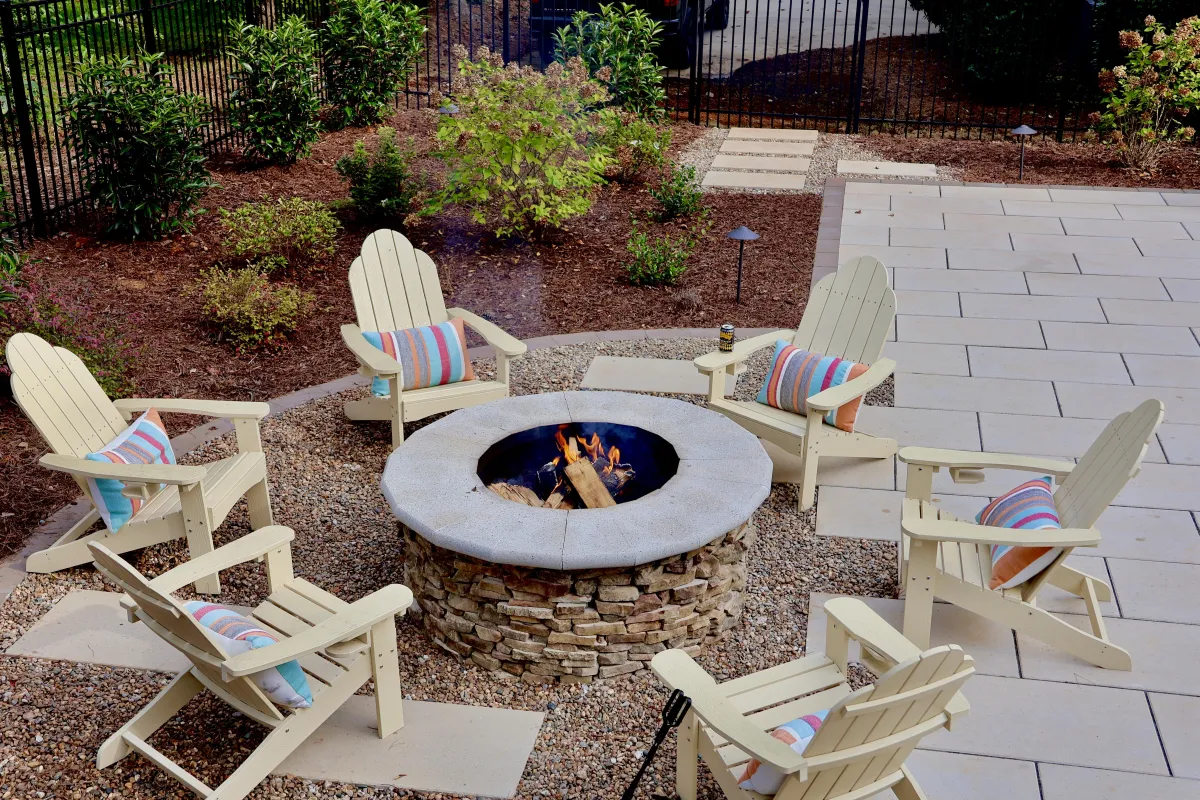
Why 1,270 Feet Changes the Math on an Outdoor Fireplace
Pool content in Georgia is usually written from Gwinnett County (~900 ft), Cobb (~1,000 ft), or Fulton (~1,000 ft). Those elevations produce roughly 18–22 hard freeze events per year. A homeowner in Johns Creek might realistically use an outdoor fireplace from mid-October to late March — about five and a half months of “it’s cold enough to want a fire.”
Dawsonville sits at the southern edge of the Blue Ridge foothills. The city proper is at roughly 1,270 feet, and subdivisions east of GA-400 like Etowah River Club and Kensington Ridge climb higher. That extra elevation pulls the shoulder seasons wider, and Dawson County records about 30 freeze events per year — roughly 50% more cold snaps than Gwinnett.
Practically: a Dawsonville homeowner uses an outdoor fireplace from early October through April. Add four to six “cool evening” fires per month from May through September, and the annual use count goes from ~40 nights in Snellville to 120+ nights in Dawsonville. Three times the use. That’s the number that finally pushes a stacked-stone fireplace out of “would be nice” into “most-used feature after the pool.”
The Remodel Scope — And Why Pairing Fire Features With It Saves Real Money
The pool was a 16×34 rectangle with a 7-foot deep end, original plaster from the early 2010s, original travertine coping, and original stamped-concrete decking that was starting to spall around the skimmer throat. The scope on the pool side was what we’d call a mid-tier full remodel:
- Drain, pressure-wash, and chip out 1,850 sq ft of interior plaster
- Replace waterline tile with 1″x2″ glass blend
- Pull and reset travertine coping, new mortar bed
- Replace the stamped concrete deck with 12″x24″ porcelain pavers on a pedestal system
- Upgrade the filtration to a Pentair IntelliFlo3 VSF with a new 420-sq-ft cartridge filter
- New LED bubbler jets on the sun shelf
That base scope came in at just under $78,000. Adding the stacked-stone fireplace as a standalone future project — meaning a separate mobilization, separate permit, separate excavator delivery off GA-400, separate mason crew call-out — had been quoted at roughly $31,500 two years earlier. Building it as part of the remodel cost $25,100. The $6,400 delta was almost entirely soft costs: one permit instead of two, one mobilization, one trenching pass, shared concrete truck minimums, and shared debris haul-off.
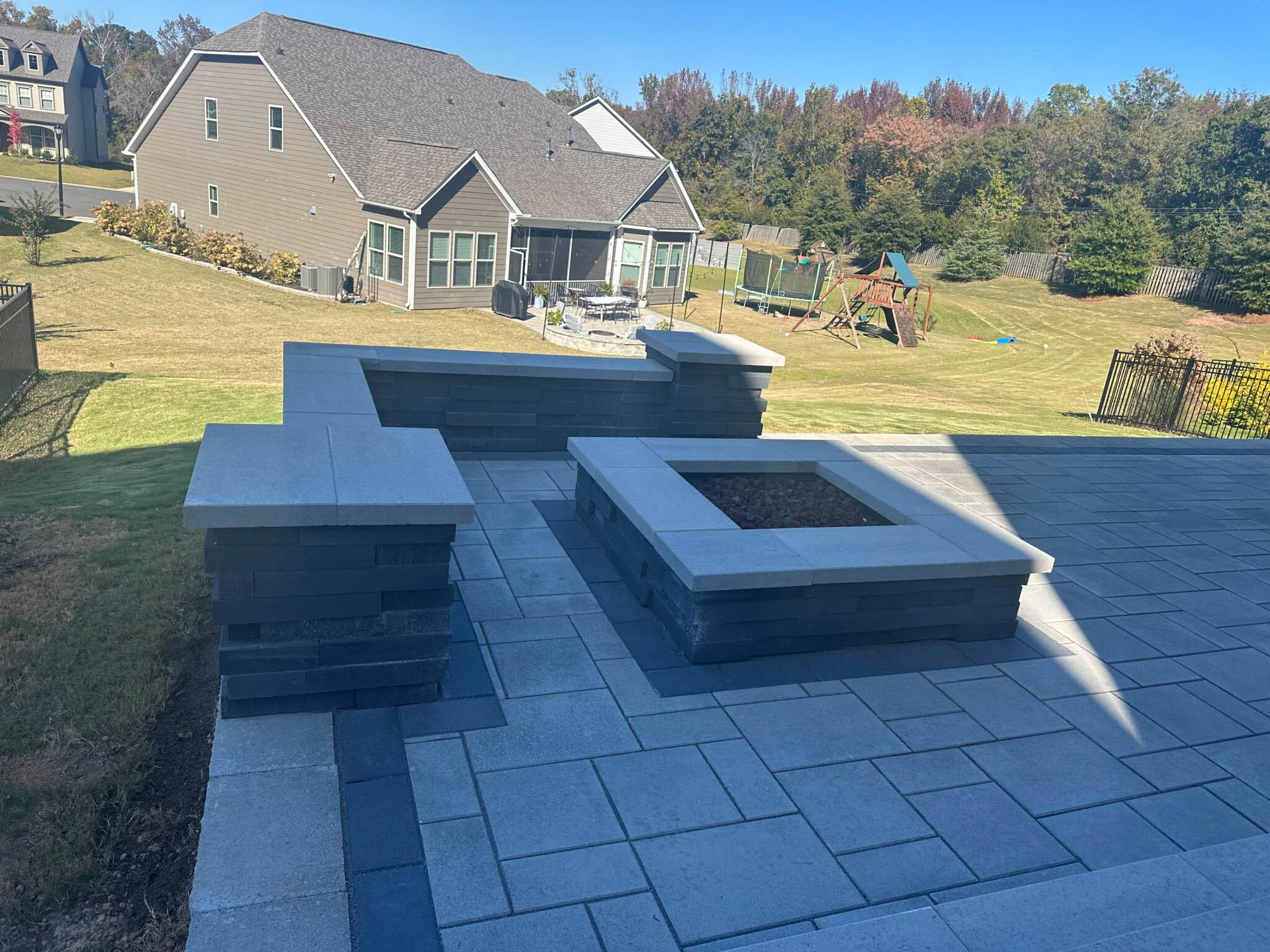
Where the Shared-Scope Savings Actually Come From
Homeowners often assume the savings come from labor discounts. They don’t. Crews get paid the same whether they’re building one feature or two. The savings come from fixed costs that only have to be paid once:
- Permit pull: Dawson County Dept. of Planning & Development at 25 Justice Way charges a single residential accessory-structure permit fee whether you’re adding one fire feature or a fire feature plus deck replacement. One trip, one fee, one inspection cycle.
- Excavator mobilization: Getting a mid-size tracked excavator up GA-400 to a Foxcreek job site, including lowboy and operator, runs about $1,800 round trip. Doing it once instead of twice saves $1,800.
- Concrete truck minimum: Ready-mix trucks have a short-load fee below about 4 cubic yards. Bundle the fireplace footing, equipment pad, and deck prep into one pour and you avoid two short-load surcharges of around $180 each.
- Stone delivery: One pallet-truck delivery from the stoneyard in Cumming instead of two. That’s one $275 delivery fee instead of two.
- Debris haul-off: One 20-yard dumpster swap cycle handled old plaster chips, old deck concrete, and fireplace excavation spoil in one go.
Soft costs eat projects. The only way to beat them is to consolidate — and the only time you can consolidate is when the work is already open. Once the pool is refilled and the deck is set, every one of those line items resets to full price.
Bundling rule of thumb for Dawsonville remodels: if you’re already doing a full pool remodel — deck replacement, equipment upgrade, interior refinish — adding any single fire feature during the same window saves roughly 18–25% of the feature’s standalone price. A second feature on top of that saves another 8–12%.
Why Dawsonville Fireplace Footings Have to Be 48 Inches, Not 36
This is the section most contractors don’t write. We’re going to.
Pool and hardscape engineering specs in Georgia are mostly inherited from Piedmont clay assumptions — the thick, plastic, slow-draining, relatively stable Cecil series clay that covers most of metro Atlanta. Cecil clay is forgiving. It doesn’t frost-heave much because it holds moisture uniformly. A 36-inch footing under a fireplace chase will stay flat under it for decades as long as you hit solid clay and get a proper pad.
Dawsonville’s subsoil is different enough that the same spec will fail. The city sits on the Blue Ridge geologic province, not the Piedmont. What you find in a typical Foxcreek or Riverbend backyard at excavation depth is saprolite — partially weathered granite and schist that looks like gritty, crumbly rock-soil with visible mica and quartz. Topsoil is thin here. The Cecil series still exists at the surface in places, but it’s thinner than you’d find in Walton County, and underneath it you get residuum from mountain bedrock rather than deep clay.
Saprolite has three properties that matter for a fireplace:
- It drains fast. Better than clay. Water moves through it laterally and vertically, which is great for pool bases but dangerous for a tall, heavy stone structure with a chimney moment arm.
- It’s non-uniform. You’ll hit pockets of soft residuum next to pockets of nearly intact weathered granite. A footing bearing half on soft saprolite and half on hard rock will rotate as the soft side settles.
- It holds freeze-thaw moisture differently than clay. With 30 freeze events per year instead of 20, and with water moving through the soil profile rather than sitting in it, the upper 18–24 inches of subsoil sees more freeze-thaw cycling than equivalent depth in Gwinnett.
So we spec 48-inch footings for tall fire features in Dawsonville — 12 inches deeper than what you’d pour in Snellville. Under the footing goes a 4-inch open-graded #57 gravel drainage mat, wrapped top and bottom in non-woven geotextile, to give any water that reaches footing depth somewhere to move laterally instead of pooling against the concrete. The footing itself is a reinforced 24″ x 24″ x 48″ deep pour, #5 rebar cage, tied into the vertical rebar of the fireplace chase.
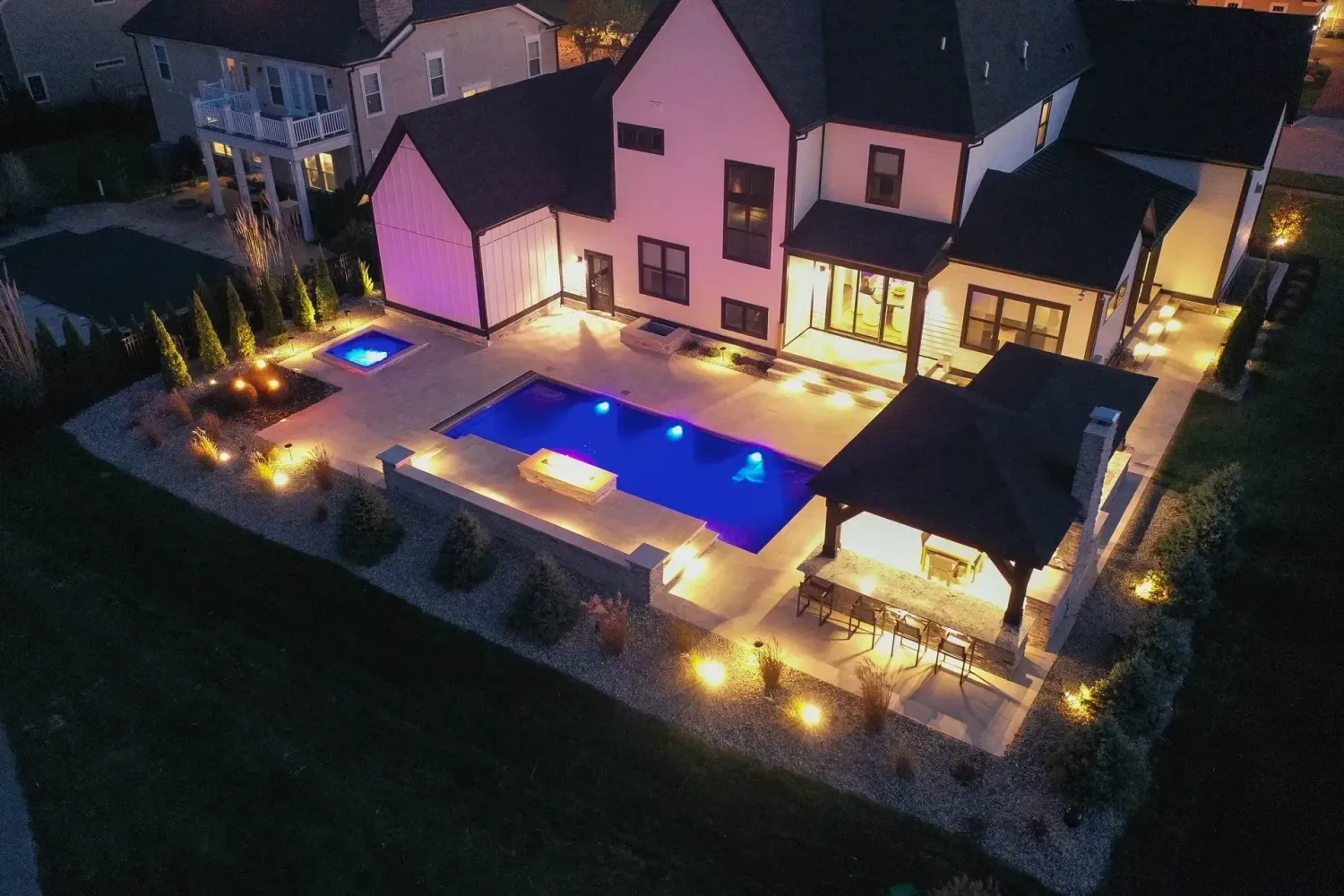
The Blast Problem — And How We Bid for It
Roughly one in four Dawsonville pool or deep-footing excavations hit intact granite that can’t be removed with a standard bucket and ripper tooth. In Foxcreek specifically — the subdivision where this project sits — the rate is closer to one in three, because the ridge the neighborhood was built on has shallower bedrock than the lots closer to the Etowah River.
This project hit rock at 34 inches — intact boulders big enough that the excavator couldn’t make progress on the back corner of the footing. We went with a controlled blast instead of handheld pneumatic breakers (which would have added two days of labor).
In Dawson County, controlled residential rock blasting requires a licensed blaster, 48-hour neighbor notification, and a pre-blast survey of the house foundation. Cost-wise, we bid Dawsonville rock risk at a premium of $8 to $14 per cubic yard over the baseline price we’d quote in Forsyth or Gwinnett. On this project, the fireplace footing excavation ran 3.3 cubic yards, the portion in rock was 1.4 cubic yards, and the blast premium landed at around $1,500 — almost exactly what we’d carried in the contingency line.
If you’re bidding a Dawsonville project and your contractor’s number doesn’t mention rock, ask why. Either they’ve pre-inspected and know it’s clean residuum, or they’re about to send you a change order.
Stone Selection — Why We Used Tennessee Fieldstone and Not Local Dawson County Rock
This is counterintuitive so it deserves its own section. The area is full of gorgeous mountain stone. Drive up Hwy 136 toward Amicalola Falls and you pass a dozen stoneyards selling local rough-cut fieldstone and ledgestone for landscape walls.
We didn’t use any of it for this fireplace. We trucked in Tennessee fieldstone from a yard in Cumming off GA-400.
Reason: thermal behavior. A wood-burning outdoor fireplace runs an interior chamber temperature of roughly 900–1,200°F. That heat soaks into the first 3–4 inches of stone veneer and cycles with each fire. Stones with fine, uniform grain structure — like the sandstone-family Tennessee fieldstone — handle that cycling for decades. Stones with internal banding, mica layers, or embedded quartz seams (which describes a lot of North Georgia weathered granite and schist) have built-in weakness planes. After 20–30 hot-fire cycles, those planes separate. The stone doesn’t fall off the wall, but it spalls at the corners and develops hairline fractures that eventually need re-pointing.
For a seat wall, a border stone, or a cold-use landscape feature, local rock is beautiful and perfectly fine. For the fire face of a real wood-burning fireplace, we source stone chosen for thermal stability. That single choice is worth maybe 10 to 15 years of additional service life before the first re-pointing job.
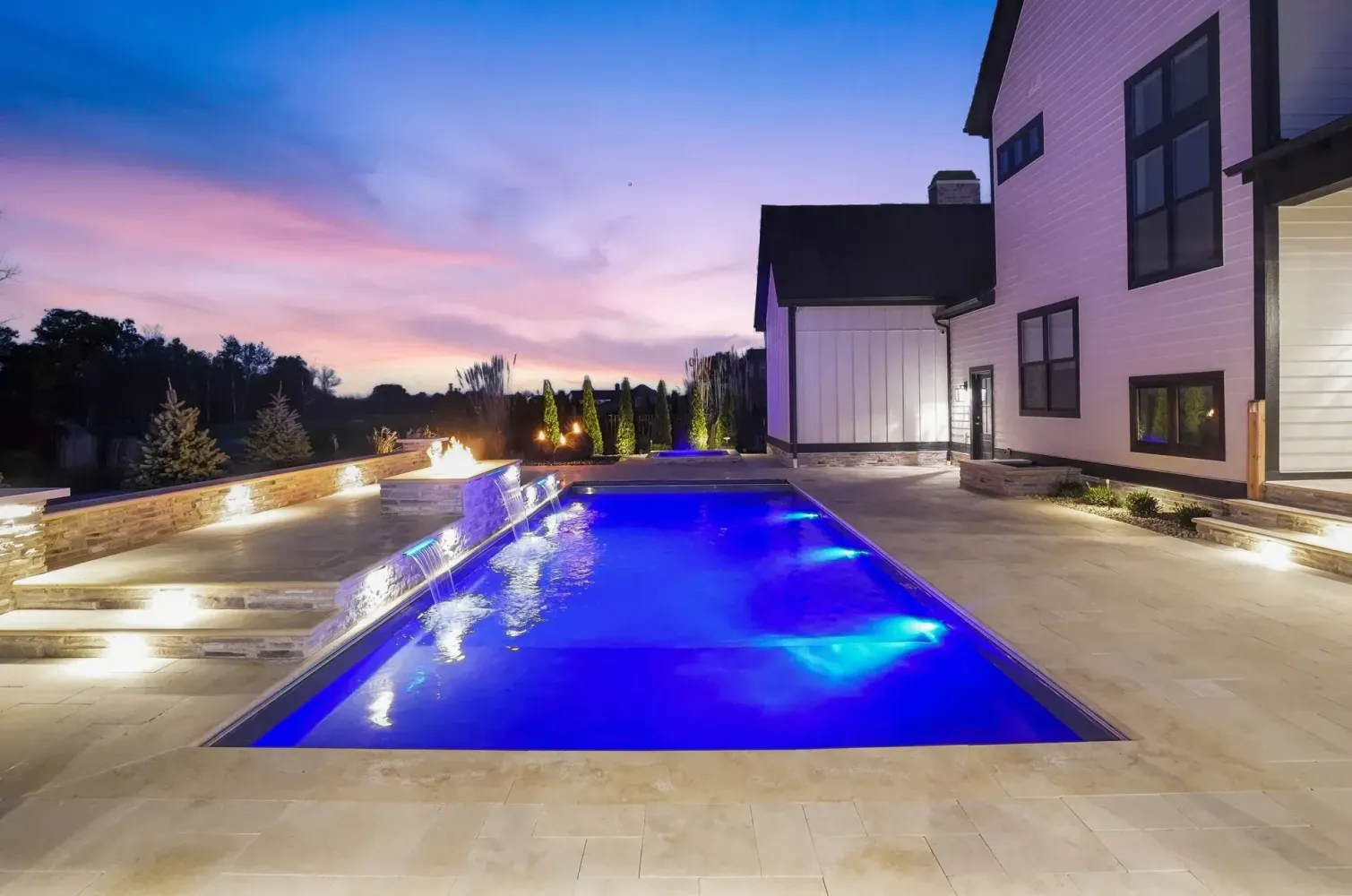
Permits, Utilities, and the Amicalola EMC Coordination
A single consolidated permit through Dawson County Planning & Development covered the pool remodel (plumbing and electrical sub-permits) and the accessory fire feature. Review turnaround in Dawson runs roughly 7–10 business days for residential.
The utility coordination is the part people miss. Amicalola EMC is the electric cooperative that serves most of Dawsonville, and their underground service drop depths in this area are shallower than you’d expect — often 24 to 30 inches rather than the 36 inches you’d see on a Georgia Power residential feed. An excavator dropping a 48-inch footing trench within 6 feet of the service line needs that line hand-located before the bucket drops. We had Amicalola EMC out 72 hours before excavation; their service drop ran 28 inches deep along the property line, 9 feet off the fireplace location. Clean separation, no relocation needed.
Gas Line or Wood-Burning? The Dawsonville Answer is Usually Wood
A third of the fireplace customers we quote in the metro Atlanta service area go gas. In Dawsonville, it’s closer to 10%. Three reasons:
- Propane supply: Much of Dawsonville is on propane, not natural gas. Running a fireplace on propane means dedicating a 500-gallon buried tank or a very large above-ground tank for what is essentially a single appliance. The homeowner is better off burying the tank for whole-home gas needs and leaving the fireplace off of it.
- Cultural fit: Dawson County homeowners tend to prefer the ritual of a real wood fire — especially when the fire is the centerpiece of a 120-night-a-year use pattern. A Foxcreek or Riverbend buyer generally isn’t looking for the convenience of a knob-turn flame.
- Elevation & draw: Properly sized wood-burning chimneys draw beautifully at 1,270 feet. Air density and temperature differential both favor natural draft here. A well-built 16″x16″ flue over a 36″x24″ firebox will pull smoke cleanly in almost any wind condition.
The Foxcreek homeowner chose wood-burning. We built a Rumford-style firebox (tall and shallow) with a 5-inch smoke shelf, a cast refractory throat, and a stainless-steel flue liner. The chimney terminates 42 inches above the ridge of the firebox structure, with a copper spark arrestor cap.
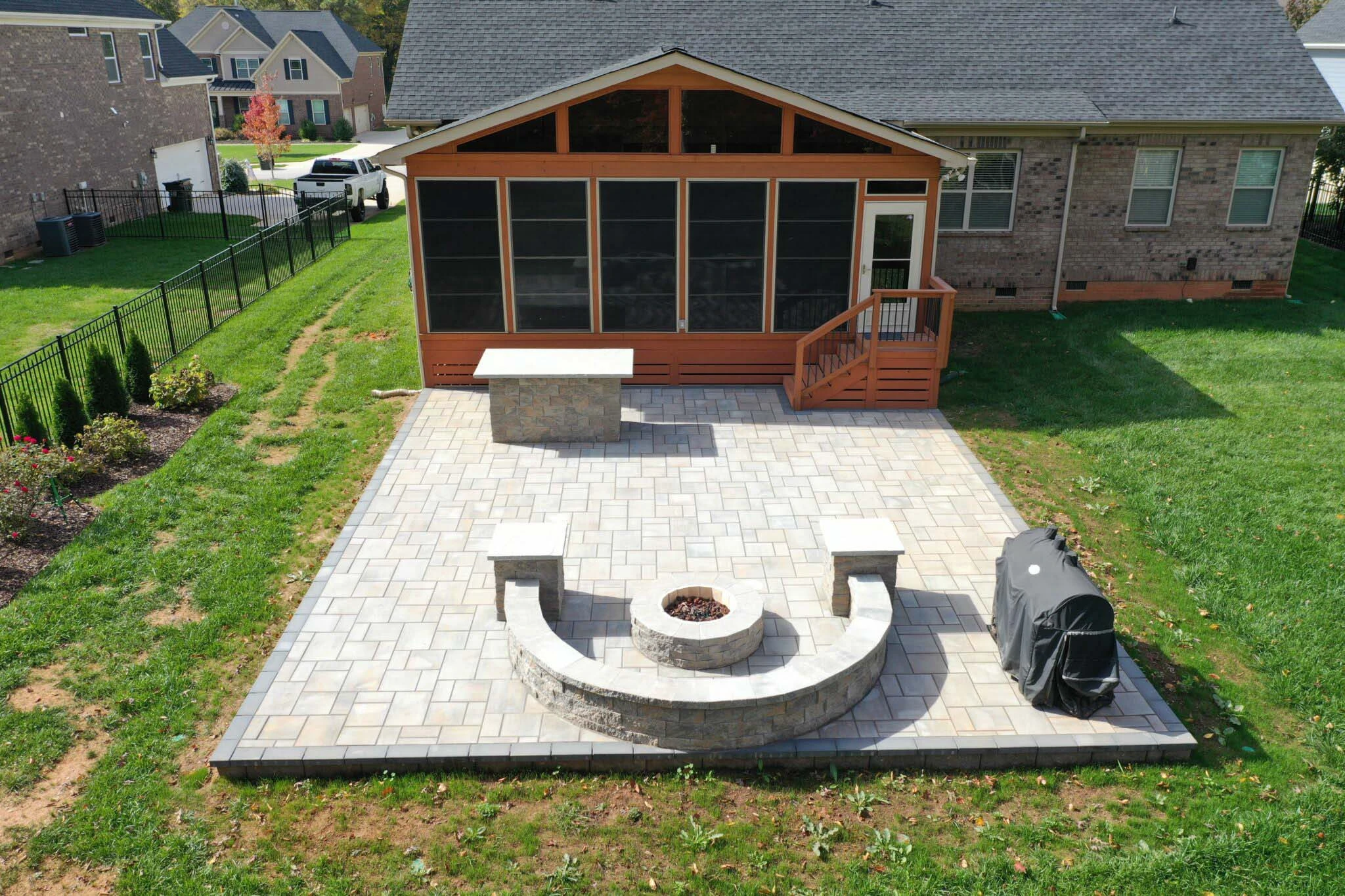
The 14-Day Schedule — And How We Sequenced the Two Features Together
A full pool remodel on its own at this scope runs 16–22 working days depending on cure schedules. Adding the fireplace as a parallel-track feature added only 3 days to the total, because most of the fireplace work happened during pool-side cure windows:
- Days 1–2: Drain pool, pressure wash, mobilize excavator. Trench fireplace footing, equipment pad, and shared gas/electrical chase in one pass.
- Day 3: Rock breakout + blast at fireplace corner (this is where most of the schedule variance lives on Dawsonville jobs).
- Days 4–5: Pour footing, equipment pad. Start chipping out pool plaster.
- Days 6–8: Steel-frame the fireplace chase and firebox. Plaster prep on pool side. First inspection.
- Days 9–12: Mason sets stone veneer on fireplace while pool crew sets tile and coping. Two trades, two features, no conflict.
- Day 13: Deck install (porcelain pedestals).
- Day 14: Plaster pool. Start fill. Hearth stone set, chimney cap installed.
- Days 15–22: Pool finishes filling and balancing. Mason finishes re-pointing. Final inspection, both features on the same visit.
The critical path was the pool. The fireplace slotted in around it. That’s only possible when both features are designed, permitted, and scheduled as one project from day one.
What to ask before signing a remodel-plus-fire-feature contract in Dawsonville: (1) Is the fireplace footing spec written in as 48-inch depth with a #57 gravel drainage mat? (2) Does the rock-blast premium sit in the contract as a named line item with a $/cubic-yard number, or is it hidden as an open “site conditions” allowance? (3) Is the permit a single consolidated pull through 25 Justice Way, or two separate permits? The answer to all three is how you tell a Dawsonville-experienced contractor from one who’s driving up from Fulton for the first time.
What the Finished Project Looks Like — And How It Performs Two Winters In
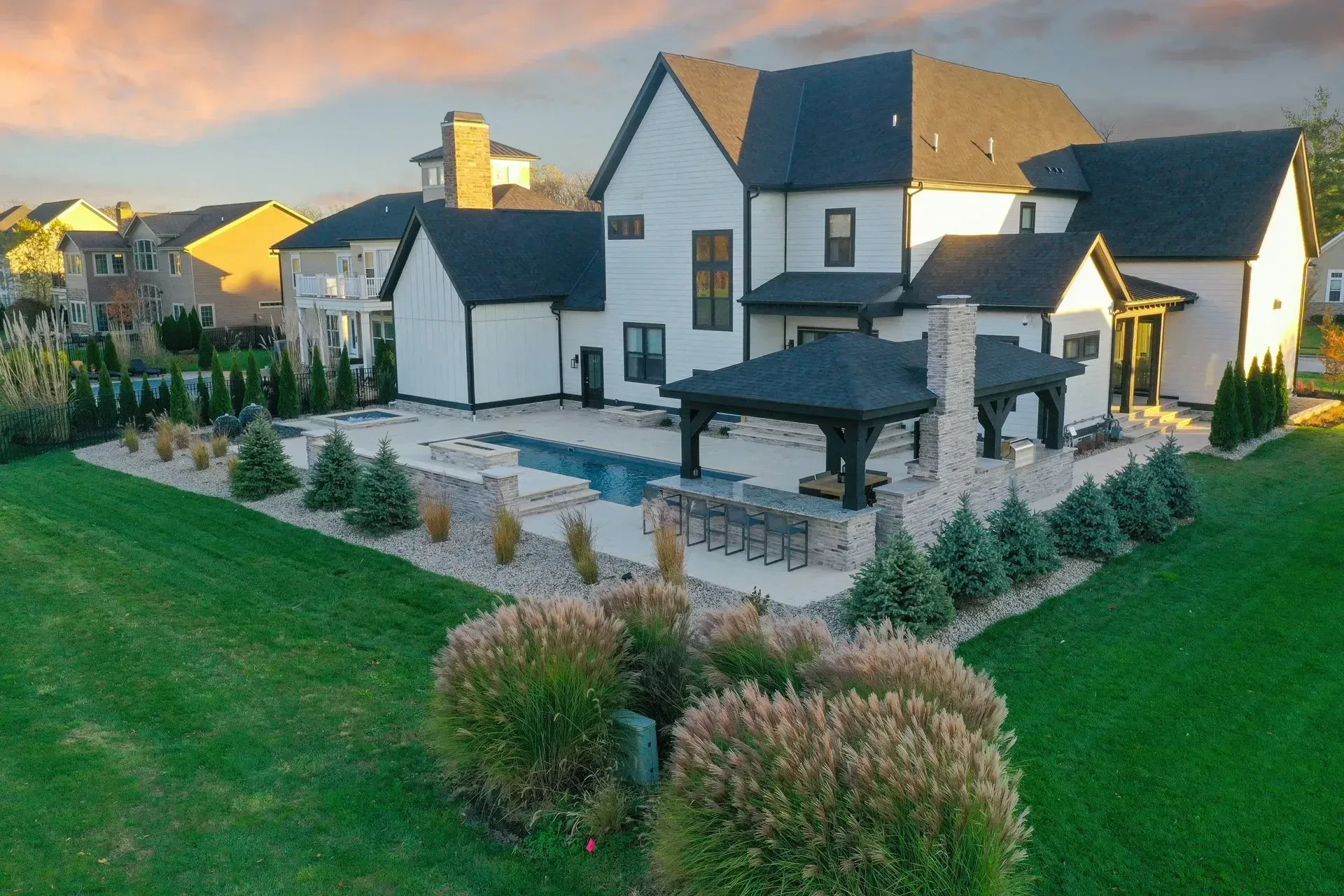
The homeowner has owned the finished pool-plus-fireplace combination through two full winters now, including the cold snap of the 2025 polar push that hit Dawsonville with four consecutive nights below 20°F. The footing is flat. No cracks in the chase, no separation at the stone veneer, no hearth movement. The Rumford draws cleanly in every wind condition we’ve seen, including the north-valley gusts that channel through the Foxcreek ridge line in late fall.
She reports using the fireplace an average of 3 evenings a week from mid-October through early April, which lines up almost exactly with the 120-nights-per-year use count we projected. It’s the most-used feature in the backyard outside the pool itself.
The pool side has performed identically well. The Pentair IntelliFlo3 is pulling roughly 40% less electrical draw than the old single-speed pump, which matters when your utility is Amicalola EMC and the winter kWh rate keeps climbing. The porcelain pedestal deck has zero spalling going into year three.
The Template For Your Dawsonville Remodel
If you own a pool in Foxcreek, Riverbend, Mountain Laurel, Applewood, Etowah River Club, Kensington Ridge, or Chestatee, and you’ve been thinking about a fireplace as a “someday” add-on, the case for pairing it with your remodel is straightforward:
- The elevation gives you 3x the annual use of a metro-floor yard. The feature earns its cost faster.
- The bundled permit and shared mobilization save 18–25% vs. standalone.
- The subsoil spec (48-inch footing, gravel drainage mat) is already being bid into the excavator’s day — no separate mobilization premium.
- The rock-blast contingency is already carried in the pool excavation number. Stacking a fireplace footing onto that contingency doesn’t double it; it absorbs into it.
- The 14-day schedule extension is absorbed inside the pool’s cure windows. You’re not adding weeks of tear-up to your yard — you’re filling idle days.
The Foxcreek project is now our standard template for every Dawsonville remodel that comes in asking about fire features. We quote the pool and the fireplace as one consolidated scope, one permit, one mobilization. The homeowner sees the bundled number and the standalone-equivalent number side by side on the same contract page. So far, 100% of clients who’ve seen that comparison have bundled.
Pool remodeling and fire feature design across 20+ cities within 30 miles of Winder, GA
Whether you’re in Foxcreek at 1,270 feet or in Lilburn at 900, we bid your remodel to the subsoil under your yard — not to a generic Atlanta template. Bundled scopes save real money when they’re engineered to the actual site.