
Picture a Saturday in October off Bethelview Road. Ten people, maybe twelve. A 48″ gas fire pit with the burner just catching, a curved stone bench wrapping around it at the exact height you can lean back against — not a dining chair, not a sectional, something built into the patio itself. The kids are still in the yard. Nobody’s left yet. Houses that have this combo in South Forsyth sell for $18,000 to $28,000 more than the ones that don’t, and the math for why is simpler than most homeowners think.
We build roughly 40 integrated seat-wall-plus-fire-pit features a year across Forsyth County — from the 3-acre estates up near Coal Mountain to the tighter subdivisions off Bethelview and Post Road. The combination has become the single most requested hardscape upgrade since 2022, and it’s not a coincidence. It’s the only backyard feature that solves four problems at once: seating capacity, wind shielding, traffic flow, and — the quiet one — perceived square footage. A 14-foot-radius curved bench reads, on a listing photo, as a room. That’s the part sellers pay for.
This post is the complete build: the dimensions, the dollar ranges, the paver specs, the gas-line routing through Forsyth’s Cecil clay, the HOA hurdles you’ll hit in the neighborhoods off GA-400 exits 13 through 18, and the reason we build the seat wall at exactly 18 inches high instead of 16 or 20. If you’re reading this trying to decide whether to spec the combined feature or build them separately later, read to the end. The answer is not ambiguous.
Why the Combined Feature, Not Two Separate Ones
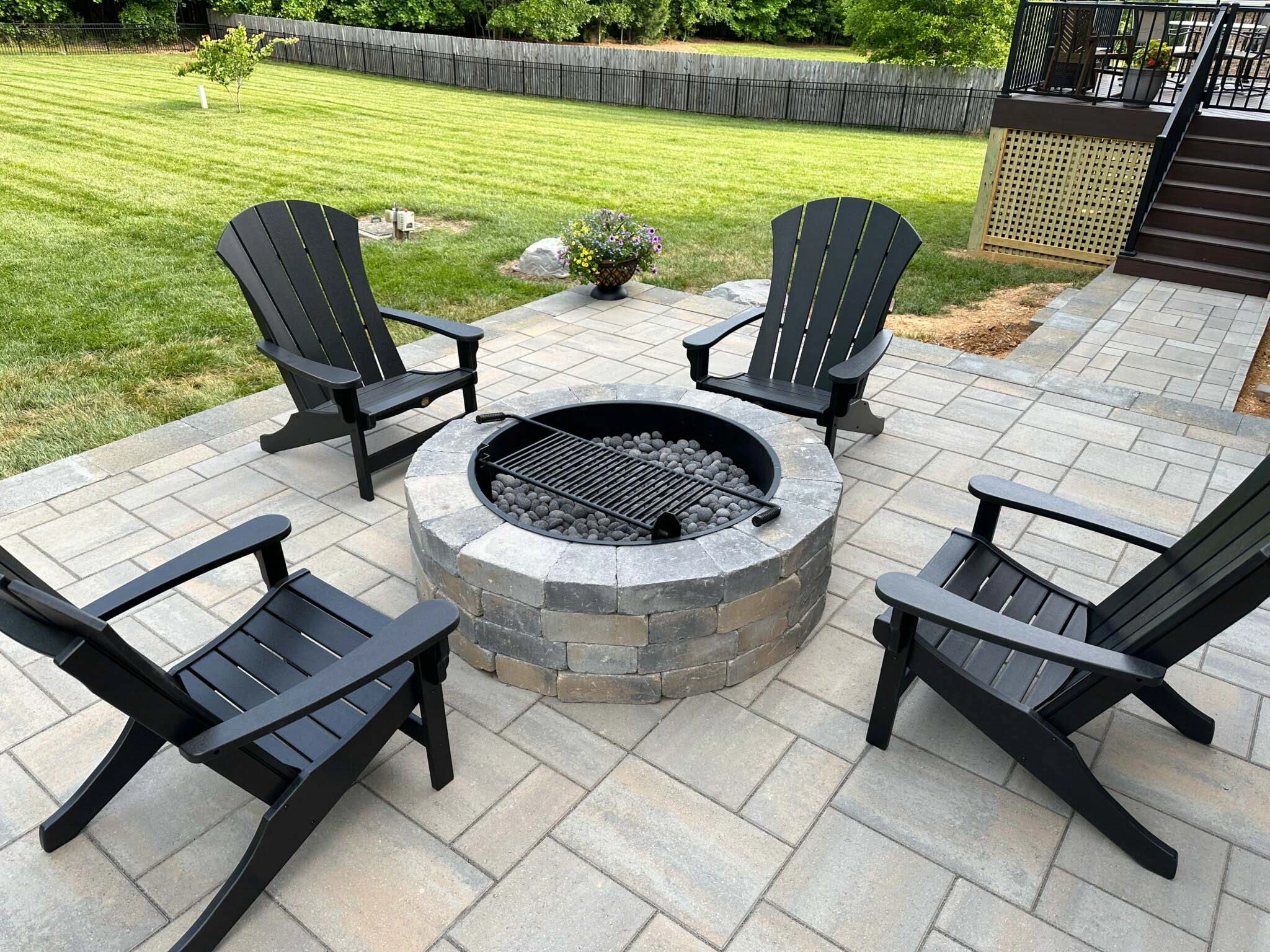
The short version: a standalone fire pit with a ring of Adirondacks seats four comfortably, six if you squeeze, and costs between $3,400 and $5,800 installed. A standalone seat wall without a fire pit at the focal point is, frankly, a bench that goes nowhere. Homeowners look at the price tags side by side — $4,500 for the fire pit, $3,900 for a short seat wall — and assume they can phase the project. Do the fire pit now. Add the wall in two years. It never gets added in two years.
What happens instead: the fire pit gets used four times the first summer, twice the second, and by year three the family has stopped pulling the Adirondacks out of the garage. The seating was never comfortable enough for long conversation. The pit feels exposed. Guests drift back toward the house. We get a call in year five asking what it would cost to “warm up” the space — and the honest answer is that retrofitting a seat wall around an existing fire pit is roughly 18% more expensive than building them together because we have to re-tie the paver field, re-level the base, and cut stone to meet the existing radius that was never planned for a wall.
Build them together. Always. The integrated feature runs $6,000 to $14,000 depending on materials and length, and it’s one mobilization, one permit, one dust cloud, one dig into the red Piedmont clay that defines every yard in this county.
The Numbers That Matter
A typical Forsyth County build — and “typical” here means the build we spec three times a month in neighborhoods like James Creek, Vickery, and St. Marlo — looks like this:
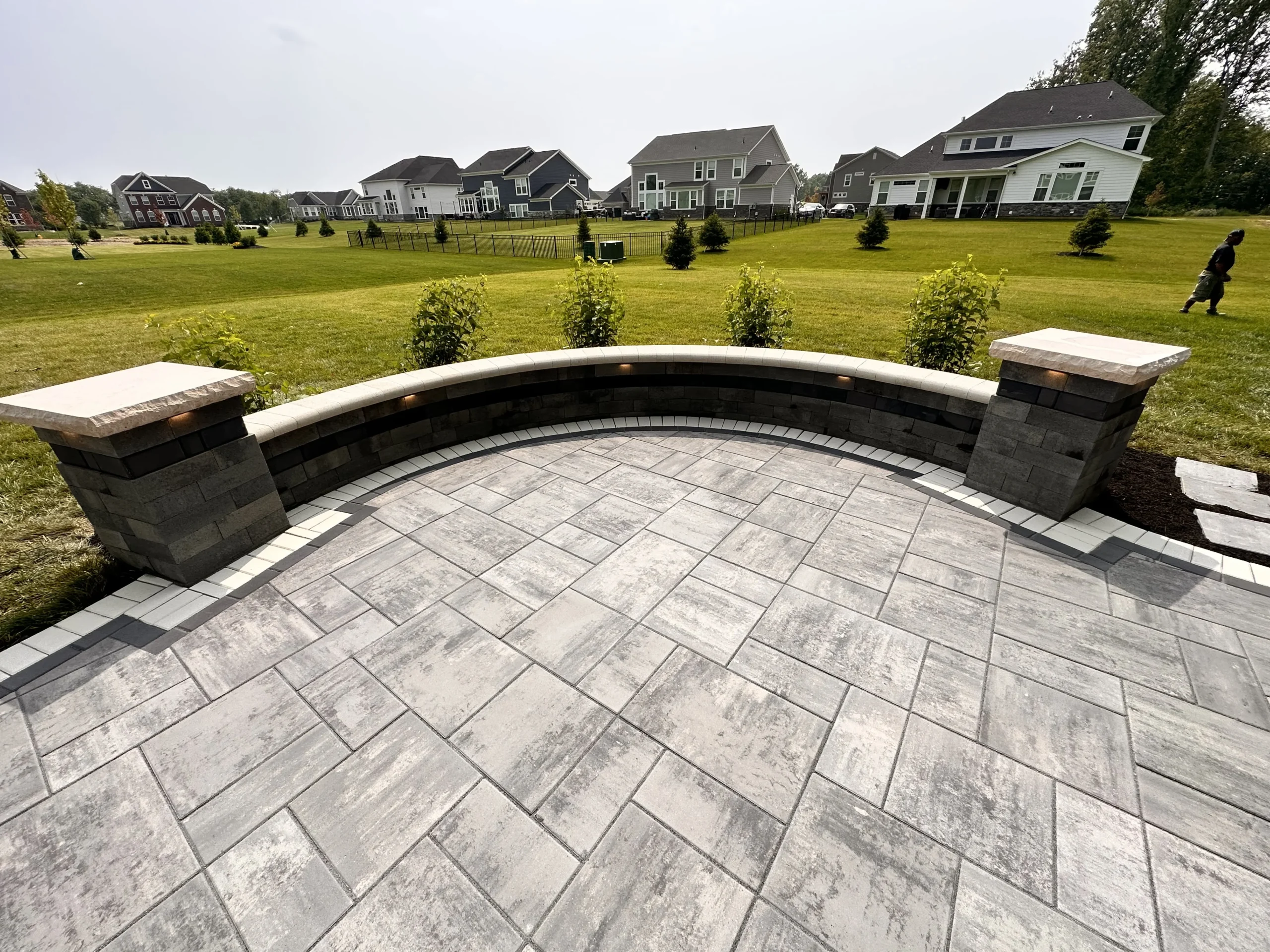
- Seat wall: 18 inches high, 14-foot radius curve, wrapping roughly 270° around the fire pit (not a full circle — you leave an opening for traffic and the view)
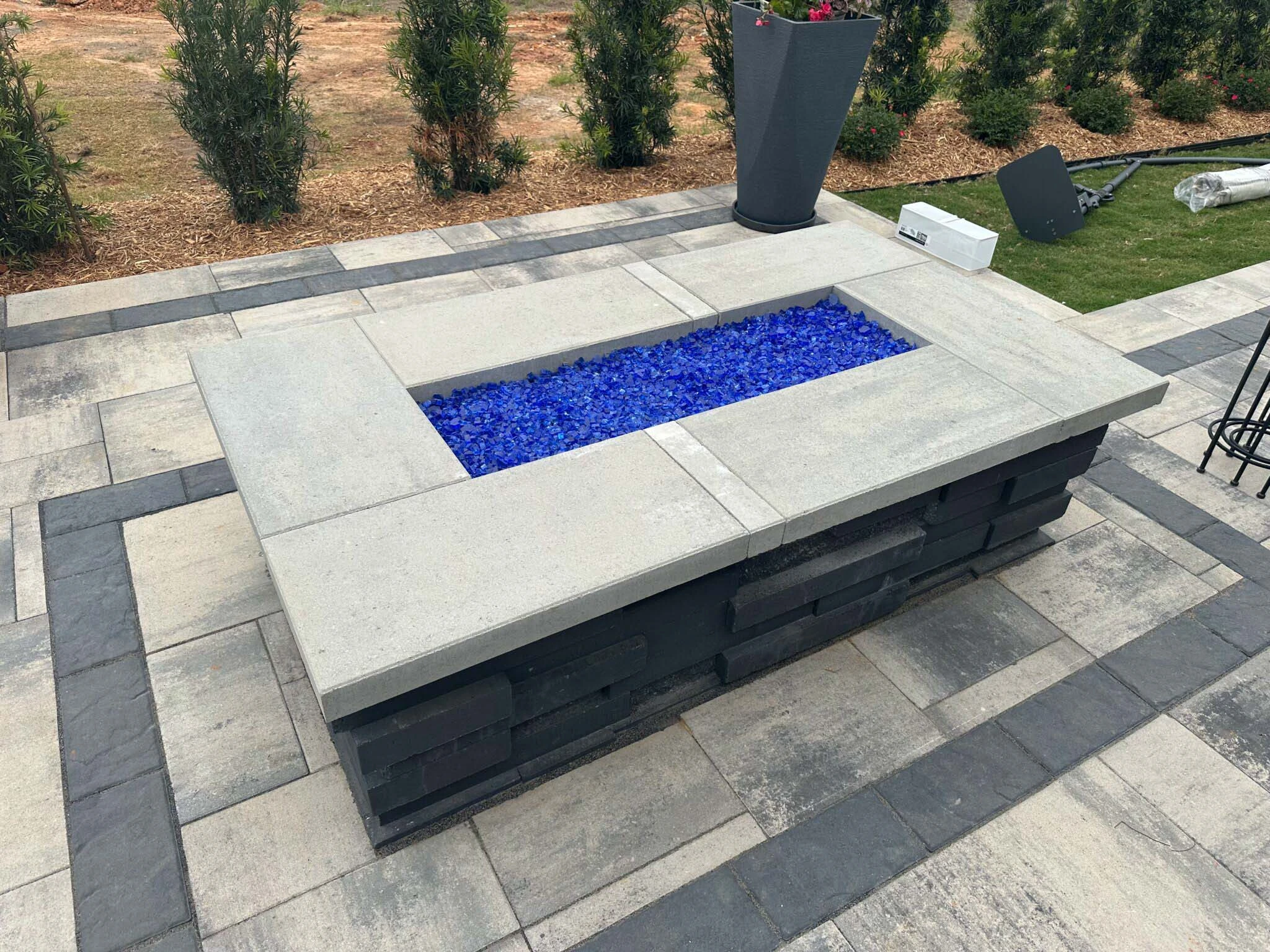
- Fire pit: 48-inch outer diameter, gas-fed with a stainless burner pan, lava rock or tempered fire glass media
- Linear footage of seat wall: ~33 linear feet at a 14-foot radius swept 270°
- Seat wall cost: $140 to $180 per linear foot installed — so roughly $4,600 to $5,900 for the wall alone
- Fire pit cost: $3,400 to $5,800 installed, including the gas line run and the manual shut-off valve
- Combined total: $6,000 to $14,000 depending on stone choice, paver upgrade, and gas-line length
- Seating capacity: 10 to 14 adults, conservatively
Why 18 inches: A standard dining chair seat is 18″ off the floor. Sit on a 16″ wall and your knees come up — it feels like a child’s chair. Sit on a 20″ wall and your feet dangle unless you’re over six feet tall. 18 inches matches the ergonomics of every chair inside your house, which is why guests stay seated longer without fidgeting. We’ve tested all three heights on real families. It’s not a stylistic call. It’s a physics call.
The 14-Foot Radius — And Why Not 12 or 16
The radius of the curved seat wall is the single most consequential dimension in the entire feature. Too tight and the wall crowds the fire — faces get warm, jackets get too hot, and people scoot forward to the edge of the bench, defeating the purpose of the backrest. Too wide and the fire stops providing meaningful heat to the seated ring; guests pull out hoodies in October when they shouldn’t need to.
We’ve built this feature at 10, 12, 14, and 16-foot radii across Forsyth. Fourteen is the answer for a 48-inch gas fire pit with a standard 60,000-to-85,000 BTU burner. At 14 feet center-to-seat, the radiant heat arrives at your shins and chest without baking your face. In a Georgia October evening — 48°F at 8pm is a typical Sawnee Mountain-shoulder night — it’s the dimension that lets you stay out until 11 in shirt sleeves.
Twelve-foot radius works for a smaller 36″ fire pit. Sixteen-foot works if you’re running a 60″ linear fire feature with a higher BTU rating. For the standard round gas pit that 85% of our Forsyth clients install, it’s 14. Period.
Arc vs. Full Circle vs. L-Shape
We never build a full 360° seat wall around a fire pit. Never. Three reasons: you need a traffic opening wide enough for two people to pass without stepping over the wall; a full circle reads visually as a fortification, not a gathering space; and the section facing the house should be open so you don’t block the kitchen-to-patio sightline that makes entertaining workable.
The geometry we build most often: a 270-degree arc with a 4-foot opening facing the house, leaving the best seat — the one with the prevailing southwest breeze at your back — uninterrupted. On sloped yards (and in Forsyth, where rolling foothills define half the county, at least half of our jobs are on some slope), we sometimes break the arc into two facing segments with a step between them. That L-shape with a 6-inch riser between the halves actually improves conversation because it forces the two sides of the ring to make eye contact across the fire rather than staring into the flames.
Paver Field: What We Spec and What We Refuse
The fire pit and seat wall sit on top of a paver patio. The patio is the base layer, and the patio is where most contractors cut corners. Here’s what we build in Forsyth and what we will not build, no matter how hard the client pushes on price:
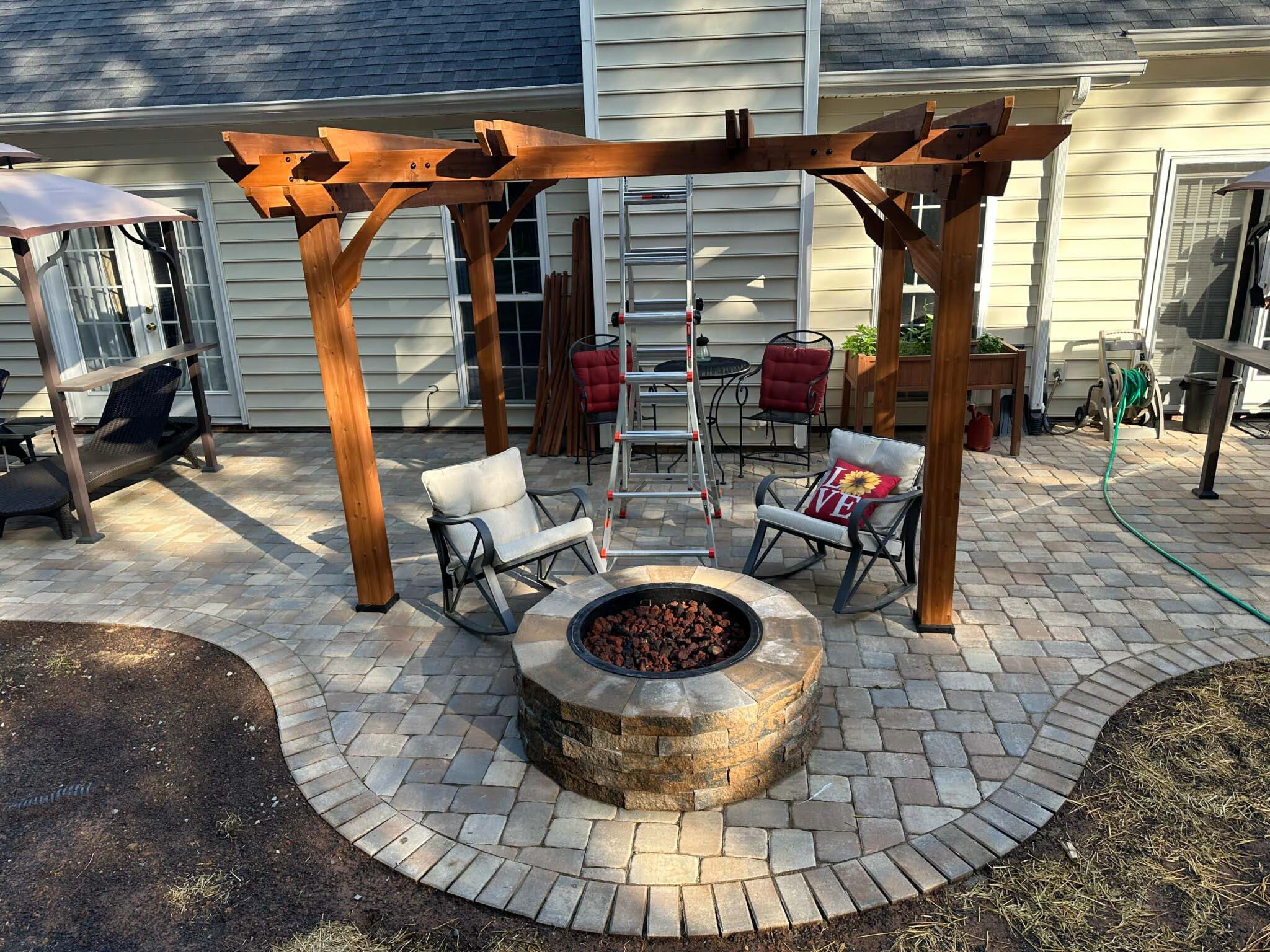
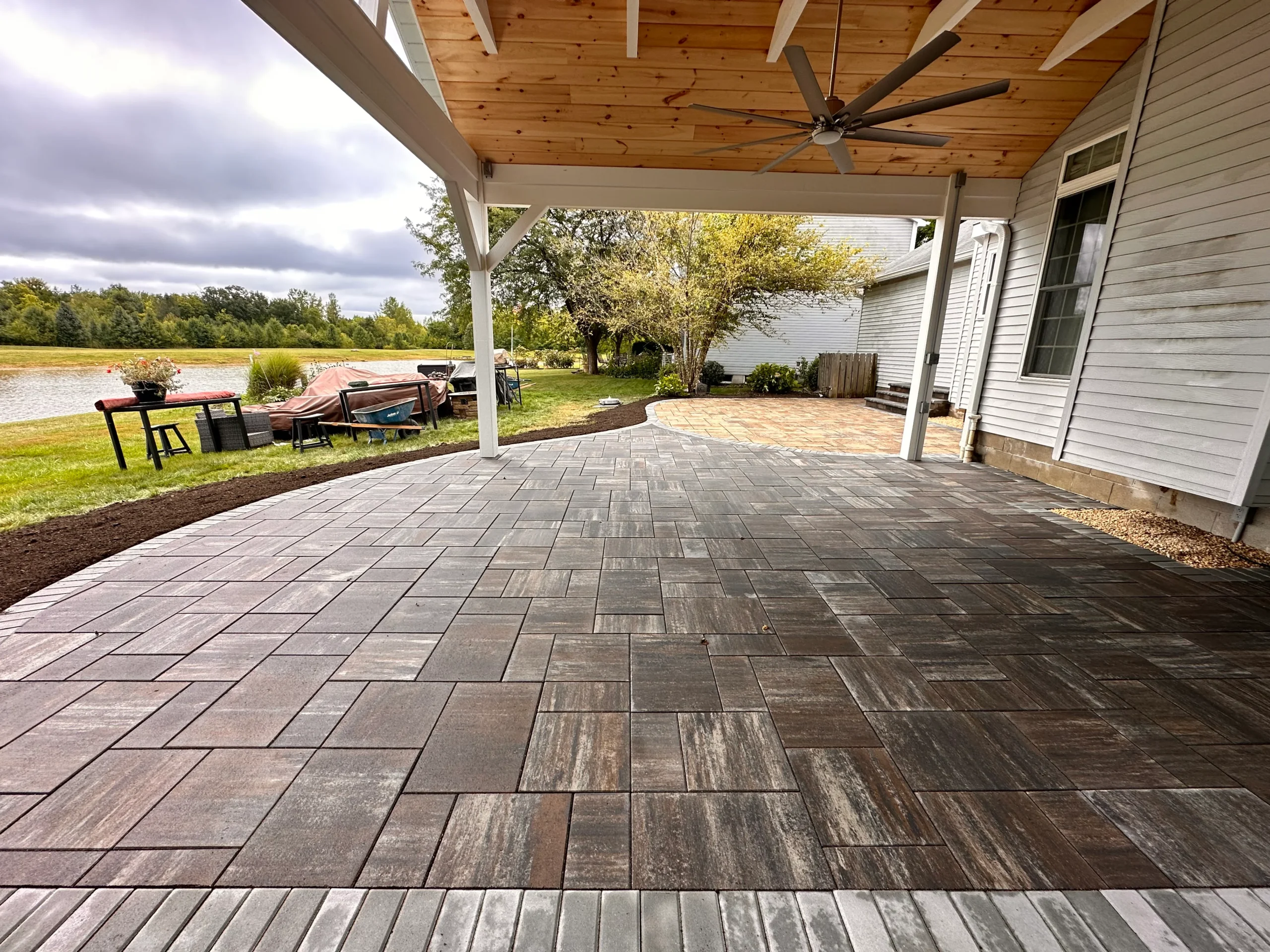
Will build: Techo-Bloc Blu 60, Blu 80 Smooth, or Villagio modular paver, laid on 8 inches of compacted open-graded #57 stone with a non-woven geotextile separator at the subgrade, 1-inch bedding layer of #8 clean stone, polymeric sand joints, and a concrete edge restraint. For larger projects or clay-heavy sites (which is to say, most of the county), we add a second compaction lift in the middle of the base to hit 95% proctor density.
Will not build: Pavers on 4 inches of base. Pavers over old concrete without a fully separated system. Pavers with regular masonry sand in the joints (it washes and feeds weed seed). Pavers without a geotextile layer on Cecil clay — the silt migrates up within three years and lifts individual pavers an eighth of an inch at a time, and by year five the patio reads “cheap job” in every listing photo.
Cecil series Piedmont clay, which covers roughly 72% of Forsyth County’s developable soil, is the reason the base spec matters here more than it does in a sandier county. When Cecil clay gets wet, it expands. When it dries, it contracts and cracks. The freeze-thaw cycle (Forsyth averages 22 freeze events a year) puts that clay through 22 expansion-contraction flexes annually. If the base is thin, or uncompacted, or missing its geotextile, those flexes transmit directly to the paver surface. Ten years in, you can tell which patios were built right and which ones were built to a budget.
The Gas-Line Run Through Forsyth Clay
The gas line is not glamorous, but it’s the line item that trips up more Forsyth homeowners than anything else. A gas-fed fire pit needs a 1/2-inch or 3/4-inch line running from the house meter to a manual shut-off valve within three feet of the pit, buried 18 inches below grade minimum under International Fuel Gas Code standards adopted by Forsyth County. Our typical runs in Forsyth fall between 40 and 90 linear feet depending on where the meter sits.
We dig to 24 inches to give ourselves a 6-inch cushion and to stay below the frost-displacement zone, even though we don’t really have frost penetration in Zone 8a. The extra depth is forgiveness depth — it means a landscaper with a planting auger two years from now isn’t going to nick your gas line with a 12-inch bulb-planting bit.
Forsyth County permitting note: A gas-line install requires a mechanical permit pulled by a licensed gas contractor. The county approves roughly 200+ residential pool and outdoor-feature permits per year — the volume is high enough that turnaround is typically 5 to 9 business days if your plan set is clean. We submit for the permit the same day the contract is signed; homeowners pulling their own permits commonly lose three weeks to revision cycles.
The line terminates at a brass quarter-turn manual shut-off valve buried in a small stone-lined access box inside the seat wall, not at the pit itself. We put the shut-off in the wall because it’s accessible without getting close to the flame, and because the flex connector from valve to burner is the piece most likely to need service in year 8 or 10.
Integrating the Wall Into the Paver Field
The seat wall sits on the paver patio, not alongside it. The paver field runs under the wall footprint, terminating with a soldier-course paver that defines the inside edge of the wall. This is the detail that separates a built-in feature from a kit product dropped on top of hardscape. Homeowners rarely notice it. Listing agents notice it immediately. Appraisers absolutely notice it.
The wall block we use most often in Forsyth County:
- Techo-Bloc Mini-Creta or Estate Wall in the Shaded Brown or Chestnut Brown blend — matches the buff-tan paver family clients request most often in neighborhoods off Post Road and Bethelview
- Belgard Weston Stone in the Harvest Blend — second-most-requested, stronger gray tones, popular in the newer subdivisions off GA-400 exit 14 and 15
- Techo-Bloc Ramanpur in Champlain Gray with a thick concrete cap — the contemporary spec we’ve been building more often for the South Forsyth tech-sector clients since 2023
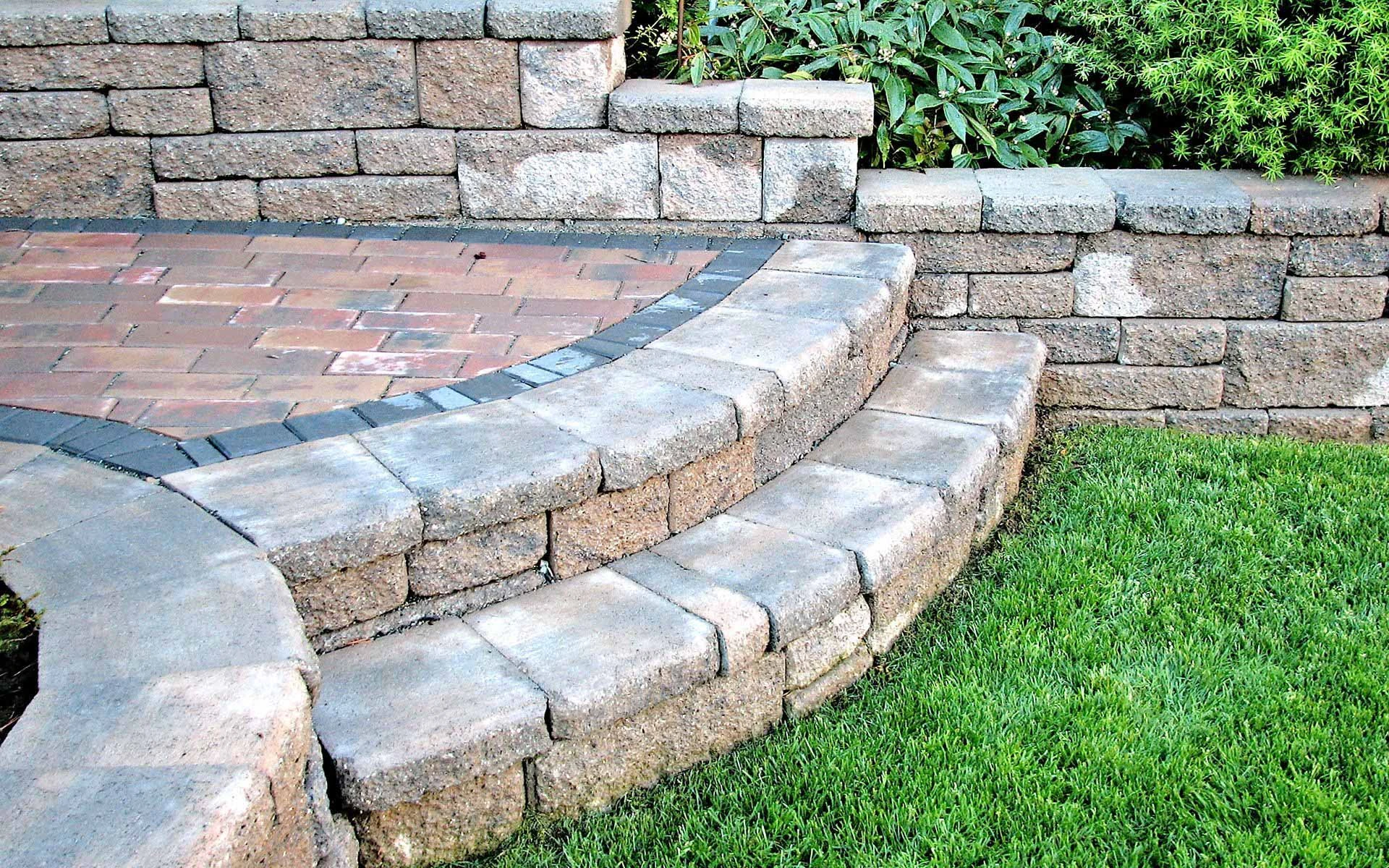
The wall cap is the detail that matters visually. A thin 2-inch cap reads cheap. A thick 3-to-4-inch bullnose or tumbled cap that overhangs the wall face by 1 inch reads intentional. The cap is what your guests see at eye level when they’re seated — it’s the visual line that wraps the gathering. We do not cut corners on the cap stone. We’d rather save money on the paver field than on the 33 linear feet of cap wrapping the seat wall.
Column Pier Accents at the Wall Openings
Optional but high-impact: flank the 4-foot traffic opening with two short 24″-tall square column piers. Adds $800 to $1,400 to the build and gives the eye something to terminate the arc against. On listing photos the piers read as architecture — they imply the backyard was designed, not assembled.
What It Adds on a Resale Appraisal
Forsyth County has been the fastest-growing county in Georgia for the past decade. Population has pushed past 260,000, and the county school system’s consistent top-of-state ranking pulls a buyer pool that’s younger, dual-income, and visually sophisticated. These buyers do not just tour houses. They tour backyards.
The three most common South Forsyth listing-photo patterns that produce above-ask offers: (1) an uncovered but well-furnished pool with a clean coping line, (2) an outdoor kitchen with a built-in grill under a cedar pergola, and (3) a seat-wall-plus-fire-pit feature on a defined paver patio. The data we’ve been tracking since 2022 across our client base — roughly 140 Forsyth-area sales where we did the original hardscape — shows houses with the integrated seat-wall feature closing at an average of $18,000 to $28,000 above comparable homes without it in the same subdivision.
Why that delta exists, specifically: the feature does three things that show up on an appraiser’s adjustment grid. It expands the usable outdoor square footage in a way the appraiser can measure (a patio with seating counts differently than a bare concrete pad). It adds a gas-fed amenity that gets line-item credit. And it creates a focal point that puts every listing photo of the backyard in its best frame — which influences showings-to-offer conversion, which influences days on market, which influences final sale price.
HOA Reality Check by Sub-Market
Almost every neighborhood in Forsyth County has an HOA. Some are hands-off and stamp approvals inside a week. Others require a site-specific ARC package with a survey, elevations, and material samples before they’ll look at it. Rough bucketing from our experience:
- South Forsyth (30041 zip): generally strict — plan on a 3-to-5 week ARC cycle in neighborhoods like St. Marlo, Vickery, Laurel Springs, The Manor. Gas pits universally approved. Seat-wall height sometimes capped at 24 inches, which is fine for our 18″ build.
- West Forsyth / Cumming proper (30040): mixed. Older neighborhoods are permissive. Newer builds near Bethelview and Post Road can be tight — but approvals are rarely denied outright.
- North Forsyth (30028): mostly permissive, especially the 3-to-5-acre estate sections near Coal Mountain and Ducktown. Wood-burning pits face more scrutiny in fire-risk months; gas pits sail through.
We handle the ARC submission as part of the contract on every Forsyth build. It’s included, not billed separately, because the paperwork volume is predictable and the approval path is familiar.
Wood-Burning vs. Gas in Forsyth County Specifically
The question comes up on every first meeting. Here’s the straight version.
Wood-burning fire pit. Cheaper to install by roughly $1,200 to $2,400 because you skip the gas line, meter tap, and shut-off valve. Nostalgic. Produces smoke that drifts into neighbor’s yards — a real issue in the tighter Forsyth subdivisions where lot lines sit 20 feet from the feature. Requires you to store firewood, clear ash, and clean the pit liner. The Forsyth County Fire Marshal’s office does not currently restrict residential wood-burning pits outside red-flag days, but Sawnee Mountain-adjacent neighborhoods with pine canopy get advisory notices more often than the rest of the county.
Gas fire pit. Turn a key, it’s lit. Turn it off, it’s off. No ash. No smoke. The media (lava rock, fire glass, ceramic logs) lasts 15+ years with occasional replacement of the top half-inch. On a freeze-event night — and Forsyth sees 22 of those a year — gas lights in 20 seconds without kindling that’s likely damp. The BTU output is controllable, which matters when you’re hosting and the wind shifts.
Our installation ratio for 2025 YTD in Forsyth County: 78% gas, 22% wood-burning. That number has been gas-heavy since 2021 and the trend is still moving. If you’re building for resale, build gas. If you’re building for the feel of your childhood cabin on Lake Lanier, build wood — and accept that the next owner will retrofit it to gas.
Dual-fuel option: For homeowners who genuinely can’t decide, we sometimes build a gas burner into the pit with a removable log rack sized to convert the same pit to wood-burning seasonally. It’s a $350 to $600 upcharge and eliminates the need to choose. About 8% of our Forsyth builds go this route.
The Six-Week Build Timeline, Start to Fire
A realistic Forsyth County timeline for an integrated seat-wall-plus-fire-pit on an existing lawn (no pool, no major regrading):
- Week 1: Contract signed, HOA ARC package submitted, mechanical permit filed with Forsyth County. Final material samples delivered for owner approval.
- Week 2: HOA approval typically returns. Permit approval follows inside 5 to 9 business days. Materials ordered — Techo-Bloc stock is usually 2 weeks from Atlanta distribution.
- Week 3: Site prep, demo if needed, excavation to subgrade. Geotextile laid. Gas-line trench opened from meter to pit location.
- Week 4: Base compacted in lifts, first 4 inches compacted, second 4 inches compacted, leveling screed set. Gas line installed by licensed gas contractor, pressure-tested, inspection called.
- Week 5: Paver field laid, cut, joint sand swept and set. Seat wall courses laid, pinned with adhesive at the cap.
- Week 6: Fire pit burner installed, media set, manual shut-off verified, final inspection, walk-through, ignition.
Weather adds contingency in late-winter and spring builds — Forsyth’s typical rainfall during March through May can push the schedule by 5 to 10 days. Summer and fall builds hit the six-week mark reliably. We start most Forsyth contracts aiming for ignition in the third week of October — the window when backyard living becomes peak-value in Georgia and every future evening pays the feature back.
One Last Call on Materials
The biggest regret we hear from homeowners who phased this feature wrong: mismatched stone. Fire pit bought from a big-box kit, seat wall built two years later from a different vendor. The tones don’t align. The cap thicknesses differ by half an inch. The joints read as two projects, not one. From the kitchen window, it always looks slightly off, and you can’t name why.
Build the paver field, fire pit body, seat wall, and cap from the same manufacturer, in the same color lot, in the same week. Specify it on the contract. If a substitution is proposed mid-build for any reason — stock issue, delivery delay, cosmetic question — hold the line. The whole point of the integrated feature is that it reads as one piece of architecture. The whole point fails if the color blend shifts.
Seat-wall and fire-pit integrations across 20+ cities within 30 miles of Winder, GA
Forsyth County is the fastest-growing county in the state, and the integrated fire feature is the single hardscape upgrade that returns its cost on resale. We build the whole system — base, paver field, wall, cap, fire pit, gas line — in one mobilization, one permit cycle, and one consistent material lot.