
A quarter-acre lot off Old Peachtree Road won’t hold a 16×32 pool — not with Gwinnett’s 10-foot rear setback and a 7-foot side yard. But a 450-gallon raised spa paired with a 1,400-gallon cold plunge can, and it gives you more usable days per year than the pool your neighbor just spent $168,000 on.
Here’s the scenario we keep walking into in Village Grove, Woodbury, and the older Old Peachtree tracts: the homeowner wants water. They have the budget. They called three pool builders. All three walked the backyard, checked the Gwinnett setbacks, looked at the septic field, looked at the grade drop toward the neighbor’s fence, and said some version of the same thing — “you can’t fit a real pool back here.” Then they handed over a $145K–$180K proposal anyway for a cramped 12×24 plunge that would sit five feet from the back door and block the sightline from the kitchen window.
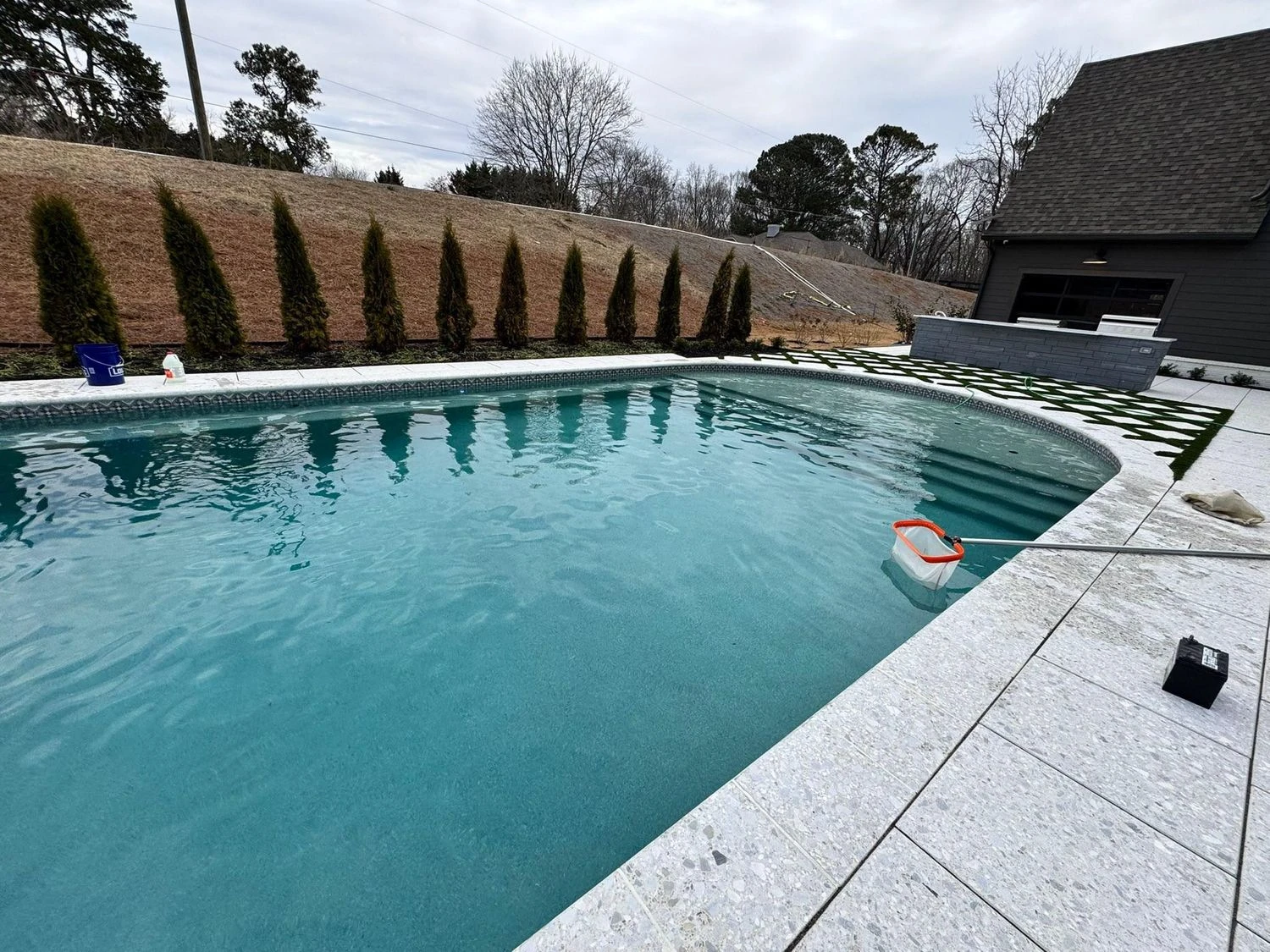
We built something different for a family in Village Grove last fall. An 8×8 raised gunite spa on the high side of the yard, a 10×14 swim-jet cold plunge two steps down on the low side, a travertine connector pad between the two, a single Gwinnett County residential pool permit covering both vessels, and a finished build at $62,400. Year-round water use, no septic conflict, no fight with the HOA architectural review, and the kitchen window still looks out over the dogwood. This post is how that design works, what it costs, why the county permits both as one project, and how to tell whether the approach actually fits your Suwanee lot.
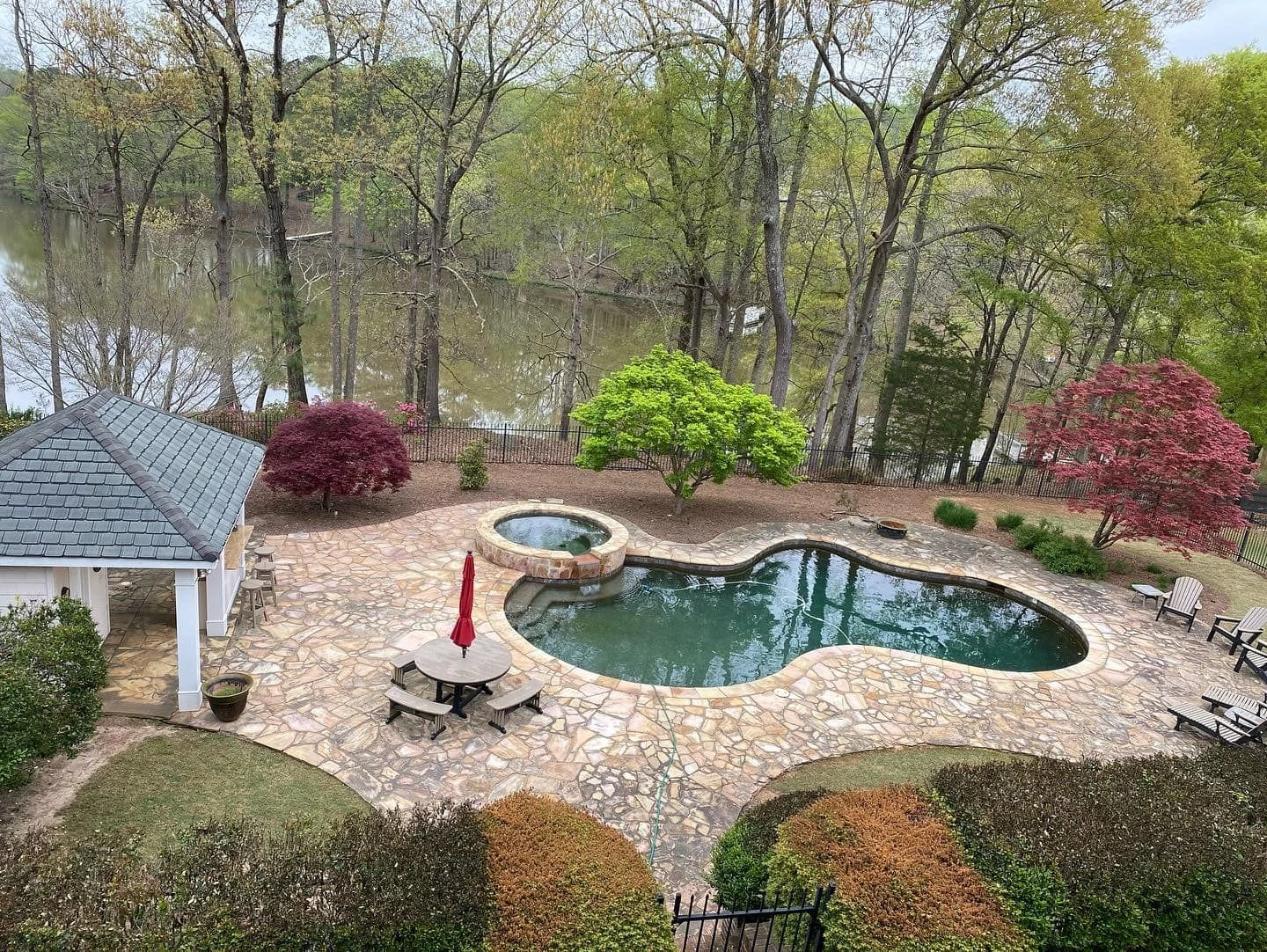
Why Quarter-Acre Suwanee Lots Can’t Fit a Real Pool
Suwanee’s older inventory — the 1980s and 1990s traditional builds in Village Grove, Woodbury, and the original Old Peachtree corridor — sits on lots that averaged a quarter to a third of an acre at plat. Gwinnett County Unified Development Ordinance pool setbacks require 10 feet from the rear property line to the water’s edge, 7 feet from any side lot line, and 10 feet from the house foundation. A pool equipment pad adds another 5 feet minimum from the neighbor’s fence.
Do the math on a typical 90×110 rear yard with the house footprint eating 45 feet of depth. You have roughly 55 feet of backyard to play with. Strip 10 feet of rear setback and 10 feet off the house, and you’re down to 35 feet of usable length — before you factor in the septic drain field, the HVAC condenser pad, the gas meter, the utility easement running along the back of most Peachtree Industrial Blvd-era subdivisions, and the slope break that usually starts somewhere in the middle of the yard in the Chattahoochee watershed Piedmont.
A 16×32 rectangle with a 3-foot deck perimeter needs 22×38 of clear ground. You don’t have 22×38 clear. You have maybe 18×26 — if the septic tank cap isn’t in the middle of it. That’s the moment a builder either talks you into a cramped 12×24 nobody will use, walks away from the job, or gets creative.
Gwinnett County setback math for Suwanee pools: 10 ft rear, 7 ft side, 10 ft from foundation, 5 ft from any septic drain field line, permit submittal at 446 W. Crogan St., Lawrenceville. A raised 8×8 spa needs a 13×13 clear footprint when you add coping and the 5-foot walk-around — it fits on lots where a 16×32 pool legally cannot.
The 8×8 Raised Spa — Why 450 Gallons Changes the Year
A pool is a summer object. In Suwanee — USDA Zone 8a, ~20 freeze events a year, water temperatures that dip below 70°F from mid-October through mid-May — a pool is actively usable about 135 to 160 days a year. A properly-built raised spa, with a Pentair MasterTemp 400K BTU natural-gas heater and a thermal cover, is usable 365 days a year. That changes the use-case math before you’ve even priced it.
An 8×8 raised gunite spa holds roughly 450 gallons. That’s tight — four adults comfortably, six if they like each other. It sits 18 inches above the deck with a natural-stone veneer face, which means the coping doubles as spillover seating when the spa isn’t running. We run the structure with 8-inch gunite walls, #4 rebar on 12-inch centers, a 12-inch floor slab, and a raised-bond beam that doubles as the water feature when it spills into the cold plunge below.
At 104°F the spa heats from 70°F in about 45 minutes on a 400K BTU heater. From 50°F January cold, about 2.5 hours — which is why the Pentair IntelliFlo VSF variable-speed pump gets paired with the MasterTemp: the VSF can pre-circulate at a low watt draw for 30 minutes before the heater kicks on, priming the lines, saving the heater a cold start. Monthly gas cost on a twice-a-week December use pattern runs $55 to $80 depending on Atlanta Gas Light rates that season.
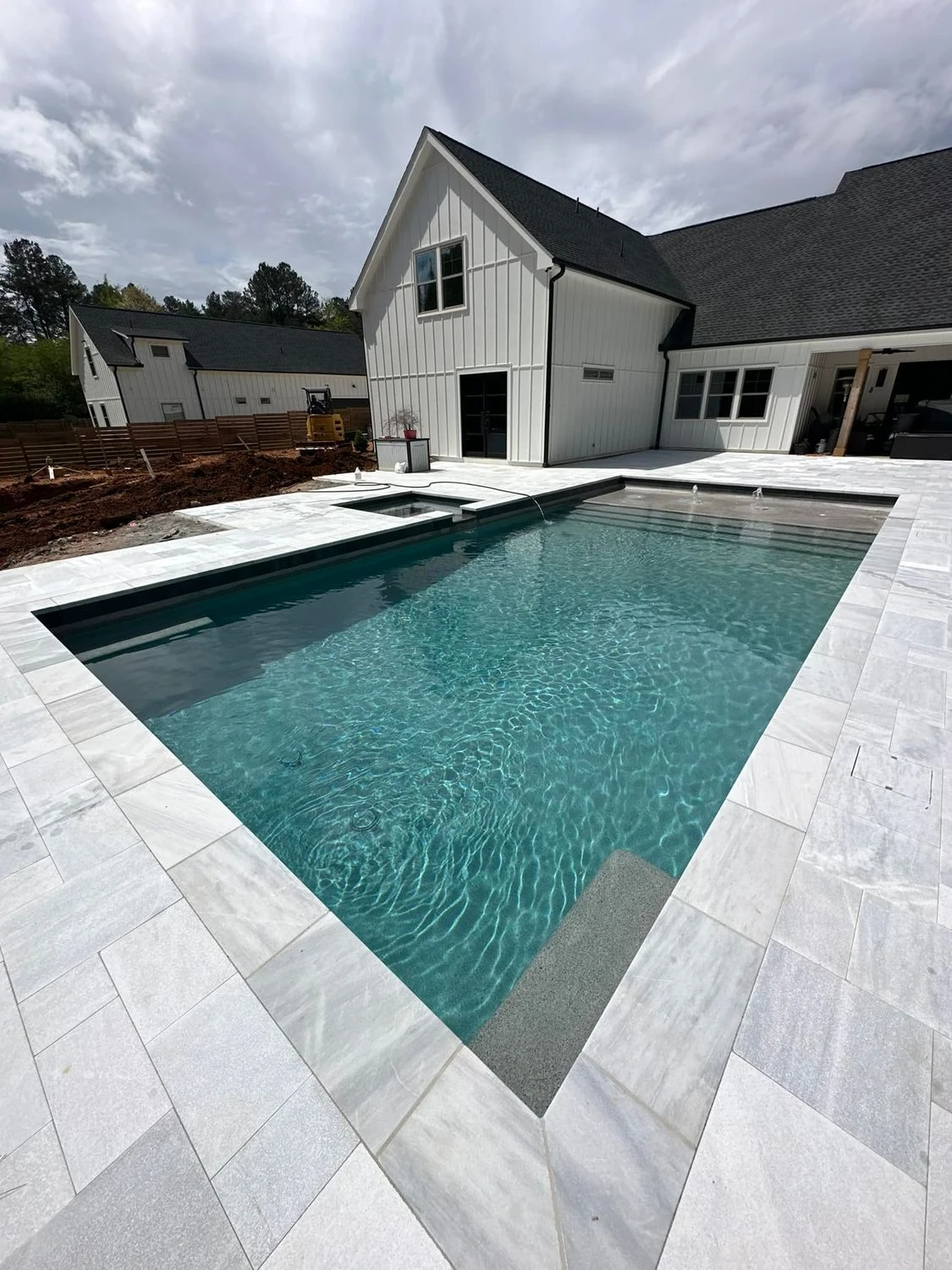
Why Raised and Not In-Ground
On a tight lot a raised spa solves three problems a sunken spa creates. First, excavation: a sunken spa needs the same excavator access a pool does, which on an Old Peachtree quarter-acre usually means pulling a fence panel and running the track hoe through the neighbor’s yard. A raised spa can be built with a mini-ex and a tight-access Bobcat. Second, septic: raising the spa 18 inches above deck means the floor slab sits on engineered fill, not cut grade, which keeps the structure well clear of any shallow septic lateral. Third, presence: a raised spa reads as architecture — a bond-beam feature you see from the kitchen window — instead of a hole in the ground.
The 10×14 Cold Plunge With Swim Jets — A Workout That Replaces the Pool
Here’s the other half of the design. Two steps down from the spa, we build a 10×14 gunite plunge basin, 4 feet deep, holding roughly 1,400 gallons. In summer it runs at 78°F to 84°F on a passive basis — the surface absorbs enough Suwanee sun to stay warm without a heater. In winter the homeowner chooses: leave it cold at 50°F for morning plunges, or run a small Pentair UltraTemp 110 heat pump to hold it at 68°F for off-season light swim.
The key piece is the swim jet. A BADU SwimJet 5 HP unit mounted at the shallow end puts out a current strong enough for a tethered swim workout — 35 to 40 minutes of continuous freestyle against resistance in a basin that’s only 14 feet long. The unit draws 240V through a dedicated 30-amp breaker off the Jackson EMC subpanel. You get the fitness use-case of a full-size lap pool in a footprint a third the size. You get the summer cold-dip and the winter recovery soak. You lose the weekend-afternoon-float-on-a-raft scene — which, honestly, on a Village Grove lot you weren’t getting with a 12×24 cramped plunge anyway.
Why the Swim Jet Beats a Short Lap Pool
A 14-foot basin with a swim jet is a better lap workout than a 24-foot pool without one. In a short pool you spend half the session turning at the wall, breaking rhythm, resetting breath. Against a continuous jet current you stay in stroke for 35 minutes unbroken. We’ve had homeowners swim 2,000+ yards in a single session in a 14-foot plunge — something physically impossible without turning every ten seconds in a 24-foot pool.
Gwinnett County Permits Both as One Project
This is the single most valuable piece of the spa-first approach and almost nobody knows it. Gwinnett County Department of Planning & Development, working out of the Lawrenceville office on W. Crogan Street, permits an attached spa and pool under a single residential pool permit — same fee schedule, same plan review, same inspection cycle. A raised spa plus a cold plunge basin connected by shared plumbing and sharing an equipment pad qualifies as “one pool project with integrated spa feature.”
Permit fee on a Gwinnett residential pool permit runs $285 plus the per-valuation surcharge — roughly $340 to $420 total for a $65K project. That’s one fee covering both vessels. Versus separate permits on two standalone water features, which run you $285 × 2, plus two plan reviews, two inspection cycles, two approval windows. The single-project permit also compresses the HOA architectural review submittal — one drawing set, one site plan, one material spec — which on a Laurel Springs-adjacent lot can mean the difference between a 3-week turnaround and a 7-week one.
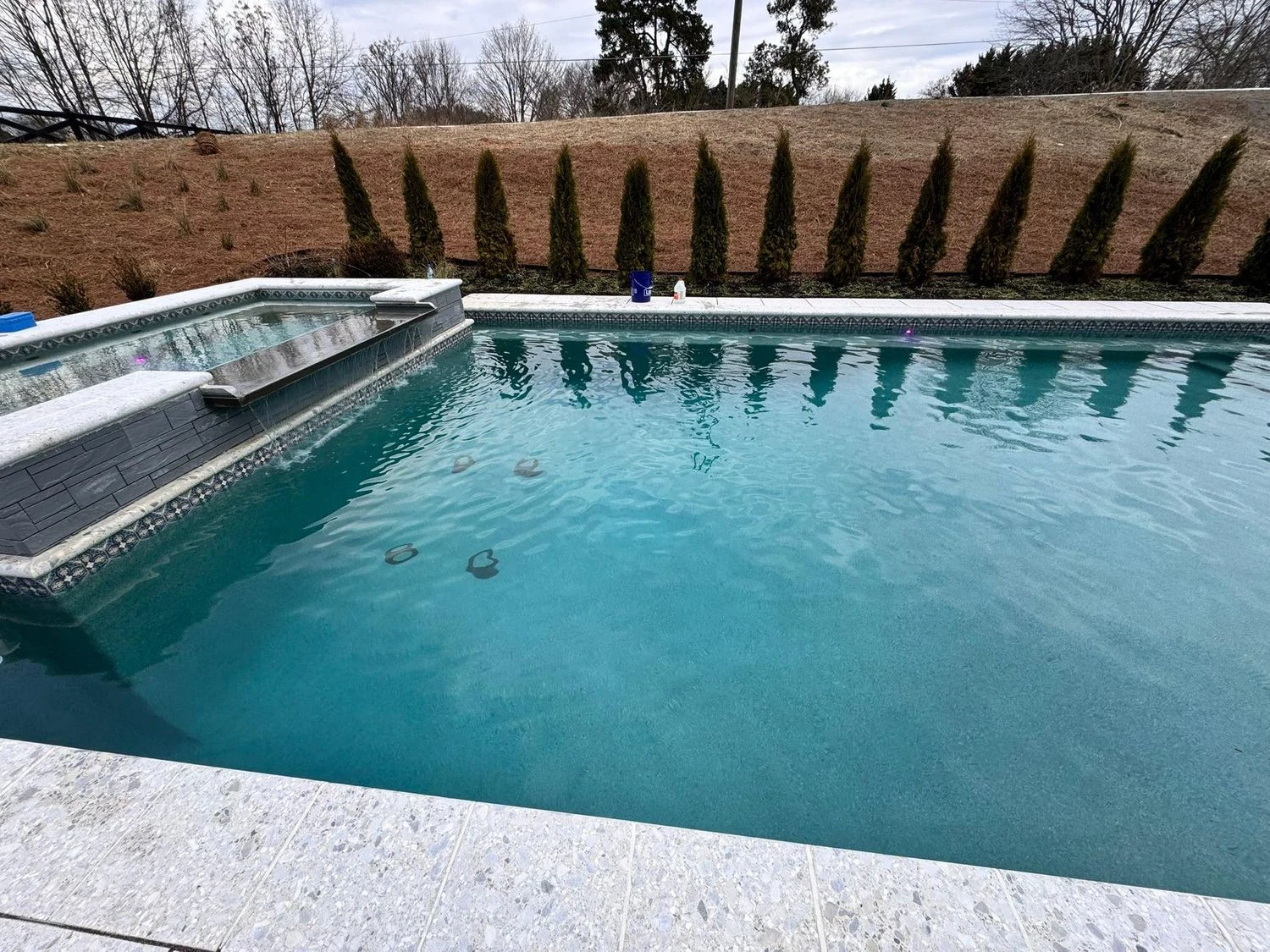
What the ARB Actually Approves Faster
Architectural review committees across the Suwanee premium neighborhoods — Laurel Springs, River Club, Bear’s Best, the Manor, Highgrove — approve a spa-first build measurably faster than a full-pool build. Reason: smaller excavation footprint, less disturbance to neighbor sightlines, less slope regrading, less tree removal. On the Village Grove project, ARB approval came back in 16 days. The comparable full-pool submittal next door took 31 days and came back with revisions.
The $48K to $72K Build — Actual Line Items
Here’s the honest money. The Village Grove project landed at $62,400 finished. A baseline spa-plus-plunge on a simpler lot lands closer to $48K. A premium version with natural-stone veneer on both vessels, an integrated fire bowl on the spa bond beam, and a covered pergola over the connector pad can push $72K.
- 8×8 raised spa shell (gunite, engineered fill, rebar, plumbing rough-in): $14,200
- 10×14 cold plunge basin (gunite, excavation, plumbing rough-in): $12,800
- Pentair MasterTemp 400K BTU gas heater + gas line trench: $5,400
- Pentair IntelliFlo VSF pump, cartridge filter, plumbing manifold: $3,900
- BADU SwimJet 5 HP with dedicated 240V run from Jackson EMC subpanel: $6,800
- Travertine coping, connector deck, spillover lip (240 sq ft): $7,200
- Natural stacked-stone veneer on spa face: $3,100
- Waterline tile (both vessels), interior plaster (quartz aggregate): $4,400
- Pentair IntelliBrite 5G LEDs (2 spa, 2 plunge) + Lutron control: $2,800
- Gwinnett permit, HOA submittal, engineering site plan: $1,800
Compare against the cramped 12×24 plunge pool those three other builders quoted: $148K to $178K. For roughly a third the cost, the spa-plus-plunge delivers more genuine use days per year, a lower gas and electric operating cost, and a lot more visual presence from the kitchen window. The only real loss is the raft-float summer pool scene — and you could not have gotten that from a 12×24 plunge anyway.
Jackson EMC load math: A 60-amp subpanel is adequate for the full system. Heater and pump on the gas side, swim jet on a dedicated 30A 240V breaker, LED transformer and Lutron repeater on a 15A circuit. Jackson EMC territory transformer sizing in Village Grove is typically 25kVA — the spa-plus-plunge package adds roughly 6kVA of peak load, well inside the envelope.
When the Spa-First Approach Doesn’t Fit — Three Lot Conditions to Rule Out
This design works beautifully on the right lot. It does not work on every lot. Before we price a project we check three conditions on the Suwanee property. If any of these is a red flag, we have a different conversation with the homeowner.
Condition One — Septic Field Location
Older Village Grove and Woodbury homes often have the septic field in the middle of the rear yard. A raised spa can sit beside the field but not on top of a drain line — Gwinnett code requires a 5-foot lateral separation from any septic component. We pull the septic permit on file with Environmental Health before we spec a location. About one in four lots in these neighborhoods has a field layout that forces us to either put the spa in a non-ideal corner or walk away.
Condition Two — Grade Drop and Retaining
Suwanee’s Piedmont topography creates backyards that drop 4 to 8 feet across the rear. A spa-plus-plunge actually uses that drop well — the spa on the high side spills into the plunge on the low side. But if the drop exceeds 8 feet across the footprint, you’re into engineered retaining wall territory: $180/linear foot for Techo-Bloc structural block, $240/linear foot for natural-stone veneer on a block backer. That can add $12K–$20K to the project, which shifts the math on whether the spa-first approach still wins.
Condition Three — Tree Canopy and Root Structure
Mature hardwood canopy is what makes older Suwanee backyards beautiful and what often makes them impossible to build in. White oaks and tulip poplars on 40-year-old root systems cannot be excavated through without killing the tree. If the best spa-plus-plunge location requires cutting a 24-inch oak, we either find an alternate location or tell the homeowner to keep the tree. The trees in Village Grove and Old Peachtree are worth more to the property than the water feature.
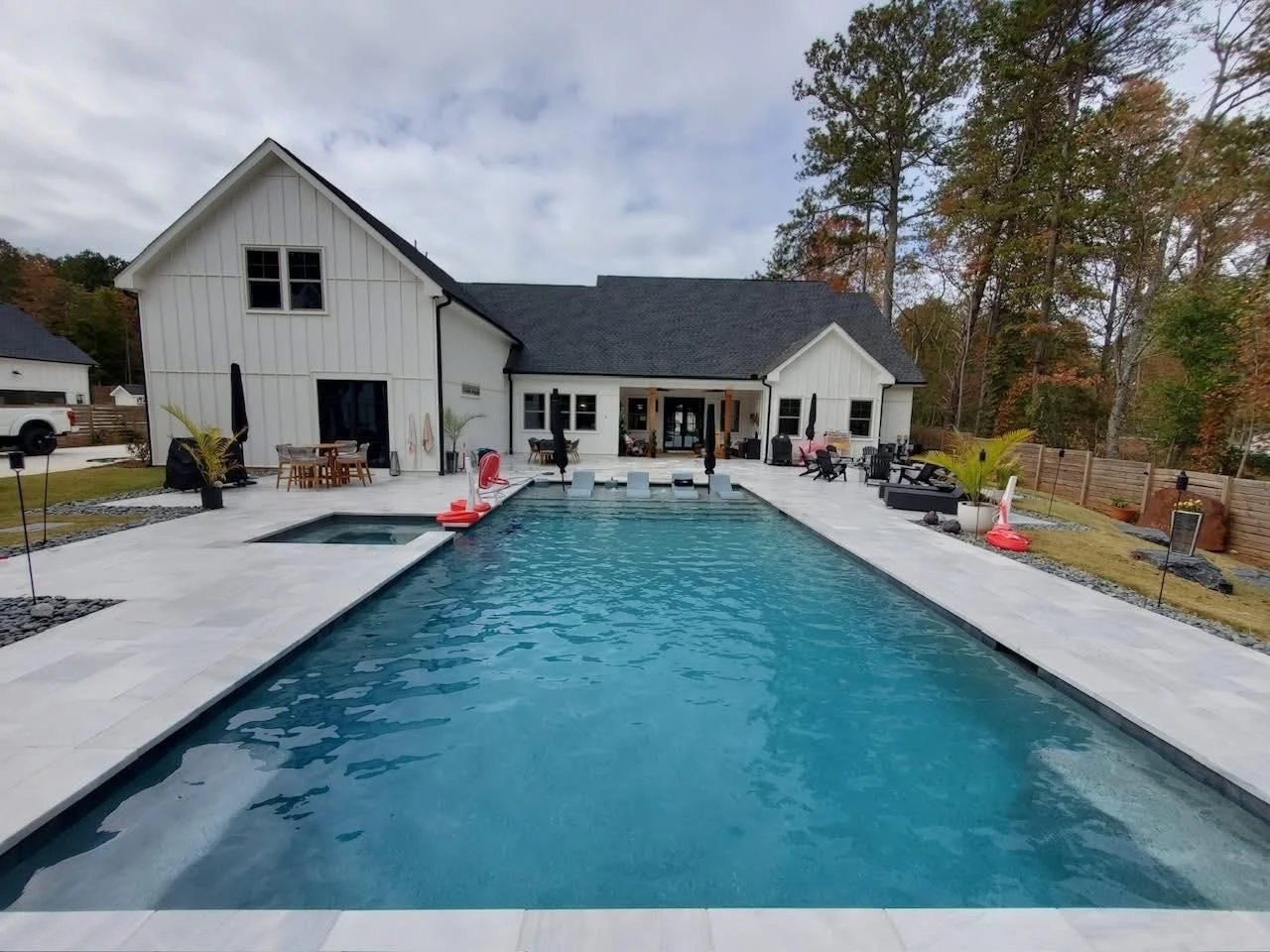
What the Build Looks Like — 4 Weeks, Not 4 Months
A full custom pool build in Suwanee runs 14 to 22 weeks from permit to swim. A spa-plus-plunge build on the same lot runs 4 to 6 weeks. Smaller excavation, less gunite tonnage, less plumbing, faster inspection cycle, faster cure on the plaster. Here is the week-by-week on the Village Grove project:
- Week 1: Layout, excavation for plunge basin, engineered fill for raised spa pad, rebar cage tie-in, rough plumbing
- Week 2: Gunite shoot (both vessels, same day, same truck), 7-day cure initiated, gas line trench, electrical rough
- Week 3: Waterline tile set, travertine coping, stacked-stone veneer on spa face, equipment pad pour and equipment set
- Week 4: Interior plaster, water fill, startup chemistry, heater commissioning, swim-jet commissioning, final Gwinnett inspection, homeowner walk-through
Four weeks from breaking ground to a first soak. In a full-pool build the shell cure alone eats 28 days. This is part of why the spa-first approach lands differently with homeowners: it’s not just cheaper, it’s visible faster. Contracts signed in February land in the water by late March — before the first warm Suwanee weekend.
Who This Design Is Right For — And Who Should Keep Looking
Three kinds of Suwanee buyers find this the right answer. First, the small-lot homeowner in Village Grove, Woodbury, or Old Peachtree who’s been told “you can’t fit a pool back here” and doesn’t want to settle for a cramped 12×24. Second, the empty-nester or retired couple who wants year-round water, prefers the spa and the cold plunge over a pool they’d use six weekends a year, and values the lower operating cost. Third, the fitness-focused family where the swim-jet workout replaces a gym membership.
Three kinds of buyers should keep looking at full pool options. Families with school-age kids who want the float-and-splash summer experience — a 10×14 plunge isn’t that. Entertainers who host 15-20 people poolside — you need real pool length for that crowd. And anyone who’s already on a larger lot in Laurel Springs, The River Club, or Bear’s Best where a full custom pool actually fits — the spa-plus-plunge on an estate lot reads as small when the lot could hold a 20×44 rectangle.
If you’re in the first group — and you’ve had the “can’t fit a pool” conversation with another builder — the spa-first design is the outside-the-box answer the Gwinnett County permit office already approves, the Suwanee ARBs already green-light in under three weeks, and the Jackson EMC service already supports without a panel upgrade. It’s the answer your lot was asking for the whole time.
Custom pool construction across 20+ cities within 30 miles of Winder, GA
From 8×8 raised spas on quarter-acre Suwanee lots to full resort-scale pool builds on River Club estates, Primetime Pools GA designs and builds water features engineered to the specific setback, soil, and HOA conditions of each Gwinnett and Northeast Atlanta property.