
Every October, the phone starts ringing in East Cobb. The pool was full Labor Day weekend. Now the homeowner is adding a garden hose twice a week and wondering if the shell cracked. It almost never has. The leak is hiding in a place nobody thinks to look — the skimmer throat seal.
A Marietta pool is a very specific animal. It sits in Cobb County, on Piedmont clay, at roughly 1,118 feet of elevation, under one of the densest mature tree canopies in Metro Atlanta. The combination of oak, poplar, sweetgum, and pine that gives Indian Hills and Atlanta Country Club their character is the same combination that turns your skimmer into a choke point for eight weeks a year. When the basket clogs, water finds another way past — and once it starts finding a way past, the skimmer throat becomes the leak path.
This post is about that exact failure. Not a general “pool leak checklist.” Not a swing at plaster cracks or pump seals. A forensic look at why a specific component — the horizontal opening where the gutter of water exits your pool and enters the skimmer housing — leaks water in autumn at a rate most Marietta homeowners mistake for evaporation or splash-out. And what the $380–$640 rebuild looks like versus the $60–$120 prevention.
Why Marietta’s Mature Canopy Is the Mechanical Problem
Drive through Burnt Hickory, Walton Woods, or Sope Creek in mid-October and count the pools with visible leaf rafts on the surface. Then count the ones without. The ratio tells you something about the failure rate.
The USDA Zone 7b/8a boundary runs right through Cobb, which means Marietta’s deciduous canopy holds leaves later than North Fulton and drops them faster than South Fulton. Homeowners report peak fall on a four-to-six week window roughly spanning late October through early December. In that window, a pool sitting under any significant oak or poplar shade takes in several gallons of organic debris per day — heavy, water-logged debris that sinks the moment it’s saturated and, critically, jams the skimmer basket from the bottom up.
A clogged basket is not a water loss event by itself. It is a pressure event. When water can no longer pass through the basket’s perforations at the rate the pump is calling for, the pump pulls harder. Suction increases. And the path of least resistance shifts from through the basket to around the basket — specifically, through any compromised seal at the skimmer throat, down the exterior of the skimmer body, and into the surrounding soil.
That exterior-of-the-body pathway is the diagnostic signature of this particular failure. You do not see it on the surface of the deck. You do not see it as a wet spot next to the skimmer lid. You see it as a pool that drops 1–2 inches per week from mid-October through Thanksgiving.
What the Skimmer Throat Actually Is (and Why It Fails)
The skimmer throat is the horizontal rectangular opening that accepts surface water from the pool. On a gunite pool it is the cast-in slot at water level, tiled around its perimeter, with a weir door swinging at its mouth. On a fiberglass pool it is the molded port where the skimmer housing meets the shell. In both cases there is a seal — either a gunite-to-skimmer cement bond, or a factory gasket with a sealant bead — that is supposed to keep pool water moving into the basket rather than around the housing.
That seal fails for predictable reasons. In Marietta specifically, we see four common failure modes:
- Freeze-cycle fatigue. Cobb averages roughly 22 freeze events per year. Water trapped behind the throat seal expands, contracts, and slowly opens a hairline path.
- Piedmont clay movement. Cecil-series red soil swells wet and shrinks dry. The skimmer body, anchored to the pool shell, stays put. The soil around it does not. Over ten to fifteen years the seal shears.
- Rebar rust expansion. On older East Cobb pools — think 1980s Indian Hills rebuilds — the rebar inside the skimmer throat can begin to oxidize where concrete cover is thin. Rust expands at nine times its original volume and cracks the throat from the inside.
- Over-suction during peak leaf load. This is the fall-specific failure. Repeated high-vacuum events tear the already-aging seal the rest of the way open.
The first three failures are slow and chronic. The fourth is acute and seasonal — and it’s why your pool does not lose water in August the way it loses water in November.
Marietta baseline evaporation: A 400 sq ft pool surface at 90°F summer highs loses about 1/4″ per day from evaporation. In October through November, that drops to roughly 1/8″ per day. If you are losing 1–2 inches per week in fall — you are not looking at evaporation. You are looking at a leak.

The Three-Test Diagnostic Sequence We Run
When we take a Marietta fall water-loss call, we run three tests in a specific order. The sequence matters. Each test rules out a category of leak before we spend money on the next one.
Test 1 — The Bucket Test
This one rules out evaporation-vs-leak, and it costs nothing. Fill a plastic bucket with pool water to a line marked exactly at pool surface level. Set the bucket on the top step of the pool, weighted so it cannot tip. Do not run the pump for 24 hours. Come back. If the pool level has dropped more than the bucket level, water is leaving the pool through a leak. If they drop the same amount, it’s evaporation.
In a fall diagnostic on a Marietta Country Club pool last November, the bucket dropped 1/8″. The pool dropped 1-3/8″. That’s a 1-1/4″ leak over 24 hours — in a pool that had not leaked all summer.
Test 2 — The Skimmer Dye Test
With the pump off and the pool level dropped to mid-skimmer-throat (typically 1″ below the tile line), we inject a plume of food-grade leak-detection dye directly at the seal between the skimmer housing and the pool wall. If the seal is intact, the dye hangs in the water and slowly dissipates. If the seal is breached, the dye is pulled through the gap within 30–90 seconds — visible as a tight stream rather than a cloud.
This test is the single most diagnostic thing we do on a fall leak call. When we see dye pull at the throat, we know we are looking at a $380–$640 skimmer rebuild, not a $6,000 plaster job.
Test 3 — The Pressure Test
If the dye test is inconclusive — and on older Brookstone and Seven Oaks pools we’ve had to run it twice because of water movement at the throat — we isolate the skimmer line with an inflatable test plug and pressurize it to 15 PSI. A healthy line holds pressure for 15 minutes without drop. A leaking line will lose pressure measurably, and the drop rate tells us roughly how big the breach is.
The Rebuild: What $380–$640 Actually Buys You
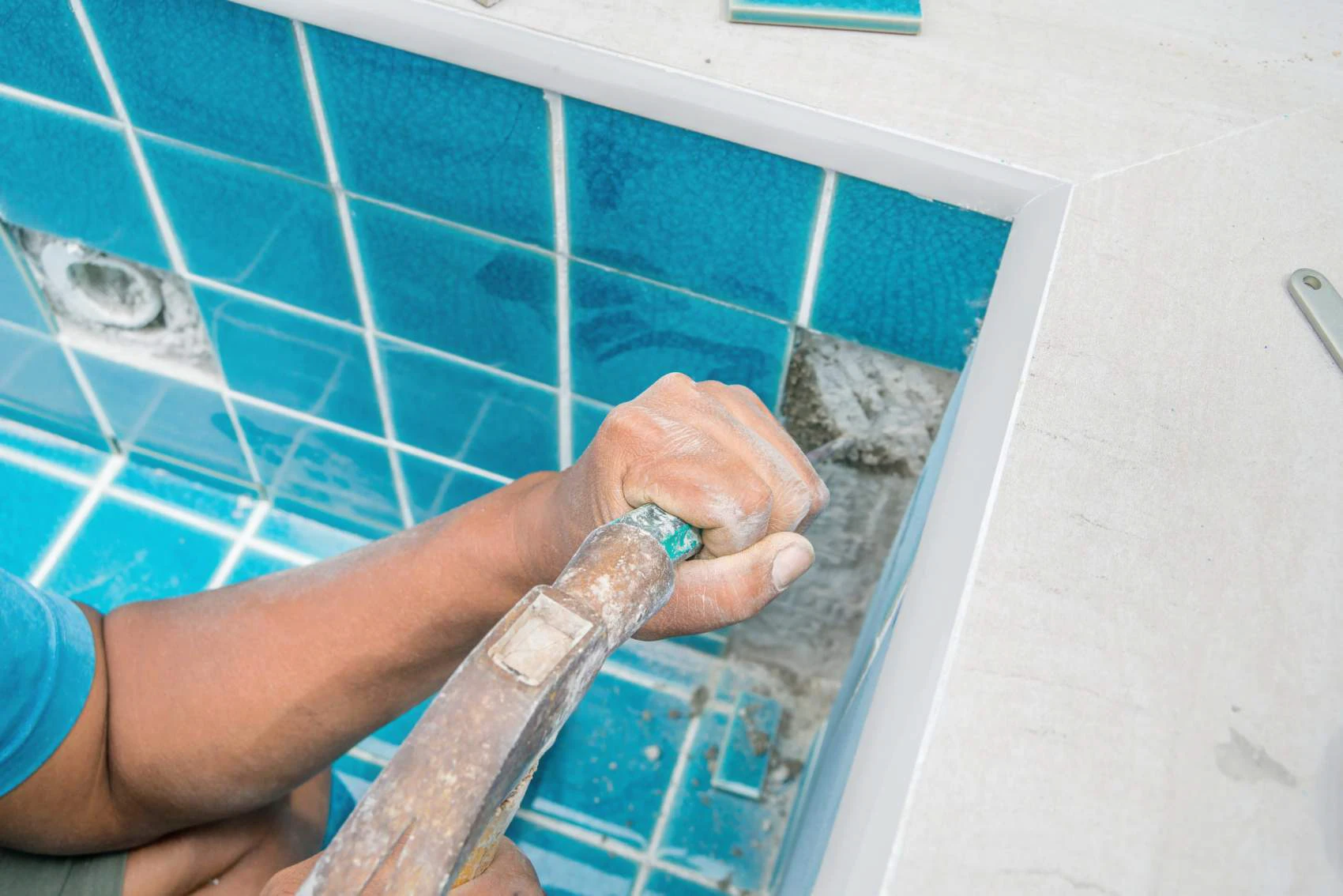
Skimmer throat repair is one of the more satisfying line items in our repair book because the fix, done right, is genuinely permanent. The range we quote in Marietta is tight — $380 on the low end, $640 on the high end — because the variables are small. The labor and materials don’t change much. What changes is access.
What’s in the Low End ($380)
- Pool drained to 2″ below the skimmer throat (about 800 gallons of displacement).
- Old sealant and hydraulic cement chased out of the throat with a carbide tool.
- Surface prepped with a bonding agent.
- Fresh bead of pool-grade polyurethane sealant, backed by hydraulic cement at the structural joint.
- 24-hour cure, refill, prime, and a second dye test to confirm.
What Pushes You to $640
- Waterline tile damage during demolition (almost always on 1980s–1990s pools where the original tile is no longer available and a pattern match has to be sourced from Noble Tile Supply in Doraville).
- Rebar rust extending past the throat into the skimmer body, requiring rust conversion and cement patching.
- Weir door replacement — the swinging leaf-catching door fails often on older Hayward SP1091LX skimmers, and the part alone is $45.
- Homes on the Atlanta Country Club side of Marietta with strict HOA debris and access rules that extend the job by half a day.
What you should not pay for: If a contractor proposes a full skimmer replacement as the first option on a throat-seal failure, get a second opinion. Replacing the entire skimmer housing on a gunite Marietta pool runs $2,400–$3,800 with deck cut-out — and it is the right call maybe one time in ten. A properly diagnosed throat seal rebuild does the job at a fraction of the cost.
The $60–$120 Prevention Most Homeowners Never Hear About
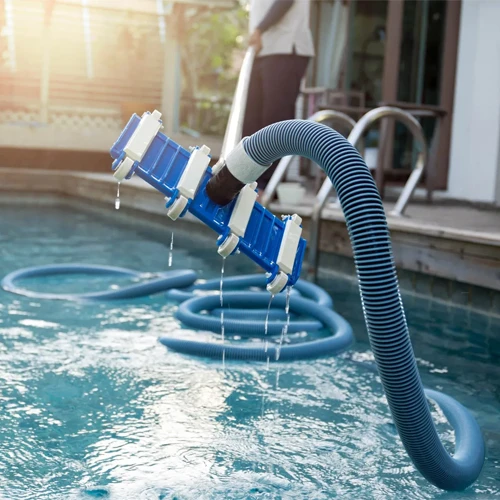
The economics here are lopsided. A heavier-load skimmer basket — the deeper profile models built for high-leaf environments — costs $60 to $120 depending on skimmer model. Combined with a fitted mesh leaf cover used from late October through early December, you remove the suction-spike event entirely.
The basket options that work on the Hayward SP1091LX and the Pentair Bermuda we see most often in Marietta:
- Pentair 513330 extended-capacity basket — $68. Roughly 40% more volume than the stock basket. Ideal for a pool under moderate oak shade.
- Hayward SPX1082CA heavy-duty basket — $72. Drop-in fit for 1091 skimmers. Same profile, thicker wire, longer life.
- Hayward SPX1070M leaf rake adapter — $119. Sits inside the basket and functions as a removable liner; empty the liner without pulling the full basket. Saves about 20 seconds per empty, and during leaf peak you’re emptying 1–2 times per day.
Pair any of those with a mesh leaf net over (not in place of) your standard winter or solar cover, and you prevent 90% of the organic load from ever reaching the basket in the first place. The Cobb mature-canopy zones where this prevention pays back in one season:
- Indian Hills — dense hardwood canopy, many pools within 15 feet of mature tree line.
- Sope Creek and Willeo Creek corridors — riparian tree density, high leaf load per acre.
- Atlanta Country Club — mature landscape design specifically prioritizes tree canopy over pool areas.
- Walton Woods and Chestnut Hill — 1970s-era lots with 50-year-old oak and poplar overstory.
If your pool is in one of those neighborhoods and you have not replaced the basket since the pool was built, assume you are running a stock-profile basket with the wrong throughput for your tree load.
Why Cobb-Specific Conditions Make This Worse Than North Fulton
We repair pools in a wide radius around Winder, and the skimmer throat failure pattern is not uniform across Metro Atlanta. Cobb, and Marietta specifically, runs hotter on this particular failure than the surrounding counties, for a few stackable reasons.
Utility infrastructure. Homes inside incorporated Marietta draw 240V service from Marietta Power. Homes in the surrounding unincorporated Cobb area draw from Cobb EMC — a distinct cooperative, not Georgia Power. Both deliver clean service, but the distinction matters for pump specs and for who you call when your variable-speed Pentair IntelliFlo trips a breaker in a high-suction event. Most Marietta pools we see with chronic fall leaks also have oversized single-speed pumps from the pre-2021 federal efficiency mandate. Those pumps pull harder through a clogged basket than modern variable-speed models do, and they tear throat seals faster.
Topography. Marietta sits at roughly 1,118 feet of elevation with Kennesaw Mountain rising to 1,808 feet on its north boundary. Backyards on the mountainside of 41 and I-75 are subject to wind patterns that concentrate leaf fall in specific corners of the yard. We see pools in Burnt Hickory where one skimmer on the prevailing-wind side takes 80% of the basket load while the opposite-side skimmer stays clean. That imbalance accelerates throat seal fatigue on the loaded side.
Soil. Cecil-series Piedmont clay is the default across Cobb. East Cobb has pockets of sandy-loam that drain faster, which helps — but most of Marietta is on clay that shrinks, swells, and shears fittings over decades. A 20-year-old Indian Hills pool almost always has some skimmer movement to deal with by the time we see it.
Permit context. Skimmer rebuild itself does not typically require a permit from Cobb County Community Development at 1150 Powder Springs St., but any associated plumbing rework that extends beyond the skimmer housing can. We pull permits for any repair that touches the circulation loop beyond the skimmer snout, and we document it — because at resale, a clean permit record matters.
The Fall Action Plan: What to Do Right Now
If you are reading this between late September and Thanksgiving and you suspect you are losing more water than the weather can explain, here is the order of operations we recommend for Marietta homeowners before you call anyone.
- Mark the tile. Use a grease pencil or a piece of painter’s tape at the exact water level. Note the date and time.
- Run a bucket test for 24 hours. Pump off. Cover off. If the differential is more than 1/4″, you have a leak.
- Pull the skimmer lid and photograph the throat. Look for a visible gap between the skimmer body and the pool shell, cracked hydraulic cement, or missing sealant. Send those photos when you call a repair contractor.
- Upgrade the basket anyway. Whether or not you have a leak, $60–$120 on a heavier-load basket pays back in labor and peace of mind within one season in Cobb.
- Do not drain the pool to investigate. A full drain on a Piedmont clay lot risks a gunite pool popping out of the ground under hydrostatic pressure from the water table. This is particularly a concern on lower-lying Willeo Creek and Sope Creek properties.
If the diagnostic points to the throat — and in our experience on fall Marietta calls it does about 60% of the time — the rebuild is a single-day job. Drain in the morning, rebuild through midday, cure overnight, refill and verify the next afternoon. Done right, you don’t think about it again for a decade.
Fall water loss in Marietta is not mysterious. It is not a “gotta live with it” problem. It is almost always a skimmer throat problem, driven by a specific interaction between the most beautiful thing about East Cobb — the mature tree canopy — and the most overlooked mechanical detail in your backyard. Diagnose it right. Fix it once. Then spend the rest of fall enjoying a pool that stays where you left it.
Pool Repairs across 20+ cities within 30 miles of Winder, GA
From skimmer throat rebuilds in Marietta to plaster resurfacing in Cumming, we handle the quiet mechanical failures that keep a pool from losing water — and losing summers.