
There is a specific problem that shows up on East Cobb pool decks about eighteen months after the final punch list, and most builders never warn the homeowner it is coming. The travertine that looked perfect at handover has gone dark, slick, and green along the shaded side — and the crew that installed it is long gone.
That failure pattern is not a material defect. It is a microclimate mismatch. Marietta has one of the densest mature tree canopies in the entire Metro Atlanta footprint, and a lot of the best pool lots in East Cobb, Indian Hills, and Atlanta Country Club sit under 60 to 70 percent shade at ground level. Travertine is a beautiful, porous, cool-to-the-touch limestone — and under persistent shade with a moisture load that never fully dries, it behaves very differently than the same material installed twelve miles south in a full-sun Grant Park backyard.
This post is a field-tested comparison of the two pool-deck materials we specify most often in Cobb County: travertine (French-pattern, tumbled, cream) and Techo-Bloc Blu 60. We are going to cut through the Pinterest fight, show you where each one wins, and tell you specifically what we do differently on shaded Marietta lots to keep either choice looking clean at year ten.
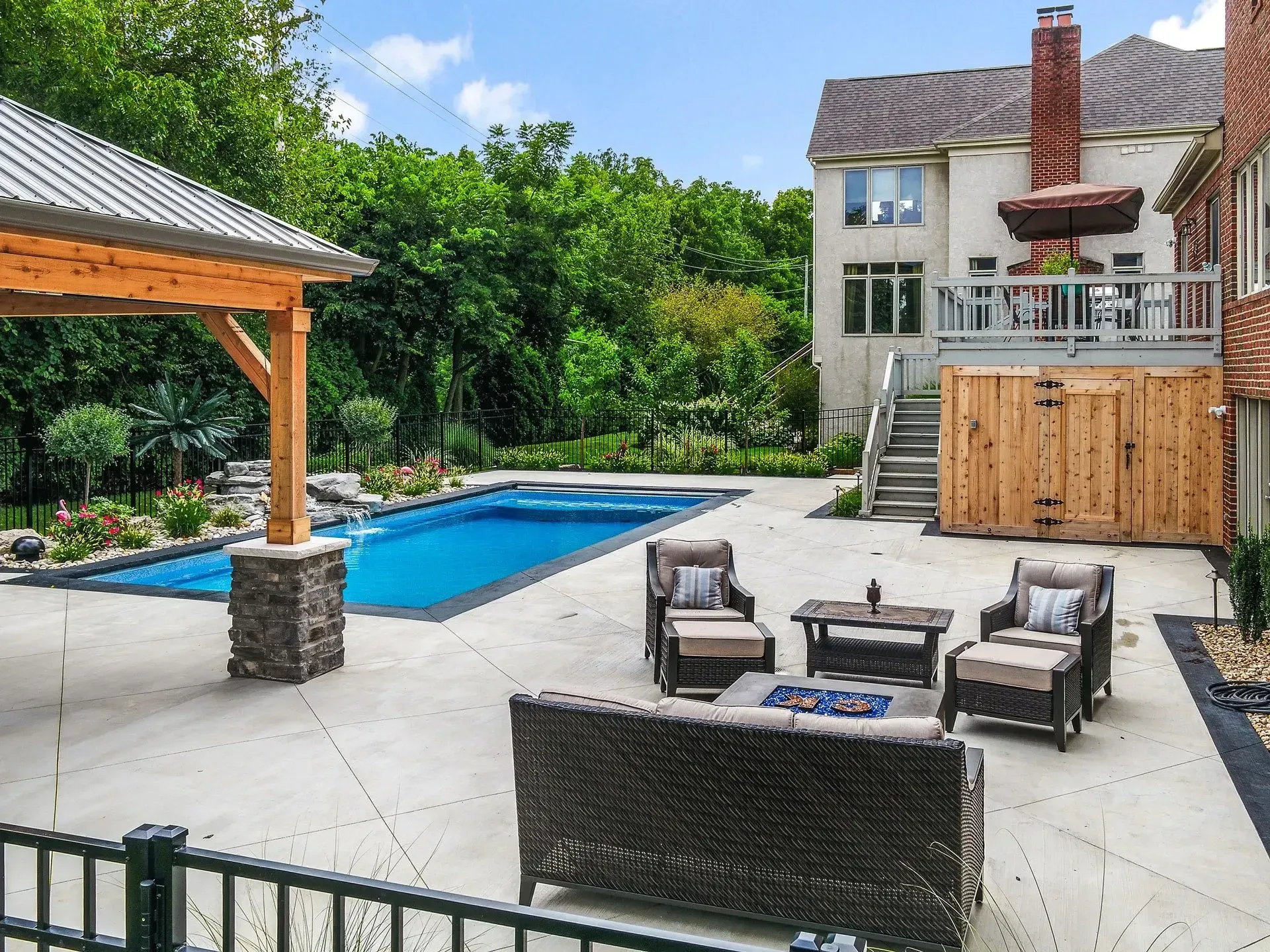
The Marietta Canopy Problem — Why Sun Exposure Dictates the Deck Spec
Marietta is not one microclimate. It is roughly six. Drive from Marietta Square out to the Kennesaw Mountain boundary and the tree cover climbs with every mile. East Cobb, particularly the Sope Creek and Willeo Creek corridors bordering the Chattahoochee, carries the densest canopy — 80-to-120-foot white oaks, poplars, and hickories that have been rooted there since well before the subdivisions went in. That canopy is precisely what makes these lots worth what they are worth. It is also what makes the deck spec so unforgiving.
Here is the specific mechanism: in a full-sun backyard, travertine and concrete pavers both dry out completely between rainfalls. UV light sterilizes the top surface. Wind moves air across the stone. A normal Atlanta storm dumps water, the sun re-appears, the deck is bone-dry by dinner. Nothing grows.
Under a dense oak canopy, the same deck stays damp for 48 to 72 hours after rainfall — sometimes longer during October and November when the leaf load peaks. Direct UV hours drop from 10 per day to 2 or 3. The temperature on the deck surface stays 8 to 12 degrees cooler than the ambient air. And that combination — persistent moisture, low UV, cool surface — is exactly the environment where moss, algae, and lichen thrive.
The material choice matters because the two decks we build most often in Cobb respond to that environment very differently. One is porous limestone that drinks water in and lets microbial growth colonize the internal pore structure. The other is a sealed concrete-composite paver engineered for low-porosity performance. Same shade, same leaf load, very different ten-year outcome.
Travertine in Marietta Shade — Where It Works, Where It Fails
Travertine is the Cadillac deck material in this market. French-pattern cream travertine, tumbled edges, four-piece modular layout — that is the specification that shows up on roughly 55 percent of high-end Cobb pool projects. It is cool to bare feet in August, the color is consistent lot-to-lot, the installed price sits in the $26 to $34 per square foot range for the deck plus coping, and aesthetically it is hard to beat.
What it is not: impermeable. Natural travertine carries a roughly 5 to 7 percent open porosity at the surface. Those little pinholes and veins you see when you run your hand across a slab are not cosmetic — they are absorbent. In a sunny backyard, that porosity is a feature: the stone breathes, dries, and resists trapped-moisture freeze-thaw damage across our roughly 22 freeze events per year. In a shaded backyard, that same porosity is the problem.
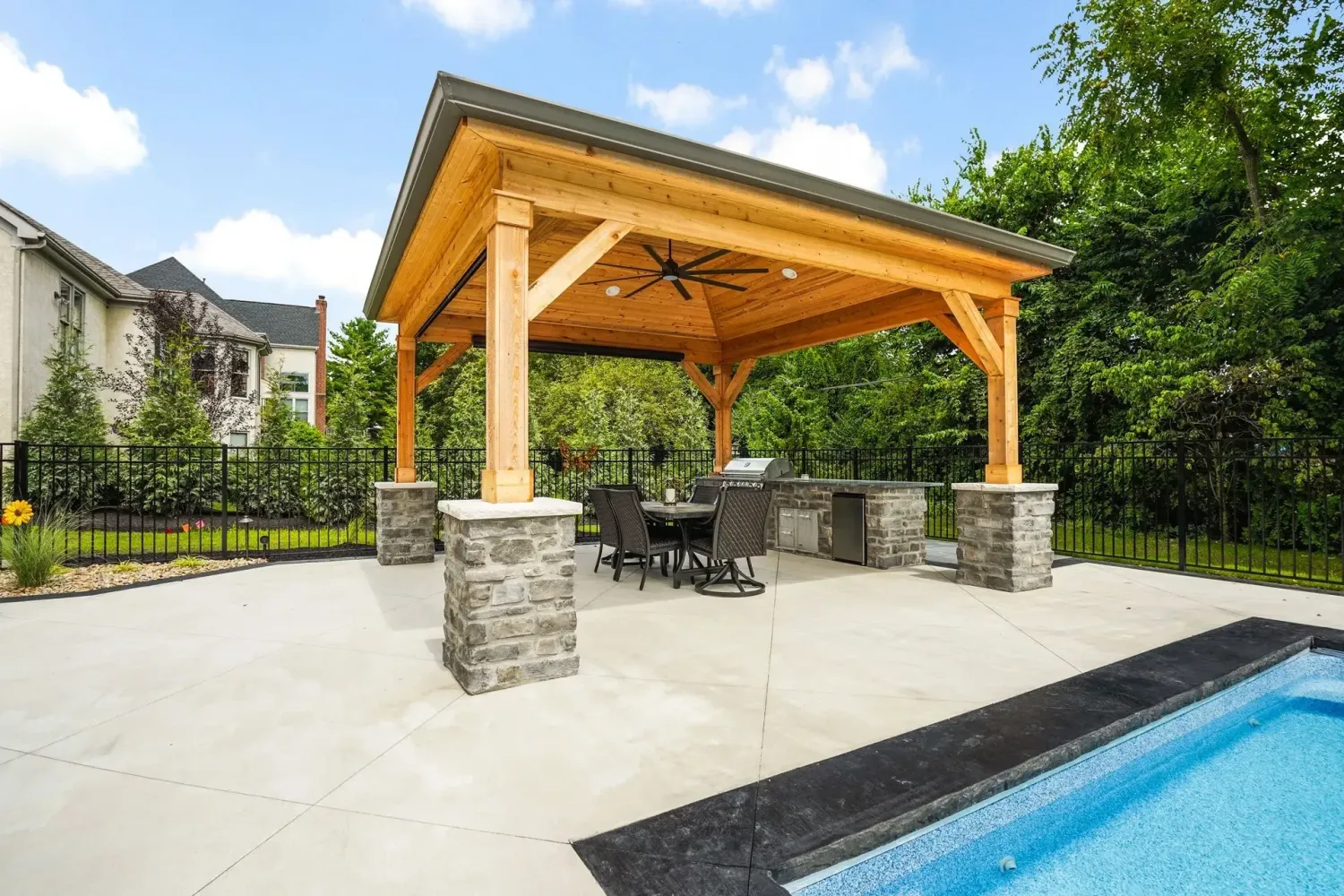
The failure timeline is predictable. Travertine installed under heavy shade without the right sealer and joint spec typically starts showing green fringing along the joints at month 14 to 18. By month 24, the joint sand is colonized. By month 30, you are looking at dark staining on the shaded long-side of the deck that will not scrub out — the microbes have moved into the pore structure below the surface and the stone itself is now the substrate.
The fix is not cheap. A full chemical restoration — soft-wash with a sodium-hypochlorite-based biocide, deep joint cleanout, re-sand, and two coats of penetrating sealer — runs $3 to $5 per square foot. On a 900-square-foot pool deck that is a $2,700 to $4,500 surprise at year three that nobody quoted you at year zero.
The Cobb travertine spec that works under shade: French-pattern tumbled travertine set on a 1-inch mortar bed over 4-inch compacted base, joints filled with SEK-Surebond moss-resistant polymeric sand, two coats of Stone Care International Aqua Mix Sealer’s Choice Gold, re-sealed every 36 months. Miss any one of those four things and the ten-year outcome gets ugly.
Techo-Bloc Blu 60 — The Shade-Tolerant Alternative That Wins at Year Ten
Techo-Bloc is a Quebec-based concrete paver manufacturer whose product we have been specifying more aggressively on heavily shaded Marietta lots for about the last four years. The specific line we like is Blu 60 — a 60 mm (roughly 2-3/8 inch) concrete paver with a proprietary surface treatment Techo calls “Protecta” that drops the open porosity to under 1 percent at the surface. Installed price is $22 to $28 per square foot for the deck plus matching coping band, so it is meaningfully cheaper than travertine as well.
The aesthetic reads differently — more contemporary, cleaner edges, less old-world. Colors run from warm greige (“Greyed Nickel”) to deeper charcoal (“Onyx Black”) and a few limestone-mimicking cream blends that, at eye level, read convincingly close to travertine without the porosity penalty. On a brick traditional home in Indian Hills, the Greyed Nickel tends to lay in better; on a contemporary build in the Burnt Hickory area, the deeper tones carry the design.

Here is the reason we lean on Blu 60 in shade: the sealed surface does not accept microbial colonization the way open travertine does. In a side-by-side we have been informally tracking across six Cobb projects (three travertine, three Blu 60, all on lots with 60 percent-plus canopy coverage), the Techo decks are clean at year five with nothing but annual pressure-rinse maintenance. Two of the travertine decks required full restoration by year three.
Blu 60 also outperforms on one specific failure mode that shows up in Cobb disproportionately: sugar maple sap. A mature sugar maple drips a mild sugar solution onto whatever is beneath it every spring, which feeds mildew colonies like gasoline on a fire. On open-pore travertine it creates permanent black rings. On a sealed Techo surface it rinses off.
Head-to-Head — The 10-Year Maintenance Math on a 900 sqft Shaded Marietta Deck
Instead of abstract pros and cons, here is the actual dollar math we walk clients through when the lot is shaded. Assume a 900-square-foot pool deck, East Cobb lot, roughly 65 percent canopy shade, installed in spring of year zero. Both decks are built on the same base spec — 4-inch compacted crusher run, non-woven geotextile separator, 1-inch bedding layer.
Travertine — 10-year all-in cost
- Year 0 install (deck + coping): $27,000 at $30/sqft
- Year 3 restoration (cleaning + re-seal): $3,600
- Year 5 joint refresh (re-sand + spot seal): $1,400
- Year 7 full restoration (second round): $4,100
- Year 10 pre-sale refresh: $2,800
- 10-year total: $38,900
Techo-Bloc Blu 60 — 10-year all-in cost
- Year 0 install (deck + coping): $22,500 at $25/sqft
- Year 2-9 annual pressure rinse (homeowner DIY, negligible): $0
- Year 5 joint top-off (polymeric sand refresh): $650
- Year 10 optional re-sealing (not required): $1,800
- 10-year total: $24,950
The gap is roughly $14,000 over a decade, most of which shows up in years three and seven when the travertine needs chemical restoration. If you are in the lot for the long haul — which most buyers in Atlanta Country Club, Marietta Country Club, or Walton Woods are — the compounding maintenance bill on shaded travertine is real money.
Two numbers inside that math deserve a closer look. First, the year-three restoration figure is not a worst-case estimate — it is a market rate we confirmed with three independent stone restoration contractors working in Cobb County during the 2025 season. Second, the Blu 60 install premium over the theoretical cheapest option (poured broom-finish concrete) is smaller than homeowners assume: concrete might save another $4 to $6 per square foot at install, but concrete under heavy shade develops its own surface problems — efflorescence, hairline cracking at freeze-thaw cycles, and rapid darkening — that erase the savings inside seven years. When the full curve is drawn, Blu 60 is the lowest-total-cost deck we can put on a shaded East Cobb lot.
When We Still Specify Travertine in Marietta — The Lot Conditions That Flip the Pick
This is not a piece arguing that travertine is a bad deck material. It is a piece arguing that canopy changes the pick. There are plenty of Cobb lots where travertine is still the right call, and we install it happily when the conditions support it.
Travertine is the right material when:
- Canopy coverage is under 30 percent. Full-sun or mostly-sun backyards let travertine dry, the UV does the microbial control work for free, and the material is going to look gorgeous for 20-plus years. We see these conditions on newer infill lots in the Brookstone and Chestnut Hill subdivisions where the tree cover is still young.
- The pool is within 15 feet of the house on the south or west side. Solar reflection off the house facade gives the deck a second drying cycle per day. That is enough to shift the moisture balance.
- The design is traditional or Tuscan-referential. Cream travertine on a 1990s brick traditional in Atlanta Country Club reads correct in a way Techo-Bloc never will. Aesthetic fit is real, and for a ten-year homeowner who is going to actively maintain the deck, the $14,000 premium is defensible.
- The homeowner wants the bare-foot temperature advantage. Travertine runs 6 to 10 degrees cooler than concrete pavers in direct August sun. On a full-sun lot where the family is barefoot on the deck most of the summer, that matters.
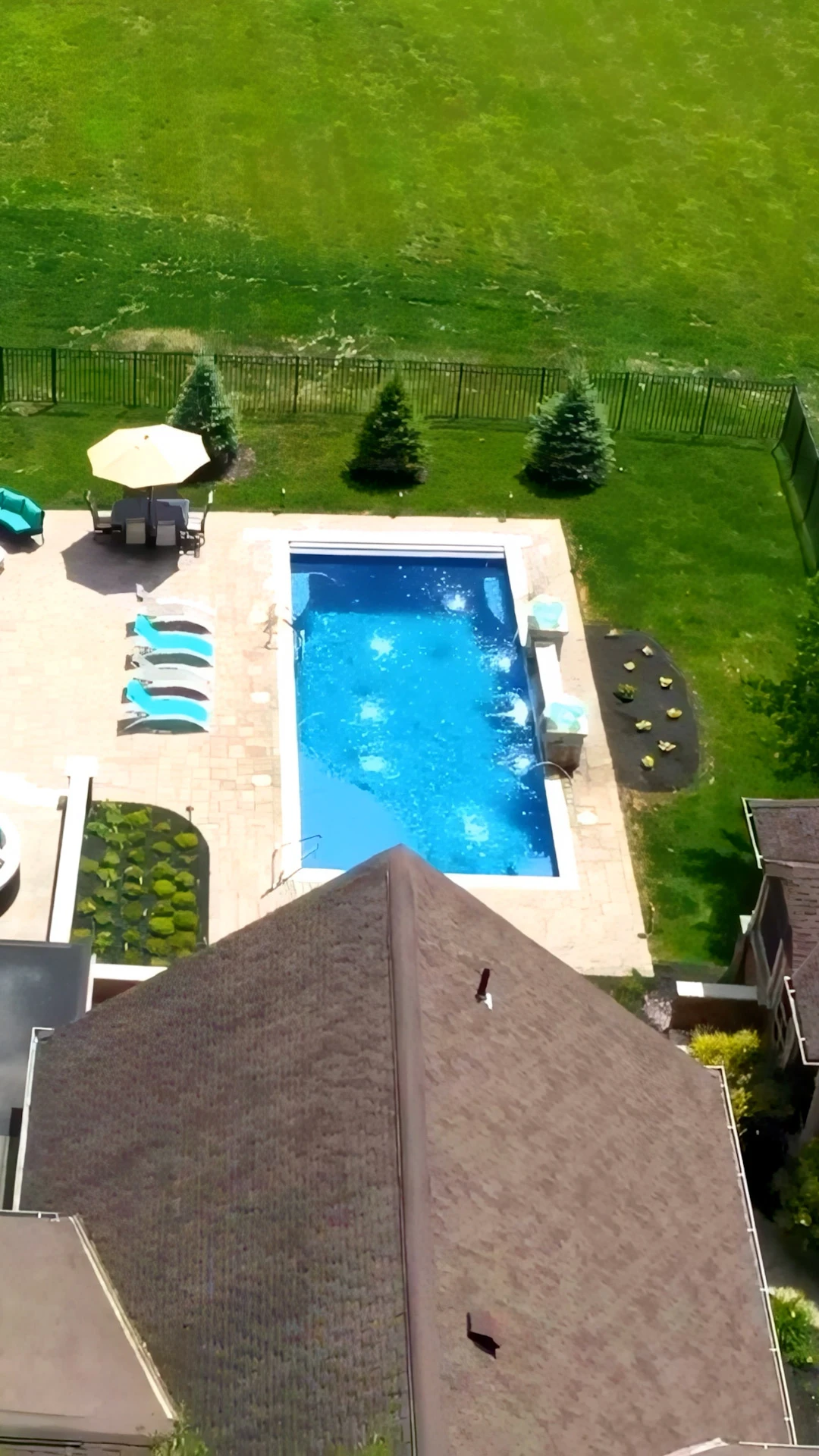
We look at every Cobb lot the same way. We do a shade audit before the deck spec is finalized: drone overhead at 10 a.m., noon, and 3 p.m. on a clear day, overlay the shadow patterns, and calculate the average shade percentage on the proposed deck footprint. Under 30 percent, travertine is in play. Thirty to 50 percent, both materials work with the right joint-sand and sealer protocol. Over 50 percent — which describes a majority of the East Cobb backyards we bid — Techo-Bloc Blu 60 is the spec we recommend, every time.
The Marietta-Specific Spec — What We Build Differently in Cobb County
Cobb County has its own permit and build culture, and a few local factors change how we detail either deck. Permits go through Cobb County Community Development at 1150 Powder Springs St. in downtown Marietta. The pool itself requires a permit, and if the deck is attached structurally to the house or exceeds certain area thresholds it gets rolled into the same review. We handle this turnkey — the homeowner never touches the permit office.
Electrical service is the other local nuance. Marietta has two utility footprints: Cobb EMC serves most of the unincorporated county and significant chunks of East Cobb, while Marietta Power serves the incorporated city core. The bonding and grounding spec under NEC §680 is identical either way, but the service-entry coordination is different, and on a pool-equipment sub-panel we need to know which utility we are pulling from before the plans are final. Cobb EMC 240V service is not interchangeable with Georgia Power paperwork.
Soil is the third factor. Most of Cobb sits on Piedmont red-clay soil (Cecil series) with granite bedrock anywhere from 3 to 15 feet down. East Cobb along the Chattahoochee corridor has slightly better-draining sandy-loam pockets, but it is not uniform. We hit rock on roughly one in four projects in the Burnt Hickory and Atlanta Country Club subdivisions. Rock means either a pneumatic hammer line item or a re-engineered base to work around it — both addressed in the original contract so it is not a change-order surprise.
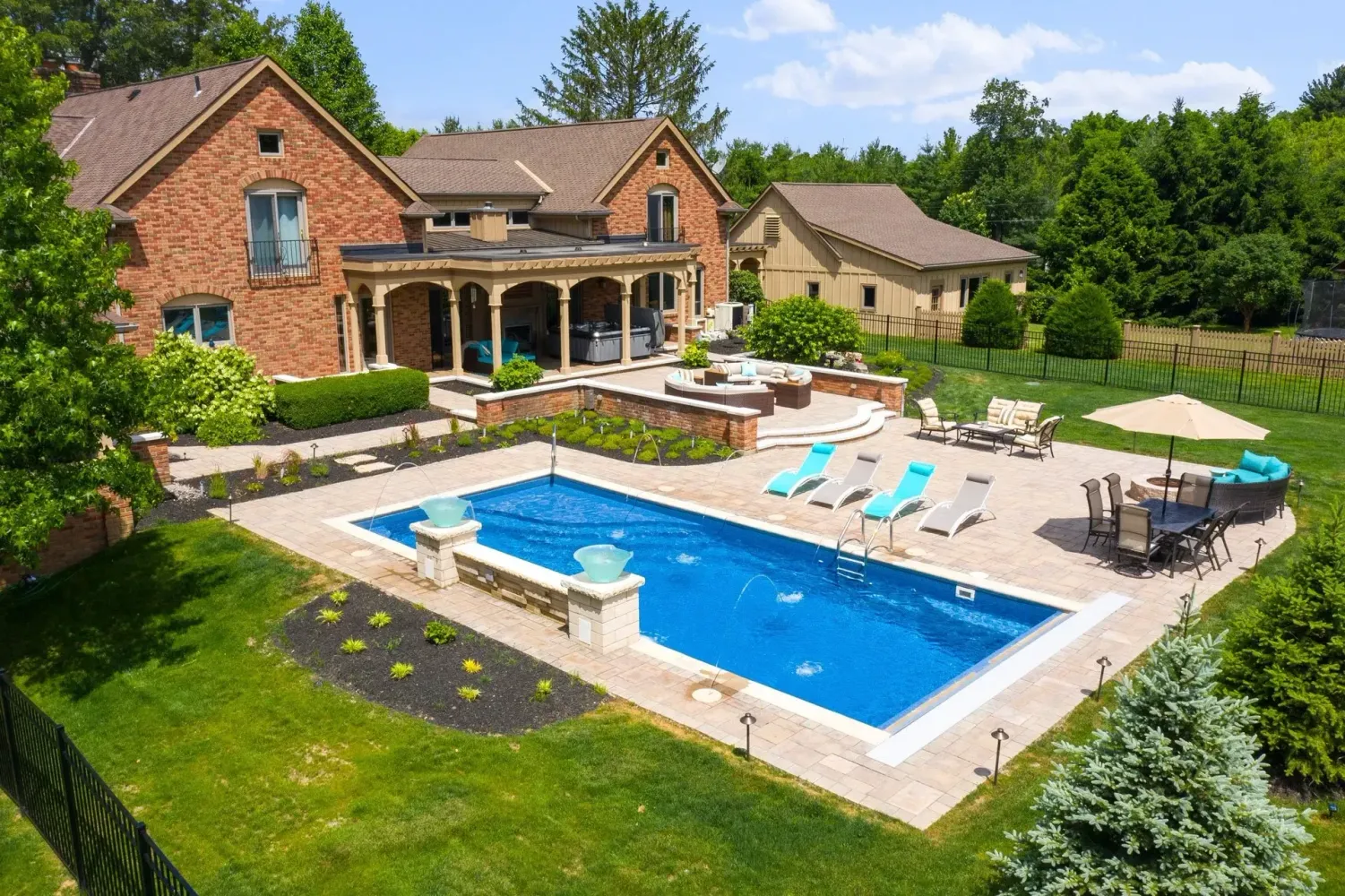
On the drainage side, Marietta’s rolling Piedmont terrain means most backyards have a 3-to-6-foot grade change from the house to the rear property line. We never build a flat deck. Our minimum fall is a quarter-inch per foot away from the pool coping, routed to a drain grate that ties into a daylighted perimeter line. Shaded decks especially need this — standing water is the trigger for everything we are trying to prevent.
The last local detail is the annual maintenance rhythm. We hand every shaded-lot client a simple one-page service calendar: soft-wash at the end of October after the oak leaves drop and before they pack into the joints, a March joint top-off as the pool opens, and a spot-check mid-July. Five years into these protocols, we have not had a single warranty claim on a Techo Blu 60 deck in Cobb, and zero algae restorations needed.
There is one more Marietta-specific factor worth naming: wind. Lots on the north side of town, closer to the Kennesaw Mountain slope, pick up stronger seasonal wind than what you feel on the Chattahoochee side of East Cobb. That Kennesaw-adjacent wind accelerates leaf movement — good news, because leaves blow off the deck faster and spend less time composting into the joints. But it also means any loose pool cover, umbrella, or lightweight deck furniture needs to be specified with that wind load in mind. We typically tell clients on Burnt Hickory-area lots to spec umbrellas with anchor bases at least 10 percent heavier than what the manufacturer lists for a standard suburban setting.
HOA review is the other Cobb-specific procedural layer. Subdivisions like Atlanta Country Club, Indian Hills, and Marietta Country Club all have active architectural review boards that must approve pool-deck material, coping, fencing, and landscape plans before a shovel goes in the ground. Board turnaround in those three neighborhoods typically runs two to four weeks, and they are not rubber-stamp committees. We have learned to submit a one-page material spec with 4×6 printed samples of the travertine or Blu 60 at the outset — that single step has cut our average HOA-to-build timeline by roughly three weeks on projects in the tightest-reviewed subdivisions.
October-clean protocol for shaded Marietta decks: Schedule a professional soft-wash between Oct 20 and Nov 10, before the second wave of oak leaf drop. Use a 0.5 percent sodium hypochlorite solution at 40 psi, dwell 8 to 12 minutes, rinse with fresh water. This one appointment is the difference between a clean deck in March and a green deck in March.
The 3-Question Decision Framework We Walk Every Marietta Client Through
When we sit with a Marietta homeowner at the kitchen table with the drone imagery printed and the material samples laid out, the conversation comes down to three questions. If you answer honestly, the correct material almost always declares itself.
Question 1 — What is the actual shade percentage on the deck footprint?
Not your guess. Measured. If you do not know, we measure it. Under 30 percent shade, travertine is on the table. Over 50 percent shade, Techo-Bloc Blu 60 is the spec. Between 30 and 50 percent, both can work but the joint-sand and sealer protocol has to be tightened and the maintenance calendar has to be honored.
Question 2 — How long do you intend to own the property?
Under five years, the material math is closer than it looks — travertine carries a resale aesthetic premium that partly offsets the year-three restoration bill. Over ten years, Techo-Bloc wins on pure cost of ownership by a margin that is hard to argue with. The break-even point for a shaded lot is roughly year 4 or 5.
Question 3 — Are you going to maintain the deck or outsource it?
Travertine, properly specified and honestly maintained, is a 25-year deck. It demands an owner or a property manager who will actually commission the biennial restoration and the quarterly soft-wash. Techo-Bloc does not demand that — it tolerates a lighter maintenance touch without punishing you for it. If your honest answer is that you will pressure-wash once a year and that is it, Blu 60 is the only correct pick regardless of what the shade study says.
There is no universally right deck material. There is only the right deck material for your specific Marietta lot, your specific canopy, your specific horizon of ownership, and your specific tolerance for maintenance. When we get those four inputs aligned with the material, we build a deck that is not just beautiful at handover — it is still beautiful at year ten.
Pool decks built for Marietta canopy — across 20+ cities within 30 miles of Winder, GA
If your lot sits under mature East Cobb oaks, the deck spec matters more than the brand name on the paver. We’ll walk the property, run the shade study, and put the correct material — travertine or Techo-Bloc — on your plan.