
Forsyth County approves more than 200 pool permits a year across 247 square miles and 260,000 residents — and every outdoor kitchen tied to one of those pools rides or dies on a 100-amp Sawnee EMC subpanel that most homeowners never see on the estimate.
That single number is the story. The grill doesn’t fail. The refrigerator doesn’t fail. The LED strips don’t fail. What fails is the electrical budget — because the homeowner was quoted a kitchen and never told the real bill for the wire, the conduit, the panel schedule, the GFCI count, and the inspection trip the inspector will take at rough-in and again at trim. This post walks the entire process, dollar by dollar, from the pre-drywall load calc through the final sticker. You will know exactly what Sawnee EMC requires, what the Forsyth County inspector looks at, and where the $680–$980 subpanel install line item actually lands inside a $2,000 typical kitchen electrical package.
We build these kitchens across every corner of the county — 30028 in the north, 30040 through the middle, 30041 down in south Forsyth. The physics of a dedicated refrigerator circuit doesn’t change between Coal Mountain and Bethelview. The code doesn’t change between a Lake Lanier lot on Browns Bridge Road and a Shiloh subdivision off Post Road. What changes is how many of the details you understand before you sign.
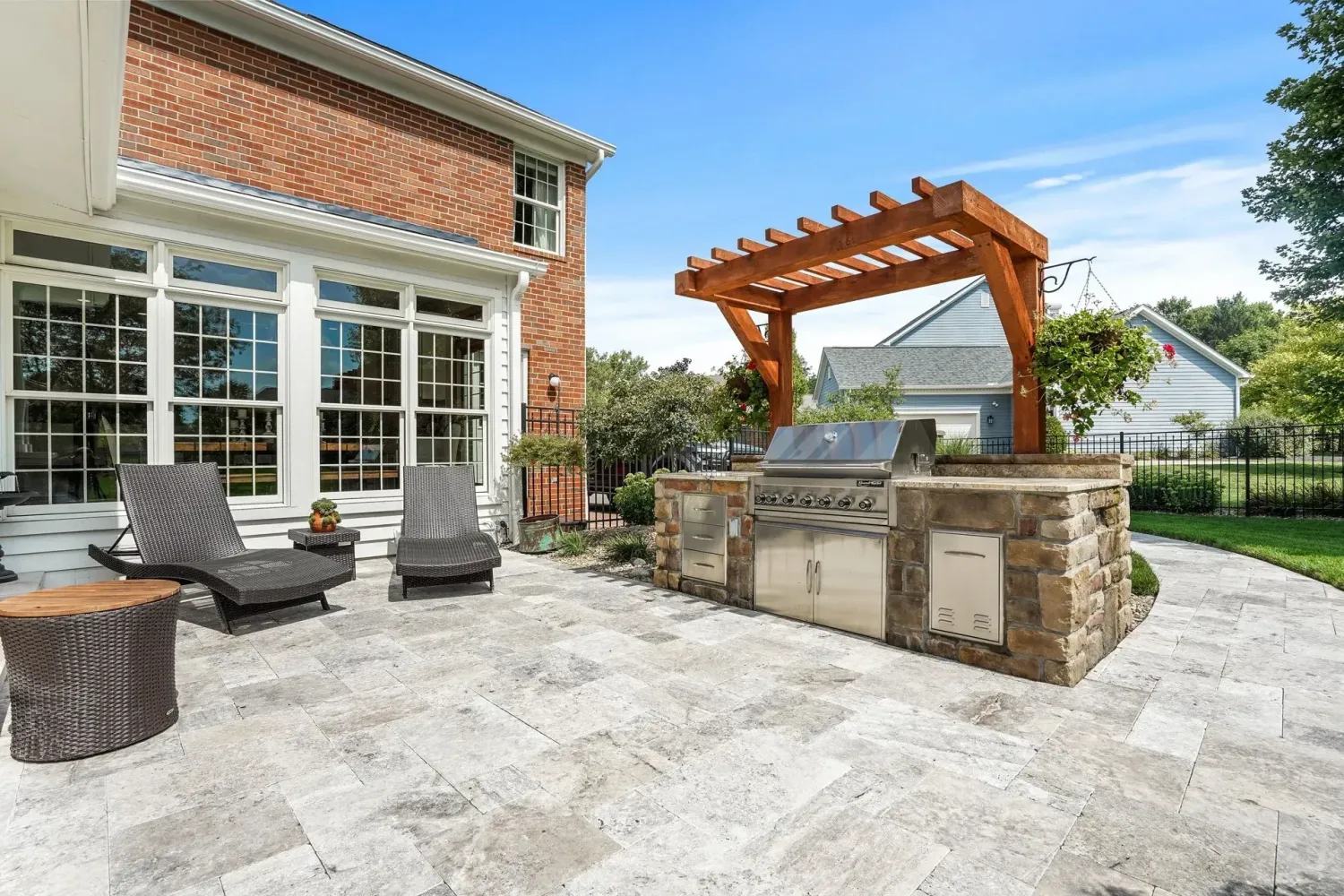
Step 01 — The Load Calc Before You Dig a Trench
The inspector won’t sign off on a rough-in until there is a written load calculation sitting in the permit folder. This is the first step and almost always the first place a homeowner gets surprised. A typical Forsyth outdoor kitchen pulls more amperage than people expect once you add it all up honestly.
Start with the appliances. A built-in stainless refrigerator draws roughly 2 amps continuous but needs a dedicated 20-amp circuit — not shared, not piggy-backed off the grill lights, not sneaking power from the pool panel. The inspector will ask for the nameplate data, and if he sees two loads on one breaker that shouldn’t be there, the rough-in fails. An ice maker is another dedicated 20. A Kamado Joe or Big Green Egg with electric starter is another receptacle. A 5-burner grill with a rotisserie motor and interior lights is another. A power side-burner is another. A flat-top griddle on the higher-end islands can pull 15 amps by itself on the 120V models.
Then come the non-cooking loads. Recessed ceiling cans under a pavilion count. Pendant lights over a bar count. Undercounter LED strips count. Ceiling fan on a 42-inch blade counts. A wall-mounted TV counts. String bistro lights across a pergola count. Every one of those is a load line on the calc, and every one of them needs a home on a breaker.
Sawnee EMC subpanel install range: $680–$980 for a 100-amp subpanel fed from the main service, installed in a weather-rated enclosure within sight of the kitchen. Higher end is lots with a long home run or rock that slows the trench.
Add it all up and a modest kitchen — grill, fridge, two GFCI receptacles, six cans, one fan — is already sitting at 45 amps of connected load with demand factors applied. A full build with griddle, kegerator, TV, beverage fridge, bar pendants, and a ceiling fan routinely crosses 70. That is why the 100-amp subpanel has become the Forsyth standard. A 60-amp will work on paper for the smallest single-bay island, but the moment the homeowner says “while you’re at it, add a pizza oven and a heater,” the 60 is maxed.
Step 02 — Why It’s a Dedicated 100-Amp Subpanel, Not a Home Run to the House
Sawnee EMC, the electric cooperative that serves every address in Forsyth County, does not care how you physically wire the kitchen. The code is the code. But the practical reality on a Forsyth lot — the driveway approach, the cedar clay soil, the distance from the main panel in the garage to the outdoor kitchen on the far side of a pool — makes a dedicated subpanel the right move nine builds out of ten.
Here is the math. A 100-amp subpanel trenched to the kitchen location in 1-1/4-inch PVC conduit with #2 copper or #1/0 aluminum conductors costs roughly the same as running four or five individual home runs back to the main panel. The subpanel gives you twelve to twenty breaker slots at the kitchen itself, which means every future addition — a heater, a misting pump, an extra receptacle, a second fridge — ties in locally instead of re-trenching to the house.
The inspector also prefers it. A labeled local panel with every circuit clearly identified passes a trim inspection faster than a tangle of home runs buried in drywall across a 140-foot run. Faster inspection is free money.
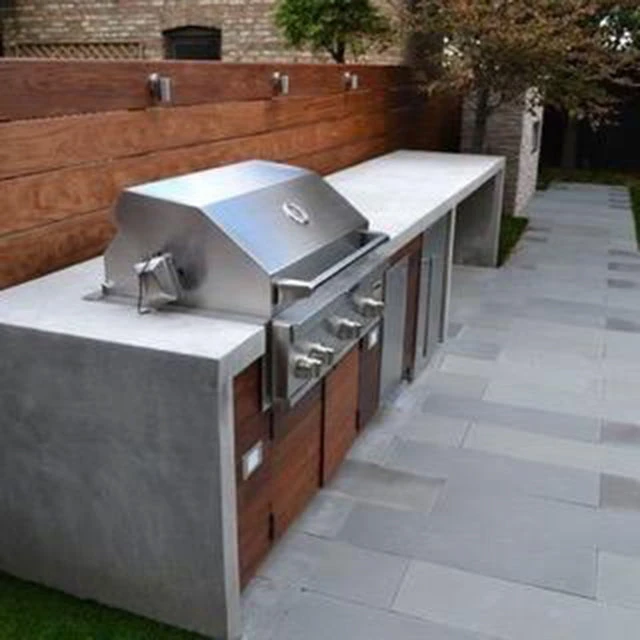
Step 03 — GFCI on Every Receptacle, Every Time, No Exceptions
This is the single most common failure point on a Forsyth County rough-in. The NEC requires GFCI protection on every 120V receptacle installed outdoors. Not most. Not the ones near the sink. Every single one. That includes the receptacle behind the refrigerator that nobody will ever plug a blender into. It includes the receptacle under the grill island that powers the rotisserie motor. It includes the pendant-light receptacle on the bar pergola.
The cleanest way to do it — and the way we do it on every Primetime Pools GA build — is to install GFCI at the receptacle itself, not at the breaker. Weather-resistant tamper-resistant GFCI outlets in in-use bubble covers at every box. It costs about $18 per receptacle more than a standard outlet, but when a nuisance trip happens on a rainy Lake Lanier afternoon you can reset the single outlet at the kitchen instead of walking back to the subpanel. Six receptacles, $108 in device cost, pays for itself the first time the fridge trips during a party.
GFCI rule of thumb: Every outdoor 120V receptacle in Forsyth County needs GFCI protection, a weather-resistant rating (marked “WR”), a tamper-resistant shutter (“TR”), and an “extra-duty” in-use cover. Three markings, one cover, zero exceptions.
Step 04 — LED-Compatible Dimmer Circuits and Why They Matter at Dusk
The twilight photo — the one every homeowner saves on Pinterest — exists because of the dimmer. Undercounter LED strips at full brightness look like a Waffle House kitchen. Dimmed to 30 percent, they glow. Carriage lanterns on stone pilasters need to be dimmable or the kitchen feels like a gas station. Pendant lights over a bar need a separate dimmer from the pavilion cans. This is circuit design, not afterthought.
Every lighting circuit on a serious outdoor kitchen needs to be on a Lutron Maestro or equivalent LED-compatible dimmer. Not a standard dimmer. LED drivers are finicky about dimmer compatibility — the wrong dimmer makes the LEDs flicker, hum, or refuse to dim below 40 percent. Lutron’s outdoor-rated LED dimmers are about $62 each at retail, and you want one per zone: undercounter, pavilion cans, bar pendants, sconces, fan-light. A four-zone kitchen is four dimmers, $248 in device cost, wired on 14-2 home runs back to the subpanel.
If the original bid didn’t spell out “Lutron LED-compatible dimmers” by brand and model, assume you’re getting $12 builder-grade dimmers that will be the first thing you replace next spring. Ask.
Step 05 — The Dedicated Refrigerator Circuit and the Warranty Trap
This one sounds boring. It isn’t. A dedicated 20-amp circuit for the refrigerator is a warranty requirement on most outdoor fridges — Sub-Zero, U-Line, Marvel, Perlick all specify it in the install manual. Plug that fridge into a shared receptacle and the factory voids the warranty the first time you file a claim. The compressor failure two years in will cost you $1,200 you didn’t budget.
The fix is trivial at rough-in: one home run of 12-2 wire from the subpanel to a single WR/TR GFCI receptacle directly behind the fridge bay. Maybe $45 in material and 20 minutes of labor if it’s already in the trench. The fix after the fact — tearing out stone veneer on a U-shape island in a Shady Grove backyard to add the circuit a year later — is $1,800 and a three-day disruption. Get it right the first pass.
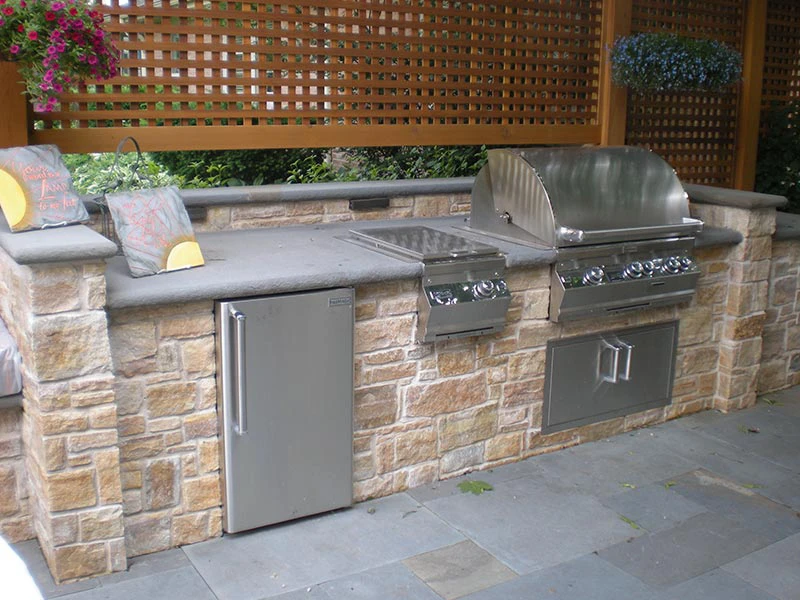
Step 06 — Rough-In Inspection, Trim Inspection, and the $2,000 Honest Number
The Forsyth County inspector will come out twice on a kitchen of any real size. Rough-in inspection happens after the trench is open, the conduit is pulled, the boxes are set, and the wire is in but not yet connected. He is looking at depth of bury (18 inches minimum for PVC, 24 for direct-bury UF), conduit type at transitions, box fill calculations, and the permit itself. Miss any of that, he leaves a red tag and you rebook a second trip three to seven days later.
Trim inspection happens after drywall, after veneer, after the appliances are set and wired. He is looking for GFCI at every outlet, correct torque on panel lugs (Sawnee EMC specifies 45 inch-pounds on aluminum feeder lugs), labeled breakers, AFCI where required, and a posted panel schedule inside the subpanel door. A clean trim inspection takes eight minutes. A dirty one can stretch across two more trip charges and four weeks of delay.
Typical Forsyth County kitchen electrical, all-in:
• Rough-in labor + wire + conduit + boxes: $1,200
• 100-amp Sawnee EMC subpanel + feeder: $680–$980
• Trim labor + devices + dimmers: $800
• Permit + two inspection trips: $180
• Total typical kitchen electrical: $2,000
That $2,000 is the number most homeowners never see broken out on the original pool contract. It is real. It is standard. And if your pool builder didn’t include it as a named line item, it is either buried inside “allowances” or it’s about to be a change order.
The DIY-vs-Pro Math, Honestly
Can you do this yourself? If you are a licensed electrician in Georgia, yes. If you are not, Forsyth County will not issue you a homeowner permit for outdoor kitchen wiring on a permitted pool job — the pool permit pulls the electrical under its umbrella, and the umbrella requires a licensed contractor on the paperwork. Trying to DIY around this by wiring after inspection means the first time you have a claim, the insurance adjuster finds unpermitted electrical work inside a pool zone and denies the claim in full. Don’t.
The real DIY savings aren’t in the wiring labor. They are in the choices: buying your own Lutron dimmers and handing them to the electrician (saves $40 per device on markup), owning the fridge and having it on-site for the rough-in (saves a return trip), and picking up a 100-foot coil of 12-2 UF wire at Home Depot for $78 yourself instead of paying contractor markup. Real savings, zero risk. Twenty percent off a $2,000 line item is $400 back in your pocket.
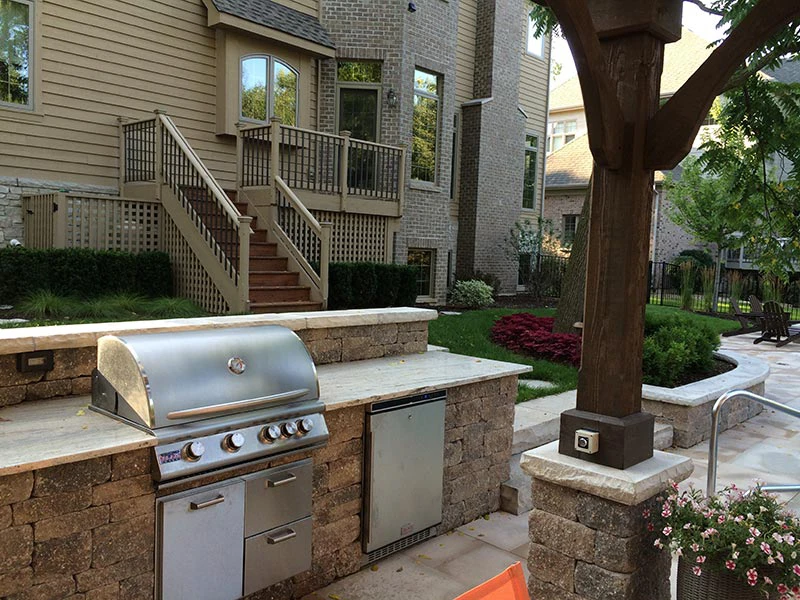
Why North Forsyth Is Different From South Forsyth
South Forsyth — the 30041 zip, the Johns Creek-adjacent subdivisions, Shiloh and Bethelview and Brookwood — runs on Atlanta-commuter schedules. These kitchens are the weekend-entertaining type: bar seating, TVs, dimmer scenes, the whole social package. Panel schedules on these builds routinely hit 80 amps of connected load.
North Forsyth — 30028, up near Coal Mountain, the 3-to-5-acre estate lots — runs bigger but simpler. Fewer TVs, more Big Green Eggs. Pavilion with real bones. The load calcs are often lower than south Forsyth despite the properties being twice the size, because the appliance count is smaller. The real cost driver up north is the trench run: on a five-acre lot, the main service might be 180 feet from the kitchen, and that feeder alone can add $400 to the subpanel line item.
The Lake Lanier south shore — Browns Bridge Road, the Hwy 369 corridor, the lots that back up to the water — has its own wrinkle. Lake Lanier humidity is measurably higher than inland Forsyth, and the salt-free fresh water still chews stainless-steel cover plates. We spec marine-grade 316 stainless cover screws and Deltrex in-use covers on Lanier builds. Adds about $8 per receptacle. Pays for itself in the first Georgia summer.
HOA Density, Sawnee Mountain Rockouts, and Why the Subpanel Location Matters
Almost every Forsyth subdivision has an HOA. Many of them have written rules about where an exposed electrical panel can live on a house exterior. If the subpanel is visible from the street, the HOA may require it painted to match the siding or boxed inside a decorative cover. Plan for this at rough-in, not after trim.
North-end builds — anywhere near the Sawnee Mountain Preserve ridgelines or in the Coal Mountain rocky pockets — occasionally hit solid rock in the trench. When that happens, the rental day for a jackhammer and breaker adds roughly $350 to the install. It isn’t a contractor gouge. It’s a real cost that isn’t avoidable once you’re in granite. Knowing it might be coming lets you budget for it.
The Panel Schedule the Inspector Wants to See
When we close out a Forsyth County outdoor kitchen, the subpanel door has a printed, laminated schedule stuck inside. Every breaker labeled, every circuit identified, every load named. The inspector opens the door, reads the schedule, checks two or three breakers against what he sees in the box, and signs. Clean.
A sample schedule for a medium Forsyth build:
- Breaker 1-2: Feeder main disconnect (2-pole 100A)
- Breaker 3: Refrigerator — dedicated 20A
- Breaker 5: Grill receptacle + rotisserie — 20A
- Breaker 7: Counter GFCI receptacles (2) — 20A
- Breaker 9: Pavilion cans + fan light — 15A on LED dimmer
- Breaker 11: Undercounter LED strip — 15A on LED dimmer
- Breaker 13: Pergola string lights + sconces — 15A on LED dimmer
- Breaker 15: TV outlet + low-voltage transformer — 20A
- Breaker 17: Ice maker — dedicated 20A
- Breaker 19: Spare — 20A (for future pizza oven or heater)
That’s nine used breakers and one spare in a 20-slot panel. Room to grow. Room to add the pizza oven next spring. Room for the misting system in 2028. A homeowner who plans it this way never has to re-open drywall or re-trench. That is the whole reason the subpanel exists.
What to Ask Your Builder Before You Sign
If you’re getting quotes from pool builders in Forsyth County right now — and we know you are, because Forsyth approves more pool permits than any other county north of I-285 — ask these five questions before you hand over a deposit:
- Is the kitchen electrical broken out as its own line item, or bundled into “allowances”?
- Is it a dedicated subpanel or home runs back to the main panel? (The right answer is almost always subpanel.)
- How many amps is the subpanel and what’s the feeder size? (100A with #2 copper or #1/0 aluminum is the standard.)
- Are LED-compatible dimmers spec’d by brand, or generic? (Lutron or equivalent should be named.)
- Is the refrigerator on a dedicated 20, or shared? (It needs to be dedicated for warranty.)
Any builder who can answer those five cleanly, in under a minute, has done this before. Any builder who dodges, hedges, or says “we’ll figure it out at rough-in” has not. The $2,000 line item shows up either way. You get to decide whether you paid for it up front with eyes open, or got surprised by it in week six as a change order.
Forsyth County is growing fast — fastest-growing county in Georgia for the past decade. That growth means the electrical inspectors are busy, the Sawnee EMC meter set queue can run two weeks out in peak season, and the pool permit volume is real. Planning the electrical before the trench opens is how you keep a sixteen-week build from becoming a twenty-two-week build. It’s also how you end up with a kitchen that still works flawlessly in year seven, when the grill is on its second replacement and the fridge is on its first — because the bones underneath are sized right.
Outdoor kitchens wired right across 20+ cities within 30 miles of Winder, GA
From the Coal Mountain estates up on 30028 down to the Bethelview subdivisions on 30041, we design the electrical before we pour concrete — subpanel, load calc, GFCI, dimmers, inspection. All on paper before the trench opens.