
Every pool-deck and retaining-wall drainage spec you’ve read online was written for Piedmont clay. Dawsonville doesn’t sit on Piedmont clay. It sits on weathered granite and saprolite, and that one geologic fact is why year-5 retaining walls in Foxcreek and Kensington Ridge fail at a rate you simply don’t see in Lawrenceville or Snellville.
The contractors who show up in Dawsonville with an Atlanta-metro drainage detail on their tailgate are going to build you a wall that looks perfect on handover day, holds beautifully through year one, shows a faint bulge at the third freeze-thaw cycle, and starts shedding caps by year four. We’ve been pulled in to do the repair on enough of them to write this post without hedging. The drainage rules up here are genuinely different, and the reason is saprolite.
Dawsonville sits at roughly 1,270 ft elevation — the highest city in the Primetime service area — which means it also sits on the wrong side of a geologic transition. You are no longer in the Piedmont province by the time you get to Dawson County. You are in the southern foothills of the Blue Ridge, and the subsoil profile changes in ways that matter enormously for anything you bolt, bury, or bed into the ground.
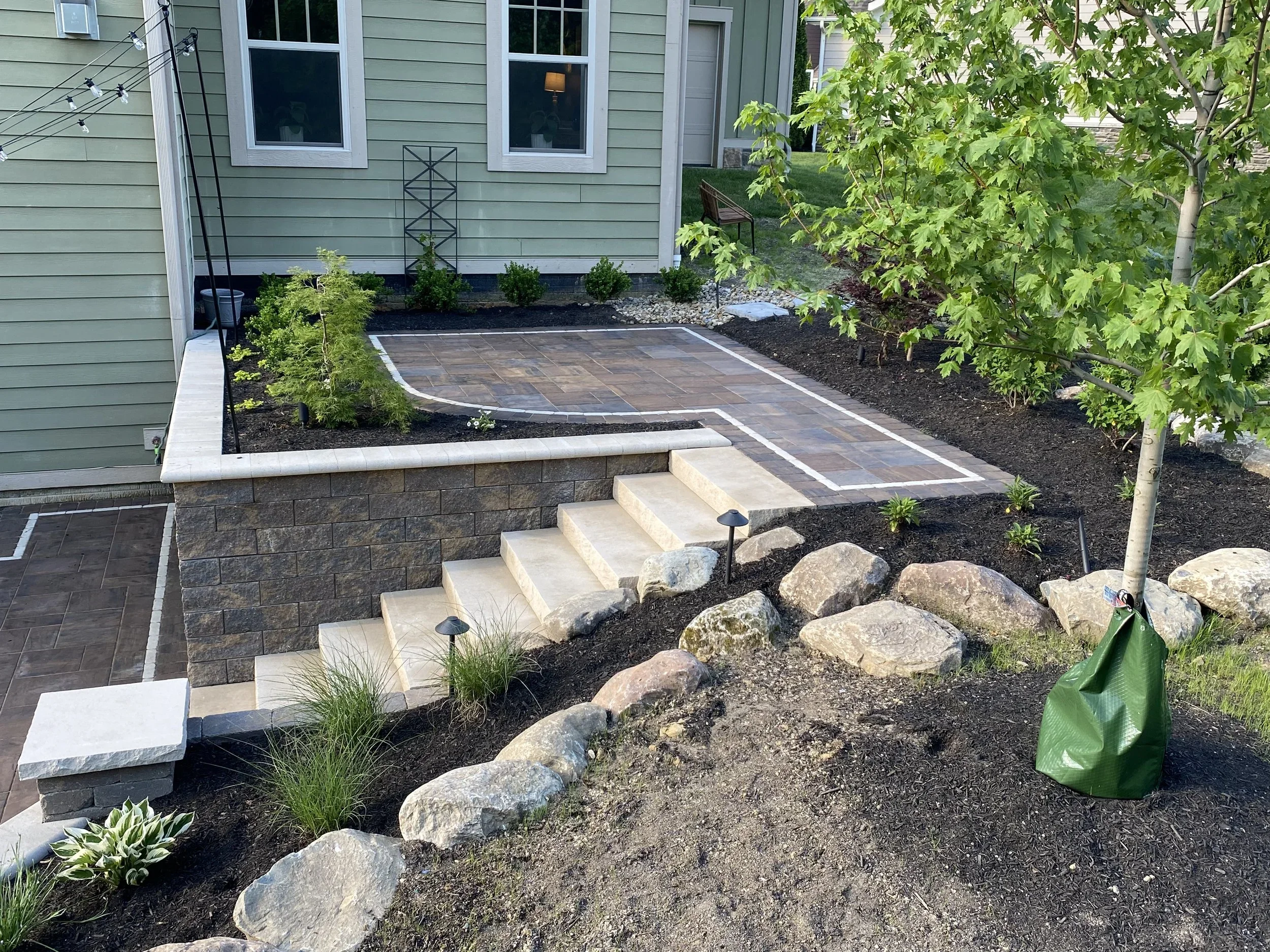
What Saprolite Actually Is (and Why Your Contractor Probably Can’t Pronounce It)
Saprolite is the crumbly, tan-to-reddish layer of chemically weathered rock that sits between true topsoil and unweathered granite bedrock. It looks like soil until you pick up a handful and feel the mineral grit. It crushes to a coarse sand under pressure. It is, structurally, a rock that has forgotten it’s a rock.
Across most of Atlanta metro, the mantle is Cecil-series clay — dense, red, sticky when wet, and notoriously bad at accepting water. Here in Dawson County, the topsoil layer over that weathered parent material is thin, often 8 to 14 inches before you hit stony residuum or saprolite proper. In parts of Riverbend and Mountain Laurel we routinely expose saprolite at 18 inches below grade. It’s not a special site. It’s the default.
Now the part your metro-Atlanta contractor is going to get catastrophically wrong: saprolite drains 4 to 8 times faster than Cecil clay. A downpour that ponds for 40 minutes in a Dacula backyard will disappear through saprolite in six. That sounds like a gift. It is a trap.
The Saprolite/Bedrock Interface — Where Retaining Walls Go to Die
Here is the geologic truth nobody writes about in a generic “how to build a retaining wall” guide. Saprolite drains fast until it hits unweathered bedrock. At that interface — typically 4 to 9 feet below grade in Dawsonville, sometimes shallower — the water stops. There’s nowhere for it to go. The bedrock is competent granite. It won’t accept water. And the saprolite above it is now acting like a thick sponge sitting on a ceramic tile.
Forensically, this is what we see when we open up a failed year-5 wall in a Foxcreek or Etowah River Club backyard: the geotextile is intact, the block is intact, the cap is intact, and the entire wall has rotated outward 1.5 to 2.5 degrees because a perched water table built up behind it every time it rained hard for more than 40 minutes. The saprolite couldn’t release water downward into bedrock. The drainage detail the contractor used — designed for Cecil clay — didn’t pick up the perched layer because it was placed at the wrong elevation.
A wall failing at 1.5 to 2.5 degrees of rotation is, in layman terms, leaning. You notice it first as a caps line that no longer looks straight when you stand at the corner of the driveway. Then the caps start separating. Then a block pops. By the time the homeowner calls us, repair is $14,000 to $28,000 — full teardown, full rebuild, correct drainage, reset the cap course.
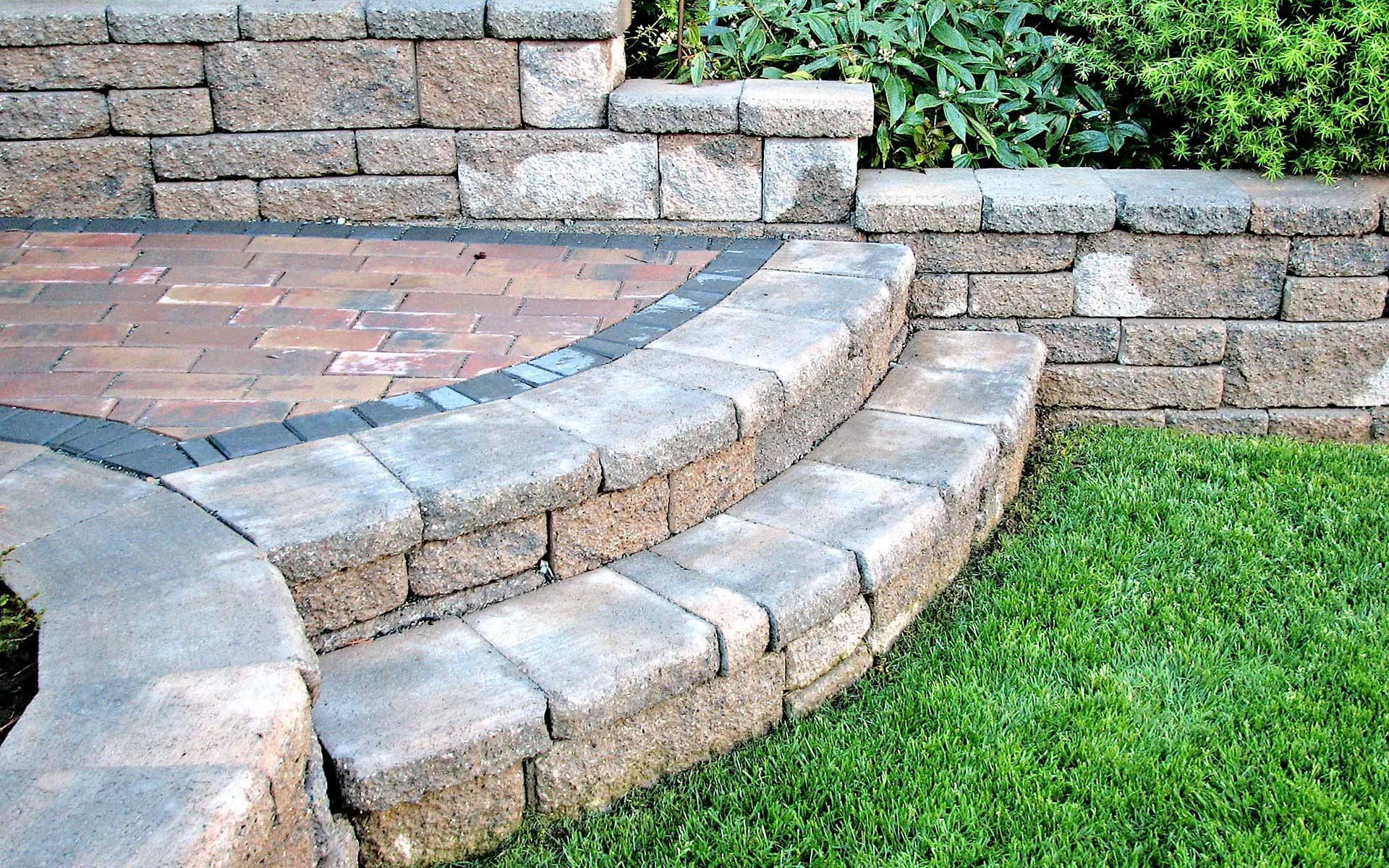
The Dawsonville Drainage Detail — What We Actually Spec
A generic Atlanta-metro wall gets one perforated pipe — typically 4-inch corrugated — wrapped in non-woven geotextile and bedded in #57 stone at the base of the wall, sloped at 1%. That works fine on Cecil clay because the clay isn’t giving up water fast. The pipe has time to daylight it out.
In Dawsonville, that same detail fails because it’s catching water at the wrong horizon. The perched layer forms 18 to 36 inches above the bedrock interface, not at the wall base. So we build a two-tier drainage system:
- 4-inch perforated pipe at the saprolite/bedrock interface — wrapped in a non-woven 8-oz geotextile, bedded in 1.5″ open-graded stone, sloped at 1.5% minimum. This pipe catches the perched water at its actual source.
- 6-inch perforated pipe at the wall base — same geotextile wrap, same stone, 1.5% slope. This is the conventional pipe a metro contractor would install, and it’s still needed, just not sufficient on its own.
- Positive subdrain every 40 linear feet — a rigid, daylighted outlet that ties both tiers together and gives perched water a forced exit path to a safe discharge point on the downslope side of the wall.
That detail adds $6 to $9 per linear foot over the metro standard. On a 120 LF terrace wall in Applewood or Kensington Ridge, that’s a $720 to $1,080 uplift at install. Measured against a $14K–$28K teardown at year 5, it is the cheapest line item in the entire project.
What to ask for in the contract: “Two-tier perforated drainage system. 4-inch pipe at saprolite/bedrock interface, 6-inch pipe at wall base, both wrapped in 8-oz non-woven geotextile and bedded in open-graded stone. Rigid, daylighted subdrain every 40 LF. Minimum 1.5% slope on all perforated runs.”
Rock Excavation, Blast Charges, and Why GA-400 Trucking Matters
There’s one more cost line item the drainage spec forces onto the table — rock excavation. In Cumming or Duluth, a pool excavation or deep footing dig hits clay, then weathered rock, then bedrock — and the contractor almost never has to break rock with anything heavier than a mini-ex hammer. In Dawsonville, rock excavation is a real event. Not every lot, but enough of them that the intake conversation has to include it.
Pool excavations in parts of Chestatee and near the Etowah River Club sometimes require mechanical rock breaking or, on harder ledges, small-charge blasting coordinated through a licensed subcontractor. Pricing ripples through the whole project — we quote a blast-contingency line at $8 to $14 per cubic yard over the standard dig rate, capped per contract so the homeowner isn’t open-ended on it.
This is also where Dawsonville’s proximity to GA-400 actually saves money. Equipment trucking from Alpharetta suppliers runs cleanly up the 400 corridor, which is why we can keep mobilization fees for mini-excavators and 320-class hydraulic hammers from spiraling. A Big Canoe address can add a day of trucking logistics. A Hwy 53 or Hwy 9 address near downtown Dawsonville does not.
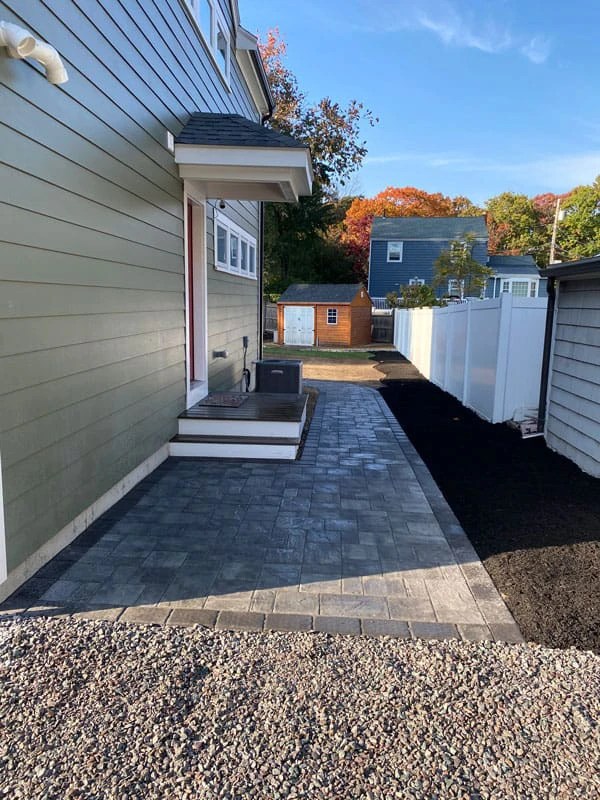
Freeze-Thaw Is 50% More Aggressive Up Here — and That Changes the Base Spec
Dawsonville sits at the Zone 7b/8a USDA hardiness boundary. The practical consequence: we see roughly 30 freeze events per year here versus 20 in Dacula or Snellville. A 50% increase in freeze-thaw cycles is not trivial for any hardscape element that involves water, stone, and joint material.
What changes in the build spec because of this:
- Base depth goes from 6 inches to 8 inches compacted on pool decks and patios. More freeze-thaw means more moisture movement through the base, and the additional 2 inches of open-graded stone gives the base a larger thermal mass buffer.
- Polymeric sand gets upgraded from standard haze-resistant to a calcium-silicate blend rated for 40+ freeze-thaw cycles per season. Standard sand in a Dawsonville climate will wash out of joints by year three; the upgrade holds to year seven-plus.
- Geotextile separator layer between subgrade and base is no longer optional. On a flat Grayson lot we could, in theory, skip it. In Dawsonville saprolite with 30 freeze events per year, the frost-induced pumping of fines into the base aggregate is guaranteed within three seasons if there’s no separator.
The compound effect: a pool deck built to Dawsonville spec costs about 7% more per square foot than the same deck in Loganville. Installed correctly, it also lasts roughly twice as long before it needs a major reset. That ratio — 7% more up front for 100% more life — is why the math always works out in favor of the upgraded spec.
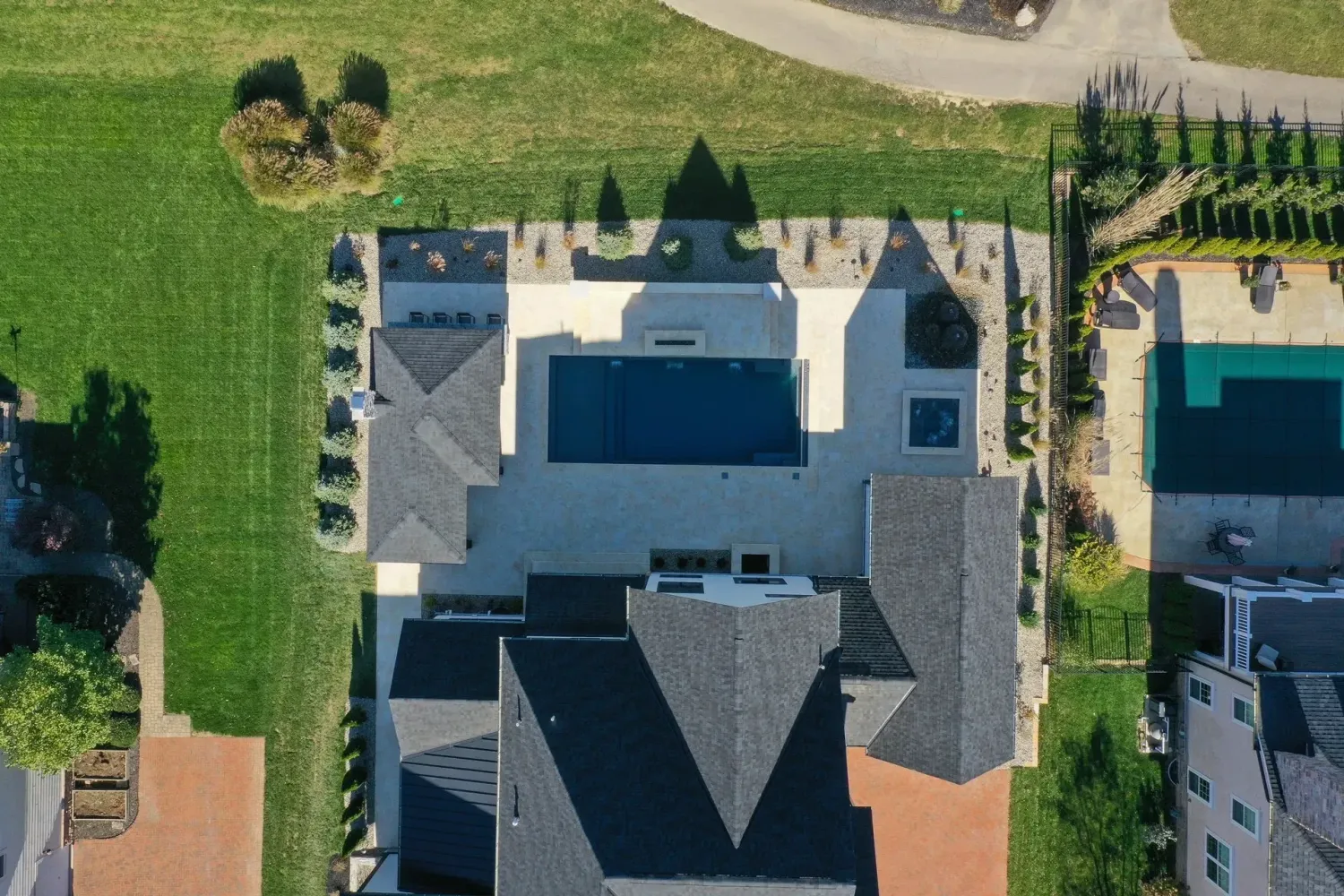
Permits, Amicalola EMC, and the Real-World Schedule
Permitting in Dawson County is handled through the Dawson County Department of Planning & Development at 25 Justice Way, Dawsonville. For hardscape that doesn’t involve a pool, most projects only require a land-disturbance check if the disturbed area exceeds a threshold. Walls over 4 feet from the base of the footing to the top of the cap require engineering stamp and a separate permit — this is routine, but it adds two to three weeks to the schedule and we factor it in at contract signing.
Electrical service for landscape lighting, pool equipment, and any outdoor kitchen work goes through Amicalola EMC rather than Georgia Power for most of Dawsonville. Their service-drop timelines run a little longer than Georgia Power’s metro schedule, so if your project includes new panel capacity or a dedicated pool-equipment circuit, we coordinate that request with them the week the permit is pulled. Calling it in mid-project adds two weeks easily.
The net effect on schedule: a standard 120 LF retaining wall + paver patio + pool deck project that would take six weeks in Forsyth County typically runs seven and a half weeks in Dawsonville. Most of the delta is permitting, EMC coordination, and the extra drainage tier. None of it is avoidable.
Permit call worth making early: Dawson County Planning & Development, 25 Justice Way. Ask specifically whether your lot sits inside a state-waters buffer if you’re anywhere near the Etowah River, Amicalola Creek, or a tributary — buffer rules can reshape where walls and decks are allowed before you’re even to the drainage discussion.
The Forensic Picture — What a Failed Wall Tells You Three Years In
We pulled apart a failed year-4 wall in a neighborhood near Chestatee last spring. The homeowner had hired a metro-based builder who’d worked on 80+ projects across Gwinnett and was, by all accounts, competent. Competent in Gwinnett. The wall was a three-course terraced Techo-Bloc segmental — beautiful face, clean cap line on day one, proper geogrid every other course, proper #57 stone drainage chimney behind the block, single 4-inch perforated pipe at the base sloped at 1%.
The build was textbook. For Lawrenceville.
What we found on teardown: the chimney stone was still clean. The geotextile was intact. The pipe was flowing freely. And 22 inches above the pipe, at the original saprolite-to-weathered-granite interface, we found a three-inch-thick saturated lens. Water that couldn’t go down because it hit bedrock, couldn’t go sideways fast enough because the chimney stone wasn’t at that elevation, and so it built up and applied about 180 pounds per square foot of lateral pressure to the back of the blocks during every heavy rain event.
Four years of that cycle rotated the wall. No single storm caused the failure. The cumulative load did. A second perforated pipe at the saprolite interface would have short-circuited the entire failure mode for an extra $780 at install. Instead, the homeowner paid $22,400 to have us tear it out and rebuild it correctly.
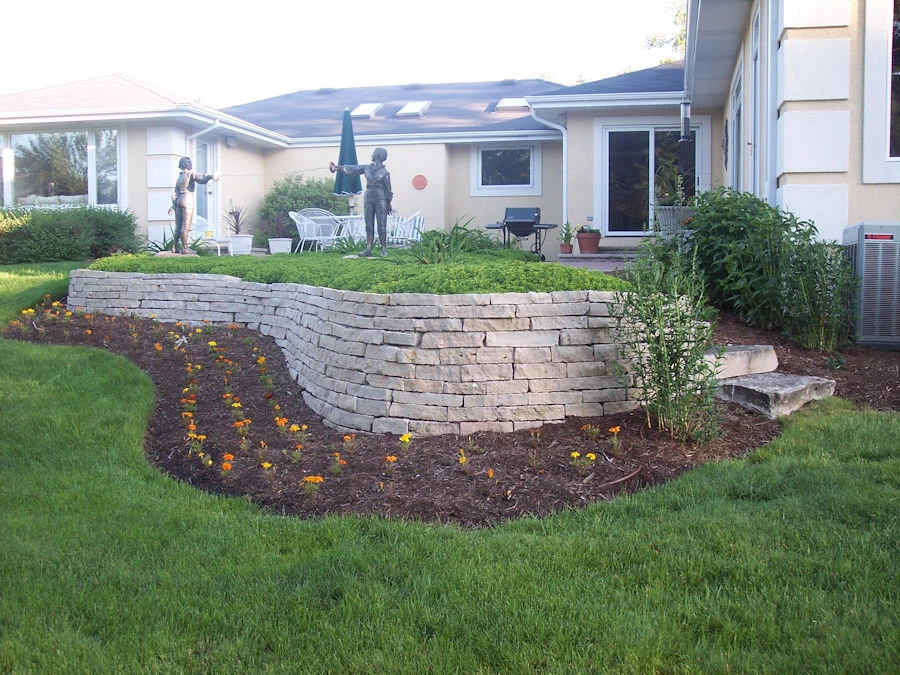
That’s the story behind every number in this post. Not a theoretical concern. A specific wall, a specific failure mode, a specific invoice. The difference between building for Atlanta metro and building for Dawson County is a few hundred dollars in materials and a contractor who understands the geology under your lot.
What to Look For When You Call a Contractor in Dawsonville
A few signals sort the contractors who actually build for this geology from the ones who are repeating Atlanta-metro details:
- They mention saprolite or weathered granite without being prompted. If the word never comes up on a site visit, they’re running a clay-based drainage spec.
- They ask about your downslope discharge path before quoting wall drainage. Perched-water drainage has to daylight somewhere; if they don’t care where, they haven’t thought about it.
- Their contract includes a rock-excavation contingency line. Dawsonville digs hit rock often enough that not addressing it in writing means you’ll be renegotiating mid-project.
- They spec 8-inch compacted base on decks and patios, not 6-inch. This is the single cleanest indicator that a contractor has done freeze-thaw work at elevation.
- They name Amicalola EMC when discussing electrical coordination. It’s a small thing, but contractors who’ve never worked the town default to Georgia Power.
Any contractor you’re evaluating should comfortably handle the list above. If three or more answers feel vague, you’re probably talking to someone who’ll build you a textbook wall — just the wrong textbook.
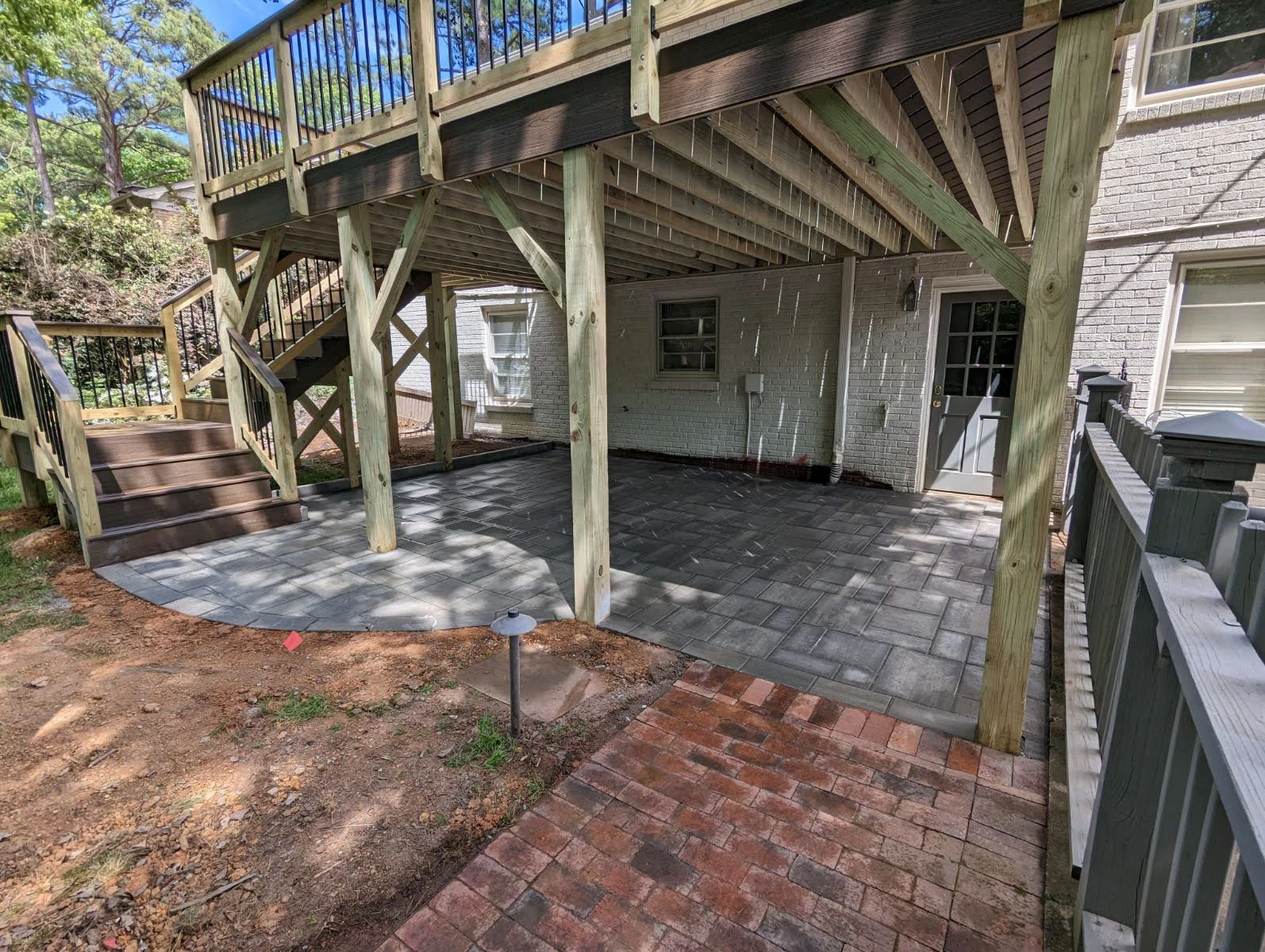
Dawsonville is not Dacula, and it’s not Duluth. It sits on a different substrate, cycles through a more aggressive freeze-thaw season, and answers to a different utility. Any hardscape that lasts three decades up here gets built to that reality — starting with a drainage detail that respects the saprolite under the lot.
Hardscape design & construction across 20+ cities within 30 miles of Winder, GA
From Dawsonville saprolite to Snellville Cecil clay, we build the drainage detail the substrate actually requires — not the generic spec every metro contractor uses.