
A Marietta homeowner called us last spring with a question: “My pool’s twenty-six years old, and there’s a hairline crack running diagonally across the shallow end wall. My last two contractors said patch it and move on. Why do you want to cut down half my yard to fix a crack?” The answer is root intrusion from mature oak canopy, and in East Cobb it is the single most misdiagnosed failure mode on pool shells built between 1995 and 2005.
Here is the short version before we get technical. The white oak in your backyard is probably older than your pool. Its fibrous root mat extends roughly as far horizontally as the tree is tall, which in a 60-to-80-foot canopy means roots are sitting 6 to 12 feet out from your shell wall right now. As those roots thicken with each growing season, they apply steady lateral pressure against the gunite. By year 20 to 30, that pressure finds the weakest stress line in the shell, and you get a crack. Cosmetic patching buys you eighteen months. Real repair requires a 60-mil HDPE root barrier, epoxy injection, and structural reinforcement. In Marietta’s Piedmont clay soils, the job usually runs $4,800 to $8,400.
This post walks the full diagnostic, because the wrong repair on the right crack is a five-year countdown to doing it all over again.
Why Marietta Oaks Crack Pool Shells Differently Than Trees Anywhere Else in Metro Atlanta
The Piedmont soil under Marietta is a specific geological personality, and it behaves like no other subgrade in the region. Cecil-series clay dominates from Powder Springs Street east toward the Chattahoochee, with granite bedrock sitting anywhere from three to fifteen feet below finished grade depending on the lot. East Cobb pockets — the areas around Indian Hills, Atlanta Country Club, and the Sope Creek watershed — have slightly better-draining sandy-loam seams, which is exactly why those neighborhoods grew the biggest white oaks in the county.
White oak (Quercus alba), northern red oak (Quercus rubra), and southern red oak (Quercus falcata) dominate the canopy in older East Cobb subdivisions. A mature white oak in the Indian Hills area frequently exceeds 75 feet tall with a canopy spread approaching 80 feet. The root system is not a mirror of the canopy — it is wider and shallower. The fibrous feeder root zone on a mature oak in Cecil clay extends outward two to three times the drip line, with the densest root mat in the top 18 inches of soil where oxygen and water exchange happen.
When someone drops a gunite pool shell into that soil profile in 1998, the excavation severs whatever roots were in the dig envelope. The tree responds the way trees always respond to root injury: it pushes new root growth aggressively toward the disturbed soil. Fresh backfill around a pool shell is softer than the undisturbed clay beyond it, so feeder roots race into that cushion. Three years later, they’ve found the shell. Ten years later, they’re riding along the exterior gunite surface looking for the path of least resistance. Twenty years later, they’ve thickened into primary structural roots, and now they push.
The 6-to-12-foot rule: On any Marietta lot with a mature oak within 12 feet of the pool wall, assume root contact against the shell. On any lot with an oak within 6 feet, assume active lateral pressure. This is not conjecture — we’ve pulled soil cores on dozens of East Cobb pools to confirm it.
Compare this to a Snellville or Lawrenceville lot where the 1990s subdivision was clear-cut before construction and the homeowner planted ornamental Bradford pears at 15 feet of spacing. No root intrusion problem, ever. Marietta is different because the trees were already there when the developer arrived, and in the high-dollar East Cobb streets, the trees were protected. That’s how Atlanta Country Club and Indian Hills got their identity — and it’s also how their pools got cracks.
Distinguishing Root-Intrusion Cracks From Settlement, Freeze, and Plaster Cracks
If you walk your pool and find a crack, the first instinct is to assume the shell has failed. The truth is that most cracks you can see are cosmetic plaster cracks, not structural gunite cracks. The distinction matters because plaster cracks get sanded and re-surfaced; structural cracks get epoxy-injected. And root-intrusion cracks get epoxy-injected plus a root barrier, because if you skip the barrier the crack comes back.
Here is the four-way diagnostic we walk every Marietta shell repair:
1. Plaster-only (cosmetic) cracks
Thin, spidery, web-like cracks that don’t follow any single direction. They show up as discolored lines on the plaster surface but do not leak water. A coin edge pressed into the crack does not catch. These need a replaster, not structural work. On a 1990s Marietta pool that has already had one replaster (typical service life is 8 to 12 years on white plaster), cosmetic crazing is usually age, not intrusion.
2. Freeze-spall cracks
Marietta sees roughly 22 freeze events per year, and the damage shows up at the waterline tile and coping line — not on the shell walls below. Freeze cracks run horizontally, stay within the top 12 inches of the shell, and almost always come with bond-beam damage. If the crack is at the coping, the tree didn’t do it — winter did.
3. Settlement cracks
Piedmont clay expands and contracts with moisture. On a pool sited downhill from a house with poor roof drainage, you’ll see a diagonal crack running from the deep-end floor up through the wall, usually with offset — one side of the crack sits higher than the other. Settlement cracks do not require a root barrier. They require drainage correction, pier underpinning, and an epoxy injection.
4. Root-intrusion cracks
These have a signature. They are vertical or diagonal, they almost always appear on the shell wall closest to the suspect tree, and they widen at the top. Probe the soil behind the shell wall with a half-inch steel rod (we carry a 4-foot sectional probe) and if the probe hits a root within 24 inches of the wall, you have confirmation. The crack is not the tree’s fault. The lateral pressure from a thickening root found the weakest rebar lap splice in the shell and pried it open.
The Three-Part Repair: Root Barrier, Epoxy Injection, Structural Reinforcement
Once you’ve confirmed root intrusion — visual crack orientation, probe-strike within the root zone, and ideally a small exploratory excavation at the exterior of the shell wall to photograph the offending root — the repair becomes a three-system job. Skip any of the three and the repair fails inside five years.
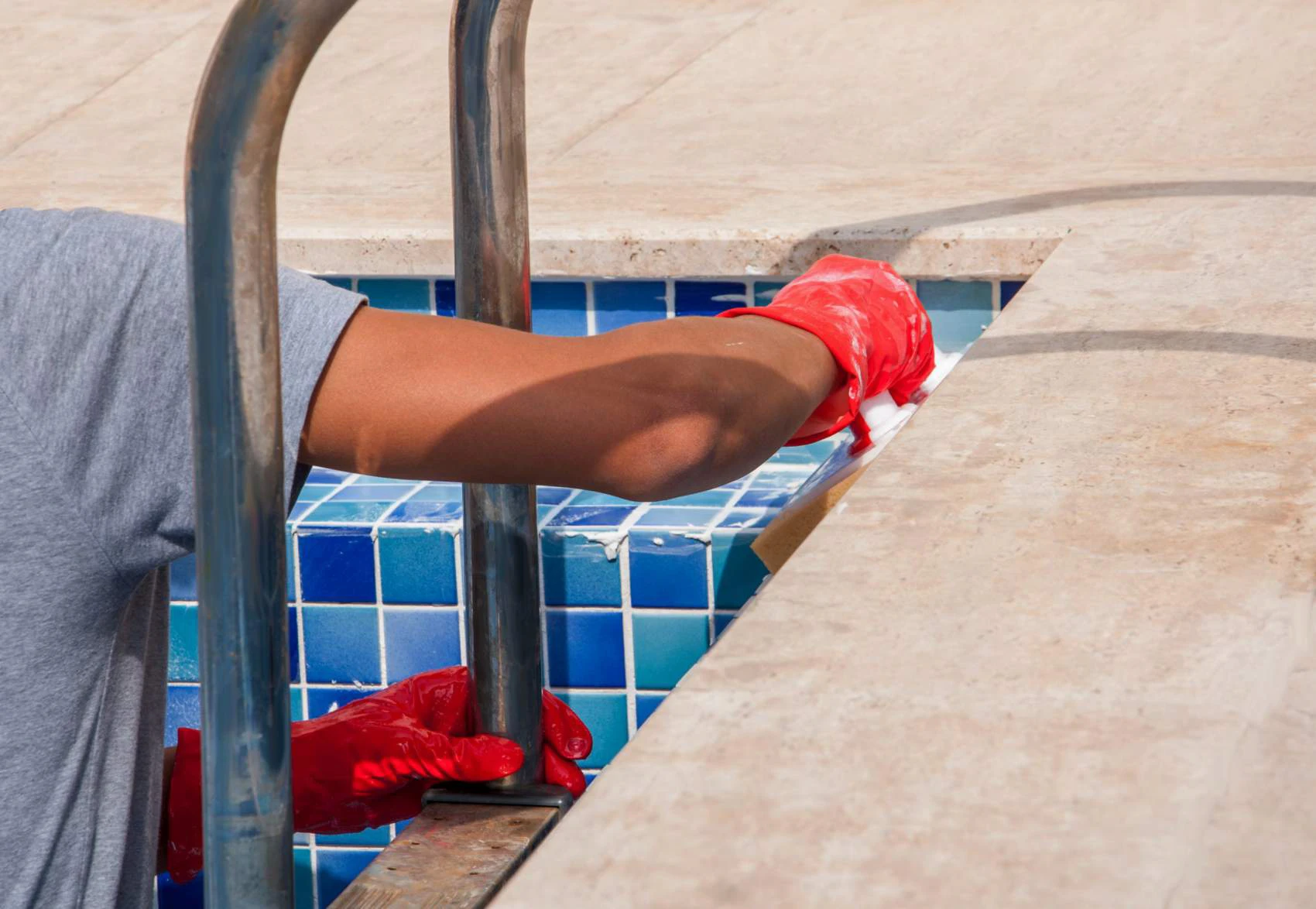
Part one: the root barrier
We install 60-mil HDPE (high-density polyethylene) root barrier, specifically DeepRoot UB 48-2 or Century Rootguard 60 depending on supply. Sixty-mil is not arbitrary — it’s the thickness that survives the lifespan of the tree and resists the hydraulic root fracture pressure mature oaks can generate (roots can exert up to 137 PSI of lateral force against a rigid surface). We trench vertically between the shell and the tree using a mini-excavator with a 12-inch bucket, down to a depth of 48 inches minimum, and run the barrier horizontally along the exterior face of the pool shell for the full length of the exposed wall plus 8 feet past each end.
On a typical Indian Hills backyard with a single offending white oak, the trench runs 35 to 55 linear feet. On properties with a grove condition — and there are plenty of them in Atlanta Country Club and Burnt Hickory — we’ve run 120 linear feet of barrier on a single job.
Part two: epoxy injection on the existing crack
With the root pressure permanently relieved by the barrier, the existing crack is now structurally stable but still a water pathway. We use a two-part structural epoxy (Sika Sikadur 52 or Simpson Strong-Tie Crack-Pac Flex-H2O depending on crack width) pressure-injected through surface ports spaced 8 inches apart along the crack face. The epoxy fills the full depth of the crack through the gunite shell and bonds both faces back into monolithic structural performance.
Part three: structural reinforcement
Cracks that were active long enough to open past 1/8-inch width have usually lost rebar integrity at the lap splice. We expose the rebar from the exterior of the shell, tie in a sister bar of #4 rebar with a 40-diameter lap, and spot-gunite the repair area back to original wall thickness plus a 1-inch overbuild. The overbuild gets ground flush, and the plaster finish gets patched or re-coated depending on how much interior surface was disturbed.
Expected repair cost range in Marietta — 2026: $4,800 to $8,400 for a single-wall root-intrusion repair on a 16×32 to 20×40 pool. The barrier alone is typically $1,800 to $3,200 of that total; epoxy injection runs $900 to $1,800; structural rebar and spot-gunite $1,200 to $2,400; site restoration and replaster patch $900 to $1,600.
Cobb County Specimen Tree Rules and What You Can’t Do to the Oak
Marietta homeowners hear “root barrier trenching” and often ask the same question: can’t we just cut the roots off, or remove the tree? Sometimes, yes. Often, no — and here is where the permitting reality kicks in.
Cobb County, and the incorporated City of Marietta specifically, protect trees through two overlapping code layers. First, any tree with a diameter-at-breast-height (DBH) of 30 inches or greater on a residential lot is flagged as a specimen tree under Cobb County’s Community Development tree ordinance. Removal of a specimen tree requires a permit from Cobb County Community Development at 1150 Powder Springs Street, documented arborist justification, and frequently replacement planting at a 2:1 or 3:1 caliper-inch ratio. Second, many East Cobb subdivisions have HOAs with their own tree-preservation covenants that are stricter than county code — Atlanta Country Club and Indian Hills both require board approval for any tree removal, full stop.
What this means for your crack repair: if the offending oak is a specimen tree on a lot inside a protective HOA, you are not removing it. You are installing a root barrier. The barrier is, in fact, the code-compliant solution, because it solves the pool problem without killing the tree.
Cobb County also has adjacent-tree protection requirements during construction. Any excavation within the critical root zone (defined as 1.5 times the DBH in feet, as the radius from the trunk) requires protective fencing during work and written arborist approval if excavation will sever structural roots. On a 36-inch-DBH white oak, that’s a 54-foot protective radius — meaning the trench line for the root barrier itself may require an arborist letter if it crosses into that zone. We routinely coordinate with Downey Trees, Bartlett Tree Experts, or Arborguard on East Cobb jobs where the specimen designation applies.
If the tree is not a specimen tree and not inside an HOA-protected covenant, removal can be an option, but it’s rarely the right one. A mature oak canopy adds $8,000 to $20,000 to a Marietta property’s appraised value and drops cooling load by 8 to 14 percent during July and August. Saving the tree while fixing the pool is almost always the correct math.
Why Patch-Only Repairs Fail in Five Years and How Marietta’s Climate Accelerates It
We’ve been called to at least a dozen East Cobb pools where a previous contractor injected epoxy into a root-intrusion crack, skipped the barrier entirely, and walked away. Every one of those pools cracked again — in the same location or six inches up the shell wall — within four to five swim seasons. The failure mechanism is not a mystery: the root never stopped pushing. The epoxy fix held for one growing season because the tree was recovering from whatever minor root disturbance the excavation caused. By year three, the tree was back to normal root thickening. By year four, the lateral pressure returned. By year five, the next-weakest stress line gave.
Marietta’s climate actively accelerates this failure. Annual rainfall at approximately 52 inches per year feeds aggressive root growth during the March-through-June growth surge. The Zone 7b/8a border means oaks don’t go as dormant as they would in Dawsonville or Gainesville — warm winter spells trigger intermittent root elongation even in January. Summer highs of 90 to 94°F with two-week rainless stretches pull moisture from the clay, cracking the soil into vertical fissures that the feeder roots immediately exploit. Every climate variable in Cobb County is pushing the root mat toward water, and the capillary zone behind a buried pool shell is the most reliable water source in the yard. Your pool is, agriculturally speaking, an irrigated tree feeder.
There is a second failure mode that patch-only contractors rarely flag. Once a root has worked its way into the crack plane, it physically occupies the crack during growth. Chisel out the visible root tip, inject epoxy, and you’ve left residual root tissue inside the shell matrix. That tissue stays biologically active for months after injection, and as it decomposes it leaves a void directly adjacent to the epoxy bond. The first freeze-thaw cycle after repair flexes the bond across that void, and you’ve started the next crack before the pool has seen its next summer.
The barrier is not optional. It is the variable that makes the other two components (epoxy injection and structural reinforcement) hold for the 20-plus year design life we’re actually aiming for.
Failure timeline for patch-only repairs in Marietta: Year 1 — visible fix holds, homeowner assumes resolved. Year 2-3 — tree recovers from disturbance; root pressure resumes. Year 4 — hairline re-emerges within 6-12 inches of original. Year 5 — full structural crack re-opens. Total wasted spend: the original patch plus a repeat diagnostic, typically $3,500 to $5,500 before the real fix even starts.
When to Repair, When to Replaster, and When to Walk Away From the Pool Entirely
The last question we get on every Marietta crack call is the hardest one: is this pool worth fixing? The honest answer depends on three variables — age, crack severity, and how many other systems are at end-of-life. Here is how we triage it.
Repair the crack and keep swimming
If the shell is 15 to 30 years old, the plumbing system is still 2-inch PVC in good condition, the equipment pad is less than 10 years out, and the crack is a single linear defect with a clearly diagnosable root cause — do the full three-part repair and keep the pool. Total cost of root barrier plus injection plus reinforcement plus replaster patch lands in the $4,800 to $8,400 range, and you buy back a 20-plus year service life on the shell. Compared to a full demolition-and-new-build at $90,000 to $160,000 on a typical Marietta lot, the repair is the obvious move.
Repair plus full replaster
If the pool is 20 to 35 years old and the interior plaster is at the end of its service life anyway (pitting, delamination, chronic staining), combine the structural repair with a full replaster. We pull plaster down to bare gunite, do the full crack repair from both sides of the shell, and re-surface with white plaster, quartz aggregate (StoneScapes Mini Pebble), or PebbleTec depending on finish preference. Combined cost typically runs $14,000 to $24,000 on a 16×32 shell. You’re essentially rebuilding the pool from the shell inward.
Walk away from the pool
If the pool is 35-plus years old, the shell has multiple structural cracks in different quadrants, the original rebar was not epoxy-coated (standard before 1985), and the plumbing is galvanized or 1.5-inch PVC on chlorinated primer, the math flips. At that point you are chasing failures indefinitely, and the responsible conversation is a demo-and-rebuild or a full fill-in and landscape. We’ve had that conversation with East Cobb homeowners on 1970s builds where the investment to keep the pool alive exceeded the cost to rebuild it fresh from a clean excavation with modern root-barrier planning baked into the original design.
The pre-purchase inspection case
One more scenario specific to Marietta: pre-purchase pool inspections on East Cobb homes in the $700K-to-$2M range. If you’re buying a 1998 Indian Hills house with a pool the listing calls “recently refinished,” ask for the scope. A cosmetic replaster on top of an undiagnosed root-intrusion crack is a known East Cobb listing-prep pattern, and you will inherit the repair bill within two to four swim seasons. We do paid pre-purchase pool inspections across Cobb County specifically because the repair-vs-walk-away math needs to happen before the closing attorney’s pen hits paper.
The oak canopy that makes East Cobb beautiful is the same canopy that cracks pool shells. That’s not a reason to panic — it’s a reason to diagnose carefully, repair completely, and stop accepting patch-only fixes that fail inside a five-year window. The barrier is the math. Everything else is negotiation.
Structural pool repairs across 20+ cities within 30 miles of Winder, GA
From East Cobb oak-canopy backyards to new builds along the Chattahoochee, we diagnose the cause before we prescribe the fix — because the barrier is the only reason the epoxy holds.