
Every hardscape contractor south of I-85 was taught the same drainage math: 4-inch perforated pipe, pitch at a quarter-inch per foot, daylight it, done. That math is wrong for any Suwanee lot that touches the Chattahoochee floodplain — and it’s wrong in a way that the county inspector may not catch, but FEMA and your insurance carrier absolutely will.
There are two Suwanees. The one most of us live in — Village Grove, Highgrove, the 1990s traditionals east of Peachtree Industrial — drains like standard Gwinnett Piedmont. Cecil-series clay, rolling lots, gravity works. Then there’s the other Suwanee. The one along Settles Bridge Road, the riverfront estates, the back edge of Laurel Springs where the lot drops toward the Chattahoochee. That Suwanee is inside or adjacent to a federally designated Flood Zone AE, and the drainage engineering behind a patio there is closer to what you’d spec for a commercial parking lot than a residential backyard.
Most contractors don’t know the distinction exists. The ones who do usually quote the job the same way anyway, because designing for it properly adds cost and nobody wants to be the expensive bid. So the homeowner buys a $48,000 travertine terrace that looks flawless for the first two years and then gets punched apart the first time the river comes up eight feet in a September storm. We’ve been called to reset three of those in the last eighteen months. This is the post that explains why — and what actually holds up when the Chattahoochee runs backward through your subdrain.
The flood zone nobody told you you were buying into
When you buy a Suwanee lot, the flood zone designation is in the title paperwork. Exactly once. Nobody reads it, including most builders. Flood Zone AE means FEMA has modeled this parcel as having a 1% annual chance of flooding — the so-called hundred-year flood, though that name is misleading because the probability is annual, not once-a-century. Over a 30-year mortgage, a Zone AE property has roughly a 26% chance of seeing at least one base-flood event. That’s higher than the odds of a house fire over the same period.
In Suwanee, Zone AE mostly follows the Chattahoochee corridor along the southwest border. Settles Bridge, parts of the lower reaches of Laurel Springs that drop toward the river, scattered estate lots off Old Peachtree Rd — these are the parcels with a base flood elevation (BFE) on file. You can check yours at the FEMA Flood Map Service Center by punching in the address. The BFE for most of the affected Suwanee lots sits between 891 and 906 feet, depending on where along the river you are.
Here’s what matters for hardscape: in a Zone AE, any new impervious surface you add to the lot has to be engineered against the BFE, not against typical storm runoff. Patios, driveways, pool decks, retaining walls with footings below grade — all of it. And there’s a federal cap. Under the National Flood Insurance Program rules that Gwinnett enforces through its Dept. of Planning & Development, you can’t increase the parcel’s impervious area by more than 10% of baseline without submitting a mitigation plan. Violations trigger compounding problems: Gwinnett can refuse to finalize the project; FEMA can revoke flood insurance eligibility; and your lender can declare the loan in technical default if the insurance lapses.
The 10% rule in plain English: if your Suwanee riverfront lot currently has 4,200 sq ft of impervious surface (house footprint + driveway + existing patio), you can add up to 420 sq ft of new hardscape before mitigation is required. A typical 20×30 paver patio is 600 sq ft. Do the math before you sign a contract.
Why the standard 4-inch subdrain fails here
The residential drainage default — a 4-inch perforated PVC pipe wrapped in geotextile, bedded in #57 stone — is sized for surface water flowing one direction: off your patio, downhill, out of the yard. It handles the inch-per-hour rainfall events we get most of the summer. What it cannot handle is backflow: the condition where the river rises faster than your subdrain can discharge, and water starts pushing up the pipe into the aggregate base under your hardscape.
When backflow happens, two things fail at once. First, the hydrostatic pressure lifts the patio. Travertine, pavers, flagstone — none of it matters, because the lifting force is coming from underneath, and the weight of the stone can’t resist it evenly. You get spot upheaval: a corner rises a half-inch, a single paver tips, the joint sand runs out. Second, the fines in the Cecil-series clay around your base course get mobilized and carried into the stone, turning a well-draining 8-inch compacted base into a mud slurry within hours. Once the water recedes, the patio sets back down, but the base is permanently compromised. Freeze-thaw in the first winter finishes it off.
The fix is not a bigger pipe by itself. The fix is a system. An 8-inch SDR-35 subdrain replaces the 4-inch, because the larger diameter handles reverse flow and sediment both. The discharge end gets a mechanical backflow preventer — we spec a Zurn Z1090 or equivalent cast-iron check valve rated for wastewater duty, not a plastic one — so when the river pushes, the valve closes and the subdrain becomes a sealed reservoir instead of a pressure highway. The aggregate base gets upsized to 12 inches of #57 stone and a geotextile wrap top and bottom, not just under. And critically, the whole assembly gets a vent pipe rising above the BFE, because without a vent, a sealed reservoir can’t drain when the river drops.

What a forensic failure actually looks like
In March of 2024 we got a call from a homeowner off Settles Bridge Rd. Their travertine pool deck — installed by another contractor in 2020, about $52,000 at the time — had developed a raised seam along the back edge where the deck met a tumbled-block retaining skirt. The pool company came out, said it was settlement, and told them to call a concrete lifter. The concrete lifter came out, drilled a test hole, and called us.
Here’s what had actually happened. The original install used a 4-inch SDR-21 perforated pipe daylighted into the slope heading toward the river. Fine for normal rain. In February 2024 the Chattahoochee crested at 11.2 feet at the Buford Dam release gauge — not a record, but enough to push water laterally into the riverbank for about 36 hours. The backflow entered the subdrain, pressurized the aggregate base, and lifted the retaining skirt off its footing. When the water receded, the skirt settled back, but the joint between the raised deck and the skirt never closed again. The travertine pad had moved three-quarters of an inch out of plane.
The repair was not cheap. We had to pull a 14-foot-wide section of travertine, excavate to subgrade, rebuild the base with an 8-inch subdrain, install a backflow preventer, and reset the stone. Reset labor plus materials plus rented equipment ran $18,400. If the original contractor had specified the floodplain-appropriate system at install, the upcharge over standard drainage would have been around $6,500. The homeowner paid three times what correct work would have cost, and that’s before we count the two years of enjoyment they lost.
Equipment pad elevation — the other thing nobody gets right
If the hardscape has pool or spa equipment tied to it, the pad has to be above BFE plus a margin. The Gwinnett County floodplain ordinance (aligned with FEMA Zone AE rules) requires all mechanical equipment — pool pumps, heaters, filters, automation panels — to be elevated at least one foot above BFE, and many lenders will require two. On a Settles Bridge lot with a BFE of 898 feet and a yard grade of 895, that means a pad sitting 4 feet above existing grade — which is not something you pour on a whim.
The right way to do it is a poured concrete pad on a reinforced block pedestal, tied to the retaining wall system with rebar dowels. We size the pad for the equipment plus 30% for future additions, and we run the plumbing up through a sweep bend so the lines don’t break if the pedestal settles. The equipment is on Jackson EMC 240V service — not Georgia Power, because the west side of Suwanee is Jackson EMC territory — which matters because Jackson’s meter socket has a different approved mount clearance than Georgia Power, and the electrician has to know before he roughs in.
The wrong way — and we see this one a lot — is a flat concrete slab at grade with the pump and heater sitting on it. First flood, the motor housing fills with water, the bearings grenade, and you’re replacing an $1,800 Pentair IntelliFlo3 on top of the drainage repair. Insurance will often cover the pump but not the pad that was built in violation of the ordinance, so you pay for the concrete twice.
Laurel Springs and the HOA architectural review wrinkle
If your Suwanee lot sits inside Laurel Springs or The River Club, the county floodplain rules are only half your paperwork. The HOA architectural review committee reviews every hardscape project against its own standards, and Laurel Springs in particular runs one of the strictest review processes in Gwinnett County — typical turnaround is 3 to 4 weeks, and incomplete submissions start the clock over. We build that review window into every schedule, because skipping it means a stop-work order and a fine.
What the ARC wants to see, in order: a site plan with existing impervious area quantified, a proposed plan with new impervious area and the delta against the 10% federal cap, a drainage narrative describing the subdrain system and backflow protection, a materials spec (usually they approve travertine, Techo-Bloc Blu 80, natural ashlar stone, and certain flagstones — they reject most stamped concrete), and an equipment pad elevation callout if applicable. The committee wants to see that you know you’re in a floodplain. Half-baked submissions get returned.
We’ve had jobs where the Laurel Springs ARC asked us to resubmit with a stamped drainage plan from a licensed civil engineer. That’s a real cost — typically $1,200 to $1,800 for the engineering — but it’s not optional on the higher-profile lots. Budget for it. The homeowners who fight this step usually lose, and losing adds a month to the schedule.
What the full floodplain-correct hardscape actually costs
People want a number, so here’s the honest one. A standard non-floodplain paver patio in Suwanee — say 500 sq ft with a 20-foot retaining wall, Techo-Bloc Villagio or equivalent — runs $22,000 to $28,000. The same patio on a Settles Bridge Zone AE lot, done correctly with the 8-inch subdrain, backflow preventer, 12-inch aggregate base, vent riser, and elevated equipment pad if applicable, runs $31,000 to $38,000. The delta is roughly 30–40%.
Of that upcharge, about $3,200 is the pipe and valve hardware, about $4,800 is the additional excavation and stone for the upsized base, and the rest is engineering, stamped drawings, and the extra permit review time through the Gwinnett Department of Planning & Development at 446 W. Crogan St. in Lawrenceville. It’s not padding. It’s what floodplain-correct work costs. The contractor who quotes you standard-patio pricing on a Zone AE lot is either unaware of the rules or is planning to finish the job before anyone figures out they were skipped.
Quick floodplain hardscape checklist:
1) Pull the FEMA flood map, confirm zone designation and BFE. 2) Calculate existing impervious area and the 10% cap. 3) Spec an 8-inch SDR-35 subdrain with cast-iron backflow valve. 4) Use 12 inches of #57 stone wrapped in geotextile, top and bottom. 5) Elevate any mechanical equipment 1-2 feet above BFE. 6) Budget 3-4 weeks for HOA ARC review if inside Laurel Springs or The River Club. 7) Keep your drainage plan — you’ll need it for flood insurance renewals.
Suwanee is the premium pool and hardscape market in Gwinnett for a reason. Laurel Springs, The River Club, Bear’s Best Atlanta, the Settles Bridge estate corridor — these properties trade at the top of the county, and the hardscape that sits in the back of them represents $40,000 to $180,000 investments. Throwing the wrong drainage under them to save $6,500 at install is the worst possible false economy. The cost of a teardown-and-rebuild, including demolition of the finished stone, hauling, replacement material at current prices, and labor, typically runs 2.5x to 3x the original correct install.
There’s also the insurance angle. Flood insurance in Zone AE runs roughly $1,400 to $2,600 per year for a Suwanee riverfront home, and the policy has a schedule of covered improvements. Hardscape installed without the documented floodplain-compliant drainage plan doesn’t qualify for claim coverage if it fails in a base-flood event. We’ve watched homeowners discover this the hard way after a claim gets denied. The same insurance carrier that cut a check for flood damage to the house will refuse the patio damage because the patio was never properly documented.
And then there’s the resale piece. Real estate attorneys in Gwinnett have started including specific disclosure language about floodplain hardscape in their closing packets. Buyers ask for the drainage documentation; appraisers note it; inspectors call it out. A Suwanee riverfront property that can produce a stamped drainage plan, permit records from 446 W. Crogan St., and a documented backflow system sells faster and for more than the one next door that can’t.
How we work through this at Primetime Pools GA
On every Suwanee project that touches a Zone AE or adjacent parcel, we start with the flood map pull and the impervious-area math before we write a number on the contract. If the homeowner is over the 10% cap, we redesign the footprint before we price the job. If they’re under it, we spec the full floodplain-compliant drainage assembly and price it transparently so they can see exactly what the upcharge is buying. The design drawings get reviewed by our civil engineer before anything goes to Gwinnett or to the HOA.
We also don’t accept Zone AE jobs from contractors who want to sub us out under their own permit. The liability for floodplain compliance sits with whoever pulls the permit, and we don’t put our license behind somebody else’s drainage decisions. That’s a harder conversation than it sounds like, but it’s the conversation that keeps our warranty intact at year 4 or 5 when the first real storm comes through.
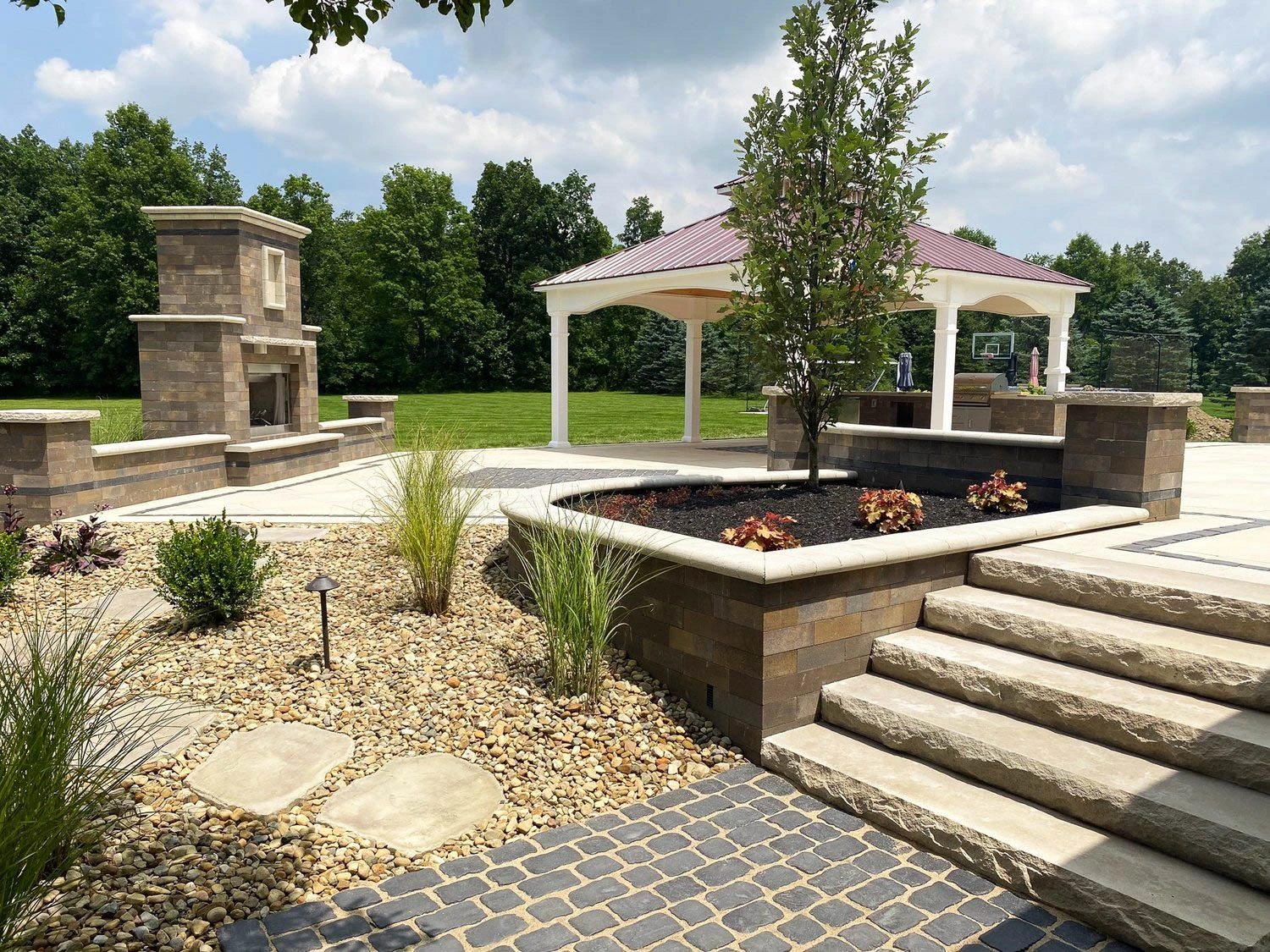
The bigger picture: a Chattahoochee-adjacent property in Suwanee is a different animal than a Village Grove interior lot, and it deserves a different drainage plan, a different budget, and a different contractor conversation. The ones who tell you “a patio is a patio” are the ones who’ve never had to tear one out. The ones who start the first meeting by asking what zone you’re in are the ones who plan to build something that’s still flat thirty years from now.
Floodplain-correct hardscape across 20+ cities within 30 miles of Winder, GA
If your Suwanee lot sits in Zone AE — or you just want a contractor who pulls the flood map before writing the quote — we’d rather spend the first hour on drainage math than the next twenty years reselling you the same patio.