
“We love the look of charcoal gray pavers, but every time we walk around our pool in August, the deck feels like it’s melting our feet. Is there a paver that actually stays cool in Dacula’s summer heat, or are we stuck rebuilding the whole thing?”
That question came in from a Hamilton Mill homeowner last July. It is also the single most common message we get between mid-June and Labor Day. The answer is a conversation about color, mass, surface texture, joint material, sealer, and how exposed the deck is to the Zone 8a afternoon sun that bakes Dacula from 1 p.m. through dinner.
Paver surface temperature is not a mystery — it is physics. A darker paver absorbs more incoming solar radiation and converts it to heat. A denser, thicker paver stores heat and releases it slowly, which is why a dark 2 3/8-inch slab can still be warm at 9 p.m. Lighter colors reflect more radiation. Larger-format pavers with smoother surfaces can feel hotter than textured ones at the same temperature because heel skin contacts more surface area. And the joint sand between units matters more than almost any homeowner realizes.

Over the last five seasons we have tested surface temperatures across six paver lines on live Dacula job sites, typically at 4 p.m. with ambient air at 93°F to 97°F, on deck sections in direct sun since noon. The numbers below are infrared readings on installed decks, not spec-sheet lab numbers. This is what a bare foot actually encounters on a Saturday in Zone 8a.
The post below walks through six specific pavers we install in Dacula pool decks, what each reads on the thermometer, where each makes sense, and the accessories — joint sand, sealer, drainage — that can move the number five to ten degrees in either direction.
1. Techo-Bloc Blu Grande in Driftwood Gray — The Large-Format Workhorse
The Techo-Bloc Blu Grande in driftwood gray is the single most specified paver on our Dacula pool deck projects, and the reason is its surface temperature. At 95°F ambient with full sun since noon, our infrared readings on installed decks land at approximately 112°F. For context, that is roughly nine degrees cooler than the same deck in a charcoal or shale finish, and about eighteen degrees cooler than broom-finish concrete in the same sun.
Blu Grande is a 16-inch by 24-inch large-format unit. Homeowners usually ask first about the look — the proportions read more like natural cut stone than traditional 6-by-9 paver geometry — but the thermal performance is what makes it a pool-deck answer instead of just a pretty patio answer. Driftwood gray sits in the light-to-medium range of Techo-Bloc’s color palette with a slight warm undertone that keeps it from reading as cold white against brick or stone veneer homes (which is most of Dacula’s 1995-2010 subdivision housing stock).
Surface temperature (installed, 95°F ambient, 4 p.m., full sun): ~112°F
Unit size: 16″ × 24″, 2 3/8″ thick
Best for: Open-canopy Hamilton Mill, Sycamore Ridge, and Chandler Ridge lots with minimal afternoon tree cover
Two install notes. Large-format pavers are less forgiving on base prep — a 3/8-inch dip in your base telegraphs through a 16-by-24 slab and never settles back. On Dacula’s Cecil-series clay soils, that means a full 6-inch compacted #57 stone base over geotextile fabric, no sand set, with the subgrade proof-rolled before stone goes down. The wider joints (3/16 to 1/4 inch) run more polymeric sand by volume, but the expansion tolerance is worth it in our freeze-thaw cycle of roughly twenty events per winter.
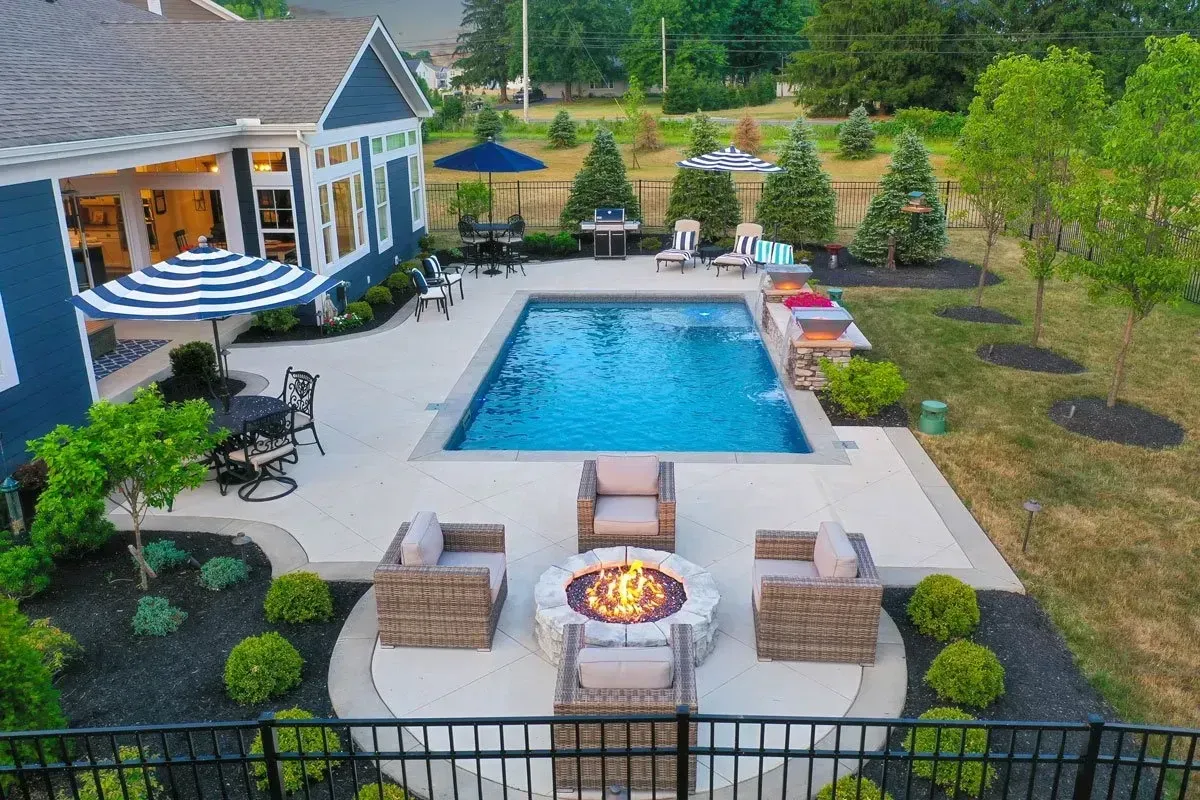
This is the paver we specify when a Dacula homeowner lists “walkable barefoot in August” as the top requirement. It is not the cheapest option on this list — it lands mid-range on our pricing — but it solves the problem the question was actually asking.
2. Techo-Bloc Industria in Multi-Blend Chestnut — When the Look Wins
Sometimes a homeowner walks our sample board and lands on a warm, earthy, multi-tonal chestnut blend and will not be talked off it. We understand. The Industria multi-blend chestnut is a handsome paver, and it belongs next to a natural stone fireplace chimney, a cedar pergola, or a brick veneer home with warm mortar. It is also the hottest paver we routinely install on Dacula pool decks.
Our readings on Industria chestnut come in around 122°F at the same 95°F ambient 4 p.m. test conditions. That is ten degrees hotter than driftwood Blu Grande and right at the edge of “uncomfortable to stand on for thirty seconds.” A healthy adult foot will read that as hot-but-tolerable during a five-step walk from the lounge chair to the water. It is not barefoot-toddler friendly in mid-afternoon.
Surface temperature (installed, 95°F ambient, 4 p.m., full sun): ~122°F
Unit size: 4″ × 8″ tumbled texture, 2 3/8″ thick
Best for: Partially shaded decks, wooded lots like those closer to Little Mulberry Park, pool areas with a pergola or covered structure overhead
The honest way to use Industria chestnut on a Dacula pool deck is to pair it with shade. On a Providence Club project we installed it under a 16-by-20 cedar pergola shading the primary lounging zone, dropping sun exposure from ten hours to about four. With that setup, the paver cools twelve to fifteen degrees during its shaded hours and the homeowner gets the warm aesthetic without the heel burn.
If the deck is fully open to the southwest sky — the pattern in newer Hamilton Mill infill with narrow sideyards and no mature canopy — we counsel against it and steer toward a lighter chestnut blend or a cream-dominant multi-mix instead.
3. Belgard Mega-Lafitt in Champagne — The Tumbled Middle Ground
Mega-Lafitt is Belgard’s answer to the large-format trend, and the champagne colorway is a genuinely useful middle ground between the coolest grays and the warmer chestnut tones. Our field readings land at approximately 115°F — three degrees warmer than Blu Grande driftwood, but seven degrees cooler than Industria chestnut.
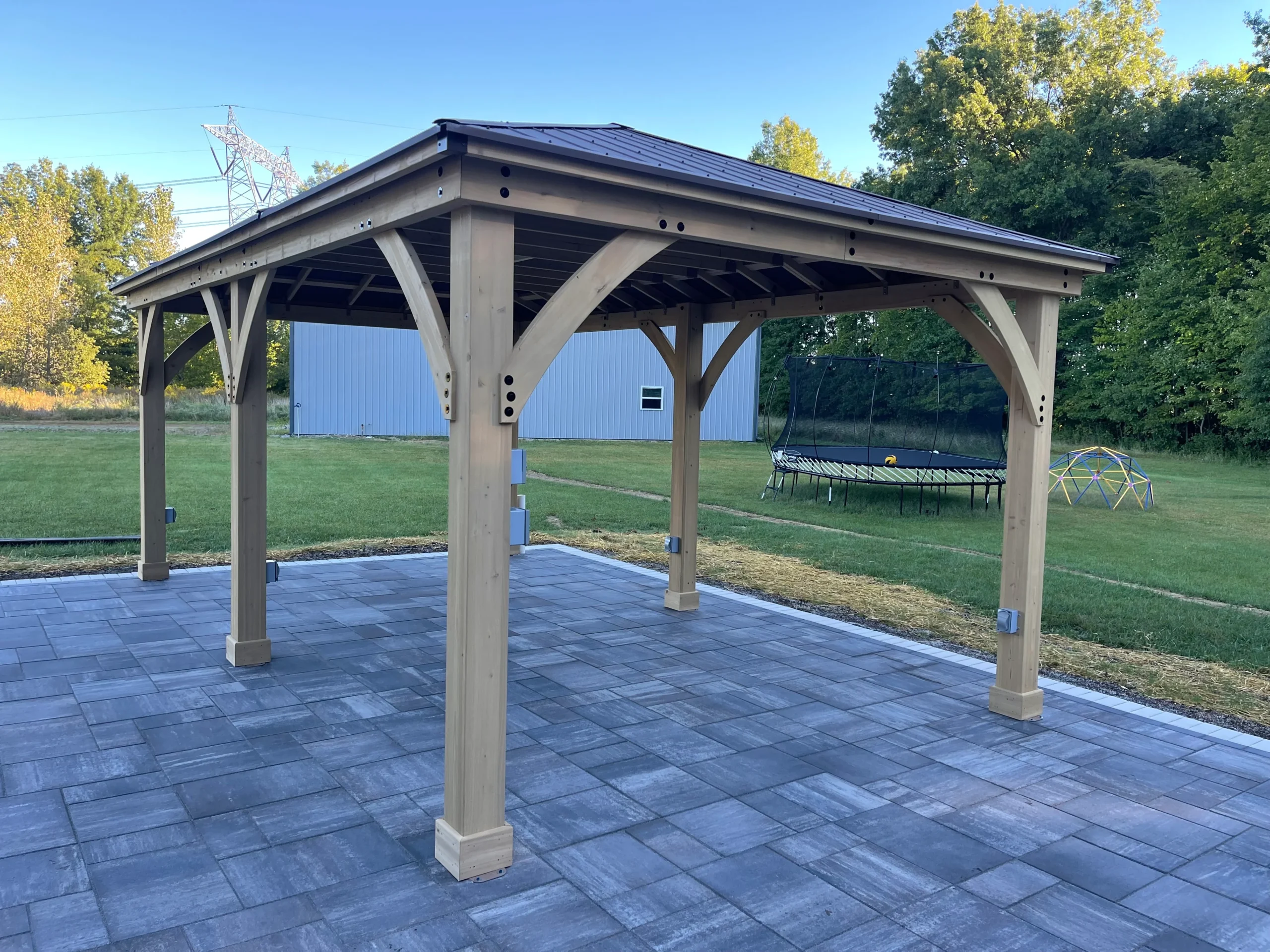
Mega-Lafitt comes in three modular sizes that interlock in a repeating ashlar pattern, which breaks up the scale without feeling busy. The tumbled edge also means the surface is not glassy smooth — wet-foot traction is better than on a sharp-edged architectural paver. That matters because a slip on a Dacula pool deck is usually the homeowner’s kid at full sprint.
The champagne palette runs slightly warmer than driftwood gray but includes enough light stone tones that it reads neutral from ten feet away. It ages well — after three to four years of Zone 8a UV exposure, we have not seen color shift, because Belgard’s color formulation is UV-stable through the slab thickness, not just a surface treatment.
Surface temperature (installed, 95°F ambient, 4 p.m., full sun): ~115°F
Unit size: Three modular sizes in ashlar layout, 2 3/8″ thick
Best for: Homeowners who want the large-format look with a warmer palette, or who need better wet traction than a smooth architectural paver
Mega-Lafitt in champagne is the paver we most often recommend when a homeowner’s finishes lean warm — brick veneer homes, stucco with tan undertones, landscaping with cream or buff stone features — and they want thermal performance without going to a cool gray that will clash.
4. Cambridge Ledgestone in Cream Blend — Textured and Traditional
Cambridge Ledgestone is the paver we recommend when a homeowner wants the look of hand-cut natural stone — varied edges, subtle color variation within each piece, a textured top surface — without the cost or irregularity of actual flagstone. The cream blend reads approximately 116°F on our infrared meter at the standard test conditions.
Ledgestone’s texture matters more than homeowners expect. The top face has a subtle split-stone pattern that breaks up the heat-absorbing surface into micro-peaks and valleys. A bare foot contacts only the high points, so perceived temperature runs a few degrees cooler than the infrared reading. In practical use, a 116°F Ledgestone deck feels closer to 112°F Blu Grande underfoot.
The cream blend mixes light buff, warm white, and occasional pale gold tones. It works well with the travertine-inspired architecture across Sycamore Ridge and Ivey Chase, and coordinates cleanly with brick or stone veneer homes.
Surface temperature (installed, 95°F ambient, 4 p.m., full sun): ~116°F
Unit size: Three-piece modular system with tumbled texture, 2 3/8″ thick
Best for: Clients who want natural-stone aesthetics, homes with travertine or limestone veneer, pool decks where wet traction is a priority
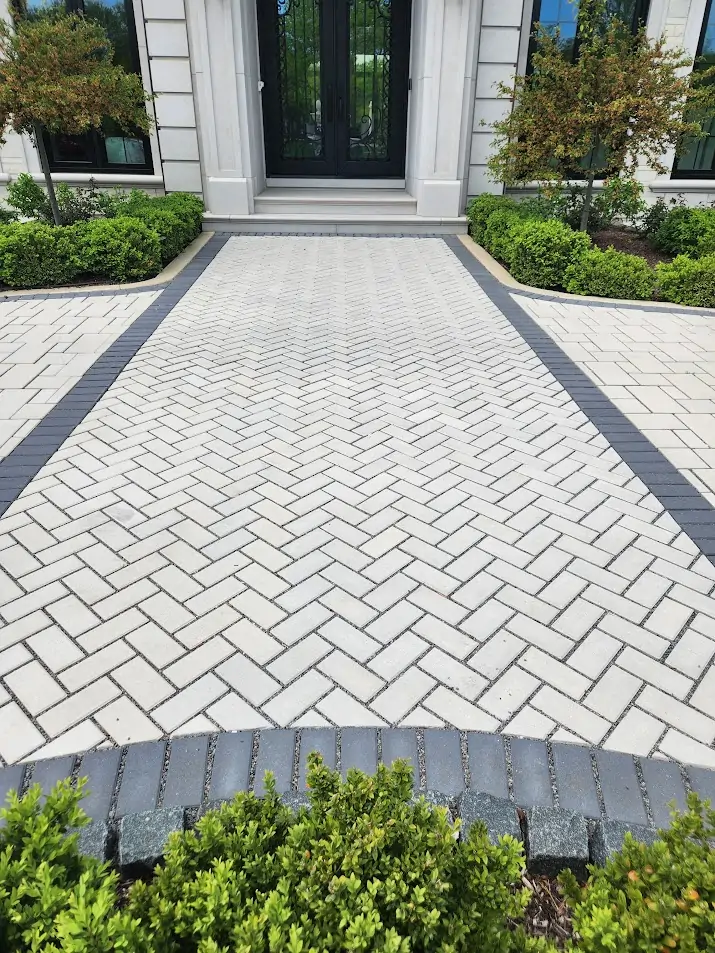
One install consideration: Ledgestone’s textured surface collects pool-deck debris — pollen in spring, leaf tannin in fall — more aggressively than a smooth paver. Sealing helps. An annual pressure wash keeps it presentation-ready. Clients who prefer no-maintenance decks tend to choose Blu Grande or Mega-Lafitt instead.
5. Travertine French Pattern in Chiseled Cream — The Stone Alternative
Technically this is not a paver in the concrete-unit sense — it is quarried travertine, cut to a French pattern (four different unit sizes that interlock in a repeating module), chiseled-edge finish. We include it in this comparison because for Dacula homeowners choosing between pavers and stone, the heat conversation is the entire deciding factor.
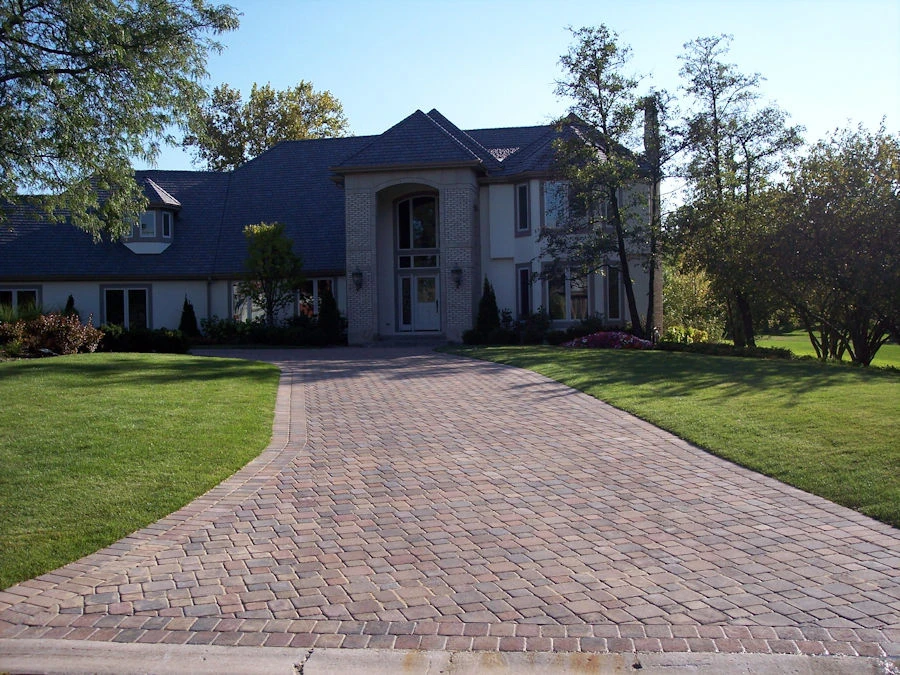
Chiseled cream travertine reads approximately 118°F at test conditions. On paper that is six degrees warmer than Blu Grande driftwood. In practice, porosity changes the equation. Travertine is naturally cellular — every piece has thousands of microscopic voids that trap moisture. In humid Dacula summer air, the stone absorbs water vapor, and as it evaporates off the surface it carries heat with it. A damp travertine deck after a thunderstorm or a pool splash cools five to seven degrees faster than concrete and holds that lower temperature longer.
The chiseled edge is a deliberate pool-deck choice. A sharp-sawn travertine edge can chip under furniture or a tumbling kid. Chiseled edges are pre-weathered, which softens the look and preempts the chip damage.
Surface temperature (installed, 95°F ambient, 4 p.m., full sun): ~118°F
Cooling effect of evaporation after splash: 5-7°F reduction, held for 15-20 minutes
Best for: Homeowners prioritizing a natural-stone aesthetic, Mediterranean or transitional home styles
Two cautions. Travertine needs a penetrating sealer every three years in Zone 8a to resist the iron staining that Dacula’s clay-laden groundwater can leach upward through the deck. And it is not freeze-thaw bulletproof — we have seen surface spalling on cheap 3/4-inch import-grade travertine when a freeze event hit a pocket of moisture in a micro-pore. We install only premium 1 1/4-inch travertine on Dacula pool decks, and have not had a callback in five years.
6. Unilock Eco-Priora — The Permeable Option for Grade Problems
Eco-Priora does not solve heat. It solves water. But on a certain subset of Dacula pool-deck projects — specifically the ones where the backyard slopes steeply toward a tributary of the Alcovy River or toward the foundation of the house — it is the only paver we will install.
The logic: a conventional paver deck on Cecil-series soils creates a 1,200 to 2,000 square foot impervious surface. When a Zone 8a thunderstorm drops 1.5 inches of rain in forty minutes, that deck has to shed every drop somewhere. Toward the house, your basement has a problem. Toward a neighbor’s yard, you have a relationship problem. Toward a creek, you have a silt-and-erosion problem Gwinnett County cares about.
Eco-Priora is an interlocking concrete paver with deliberately enlarged 3/8-inch joints filled with angular #8 washed stone instead of polymeric sand. Water drains through the paver joints at approximately 300 inches per hour — more than any rainstorm Dacula will throw at it — into an open-graded aggregate base that acts as a storage reservoir. From there it percolates back into the soil at the native infiltration rate, or is routed via perforated drain to daylight.
Surface temperature (installed, 95°F ambient, 4 p.m., full sun): ~119°F (medium-gray color)
Infiltration rate: ~300 in/hr through the joint network
Base requirement: 8-12″ open-graded #57 and #8 stone, no fines, no geotextile in the percolation path
Best for: Pool decks on sloped lots, sites near creeks, homes where the pool deck crowds the foundation
Eco-Priora comes in six color options. For heat management we specify the light-gray or granite-blend, which land around 119°F. Darker options run hotter and we avoid them in pool-deck applications. The look is architectural — straight, precise, modern — which reads well next to newer construction in Auburn Park and Chandler Ridge but can feel rigid against a traditional Hamilton Mill brick home. That is an aesthetic trade, but the hydrologic performance is the difference between a deck that lasts thirty years and one that heaves in year six because the base got saturated.
7. What Actually Changes the Number: Joint Sand, Sealer, and Shade
The six pavers above are the starting point. Three downstream decisions move the surface temperature five to ten degrees in either direction, and every homeowner should understand them before signing the contract.
Joint sand color
Polymeric joint sand is a surprisingly large percentage of a paver deck’s visual area — usually 5 to 8 percent of the total surface depending on unit size and layout. It is also a meaningful heat contributor. On dark pavers (Industria chestnut, darker grays) we specify a light-tan polymeric sand rather than the matching dark color. The logic is thermal mass: joint sand saturates with water after rain and dries through the day, so keeping that joint content from adding to the dark-paver heat load reduces overall deck temperature by 2 to 4°F. On light pavers (Blu Grande driftwood, Ledgestone cream) we go the opposite direction — a slightly darker sand creates a subtle grid that makes the deck read as more crafted and less monolithic, and because the paver itself is already reflecting most of the radiation, the darker joint’s thermal penalty is minimal.
Sealer selection
A homeowner will often ask, “should we seal the deck?” The honest answer depends on which sealer. Penetrating sealers — products like Alliance Envirosealer or Techniseal CR-95 — soak into the paver’s surface pores and leave almost no film on top. They resist oil and water staining, do not change the paver color significantly, and do not add measurable surface temperature.
Topical film-forming sealers — the wet-look or high-gloss products — sit on top of the paver as a thin polymer layer. They deepen color (which some homeowners love visually) and they add roughly 6 to 8°F to surface temperature because the polymer film has its own absorption characteristic and, being non-porous, it prevents any moisture evaporation that would otherwise cool the surface. On pool decks we almost never specify topical sealers. The aesthetic cost of a matte penetrating sealer is small; the thermal cost of a wet-look topical is large and every barefoot guest notices.
Shade structure
Every pergola, cantilevered umbrella, or covered-patio extension that shades even a portion of the pool deck drops the shaded paver temperature by 12 to 18°F. A 12-foot by 16-foot shade structure over a primary lounging zone is the single most effective intervention available to a homeowner with a warmer-palette paver choice already in the ground. We have rescued “too hot” decks — including two where the original contractor specified a dark paver without warning the homeowner — by adding a pergola over the chaise zone rather than rebuilding the deck itself.
Dacula’s geography also factors in. The open-canopy newer-construction sections of Hamilton Mill — particularly the Hamilton Mill Ridge infill west of the golf course — see full sun exposure from roughly 11 a.m. through 7 p.m. in July, with no mature tree canopy yet established. By contrast, the older wooded lots closer to Little Mulberry Park benefit from established hardwood canopy that drops afternoon sun exposure substantially. A paver that struggles on an open Hamilton Mill Ridge lot often performs perfectly well on a Little Mulberry-adjacent lot. The site always matters as much as the material.
How to put it all together
A decision tree for a Dacula homeowner in a paver showroom: open-canopy lot, full southwest sun, barefoot priority — Techo-Bloc Blu Grande driftwood gray. Wooded or pergola coverage, warmer aesthetic — Cambridge Ledgestone cream or Belgard Mega-Lafitt champagne. Natural stone — chiseled-cream travertine, sealed every three years. Sloped lot with drainage toward the house — Unilock Eco-Priora in a light color. Must have chestnut despite sun exposure — add a pergola, light joint sand, penetrating sealer only.
The deck is where you will stand, sit, and walk for the next twenty-five years. Specify the thermal behavior on the front end, and the August afternoons take care of themselves.
Pool decks engineered for summer heat across 20+ cities within 30 miles of Winder, GA
Every pool deck we build starts with the specific paver, joint sand, sealer, and shade strategy that works for your lot’s sun exposure, soil, and drainage — not a generic material spec.