
A fully integrated resort-grade lighting package for a typical 1/3-acre Dacula backyard — LED pool lights, a 12V landscape system, 15-25 fixtures, an astronomical timer, and every cable buried clean — generally lands between $6,400 and $12,800 installed. On a 1-acre estate with multi-zone control, we have written bids as high as $34,000. Those are the ranges. The rest of this post shows exactly where the money goes.
We just wrapped a lighting package on a Hamilton Mill home off Hog Mountain Rd — the kind of project that started as “can you add a few lights around the pool” and ended as a sixteen-fixture, three-zone, sunset-auto-on system that the homeowner now turns on from her phone before she has pulled into the garage. This post is that job, start to finish, with the line items and product names intact. If you are weighing what a resort-lit backyard actually costs in Dacula, this is the walk-through.
For context, I run lighting scopes as part of almost every full pool or hardscape project we deliver in Gwinnett County. Some homeowners want a single pool light and one path run. Others want the whole backyard to look like a Four Seasons after dark. The numbers below come from a middle-of-the-road resort package — roughly the ninetieth percentile of what most Dacula families actually install when they decide to do lighting correctly.
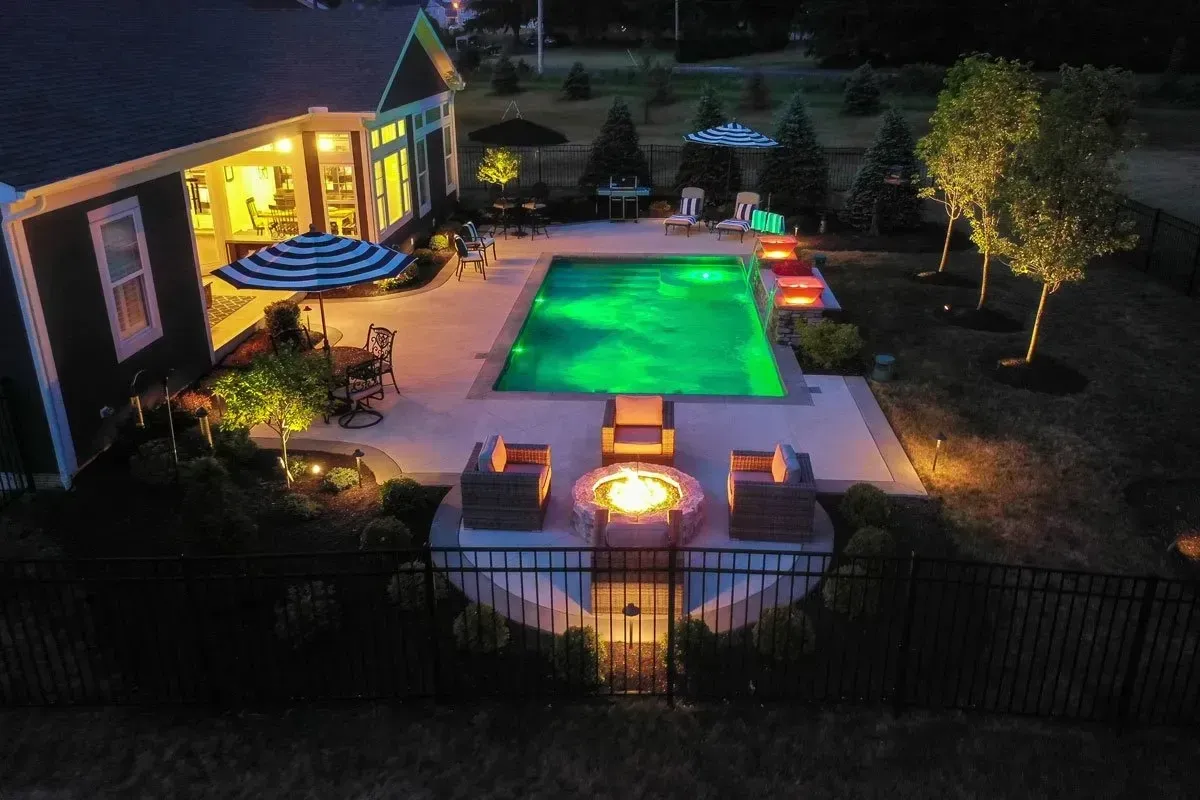
The Project: Hamilton Mill, Roughly a Third of an Acre, Budget of $11,400
The homeowners had built a concrete pool with us two summers prior. Pebble Tec interior, travertine coping, bluestone deck, a small raised spa with a sheet-water spillway. Beautiful during the day. At night — dark. They had the original single builder-grade pool light that the previous contractor had installed, plus two stake lights by the back door, and that was it. They hosted regularly. They wanted the backyard to function after sunset from April through October, which in Dacula realistically means about seven months of evening use.
We spent about forty-five minutes walking the yard at dusk on the first visit. That is always step one. Lighting at noon on a sunny Tuesday looks like nothing — it has to be designed in the conditions it will actually work in. We mapped where the eye lands first from the main kitchen window, from the upstairs primary bedroom looking down, and from the two dining zones on the deck. That gave us our focal layers: the pool itself, the spillway, the specimen trees (three mature crape myrtles and a willow oak), the pergola ceiling, the path from the driveway gate to the deck, and the column caps on the outdoor kitchen surround.
Final bid came in at $11,400. Sixteen landscape fixtures, one upgraded Pentair IntelliBrite color-changing LED retrofit for the pool, a 600W transformer with an astronomical timer, roughly 540 linear feet of direct-burial cable, and a Lutron Caseta hub for smart-phone control tied into their existing home automation. Two days of install. Everything came on that first night at 7:48 PM as a complete system. That is the project we will walk through.
Project snapshot: 1/3-acre Dacula lot · 16 landscape fixtures + 1 pool LED · 540 ft cable · 600W transformer · Lutron Caseta integration · 2-day install · $11,400 total delivered.
The Transformer and Controls — $480 of the Budget, Most of the Brains
A 12V low-voltage landscape system runs off a transformer that steps 120V household power down to the 12-15V range fixtures use. This is the single most important piece of hardware in the entire package because it determines load capacity, how many zones you can run independently, and how the system comes on and off every night for the next decade.
For this job we specified an FX Luminaire PX-600 — a 600-watt stainless-steel transformer with a built-in astronomical timer. Cost to the homeowner, installed and wired to a dedicated GFCI-protected circuit at the rear of the garage: $480. We could have dropped to a 300W Kichler at $320 or gone the other direction with a Vista Pro 900W unit at $680. The PX-600 was the right fit because sixteen fixtures plus the pool light plus a 25% future-expansion buffer put us at about 410 watts of actual load — comfortably under capacity, enough headroom for the homeowner to add four more fixtures without re-pulling the transformer.
The astronomical timer is the feature that separates resort lighting from generic landscape lighting. It geolocates to Dacula (30019), pulls NOAA sunrise/sunset data, and shifts the on-time automatically across the year. In June the system comes on at 8:52 PM. In December it comes on at 5:24 PM. The homeowner never touches it. Generic timers with a single fixed on/off clock will have your lights burning through three hours of daylight by late June, which is both wasteful and looks amateurish from the street.
For families that want phone control or integration into a Control4 or Savant smart-home hub, that is an additional $2,400-$4,800 on top of the lighting scope, depending on how many zones and how deep the integration goes. This homeowner already had Lutron Caseta running interior lighting, so we added a single Caseta-compatible relay at the transformer for $380 — a much cheaper path than a full Control4 build-out, and more than enough for her use case.
The Pool Light and the Sixteen Landscape Fixtures — Where Most of the Budget Lives
The original pool light was a 1995-era 300-watt incandescent fixture — the kind that cast a yellow-green color temperature we politely call “motel pool.” We replaced it with a Pentair IntelliBrite 5G color-changing LED. Installed cost: $1,650. That is the fixture at roughly $720, GFCI verification at $180, and the labor (drain to below light level, pull old fixture, land and seal the new, refill top-off) at $750. The pool now draws 45 watts for the same perceived brightness the old 300-watt fixture produced, with far better color rendering and the ability to shift from daylight-white during early evening swimming to a deep royal blue at 10 PM.
This is the lynchpin. You cannot build a resort lighting scheme around a motel-grade pool fixture — the pool is the largest illuminated surface in the backyard, and if its color and quality are wrong, every landscape fixture around it reads as compensation. Start at the pool. Then build outward.
Here is where cost conversations get real. Homeowners assume “landscape lighting” is the cheap part of the bid. It is not, especially if you want brass or copper housings that will not pit within three years of Dacula humidity. Here is the exact count and spec we installed:
- 4 FX Luminaire column-cap lights (brass, 3-watt LED, on the four outdoor kitchen pillars) — $96 each = $384
- 6 FX Luminaire PB bullet uplights (brass, 6-watt LED, on the three crape myrtles and the willow oak) — $128 each = $768
- 2 Kichler 15769 well lights (flush-buried into the bluestone deck, uplighting the spa water wall) — $142 each = $284
- 3 Vista Pro path lights (the 12″-tall PL series, brass, LED, walkway from driveway gate to deck) — $118 each = $354
- 1 FX Luminaire MR downlight (mounted into the pergola rafter, 6-watt, pointing at the dining table directly below) — $164
Fixture subtotal: $1,954. Homeowners compare that to big-box kits at $60-$80 for six fixtures and wonder why the difference. Two reasons. Marine-grade brass and copper housings do not pit or delaminate the way painted aluminum does within eighteen months of sustained Dacula humidity. And the LED engines inside FX Luminaire or Kichler fixtures are 50,000-hour rated with replaceable modules. Big-box fixtures are throwaways — you replace them every three to four years, which obliterates the upfront savings and looks bad in the meantime.
Cable, Conduit, and the Labor Nobody Sees
Five hundred and forty linear feet of 12-gauge direct-burial cable. That is what it took to connect sixteen fixtures across roughly 2,600 square feet of hardscaped and landscaped backyard. We ran two primary hub-and-spoke loops off the transformer — one serving the north side of the pool and the outdoor kitchen zone, the other serving the tree uplights and the path run.
At $1.80 per linear foot installed (cable, trenching, buried connections, back-fill, sod restoration where needed), that line item ran $972. Cable pricing varies $1.40-$2.20 per foot in Dacula depending on trench depth, whether we have to saw-cut through any existing hardscape, and how much conduit we need for sleeved runs under pavers or concrete. For this job we had two short saw-cuts (one through a 4-foot-wide bluestone walkway to reach the pergola, another through a driveway apron) that bumped our number closer to $1.80.
Here is where amateur landscape lighting falls apart. We pull every cable run to a single hub at the transformer — no splices buried in the yard, no tee connections under mulch. Every connection is either a direct landing at the terminal block or a heat-shrink crimp in an accessible junction. The reason is simple: eight years from now when a fixture fails, you need to isolate and swap it without digging up half the yard to find where the previous installer buried a twist-on splice. A buried splice in Piedmont clay is a three-year time bomb — moisture wicks in, copper corrodes, the run voltage-drops, fixtures dim on one end of the system.
Our labor line on this job was $2,740 — trenching and backfill, fixture staking and aiming, transformer mounting and circuit connection, cable terminations, and the night-aim session we always include. The night aim is non-negotiable — install day, we come back after sunset and walk every fixture with the homeowner, shifting aim by an inch or two, rotating glare shields, swapping beam angles. That hour on a sixteen-fixture job is the difference between a lighting scheme and a pile of lights.
Why Pool-and-Landscape Integration Matters (And Why Separate Contractors Fail at It)
Dacula homeowners who install pool and landscape lighting separately end up with two systems that fight each other. The pool builder installs one 300-watt incandescent pointing straight up through the water. A landscape contractor, hired a year later, adds twenty fixtures around the perimeter. The pool light is yellow-green. The landscape fixtures are 2700K warm white. Standing on the deck at night, the pool reads as a motel pool surrounded by a resort. The eye never settles.
We approach every lighting scope as a single integrated system from day one. The pool interior light gets color-matched to the landscape. The transformer is sized for total load. The astronomical timer runs both zones on the same schedule. Scenes are programmed so that at 10:30 PM one phone tap dims landscape fixtures to 30% and shifts the pool to deep blue — security lighting only. At 11:30 PM the system fades to zero. A cohesive package — Pentair IntelliBrite LED plus 8-12 landscape fixtures on one controller — delivers roughly three times the perceived value of a pool light plus a detached landscape system at the same hardware cost.
Dacula-Specific Considerations: Clay Soil, Freeze Cycles, and Mulberry River Humidity
Dacula sits in the NE Gwinnett Piedmont belt — clay-heavy Cecil series topsoil over weathered granite saprolite, with roughly twenty freeze events per year and summer humidity that sustains evaporation for hours after sundown. That combination means three things for a lighting install that matter for long-term reliability:
First, direct-burial cable depth has to respect clay expansion. In coarse loam you can get away with 4-6 inch cable depth. In Dacula’s clay, we bury at 6-8 inches under turf and 12 inches minimum under any hardscape crossing. Clay expands and contracts seasonally by as much as an inch vertically, and shallow cable gets pinched against paver joints over a few freeze cycles. Every cable run in the Hamilton Mill job went in at 6-8 inches and was probe-verified with a shovel before backfill.
Second, brass and copper fixtures are worth the premium over aluminum because of the humidity. Dacula’s proximity to the Mulberry River and Little Mulberry Park watershed means the eastern half of Gwinnett holds moisture longer than the western drier side of the county. Aluminum fixtures show pitting within three summers. Brass patinas gracefully and keeps its structural integrity for decades. We spec brass or copper on every permanent install.
Third, transformers have to be located where they can breathe and stay dry. We mount them on the north or east elevation of the house, under a modest rain-shadow from eaves, with a minimum 18-inch clearance from the ground and a dedicated GFCI circuit. In Dacula’s summer thunderstorm season we see inductive spikes from nearby lightning strikes that will fry a poorly grounded transformer. The PX-600 on this job got a dedicated whole-house-surge-protected circuit, which added $140 to the bid and is something I recommend on every install over eight fixtures.
Three Dacula-specific details that most contractors skip:
1. Cable buried at 6-8 inches under turf (not 4) — clay expansion tolerance.
2. Brass or copper fixtures only — Mulberry River watershed humidity will pit aluminum in three summers.
3. Whole-house surge-protected circuit at the transformer — summer thunderstorm inductive spikes.
What the Whole Budget Looks Like — And Where Resort Upgrades Push It Higher
Here is the actual invoice on the Hamilton Mill job, every line item out in the open:
- Pentair IntelliBrite 5G LED pool retrofit (installed): $1,650
- FX Luminaire PX-600 transformer + astronomical timer: $480
- Lutron Caseta smart relay integration: $380
- 16 landscape fixtures (brass/copper, FX Luminaire + Kichler + Vista Pro): $1,954
- 540 linear feet of 12-gauge direct-burial cable + connections: $972
- Trenching, labor, mounting, night-aim session: $2,740
- Two saw-cuts through existing hardscape + sleeving: $620
- Whole-house surge-protected dedicated circuit: $140
- Permitting and GFCI verification (Gwinnett Dept. of Planning & Development, 446 W. Crogan St.): $0 — included in labor
- 10% contingency and mobilization: $464
- Total delivered: $11,400
That number lands squarely in the middle of what we see most Dacula resort-lighting packages running. The lower end — around $6,400 — is a smaller scope: eight to ten fixtures, a 300W transformer, standard pool LED without color-changing, no smart-home integration. The upper end — around $12,800 — adds four to six more fixtures, a larger transformer, RGB color-changing pool LED, and basic Caseta integration.
For a one-acre estate property running multi-zone lighting with independent control of front approach, pool/patio, gardens, and tree canopy, we are routinely writing bids from $18,000 to $34,000. That is twenty-five to forty-five fixtures, two or three transformers, full Control4 or Savant integration at another $2,400-$4,800, and typically a Rain Bird ST8 or larger astronomical controller managing multiple zones on independent schedules. The cost-per-fixture actually drops at that scale, but total project cost climbs because the square footage of illuminated yard is three or four times larger.
The question homeowners ask most when comparing bids: why is one contractor quoting $4,200 for “the same scope”? It is never the same scope. One of three things is happening. Either the cheaper bid uses big-box aluminum fixtures that fail in three summers, or a 300W transformer loaded to 95% capacity with zero expansion headroom, or it skips the astronomical timer, surge protection, and night-aim entirely. Sometimes all three. You can get landscape lights installed cheap in Dacula. You cannot get a resort-grade lighting system installed cheap. They are different products.
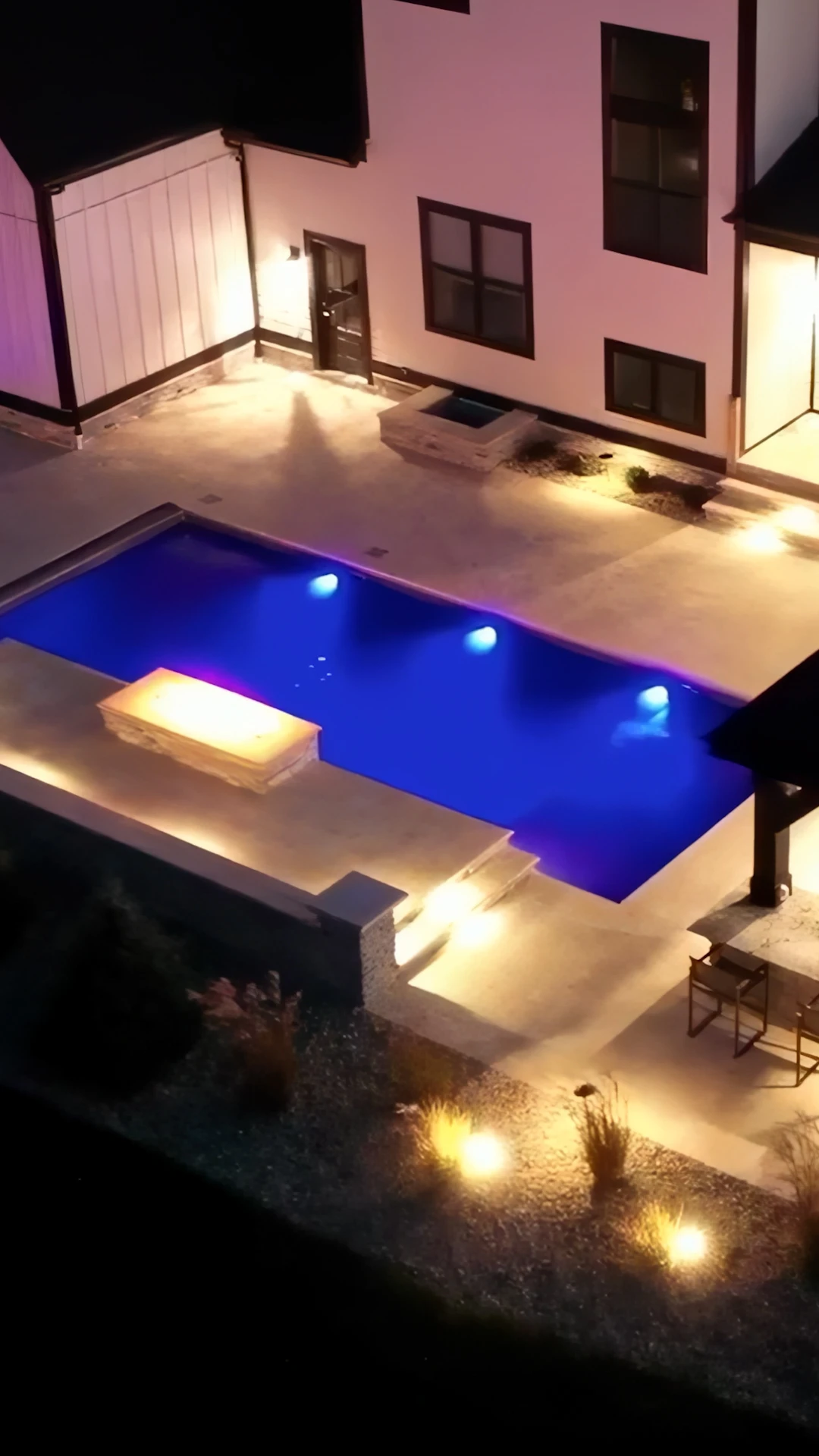
What the Hamilton Mill homeowner told me three weeks after the install: they are outside three nights a week longer into the season than they used to be. They host more. The sellers’ agents in her neighborhood have started asking her for the contractor name because her backyard shows differently at 9 PM than anyone else’s on the cul-de-sac. That is the return on an $11,400 lighting package — and it is why we approach every pool or hardscape project in Dacula with lighting scoped in from day one rather than bolted on a year later.
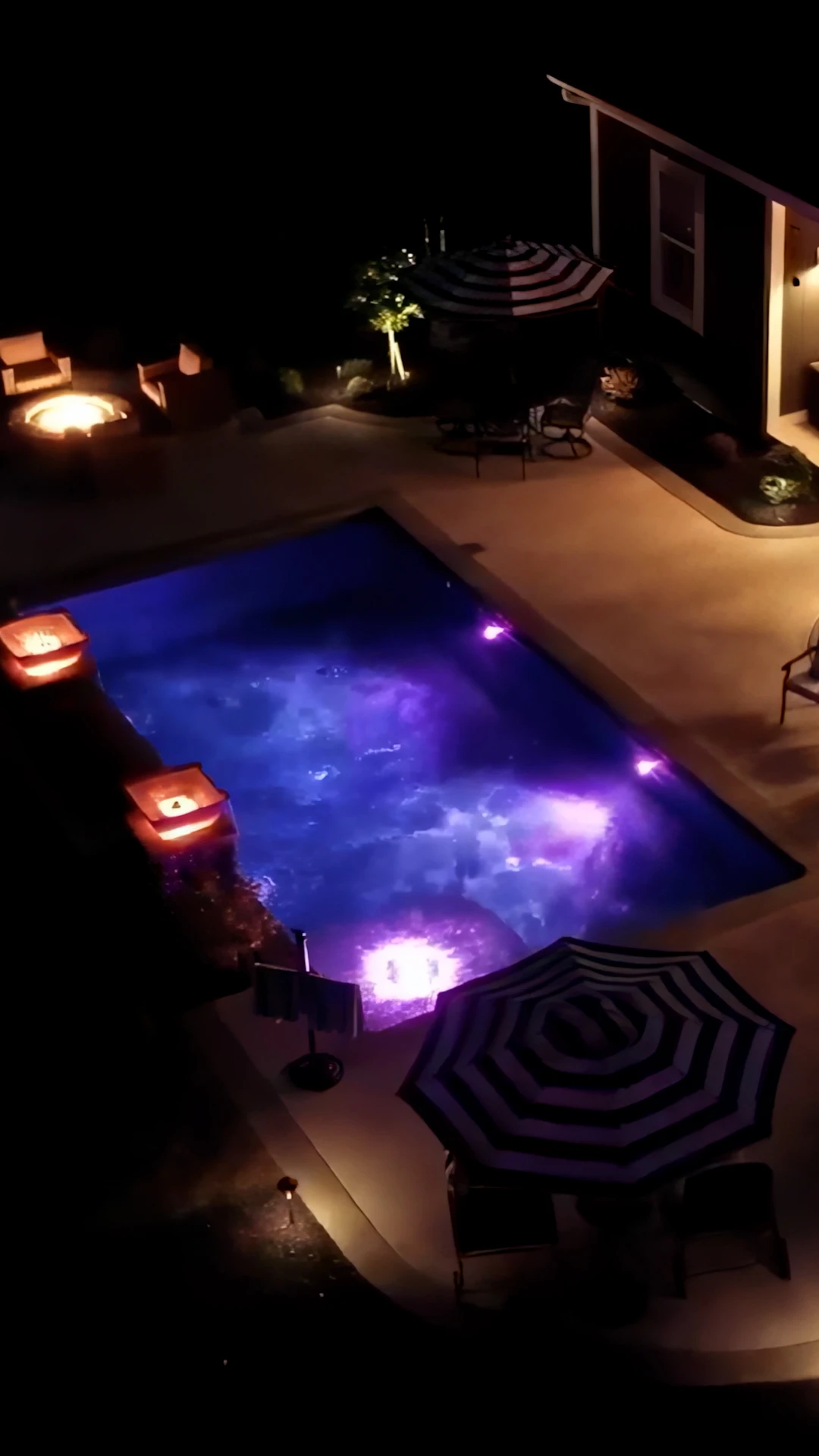
One last note on maintenance. A twelve-volt LED system in Dacula’s climate, installed with brass fixtures, 12-gauge direct-burial cable, and a properly sized transformer, should run ten to fifteen years before any significant service. The LED modules are rated at 50,000 hours — roughly twelve years of nightly use on an astronomical schedule. Annual maintenance is a thirty-minute visit to clean fixture lenses, trim landscape growth shadowing fixtures, re-aim anything the lawn crew kicked with a mower, and top off polymeric joint material around well lights. We charge $340 for that annual visit. Most clients schedule it alongside their spring pool open.
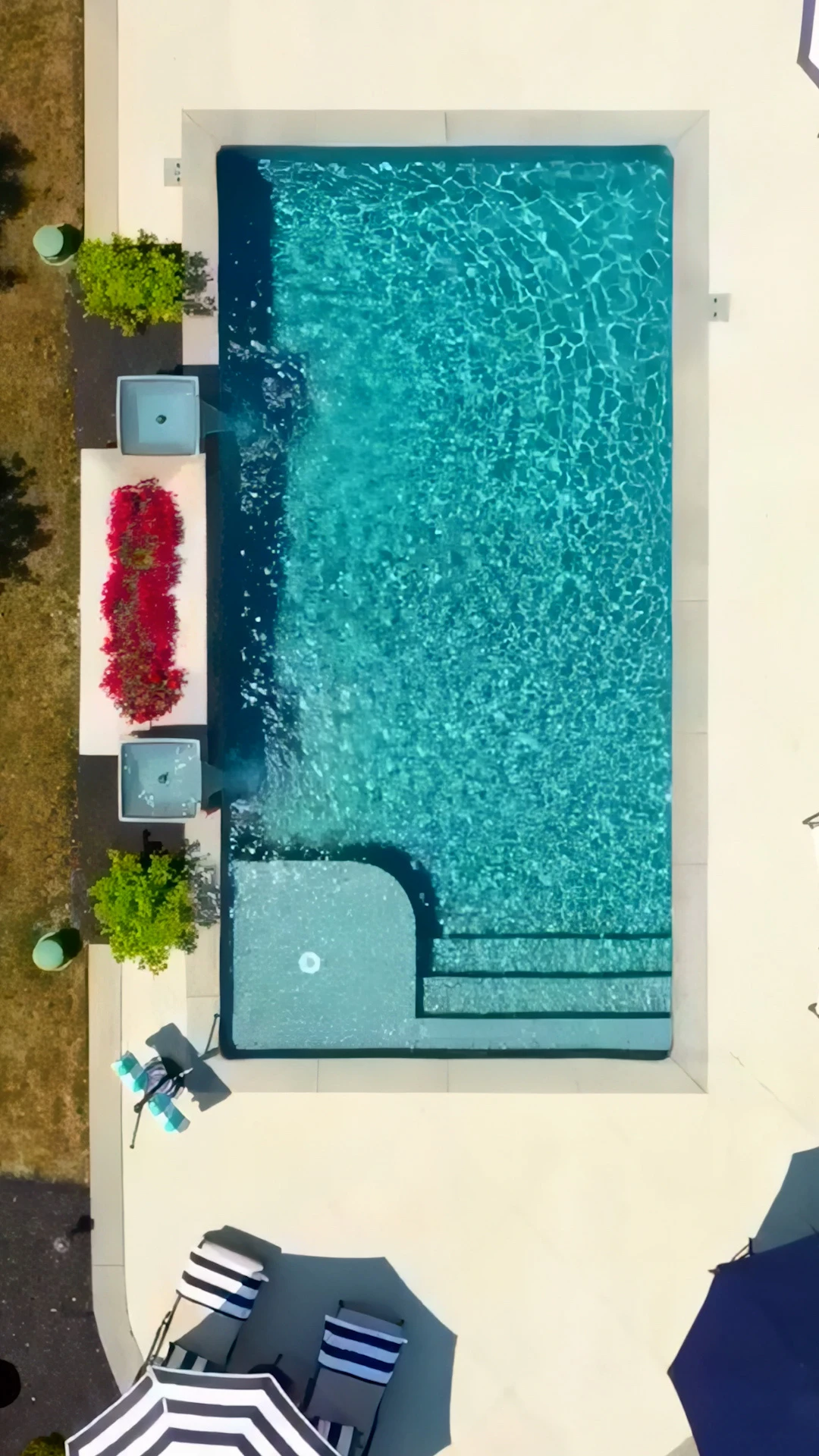
If you are planning a pool or hardscape project in Dacula and lighting is on your radar — or you already have the pool and the deck and you are ready to add a proper lighting layer — we will walk your yard at dusk, map your focal zones, and write you a line-item bid that shows every fixture, every foot of cable, and every dollar. No surprises. The numbers are what they are. What you get back is a backyard that works seven nights a week from April through October, and a system that will still be running the same way in 2036.
Resort-grade pool and landscape lighting across 20+ cities within 30 miles of Winder, GA
We integrate pool and landscape lighting into a single cohesive system — FX Luminaire, Kichler, Vista Pro fixtures, Pentair IntelliBrite pool LEDs, astronomical timers, and smart-home hubs all scoped together from day one.