
Across a 10-year ownership window, the homeowner will spend $2,400 on LED lamp replacements instead of the $18,400 an equivalent halogen package would have burned through. That single line item — lamp economics — is why resort lighting stopped being a luxury add-on in Cumming and became the smartest cut-in on the bid sheet.
The project lives on a 1-acre lake-adjacent lot in north Forsyth County, a long paver-driveway walk from the eastern arm of Lake Lanier. The scope — four Pentair IntelliBrite 5G pool lights, twenty-eight landscape fixtures aimed deliberately at the water view, one pedestal fire bowl, continuous path lighting to a private dock, and a Lutron RadioRA 2 scene controller tying it all together — totaled $22,400 installed. The house was already finished. Every wire in this post was pulled as a retrofit through a finished hardscape and a landscaped yard.
What follows is the actual line-item breakdown, the aiming decisions that make a lake-view backyard feel like a resort instead of a parking lot, and the Forsyth County permit and Sawnee EMC service details you will actually have to handle. No generic “lighting tips.” Just the build.
Why the Lake Lanier Edge Changes Your Lighting Brief
Lighting a pool in Cumming is not the same job as lighting a pool twenty miles south in Alpharetta. The Lake Lanier proximity pulls ambient humidity up, which pushes pool evaporation slightly higher and — more relevant here — carries corrosive mist onto any fixture within 200 feet of the shoreline. The Forsyth County average 52 inches of annual rainfall plus the lake-boundary-layer moisture means cheap aluminum housings pit within 18 months. Every fixture on this job is solid brass or marine-grade bronze. That is not a premium upsell. That is what survives.
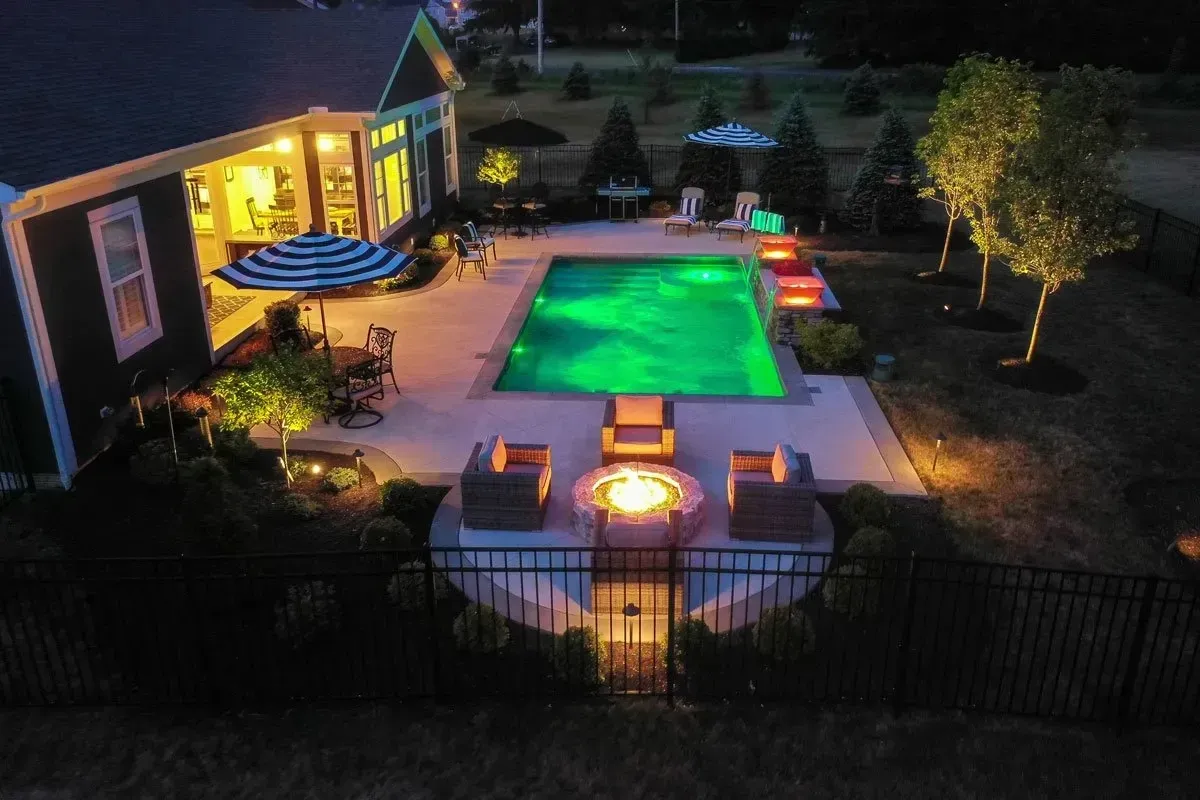
The second thing the lake does is rewrite your aiming plan. On a landlocked lot, you light the yard — trees, walk paths, the back of the house. On a lake-adjacent lot, you light for the view. Half the landscape fixtures on this build are aimed down-slope toward the water, silhouetting specimen trees against the dark surface so guests sitting at the fire bowl see a layered composition: foreground flame, mid-ground water, Lake Lanier beyond. Flip a few of those fixtures upward and you blow out the view with sky glow. Aim matters more than wattage.
The third thing the lake does is set a baseline color temperature for everything else in the yard. Lake Lanier at dusk picks up the ambient sky — muted blue-gray in November, a hotter blue-to-pink in July. We tested three landscape color temperatures on this build at the pre-install stage: 2200K, 2700K, and 3000K. The 3000K lamps read clinical and blue-tinted against the water. The 2200K lamps read orange against the blue-hour sky and washed out the lake’s own tonal range. The 2700K FX Luminaire fixtures landed at the warm-but-not-amber sweet spot that lets the water stay the dominant color in the composition. Specify that temperature in writing. It matters.
The fourth thing — and this is the detail that almost every installed lighting job in Forsyth misses — is the shoreline setback. Georgia’s shoreline rules prohibit permanent fixture installation inside the buffer zone measured from the 1,071-foot full-pool contour on Lake Lanier. The dock-path bollards on this build stop at the buffer line and hand off to a single low-wattage solar bollard at the water’s edge. A contractor who runs low-voltage wire into the buffer without consulting the Army Corps of Engineers can be made to pull it out at his own cost. Read the easement. Then read it again.
The $22,400 Line-Item Breakdown
Here is the proposal, with the pricing we actually signed against. Labor is Cumming market rate for a retrofit — trenching through finished Techo-Bloc Blu 60 pavers on the pool deck and hand-pulled conduit around mature landscaping.
Pool-interior lighting: 4x Pentair IntelliBrite 5G Color LED, 12V, niche-mount — $2,380 fixture cost, $1,120 labor including transformer and bond-compliant wire, $3,500 subtotal.
Landscape lighting: 28x FX Luminaire brass fixtures (mix of PB path, DM downlight, and NP tree uplight series), 12V — $6,160 fixtures, $4,200 labor (trench, transformer, aiming), $10,360 subtotal.
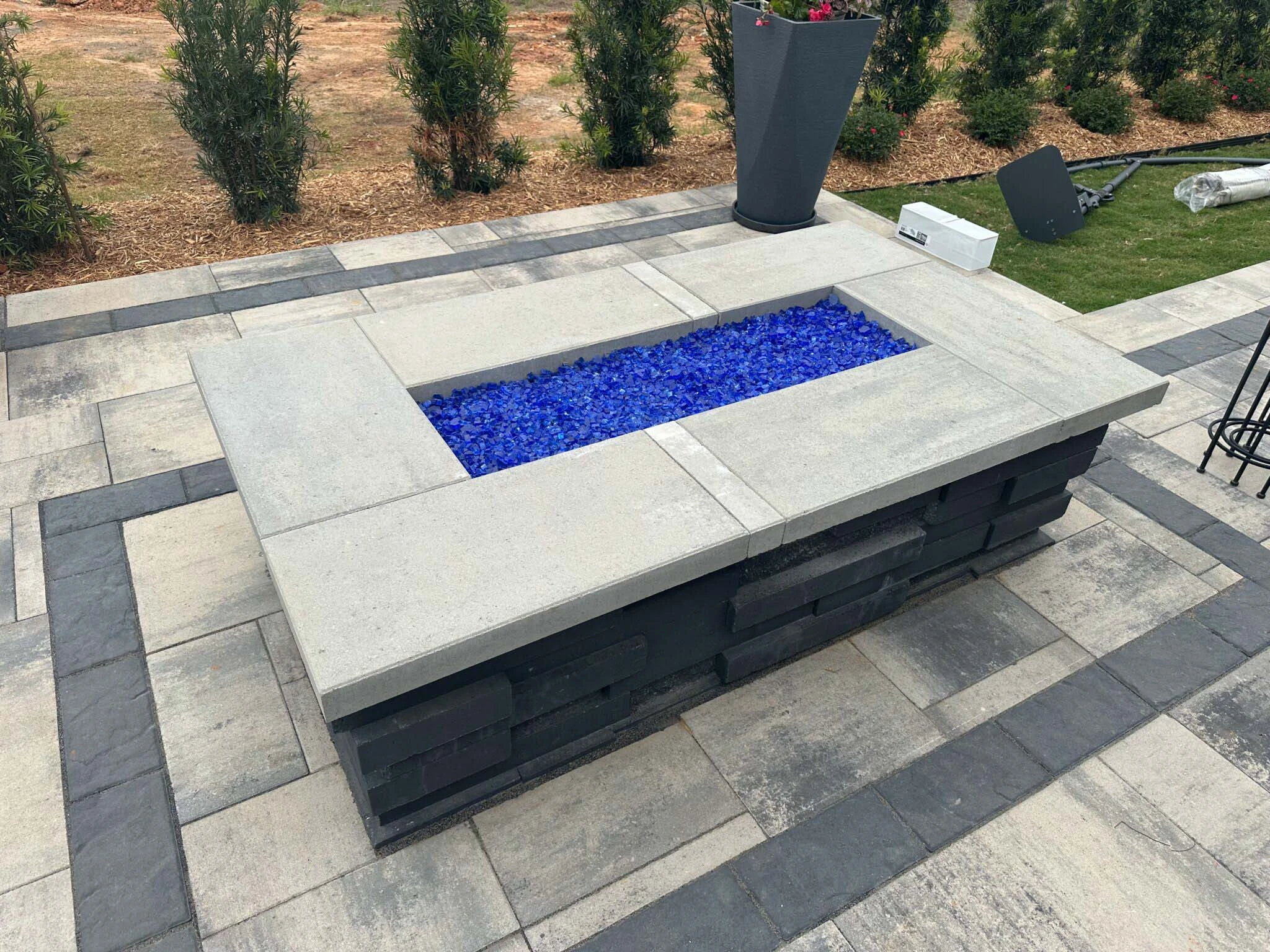
Pedestal gas fire bowl: 1x 36″ bronze pedestal bowl with cobalt fire glass and electronic ignition — $1,840 fixture, $680 gas line and ignition wiring, $2,520 subtotal.
Dock path lighting: 14x low-profile bollard-style path lights with direct-burial fixtures along the 180-foot stair-path to the private dock — $1,680 fixtures, $1,140 labor, $2,820 subtotal.
Smart control: Lutron RadioRA 2 Main Repeater, two tabletop keypads, one 5-scene wall keypad, and integration with the Pentair IntelliCenter — $1,780 hardware, $1,420 programming and commissioning, $3,200 subtotal.
Totals to $22,400 all-in. On a raw dollars-per-fixture basis that reads high until you split the labor from the goods: 47 fixtures total, about $476 per fixture installed. That includes every trench, every brass stake, every scene programmed into the Lutron system. A typical big-box DIY package runs $110 per fixture in plastic and dies in two seasons. The people who buy the Vickery and St. Marlo houses are not buying twice.
Two more budget lines worth naming explicitly. First, the transformer sizing. The landscape fixtures and the dock bollards draw a combined 340 watts at peak. We spec two 600-watt multi-tap magnetic transformers with three-inch stainless enclosures, not a single 900-watt unit. The redundancy is not over-engineering — if one transformer fails on a Friday night in August, the homeowner still has half the backyard lit while we truck a replacement over on Monday. Second, the permit fees. Forsyth County electrical permit on this scope ran $168, and the mechanical permit on the gas fire bowl ran $112. Those are flat-rate submittals, not percentage-of-project. On a $22,400 build, permits cost less than a single landscape fixture.
Labor mix on the install: three days of trenching and conduit rough-in, two days of fixture setting and aiming, one day of Lutron programming and commissioning. Six working days from materials arrival to walk-through. That cadence only holds if the homeowner’s existing irrigation drawings are available. We pulled the controls file from the Hunter Industries Pro-C controller before trenching to avoid slicing a 1-inch lateral between the pool deck and the tree line. Two sliced laterals on a competitor job last summer cost $1,400 to repair.
Why LED Won the 10-Year Math Before We Left the Driveway
The homeowner came in skeptical on LED. His neighbor’s house — a nineties build in the Polo Fields subdivision — still ran 500-watt halogen landscape fixtures and he had gotten used to the warm, heavy light they throw. Fair. But the math runs differently when you hold it up against Sawnee EMC’s current residential rate and the actual lamp replacement cycle on a lake-adjacent lot.
A halogen MR16 landscape lamp rated at 2,000 hours, used four hours a night, dies in about 18 months. Across 10 years, a single fixture burns through six to seven lamps. At $14 per lamp and the callback labor to reach stake-mounted fixtures buried behind groundcover, each lamp event costs closer to $65 all-in. Multiply by 28 landscape fixtures times seven replacements — that is $12,740 in relamp costs over a decade. Add four 300-watt pool halogen lamps at roughly the same cadence and a realistic number lands near $18,400.
The IntelliBrite LED pool lamps are rated at 30,000 hours. The FX brass landscape fixtures use integrated LED boards rated at 50,000 hours. Over the same 10 years, the expected relamp cost is the four pool-lamp boards — called at $600 per module installed — for a total near $2,400. Then fold in the energy side: the halogen package pulls roughly 2,140 watts active, the LED package pulls 340 watts. At four hours a night, the LED package saves the homeowner another $410 a year on the Sawnee EMC bill. That delta compounds.
Run the same comparison on a 20-year ownership window and the gap widens to roughly $34,000 in favor of LED — because halogen lamp costs inflate with labor while LED module pricing has dropped every year since 2018. This is the quiet fact most lighting salespeople skip: LED is not just cheaper to own, it is getting cheaper to own year over year. Halogen is getting more expensive year over year because the skilled labor to replace buried lamps is the most expensive line item in the calculation and that labor is rising faster than any other building trade in Metro Atlanta. If you see a halogen bid on a new build in Cumming in 2026, walk away.
One other number worth isolating: the color-change feature itself. On a halogen package, color change meant swapping gel filters physically — impossible on buried landscape fixtures and nearly so on pool niche lights. The IntelliBrite 5G gives you five discrete colors and seven color-wash animation modes out of the same hardware. Whether the homeowner uses them or not, having the capability baked in at the wire stage is free; retrofitting color-change into a halogen system later is not possible at any price.
Pentair IntelliBrite 5G — Why We Specified Four, Not Two
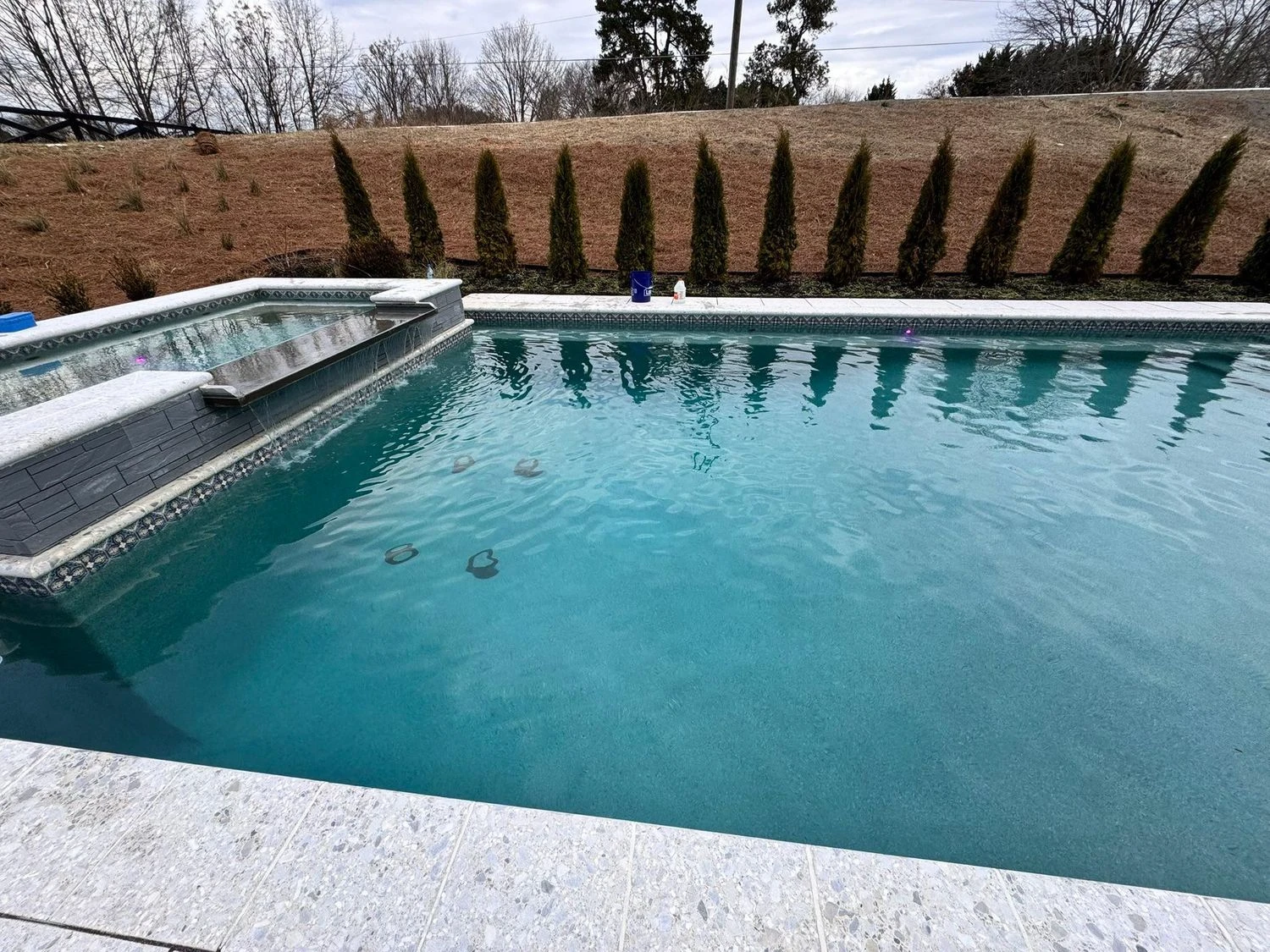
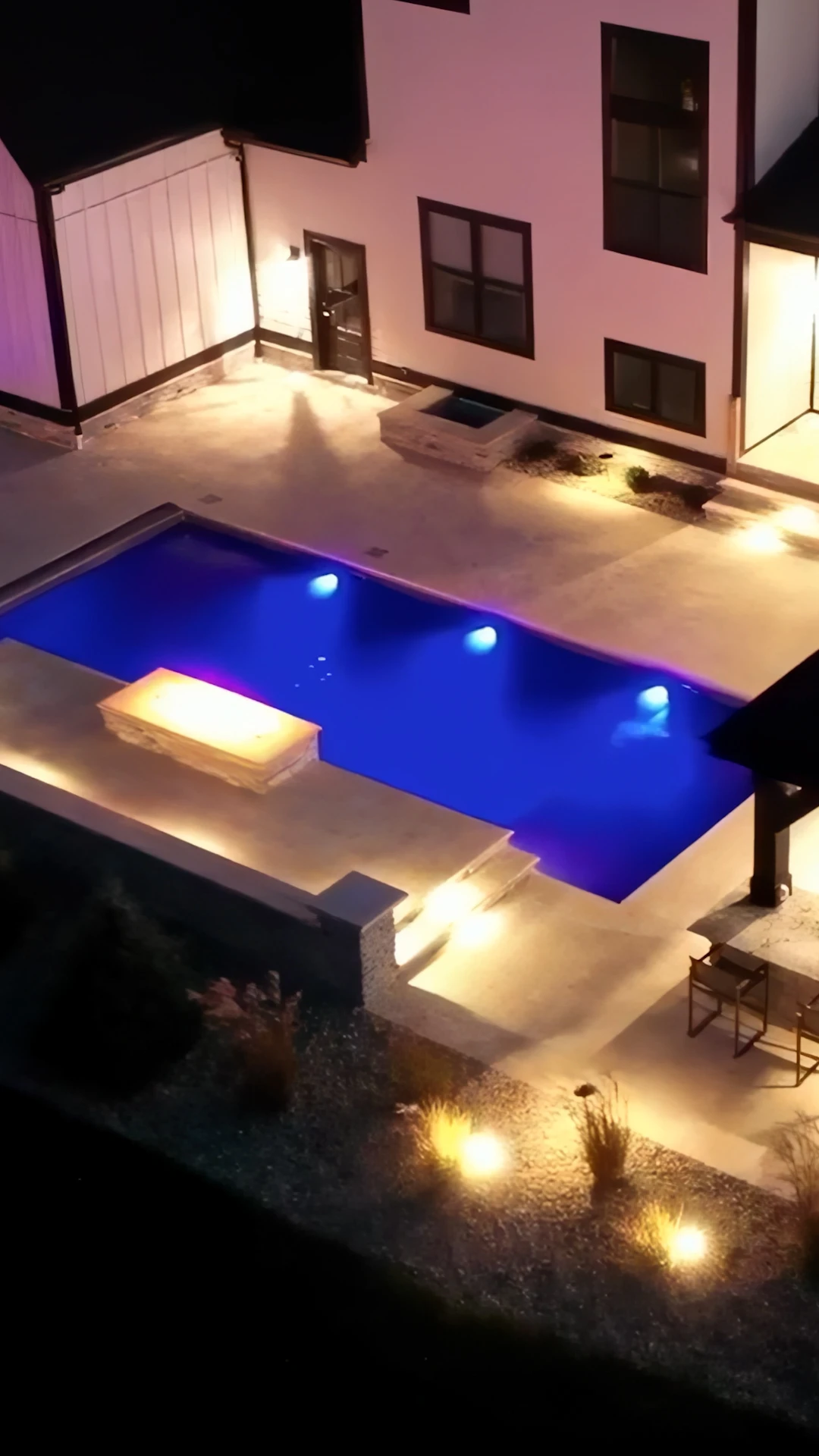
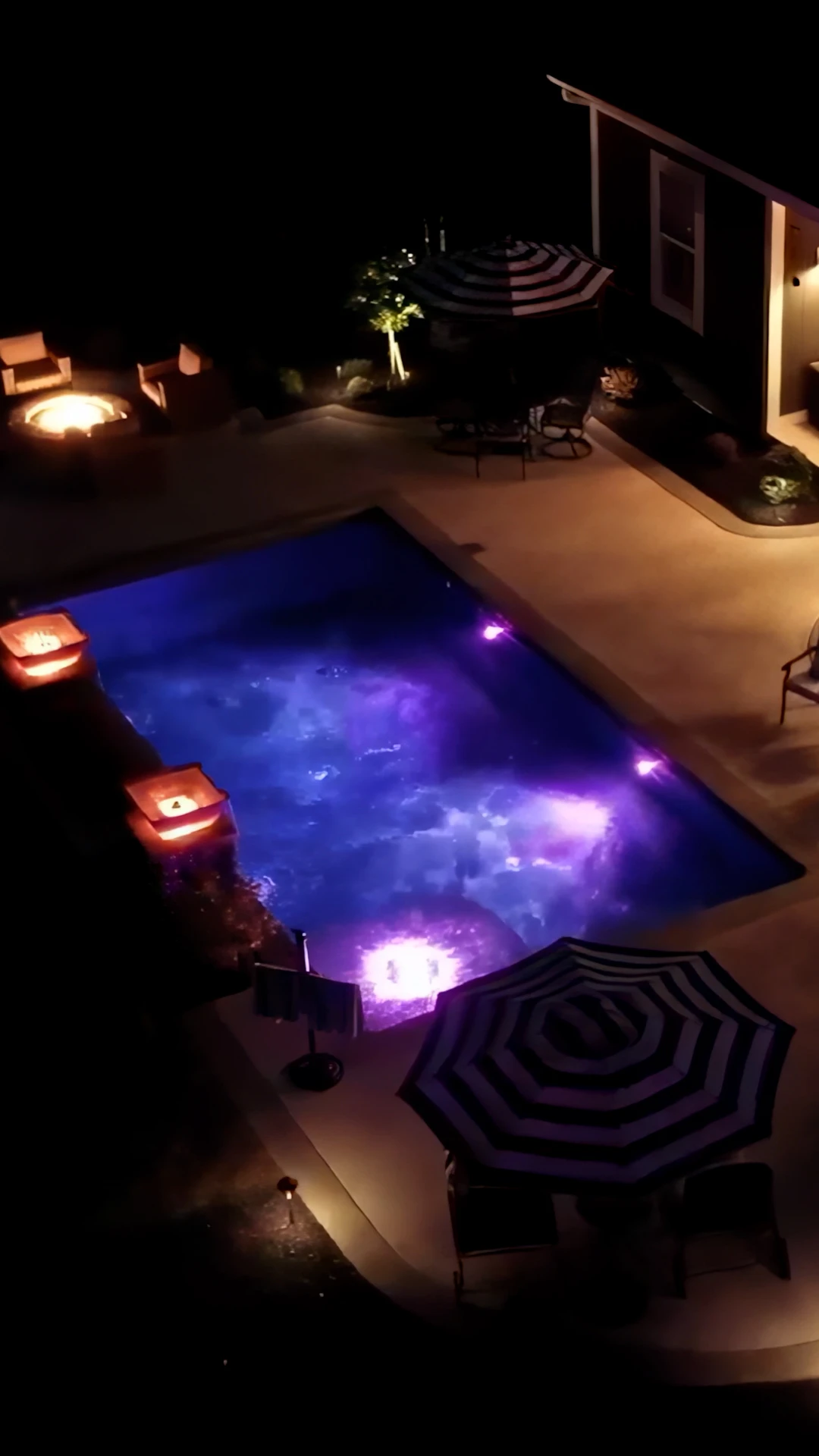
On a 20×40 rectangle with a depth range running 3.5 to 6 feet, most contractors will spec two pool lights on a single long wall and call it compliant. It is. The pool will technically light. But a lake-adjacent backyard at twilight needs pool light that reads continuous from any angle — from the dock, from the pedestal fire bowl 32 feet from the coping, from the primary-bedroom window on the second floor. Two lights leave dark pools in the corners. Four lights — one per quadrant on opposite walls — eliminate the dead zones and let you run the IntelliBrite color modes without breaking the visual.
The 5G generation gives you white light at 4,200 lumens per fixture, five discrete colors, and seven color-wash modes. On this build the homeowner runs the “Caribbean” mode on weekend entertainment nights and pure white from Monday through Thursday. The Lutron keypad handles both without anyone touching the IntelliCenter app.
Pool-light wiring on this project was pulled to a Pentair PLP100 transformer buried in the equipment pad enclosure, with a 240V Sawnee EMC service feed on its own 20-amp breaker per NEC §680. Equipotential bonding across all four niches ties into the pool bond grid at the rebar stage — not something you can retrofit later, which is why the IntelliBrite locations were marked on the shop drawing before the gunite truck pulled up.
The niche-placement rationale is worth unpacking because it affects every color-mode transition the homeowner will ever see. IntelliBrite uses sequential frame cycling across all bulbs on the same zone, which means two lights on the same wall will always be in phase and two lights on opposing walls will be 180 degrees out of phase on any non-steady color mode. On “Party” and “Caribbean” modes specifically, the four-light quadrant layout produces a rotating color wave across the pool surface that reads intentional at dusk. Two lights on the same wall produce a flat fade that reads cheap by comparison. This is why the answer is always four on a 20×40, even when the code minimum allows two.
On depth placement: all four niches sit 18 inches below the static water line, centered vertically on the pool’s long dimension at the three-foot depth point. Higher and the beams cut the waterline and flash guests walking the deck; lower and the light attenuates before it reaches the far wall. Eighteen inches is the industry settled-standard for good reason.
Twenty-Eight Landscape Fixtures, Aimed for the Lake View
A resort-grade landscape package is not about quantity. Twenty-eight fixtures on a 1-acre lot sounds excessive until you map the intended sight lines. The aiming plan broke into four zones:
- Pool-deck frame (8 fixtures) — brass path lights along the travertine coping perimeter at 10-foot spacing, plus two tree uplights on the specimen river birches that anchor the deep end.
- View layer (10 fixtures) — down-aimed tree lights in the crown of three mature oaks between the pool and the lake, creating the silhouette effect against the water. These are the fixtures that make the yard feel like it extends to Lake Lanier instead of stopping at the fence line.
- Dock path (14 bollards) — low-output, 2700K direct-burial bollards along the 180-foot stair-path down to the private dock. No uplight on the path. Just enough downward spill for safe footing at night.
- Architectural grazing (6 fixtures) — narrow-beam uplights on the board-and-batten gable ends of the house, switched on a separate Lutron scene so they can stay off during lake-viewing evenings.
That splits to 28 landscape-proper plus 14 dock bollards — 42 fixtures across the four zones. The Lutron RadioRA 2 lets the homeowner call a “Lake View” scene that kills the architectural grazing, dims the pool-deck frame to 30 percent, and leaves the tree-silhouette layer at 100. A “Guest Arrival” scene does the opposite. A “Late Night” scene drops everything except the dock bollards and a single pool light.
Aiming is where the install earns its labor premium. Each tree uplight gets sighted twice — once at dusk and once at full night — because the lamp beam that looks perfect at 7 p.m. may clip a branch at 10 p.m. when the eye’s adaptation shifts. The aiming crew runs a check list: is the fixture center-beam catching the main trunk? Is there splash onto the underside of the canopy? Is there any cast onto a neighbor’s lot line? We adjust, lock the knuckle with a 1/4-turn set screw, and flag the GPS coordinate of every fixture on the as-built. Three years into the job, when the homeowner wants to add two fixtures or the trees have grown, we open the as-built and know exactly where every transformer tap lives.
One specific fixture choice worth naming: on the tree uplights aimed at the mature oaks, we spec a 35-degree flood beam spread at 5 watts per fixture instead of a narrow 15-degree spot. The flood lights the whole canopy softly; the spot would have hot-spotted a single branch cluster and read theatrical instead of residential. For a private-residence Lake Lanier view, soft wins every time.
The Fire Bowl as the Anchor Point
One pedestal gas fire bowl, sited 32 feet from the pool coping along the sight line to Lake Lanier. It runs on a 3/8-inch buried gas line tapped off the home’s service with an in-line shutoff inside a lockable valve box — permitted through Forsyth County Dept. of Planning & Community Development on a mechanical-only permit, reviewed in roughly nine business days. The cobalt fire glass media reads richer than amber at dusk, and it reads cleaner against the LED-blue pool than clear glass would have.
The fire bowl has a single purpose on a lake-adjacent lot: it gives the evening a foreground. Without it, the eye runs straight from coping to water and the yard feels flat. With it, the guests have something to sit around, something to face, and the rest of the lighting composition has a visual anchor. This is the one fixture on the bid sheet that sells itself every time it is lit.
Lutron RadioRA 2 — Why We Stopped Using Wi-Fi-Only Controllers
Every lighting-control conversation in Cumming starts the same way: “Can’t we just put everything on a Wi-Fi app?” You can. The problem is what happens when the ISP goes down, the router reboots at 2 a.m., or a guest knocks the wrong plug out of the wall. Wi-Fi-only controllers fail visibly. Your backyard goes dark mid-dinner. Nobody forgets that.
The Lutron RadioRA 2 system runs on its own 434 MHz RF mesh, independent of the home network. The Main Repeater sits in the mechanical room, two tabletop keypads plug into the living-room and primary-bedroom outlets, and a five-scene wall keypad mounts at the back patio door. Scenes live in the hardware. The house could lose internet for a week and the lighting still fires on a keypad press. When it does connect back to the internet through the optional Lutron Connect Bridge, the homeowner also gets phone-based control from anywhere — but that is the convenience layer, not the primary interface.
Programming takes about four hours on a typical install. The keypad engravings are ordered from Lutron in the customer’s wording — “Lake View,” “Evening,” “Dinner,” “Late Night,” “Off” — so guests who have never been to the house can figure out which button to press without coaching.
The scene-integration piece with Pentair IntelliCenter is what ties the whole package together. Standard Lutron installers will hand off at the keypad. A proper resort-lighting integrator writes the Pentair JSON command strings into the Lutron scene engine so that pressing “Lake View” also runs the IntelliBrite color-set command on the pool controller, turns the scupper pump off for a quiet surface, and signals the Jandy valve on the spa to close. Four pieces of equipment respond to one button press. That is the finished-experience deliverable. Without that integration, the homeowner ends up with three apps on the phone and two keypads on the wall that fight each other. We sell against that outcome on every scope.
Sawnee EMC service sizing: The added lighting load is small — under 400 watts — but the 240V pool equipment service and the EV charger this homeowner added in the same year pushed the panel to 300-amp service. Sawnee turnaround on a service upgrade in Forsyth County was six weeks from application to meter set. Plan ahead if your bid overlaps with an EV build.
Permit and HOA Realities in Cumming
On a project of this scale in Forsyth County, you will handle two review tracks simultaneously. The first is the county itself — Forsyth County Dept. of Planning & Community Development at 110 E. Main St., Cumming — which reviews the electrical permit on the pool-lighting transformer feed and the mechanical permit on the gas fire bowl. Average review time on our builds across the past 18 months runs eight to eleven business days.
The second is the HOA architectural review board if your home sits in one of the luxury subdivisions — St. Marlo, Polo Fields, Hampton Park, Vickery, Windermere, The Collection at Forsyth. These boards typically turn around pool-plan submittals in two to three weeks and usually want a lighting exhibit showing fixture types, aiming directions, and how the backyard lighting reads from the street. The boards that protect property values the hardest are the ones that ask for that exhibit early. Expect it.
One detail worth knowing: several Forsyth HOAs now explicitly require Dark Sky-compliant fixtures on lake-adjacent lots. All FX Luminaire brass path and downlight fixtures we spec for Lake Lanier builds meet the standard. Cheaper imported fixtures often do not, which is how a homeowner gets halfway through installation before the ARB sends a letter.
The submittal packet we hand to the ARB on every Cumming lighting job has five components: an aerial site plan with fixture locations marked, a manufacturer cut-sheet for each fixture family specified, a wattage-and-lumen summary table, a color-temperature callout (2700K on this build), and a one-page aiming exhibit showing the intended sight-line impact. Boards that see that packet on day one approve in a single meeting. Boards that see a single site plan with 28 dots on it come back with four rounds of questions and a six-week delay. Packet construction costs us four hours of drafting time. It saves the homeowner six weeks. Every time.
The builder’s license and insurance side is less interesting but has to be right. Pool construction in Forsyth County requires a Georgia-licensed swimming pool contractor, which Primetime carries. Landscape lighting specifically does not require the state electrical license if it runs at 12V low-voltage through a UL-listed transformer — but the transformer feed to the 120V side does, and every Lake Lanier build we finish gets signed off by our in-house Class II electrician. Homeowners should ask for the license number in writing before the first trench is cut.
Resort-grade pool and landscape lighting across 20+ cities within 30 miles of Winder, GA
Every lake-adjacent build we scope in Cumming starts with the view, not the fixture list. Spec the aiming plan first, the controller second, the fixtures third — and the bid writes itself.