
Forsyth County approves more than 200 residential pool permits a year, and roughly one in three of the upper-bracket builds we see now come back for a lighting retrofit within 18 months of plaster. That’s not a design flaw — it’s what happens when a daytime drawing gets sold without a night-mode plan.
The reason is simple. A buyer in Vickery, Hampton Golf Village, or along the Browns Bridge corridor walks a yard in daylight, signs a pool contract, and only later realizes the backyard is black after 9 p.m. nine months of the year. The fix is to plan lighting as a line-item system at contract — not as a last-minute upgrade after the deck pour.
This post is a plain-English breakdown of the three tiers we actually quote in Forsyth County: a $14,000 foundation package, a $22,000 mid package, and a $28,000 resort-grade package. Every line item is real, every fixture count is what we actually deploy, and the appraisal uplift numbers come from recent comps pulled along GA-400 between exits 13 and 18.
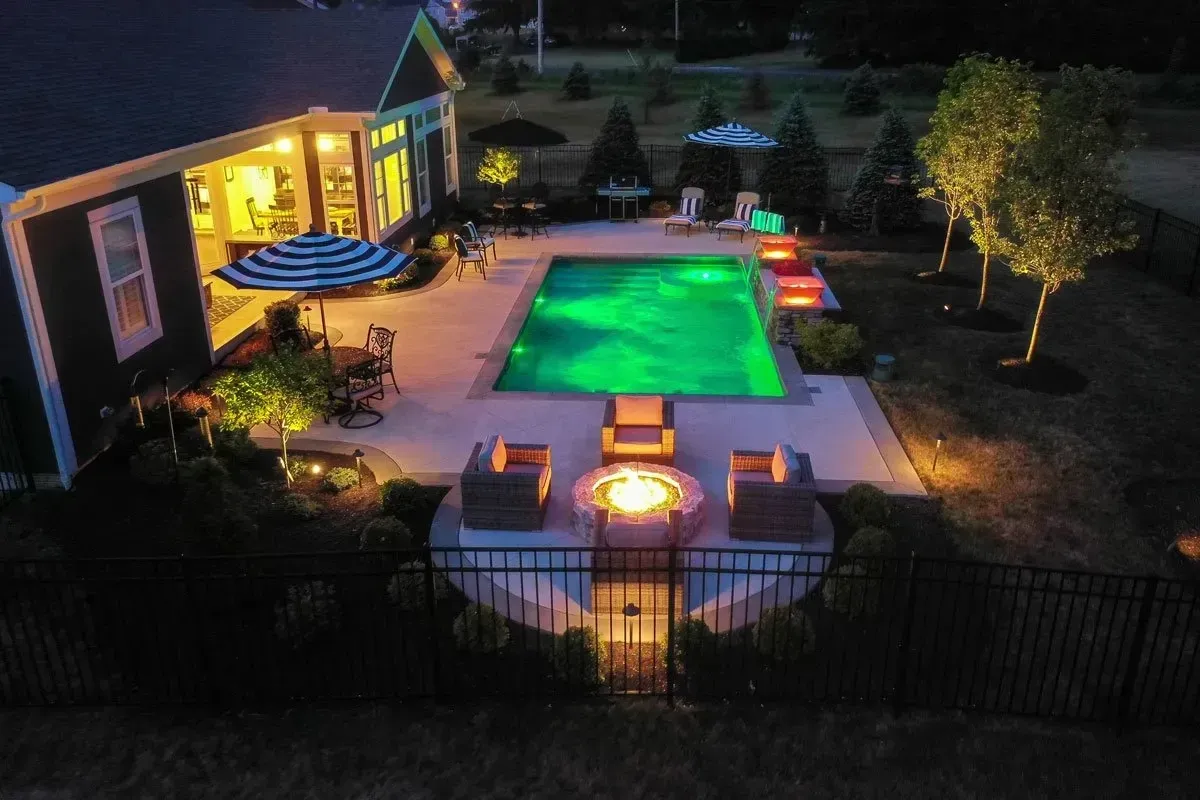
Why Forsyth County is a Lighting Market, Not a Pool Market
Forsyth County has 260,000 residents across 247 square miles and has been the fastest-growing county in Georgia for the past decade. The average new-construction estate — Cumming, Coal Mountain, Shady Grove, Bethelview — sits on a 1/3 to 5-acre lot with serious grade, mature pines, and a neighborhood HOA that regulates exterior fixture color temperature.
That combination — big lots, heavy tree cover, strict HOA fixture rules, and a county permit office approving 200+ pools a year — is exactly why lighting has to be engineered into the build, not bolted on. A pool you can’t see after dark is a pool you use three months a year. A pool with properly tuned 2700K landscape uplighting and color-sync pool LEDs is a pool you use ten.
We build across all three ZIPs — 30028 north, 30040 Cumming, 30041 south — and the lighting packages scale cleanly across them. The tier you choose is driven by lot size, tree count, and whether the plan includes fire or water features. Not by taste.
Forsyth County permit reality: Sawnee EMC is the utility. Low-voltage landscape lighting (12V transformer-fed) does not require a separate electrical permit in Forsyth, but the 120V transformer itself must land on a dedicated GFCI circuit tied to the pool equipment pad subpanel. Plan this at rough, not after plaster.
Tier 1 — The $14,000 Foundation Package
The $14K tier is the floor. It’s what we install on a standard 16×32 or 18×36 rectangle build in a south Forsyth subdivision where the lot is roughly 1/3 acre, the tree cover is moderate, and the client wants the pool to look good at night without chasing a magazine spread. It does three jobs: it lights the water, it lights the walkways, and it keeps the client out of the dark.
Here’s the line-item breakdown we actually quote:
- 4 pool LED fixtures — Pentair IntelliBrite 5G color-changing LEDs, 12V, installed one at each end wall on a 16×32 and one on each long wall on an 18×36. Run time ~50,000 hours.
- 12 landscape uplights — brass MR16 bullet fixtures, 2700K warm-white, 20-degree beam on tree uplights and 35-degree beam on shrub washes. Run from a single 300-watt transformer on the equipment pad.
- 1 transformer and homerun — 300W multi-tap with 12V, 13V, 14V, and 15V taps to compensate for voltage drop on the long runs typical of a 1/3-acre Forsyth lot.
- Basic timeclock/photocell control — astronomic timer, dusk-to-11 p.m. schedule, no app.
- Wire, junction boxes, trenching, startup, and programming.
This gets you a backyard that reads clearly at night and a pool that cycles through blue, teal, green, red, magenta, and white on a fixed 15-minute color loop. It does not get you smart control, fire integration, or perimeter security. For the typical Ducktown or Shiloh subdivision buyer, that’s the right floor.
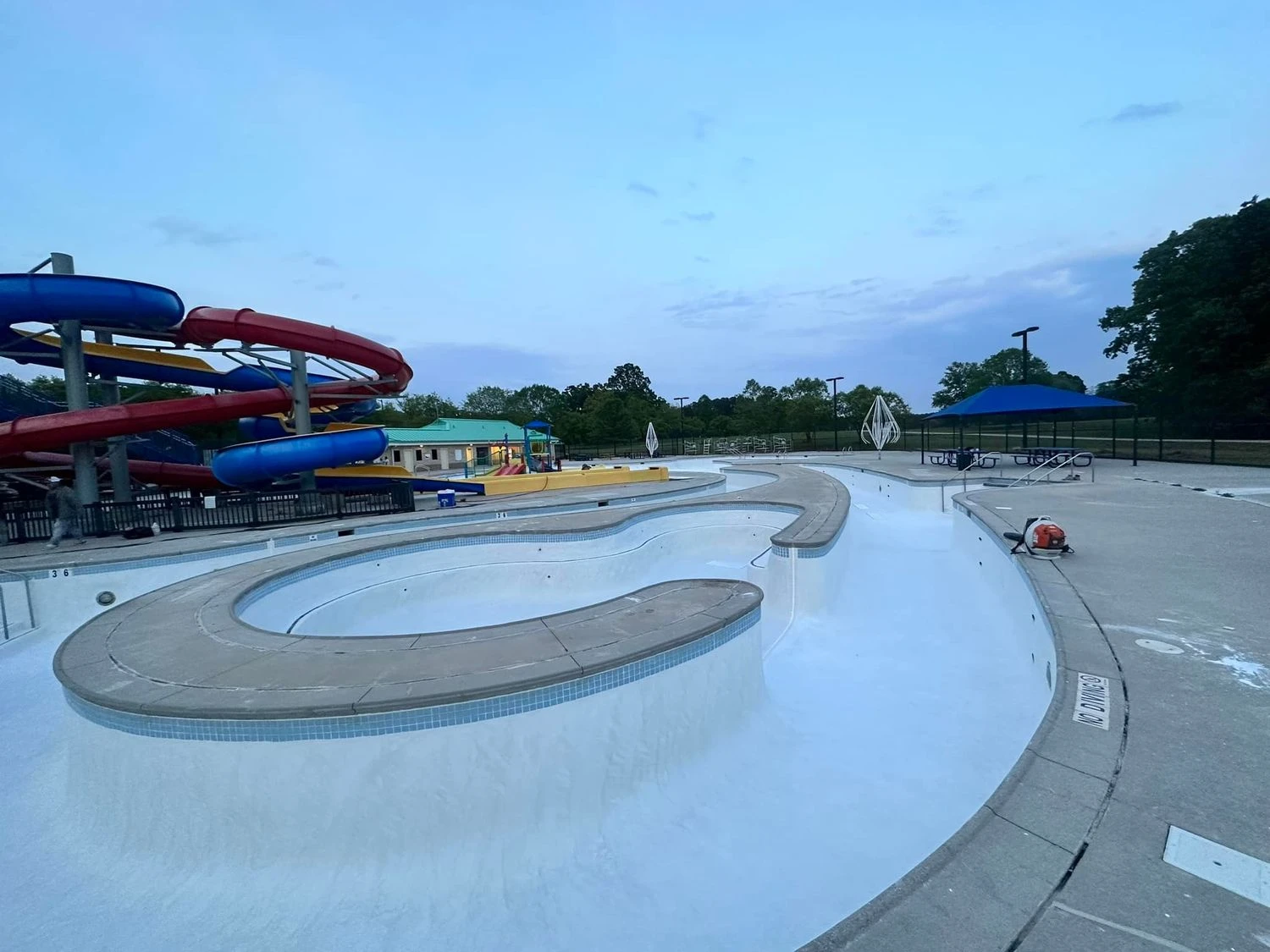
Tier 2 — The $22,000 Mid Package with Smart Control and Tree Uplighting
The $22K tier is where most of our Forsyth clients land. It’s built for the 1/2-acre to 1-acre lots in places like Vickery, The Manor, Hampton Golf Village, and along Post Road where mature hardwoods and a longer walkway demand a serious uplight count and the client expects to run the system from their phone.
It keeps everything in Tier 1 and adds five things: a bigger landscape count, path lights, tree uplighting at height, smart control, and a full scene-programming session.
- Everything in Tier 1 — 4 pool LEDs and the 12 baseline landscape uplights.
- + 10 additional landscape accent fixtures — architectural wash on the home’s front and rear elevations, column-wash lights on any stone piers, and planter-bed downlights.
- + 6 path lights — solid brass, 2700K, spaced on 8-foot centers along the primary walkway from house to pool deck.
- + 4 high-output tree uplights — 10-watt LED MR16, narrow 12-degree beam, aimed at the canopy of mature oaks or tall pines. This is the single biggest upgrade on a treed Forsyth lot — it transforms ambient light in the yard.
- Smart control — Pentair IntelliCenter for the pool lights integrated with a Lutron RadioRA3 or FX Luminaire Luxor controller for the landscape side, all accessible from a single phone app.
- Upsized transformer — 600W multi-tap, or a pair of 300W units, depending on lot geometry.
- Scene programming session — four preset scenes: “Dinner,” “Swim,” “Party,” “Security.” Each preset fires a different combination of pool color, landscape zones, and path lights.
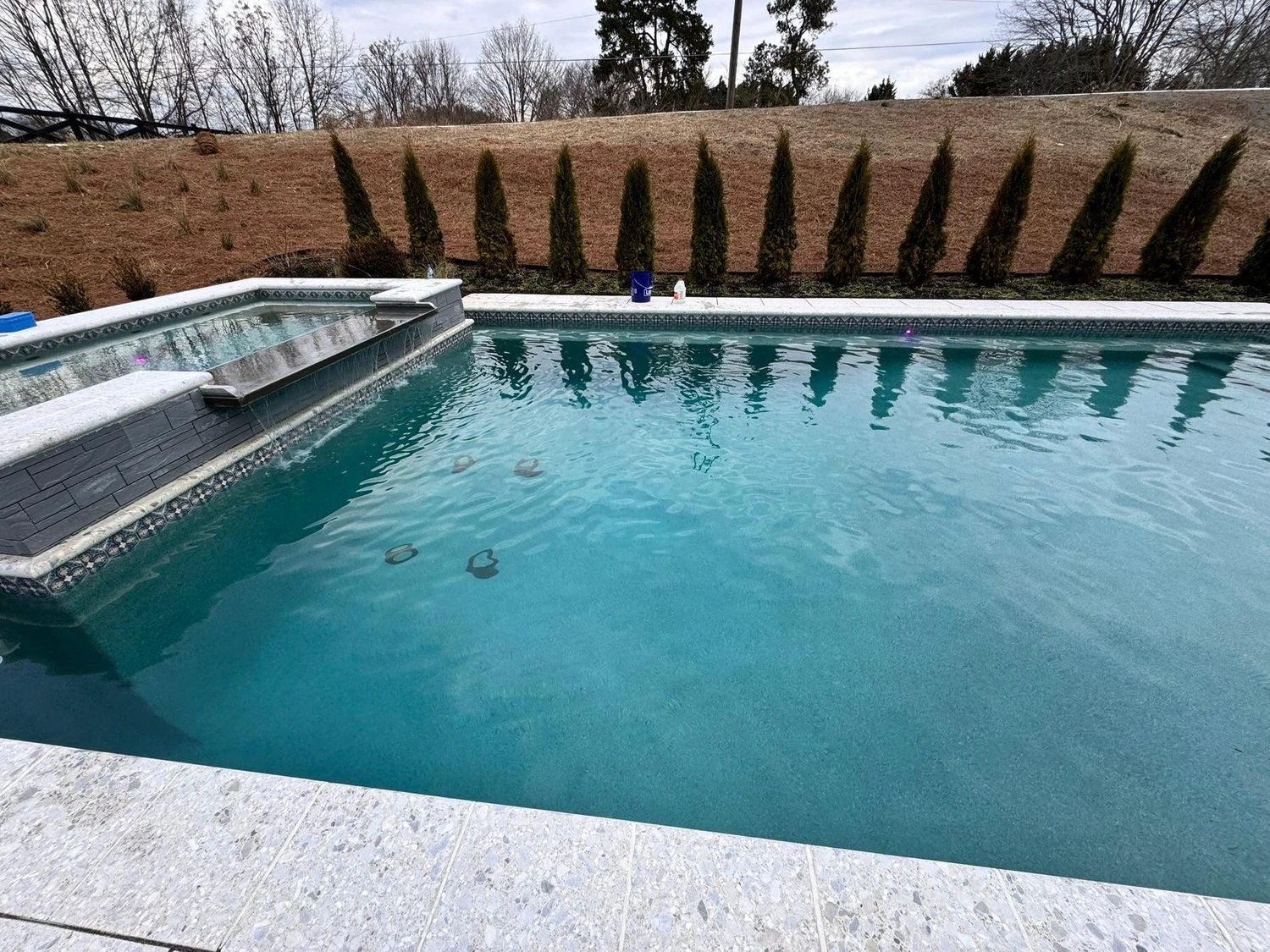
Tier 3 — The $28,000 Resort-Grade Package with Fire and Security Integration
The $28K tier is a full resort-grade lighting design. It shows up on our north Forsyth estate builds — the 3 to 5-acre lots off Kelly Mill Road, the Lake Lanier south-shore properties between Browns Bridge and Shoal Creek, and the Sawnee Mountain ridgeline cuts where the client is building a second-generation home with a full outdoor program.
It keeps everything in Tier 2 and adds four major categories: gas-fire integration, water-feature accent lighting, security-grade perimeter lighting, and a hardware-level upgrade to commercial-rated fixtures that hold calibration for a decade.
What Tier 3 adds on top of Tier 2
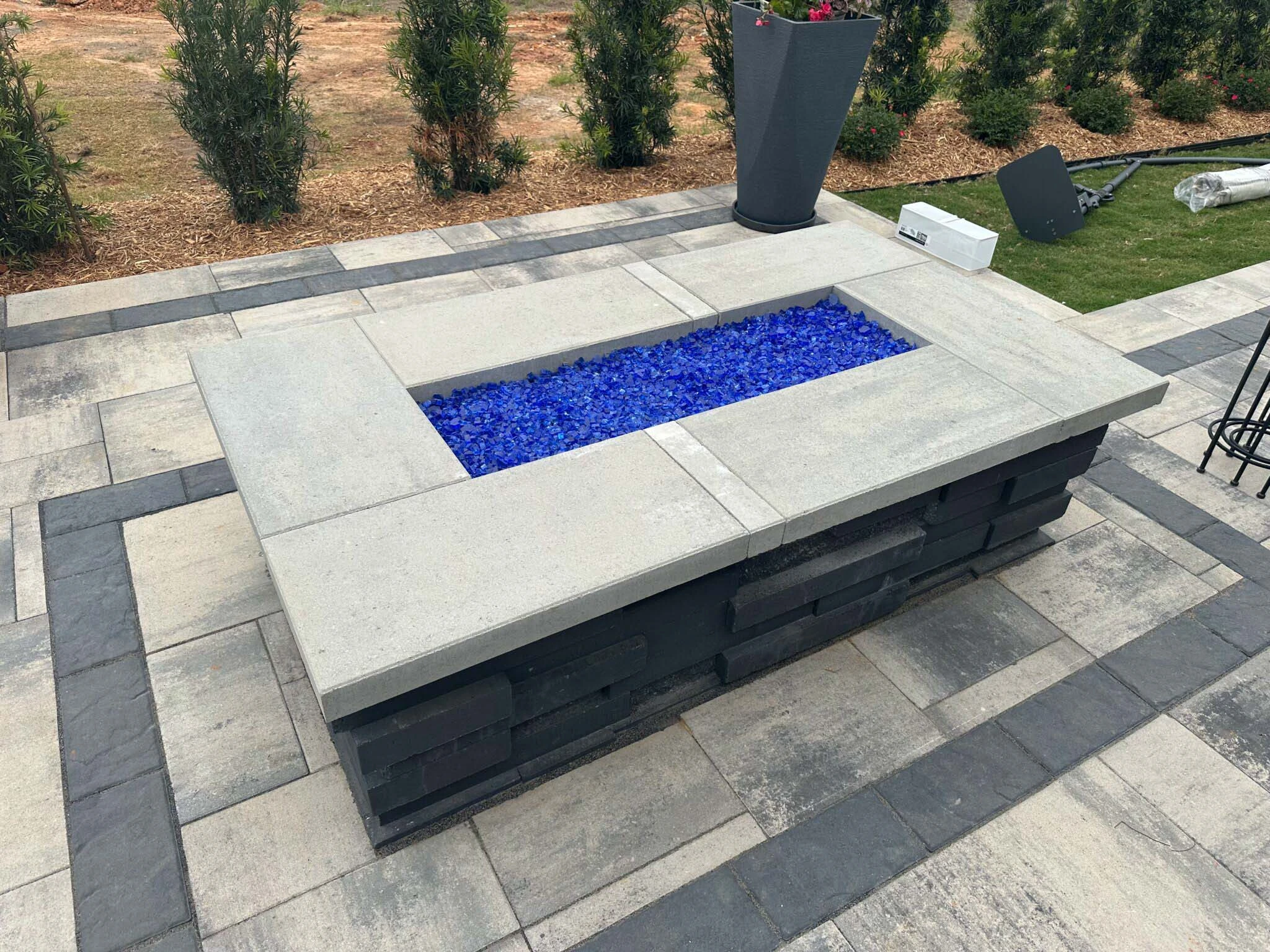
- Gas-fire integration — fire bowls, fire tables, and linear fire troughs tied into the same IntelliCenter schedule as the pool lights. The scene fires the pool color and lights the gas burner in one tap. Safety interlock requires a 24-hour manual bleed-off relay per Forsyth County gas code.
- Water-feature accent lighting — dedicated LED puck lights under scuppers, sheer-descent weirs, bubbler jets, and deck-jet runs. These run independent of the pool interior lights so the sheet water reads as a separate luminous element.
- Security-grade perimeter lighting — dusk-to-dawn 3000K downlights on every property-line corner, motion-sensor floods on the equipment pad and side yards, and a dedicated driveway-approach scene.
- Commercial-rated fixtures — FX Luminaire TM-18 brass bullets or Kichler Design Pro LED series, 20-year fixture warranty, IP66 rating. This is the spec that survives a decade of Lake Lanier humidity and Forsyth winter freeze cycles.
- Commissioning visit — a post-install evening with the client to program six custom scenes, rebalance any hotspots, and train on the app.
The fire-integration line item alone: wiring a pair of gas fire bowls and one linear trough into a scene-synced controller runs $3,800 to $5,200 on the labor side, plus the fire hardware itself. It’s the single biggest jump between Tier 2 and Tier 3.
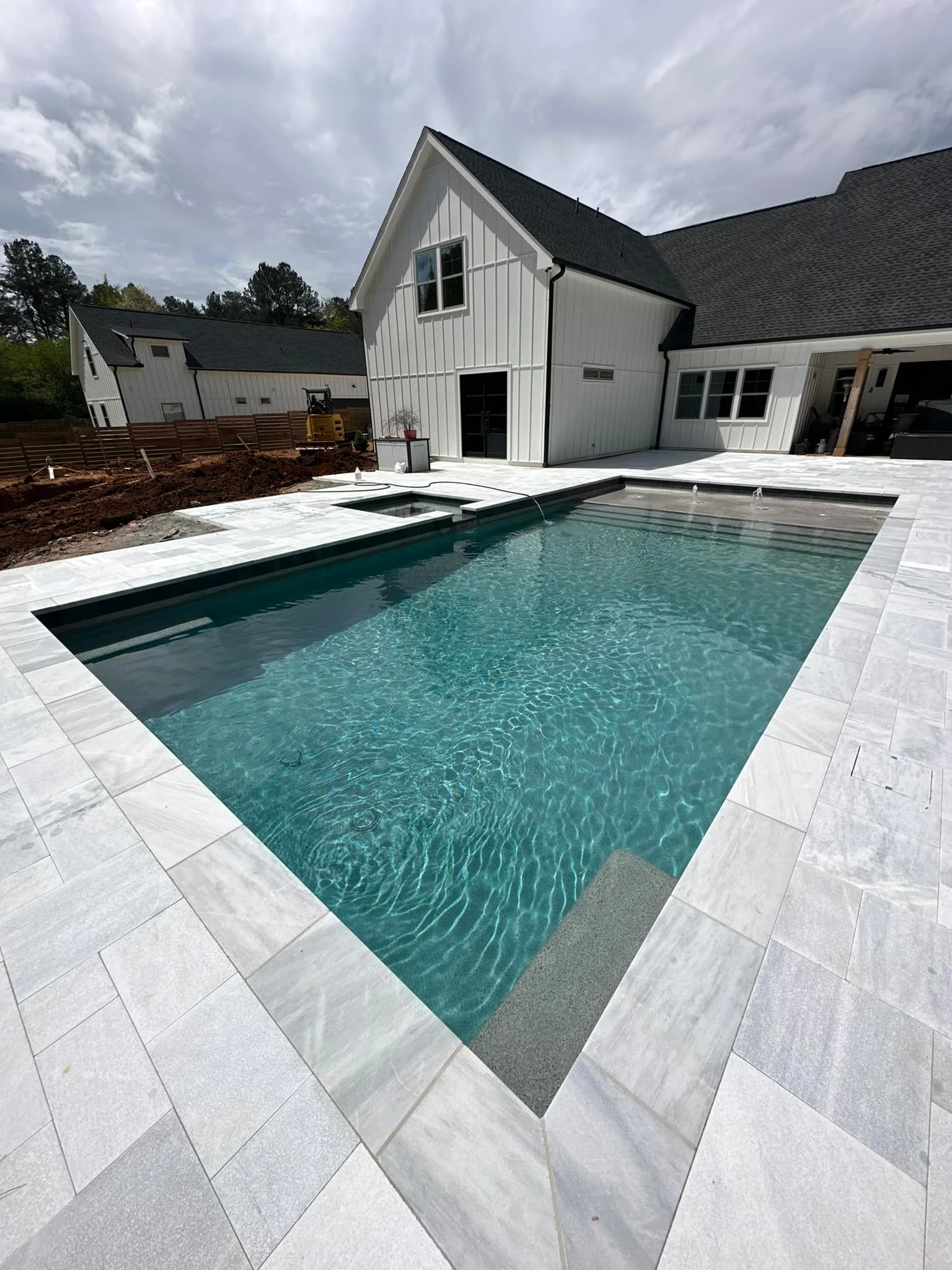
Fixture Counts by Lot Size — The Rule of Thumb We Use
The tier numbers assume lots in a predictable size band. On the outlier lots — the 5-acre Coal Mountain cuts, the narrow lakefront strips on Lanier, the tight townhome pools in south Forsyth — we adjust fixture counts per zone. Rough rule:
- 1/4 to 1/3 acre: 10–14 landscape fixtures is plenty. More is glare.
- 1/3 to 1/2 acre: 18–24 fixtures. This is Forsyth’s sweet spot.
- 1/2 to 1 acre: 28–36 fixtures with at least two transformers and two control zones.
- 1 to 5 acres: 40+ fixtures, three or four transformers, a full scene matrix, and usually a separate driveway-approach zone.
Pool LED count follows a different rule: one fixture per 150 square feet of water surface, minimum two per pool. A 16×32 rectangle = 512 sq ft = 4 fixtures. An 18×40 with a tanning ledge = 720+ sq ft = 5 fixtures. On freeform lagoon shapes with cove cutouts we’ll sometimes bump to 6 because the uneven shape creates shadow pockets.
What the Forsyth Soil and Climate Do to a Lighting System
Forsyth County sits in USDA Zone 8a and sees about 22 hard freeze events a year. Most of the county is Cecil-series Piedmont clay with the rockier Madison variant showing up as you climb toward Sawnee Mountain and Coal Mountain. That matters for lighting in three concrete ways.
Clay soil moves. It expands when wet and contracts when dry, and it does it hard. A landscape fixture set on a bare metal stake will tilt three degrees a year and end up washing the wrong target after 24 months. The fix is a poured concrete puck at the fixture base on any long-run uplight, or a locking ground spike rated for clay soil.
Freeze events crack cheap transformers. The 22 annual freezes Forsyth sees aren’t brutal, but they’re repeated. A stainless-steel enclosure rated for outdoor use is non-negotiable on the transformer — a painted steel box from a big-box retailer will rust through in four years. We specify stainless or powder-coated aluminum only.
Lake Lanier moisture accelerates corrosion on the south-shore properties. If the install is in the lakefront belt — the south edge of the county where Forsyth meets the water — we upgrade all exterior-facing fixtures to solid brass or marine-grade 316 stainless, no exceptions. Aluminum will pit inside two seasons.
ROI — What Resort-Grade Lighting Adds to a Forsyth County Appraisal
This is the number clients ask about first and we usually answer last, because it depends on the lot, the comp set, and how the listing agent presents the package. That said, based on recent closed-sale comps in Forsyth County over the past 18 months, here’s the defensible range we give clients:
- Tier 1 ($14K install) — appraisal add of $18,000 to $22,000. Net uplift above cost: $4K–$8K.
- Tier 2 ($22K install) — appraisal add of $24,000 to $28,000. Net uplift above cost: $2K–$6K. The smart-control story is what closes buyers.
- Tier 3 ($28K install) — appraisal add of $28,000 to $32,000. Net uplift above cost: break-even to $4K. The real return is 8–10 years of enjoyment, not the resale math.
The honest read: Tier 1 pays itself back on the appraisal, Tier 2 roughly pays itself back, and Tier 3 is a lifestyle purchase that holds its value but doesn’t hand you a windfall at closing. Nobody should install Tier 3 as an investment play. It’s for the people who live in the house.
Forsyth County Schools factor: Lighting packages hold appraisal value better in Forsyth than in most metro Atlanta counties because the school district is consistently top-ranked in Georgia and the buyer pool skews toward long-hold family purchasers who actually use a backyard. Light it for them.
What We’ve Learned from 40+ Forsyth County Lighting Retrofits
Most of the lighting work we do in Forsyth isn’t new construction — it’s retrofit on pools we built three to six years ago, or pools another builder left bare. A handful of patterns hold up across every retrofit we’ve touched:
Clients underestimate path lighting by 60%. Every retrofit client has said the same thing: “I wish I’d put more path lights in.” The fix at new-build time is to spec path lights on 8-foot centers, not 12-foot centers. It costs about $180 per extra fixture installed at rough and you never hear a complaint.
The HOA fight is almost always about color temperature, not fixture count. Forsyth has HOA density approaching 90% in the newer subdivisions. Every ACC requires 2700K or warmer. Spec 2700K across the entire package and your HOA approval goes from a three-month battle to a one-week formality. Never spec 3000K or 3500K on a front-yard-visible fixture.
Smart control gets used or it doesn’t — plan for both. Roughly half our Tier 2 and Tier 3 clients use the app daily. The other half find their four preset scenes in the first month, pick a favorite, and never open the app again. That’s fine — but the scene programming has to happen on install day with the client in the yard, or the system defaults to whatever the installer saved and the client ignores it.
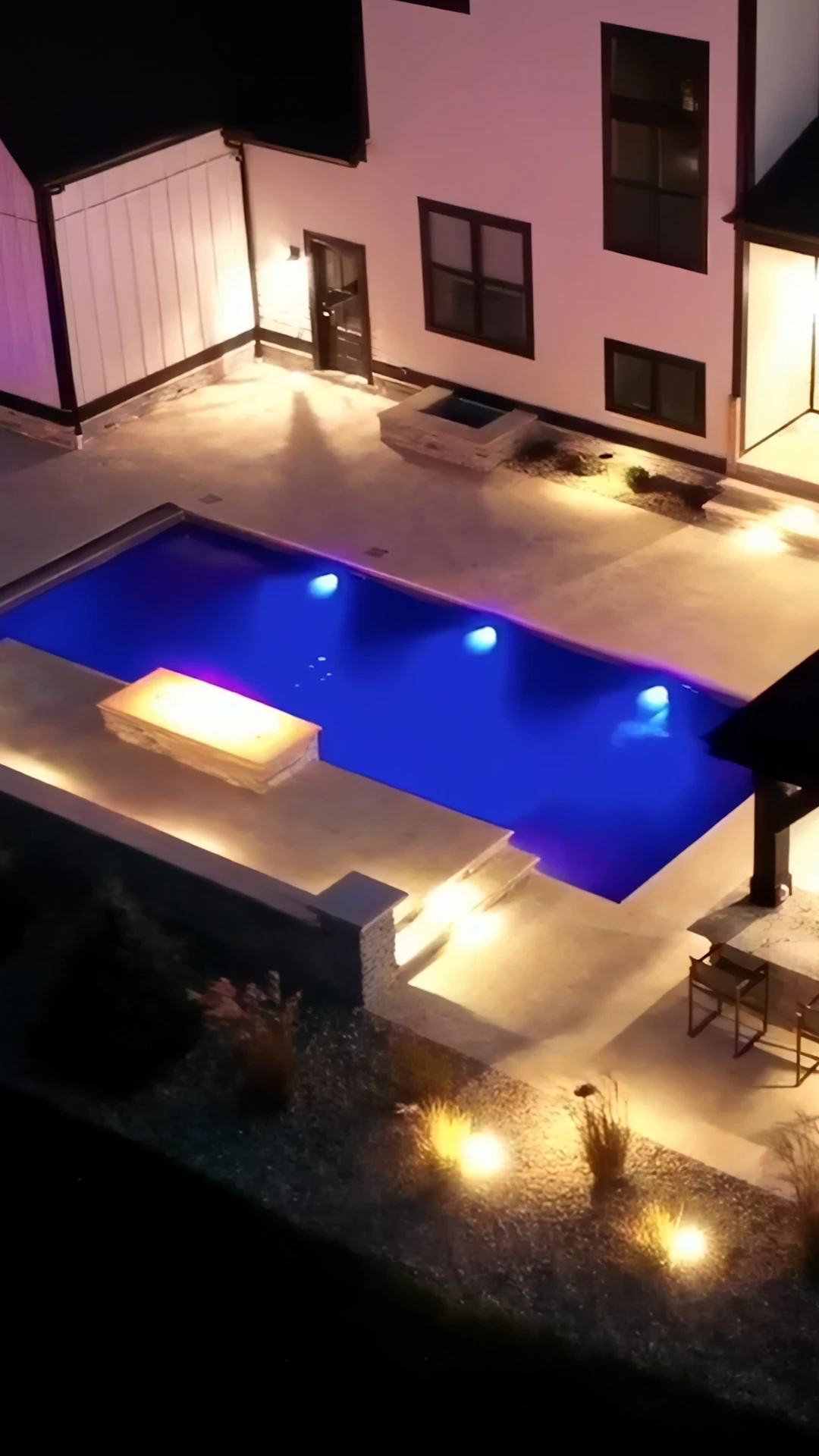
Water-feature lighting is the single most-photographed element. The posts our Forsyth clients tag us in are almost always a scupper bowl or sheer descent lit with a color-change LED, shot at dusk. If budget is tight and the pool has water features, spend the water-feature line item and cut elsewhere.
How We Actually Build One — Scope, Sequence, Schedule
The lighting package runs in parallel with the pool build, not after. On a standard Forsyth County project the sequence is:
- Pre-excavation design walk — we walk the yard at dusk with the client, mark the tree uplights and path runs in flag paint, and set the transformer location at the pool equipment pad.
- Rough trench at dig — while the pool is being dug, the landscape trencher lays the 12V wire loops and the 120V homerun from the transformer back to the subpanel. This is the cheapest window to trench — every foot of wire costs 70% less during pool excavation than after deck pour.
- Junction boxes set pre-deck — we set all waterproof J-boxes before the deck pour so no fixtures ever sit on stakes in the middle of a finished patio.
- Pool LEDs installed at plaster prep — the niches and conduit are roughed at gunite; fixtures land at plaster prep so they’re never scratched during finishing.
- Fixtures set at landscape install — 48 hours after deck pour, crew walks the yard with the client at dusk and aims every fixture live with the transformer running.
- Scene programming night — the last visit, between dusk and 10 p.m., with the client on-site. This is the visit that makes the system actually get used.
The entire lighting scope adds 3 to 5 days to the pool build on a Tier 2 package, and 5 to 8 days on a Tier 3 package with fire integration. On a typical 14-week Forsyth pool build, that’s absorbed into the finish schedule with no extension to the deliverable date.
What It Costs to Skip a Tier — And What We Tell Clients to Cut First
Not every Forsyth client can swing Tier 2 or Tier 3 at build time. What we tell them is this: install the Tier 1 infrastructure now — transformer, conduit, J-boxes, and homerun — even if the fixture count is light. Adding fixtures to an existing wire loop is a $120-per-fixture proposition. Retrenching a buried wire loop after deck pour is a $2,400+ proposition.
The expensive mistakes we see from other builders’ jobs in Forsyth, in descending order of cost to fix:
- No transformer conduit at rough. Fix cost after plaster: $3,800–$6,200. This is the $6K mistake.
- Pool LED niches not set at gunite. Fix cost: $4,500+ per niche because it’s a wall-saw cut.
- Landscape wire loop sized for 10 fixtures when client wants 20. Fix cost: $1,800–$2,400 to retrench.
- Transformer on house wall, not equipment pad. Fix cost: $600–$1,200 plus a code-violation callback.
- 3000K instead of 2700K on front-yard fixtures. Fix cost: $40 per lamp but about eight weeks of HOA back-and-forth.
If budget forces a cut, the right order to cut is: reduce landscape fixture count before reducing pool LED count, skip the security-perimeter zone before skipping smart control, and never skip the transformer upsize. A 300W transformer in a yard that needs 600W is a brownout waiting to happen on the coldest Forsyth January night of the year.
Resort-grade pool and landscape lighting across 20+ cities within 30 miles of Winder, GA
From a 16×32 rectangle in a Cumming subdivision to a 5-acre Coal Mountain estate on Lake Lanier, we scope the lighting package at contract — not after the deck pours.