
The homeowner met me in the driveway off Lower Roswell Road with a folder in one hand and a pool brush in the other. “We have been staring at this 1987 rectangular gunite pool for nine summers,” she said. “We do not want a new liner. We do not want new plaster. We want a different pool in the same hole.” That sentence set the scope for a $84,000 reshape and, honestly, one of the most satisfying pool remodels we finished all year in Indian Hills.
This piece walks through the entire project — what we broke out, what we rebuilt, why Marietta’s permit office treated it as new construction, and where the dollars went. If you own an older rectangular pool in East Cobb and keep getting quoted only for resurfacing, this is the scope tier nobody quotes you until you ask. We serve Marietta, the Atlanta Country Club corridor, Burnt Hickory, Walton Woods, and the rest of the 30062–30068 ZIP footprint out of our Winder shop.
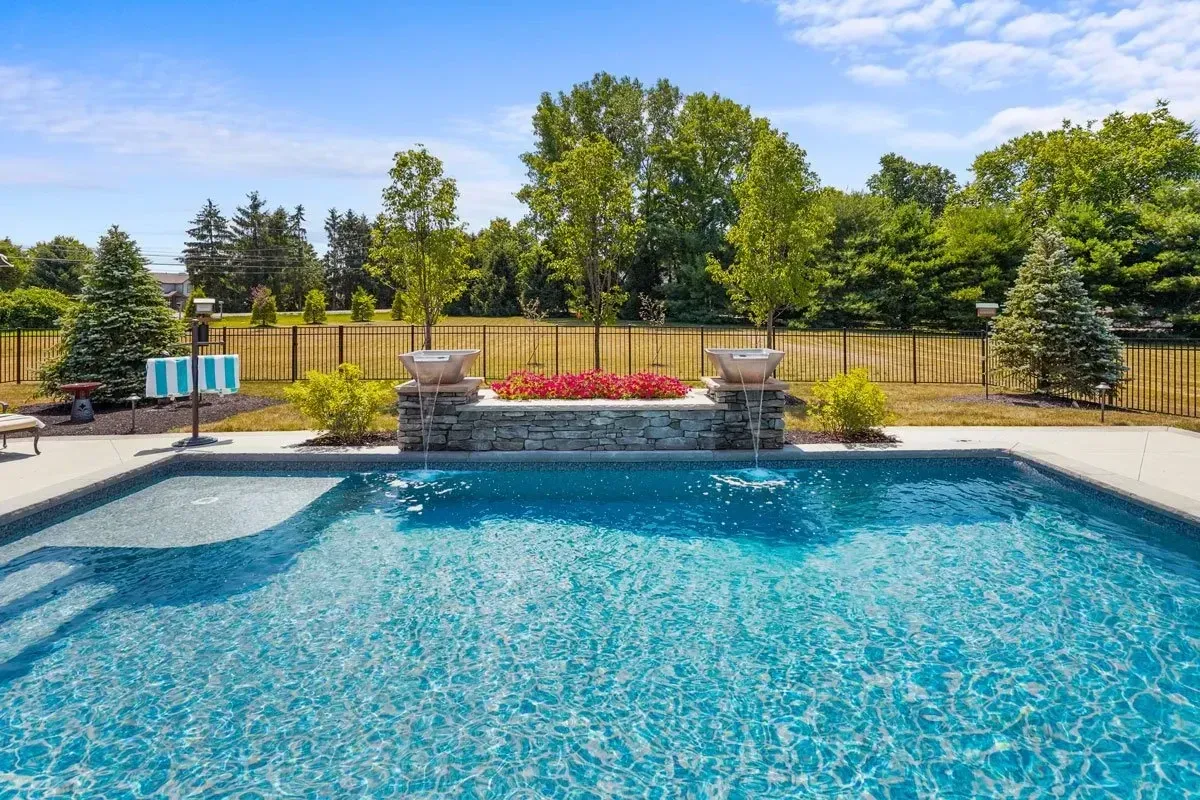
The day we walked the pool and decided to break out 40% of the shell
On the first visit we did what we always do on an older Cobb County pool: walked the perimeter, tapped the bond beam with a rubber mallet every twelve feet, pulled the skimmer baskets, and asked three questions. How do you use the pool? What do you wish it did that it does not? What stops you from loving it?
Their answers were specific. They used it for wine-not-volleyball entertaining and reading with a toddler and a chocolate lab who refused to swim past her shoulders. The diving well was useless to them. The straight shotgun-rectangle shape meant the only “hang out” spot was a set of step corners too small for two adults. The broom-finish deck had three cracks running from the skimmer to the grass on the north side — classic East Cobb Piedmont clay movement.
We priced three tiers. Tier one was a cosmetic resurface: quartz plaster, new waterline, new LED niche, about $22,000 to $28,000. Tier two was resurface plus a bolt-on sun shelf, $38,000 to $46,000. Tier three — the one they picked — was a true shell reshape: break out the entire shallow end and south long wall, rebuild as a freeform with an integrated 10-foot tanning ledge and radiused step bench, eliminate the diving well, pour a new travertine deck.
Tier three came in at $84,000. Their cosmetic-only number would have been $26,500. They paid 3.2x the price and got a pool they will actually use every weekend for the next twenty years. Their neighbor three doors down has since asked us to quote the same reshape on a pool from the same subdivision.
When a reshape beats a resurface: If the pool’s shape is the problem — wrong depth curve, no shallow lounging zone, diving well nobody uses, corners you wish were curves — no amount of new plaster fixes it. The shell is the product. Plaster is just paint. If you plan to stay in the home seven years or longer, reshape math beats resurface math every time.
Why the Cobb County permit office treats a 40% reshape as a new pool
The first conversation I had at Cobb County Community Development at 1150 Powder Springs Street was polite and very short. “If you are removing more than thirty percent of the shell,” the plans reviewer said, “we treat it as new construction. Full plan review. Full structural stamp. Full pool barrier compliance to current code.” That is not unusual — it is actually the rule in every Metro Atlanta county I work in — but it matters because the 1987 pool was grandfathered into absolutely none of the current safety code.
Current Cobb pool-barrier rules require a 48-inch perimeter fence with self-closing, self-latching gates, no horizontal climbing rails pool-side, and a 4-inch max gap under the fence. The 1987 fence was 42 inches with horizontal 2×4 rails and a gate that did not self-close. Budgeted $7,400 for a new 48-inch black aluminum pool fence.
The electrical was worse. Current NEC §680 requires a 3-foot equipotential bonding grid and a #8 solid copper bonding loop tied to all metal within 5 feet of water. We pulled a new Cobb EMC 240V service drop — not Georgia Power, which matters because Cobb EMC’s service-connection paperwork flows through a different office and adds two weeks to the schedule if you do not file early.
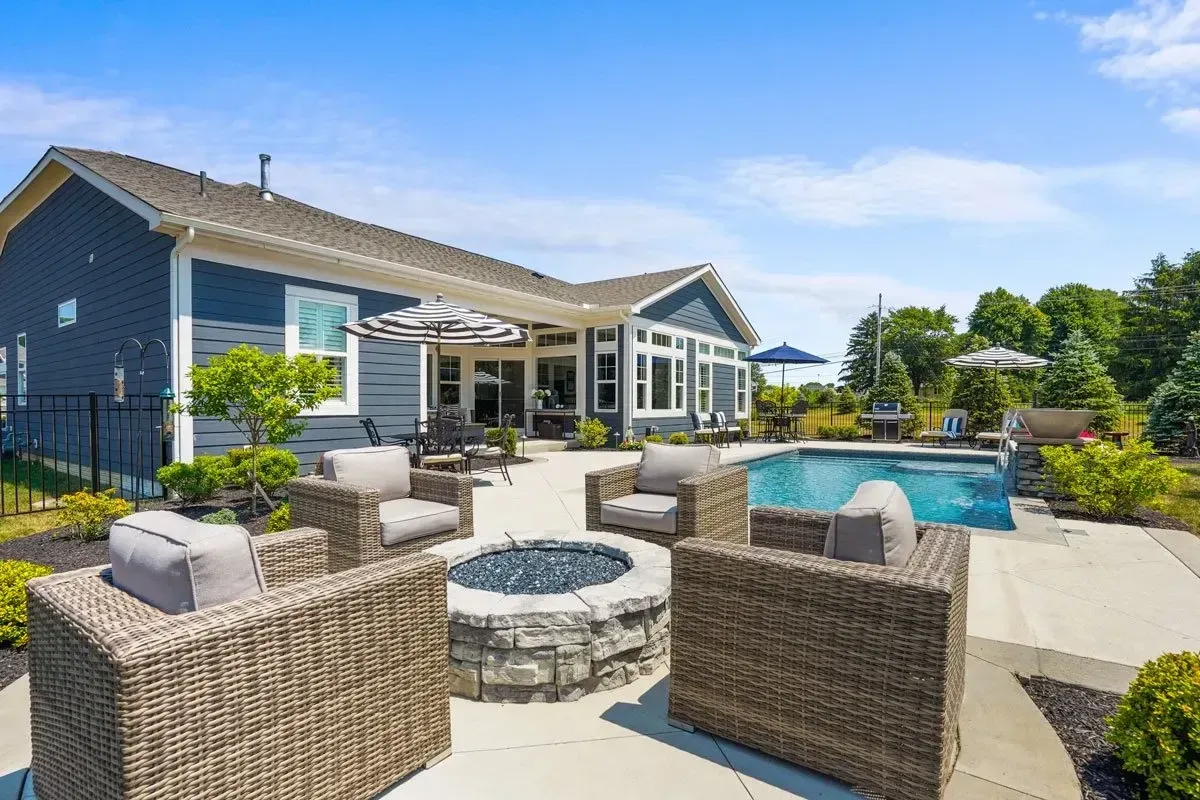
Design phase: how a 16-by-36 rectangle becomes a freeform that actually looks bigger
The homeowner was worried the pool would look smaller. It is a reasonable fear and a wrong one. The finished freeform has slightly less surface area — 540 sq ft vs the original 576 sq ft — but reads as larger because the shallow end now has a visible beach-style transition. Your eye follows curves longer than straight lines. Freeforms feel expansive. Rectangles feel measured.
What we kept: the deep-end corner, because the plumbing, returns, and main drain there were intact and in code. The east long wall, within a half-inch of vertical with no visible cracks. The east bond beam, cast thick enough to tie the new rebar cage into with epoxy-set dowels.
What we broke out: the entire shallow end (west 14 feet), the south long wall (the full 36 feet plus return bend), and the diving well floor below 5 feet — roughly 40% of the shell by surface area. Six dumpster swaps in the first eight days.
What we added: a 10-foot tanning ledge at a constant 9-inch water depth across the new shallow end, a curved bench step doubling as a seat wall, two in-ledge bubbler jets, and a gentle kidney-curve south edge flowing into the new travertine deck instead of meeting it at a hard miter corner.
Why 9 inches is the correct tanning ledge depth — not 6, not 12: At 6 inches a chaise sits wet-footed and kids cannot sit in the water. At 12 inches a chaise floats and you cannot put your elbow down. Nine inches lets an adult sit shoulder-deep in a lounger, lets a toddler stand safely, and lets a lab stand without swimming. We have set this spec on every ledge we have built since 2019.
Week-by-week build: the 6-week construction schedule broken out by trade
The homeowner asked for a day-by-day calendar before we broke ground. We gave her a week-by-week one because pool construction has too much weather risk to promise specific days. Here is how the 42 calendar days actually shook out.
Week 1 (demo and over-dig): drained the pool to the deep-end drain, cut the existing deck with a diamond saw in 4-foot tiles, broke out the shell walls and shallow-end floor with a mini-excavator and a hydraulic breaker attachment. Hauled off an estimated 34 tons of gunite rubble and broken deck. The diving board had already been removed in 2019, which saved us a half-day of hardware removal.
Week 2 (grade, form, steel): laser-set the new shell grades, built the rebar cage for the new freeform using #4 rebar on 10-inch centers with #3 stirrups at wall-to-floor transitions, tied the new cage to the preserved deep-end bond beam with 12-inch epoxy-set dowels on 8-inch centers. This is the skeleton you are paying for. It is the part you will never see once the plaster is on. It is the part that determines whether the pool lasts ten years or forty.
Week 3 (gunite shoot): one 9-hour shoot, 22 cubic yards placed. We shoot to a minimum 8-inch wall thickness, 6 inches on the floor, and 10 inches at the bond beam. Loudest day of the project — bring earplugs for the dogs.
Week 4 (plumbing, electrical, tile): new 2-inch Schedule 40 PVC returns, a 3-inch main drain trunk, and hydro-test to 25 psi for 24 hours. Waterline tile went in Thursday and Friday — a 6×6 glass mosaic in pale blue-gray picked from our sample boards.
Week 5 (deck pour): set bluestone coping at 1-inch reveal above waterline, poured a travertine deck over 6 inches of compacted granite base with 1-inch setting bed. We use French-pattern travertine on about 70% of East Cobb reshapes because it hides minor settlement cracks better than any other deck material.
Week 6 (plaster, fill, startup): quartz finish plastered over 6 hours with 4 plasterers on site. Full fill from the hose bib took 31 hours. Startup chemistry, pump priming, and a 28-day plaster cure handoff closed the job.
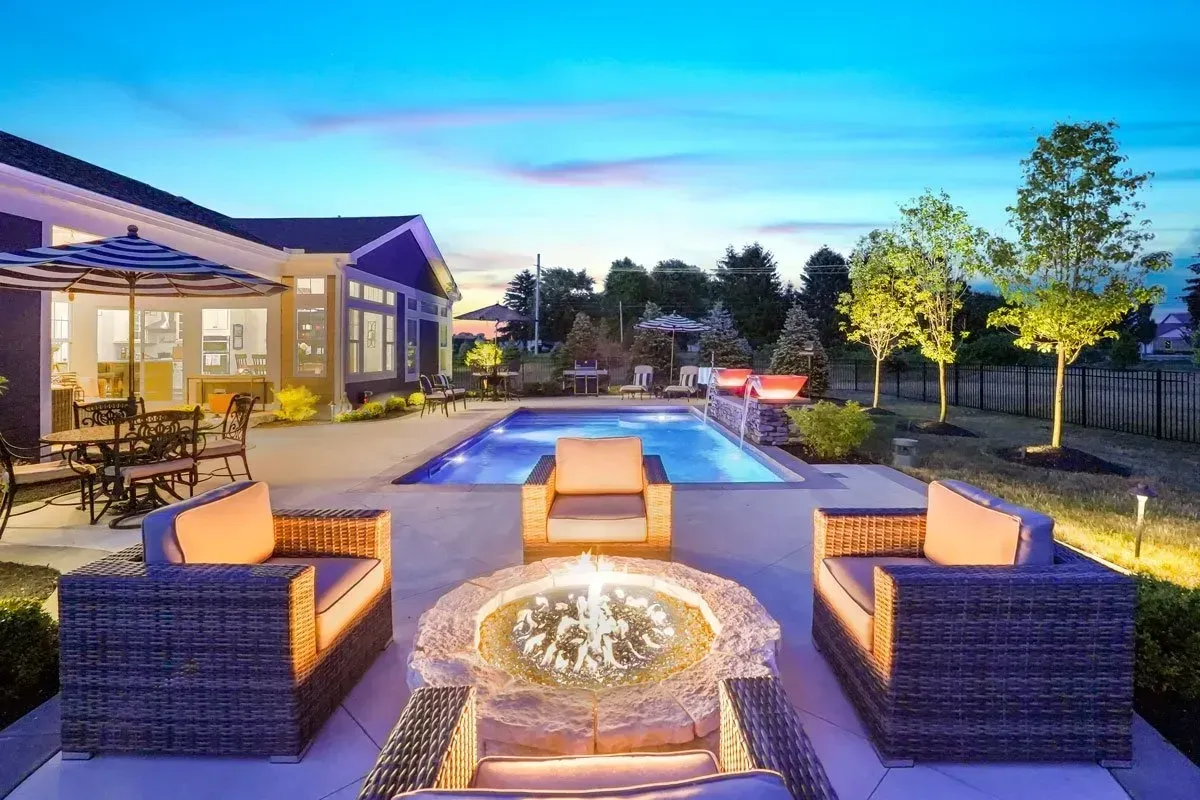
The equipment pad relocation nobody talks about in reshape quotes
The original equipment pad sat 18 feet off the deep-end corner, 15 feet from the homeowner’s bedroom window. We relocated the entire pad 34 feet west behind a new cedar screen wall, with new 3-inch suction trunk, new 2-inch return, a sub-panel fed from the Cobb EMC service drop, a 240V GFCI breaker, and a concrete pad at 4 inches over compacted base. The Pentair IntelliFlo3 VSF variable-speed pump is quieter than the old single-speed anyway. Relocation added $9,200 and removed every decibel of equipment noise from the primary bedroom side.
If your 1980s reshape quote does not mention equipment pad location, ask out loud. Moving equipment during a reshape is cheaper than moving it later — deck is already broken up, trenches already open.
Where $84,000 actually went — a line-item the homeowner saw
We publish contract line items for every remodel because opaque pricing is the single most common complaint we hear about pool contractors in Cobb. Here is how the $84,000 broke down for this specific Indian Hills project.
- Demolition and haul-off (shell + old deck): $9,800
- Excavation and re-grading to new freeform profile: $5,400
- Rebar, steel tie, epoxy dowels, formwork: $6,600
- Gunite shoot (22 cubic yards): $11,200
- Plumbing (suction, return, main drain, hydro-test): $7,800
- Electrical (panel, bonding grid, GFCI, LED niche, Cobb EMC connection): $6,400
- Equipment pad relocation + Pentair IntelliFlo3 VSF + cartridge filter: $9,200
- Waterline tile (6×6 glass mosaic) and bluestone coping: $5,100
- Quartz plaster interior finish: $6,400
- French-pattern travertine deck (560 sq ft, compacted base, setting bed): $12,600
- 48-inch black aluminum pool barrier + self-closing gate: $7,400
- Cobb County permit + structural stamp + plan review: $2,100
- Startup chemistry, 28-day cure management, handoff training: included
Total: $90,000 ballpark on paper. Contracted at $84,000 after we absorbed the excavation rework on a wet week. The homeowner wrote one check for deposit, a second at gunite, and a third at plaster cure. No surprise invoices, no change orders after week one.
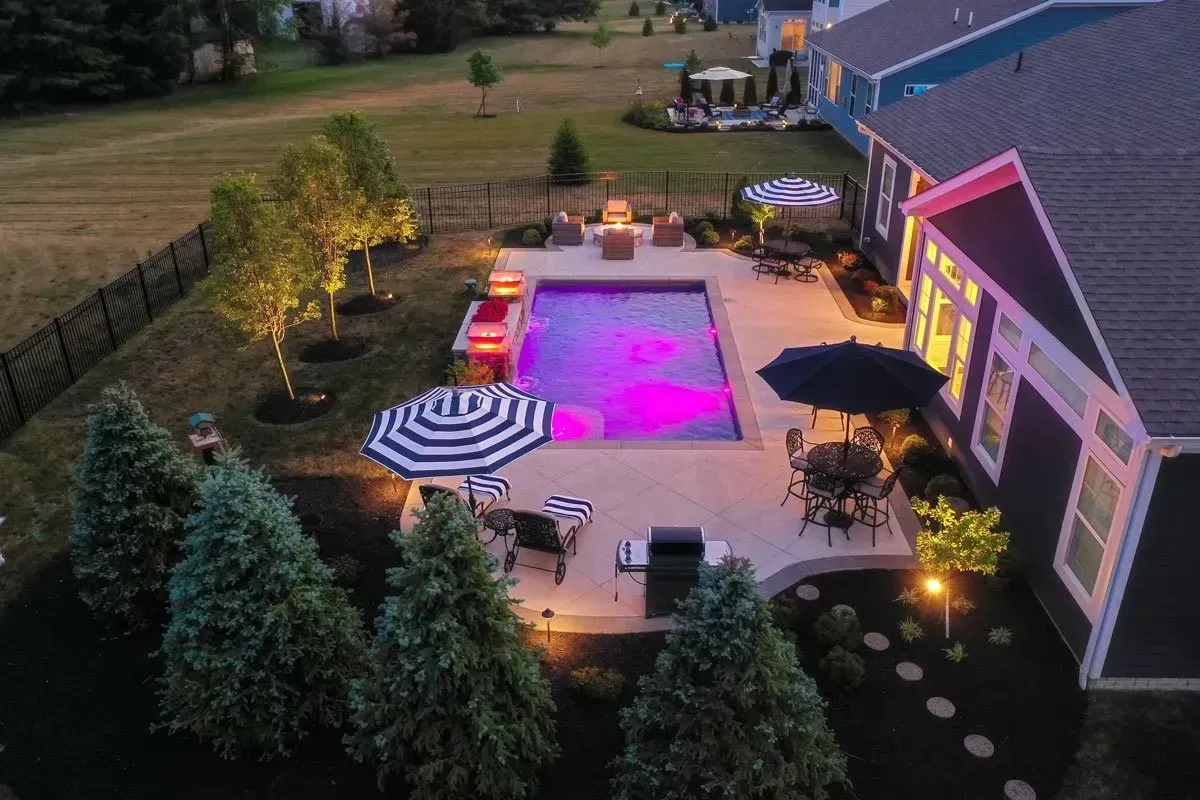
Home value impact — the number the homeowner’s realtor ran for us
The homeowner’s agent at Atlanta Fine Homes ran comps against the subdivision set in Indian Hills and Atlanta Country Club from the previous eighteen months. Her answer: a reshaped, updated freeform with an integrated tanning ledge and modern equipment adds between $38,000 and $58,000 to sale price in East Cobb vs a comparable home with a dated rectangular pool.
That math holds here because Marietta sits on the USDA Zone 7b/8a border with roughly 22 freeze events per year — about 7 usable pool months (April through mid-October). Long enough to justify the investment without the 3-month pool season that makes northern pools feel pointless. On pure ROI, the reshape recovered 45% to 69% of cost in appraised value. On “did it change how we live in the house,” the homeowner described it as “the only renovation we use every single day from April to October.”
Marietta-specific value math: Cobb County school district scores, Atlanta Country Club proximity, and the mature tree canopy in 30068 push pool ROI higher here than in comparable ZIPs in Gwinnett or Forsyth. The buyer pool in East Cobb expects a modern pool — reshaped 1980s shells read as updated, not vintage.
What specifically broke, what we had to redo, and what we learned
I promise you no pool construction or remodel finishes without at least one problem. Here are the three on this job.
Problem one: the rebar cage. On week two we found a 6-foot stretch of preserved wall rebar tied with #16 tie wire instead of the spec’d #14, with two intersections corroded through. Replaced 18 dowels with new epoxy-set #4 rebar and added overlap stirrups every 16 inches. Added two days. Added $820 in labor. Did not add a nickel to the contract.
Problem two: unexpected granite. Marietta sits on Cecil soil series in most yards, but this lot had a granite boulder roughly 4 feet below the shallow-end over-dig. We rented a Bobcat E42 with a Stanley MB656 hydraulic breaker for a half-day, broke it into four haul-able pieces, and kept digging. Added $1,100 in rental and labor — the one line item we warn every East Cobb homeowner about before signing.
Problem three: skimmer leaf load. Under the homeowner’s mature oak canopy, the original single skimmer filled twice a day in late October. We upgraded to a twin-skimmer design with Hayward SP1088 weir doors. The twin-skimmer bump added $480 to the plumbing line. Anyone reshaping a pool in Walton Woods, Brookstone, or Indian Hills should budget for this — it is the single biggest maintenance complaint we hear in those neighborhoods.
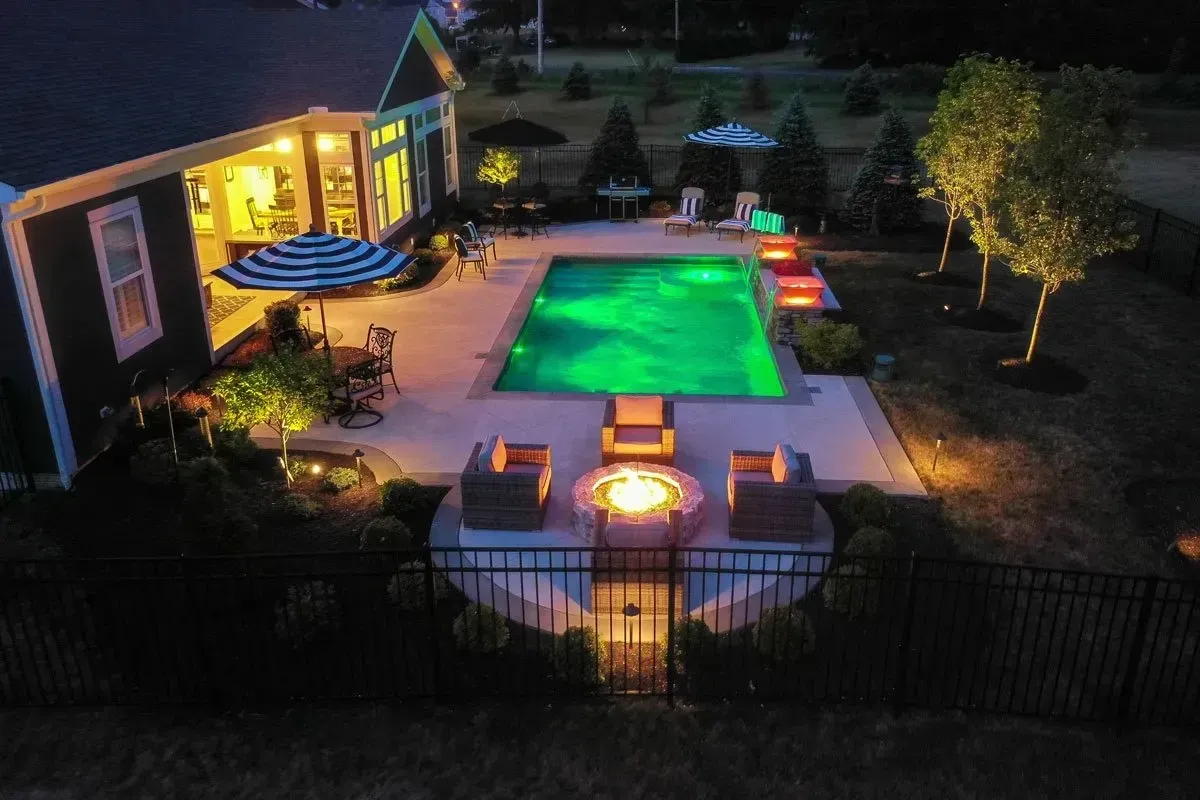
The tanning ledge details most contractors get wrong
Tanning ledges come up in every remodel intake. Here is the engineering that separates a ledge that feels great from one that feels weird.
Depth: 9 inches. Not 6, not 12. At 6 inches a chaise sits wet-footed. At 12 a chaise floats. Nine is the number we settled on after building close to 140 ledges across Metro Atlanta since 2018.
Surface area: minimum 8 feet wide, 6 feet deep. This one came in at 10 feet wide, 7 feet deep — 70 square feet — which fits two chaises plus a toddler with a bucket.
Bubblers: two Pentair MagicStream laminar jets, 30 inches apart, plumbed on their own 1.5-inch return line with an in-deck diverter valve so you can turn them off without killing main pool circulation. That diverter valve is the single detail separating a pro install from a DIY ledge.
Interior finish: quartz plaster, hand-tooled with a micro-texture (not a slope). Coping step down to main pool depth is a deliberate 17-inch transition — pool-code legal as a seat height.
Why this project does not work as a DIY or owner-builder approach
Every few months a Marietta homeowner asks about acting as their own general contractor to save the 20% GC margin. The issue is not any one trade — it is the sequence. Demo determines over-dig geometry, which determines rebar cage depth, which has to match the Cobb County inspection window (72 hours out in summer). Gunite lands the day after rebar passes. Electrical bonding gets poured into the gunite and cannot be opened back up. Plaster cannot be shot below 50°F or above 90°F.
Missing any one handoff by three days pushes the whole project two weeks. That is why we contract the whole thing under one roof, why our contracts include weather-delay clauses, and why our schedule accuracy rate across 108 pool remodels we have finished in Cobb and Gwinnett since 2021 runs at 94% on-time at final handoff.
Who this reshape is right for — and who it is not
This scope is right for you if: you own your home in Marietta (especially East Cobb, Indian Hills, Atlanta Country Club, Walton Woods, Burnt Hickory, Brookstone, or Sope Creek), the house and pool were both built between 1975 and 1999, you have lived with the pool at least three summers, and the shape is the thing that stops you from loving it. If your pool is structurally sound but visually tired, you want a resurface at $22,000 to $34,000, not a reshape.
This scope is not right for you if: you are selling within 36 months, the existing structure has cracks running below the waterline into the floor (that is a full rebuild), or your HOA is one of the aggressive ones in Atlanta Country Club which requires ARC approval for any exterior work exceeding $10,000 — that approval alone can add 6 to 9 weeks to the schedule. We handle ARC submittals for every East Cobb client inside the contract. Our stock packet has been submitted to the Atlanta Country Club ARC seven times. Your neighborhood board has seen our work before.
How we schedule a Marietta reshape from first call to swim day
Our intake is a 60-minute call, not a 15-minute sales pitch. The homeowner sends photos by text and answers three questions: when do you want to swim in the finished pool, is HOA approval required, and have you lived through at least two full summers with the existing pool. That last question matters because reshape decisions made in the first summer of ownership are wrong half the time — you have not seen how you actually use the space yet.
We then schedule a 90-minute on-site visit. No team, just a lead designer and the owner of the company. We walk the property, measure, talk through lifestyle, and leave the homeowner with a printed one-page summary. Full quote follows within 7 business days. From signed contract to swim day, our average Marietta reshape runs 12 to 14 weeks — 4 weeks for Cobb County permit review and ARC approval, 6 weeks of construction, 2 weeks of plaster cure, 1 week of buffer. To swim by Memorial Day, we need a signed contract by mid-January.
Pool remodeling & full-shell reshapes across 20+ cities within 30 miles of Winder, GA
If you own a 1980s or 1990s rectangular pool in East Cobb and want to stop resurfacing a shape that was never right, the reshape scope tier is the quote most contractors will not bring up until you ask. We will.