
It’s 4:47 on a July Tuesday in Coal Mountain. The sky off Sawnee Mountain goes from blue to bruise in nine minutes, the first gust slaps the backyard at 52 mph, and the homeowner is standing in the kitchen staring out the sliding door at a brand-new outdoor cook space — wondering whether the roof over the Blackstone is about to end up in the neighbor’s pool.
That scenario plays out across Forsyth County roughly eight to twelve times a summer. It’s not theoretical. Forsyth — all 247 square miles of it, from the 30028 zip in the north down through Cumming’s 30040 and into the 30041 commuter belt in the south — sits in one of the most microburst-active pockets in metro Atlanta. Lake Lanier’s moisture feeds the afternoon convection, Sawnee Mountain’s ridge kicks the airflow upward, and when the downdrafts hit, they don’t hit gently. The National Weather Service Peachtree City office has logged straight-line wind events exceeding 70 mph in Forsyth every summer since 2018.
So when a homeowner in Bethelview, Shiloh, or the north end near Ducktown calls Primetime Pools and says “I want an outdoor kitchen,” the very first real design question isn’t the grill. It isn’t the countertop. It’s the cover. A pavilion with a solid roof, an open pergola, or a retractable cantilever sun shade — three fundamentally different structures, three wildly different price points, and three completely different answers to the question: what happens on a Tuesday at 4:47 in July?
Why Forsyth’s wind profile rewrites the cover math
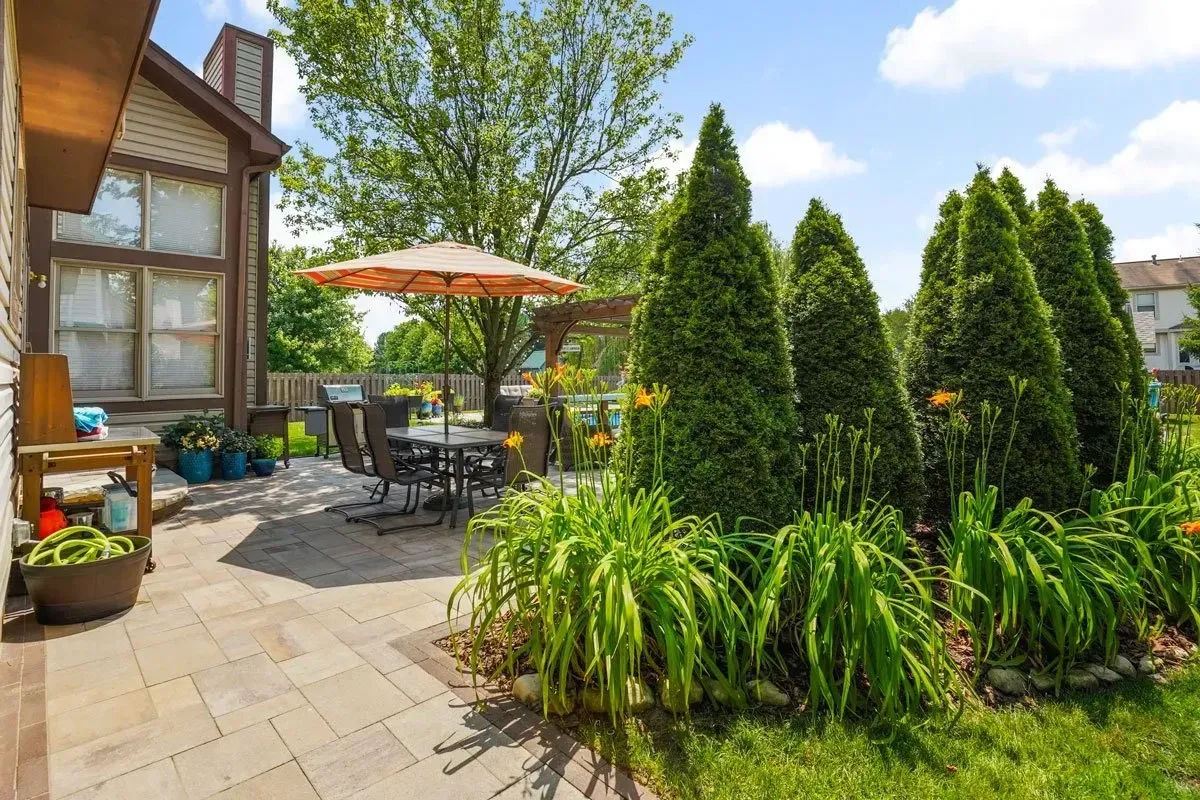
Before we compare the three structures, you have to understand what a Forsyth backyard actually sees in a typical July. Steady afternoon sustained winds of 12-18 mph are normal. Thunderstorm gust fronts in the 35-55 mph range show up two to four times a week between mid-June and early September. And every summer — every summer — at least one microburst event inside the county crosses 70 mph sustained for 45-90 seconds. That’s enough force to lift an unanchored 12×16 pergola clear off a concrete pad.
The reason Forsyth runs hotter than, say, Gwinnett is topography. Sawnee Mountain at 1,946 feet and the broader Blue Ridge foothills along Hwy 369 (Browns Bridge Road) create what meteorologists call orographic lift — warm humid air off Lake Lanier rises, cools on the ridge, and dumps back down as a concentrated column of air. The downdraft fans out when it hits ground level, and if your backyard happens to be on the fan line, you get hit with a two-to-three-minute burst that’s stronger than anything registering at the closest ASOS weather station. By the time NWS Peachtree City pushes the severe thunderstorm warning, your pergola has already made its decision.
This is why the cover question in Forsyth is engineering-first. In Fulton or DeKalb it’s mostly an aesthetic and shade-coverage decision. Here it determines whether you’re replacing cedar 4×4 posts in August 2027.
Option 1: The Pavilion — a real roof, engineered loads, $22K to $44K
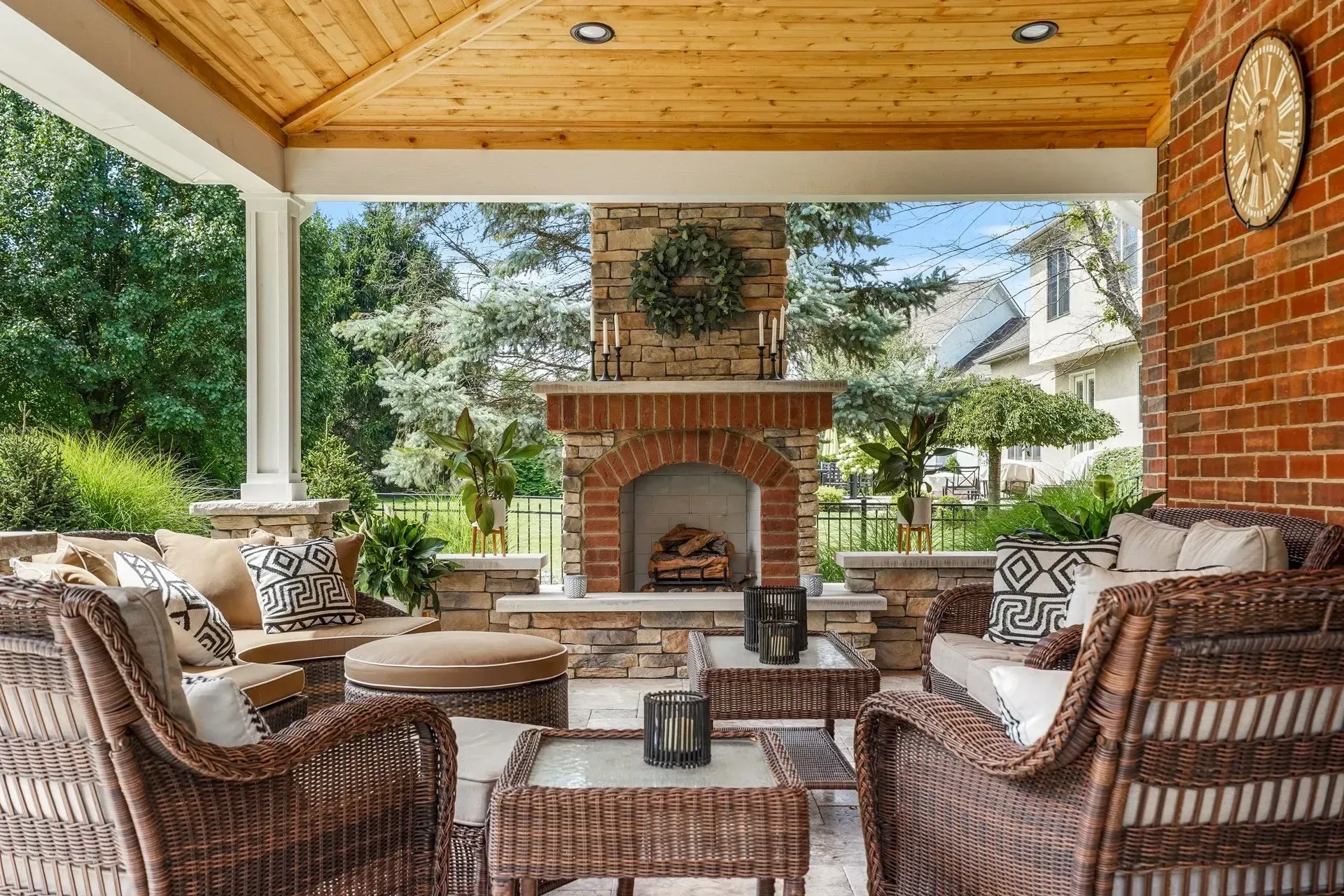
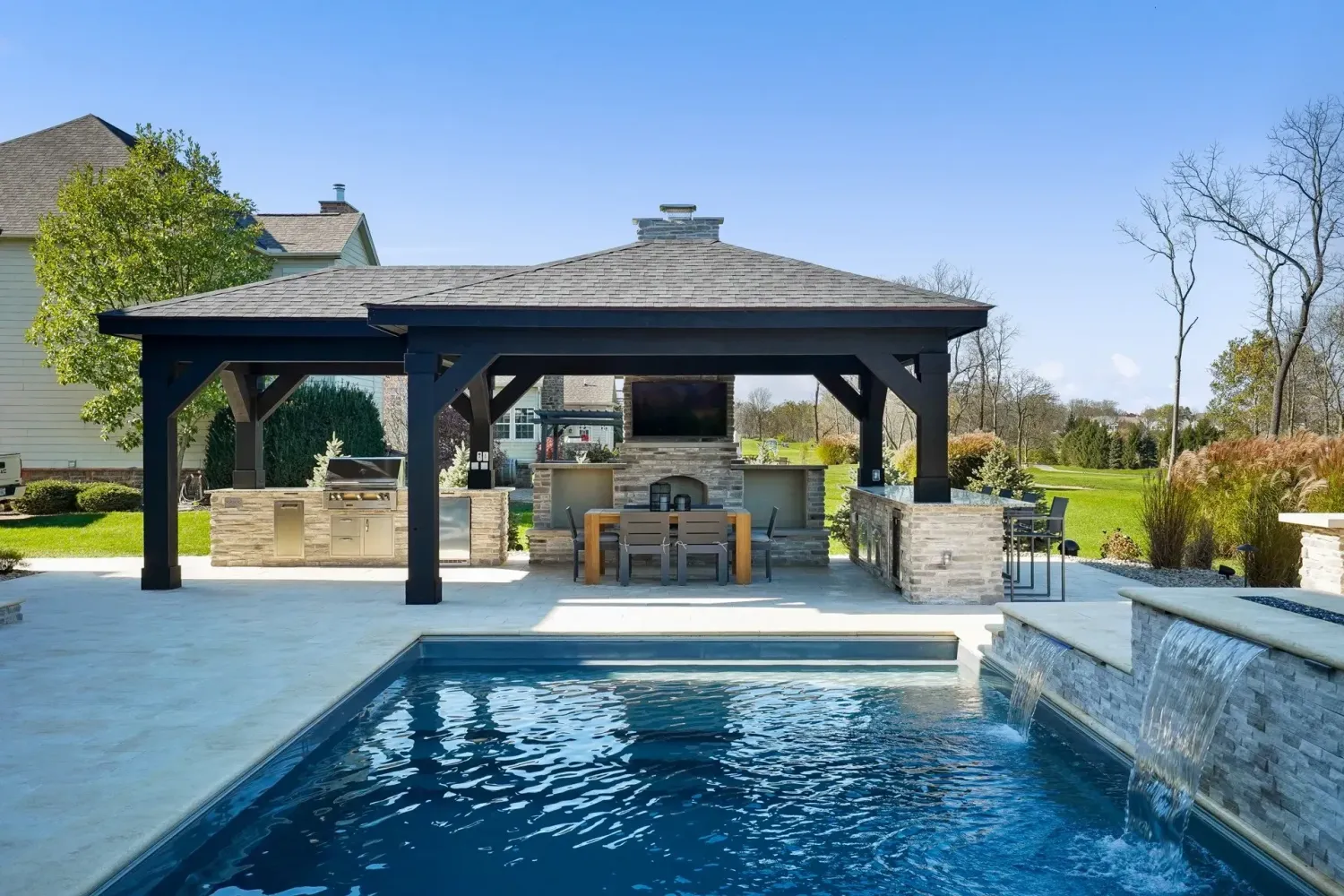
A pavilion is a solid-roof structure — asphalt shingle, standing-seam metal, or tongue-and-groove cedar with a membrane underneath — sitting on 6×6 or 8×8 posts anchored into concrete piers that extend at least 24 inches below grade. It’s a permanent, permitted, engineered structure. In Forsyth County, any covered structure over 120 square feet attached to an outdoor kitchen triggers a building permit through the Forsyth County Department of Planning & Community Development on 110 East Main Street in Cumming, and the permit requires stamped plans showing 115 mph design wind speed per the Georgia amendment to the 2018 International Residential Code.
That 115 mph number matters. It’s the design threshold your structure has to survive per code — not the wind you expect to see, but the wind it has to resist without failure. A properly built pavilion in Forsyth will sit through a 70 mph microburst without so much as a creak because it was engineered for 45 mph more than that.
The trade-off is cost and permanence. A 14×18 pavilion with a shingle roof, cedar T&G ceiling, four stacked-stone column bases, and integrated lighting runs $22,000 to $28,000. Move up to a 16×22 with a standing-seam metal roof, Ipe decking on the ceiling, mounted ceiling fans, and two recessed TV locations and you’re at $34,000 to $44,000. That’s before the kitchen equipment goes under it.
Forsyth pavilion permit reality: average permit turnaround from submission to approval is 18-24 business days. Forsyth County approves roughly 200+ outdoor structure permits per year, so the plan reviewers have seen your design before. Clean plans get through in 15 days; ambiguous plans bounce.
Option 2: The Pergola — wind passes through, $8K to $18K
A pergola is the opposite engineering philosophy. Instead of resisting wind with a solid roof, it lets wind through. The slats — typically 2×6 rafters on 16-inch centers or louvered aluminum blades — have gaps of 2-6 inches between them, so a 55 mph gust doesn’t load the structure like a sail. It passes through, shaves a few degrees of velocity off at ground level, and keeps moving.
That physics changes everything. A pergola doesn’t need the same pier depth, doesn’t need the same post dimensions, doesn’t need stamped engineering for wind resistance in the same way. Forsyth County will still permit it if it’s over 200 square feet or attached to the house, but the review is faster and the cost structure is completely different.
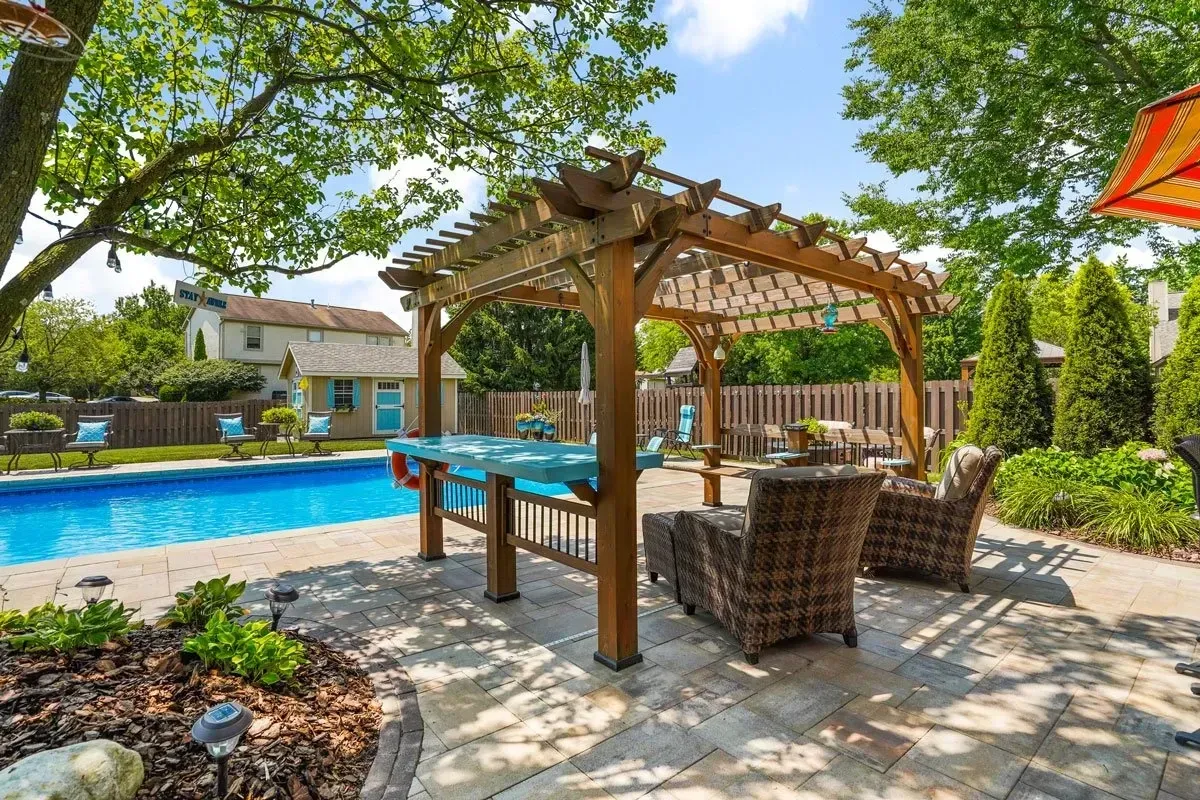
Pricing: a 12×14 cedar pergola with 6×6 posts, anchored into a poured patio, runs $8,000 to $11,000. A 14×18 with steel I-beam stringers hidden inside cedar wraps, powder-coated aluminum louvers, and integrated LED runs $14,000 to $18,000. Upgrade to a motorized louvered roof — StruXure or Azenco R-Blade — and you’re at $22K to $34K, which is pavilion territory, but with a fundamentally different look.
The catch with pergolas is rain. An open-slat pergola gives you 40-50% light passage, which is great for keeping a cook space cool in August, but it doesn’t stop precipitation. Motorized louvers solve that — they close flat during rain and tilt open the rest of the time — but the moving parts introduce maintenance the pavilion doesn’t have. A louvered roof motor typically carries a 5-year warranty and an expected service life of 12-18 years in Forsyth’s humidity.
Option 3: The Cantilever — retractable, brilliant, wind-limited to 25 mph
The third option is the newest entry and the one most Forsyth homeowners haven’t fully thought through. A cantilever retractable sun shade is a single-post or wall-mounted arm with a 10×13 or 13×16 tensioned canopy that extends over an area and retracts flush against the structure when not in use. Think Sunbrella fabric on an articulated aluminum arm, remote-controlled, sometimes motorized.
The appeal is obvious: the cover is only there when you want it. On a clear May evening, you retract the canopy and cook under open sky. On a 94-degree August afternoon, you extend it and get 100% shade coverage. No permanent shadow on the house. No bulky structure. And the price is the friendliest of the three — $6,000 to $14,000 installed for a quality commercial-grade unit like a Solara or ShadeFX system.
But here’s the fatal print on the spec sheet every installer should hand you and almost none do: cantilever retractable canopies are wind-speed-limited to 25 mph. Above 25 mph sustained, the manufacturer warranty voids if the canopy is extended. Some motorized systems have wind sensors that auto-retract at 22-25 mph. Most don’t.
The Forsyth cantilever reality: in a typical July, Forsyth sees 12-18 mph sustained winds all afternoon on clear days and 35+ mph on storm days. That means your cantilever canopy is either already retracted (giving you zero shade when you want it most) or sitting outside its warranty envelope when you need it to work.
The real-world comparison: what a July Tuesday looks like under each
Let’s run the same scenario under all three structures. It’s 3:30 on a Tuesday afternoon in Big Creek, near the south end of Forsyth off Kelly Mill Road. Forecast says isolated storms after 5 p.m. Family is cooking dinner outside. At 4:47 the first gust hits — 52 mph sustained for two minutes, peak microburst 68 mph for 40 seconds. Here’s what happens under each cover:
Under the pavilion: nothing. The rain hits the roof, drains through the gutters Primetime Pools integrated into the fascia, and runs into the French drain tied to the daylight line. The family finishes dinner. The structure doesn’t move. The TV under the ceiling fans doesn’t get wet. Total disruption: zero minutes.
Under the pergola (open slat): some disruption. Rain comes through the slats at about 50% volume. The kitchen gets wet; the cook moves the Blackstone against the house wall or under a portable cover. Wind passes through the structure without loading it — the 68 mph gust makes the cedar creak but doesn’t threaten it. After the storm passes, the kitchen surfaces dry out in 20 minutes. Total disruption: 25-30 minutes.
Under the pergola (motorized louvered): closed louvers in 12 seconds when the rain sensor triggers. Kitchen stays dry. Wind passes through the shut louver gaps in the frame. No disruption.
Under the cantilever canopy: if the wind sensor worked, the canopy auto-retracted at 4:41 when sustained winds first hit 23 mph. Family is now cooking in the open while the storm arrives. If the sensor didn’t work — or the homeowner overrode it — there’s a non-zero chance the canopy rips along the tension seam or the arm bends. Even if everything holds, the warranty is void. Total disruption: 40+ minutes plus potential $3,000-$6,000 replacement.
How Forsyth soil and footing depth change the pavilion math
One subtlety that makes Forsyth different from a flatland county like Gwinnett: soil. Most of Forsyth sits on Cecil series Piedmont clay, which is decent for bearing but miserable for drainage. Up north toward Coal Mountain and along Sawnee’s ridgelines, the soil turns rockier with seams of saprolite and occasional granite outcrops. What that means for a pavilion build is pier depth and anchoring get negotiated on a site-by-site basis.
On a standard Cecil-clay lot in Brookwood or Shiloh, pavilion piers go to 36 inches below grade, 12-inch diameter, with rebar cage and concrete poured to the top. That buries the frost line (Forsyth sits in USDA Zone 8a and sees roughly 22 freeze events per year, so frost isn’t severe but it’s not zero either) and gives the post a 4-to-1 embedment ratio against the uplift loads.
On a rockier lot in the north county — say, a 3-acre estate off Hwy 369 heading toward Lake Lanier — we sometimes can’t go 36 inches because we hit rock at 18-22 inches. In that case the engineer signs off on a shallower pier with epoxy-set anchor bolts drilled into bedrock. It’s a more expensive detail ($400-$800 extra per pier) but it’s stronger than clay-set concrete. North Forsyth customers usually end up paying for it; they also end up with the most bulletproof structures in the county.
Budget reality: what each covers in the full kitchen build
Here’s the honest money talk, because the cover is only one line on the outdoor kitchen invoice. A full Forsyth County outdoor kitchen build — cover, kitchen, deck, gas run, electrical, lighting, and drainage — lands in one of three tiers depending on which cover you pick:
Cantilever tier — $28K to $46K total. You spend $6K-$14K on the canopy, $14K-$22K on a basic outdoor kitchen (Blaze or Bull grill, stainless doors, tile counter, small paver pad), $3K-$5K on gas and electrical, $2K-$4K on lighting. This is the entry-level luxury build. It’s handsome, it’s functional, it’s wind-limited. For a Cumming buyer who entertains on clear Saturdays and accepts storm-day retraction, it works.
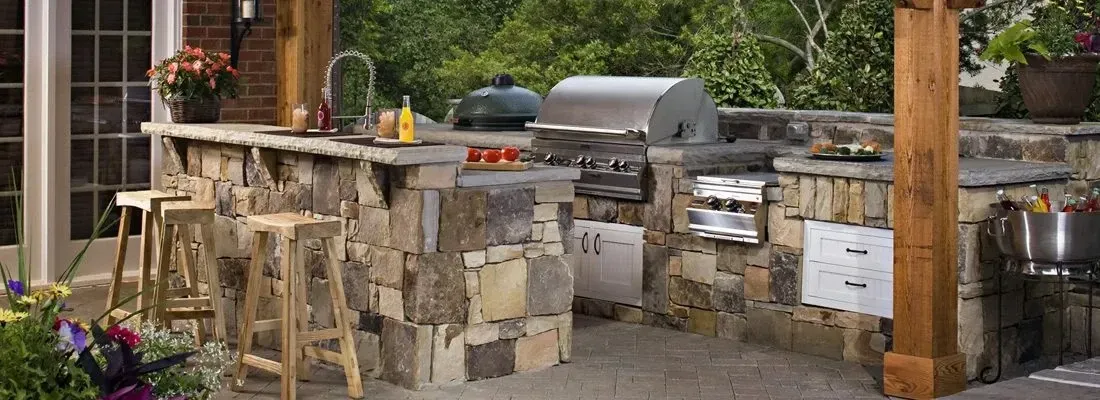
Pergola tier — $48K to $78K total. Cedar or louvered aluminum pergola at $11K-$22K, mid-to-high kitchen with Fire Magic Echelon or Lynx Sedona grill, stone counter, full outdoor refrigeration, integrated audio, 12×18 paver pad, lighting package, gas run, 60A sub-panel. This is the sweet spot for 70% of Forsyth buyers. Handles wind through permeability, handles most rain through slat or louver closure, handles 95% of the calendar.
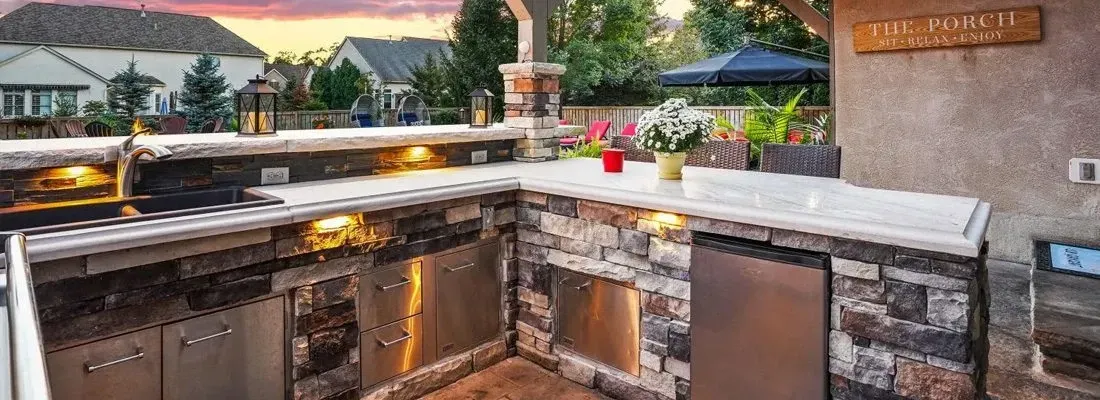
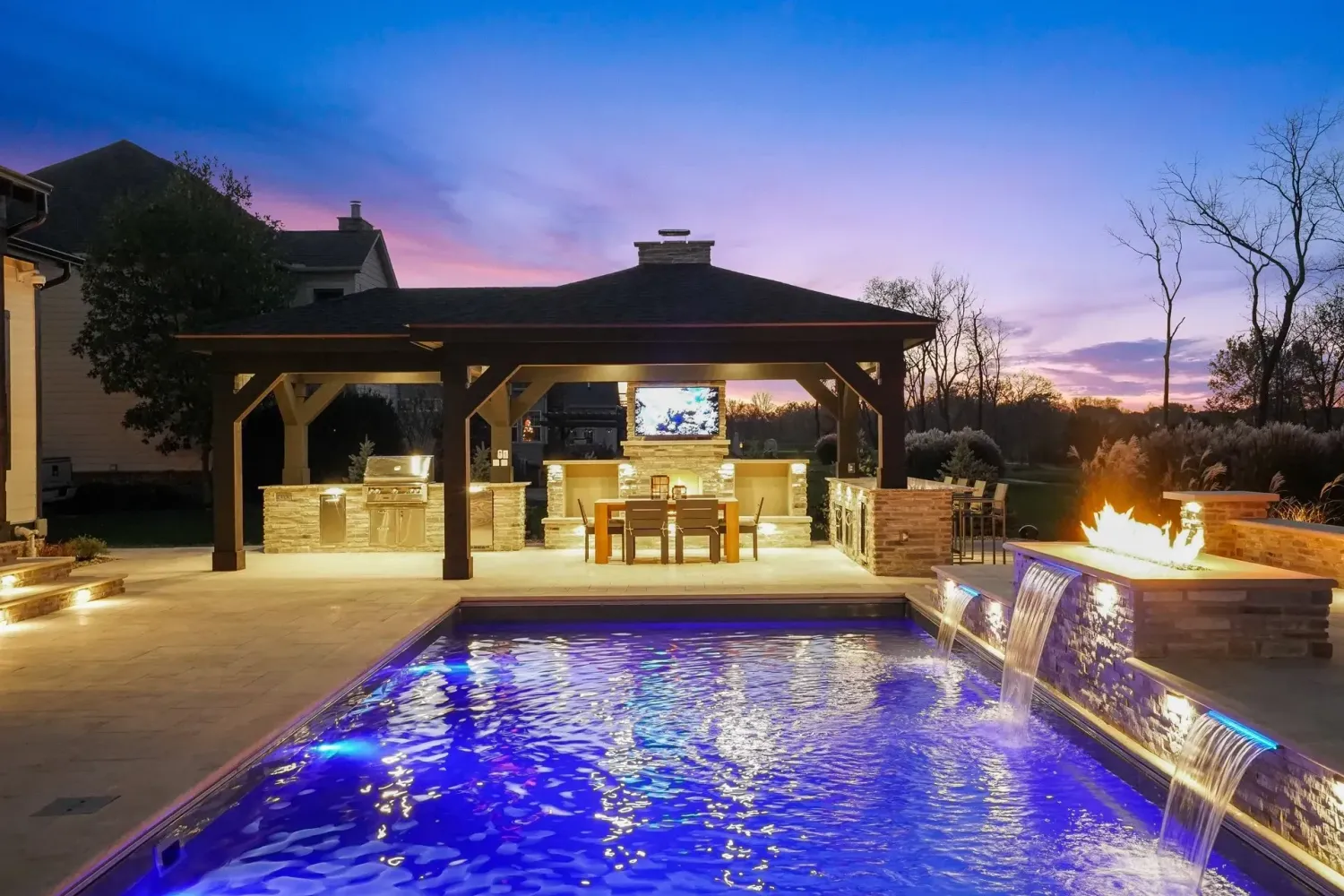
Pavilion tier — $72K to $140K+ total. 14×22 pavilion at $28K-$40K, full luxury kitchen with Hestan or Kalamazoo Hybrid grill, quartzite or leathered-granite counter, two beverage centers, ice maker, dishwasher, built-in ice bin, ceiling fans, recessed TV, surround audio, 14×24 paver deck, gas and electrical scoped for full estate service. This is the Lake Lanier south-shore build, the Bethelview estate build, the kind of outdoor kitchen that gets photographed for a magazine and passes the 70 mph July test without the homeowner even getting up from the table.
The Primetime recommendation by Forsyth sub-market
Forsyth isn’t one market. South Forsyth (30041, GA-400 exits 13-14, Brookwood, Shoal Creek) is an Atlanta-commuter HOA-dense belt with 0.4-to-1-acre lots, strict ARC committees, and neighbors 30 feet from your property line. North Forsyth (30028, Coal Mountain, Ducktown, the Lake Lanier south shore) is 2-to-5-acre estates, looser HOAs, more exposure, more wind. West Cumming (30040, around Sawnee Mountain and Bethelview) splits the middle.
For south Forsyth, we almost always recommend a pergola — motorized louvered if the budget allows, cedar slat if it doesn’t. The HOA architectural committees approve them faster than pavilions (a pavilion reads as “outbuilding” to most ARC reviewers and triggers more scrutiny), the wind exposure is moderated by surrounding houses, and the 40-50% light passage keeps a tight backyard from feeling cave-like.
For north Forsyth — where the Sawnee EMC utility lines run through wooded lots and every July storm arrives with 30 mph more velocity than it had south of the county — we recommend a pavilion, period. The wind exposure on a 3-acre lot with tree-line gaps is categorically different from a subdivision lot. Spend the $24K extra over a pergola and sleep through every storm for the next 40 years.
For west Cumming and Bethelview estates, it’s usually a hybrid: an attached pavilion over the cook zone (grill, counters, fridge) and an adjacent open pergola over the dining table. The pavilion protects the equipment and the TV; the pergola gives the dining space the open-sky feel. We build two to three of these a year and they’re consistently the best outdoor kitchens in the county.
The answer to “pavilion, pergola, or cantilever” in Forsyth County isn’t a preference question. It’s a risk-tolerance question, a budget question, and a wind-profile question layered on top of each other. Get those three answers right before you pick the finishes, the grill, or the countertop material. The kitchen outlives the decade. So does the storm that hits it.
Outdoor kitchen design & construction across 20+ cities within 30 miles of Winder, GA
Every Forsyth County cover build starts with the same conversation — wind profile, lot orientation, and which July storm you want to sleep through. We pick the structure before we pick the grill.