
Q: Can a Cumming pool really trim $280 to $420 a year off its electric bill without cutting runtime? A: Yes — when a Pentair IntelliCenter is wired into a Sawnee EMC smart-meter feed and actually told what to do with the data.
Ask homeowners in Vickery or St. Marlo what “pool automation” means, and the answers drift: a phone app for the heater, a timer for the pump, maybe colored LEDs that cycle on a Friday night. Those are features. Automation — the real kind — is a control layer that reads your utility’s demand signal, runs your equipment inside the rate windows that save money, chlorinates the water on a chemistry curve instead of a clock, and texts you before a motor fails. That’s what this post is about.
Forsyth County runs on Sawnee EMC, one of the largest electric membership cooperatives in Georgia, and Sawnee is already metering your house in 15-minute demand intervals. The data is sitting there. The question is whether your pool equipment is doing anything with it. For the vast majority of Cumming builds we audit, the answer is no — the pump runs on a wall timer set in 2019, the heater is manual, and the IntelliChem unit the previous builder installed was never actually commissioned.
This piece walks through how we integrate a Pentair IntelliCenter package — hardware, firmware, IFTTT/SmartThings bridge, Lutron RadioRA 2 handoff — on new Cumming builds, what it costs installed, and why the electrical realities of Sawnee’s 240V service and Forsyth County permitting shape the wiring before you ever touch the app.
Why Sawnee EMC’s 15-Minute Demand Data Changes the Math
Georgia Power customers in Buford or Sugar Hill get one rate structure. Sawnee EMC members in Forsyth County get another — and Sawnee’s residential schedule includes a time-of-use option with a meaningful off-peak discount. The rate card moves every year, but the shape is consistent: on-peak hours run roughly 2 PM to 7 PM weekdays, with everything else priced lower. Summer peak kWh pricing can run 2.5 to 3 times the overnight rate.
A typical Cumming inground pool draws 2,400 to 3,600 kWh/year for filtration alone, depending on pump horsepower, pad plumbing losses, and run schedule. Move 80% of that load out of the on-peak window — and run the variable-speed pump at a lower RPM for longer instead of high RPM for less — and the annual electrical cost of the pool drops in the range we already named: $280 to $420 for most homes we’ve measured in Windermere and Hampton Park. Add a heat pump for year-round swimming and the delta gets wider.
You can’t capture any of that savings with a mechanical timer. The timer doesn’t know what time Sawnee starts peak billing, doesn’t know about the algae-bloom night you need an extra two hours, and has no idea your heat pump just tripped its high-pressure switch at 3 AM. The IntelliCenter does.
Sawnee EMC load data, in practice: Residential smart meters report kWh in 15-minute intervals through the MyUsage portal. Pulling that into SmartThings (via IFTTT or a Hubitat bridge) gives the IntelliCenter a real-time view of whole-house demand. We program the pump to back down during HVAC peak draws, then catch up overnight.
What a Pentair IntelliCenter Actually Is (and Isn’t)
The IntelliCenter is the control brain — a load center that replaces the old EasyTouch or IntelliTouch board Pentair shipped for a decade. In a full Cumming build, it handles eight or ten relay and valve circuits: main pump, booster pump, heater, spa blower, three to four lighting scenes, waterfall pump, and two actuator valves for spa-to-pool changeover. The IntelliCenter talks to Pentair’s IntelliFlo3 VSF pump over RS-485, talks to the IntelliChem chemistry controller the same way, and pushes status to the ScreenLogic app and the homeowner’s phone.
Installed pricing in Cumming, as of this quarter:
- IntelliCenter i8P or i10P base package — $4,200 to $6,400 installed, depending on circuit count and whether we’re replacing legacy gear or roughing into new construction
- IntelliChem pH/ORP dosing controller — $1,850 to $2,400 installed, including acid and chlorine feed tanks
- Color-logic LED retrofit (pool + spa) — $1,100 to $2,200 depending on fixture count
- Lutron RadioRA 2 handoff for landscape and pavilion — $2,800 to $5,500, quoted separately; this is the piece most builders skip
What the IntelliCenter is not: a replacement for Sawnee’s smart meter, a utility-sanctioned demand-response device, or a substitute for proper bonding and grounding. It’s a controller. Everything upstream of it — the 240V sub-panel, the GFCI protection, the NEC §680 bonding grid — still has to be built right.
The Sawnee EMC 240V Service Reality in Forsyth County
Most Cumming homes built after 2005 have a 200-amp main service. Newer luxury builds in St. Marlo and Polo Fields routinely carry 320A or 400A services because of EV chargers, tankless water heaters, and full-house generators. The pool equipment pad takes its own 60A or 100A sub-panel fed from a pool disconnect — code requires the disconnect within sight of the pool and at least 5 feet from the water’s edge per NEC §680.12.
Sawnee’s service requirements add one wrinkle the manufacturer spec sheets don’t show: on lots with a detached pool pad more than 75 feet from the meter base, voltage drop on the 240V feeder becomes material at pump startup. An IntelliFlo3 drawing 12 to 14 amps at high RPM, plus a 5-ton heat pump pulling another 30 amps, can sag the feeder enough to cause nuisance trips on the pad-mounted GFCI. We upsize the feeder wire a gauge or two on long runs — #4 AWG aluminum instead of #6 on the typical 100-foot Windermere run — and the problem disappears.
Forsyth County’s Department of Planning & Community Development at 110 E. Main St. reviews the electrical sheet as part of the pool permit. Plans need to show the disconnect location, feeder size, bonding grid, and GFCI coverage. Reviews run 7 to 10 business days in normal season, longer in March through May when permit volume spikes with the spring build queue. HOA review in St. Marlo or Polo Fields typically runs 2 to 3 weeks concurrently — we file both on the same day so they overlap.
IFTTT, SmartThings, and the Demand-Response Loop
The IntelliCenter ships with ScreenLogic, Pentair’s own app. ScreenLogic is fine for scheduling and scene control, but it doesn’t read anything outside the pool. The integration step — the reason this whole post exists — is bridging Pentair’s API to a broader home automation hub, usually Samsung SmartThings or Hubitat, so the pool can react to signals from the rest of the house.
The pattern we use on Cumming builds:
- IntelliCenter to SmartThings — via the Pentair cloud API and a community-maintained SmartApp. Gives SmartThings read/write access to every circuit, valve, and sensor on the pad.
- Sawnee MyUsage to SmartThings — via IFTTT. When 15-minute demand crosses a user-defined threshold (most homes set it at 5 kW), IFTTT fires a webhook that SmartThings routes to the IntelliCenter: drop pump RPM from 2,400 to 1,200, delay heater call for 30 minutes, skip booster cycle.
- IntelliChem dosing on chemistry, not clock — pH and ORP probes feed the controller continuously; acid and chlorine doses fire in small, metered amounts all day long instead of a big Sunday-night slug that wrecks cyanuric ratios.
- Fault alerts via SMS — any fault code (high-pressure trip, low-flow, over-temp, probe error) triggers a Twilio-backed SMS through SmartThings. Homeowner gets a text; we get a copy if they’ve opted in to remote monitoring.
The loop is not complicated, but it has to be commissioned correctly. On rebuilds where we inherit someone else’s pad, the most common failure we find is that the previous builder installed the hardware, handed the homeowner the ScreenLogic login, and never linked anything to anything. The IntelliChem ran on default setpoints. The pump ran 8 hours at high RPM because that was the factory default. The smart part of “smart pool” was switched off at install.
Lighting, Scenes, and the Lutron RadioRA 2 Handoff
Pool lighting is where the IntelliCenter shines for the homeowner who wants the backyard to feel designed, not just lit. Pentair’s ColorLogic LED system supports 10 fixed colors and 7 preset shows, all addressable through IntelliCenter circuits. On a typical Cumming build we program four scenes:
- Evening dinner — pool at 20% warm white, spa at 40%, pavilion at 60%
- Weekend party — ColorLogic “Mardi Gras” on pool, spa spill on, landscape uplights at full
- Security — perimeter landscape on, pool and spa off, triggered by any exterior motion sensor
- Sleep — everything off, pump drops to circulation RPM, heater to low-temp hold
The scenes the IntelliCenter can reach stop at the equipment pad. Landscape path lights in the beds, soffit lights on the pavilion, under-cabinet lighting in the outdoor kitchen — those all belong to the house’s lighting control system. On high-end Cumming builds we hand that off to Lutron RadioRA 2, which keypads beautifully with either Caséta or HomeWorks depending on the existing panel. The IntelliCenter triggers a virtual switch in SmartThings, SmartThings tells Lutron to run the matching scene, and the whole backyard — pool lights, spa, pavilion, landscape, music zone — moves together on a single keypad button.
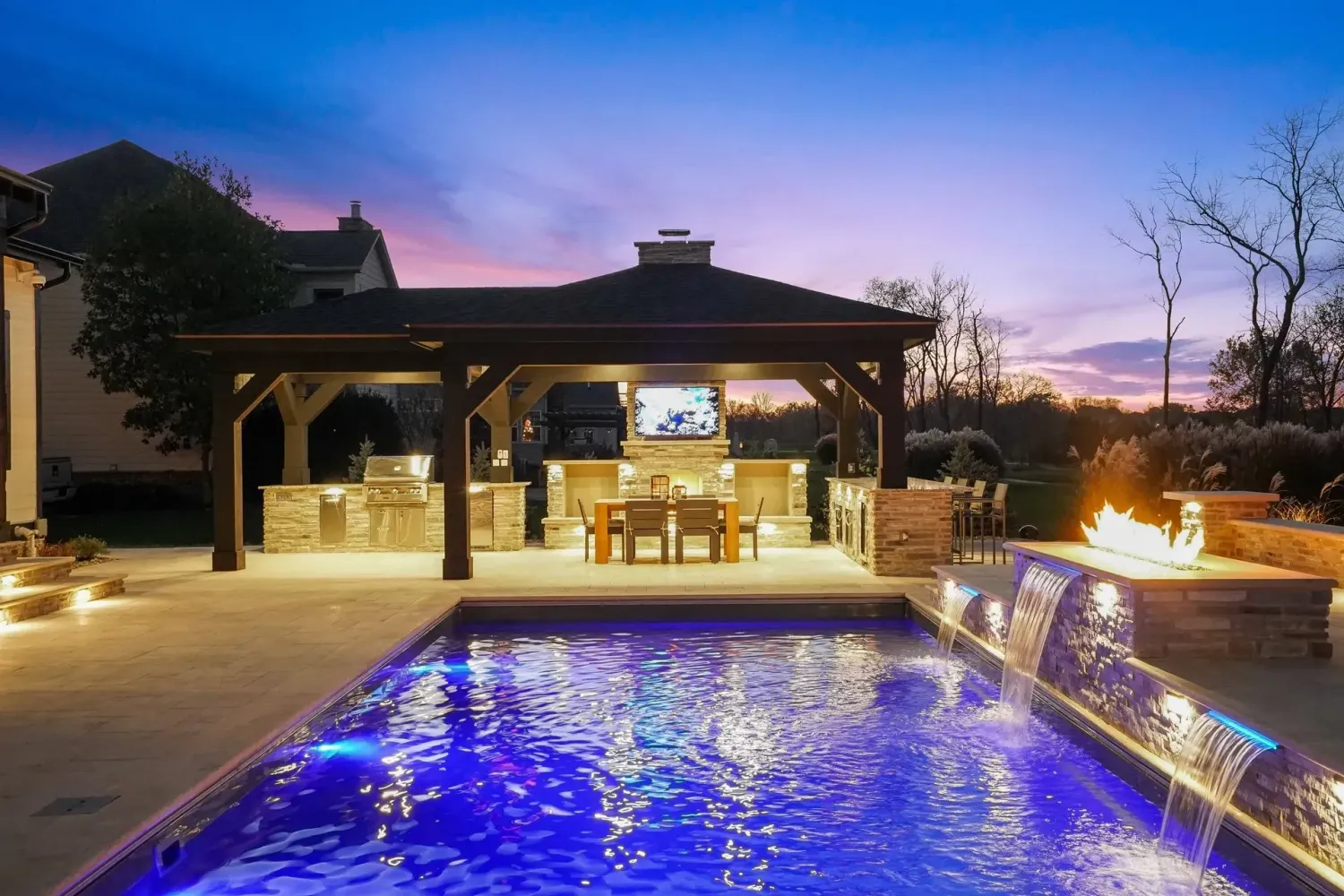
Without that handoff, homeowners end up with two apps, two schedules, and two sets of scenes that drift out of sync within a month. With it, there’s one button in the kitchen labeled “Evening” and the whole property knows what to do.
Chemistry, Evaporation, and the Lake Lanier Humidity Factor
Cumming pools evaporate faster than pools in drier parts of metro Atlanta. Lake Lanier sits on the northern and eastern edge of Forsyth County, and the lake’s surface moisture lifts summertime relative humidity around Vickery, Windermere, and the Sawnee Mountain foothills by an average of 6 to 10 points over Dacula or Loganville at the same hour. That sounds counterintuitive — higher humidity means less evaporation — but the dynamic is non-linear. Evaporation tracks the gradient between pool-surface temperature and air dew point, and summer dew points near Lanier are consistently higher, which compresses the gradient. Net effect: 0.20 to 0.28 inches per day evaporation in July instead of 0.30 to 0.35.
Lower evaporation sounds good until you realize what it means for chemistry. The pool isn’t concentrating dissolved solids as fast, but it’s also getting less rainwater dilution relative to surface area — every rain event near Lanier carries more local mineralization. IntelliChem dosing against live ORP and pH readings handles this gracefully; fixed-dose chlorine pucks or a rigid liquid schedule don’t. On Lanier-adjacent Cumming builds we calibrate the ORP setpoint 20 to 30 mV higher than we would on a Grayson pool to compensate.
Freeze event protection: Forsyth County averages 22 freeze events a year. The IntelliCenter’s built-in freeze protection fires pump circulation at 36°F air temp and holds until 40°F. On heat-pump-equipped Cumming pools we add a second rule — run the booster pump on any fire-feature line to keep the feature plumbing from burst failure on hollow-back runs.
What It Costs, What It Saves, and What Breaks If You Skip It
Here’s the total-package math for a typical new custom Cumming build with full automation, which is the scenario we see most often in Hampton Park, Mashburn Plantation, and The Collection at Forsyth corridor homes:
- IntelliCenter i8P — $5,200 installed
- IntelliChem + acid/chlorine feed — $2,100 installed
- ColorLogic LED pool + spa — $1,600 installed
- Lutron RadioRA 2 (pool, pavilion, landscape zones) — $4,400 installed
- SmartThings + IFTTT commissioning + two homeowner training sessions — included in build
- Total automation line item — $13,300 on a typical $140,000 custom build, or roughly 9.5% of project cost
Annual savings and avoided costs, conservatively:
- Sawnee EMC off-peak scheduling — $280 to $420/year, measured on three Cumming homes we still monitor
- Chemistry savings from dosed-not-dumped feed — $180 to $260/year in muriatic acid, liquid chlorine, and shock
- Early fault alerts preventing a failed heat-pump defrost board or blown pump seal — $1,200 to $2,800 avoided per event, averaging one event every 3 to 4 years on the builds we’ve tracked
The math on the line-item premium works out to roughly a 5-to-7-year simple payback on electricity and chemistry alone, before counting any equipment preservation value. On a pool that’s built to last 30 years, that’s money you get back four or five times over the asset’s life.
What breaks when builders skip automation: the pump runs hotter and longer than it should, chemistry dosing overshoots and undershoots the acceptable range weekly, LED colors never really get used past month three because the manual app experience is friction, heat-pump faults go uncaught until the compressor fails, and the Sawnee rate structure savings are simply left on the table. None of those are catastrophic individually. Together they describe the difference between a pool that feels expensive to own and a pool that feels like the house.
Custom Pool Construction across 20+ cities within 30 miles of Winder, GA
We integrate Pentair IntelliCenter, IntelliChem, and Lutron RadioRA 2 on new Cumming builds and rebuild jobs — engineered around Sawnee EMC service realities and Forsyth County permit review.