
Sixty bags. That’s the number we tracked on a recent Crooked Creek paver install — 60 bags of Gator Maxx G2 poured, swept, and set across 4,800 square feet of driveway, pool deck, and rear terrace. A typical Alpharetta subdivision install takes 10. Milton is a different animal.
Milton estates aren’t subdivisions. Lots run 1 to 5+ acres under AG-1 equestrian preservation zoning, grades drop 6 to 14 feet across a single paver run, and a finished hardscape package — drive, motor court, pool deck, rear patio, pavilion landing — routinely hits 3,000 to 6,000 square feet of laid paver. At that scale, polymeric sand stops being a finishing detail and becomes a structural line item. Spec it wrong, and a $175,000 driveway starts telegraphing joint failure by year three.
This post is about what changes when paver surfaces get big. Not theory. Specific sand brands, specific bag counts, specific application windows tied to the Milton calendar, and specific year-5 and year-10 refresh numbers we’ve written into maintenance proposals from The Manor Golf Club to Cogburn Estates.
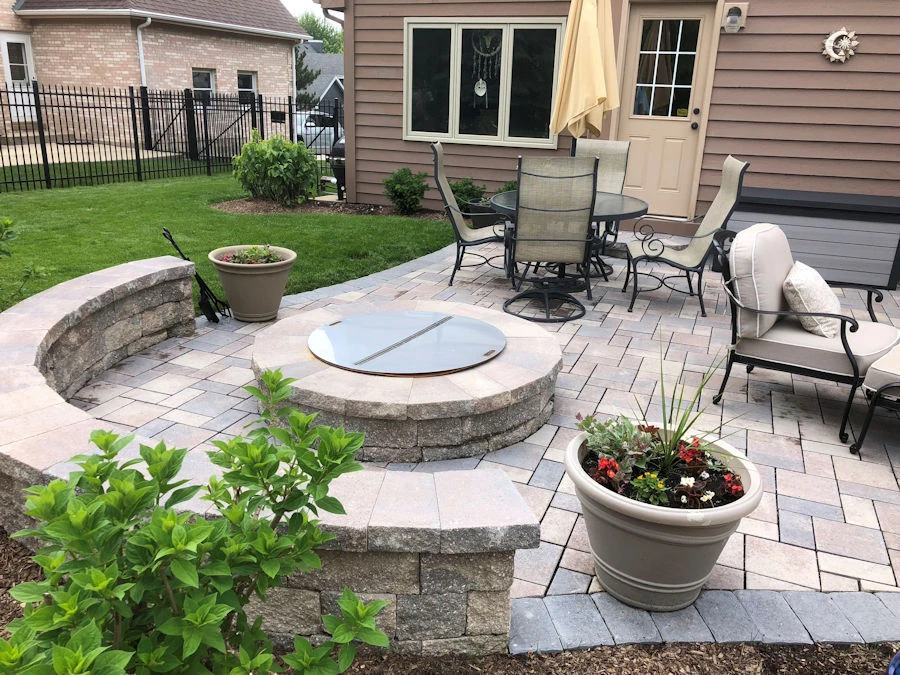
Why Milton Paver Jobs Chew Through Bags Differently
A standard Alpharetta subdivision paver patio — say 480 square feet off the back of a home in a 2015-era community — uses 8 to 14 bags of polymeric sand on initial install. The joint count is low, the paver format is usually the same tumbled Belgard or Techo-Bloc SKU end to end, and the elevation change rarely exceeds 24 inches.
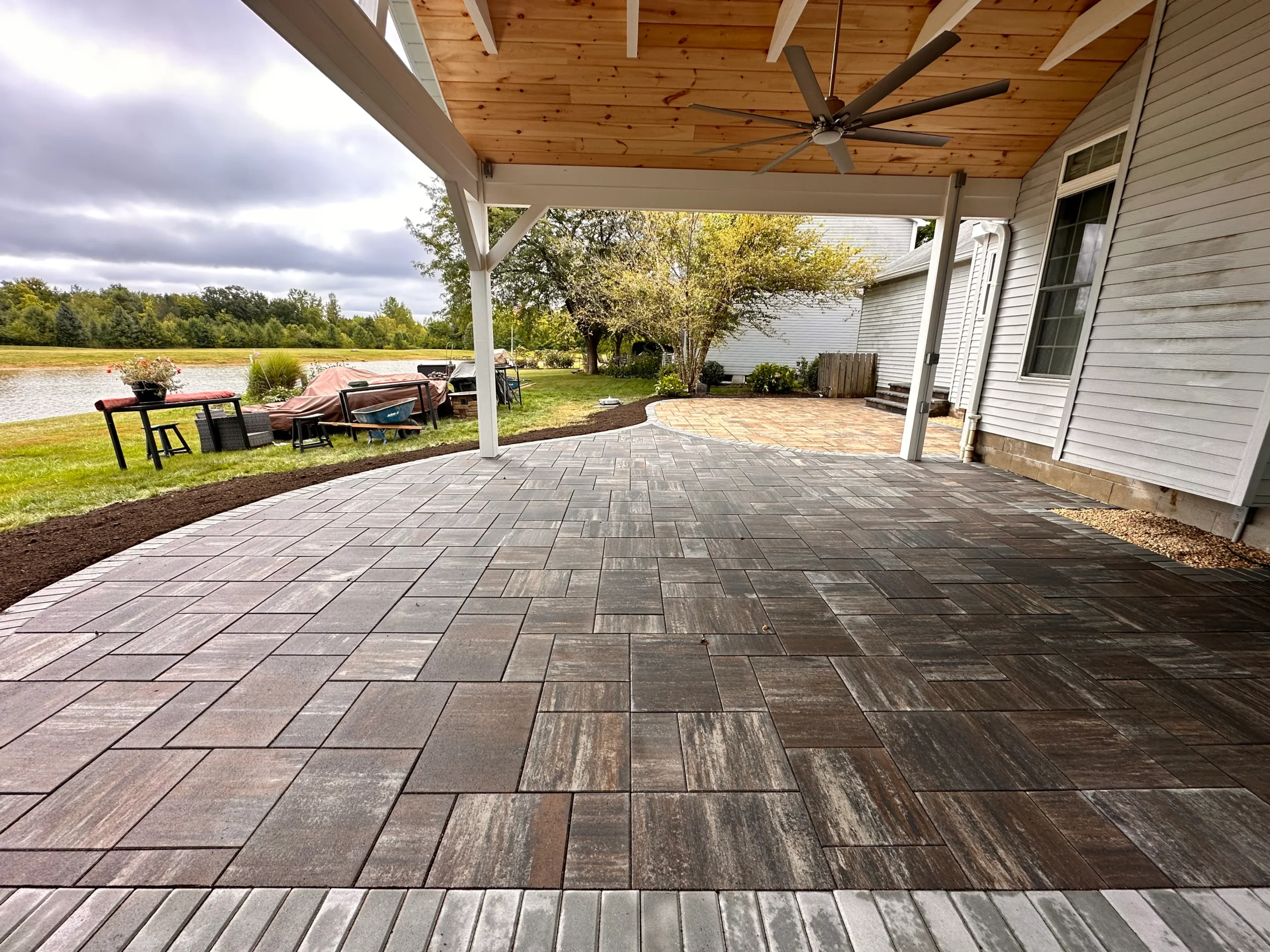
Milton estate work isn’t that. A build inside Atlanta National or off Freemanville Road typically stacks three or four paver zones: a 1,400–2,200 sqft motor court in large-format concrete paver (Techo-Bloc Blu Grande 90, say, in a 24×24 and 24×12 mix), a 600-foot drive run in a tighter herringbone, an 800–1,200 sqft pool deck in travertine or Techo-Bloc Aberdeen, and a rear patio plus pavilion pad in a fourth format. Every format change is a transition joint. Every transition joint is a sand-hungry seam.
Total laid paver on an estate package: 3,000 to 6,000 sqft. Total linear feet of joint: often 4,500 to 9,000. Bag count at roughly 80–100 sqft of coverage per bag of Alliance Gator Maxx G2, depending on joint width and paver thickness: 40 to 80 bags. On the Crooked Creek job, 60 bags was the middle of that curve.
Bag math on estate-scale installs: 60 bags of Gator Maxx G2 at $52/bag = $3,120 material. Labor for bulk polymeric application on 4,800 sqft runs $2,400 at 50¢/sqft. Total polymeric sand line item: $5,520. That’s the number homeowners don’t see coming when they’re looking at a $175K hardscape quote.
The reason bag count climbs faster than square footage isn’t just size — it’s the transition geometry. Where a 12×24 slab meets a 6×9 cobble in a field-border detail, the joint profile shifts mid-run, and the sand has to fill deeper. Where a pool deck drops onto a pavilion pad across a saw-cut transition, the joint width variance from 1/8″ to 3/8″ means more volume per foot. Estate work is geometrically dense in a way subdivision patios aren’t.
Soil and Grade: Why Milton Polymeric Fails Faster Without Spec
Milton sits on Cecil clay over weathered granite, with saprolite shelves showing up during excavation on ridge-line lots along Hopewell Road and Bethany Bend. That geology matters for polymeric sand for two reasons: drainage behavior under the paver base, and seasonal base movement.
Cecil clay holds water. It doesn’t drain fast. When a paver base is cut over that clay and a 4″–6″ compacted GAB layer goes down, any standing moisture at the base level wicks upward through capillary action. Polymeric sand — which is swept in dry and activated with a hand-held mister — is sensitive to sub-grade moisture for the first 48 hours. If there’s moisture coming up from below while the surface is drying from above, the sand glazes at the top and stays powdery underneath. That’s a year-three failure mode, not a visible-at-install failure mode.
Grade exacerbates it. A 6-to-14-foot drop across a paver run on a rolling Milton lot means water concentrates at the low joints during rainfall. Milton sees roughly 53 inches a year. That’s a lot of water moving through the same few feet of joint detail on a sloped drive. Polymeric that’s undercured at the base will pump out of those specific low-point joints first, then progressively uphill.

The spec answer for Milton-grade-and-soil conditions is threefold. First, a thicker compacted base than the 4″ Belgard-standard minimum — we run 6″ GAB on estate drives, 8″ if the lot is Cecil-clay-dominant along the Chicken Creek floodplain in north Milton. Second, a woven geotextile separator between sub-grade and base to keep clay fines from migrating upward into the bedding layer. Third, polymeric sand specifically rated for wider joint widths and wet-climate performance — Gator Maxx G2 over Super Sand Bond, and never Techniseal NextGel on anything over 3,000 sqft because of its lower moisture tolerance during cure.
The Application Window: Why Late September Through Early November Matters
Polymeric sand cures through a polymer activation reaction that needs specific temperature and humidity conditions. Sand goes down dry, gets swept into joints, excess is blown off, and then a fine mist of water activates the polymers. Too hot, and the surface glazes before water penetrates. Too humid at install, and the sand picks up atmospheric moisture before it’s swept fully into the joint and sets prematurely on the paver face — leaving haze. Too cold, and the cure stalls.
Milton’s climate — USDA Zone 8a, roughly 22 freeze events per year, summer highs of 88–93°F — compresses the ideal application window. June through early September is too hot and too humid. Afternoon pop-up thunderstorms during that period routinely kill an install that was 90% done at 3 pm. December through February is too cold and too freeze-thaw-cyclical for reliable cure. March and April work, but pollen load — the infamous Atlanta yellow pollen — contaminates the sand surface and creates a greenish tint that persists for months.
That leaves late September through early November as the ideal window. Nighttime temperatures drop below 65°F (slowing surface cure enough to let joint cure complete), humidity stabilizes in the 45–60% band, pollen is gone, and the 48-hour post-install dry window is statistically reliable. On estate-scale work — where a single application of 40+ bags represents a full crew day and two follow-up hand-misting passes — losing the install to weather is a $5,500 re-do.
Why the window matters more on estate scale: On a 480-sqft subdivision patio, if polymeric fails from heat or humidity, the fix is 10 bags and a morning. On a 4,800-sqft Milton estate install, the fix is 60 bags, two full crew days, and coordination with the homeowner’s Manor Golf Club architectural review calendar if the install triggered a secondary inspection.
We schedule Milton polymeric applications in tight three-week blocks: the last two weeks of September and the first week of November, with the middle of October held as the primary target. Homeowners who want to push into the shoulder season — trying to finish before Thanksgiving entertaining — get told no. That’s not a scheduling preference. It’s a warranty decision.
Estate-Scale Refresh: Year 5 and Year 10 Numbers
Polymeric sand doesn’t last forever, even specced correctly. On Milton estate paver packages, we build a maintenance timeline into the original proposal so homeowners aren’t surprised at year five.
Year 1–4: Spot refresh only. Individual joint sections — typically at high-traffic entrance points, pool-deck drain transitions, or anywhere a heavy vehicle wheel load has repeatedly crossed the same seam — lose 1/4″ to 1/2″ of sand depth. We top-off those specific areas with 2–6 bags. Usually done during annual pressure-wash service at $600–$900 including labor.
Year 5: Partial refresh across 30–50% of joint area. This is the first meaningful intervention — walkable zones show darkened joint lines where sand has dropped and organic matter has filled the void. Work is 18–28 bags of Gator Maxx G2, light joint cleaning with a power broom, re-sweep, re-mist. Labor $3,200–$4,800. This is a one-day crew job on a 4,800-sqft estate package.
Year 10: Full reset. All joints cleaned to a depth of 3/4″–1″ minimum using a hot-water pressure extraction rig, re-filled with fresh polymeric at full spec, and re-activated. This is a 40–60 bag job — essentially an install-scale application minus the paver layout labor. Labor $6,400–$9,600. Done correctly, it resets the wear clock for another 8–10 years.
Add the lifetime numbers up. Original install sand line: $5,520. Year 5 refresh: mid-point $4,000. Year 10 reset: mid-point $8,000. Annual spot refresh across years 1–4 and 6–9: roughly $750 × 8 = $6,000. Total 10-year polymeric sand investment on a Milton estate: $23,520. Spread against the structural protection of a $175K paver package, that’s 13.4% of original hardscape value preserving 100% of it. Homeowners who skip the refresh cycle routinely end up doing a full lift-and-relay at year 12–15 at $40K–$70K.
Milton-Specific Operational Notes
A few things that only matter because of where the work is happening.
Permits: Milton incorporated as a separate city in 2006 and pulled away from Fulton County for planning and development review. Hardscape work that triggers a permit — anything tied to a pool, retaining wall over 4 feet, or impervious surface threshold on AG-1 lots — goes through Milton Community Development at 2006 Heritage Walk. Turnaround is generally 10–14 business days, faster than Fulton’s 18–25 day window, but Milton’s preservation review is stricter on estate-scale builds. If the paver package is inside The Manor, add 4–5 weeks for structural architectural review committee approval before permit application even starts.
Creek-buffer setbacks: Milton enforces 25–75 foot buffers from named tributaries including Cooper Sandy Creek, Chicken Creek, and Lake Creek. Paver layouts on lots along Potters Road or the north edge of the city near the Etowah River tributaries frequently get redesigned mid-proposal to pull hardscape back from the buffer line. That changes bag-count math — a 5,200 sqft proposed layout that loses 600 sqft to a creek-buffer variance still uses polymeric for 4,600 sqft, but the transition geometry shifts and the linear-joint count doesn’t drop proportionally.
Power and water at install: Most Milton estate lots run on Georgia Power, but parcels along the Forsyth County border north and east are on Sawnee EMC. Doesn’t affect polymeric directly — affects crew staging. A Sawnee-fed lot with a long drive from the road often means a generator-powered blower for polymeric excess-removal rather than a hard-wired plug. Adds 45 minutes to setup per day. On a three-day bulk application, that’s 2+ hours of extra labor billed at crew rate.
Equestrian-lot staging: AG-1 lots with active horse operations — polo grounds near Chukkar Farm, active barns off Hopewell Road — need specific staging considerations. Polymeric sand activation requires a misting pass, and over-spray onto adjacent pasture isn’t ideal. We stage material and cure zones at least 40 feet from any active equestrian area and coordinate misting timing with the homeowner’s feeding schedule.
What To Ask Before Signing a Milton Paver Contract
Three questions separate contractors who understand estate-scale polymeric from contractors who’ve only done subdivision work.
One: What bag count are you specifying for this square footage, and which specific product? If the answer is “we’ll figure it out on install” or the product is unnamed, walk. The correct answer names Gator Maxx G2 or Techniseal SmartSand, gives a bag range, and ties it to measured joint linear feet. Vague answers on 4,800 sqft installs cost homeowners thousands in year-three rework.
Two: What’s your application window and what’s your weather-abort policy? A contractor who’ll install polymeric in July because the homeowner wants to entertain by August is a contractor who doesn’t warranty their work past the check clearing. The right answer names late September through early November and tells you they’ve already declined June jobs.
Three: What’s your year-5 and year-10 refresh proposal included in the original contract? Not as a separate upsell — as a written maintenance schedule with unit pricing locked at contract signing. A contractor who hasn’t thought about year 5 on a $175K install is a contractor thinking about the check, not the hardscape.
Milton estates aren’t subdivisions. The paver scale is different, the geometry is different, the soil and grade are different, and the permitting and preservation review are different. Polymeric sand — the one material nobody sees after install — is where all of those differences compound. Specced and applied right, it’s a 15-year structural layer. Specced wrong, it’s the reason a $175,000 hardscape starts looking tired by the third spring.
Estate-scale paver and polymeric-sand work across 20+ cities within 30 miles of Winder, GA
Whether the project is a 4,800-square-foot Milton motor court or a compact rear patio, the sand spec, application window, and refresh schedule all get written into the contract up front.