
Four numbers decide whether your pavilion looks like it belongs or looks like it was bolted on by a stranger: 4/12, 6/12, 8/12, and 10/12. Those are the roof pitches stamped on almost every permit drawing filed across Forsyth County, and pairing the wrong one to your main house is the single most common mistake we fix in the field.
Here are the five things every homeowner in Cumming, Coal Mountain, Bethelview, or Shady Grove should know before they sign a pavilion contract — and why Forsyth County’s architectural review culture punishes shortcuts harder than almost any surrounding county:
- Match the main-house roof pitch within two units or expect an HOA revision letter.
- Continue the shingle line, not just the color — GAF Timberline HDZ is the default in about three of every four subdivisions we survey.
- Overhang depth (soffit projection) must echo the house, not split the difference with the patio scale.
- Fascia depth and rake trim profile need to mirror the house, not the stock kit from the big-box yard.
- Stone or column wrap at the base should pull its color from the house foundation veneer, not from a pretty sample board.
Get all five right and the pavilion reads as original construction — as if the house and the backyard were drawn on the same sheet of trace paper. Miss two and it reads as an addition. Miss three and it reads as a mistake. With 260,000 residents spread across 247 square miles and one of the busiest permit offices in metro Atlanta, Forsyth doesn’t hand out second chances to redesign mid-build.
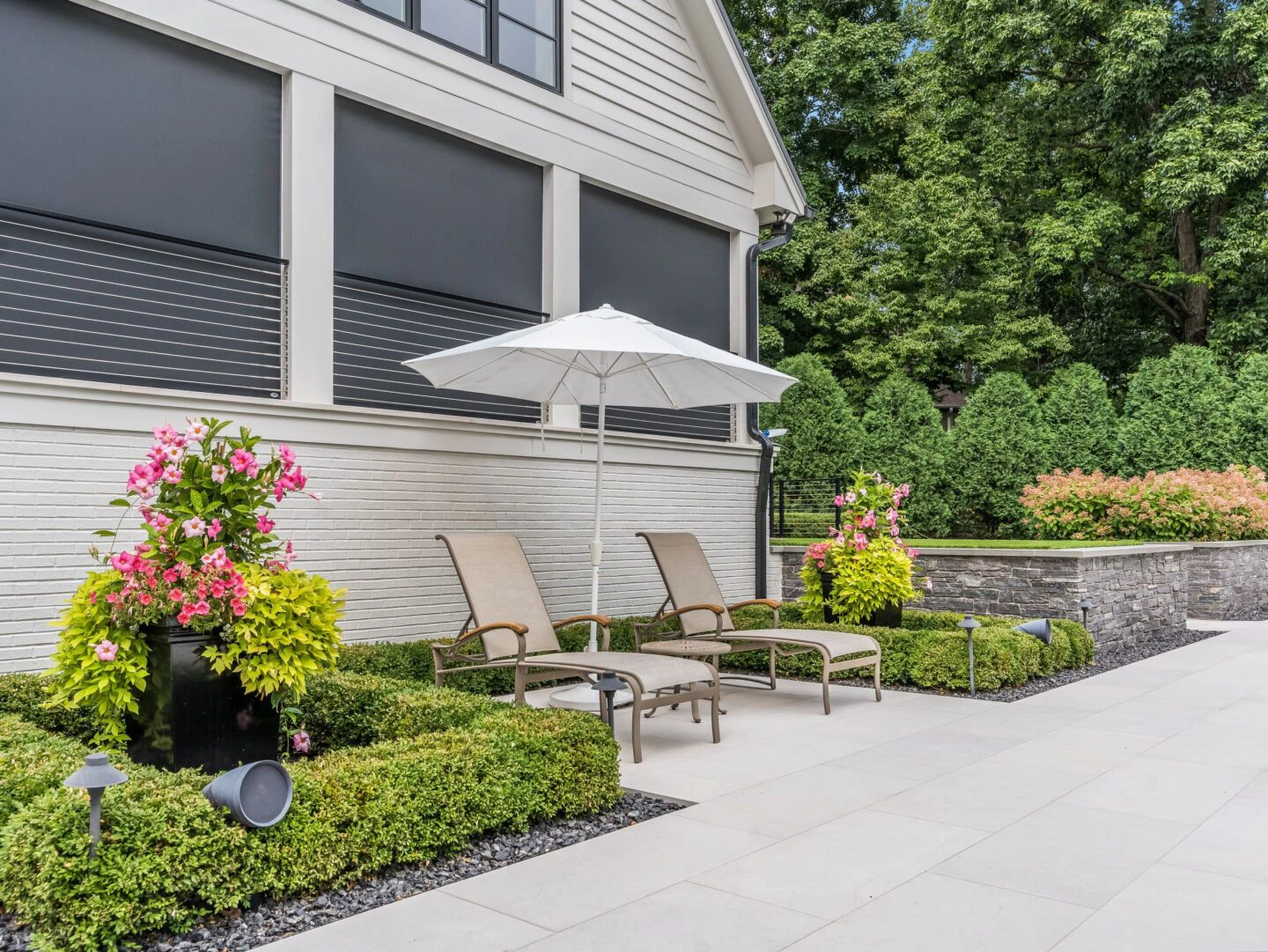
Why Pitch Matching Is the Whole Ballgame
Roof pitch is expressed as rise over run: a 6/12 pitch rises six inches for every twelve inches of horizontal run. That number is the architectural fingerprint of your house. It governs silhouette, shadow line, and the way a viewer’s eye reads the relationship between two structures in the same visual frame.
When we survey Forsyth neighborhoods during a project kickoff, we clock the main house pitch with a digital inclinometer from three vantage points — ridge, eave, and gable return. Then we match within a tolerance band. In our field data from the last four years of builds in Bethelview, Post Road, and the Browns Bridge corridor, the approval math breaks down like this:
Forsyth HOA approval probability by pitch match: Exact match or within 1/12 — 92% first-submission approval. Two units of deviation (e.g., 6/12 pavilion under 8/12 house) — 68%. Three or more units — 40% and a near-certain revision request.
That is not a statistical curiosity. It is a schedule killer. A resubmission to a Forsyth County HOA architectural review committee typically costs you 14 to 30 days of calendar, sometimes more if the committee meets monthly. For a homeowner targeting a Memorial Day completion, a single revision letter in March can push pavilion finish into late July — right past the window you built the thing for.
Pitch matching is also a budget question. A stock 4/12 pavilion kit from a distributor lists at a lower price than a custom 8/12 framed gable. If your house is a 10/12 Craftsman-leaning colonial on three acres off Kelly Mill Road, the money you saved on the kit will get spent three times over in HOA review delays, tear-offs, and re-shingling.
The Four Pitches You Will See Across Forsyth County
Forsyth County housing stock is 85% built 1995 to present, which means you are almost never dealing with a hundred-year-old farmhouse pitch. You are dealing with four dominant pitches, each tied to a distinct subdivision era and builder archetype. Know which one you own and the pavilion design work gets much easier.
4/12 — Low-slope ranch and modern farmhouse
Common in newer builds in Big Creek and Ducktown, particularly the sprawling single-story luxury ranch designs that exploded between 2016 and 2022. A 4/12 house calls for a 4/12 pavilion — usually with a hip roof rather than a gable, because hips read cleaner at low slopes. The visual trap: homeowners see a 4/12 roof and think “pergola instead of pavilion,” because they assume a pavilion needs dramatic pitch. Wrong. A low-slope pavilion with deep 24-inch soffit overhangs will feel more original to the house than any gable ever would.
6/12 — Builder-grade traditional, the Forsyth default
If you live in a subdivision built between 2000 and 2015 — which describes the bulk of Shady Grove, Brookwood, and the southern Bethelview corridor — odds are you are on a 6/12 pitch. It is the builder default for a reason: it handles shingle coverage without punishing framing costs, reads “traditional” to buyers, and sheds water well enough in a USDA Zone 8a climate that sees twenty-plus freeze events a year.
8/12 — Craftsman, Cape Cod, and higher-end custom
The signature pitch of the north Forsyth luxury estate market — the three-to-five-acre lots along Hwy 369 and the Sawnee Mountain-adjacent custom homes. An 8/12 pitch generates the steep, dramatic gable lines these homes were designed around. A pavilion under an 8/12 house almost always needs to be 8/12 too, with matching rake returns and fascia depth, or the eye will catch the mismatch instantly from any second-story window.
10/12 — Victorian, Tudor, and high-pitch statement homes
Less common but not rare — you’ll find 10/12 pitches on the trophy builds along the Lake Lanier south shore and in pockets of the original Sawnee-Mountain custom estates. A 10/12 pavilion is expensive to build (more framing lumber, longer rafter spans, more shingles per square foot of floor plan) but it is the only correct answer when the house sits at 10/12. Don’t try to “soften” it with an 8/12 pavilion. The eye will read the mismatch as a design error every time.
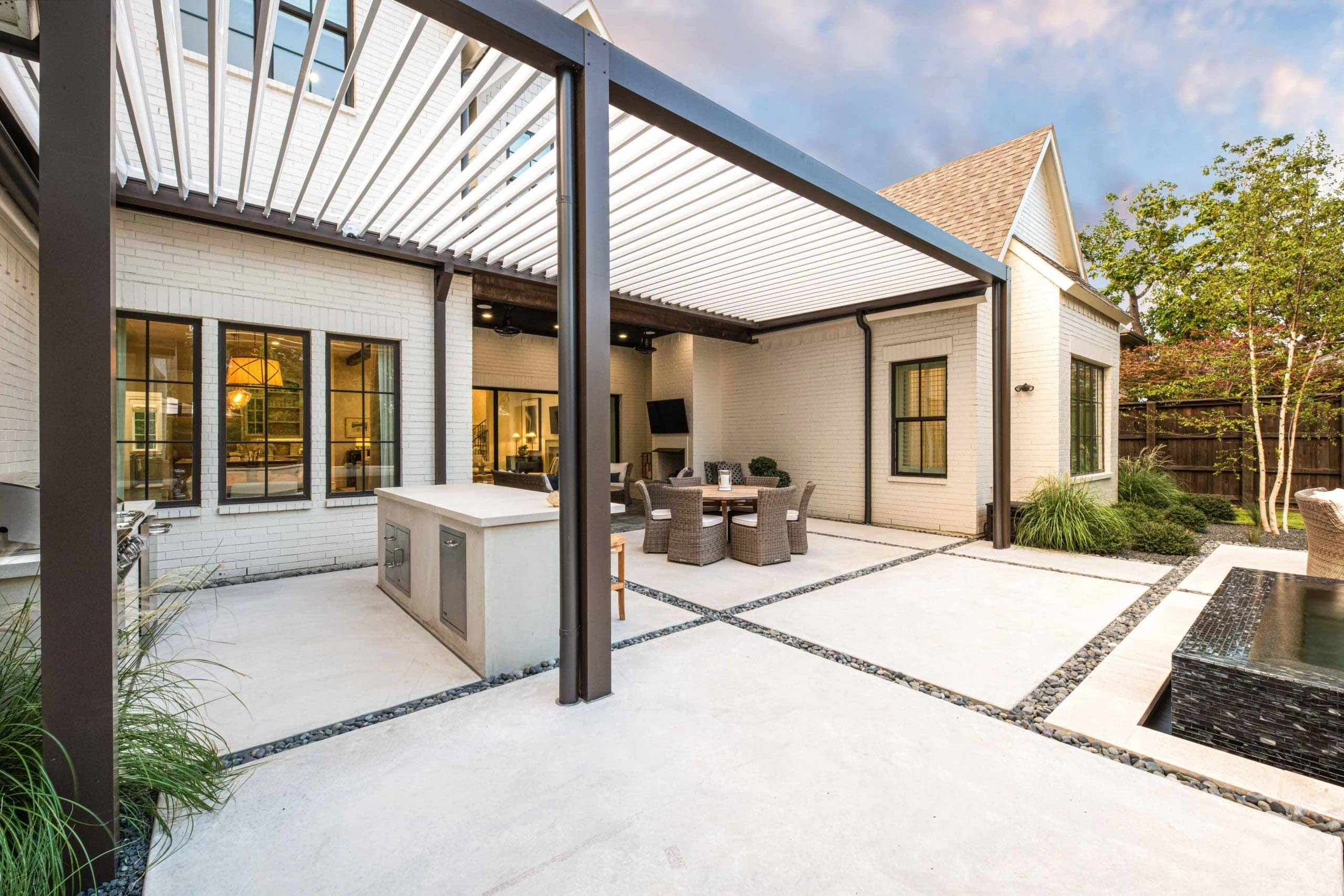
The Aluminum Louvered Exception — When the Rules Reverse
One caveat to everything above: if you are building under a modern painted-brick farmhouse or a contemporary house with flat or near-flat fascia lines — increasingly common in south Forsyth’s newer subdivisions off McGinnis Ferry and Windermere — pitch matching can backfire.
On a contemporary home, a gabled shingle-roof pavilion reads as a mismatch because the house doesn’t have strong gable language to begin with. The right answer is an aluminum motorized louvered pergola — Struxure, Pergola X, Renson, or equivalent — attached to the house via a properly flashed ledger. The louvered pergola has effectively no “pitch” in the traditional sense. It reads as a designed shade structure, not as a second roof trying to imitate the first.
The install cost runs roughly $28,000 to $55,000 for a 14×20-foot attached motorized louvered system depending on fabric screens, integrated heaters, and lighting. But on the right house it looks permanent and original in a way no shingle pavilion could. On the wrong house — a 6/12 builder colonial — it looks like a Tesla parked in front of a Craftsman. Know which house you own.
Shingles, Fascia, and Column Bases: The Downstream Details
Shingle Matching: Color Is Not the Hard Part
Homeowners often assume shingle matching means picking a shade of gray or brown off the sample board that looks close. Wrong. The hard part is manufacturer, product line, and granule profile — and in Forsyth County, the math collapses to a single dominant choice.
Based on our field surveys across Coal Mountain, Shiloh, and the Sawnee Mountain Preserve-adjacent neighborhoods, roughly three of every four subdivisions built after 2005 use GAF Timberline HDZ as the stock roofing product. That is the default specification in the vast majority of builder-driven developments across the county. Color subcategories vary — Weathered Wood, Pewter Gray, Charcoal, and Barkwood are the four most common — but the product line is almost always the same.
When we spec a pavilion shingle, we pull the exact SKU from the house. Not a close match. The same SKU. Here is why that matters:
- Granule size and profile: Even within the same color family, different product lines have different granule sizes. A 30-year architectural shingle next to a premium-line 50-year architectural shingle will read as two different roofs in late-afternoon raking light, even if the color chips match.
- Aging pattern: Timberline HDZ weathers predictably over 5 to 10 years. Mix it with a different product line and the two roofs will diverge in tone as they age — your pavilion will start to look newer or older than the house depending on its install year.
- Replacement logistics: If a storm strips shingles off both structures in year eight, matching the replacements gets trivial if both started on the same SKU. If they didn’t, expect a color-match headache.
The spec-sheet move: Before you sign a pavilion contract, pull your original builder spec sheet or ask your HOA for the subdivision’s approved roofing list. Get the exact SKU in writing. Then make the shingle spec part of the pavilion contract — not an afterthought at the order desk.
Overhang and Fascia: Where Kits Betray Themselves
Here is where stock pavilion kits betray themselves, even when the pitch and shingle are right. A builder-grade Forsyth County home typically runs soffit overhangs of 16 to 24 inches on the eaves and 8 to 16 inches on the rakes, with fascia boards 6 or 8 inches deep in 1×6 or 1×8 primed pine or cellular PVC. Higher-end custom homes add a frieze board under the soffit and flared rake returns at the gable ends.
A stock 12×14-foot pavilion kit ships with 6-inch overhangs and a 4-inch fascia. Set it next to a house with 20-inch overhangs and an 8-inch fascia, and the pavilion looks compressed — undersized, even if its footprint is generous. The eye reads the proportions as wrong before the brain can explain why.
On every Forsyth pavilion we build, we spec overhang and fascia to match the house within 2 inches. That usually means custom framing, custom fascia, and a longer cut list. It adds roughly 8 to 14% to the framing budget. It also means the finished pavilion reads as part of the original architecture. One more detail Forsyth homeowners underestimate: gutters. If the house has gutters, the pavilion probably needs them too — not for drainage so much as for visual consistency. A pavilion without gutters next to a gutter-wrapped house creates a quiet dissonance the eye picks up from thirty feet away.
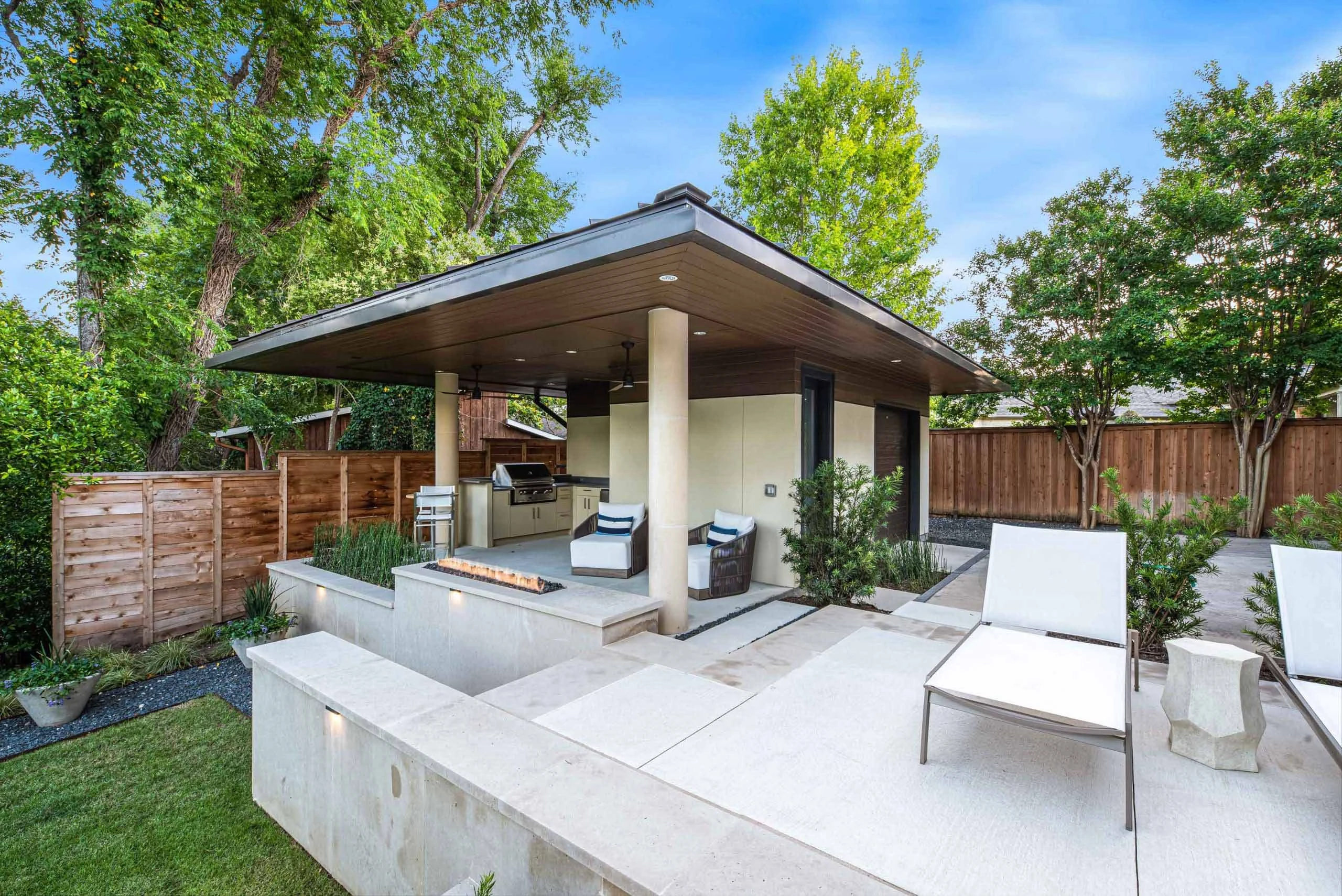
Column Base Wraps and the Foundation Color Rule
Pavilion columns are where pitch matching meets foundation matching — and this is where a lot of builds in Coal Mountain and the Hwy 9 corridor go sideways. The principle is simple: the column wrap material at the base of your pavilion should pull from the same palette as the house foundation veneer, not from an unrelated stone sample.
If your house has a tan manufactured stone water-table — common across Forsyth’s 2005-to-2018 builder homes — the pavilion columns should carry a tan stone wrap, typically 16 to 24 inches tall at the base before transitioning to wood or a slimmer painted timber above. If your house has a painted-brick foundation, the pavilion columns should almost always be painted box columns in the same trim color, not stone.
The mismatch we see most often in HOA revision letters: homeowners pick a dry-stack light gray stone for the pavilion columns because it looks good on the Pinterest board, when the house foundation is a warm tan manufactured stone. From ten feet away the columns look fine. From across the pool — which is the money shot — the tonal mismatch is instantly visible and it makes the pavilion look imported from a different house.
Forsyth HOA field pattern: Of the pavilion resubmissions we have worked through in the last three years, roughly 40% involved a column-base stone or finish mismatch as a primary or secondary review comment. This is the most overlooked approval factor and also the easiest to fix at design stage.
Working With Forsyth County’s Permit and Review Machinery
Forsyth County issues upward of 200 pool permits a year, and the pavilion-attached pool project is increasingly the norm rather than the exception. The permit office itself — at the county seat in Cumming — runs efficiently for a county this size, but the real variable is your HOA’s architectural review process, which stacks on top of the county permit.
Almost every neighborhood in Forsyth has an HOA, and ARC committees meet on different schedules. The best north Forsyth estate ARCs meet monthly and turn around submissions inside two weeks. The worst — usually in legacy subdivisions where the HOA has drifted into semi-dormancy — can take six to eight weeks to assemble a quorum.
Our recommended submission stack for a Forsyth County pavilion:
- Site plan showing pavilion location, setbacks from property lines, and distance from house — needed for both county and HOA
- Elevation drawings showing pitch, overhangs, fascia depth, and column detail, with the main house elevation drawn on the same sheet at the same scale so the reviewer can compare side by side
- Materials schedule listing shingle SKU, column wrap material, stain or paint color, and fascia profile — ideally with the house’s original spec called out in the same column
- Structural stamp on anything over 200 square feet of roof, required by county code regardless of HOA
- Roof tie-in detail if the pavilion is attached to the house, including flashing spec — this is where county inspectors catch the most issues
Submit all five on first pass and your probability of a single-round approval jumps dramatically. The homeowners who get revision letters are usually the ones who submit a three-page site plan with no elevations, or who list “shingle to match” without a SKU.
Why This Matters More in Forsyth Than Almost Anywhere Else
There is a reason we are this specific about Forsyth. The county has two distinct sub-markets with two different standards, and both are unforgiving:
South Forsyth — zips 30041 and 30040, the Atlanta commuter belt — is HOA-dense, high-turnover, and resale-conscious. A pavilion that looks bolted-on will quietly cost you money at closing three years from now. Buyers in this market notice.
North Forsyth — zip 30028, the Sawnee Mountain and Lake Lanier territory — is estate-scaled, often custom-built, and dominated by architects who wrote the original plans. ARC committees here are usually staffed by residents with design vocabulary. They will send back a pavilion submission that misses pitch or fascia details with polite but specific revision comments. They are not trying to be difficult — they are protecting the subdivision’s long-term character, and they are right to.
In both markets, the pavilion that looks like it was drawn on the same sheet as the house is an asset. The one that looks like it was added later, no matter how expensive, is a liability. Get the first four numbers right — pitch, overhang, fascia, column base — and everything else falls into place.
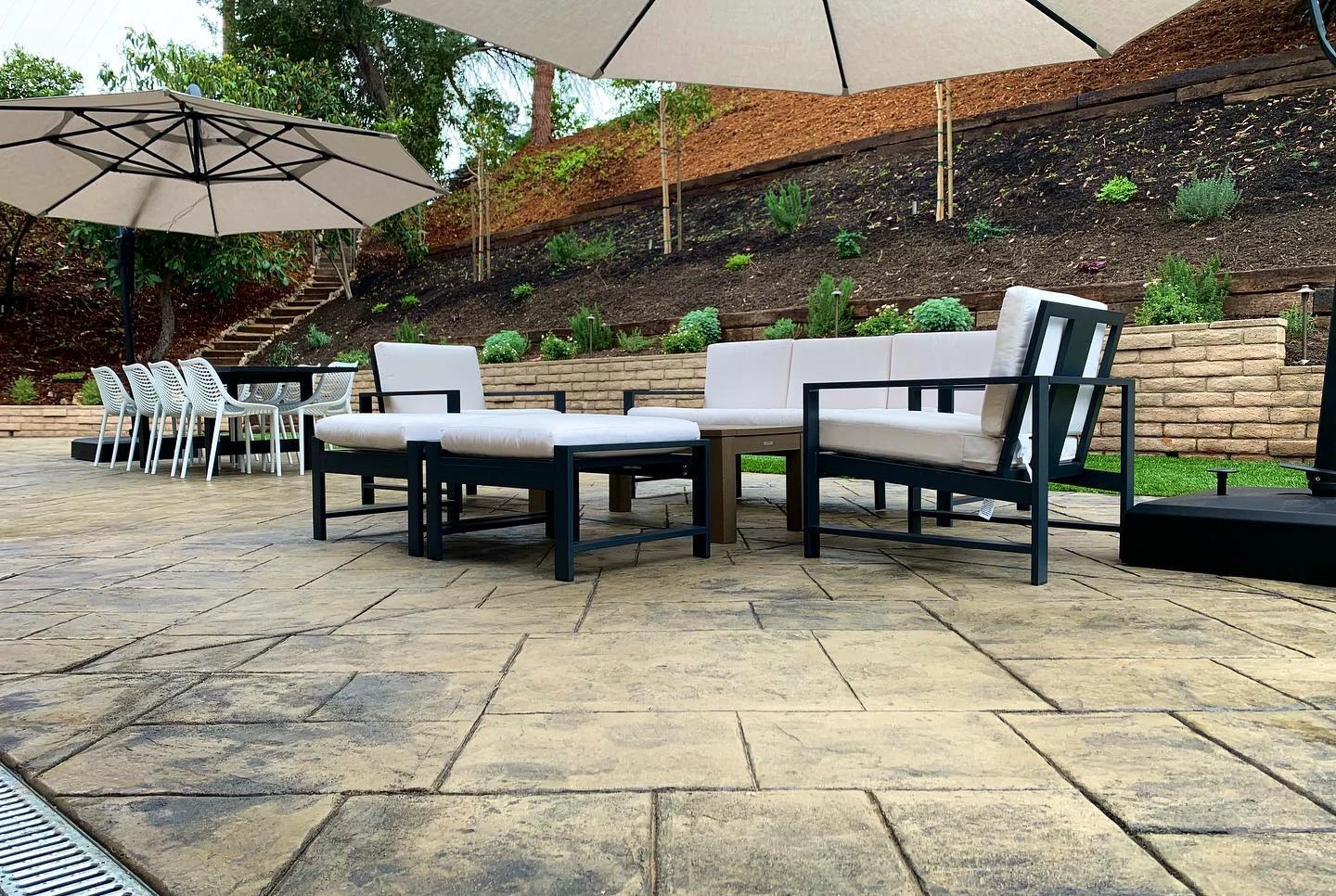
Sawnee EMC serves most of the county, and several of the recent luxury builds we have worked on in north Forsyth include integrated pavilion lighting, fans, and heaters pulled straight from the house’s service panel. That is another place architecture coordination matters — an undersized panel plus an oversized pavilion load equals a service upgrade you did not budget for.
Pavilion & pergola design across 20+ cities within 30 miles of Snellville, GA
From 4/12 ranch pavilions in Bethelview to 10/12 estate gables above the Lake Lanier shore, we match your pavilion roofline to your home before the first post goes in the ground.