
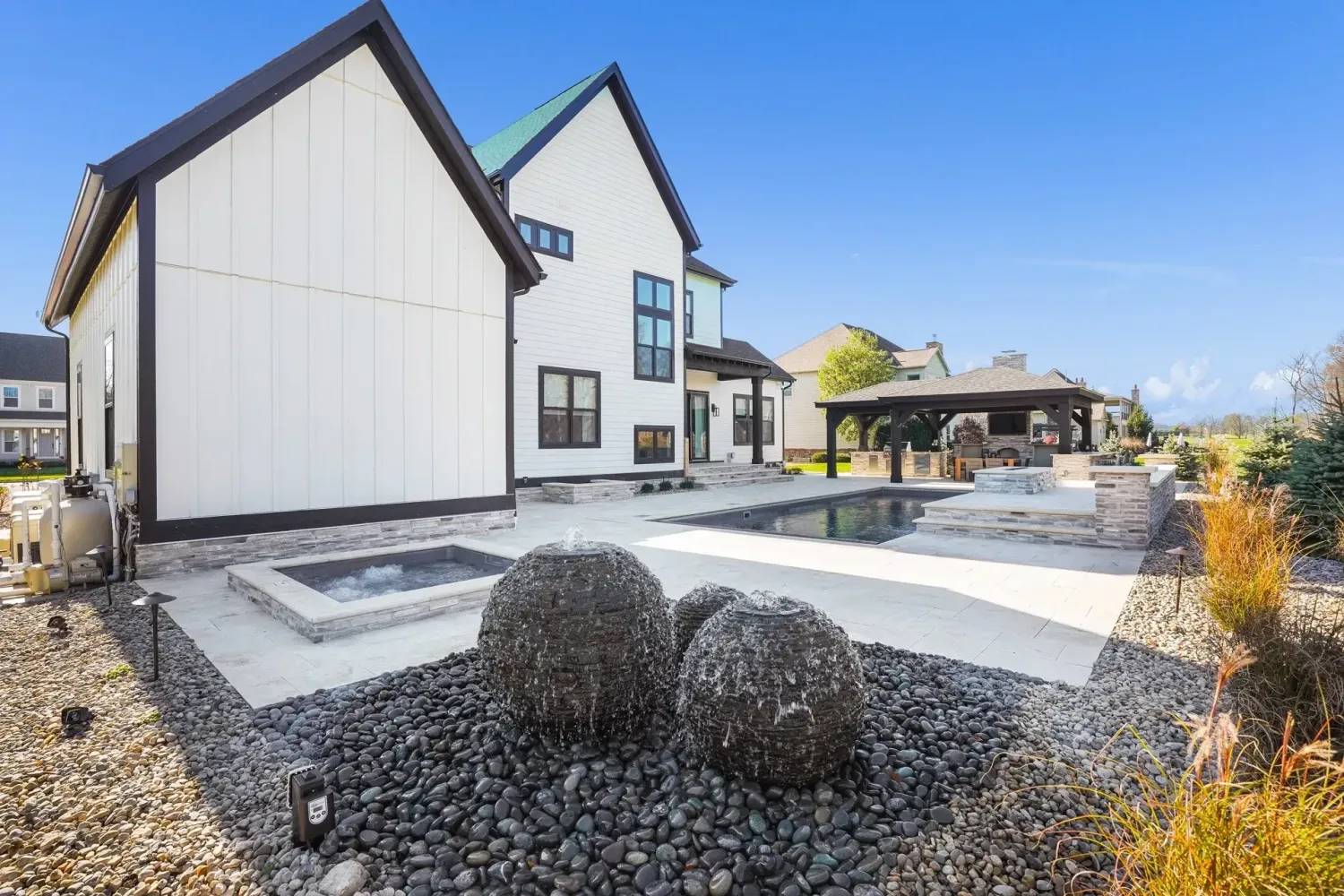
The homeowner walked us to the back corner of a 1.04-acre Hutchinson Farm lot in north Alpharetta, pointed at the tree line, and said he wanted one permit, one crew, one warranty — pool, pavilion, and outdoor kitchen delivered as a single integrated backyard. What we designed and built for him ran $462,000 all-in, and the reason it reads as one outdoor room instead of three separate projects has almost nothing to do with the pool.
This is a case study from that project. It’s written for the Alpharetta homeowner sitting on a 0.8- to 1.2-acre lot in Hutchinson Farm, Country Club of the South, Windward, or White Columns who’s tired of looking at a disconnected pool-plus-grill-station setup and wants the back of the house to resolve into something architecturally coherent. The house was a 2003 transitional farmhouse with a 10/12 primary roof pitch, cedar shutters, and a screened porch the owner wanted to keep. Every decision below flows from that starting condition.
We’ve built enough of these integrated scopes across Fulton County to know where the seams usually fail — where the pavilion ends up feeling tacked on, where the kitchen reads as a grill cart instead of a room, where the pool deck dead-ends into grass because nobody thought about how the three elements would share a drainage plane. The job on this Hutchinson Farm lot was to solve all of that at design time, not in the field.
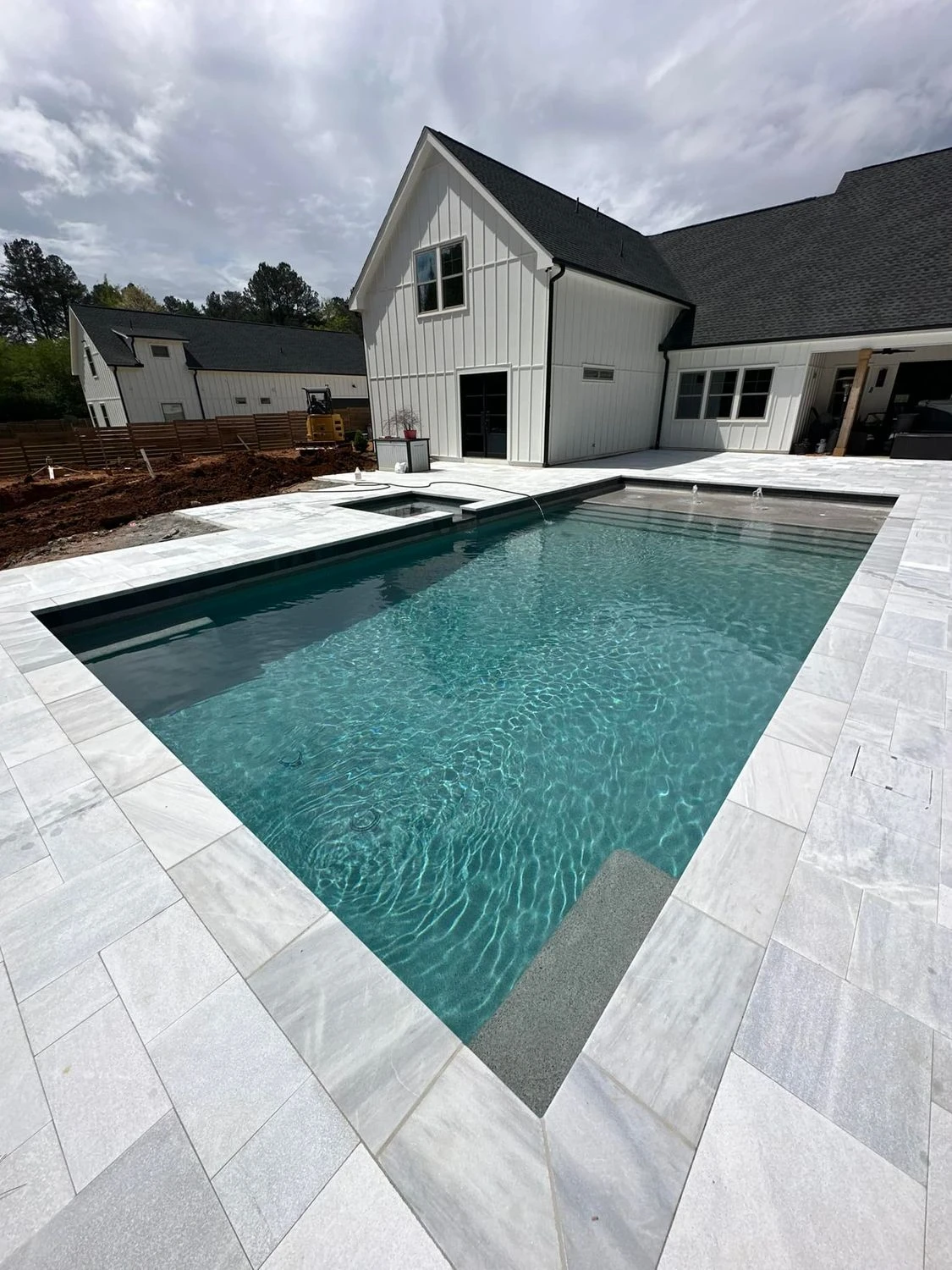
The Lot: Why Hutchinson Farm Changes the Design Math
Hutchinson Farm sits on the north side of Alpharetta off Hopewell Road, inside Zip code 30004, and the subdivision’s lot inventory is almost uniformly 0.8 to 1.2 acres with rear property lines that back to either mature hardwoods or a shared horse pasture. That matters more than most people realize.
On a half-acre suburban lot, a pool pavilion is an ornament — there isn’t room for it to be anything else. You fight for every linear foot of deck. On a 1.04-acre lot like this one, with a rear yard that’s 145 feet deep from the back of the screened porch to the tree line, the design conversation shifts. You can actually build a pavilion that reads as a second structure, not a lean-to. You can place the outdoor kitchen so prep, cook, and dining zones each get their own footprint. You can hold 12 feet of lawn between the pool deck and the patio edge and the composition still feels tight.
The Hutchinson Farm elevation also runs about 1,100 feet, with a gentle 4-foot drop from the back of the house to the tree line. That’s the kind of grade change that reads as nothing when you walk the yard but becomes a real problem once you put a 42×20 pool, a 16×24 pavilion, and a 22-foot kitchen run into the drawing. Every one of those elements wants to sit on a different elevation, and if you don’t resolve that at the site plan stage, you spend the last two weeks of the job building awkward step-downs and trying to hide drain tiles.
Hutchinson Farm typical lot spec: 0.8–1.2 acres, rear yard depth 130–160 ft, typical grade change 3–6 ft front-to-back, Cecil-series Piedmont subgrade. HOA architectural review runs 2–3 weeks and will request a detail-level site plan, material samples, and roof-pitch confirmation for any accessory structure.
Single-Permit All-In Scope: What $385K to $525K Actually Buys
Before we walk through the design, it’s worth being transparent about pricing on this kind of scope. An integrated pool-pavilion-kitchen build on a Hutchinson Farm-scale lot in Alpharetta runs $385,000 to $525,000 in 2026 dollars. The project we’re walking through landed at $462,000, and the line-item breakdown matters because most homeowners have never seen how the math actually distributes.
- Pool shell, plumbing, equipment: $168K — 42 ft x 20 ft freeform with raised spa, automatic cover track, Pentair IntelliFlo3 variable-speed pump, Pentair MasterTemp 400 heater, and full Lutron-compatible lighting.
- Bluestone pool decking: $46K — 1,850 sq ft of thermal-finish bluestone over a compacted Piedmont subgrade with 4-inch open-graded aggregate base.
- 16×24 pavilion, cedar-clad ceiling: $94K — includes engineered trusses matched to the 10/12 primary house pitch, standing-seam metal roof, T&G western red cedar ceiling, two Hunter Fan Industrial fans, and hidden LED perimeter lighting.
- Outdoor kitchen + masonry enclosure: $68K — 22-foot run with Big Green Egg XL, 36-inch Alfresco gas grill, full sink, 24-inch Perlick refrigerator, Scotsman nugget ice maker, granite counters, and stacked-stone veneer to match the house foundation.
- Integrated systems — irrigation, drainage, lighting, AV: $38K — everything tied to a single Lutron RA2 Select controller with scene presets; outdoor TV and sound integrated into the pavilion ceiling plane.
- Landscape + privacy planting + grading: $28K — screen planting along the pasture-facing property line, transplanted existing magnolias, final grade to the tree line.
- Permits, HOA review, utility coordination, mobilization: $20K — City of Alpharetta permits through 2 Park Plaza, Hutchinson Farm ARB submittal, Georgia Power service-drop relocation.
The reason that list sits in one scope and one contract instead of four subcontractors negotiating in the field is the whole point of this post. When the pavilion carpenter, the pool crew, the mason, and the kitchen equipment installer are all working off one set of drawings and one critical-path schedule, you stop seeing the $15,000-to-$22,000 of hidden coordination cost that usually buries homeowners halfway through a piecemeal build.
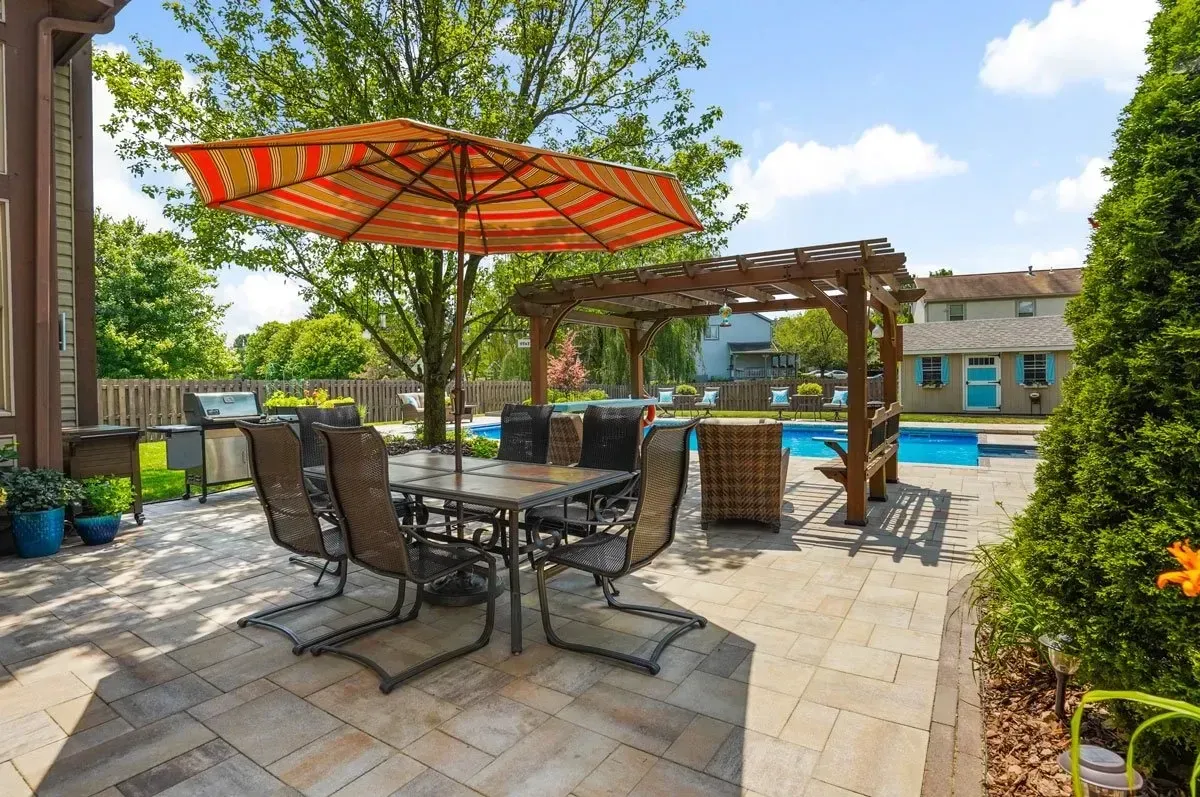
Pavilion First, Pool Second: Why We Reverse the Usual Sequence
On most integrated backyard projects, the pool is designed first and the pavilion gets shoehorned in afterward. We flip that on lots like this. The pavilion is the architectural anchor — it has a roof pitch, a ridge line, a ceiling plane, and a visual mass that either does or doesn’t resolve with the house. You can move a pool 3 feet. You cannot move a pavilion 3 feet without redrawing everything.
So the first design decision on the Hutchinson Farm lot was where the 16×24 pavilion would sit. We placed it 34 feet off the rear corner of the house, rotated 18 degrees off the house’s long axis, so the ridge of the pavilion roof echoed the gable on the back of the house without directly mimicking it. That 18-degree rotation also opened the view from the screened porch through the pavilion and out to the tree line — a sight line the homeowner specifically asked for but couldn’t articulate until we stood together at the back door with stakes in the ground.
Once the pavilion was placed, the pool followed. The shell was drawn so its long axis ran parallel to the pavilion’s long axis, with a 6-foot bluestone transition deck between the pavilion slab and the pool coping. That 6-foot dimension wasn’t arbitrary — it’s the minimum width that lets two lounge chairs sit end-to-end without crowding, and it’s also the minimum depth a pavilion-side bar-seat layout needs to clear.
Matching the Pavilion Roof to the House — The Detail That Sells the Whole Project
The single most load-bearing design detail on this build was the pavilion roof. If the pavilion roof pitch doesn’t match the primary house, the structure always reads as an afterthought — and in a neighborhood like Hutchinson Farm, where the transitional farmhouse architectural vocabulary is consistent, a mismatched pavilion is the kind of detail the Hutchinson Farm ARB flags inside the first week of submittal.
The house had a 10/12 primary pitch and a 8/12 secondary pitch on the rear gable. We specified the pavilion at 10/12 — matching the primary, not the secondary — because the pavilion sits in the primary sight line from the screened porch and needed to feel like a natural extension of the roof composition, not of the gable subordinate to it. The trusses were engineered to span the full 24 feet without interior posts, using a scissor-truss configuration that gave us an 11-foot interior ceiling height at the peak without pushing the exterior ridge line too tall.
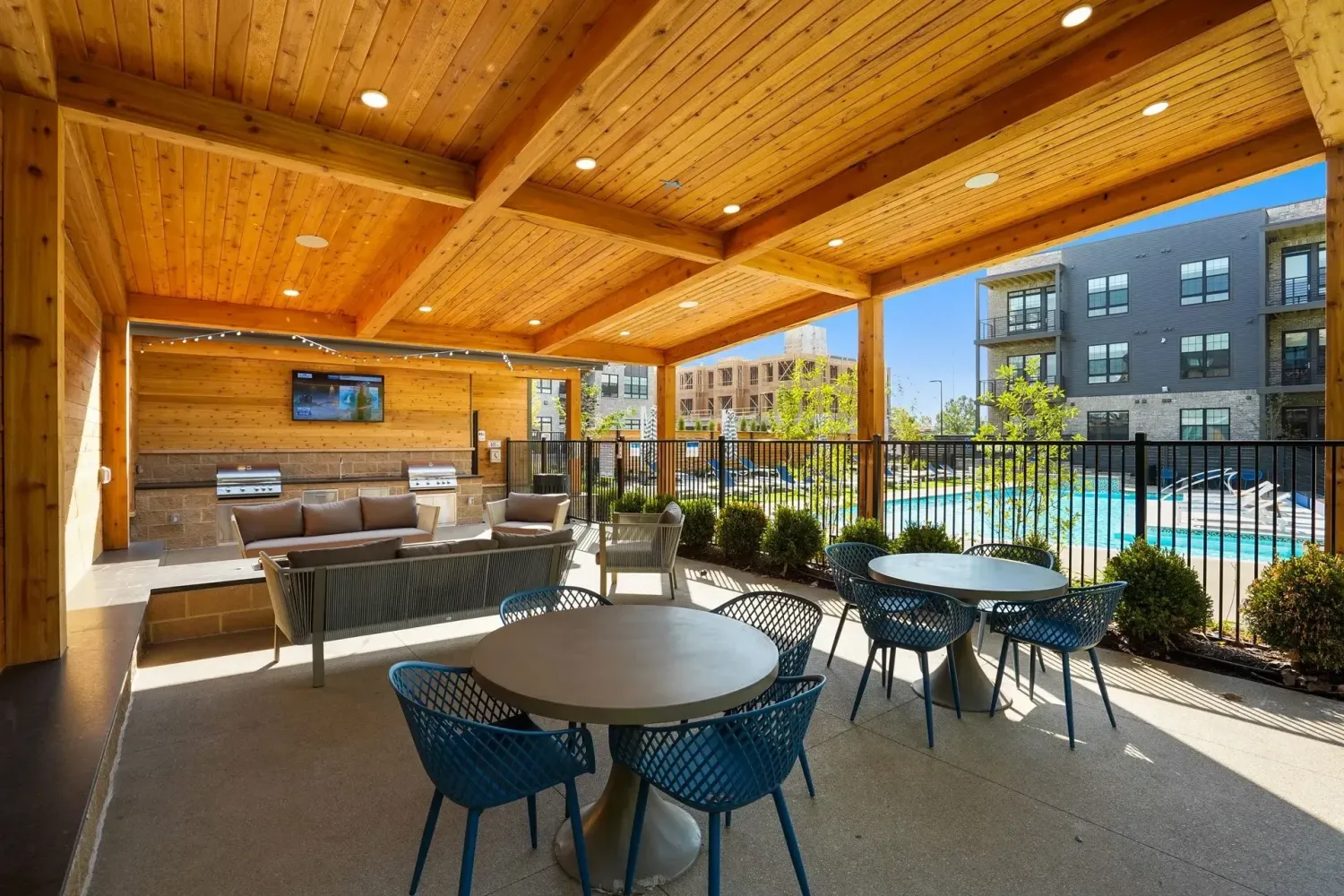
The ceiling plane got tongue-and-groove western red cedar, stained to match the cedar shutters on the house, with hidden perimeter LED cove lighting run inside a 3/4-inch reveal between the cedar and the top of the interior cedar beam. Two Hunter Fan Industrial ceiling fans, finished in oil-rubbed bronze to match the kitchen-side sconces, moved the air enough that the pavilion stayed usable into the 94°F Alpharetta July afternoons without resorting to misting systems.
Everything about the pavilion — the roof pitch, the cedar species, the fan finish, the stain color — was chosen because it already existed somewhere on the house. That’s the rule we work by on integrated hardscape design: nothing new on the pavilion that isn’t echoing something existing on the primary structure.
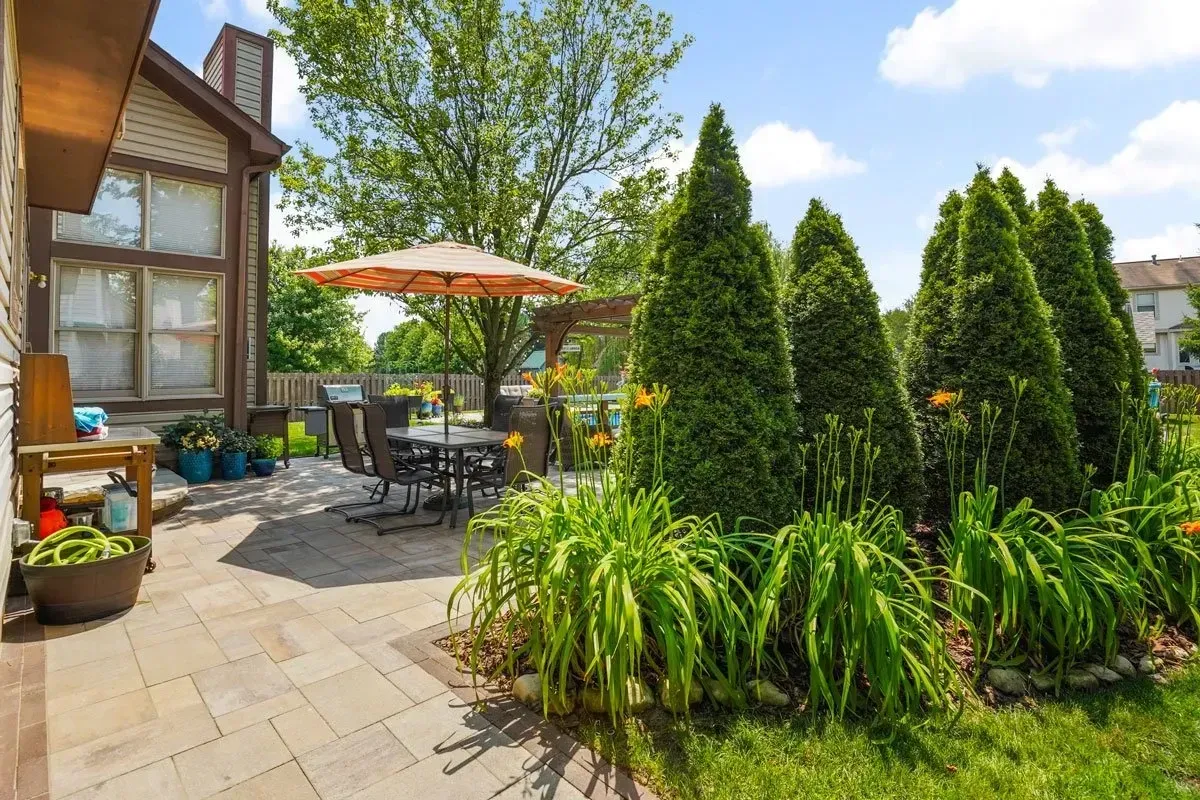
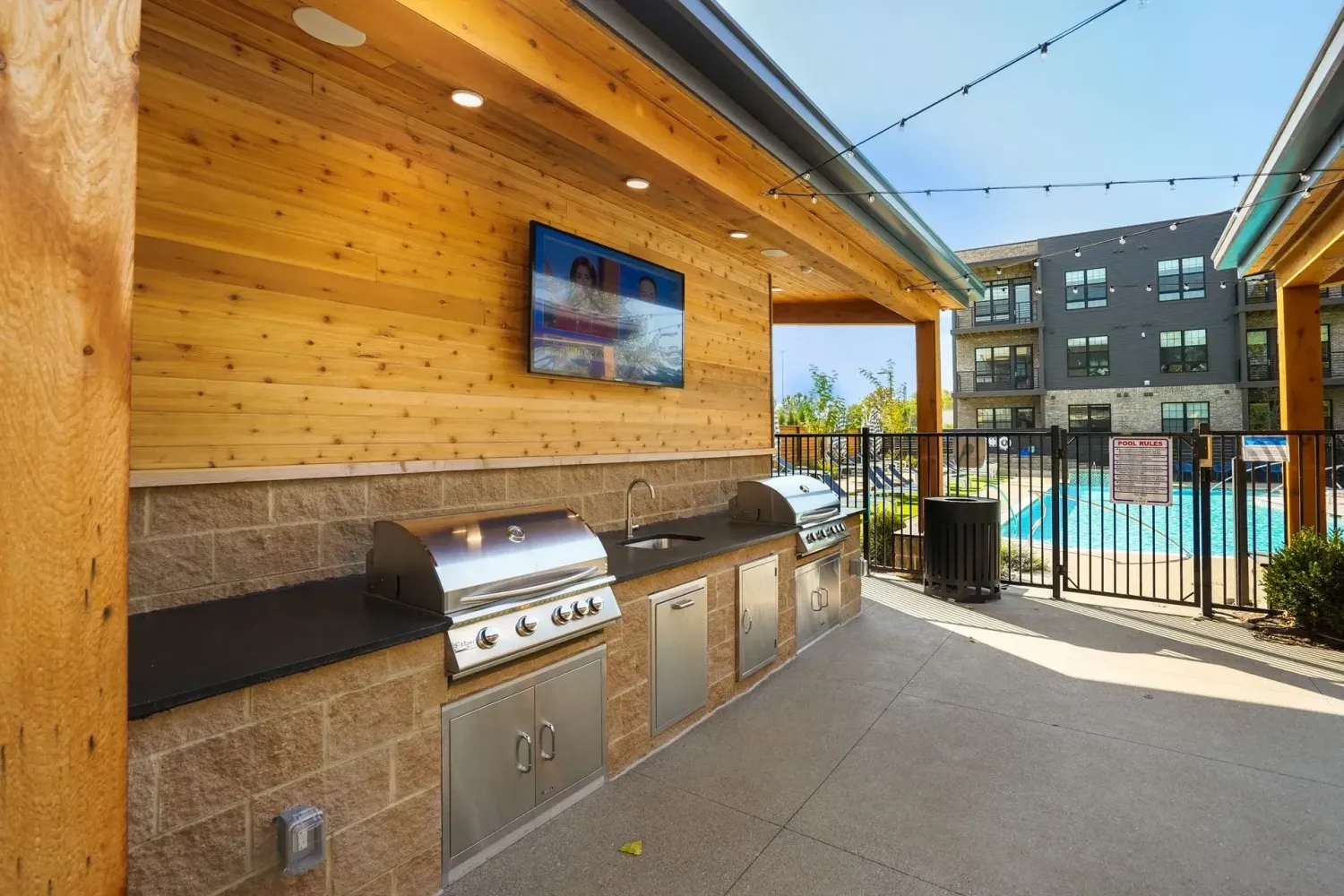
The Outdoor Kitchen: A Room, Not a Grill Station
The biggest failure mode in outdoor-kitchen design is building a grill station and calling it a kitchen. A grill station is a 6-foot counter with a gas grill, a small fridge, and maybe a side burner. A kitchen is a 20- to 24-foot run where prep, cook, and service each have a dedicated zone, and where the whole thing feels like it was laid out by somebody who cooks — because in most of these projects, it was.
The Hutchinson Farm kitchen ran 22 linear feet along the south wall of the pavilion, tucked under the eave with a 36-inch-deep counter (not the 24-inch standard — the extra depth gives you real platter-landing room). The equipment layout, left to right, read as: 24-inch Perlick refrigerator, trash pullout, Big Green Egg XL in a dedicated masonry nest, prep counter with undermount sink, 36-inch Alfresco gas grill, prep counter with Scotsman nugget ice maker below, and a beverage-station counter with open shelving above.
The Big Green Egg matters. A lot of outdoor kitchen builds in Alpharetta skip it, default to gas only, and homeowners regret it inside the first season. The Egg pulls a different cooking mode — low-and-slow smokes, pizza on the 500°F stone, overnight brisket — that a gas grill physically cannot do. Putting the Egg in a masonry nest with proper clearance (8 inches of non-combustible surround on all sides) is a one-time installation that pays back in five-figures of usable cooking nights across the next decade.
Countertops on this build were 3cm leathered-finish granite in a warm gray that picked up the stacked-stone veneer. We pulled the counter edges flush with the outside face of the masonry enclosure, which meant the stone had to be templated after the veneer was set — adds about a week to the schedule but eliminates the grout joint between stone and counter that’s the number-one failure line on outdoor kitchen builds in the Southeast humidity.
Big Green Egg masonry nest — spec: 8-inch non-combustible clearance on all four sides, stainless lift system rated for 205-lb XL, 2-inch rigid mineral-wool insulation layer between the Egg and the back masonry wall, and a powder-coated steel fabricated tray for the cooking surface that spreads load to the block wall — not hanging off the Egg’s ceramic bands.
Integrated Systems: Controls, Drainage & the Invisible Infrastructure
One Lutron Controller, Four Systems: Why Integrated Controls Change the Experience
Integrated backyard builds typically show up with four or five separate control panels — one for the pool equipment, one for the pavilion lights, one for the kitchen appliances, one for the irrigation, one for the landscape lighting. The homeowner ends up with a closet full of wall-warts and apps that don’t talk to each other, and within two years they stop using half the scenes they paid for.
On this build we put everything on a single Lutron RA2 Select controller with scene presets the homeowner could run from a wall keypad or a phone. Four scenes, programmed once, used forever:
- Evening Cook: Pavilion cedar-ceiling cove at 65%, kitchen task lights at 100%, outdoor TV on, outdoor speakers at 35%, pool pump on quiet mode, landscape path lights at 50%.
- Pool Party: Pool color-change LEDs on slow cycle, pavilion at 40%, landscape uplights on trees at 80%, kitchen task lights off, outdoor speakers at 60%.
- Quiet Dinner: Pavilion cove at 25%, pendant over dining table at 70%, landscape lighting at 30%, pool pump off, irrigation disabled for next 4 hours.
- Security: All pavilion off, all landscape on at 100%, pool pump off, irrigation disabled.
The back-of-house work to make four systems show up in one controller is not trivial — it’s about $8,000 to $12,000 of the $38K integrated-systems line on the scope breakdown — but it’s what separates an estate-quality install from a high-end-Home-Depot install. Everything runs from one place, every scene is coherent, and nothing is controlled by a battery-powered remote that’s going to die three weeks after the final walkthrough.
Drainage, Irrigation, and the 4-Foot Grade Change Nobody Wants to Talk About
The Hutchinson Farm lot had about 4 feet of fall from the back of the house to the tree line, which is the kind of grade change that reads as “basically flat” until you’re trying to resolve the pool deck, the pavilion slab, and the kitchen service aisle onto compatible elevations. The default — which most builders take — is to terrace: pavilion at grade A, pool deck at grade A-minus-8-inches, service yard at grade A-minus-18-inches. Three steps, three railings, three complaints from the homeowner by year two.
We designed this one as a single-grade plane from the back of the house out to the pool’s rear coping, with the 4 feet of grade pushed entirely to the last 20 feet of the lot — past the pool, into the planted buffer against the tree line. That meant bringing in 84 cubic yards of structural fill against Cecil-series Piedmont red clay, compacted in 8-inch lifts to 95% Proctor, with a proper drain-tile system tied into a daylight outlet at the side yard.
The irrigation and drainage got integrated into the same plan. Two drain-tile runs — one along the pavilion foundation, one along the pool deck’s rear coping — converge at a single collection box at the grade break, then discharge to a daylight 28 feet into the treed buffer. The irrigation zones were redrawn around the pavilion footprint at site-plan time, so we never ended up with the classic mistake of a sprinkler head firing against the underside of a pavilion eave at 6 AM.
Cecil clay shrink-swell behavior: Alpharetta’s dominant subsoil is Cecil-series red clay with moderately high shrink-swell behavior. Pavilion footings on Cecil must extend 24 inches below grade minimum, bearing on undisturbed clay (not fill), with 6 inches of compacted crushed stone under the footing base. Skipping this is why pavilion columns heave and crack at year 3–5 on clay-dominant Piedmont lots.
Permit, HOA Review, and the City of Alpharetta Timeline
Alpharetta homeowners have an advantage most of the surrounding metro doesn’t: permits for in-city projects go through City of Alpharetta Community Development at 2 Park Plaza, not through Fulton County’s unincorporated office. That matters because the City of Alpharetta’s review queue is typically 12 to 18 business days on a residential accessory-structure package, versus 4–6 weeks for the same package submitted to Fulton County unincorporated. On an integrated build, that three-week delta is real money — every week of permit delay costs roughly $4,000 to $6,000 in mobilization and crew-hold cost.
The Hutchinson Farm HOA adds its own 3-week architectural review on top of that. Their ARB is not rubber-stamp. They request a full site plan with grade elevations, material samples for the pavilion roof and kitchen veneer, manufacturer cut sheets for any exterior lighting visible from the street or neighboring lots, and roof-pitch confirmation stamped by the designer. On this project we pre-submitted a complete package before applying for the city permit — which saved us about 10 working days because city and HOA review ran in parallel rather than in series.
The Georgia Power coordination was the last wildcard. Most of Hutchinson Farm runs on Georgia Power’s service, but the north edge of the subdivision has a handful of lots that fall into Sawnee EMC’s footprint. The service-drop coordination for pool-equipment panels and pavilion subpanels is different between those two utilities — Georgia Power accepts a standard EPB application and typically inspects within 5 business days; Sawnee runs a different inspection calendar with a 2-to-3-week lead that has to be factored into the critical path.
The Full Delivery Timeline, Start to Finish
- Weeks 1–3: Design, site plan, HOA pre-submittal, material selection.
- Weeks 4–6: City of Alpharetta permit, Hutchinson Farm ARB final approval, Georgia Power service coordination.
- Weeks 7–9: Excavation, structural fill, pool shell shotcrete, pavilion footings.
- Weeks 10–13: Pavilion framing, roof, cedar ceiling, kitchen masonry, pool plumbing rough.
- Weeks 14–16: Bluestone deck, kitchen equipment install, granite counters, finish plaster, electrical trim.
- Weeks 17–18: Lutron programming, landscape, irrigation, punch list, final walkthrough.
Eighteen weeks from contract to walkthrough on a $462K integrated scope is aggressive but deliverable when the design work is actually complete before excavation starts. The projects that run 8 or 9 months are almost always ones where design decisions were still happening while the shell was being poured.
What Makes This Scope Worth the Premium Over a Piecemeal Build
A homeowner can technically build the pool this year, the pavilion next year, and the kitchen the year after. A lot of Alpharetta homeowners do, and we understand why — cash flow, decision fatigue, the desire to “see what they actually use” before committing to the full scope. The problem is that a phased build, on a Hutchinson Farm-scale lot with this much interlocking drainage, grading, and architectural detail, almost never resolves into a coherent whole.
Here’s what doesn’t work in a phased build:
- The pool contractor pours the deck to the exact edge the pavilion contractor needs two years later, so the pavilion slab has to sit adjacent to the existing deck with a joint line you can’t hide.
- The drainage plan was designed for the pool-only condition, so by the time the pavilion and kitchen get added, you’re patching drain tiles into a system that was never sized for the added impervious surface.
- The landscape plantings put in after the pool get torn out two years later when the pavilion footings go in.
- The electrical service was sized for the pool equipment only, so the pavilion and kitchen require a subpanel upgrade that could have been done once at the beginning.
- The HOA reviews the project three separate times, which triples the risk that the second or third submittal will run into a new ARB member with new preferences.
The all-in scope costs a 10–14% premium over the lowest theoretical phased-build total, but it delivers a backyard that reads as one room, resolves structurally, drains properly, permits once, and gets warrantied as a single integrated system. On a $462K build, that premium — maybe $50K of avoidable future cost — is the difference between a backyard you love for 20 years and a backyard you’re still patching together at year 8.
Integrated pool, pavilion & outdoor kitchen design across 20+ cities within 30 miles of Winder, GA
If your Alpharetta, Milton, or Johns Creek lot is a candidate for a single-permit all-in backyard build, we’ll walk it with you and draw a site plan before any numbers get named.