
A Forsyth County homeowner off Kelly Mill Rd called us in March wanting a rectangular pool, a sunken spa, and “eventually” a full outdoor kitchen. We pulled a combined permit at 110 E. Main St. the same week, saved him roughly $2,400 in permit fees and trenching, and he moved in before the cedar on the pavilion finished weathering.
That project is the reason this post exists. Forsyth County approves somewhere north of 200 pool permits a year, and the back-of-napkin math we see across Bethelview, Coal Mountain, and the south-Forsyth commuter corridors is almost always the same: homeowners plan the pool first, then the kitchen two summers later, and end up re-trenching the same side yard, pulling a second permit, and re-inspecting the same gas line they could have run once.
If you are considering both within the same three-year window, the economics of combining them are hard to argue with. The question is whether your lot, your HOA, and your appliance list actually support a single-build approach — and if they do, how the three utility systems talk to each other under one concrete pour.
We have built integrated outdoor rooms on 1/3-acre subdivision lots in south Forsyth and on wooded 5-acre parcels north of Hwy 20. The specifics change — footprint, pavilion scale, appliance count, septic constraints — but the principle is the same. If you build the pool right, you can hang a kitchen off the same utility spine later for a fraction of what a standalone kitchen would cost. And if you know you want the kitchen, building both at once collapses the fee stack, the mobilization stack, and the ARB calendar into a single swing.
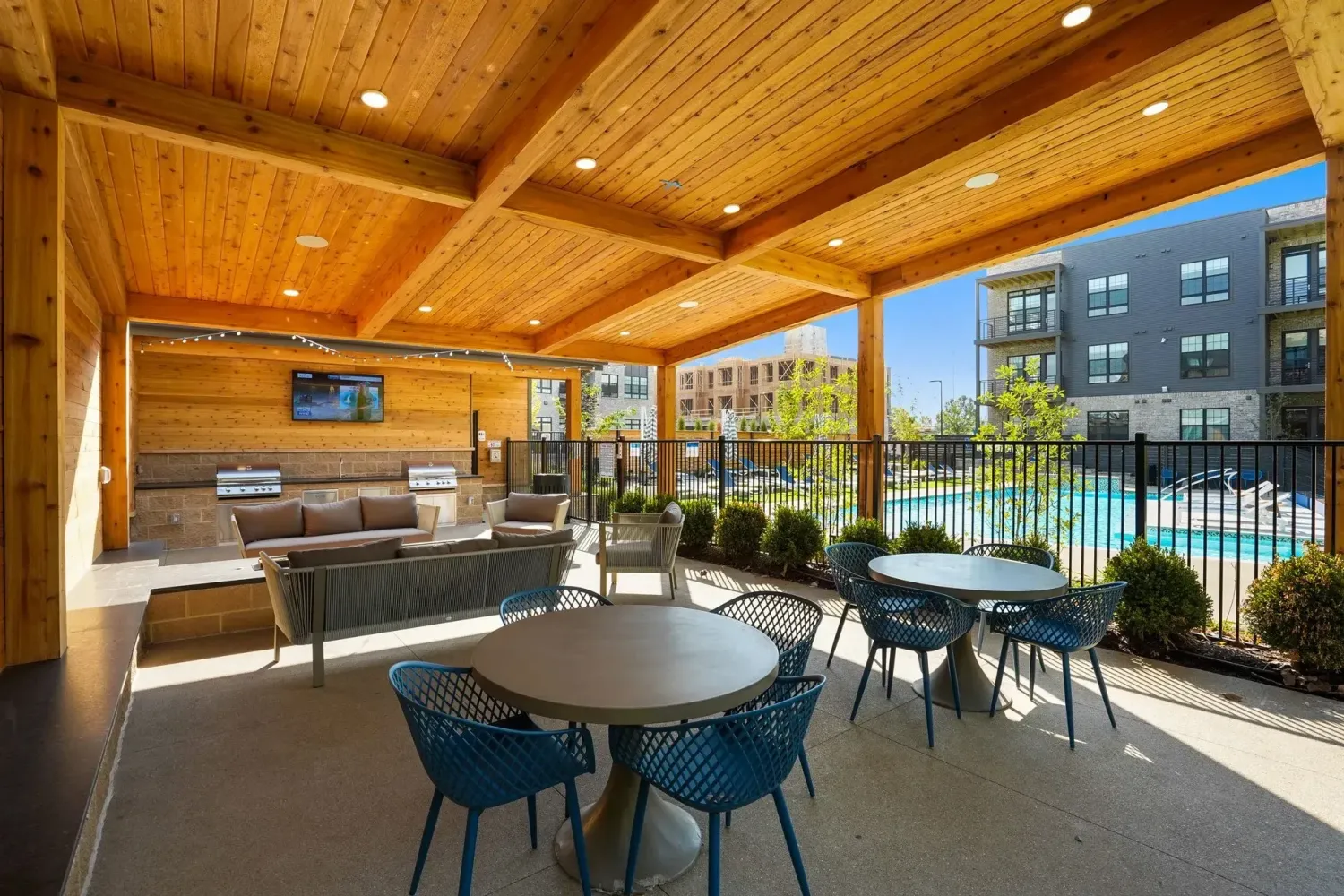
Why a Combined Permit Beats Sequential — The Forsyth County Numbers
Forsyth County’s Planning & Zoning office at 110 E. Main St. in Cumming treats a pool-and-kitchen combined submittal as a single residential accessory-structure package. You pay one plan-review fee, one structure fee, and one set of trade-inspection fees instead of two. On an average project we see the combined package come in roughly 10% under what sequential permitting would cost — call it $900 to $1,400 saved on fees alone depending on valuation tier.
That is not the real savings, though. The real savings is in the dirt. A pool build already trenches from the house meter to the equipment pad for gas (heater), electric (pump panel, lighting, bonding grid), and water (auto-fill, backwash). If the outdoor kitchen rides the same trench run, you pay once for excavation, once for bedding sand, once for compaction, once for the as-built survey. We price that shared trench work at roughly $1,500 to $3,200 in avoided cost on a typical Forsyth lot.
Add the two together on a mid-range build — say a 16×36 rectangle with a 14×12 ft cedar pavilion kitchen — and the combined package typically lands in the $65,000 to $120,000 all-in range. The same two scopes built sequentially, two summers apart, walk the homeowner closer to $85,000 to $145,000 once you factor re-permitting, re-trenching, landscape restoration, and a second mobilization for each trade.
Forsyth County combined-permit rule of thumb: If the pool and kitchen are submitted on the same residential accessory package, plan review is one cycle and trade inspections can be stacked. Sequential builds require new plan review each time, which on a busy spring can add 3 to 5 weeks to the second project’s timeline.
The Shared Trench — What Actually Runs Through It
On an integrated build, one trench does the work of three. The run from the house typically starts at the gas meter and the main electrical panel on the side of the home, crosses under the concrete deck line, and terminates at two destinations: the pool equipment pad and the outdoor kitchen base. We plan that trench at 24 inches below grade minimum, wider than most builders cut it, because we are running four separate services in it.
The gas line is the first service that matters. A pool heater at full output — think a Pentair MasterTemp 400 — draws about 400,000 BTU/hr. A quality built-in grill with a side burner and a power burner can pull another 90,000 to 120,000 BTU/hr. That combined demand almost always pushes us to a 1-inch CSST trunk line off the meter, with a tee at the equipment pad branching to the kitchen. We size it for both loads running simultaneously — the whole point of an outdoor room is that you are grilling while the spa is warming.
The water service is simpler but often ignored. A kitchen sink and a pool auto-fill both run off the same 3/4-inch PEX branch, and both need a hose-bib-style shutoff at the equipment pad. What most sequential builders miss is the winterization path: in USDA Zone 8a Forsyth County averages 22 freeze events per year, and the kitchen sink’s drain trap needs to be blown out or heat-traced. Share the trench, share the shutoff, share the blowdown port.
Then the electrical subpanel. A Sawnee EMC service into a pool equipment pad is normally a dedicated 60-amp subpanel. Add a kitchen with a refrigerator, an ice maker, a TV, pavilion cans, a ceiling fan, and a GFCI-protected receptacle bank, and you are now sizing for both loads — which puts most of our integrated builds at a 100-amp subpanel on the pad, fed from the main house panel. We run that feeder in the same trench as the gas and water.
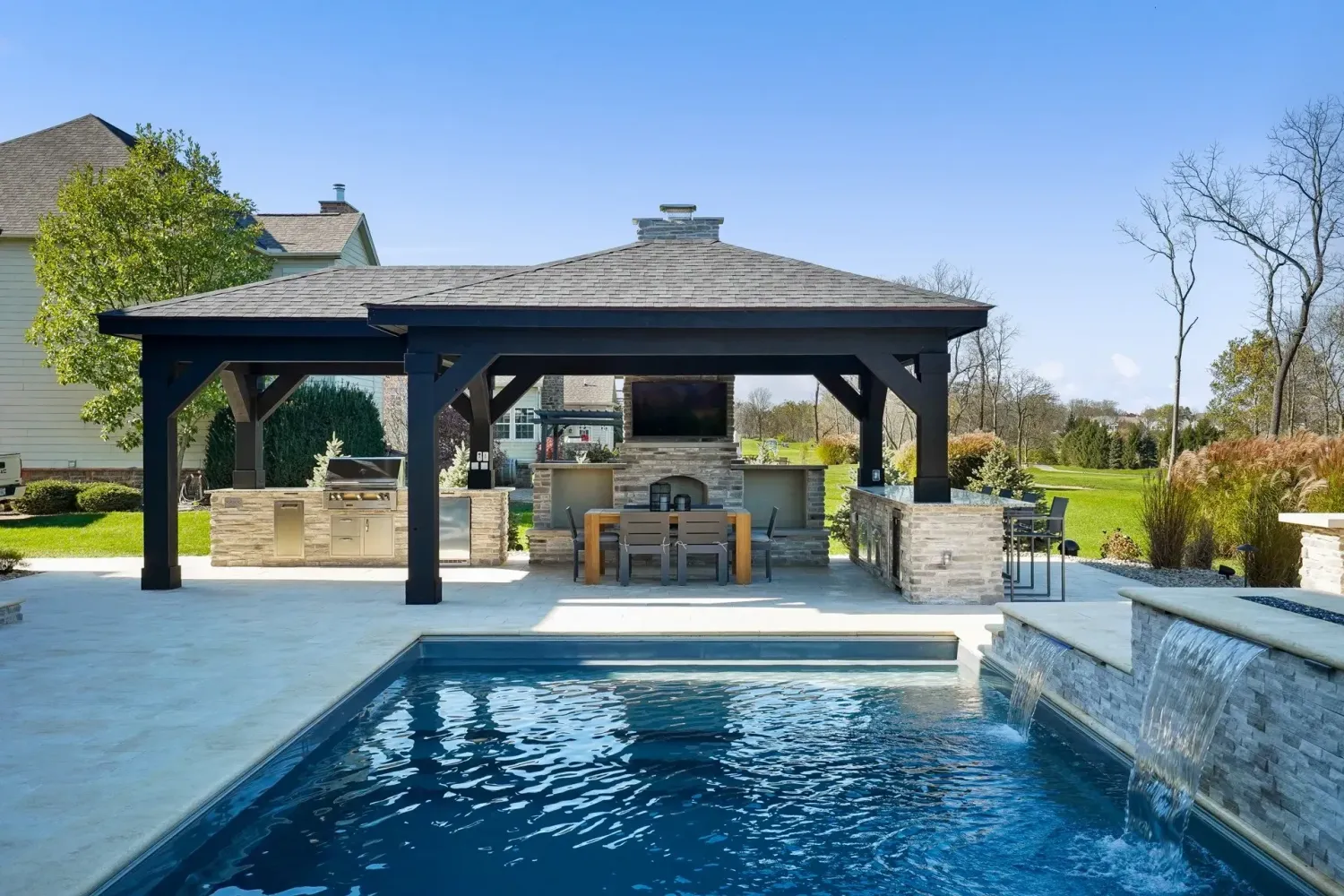
Kitchen Placement Relative to the Pool — The 10-to-15-Foot Rule
You want the kitchen to see the pool. You do not want the kitchen in the pool. Sightline matters because the cook is the host, and the host cannot be hosting if they are turned away from the deep end. Offset matters because chlorine mist, splash-out, and sunscreen overspray eat stainless-steel finishes and cedar ceilings faster than manufacturers will admit.
Our rule on integrated builds is a minimum 10 to 15 ft offset between the kitchen counter face and the pool coping, with the pavilion roofline angled so prevailing summer wind (south-southwest in Forsyth) pushes splash away from the appliances, not toward them. On the Kelly Mill project we pushed it to 14 ft and oriented the grill bay so the cook looked straight across the sunken spa.
This is also where pavilion vs pergola becomes a structural decision instead of an aesthetic one. A solid pavilion roof over appliances — cedar tongue-and-groove underside, asphalt or standing-seam above — protects the stainless from direct rain, lets you keep a flat-screen mounted year-round, and adds roughly $14,000 to $22,000 over an open pergola. In Forsyth’s Zone 8a with its 22 freeze events and heavy summer afternoon storms, we recommend the pavilion about 70% of the time. A pergola makes sense only when the kitchen is already tucked under an existing home overhang.
HOA and ARB Review — St. Marlo, Polo Fields, and the Single-Submittal Advantage
Forsyth County is HOA-dense. Almost every neighborhood in the south-Forsyth commuter belt — Polo Fields, St. Marlo, Vickery, Windermere, Hampton Golf Village — runs an Architectural Review Board (ARB) that must approve any outdoor structure. The ones we work with most often are the two that anchor the 30041 zip: St. Marlo in the Johns Creek-adjacent southeast and Polo Fields along Majors Rd.
Every ARB we have dealt with in the county prefers a single combined submittal over two back-to-back ones. Two reasons. First, it is one review cycle — the volunteer board sees your pool, your kitchen, your pavilion roof pitch, and your lighting plan in one packet, votes once, and moves on. Second, they can judge the outdoor room as a composition rather than as a pool with a kitchen added later. That tends to produce approval in one cycle instead of two, which shaves about 4 to 6 weeks off the total project calendar for homes in active HOAs.
Unincorporated Forsyth areas outside formal HOAs — Coal Mountain, Ducktown, Shady Grove, Big Creek — do not have ARB review, but they often have setback-and-easement issues that are easier to resolve once instead of twice. County planning looks at side-yard setbacks from the kitchen footprint the same way they look at pool-to-property-line setbacks. Combine the submittal and they run the math one time.
The Sub-Market Divide: North Forsyth vs South Forsyth
Forsyth County covers roughly 247 square miles and 260,000 residents, and the way those residents build outdoor rooms splits almost cleanly along Highway 20. South of 20 — Polo Fields, Windermere, the GA-400 exits 13-14 corridor — is the Atlanta-commuter belt. Smaller lots, denser subdivisions, 1/3 to 1/2-acre typical, HOA-controlled, architectural cohesion enforced. The kitchens here are tight L-shapes tucked under attached pavilions, appliance counts are modest, and the pool-to-kitchen offset runs closer to the 10-ft minimum because footprints are tight.
North of 20 — toward Coal Mountain and the Lake Lanier south shore — changes the calculus. Lots stretch to 3 to 5 acres. Homes are often 4,500 sq ft and up. Freestanding timber-frame pavilions become the norm, and the kitchen can sprawl into a full L-shape with bar seating, a side burner, a pizza oven, and a kegerator. The Hwy 369 (Browns Bridge Rd) corridor is where we do our biggest pavilion-kitchen builds — 18×14 cedar gable roofs over full cooking suites.
The soil also changes. South Forsyth is mostly Cecil-series Piedmont clay, predictable, compactable, the standard Piedmont profile we engineer every pool base for. North of Coal Mountain the clay gets rockier and ridge lines bring schist close to surface. We run a plate compactor over every base lift regardless, but north-county projects often need a 30-mil reinforced geotextile under the pavilion slab because the rocky subgrade does not compact evenly.
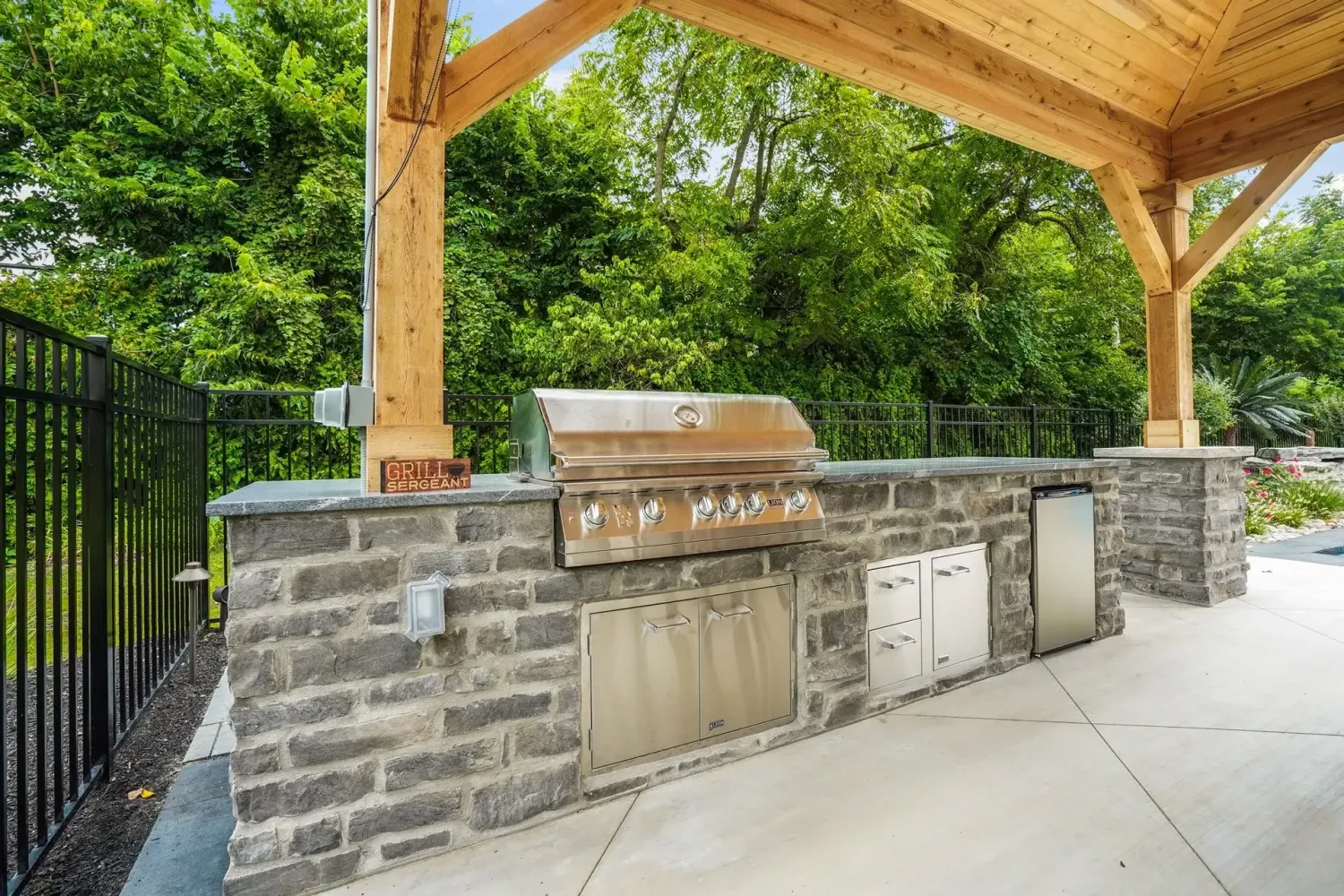
Appliance Decisions That Change the Utility Sizing
The appliance list is not a finishing decision. It is an engineering decision that has to be locked before trenching. Every appliance pulls either gas or electric, and the peak simultaneous load determines subpanel size, gas line diameter, and vent requirements.
A typical Forsyth integrated kitchen runs: one built-in gas grill (60-90k BTU), optional side burner (15-25k BTU), optional power burner or pizza oven (35-50k BTU), a refrigerator or drawer-fridge, an ice maker, a GFCI receptacle bank, TV, and lighting. If the pavilion has a ceiling fan — and in a Forsyth summer, it should — add that too. Add in the pool loads and you are looking at the same 100A subpanel we mentioned earlier, with the gas line sized for full simultaneous draw.
A vent chimney matters when the grill sits under a solid pavilion roof. Forsyth County inspectors will check for proper clearance to combustibles per the grill manufacturer’s spec — usually a minimum 18 to 24 inches from the cedar ceiling — and a dedicated exhaust path. On several recent projects we framed a small cedar-clad flue above the grill bay, lined with double-wall Class B vent pipe, to carry combustion products up through the roof and keep the T&G ceiling from yellowing.
Simultaneous-load math for sizing: Pool heater 400k BTU + main grill 90k BTU + side burner 20k BTU = 510k BTU/hr peak. That pushes us to a 1-inch CSST trunk from the meter on runs over 60 ft — which most Forsyth backyards are, given setback-driven equipment-pad placement.
What the Build Sequence Looks Like on the Ground
When the permit is combined and the trench is shared, the sequence compresses. Here is what a typical 12-to-14-week integrated build looks like for a Forsyth County project with an active HOA:
- Weeks 1–2. Design finalization, appliance selection, pavilion engineering stamp, ARB submittal.
- Weeks 3–4. Combined permit pull at 110 E. Main St. Typical turnaround is 10 business days for residential accessory with pool.
- Weeks 5–6. Excavation, shotcrete/gunite pool shell, pavilion footings, shared trench for gas, water, electric.
- Weeks 7–8. Rough plumbing inspection, rough electrical inspection, pavilion framing, kitchen base block-up.
- Weeks 9–10. Stone veneer on kitchen base, cedar T&G pavilion ceiling, countertop template.
- Weeks 11–12. Plaster/pebble finish on pool, appliance install, countertop install, electrical trim, gas final.
- Weeks 13–14. Final inspections (pool, structure, gas, electric), startup, water fill, chemistry balance, handoff.
A sequential build — pool this year, kitchen two years from now — almost always adds up to 18 to 22 weeks total on-site time and a second round of permit fees, excavation mobilization, landscape restoration, and ARB submittal. The dirt gets opened twice. The meter gets tapped twice. The neighbors see two truck parades instead of one.
The finishing tradesmen also bill differently for a combined build. A tile setter who is already on site for the pool waterline can template and install the kitchen backsplash on the same trip. A mason who is setting pool coping can lay the stone veneer on the kitchen base the same week. An electrician who is wiring the equipment pad subpanel can trim out the GFCI bank under the counter on the same trip to the inspector. Sequential builds force each of those tradesmen to mobilize twice — and every mobilization fee, per crew, runs somewhere between $400 and $900 in metro Atlanta.
The net effect: a combined 14-week build tends to cost 15 to 20 percent less than a pool-now, kitchen-later split covering the same finished scope. That gap widens the longer the kitchen waits, because every year landscape grows in around the pool equipment pad, which means every re-trench costs more in tree roots, irrigation repair, and replanting.
Real Numbers From Two Recent Forsyth Builds
Two projects we closed in the last 18 months that bracket the typical Forsyth range:
Bethelview Rd, 30040. 1/2-acre lot, south-Forsyth subdivision with an active HOA. 16×36 rectangular pool, flush sunken spa with linear trough spillover, silver French-pattern travertine deck, 12×14 attached cedar pavilion with a built-in 5-burner grill, side burner, 24-inch drawer fridge, and TV. Combined permit, shared trench. All-in landed at $108,400. Sequential-equivalent quote we priced on the same scope came in around $131,000.
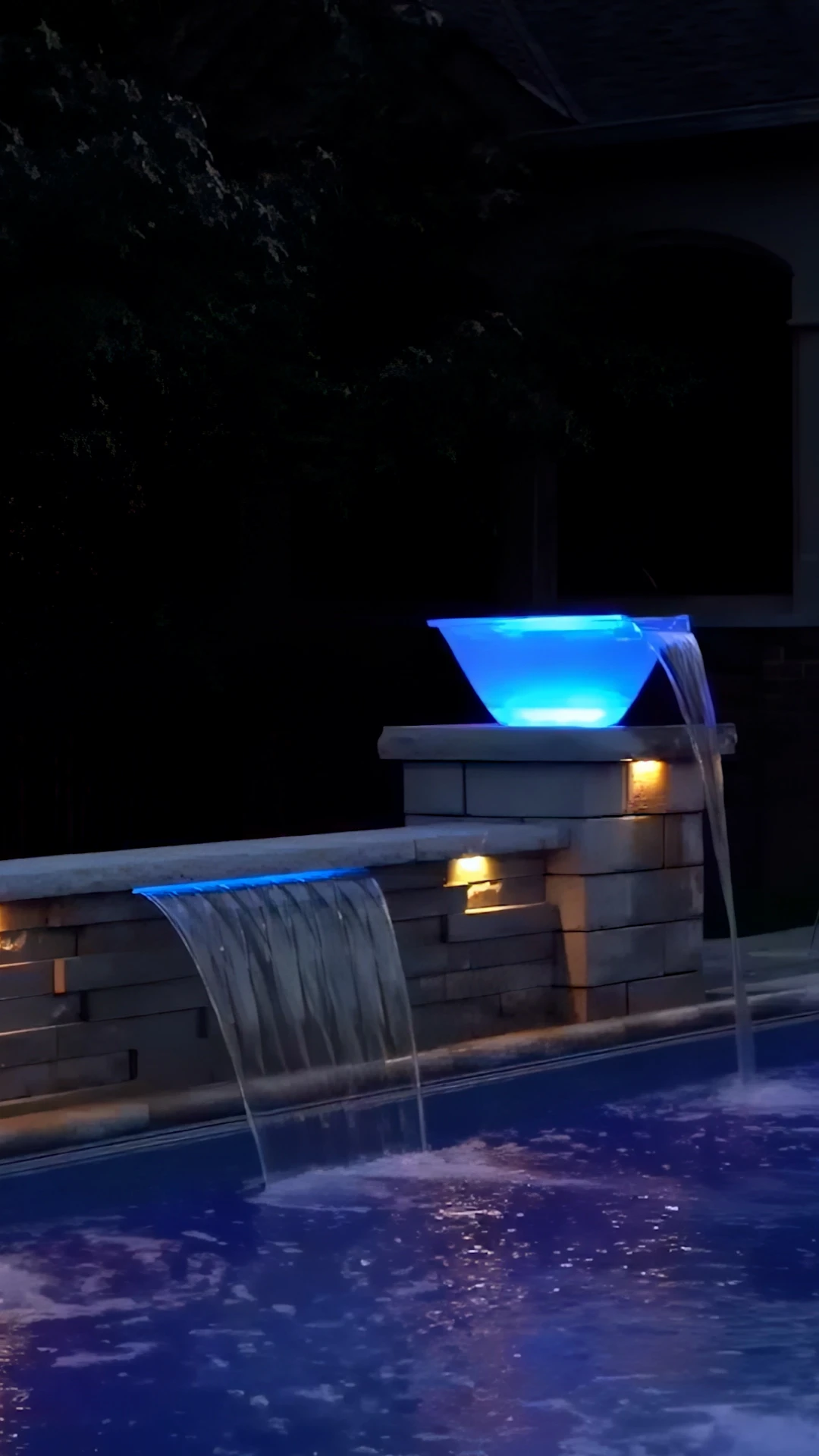
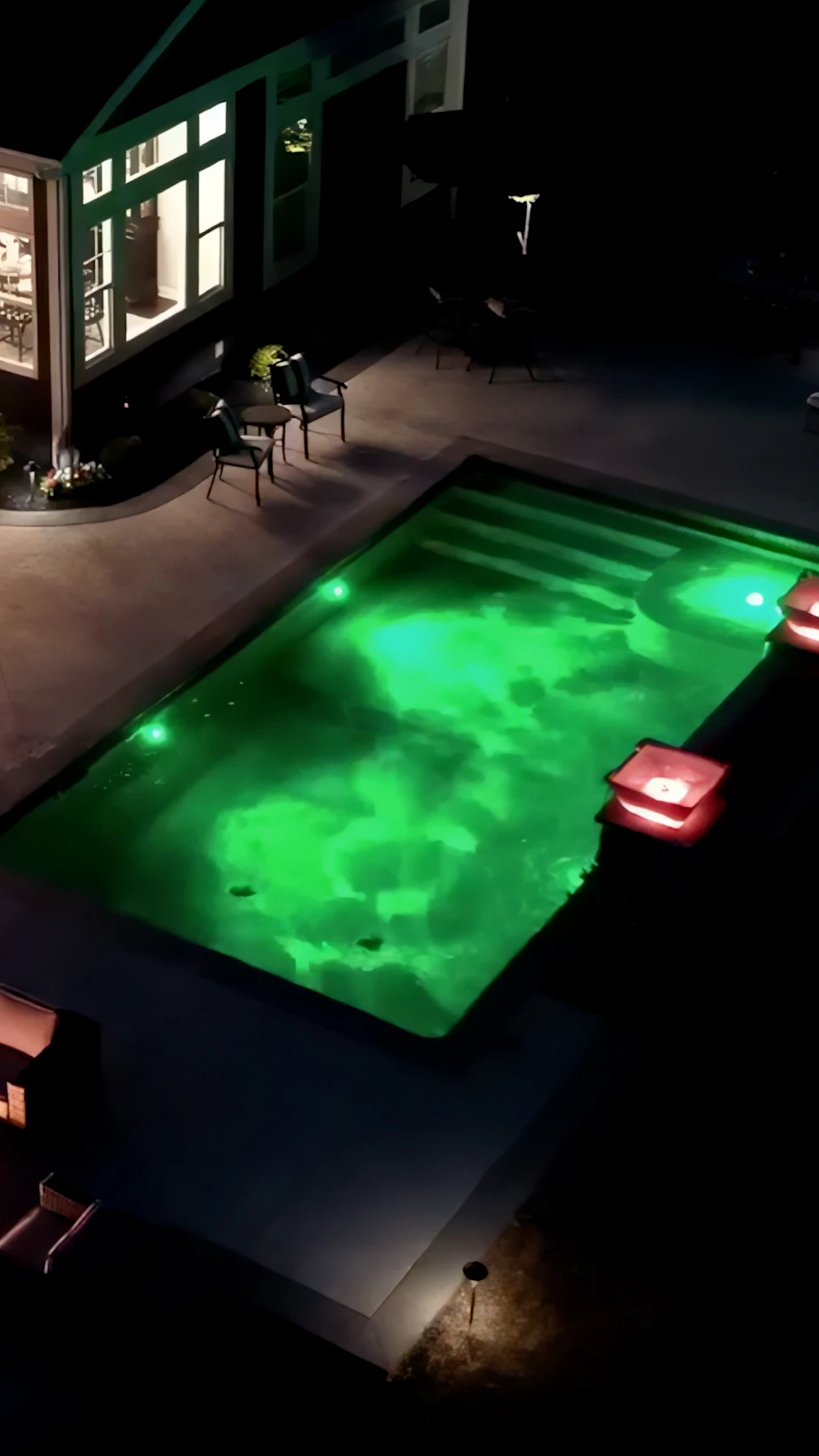
Off Hwy 369 near Browns Bridge, 30028. 4-acre wooded lot, north-county, no HOA. 18×42 rectangle with tanning ledge, raised fire trough, multiple bubbler features on a raised bond-beam wall, concrete deck, 14×20 freestanding black-timber hip-roof pavilion with a full L-shape kitchen — grill, side burner, kegerator, sink, TV, ceiling fan. Combined permit, 100A subpanel, 1-inch CSST trunk. All-in landed at $189,600 — the larger footprint and pavilion scope pushed this one beyond the typical $120K upper band.
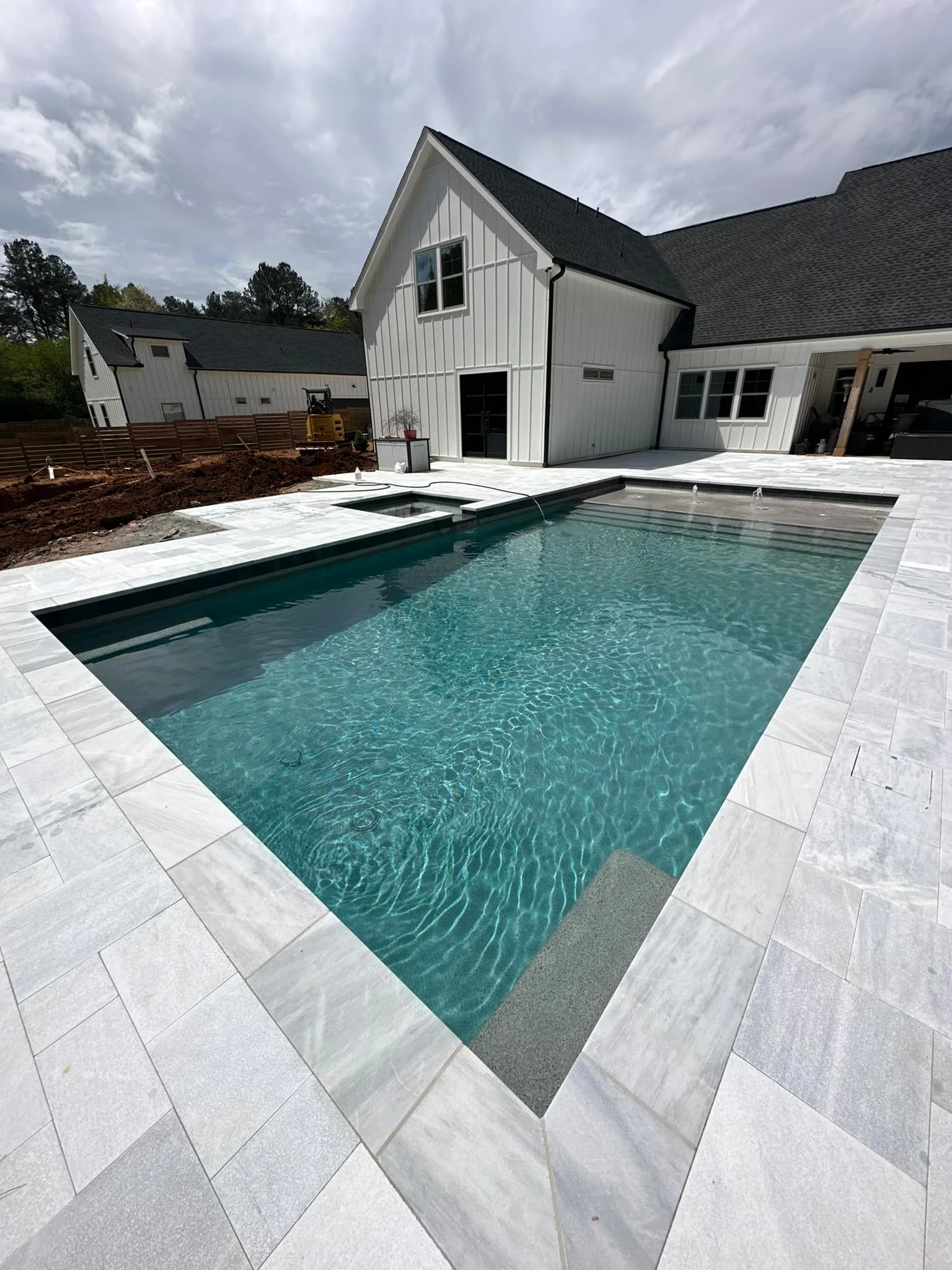
The lesson in both builds is the same. Lock the appliance list and the pool scope together. Pull one permit. Share one trench. Size utilities for simultaneous peak load. Place the kitchen 10 to 15 ft back with a sightline across the pool, and put a solid roof over it if you ever plan to mount a TV.
If the budget will only stretch to the pool this year, build the pool with the kitchen’s utility stub-outs already in place — a capped gas tee at the future kitchen location, a conduit run with a pull string for the subpanel feeder, and a water branch with a frost-proof cap. Doing that on the original build adds maybe $1,800 to $2,800 in materials. Coming back two years later to add them after the fact is where the sequential-build numbers get ugly. Forsyth’s soil does not give back gracefully once the deck is poured and the sod is knit in.
Custom Pool Construction across 20+ cities within 30 miles of Winder, GA
From the Polo Fields ARB review in south Forsyth to the freestanding pavilions north of Coal Mountain — we coordinate gas, electric, and plumbing on one combined permit so the pool and the kitchen get built together, not twice.