
The homeowner in Kensington Ridge had already torn out one fireplace. Built by a previous contractor in 2021, it smoked back into the covered porch every time the temperature dropped below 45 degrees. The mason who built it used a sea-level chimney spec on a lot sitting at 1,270 feet of elevation — a detail that nobody checked on the drawings.
By the time we walked the job in the fall of 2025, there was soot staining on the cedar ceiling, a cracked refractory panel, and a $9,200 bill from the first builder with a handwritten note attached: “draft issue is a homeowner problem.” It wasn’t. It was a physics problem, and it was solvable.
This post walks through what we rebuilt, why the altitude mattered, and the exact specification we now use on every outdoor fireplace we construct in Dawson County. If you live anywhere north of the GA-400 ridge — Etowah River Club, Big Canoe, Chestatee, Foxcreek, Applewood — the details here will apply to your project too. Sea-level chimney math does not work on a north-Georgia foothill.
Why 1,270 Feet Changes the Math
Air density drops roughly 3 percent per thousand feet of elevation above sea level. Dawsonville sits at 1,270 feet, which puts us about 4 percent lower on the density curve than a chimney built in Savannah or a sea-level beach house. Four percent sounds like a rounding error. In a masonry chimney, it is the difference between a clean burn and a porch full of smoke.
Chimney draft — the upward pull of hot gas through the flue — is driven by the temperature and density difference between the exhaust column inside the flue and the ambient air outside. Thinner ambient air means a weaker pressure differential at the top of the chimney. The hot gas has less atmosphere pushing it upward. The cold air above it has less mass to displace. Draft velocity drops, and smoke that would have risen cleanly at sea level now lingers at the smoke shelf and rolls back into the firebox.
NFPA 211 — the code governing chimneys, fireplaces, and solid-fuel appliances — provides a baseline formula: interior fireplace opening height multiplied by a flue ratio (typically 1:10 for masonry wood-burning) determines minimum flue area. The formula assumes standard atmospheric conditions. At altitude, you adjust. Our field-tested rule for Dawson County builds: add 6 inches of total chimney height above the NFPA 211 minimum, and tighten the throat damper opening by 5 to 8 percent. Taller column equals stronger thermal pull. Narrower throat equals higher exhaust velocity where it matters most — right above the firebox.
Code reference to request in writing: Your contract should cite NFPA 211, Section 10.4 (chimney termination height) and reference the 6-inch altitude adjustment. If the mason has never heard of an altitude adjustment and you are above 1,000 feet, that is the moment to pause.
For the Kensington Ridge rebuild, the original chimney terminated at 2 feet above the roofline — NFPA 211 minimum and exactly what code enforcement in Atlanta-metro Piedmont would have accepted. We demolished down to the smoke shelf and rebuilt to 2 feet 8 inches above the highest roof point within 10 horizontal feet. The homeowner was initially skeptical that 8 inches of added masonry would matter. It did. The first test burn after recommissioning held a clean draft at 38°F ambient, which was the exact condition that had failed the prior build four times in one winter.
Firebox Construction: Refractory Brick Rated for 2,100°F
A masonry firebox is not brick. It is refractory brick — a specific fireclay product rated to survive repeated cycling to high temperature without spalling. The ASTM C27 standard classifies refractory brick by service temperature. For a residential wood-burning firebox we spec medium-duty refractory brick rated for 2,100°F minimum. Hardware-store red common brick fails under this load. It will crack, spall, and dust within two burn seasons.
The first Kensington Ridge firebox had been laid with standard face brick. By the time we opened it up, the back wall showed three vertical cracks and the floor was shedding material into the ash pit. We removed every piece of non-refractory brick and relaid the firebox with a Harbison-Walker medium-duty unit, bedded in refractory mortar — not regular Type S. Refractory mortar has its own ASTM spec (C199) and is rated to hold joints above 1,500°F without migration.
The firebox floor (the hearth slab inside the firebox) got a 2-inch bed of refractory mortar over a reinforced concrete pad. Under that, a solid CMU base poured full with grout. No voids. No hollow block. Heat telegraphs through voids and finds whatever weak point it can exploit. We see the results of voided hearth bases every spring when the thaw cycle pulls moisture through cracks and the mortar sloughs off in sheets.
Smoke Shelf and Throat — The Part Nobody Photographs
Above the firebox, hidden from view, sits the smoke chamber. The smoke chamber has three critical features that 90 percent of sea-level contractors get wrong at altitude: the throat, the damper, and the smoke shelf itself.
The throat is the narrowest point in the exhaust path, directly above the damper. It transitions from the full width of the firebox opening to the flue diameter. For a 36-inch wide by 30-inch tall firebox opening — our most common Dawsonville spec — the throat should be 4 inches deep (front-to-back) and run the full width. At altitude, we tighten that depth to 3-5/8 inches. The tighter throat accelerates the exhaust gas through the narrowest point, which is what keeps smoke from spilling out the front on a cold start.
The damper sits inside the throat, typically a cast-iron plate with a handle that operates the plate’s angle. For outdoor fireplaces we spec a Vestal 36-inch cast-iron damper — the same unit that has been in production for 40 years and can be replaced without cutting into the masonry. Stainless damper units are available and we use them on pool-side builds where chlorine-laden air corrodes cast iron within 10 years. In Dawsonville, away from pool chemistry, the cast iron is fine and will outlast the rest of the fireplace.
Behind the throat and damper, the smoke shelf is a flat masonry ledge that separates the firebox from the flue proper. Its job is to catch downdraft. In a cold chimney on a windy day, outside air can push down the flue. When it hits the smoke shelf and bounces upward, it collides with rising exhaust gas and forces a brief mixing zone. Without the shelf, that same downdraft drives smoke straight into the firebox and out the opening.
The smoke shelf angle: Shelf floor should pitch 5 to 8 degrees toward the rear of the smoke chamber — not level, not forward. A forward pitch dumps moisture and creosote back toward the firebox. A proper rear pitch drains it toward the cleanout.
Flue Sizing, Height, and the 3-2-10 Rule
NFPA 211 codifies what masons call the 3-2-10 rule: chimney termination must extend at least 3 feet above the roof penetration and at least 2 feet above any structure within 10 horizontal feet. This is the minimum. It works in flat coastal neighborhoods. It is not always enough on a Dawson County lot with pitched roofs, mature hardwood canopy, and prevailing wind off the Amicalola ridge.
For the Kensington Ridge build, the covered porch sat 9 feet from a 30-foot oak. At 1,270 feet elevation, with a 6-foot interior firebox height and a 36-inch wide opening, the math ran like this: NFPA 211 minimum flue area comes out to 108 square inches (opening area of 1,080 square inches divided by 10). That maps to a 12×12 flue tile (nominal 11×11 interior, roughly 121 square inches actual). We could have used the 12×12. At altitude, we scaled up.
The final build used a 12×16 flue tile from Superior Clay — giving roughly 145 square inches of effective area. Oversized flue at altitude compensates for the lower density exhaust and provides a margin when the wind shifts. The chimney terminated at 2 feet 8 inches above the highest adjacent roof point — 8 inches more than code minimum, the altitude buffer we now specify on every Dawson County build.
Total finished interior chimney height from firebox floor to flue cap: 17 feet 4 inches. Not unusual for the topography. Dawsonville lots sit at higher elevation than Dacula by more than 200 feet, and the temperature swing that drives draft on a November evening hits earlier in the season and harder. Thirty freeze events per year versus about 20 in Dacula. Every one of those freeze nights is a stress test.
Spark Arrestor: 1/2-Inch Mesh, Not 3/4
At the top of every masonry chimney sits a spark arrestor — a stainless steel mesh cap that stops burning embers from escaping the flue and landing on the roof, the lawn, or the neighbor’s property. For wildland-urban interface areas, the mesh opening size is specified by code and it matters.
Most off-the-shelf chimney caps ship with 3/4-inch mesh openings. That is the catalog default. It does not meet the spec for elevated, wooded, north-Georgia parcels where drought cycles leave leaf litter flammable for long stretches of summer. The correct spec for any lot backing onto mature hardwoods — which describes roughly every Dawsonville subdivision from Foxcreek to Etowah River Club — is 1/2-inch maximum opening stainless mesh, aligned with NFPA 211’s guidance for areas of higher wildfire exposure.
Mesh tighter than 1/2 inch chokes draft. Mesh looser than 3/4 inch fails to catch embers. Half-inch is the engineered sweet spot. We fabricate the spark arrestor cap in-house from 304 stainless woven mesh, welded to a stainless frame with a 12-inch stand-off above the flue termination. That standoff is important — it gives rain a drip path without letting it follow the flue wall straight down into the smoke chamber.
Inspection interval: Spark arrestor mesh needs annual inspection. Creosote accumulates on the leeward face and can reduce effective opening by half within a single heating season. Chimney Safety Institute of America (CSIA) Level 1 inspection runs $185 to $265 in the 30534 zip code.
Cost, Timeline, and What Your Contract Should Say
A properly engineered Dawsonville outdoor fireplace chimney — 6-foot interior firebox, 32-inch nominal flue, stacked stone veneer, refractory firebox, full NFPA 211 compliance with altitude adjustment — lands in the $8,400 to $14,200 range. The spread is driven by veneer selection (mountain fieldstone versus dimensional cut stone), foundation requirements, and whether the chimney integrates into an existing covered porch structure or stands freestanding.
Dawson County permitting runs through Dawson County Department of Planning & Development at 25 Justice Way, Dawsonville. Permit fees on a freestanding outdoor fireplace with chimney typically run $180 to $340. The county inspector is familiar with NFPA 211 and will ask to see the flue liner spec and termination height on the drawings. Submit the drawings with altitude-adjusted dimensions called out explicitly.
Trucking cost is worth naming. Most masonry supply — refractory brick, Superior Clay flue tile, cut limestone capstones — gets delivered from Atlanta-area yards up GA-400 to the job site. Add $180 to $340 for delivery freight per masonry shipment. Rock blasting, if required because the stony residuum and saprolite subsoil that characterizes Dawson County excavation holds granite and weathered rock at 2 to 6 feet depth, adds $8 to $14 per cubic yard premium over a standard Piedmont-clay dig. Get the site evaluated before signing.
Site power for the build — mortar mixers, wet saws, compressors — comes off Amicalola EMC. If you are building at the edge of the utility’s service territory, check load capacity at your main panel before scheduling concrete day. We have had two projects in the last year where a homeowner’s 100-amp service could not run a full mason crew’s equipment without flipping a breaker during pour.
Contract Line Items to Require in Writing
- Refractory brick rated 2,100°F minimum with ASTM C27 classification called out
- Refractory mortar to ASTM C199 — not standard Type S or Type N
- NFPA 211 compliance with altitude adjustment: chimney termination 2 feet 8 inches above highest adjacent roof within 10 feet
- Throat depth: 3-5/8 inches front-to-back, full opening width
- Flue tile: Superior Clay 12×16 nominal (or larger) with refractory joint bedding
- Smoke shelf pitched 5 to 8 degrees toward rear of smoke chamber
- 304 stainless spark arrestor with 1/2-inch mesh and 12-inch standoff above flue termination
- Cast-iron damper (Vestal or equivalent) replaceable without masonry cut-in
- Dawson County permit included in contract price with inspection scheduled before any veneer installation
The Kensington Ridge project took us 18 working days end-to-end — demolition of the failed original, engineered drawing revision through Dawson County, foundation pour, firebox build, flue stack, stacked stone veneer, final inspection. That is the realistic timeline for a rebuild. A new build on a cleared pad runs 14 to 16 days. Anyone promising a finished outdoor masonry fireplace in under 10 working days is either skipping inspection holds or cutting mortar cure time. Do not let them.
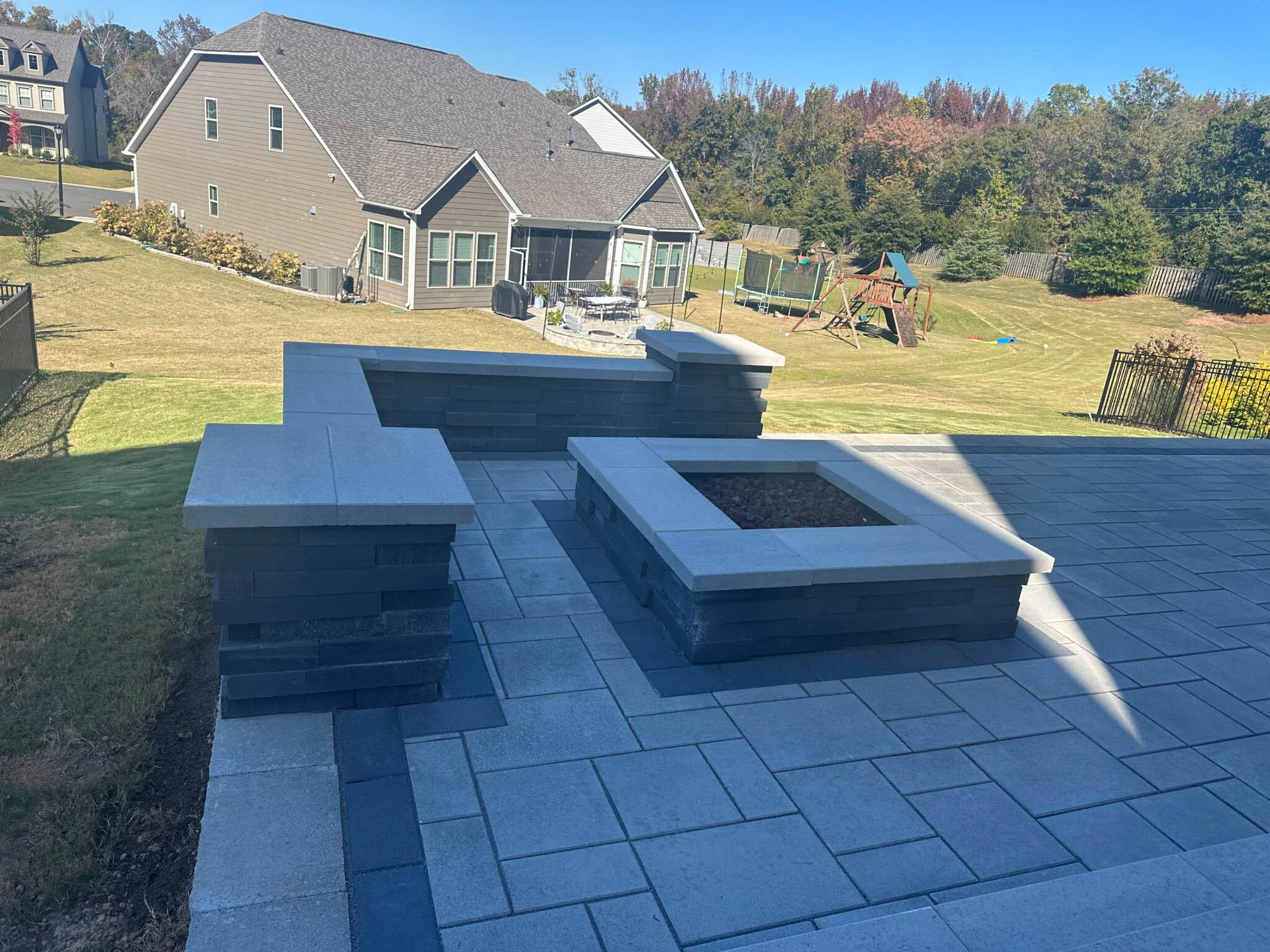
A note on the gas-fired alternative: a linear gas firepit or gas-burning fireplace does not have the same draft-dependency as a wood-burning masonry chimney, but it still has altitude considerations. Gas orifices are sized for BTU output at a given elevation. At 1,270 feet, a burner assembly factory-calibrated for sea level will run slightly rich — more fuel, less air, yellow-tipped flame, soot on the stone. Most modern units ship with a high-altitude adjustment kit for elevations above 2,000 feet; at 1,270 the adjustment is usually not required but a qualified installer should verify orifice sizing against the manufacturer’s altitude chart. On a rebuild, ask.
Sizing the Firebox Opening to the Room
One decision that homeowners overthink: firebox width. Bigger is not better. A 48-inch wide firebox pushes out more radiant heat but also demands a larger flue, a taller chimney, and — critically — a bigger combustion-air requirement that stresses draft at altitude. For a covered porch in the 250-to-400 square foot range, a 36-inch wide by 30-inch tall firebox opening is the sweet spot. It delivers enough radiant heat to feel the fire from 15 feet away on a 38-degree night, and it keeps the flue sizing within the 12×16 Superior Clay tile that your mason can source locally.
For larger covered spaces — the pavilion-scale porches we have built in Etowah River Club and Applewood, often 500 square feet and up — step up to a 42-inch wide by 34-inch tall firebox and a 16×20 flue tile. Plan for the chimney to terminate 3 feet 2 inches above the adjacent pavilion peak. Price scales roughly 15 to 22 percent over the standard 36-inch spec.
Why We Build This Way in Dawsonville Specifically
Seven years ago, the pool-builder school of thought in north Atlanta metro was: a chimney is a chimney. Code is code. You build what the drawings say and move on. Then a series of call-backs started landing on projects above 1,000 feet elevation — Dawsonville, Cumming north of GA-400, Big Canoe, Jasper. Smoke spillage, cracked refractory, spark arrestor creosote buildup that nobody could explain. Same specs as the Lawrenceville and Snellville projects, same crews, but consistent failures at altitude.
We started logging failure modes against elevation. The pattern was unambiguous. Every failure above 1,100 feet traced back to two variables: chimney height and throat geometry. Once we rewrote the internal spec to include the altitude adjustment — extra 6 inches above NFPA 211, tighter throat by 5 to 8 percent — the callbacks stopped. That is how our current Dawson County spec was born. Not from a textbook. From cold-weather callbacks.
The Foxcreek, Riverbend, and Mountain Laurel subdivisions all sit within 2 miles of the 1,270-foot elevation band. Chestatee ranges slightly lower (around 1,150 feet) but still well above the Piedmont threshold. Big Canoe — to the north of the service area proper — runs higher still, 1,700 to 2,000 feet in places, and at that elevation the adjustment is more aggressive: 10 inches above NFPA minimum and a 10 percent throat tightening. We have built three projects in the Big Canoe corridor and the spec has held.
The Dawsonville Pool Room — the historic restaurant downtown — was built before altitude adjustments were codified in any practical sense, and its interior chimney sits at a less demanding height above a ventilated kitchen hood. A residential wood-burning outdoor chimney has no kitchen exhaust to help move smoke. It has to pull on its own. At 1,270 feet, on its own, it needs every inch of height and every percentage of throat geometry that physics affords.
What Fails First on a Sea-Level-Spec Chimney at Altitude
In order of how fast they show up:
- Smoke spillage during cold starts — visible in the first 1 to 3 burns per season. The fireplace opens, smoke rolls out instead of rising. Homeowner notices immediately.
- Creosote accumulation above normal — visible at the first annual CSIA inspection. A chimney that should show light brown residue shows thick black glaze. Lower draft velocity equals slower smoke equals more condensed tar on the flue walls.
- Refractory spalling — visible year 2 or year 3. Cracks in the firebox walls from thermal cycling stress that a properly drafting chimney would have mitigated.
- Mortar joint failure at the crown — visible year 4 or 5. Moisture penetration from a chimney that ran cooler than designed, holding moisture in places it should have flashed off.
All of it is preventable. None of it is expensive to prevent at the build stage. All of it is expensive to fix after the fact — the Kensington Ridge teardown-and-rebuild ran $11,800 on top of the homeowner’s original $9,200 investment. Twenty-one thousand dollars of fireplace, to end up with the fireplace that should have been built the first time.
The Long View: Outdoor Fireplaces in Dawson County
Outdoor masonry fireplaces are long-dated assets. A properly built stacked-stone fireplace with NFPA 211 compliance and altitude adjustment will draft cleanly for 30 years without structural intervention. Annual CSIA inspection, spark arrestor cleaning, and one re-pointing of the crown around year 12 is the full maintenance schedule. Nothing heroic.
What we see more than anything in Dawson County is homeowners inheriting fireplaces built by the previous owner’s contractor, often without drawings, often without permits, often — like the Kensington Ridge build — with sea-level spec assumptions that fail at 1,270 feet. If you are buying a home in Foxcreek, Riverbend, or Applewood with an existing outdoor masonry fireplace, budget for a CSIA Level 2 inspection before closing. Level 2 includes a camera scope of the flue interior. It is the only way to catch refractory cracks and flue tile separation from the outside. Inspection cost: $325 to $485. Cheap compared to a rebuild.
The payoff for getting it right the first time is real. On a 38-degree November night in north Georgia, with a clean draft and a quarter-split of oak burning in a properly engineered firebox, you get the thing the homeowner pictured when they signed the contract. No smoke in the porch. No soot on the ceiling. No callback next spring. Just the fire doing what it is supposed to do — throwing radiant heat across a covered space, pulling a clean column up through a properly sized flue, exiting at 2 feet 8 inches above the roofline where the wind takes it the rest of the way.
That is the deliverable. Everything in this post is about making sure you get it.
Outdoor fireplaces engineered for elevation, built across 20+ cities within 30 miles of Winder, GA
From the 700-foot plateau in Gwinnett to the 1,270-foot ridgeline in Dawsonville, we build outdoor fireplaces to the altitude they actually sit at — not the code minimum that assumed sea level.