
Last April a homeowner off Providence Club Drive called us about what she thought was a resurfacing job. Her 1996 pool had picked up a rust-stained waterline, a pump that sounded like a box fan dying, and a plaster finish that felt like sandpaper when her grandkids climbed in. By the end of the site walk we had sketched a $78,400 modernization plan that went well beyond new plaster — and by October she was swimming in a pool that felt nothing like the one she had owned for 28 years.
This post walks through that project end-to-end, because Hamilton Mill and the surrounding Dacula, GA neighborhoods — Ivey Chase, Chandler Ridge, Sycamore Ridge — sit on a housing stock built mostly between 1995 and 2005. A large share of the original pools are now 25 to 30 years old, running equipment designed for an era of $0.08 per kilowatt-hour and no federal VGB main-drain standard. Modernization, not resurfacing, is usually what those backyards actually need.
We are showing one project rather than a generic checklist because the decisions you make in week one dictate the next 20 years of what the pool costs to run and how it ages. Plaster color, pump selection, coping profile, deck grade, depth target, tile choice — every one of those is a fork. Get two or three of them wrong and you spend the next decade working around them. Get them right and the pool disappears into the background of the house, which is what a pool should do.
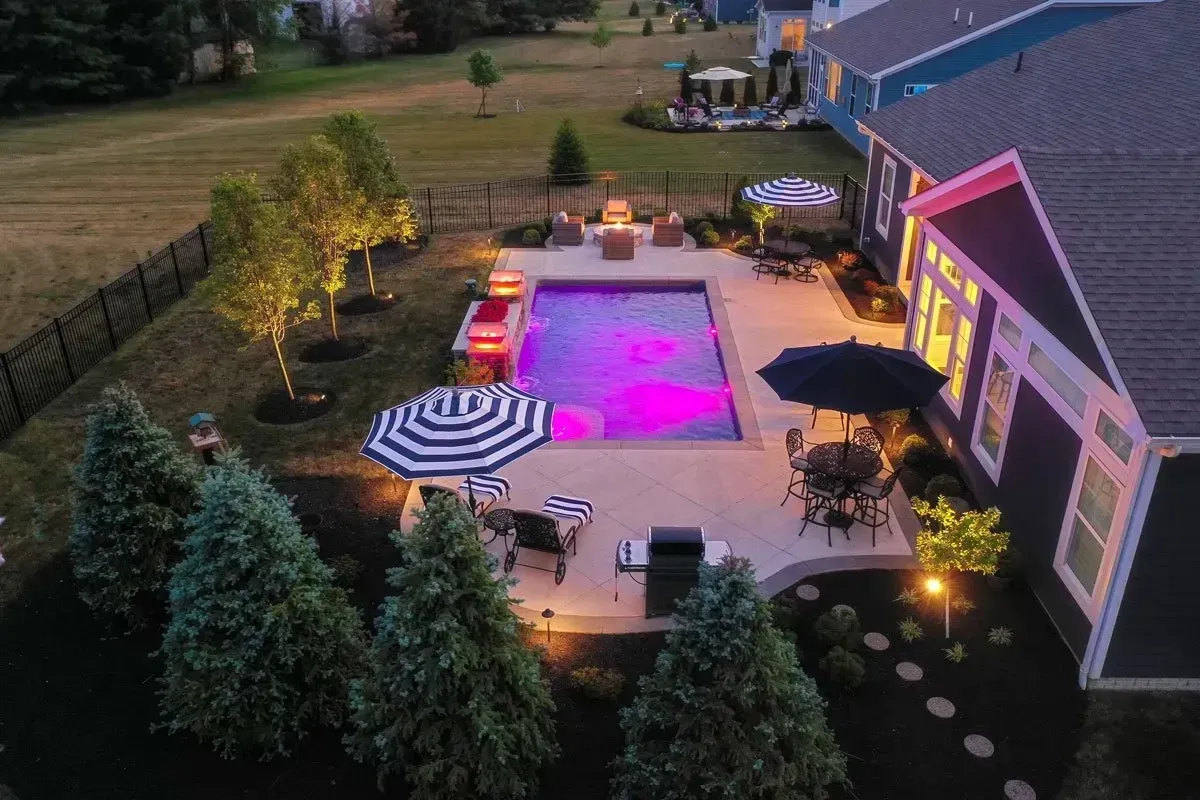
The Homeowner’s Call — What She Said, What She Thought She Needed
She said the word “resurfacing” three times in the first two minutes. That is almost always the word a Hamilton Mill homeowner uses when they notice the bottom of the pool feels rough and the plaster is staining along the waterline. It is the most visible symptom, so it becomes the headline diagnosis.
She also mentioned the pump was louder than it used to be. Her pool guy had replaced the motor two summers ago but it was “doing that noise again.” The heater — a natural-gas Raypak replaced in 2011 — was leaking slightly at the pressure switch. The skimmer lid had been cracked for years. None of that registered with her as a real problem. It was background noise to the plaster.
What she wanted was a ballpark for Pebble Tec. She had heard Pebble Tec from a neighbor. That was the scope of the call: resurface, maybe re-tile, done by Memorial Day.
We asked three questions before scheduling the site visit. First, how long has the pool been holding chlorine consistently — does she have to shock it every week? Second, has she replaced the filter media in the last three years? Third, when the pump cycles off at night, does she hear a thump in the pad. She answered yes to needing to shock constantly, no on the filter, and “yeah, always has, figured that was normal.” Those three answers told us this was not a resurfacing call.
Why that matters: chronic high chlorine demand in a 25-year-old pool usually points to compromised plaster chemistry AND a filter that is no longer actually filtering. Resurfacing alone fixes one of those and not the other.
Site Evaluation — What We Found Versus What She Thought
We showed up on a Wednesday morning with a dye test kit, a pressure gauge, a moisture meter, and a laser level. The site walk took 90 minutes. Hamilton Mill backyards are rarely flat — the community is built along a ridge that steps down toward the golf course — and this lot dropped about 4 feet from the back of the house to the far end of the pool deck.
The plaster was at end of life. We expected that. Where the homeowner’s diagnosis stopped was at the plaster. Where ours kept going was everywhere else. The tile line was cobalt-blue 1×1 glass mosaic — a very 1996 choice that had quietly lost about 18% of its tiles into the pool over three decades. The skimmer throats were original plastic, warped at the top where the coping had heaved a half-inch. The pool had one main drain, not two, and no VGB-compliant anti-entrapment cover. The equipment pad had a single-speed Hayward Super Pump of roughly 1.5 HP, a DE filter with a cracked tank band, and the Raypak 266K BTU heater.
Then we pulled the skimmer lid off and saw what we always see on these builds — the PVC plumbing turning sharply into a single 1.5″ suction line feeding both the skimmer and the main drain through an undersized tee. That is late-1990s plumbing, and it is why her pump was loud. It was cavitating against a suction line that could not physically flow the water the pump was trying to move.
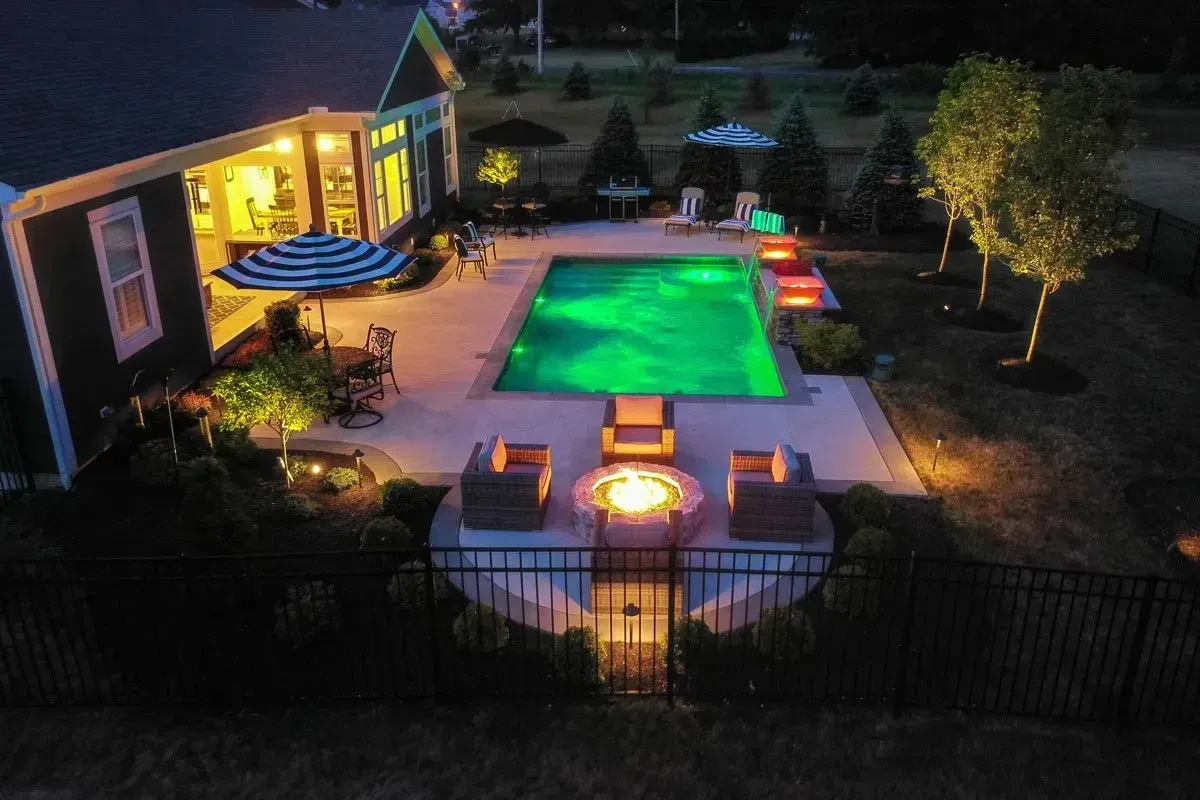
We measured the deck grade next. A laser shot from the back door down to the pool coping showed the deck had settled roughly 1.5 inches over three decades — consistent with the expansive Cecil-series clay common across Gwinnett County. That settlement had tilted the deck back toward the house, so every heavy rain moved water across the coping toward the foundation. Her basement wall had a faint efflorescence line that told the rest of the story.
Deck migration is not a crisis at 1.5 inches. At 2.5 inches it becomes one. We flagged it as a structural-rehab item, not a cosmetic one.
Scope Decisions — What To Keep, What To Replace, Where The Money Should Actually Go
When we sat at her kitchen table the following Monday with the estimate, we did something most pool companies will not do: we gave her two columns on a single page. Left column was the resurfacing job she called us for — $21,800, finished in 12 days, would hold for maybe 8 years before the underlying hydraulics and deck issues forced another intervention. Right column was the full modernization — $78,400, three months of backyard disruption, a 20-year horizon.
Then we walked her through the right column, line by line, and showed her what each line actually fixed.
- Pebble Tec Aruba Blue interior finish — $4.80 to $6.40/sqft premium over base white plaster, roughly $3,400 on her 700-sqft interior. Fixes the rough surface her grandkids complained about and adds 10 years of finish life.
- Full re-plumb with 2″ suction, dual main drains, VGB covers — eliminates the cavitation, meets current federal code, and lets a modern variable-speed pump actually breathe.
- Pentair IntelliFlo3 VSF variable-speed pump — $1,900 to $2,400 installed, replaces the single-speed Super Pump that was drawing roughly 2,200 watts at full tilt 10 hours a day. The IntelliFlo3 at typical circulation speeds draws closer to 180 watts. On Georgia Power residential rates that is a $600 to $900 annual reduction.
- Pentair cartridge filter replacing the cracked DE — no more DE powder to mix, no more tank bands to fail, finer filtration, simpler backwash protocol.
- New Raypak 407A ASME natural-gas heater — $4,800 to $5,800 installed, sized up from her old 266K BTU to a 407K to match the spa addition she was considering.
- Coping replacement, deck grinding and re-pour on the back two panels, and a drop-face travertine soldier course at the pool edge — fixes the runoff toward the house, fixes the heave at the skimmer, modernizes the visual line.
- Depth conversion from 8.5′ diving well to a 4’10” play-pool bottom — her diving board had been gone since her kids went to college, and the diving well had become a chore rather than an asset. Conversion ran $11,600 on this pool, inside the $8,400 to $14,200 band we quote for that specific retrofit.
She took three days. She came back with two questions: why not keep the DE filter, and was the depth change really worth $11,600. We answered the DE question with a photo of the cracked band. We answered the depth question by asking her how often, honestly, anyone was in water over their head on purpose. The answer was never. She signed the right column.
Demo Phase — What Came Out
Demo ran five working days. Hamilton Mill HOA rules limit construction access to weekday daylight hours and require a mud-control plan for any excavation over 6 cubic yards, which we hit easily — we pulled about 18 cubic yards of old plaster rubble, deck concrete, and diving-well shell material.
We started inside the pool. A walk-behind hydraulic chipper took the white plaster off in roughly 11 hours across two days, exposing the original gunite. We always inspect the gunite at this stage, and this shell was in excellent shape — no cracks beyond cosmetic hairlines, no rebar rust breakthrough.
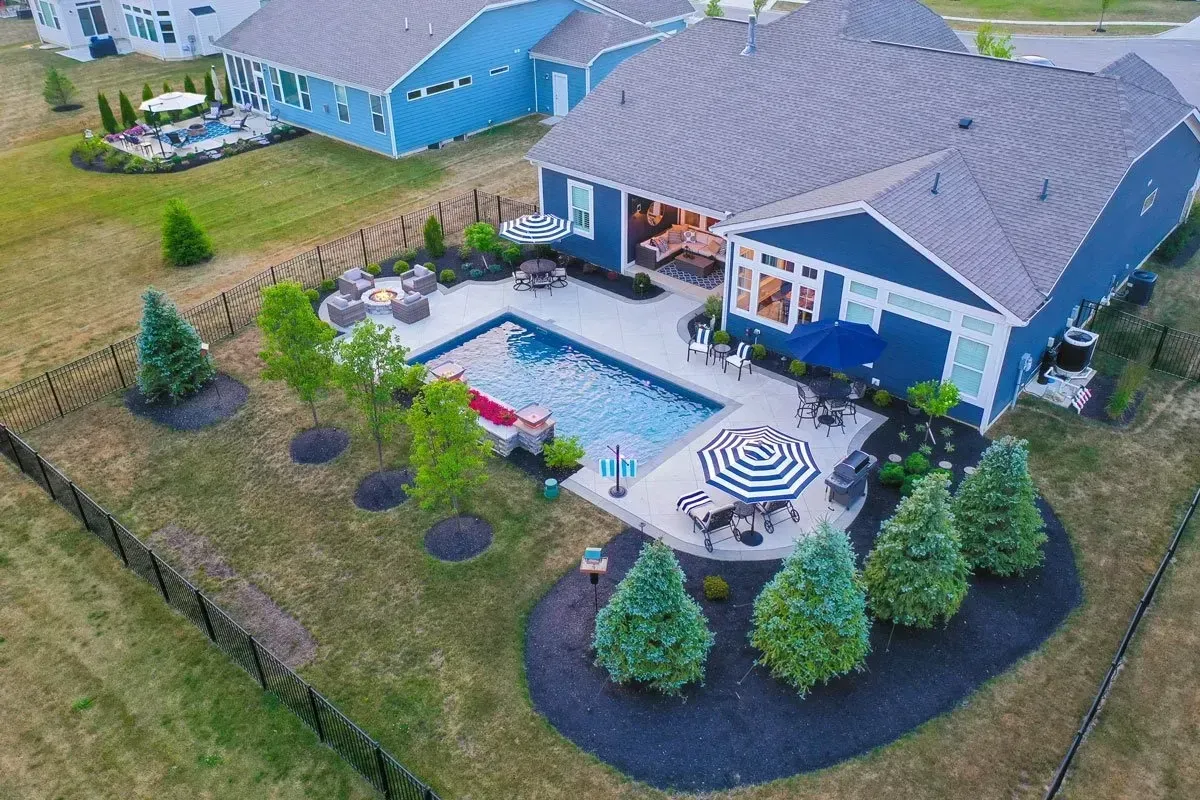
The tile came off next. Cobalt 1×1 glass releases from 28-year-old mortar with a chisel and a light mallet. We kept one panel intact for the homeowner — she wanted it mounted as a reminder of the pool’s original era.
Then the equipment pad. We cut every line and pulled the old pump, filter, and heater in a single morning. The DE filter had roughly 11 pounds of diatomaceous earth caked inside the grids, bagged separately for disposal under Gwinnett County construction-debris protocol.
Deck demo was the noisiest piece. We saw-cut the two back panels — the ones that had settled — and broke them out with a mini-excavator. That gave us clean edges to re-pour against. The front panels stayed.
Last came the diving well. You shoot new gunite onto the existing shell floor, stepped up to the new 4’10” grade, then retie rebar into the original cage to bond old and new. On this project the depth change added 14 cubic yards of gunite and three days of work.
Structural Rehab — Shell, Bond Beam, Coping
With the shell exposed, we spent four days on the work nobody photographs: repairing the pool’s bones. The bond beam — the top perimeter of the gunite shell where the coping sits — had two areas of freeze-thaw damage under the cobalt tile. Dacula, GA sees roughly 20 freeze events a year, and over 28 years that is enough to work moisture into any micro-crack. We ground back to sound gunite, re-tied fresh rebar, and shot new gunite to rebuild the bond beam profile.
The bond beam matters because everything above it — tile, coping, deck edge — depends on it being level, true, and dimensionally stable. A $6,000 travertine coping job on a soft bond beam fails in three years. We have replaced those jobs for other pool companies. We do not build them.
The bond beam on a 1990s pool: inspect for freeze-thaw damage under every 10 linear feet of tile. On a 90-foot perimeter pool like this one, expect to find 1–2 areas needing rebuild. Plan 2–3 days of labor and $1,800–$2,800 in materials.
We also retrofitted the main drain. The original single drain became two VGB-compliant anti-entrapment drains on a separate 2″ suction line to the new pad. VGB is federal code, and retrofitting it on a renovation is the right move — you are already in the shell and the incremental cost is small.
Coping came next. Her original coping was a cantilevered concrete lip — the standard 1990s look, poured monolithically with the deck. That style ages poorly in Dacula because the cantilever cracks where deck movement meets the fixed bond beam. We removed the full perimeter of cantilever coping and set a drop-face travertine coping in a color that warmed the pool’s visual temperature from cool-cobalt-1996 to warm-sand-2026.
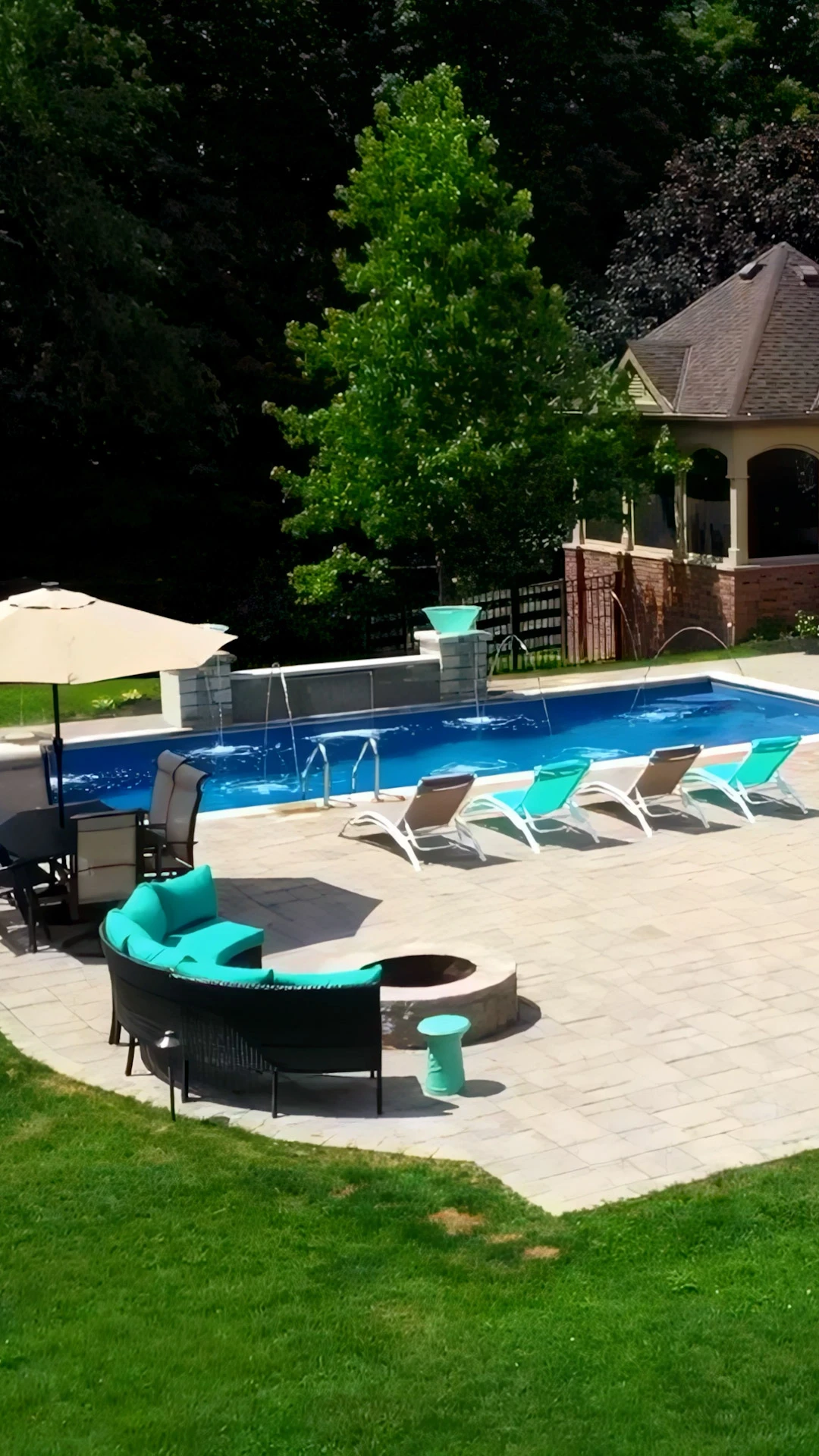
Interior Finish Transition — Old Plaster to Pebble Tec Aruba Blue
The interior finish has the largest single visual impact on a modernization and is where the dollar delta adds up fast on a 700-sqft interior.
White plaster runs roughly $4.80/sqft on a renovation. Pebble Tec in a standard color runs $9.60 to $11.20/sqft. Pebble Tec in a dark-bottom color like Aruba Blue runs the top end — about $11.20/sqft. On 700 sqft, that is a $3,400 to $4,500 premium over base plaster.
The homeowner asked why dark-bottom. Three reasons. An Aruba Blue bottom picks up 2 to 4 degrees of pool temperature on a sunny day versus white, extending the Dacula swim season by two weeks on either end. It reads like a natural pond, which is the current direction for 2020s pool design. And pebble aggregate holds color better than plaster — plaster fades and mottles, pebble stays true for 15 to 20 years.
The flip side: visibility. A 4’10” play pool with an Aruba Blue bottom is easy to see into from the coping, but a diving-well depth in the same color would have been concerning. The depth conversion made the finish choice viable.
We shot the Pebble Tec in a single day with a four-man crew. The key step is the acid wash 24 hours later — that is what exposes the aggregate. Pebble looks gray and muddy until the acid hits it. Then Aruba Blue shows up all at once.
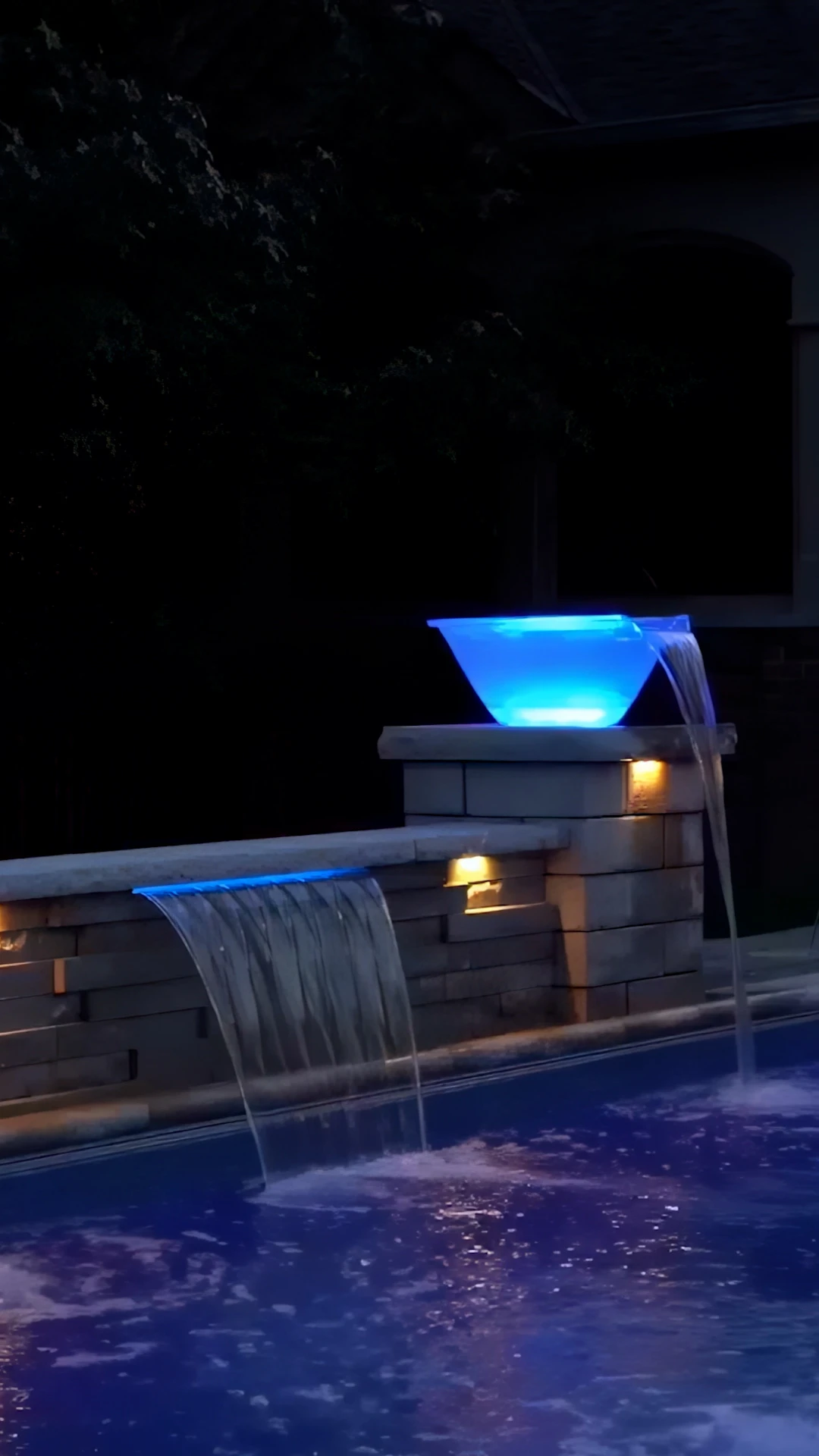
Tile above the finish: we replaced the cobalt 1×1 glass with a 2×2 fused-glass matte tile in a sand-and-grey blend. Matte does not show calcium etching the way glossy glass does, and it plays better against a dark-bottom pebble finish. The cobalt-1996 look had done its job for 28 years.
Equipment Pad Rebuild
While the finish cured, we rebuilt the equipment pad from scratch — a larger 48-square-foot pad with slope toward a new gravel drain and a completely new plumbing layout.
Pump: Pentair IntelliFlo3 VSF. This is the pump we default to on Hamilton Mill renovations because the variable-speed drive matches the hydraulic reality of a retrofitted system — most circulation hours run at 1,400 to 1,800 RPM drawing under 200 watts. Compare that to a 1.5 HP Hayward Super Pump drawing 2,200 watts flat. Over a 10-hour daily cycle, the difference is roughly 20 kWh per day, which at Georgia Power residential rates ($0.13 to $0.14/kWh) is $950 to $1,020 a year. Payback is roughly 2.5 years.
Pump swap economics on a 1996 pool: single-speed Hayward Super Pump ($300–$500 to replace like-for-like) versus Pentair IntelliFlo3 VSF ($1,900–$2,400 installed). The $1,400–$2,000 delta pays back in electricity within 30 months on a typical Hamilton Mill pool.
Filter: Pentair Clean & Clear Plus cartridge filter. We walked away from DE entirely. Cartridge filters with modern pleat density filter finer than DE for the particle sizes that matter in residential pool chemistry, and they do not require a homeowner to mix diatomaceous earth twice a year and pour it into a skimmer. That Saturday chore went away.
Heater: Raypak 407A ASME natural-gas heater. She had natural gas already stubbed from her 2011 install, so no new gas line. We sized up from her 266K BTU to 407K because she was considering a spa addition — undersizing a heater for a future spa is one of the most common mistakes on Hamilton Mill renovations. A 407K Raypak heats a 20,000-gallon pool plus a 550-gallon spa. A 266K will not.
We added a Pentair IntelliCenter automation panel — the 1996 pad had a mechanical time clock she had to manually override every time the weather changed. IntelliCenter runs pump, heater, and lights from her phone and throttles circulation down in winter automatically.
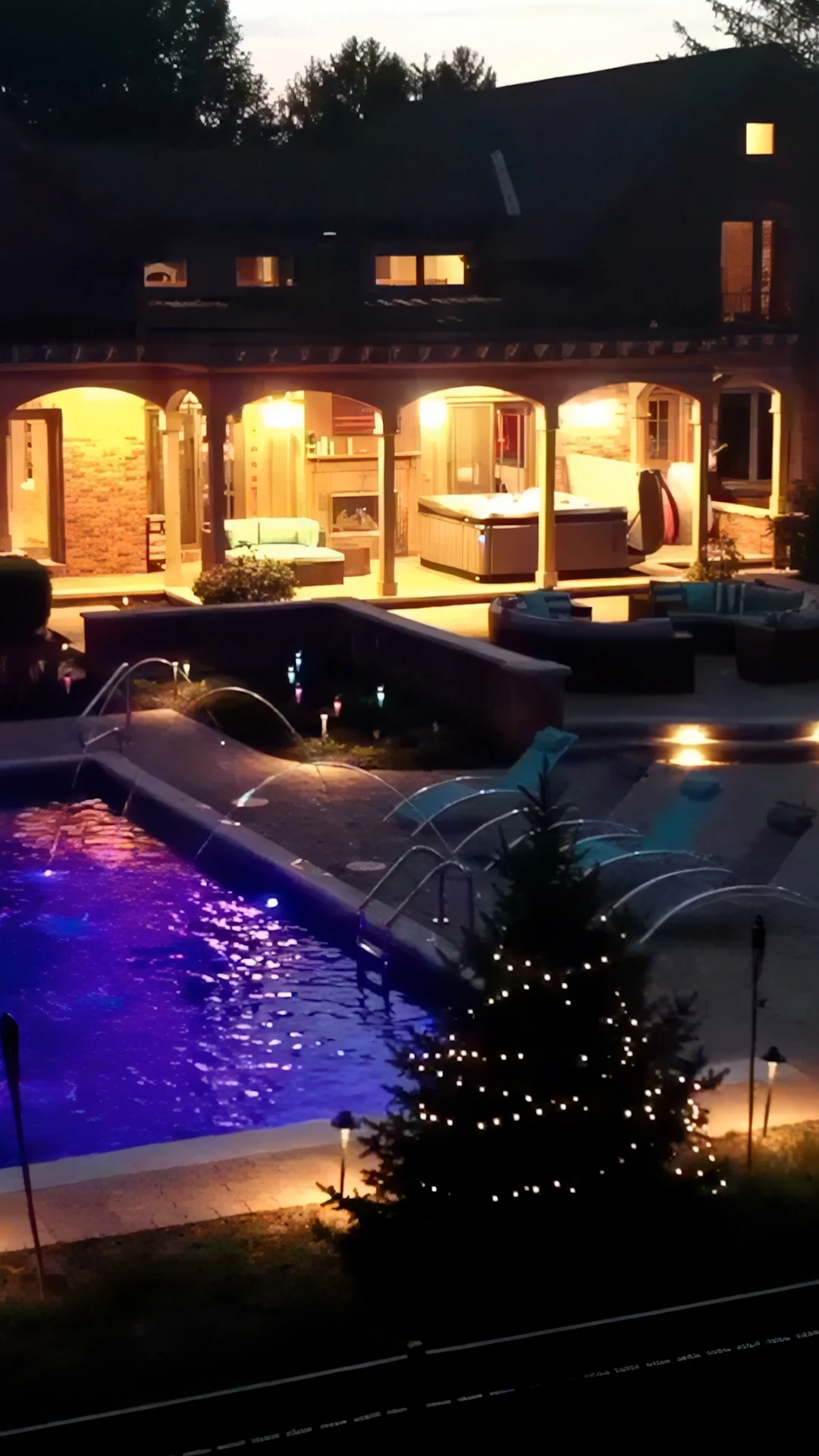
Deck Treatment + Soldier-Course Boundary
The last big line item was the deck. Her original 90-foot-perimeter cantilever concrete deck was partially kept (the front panels, which had not migrated) and partially replaced (the back two panels, which had settled and were tilting runoff toward the house).
The replacement panels got a proper base: 8 inches below finished grade, 4 inches of Gwinnett County #57 stone compacted in two lifts, 1 inch of sand-and-cement bedding, 4-inch concrete pour with #3 rebar on 18-inch centers and control joints at 8-foot intervals. Slope set at 1/8-inch per foot away from the house to keep runoff from reversing in heavy rain.
Between the kept and new panels, we ran a soldier-course boundary of travertine laid perpendicular to the deck edge. This is a detail we use often on phased deck replacements — the eye reads the soldier course as an intentional design element rather than a seam between eras.
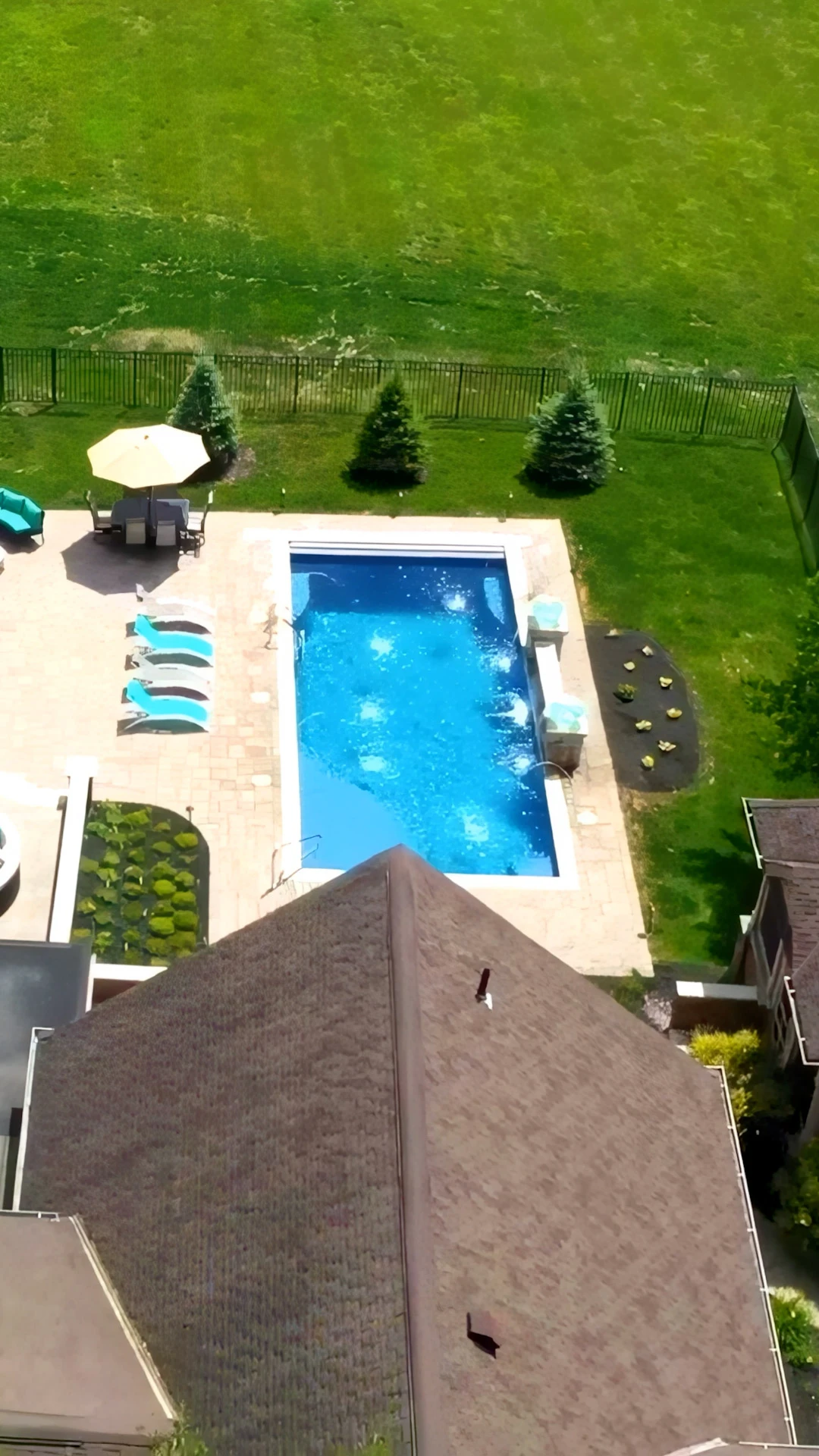
The coping-to-deck junction got a fresh 3/8-inch silicone expansion joint with backer rod. 1996 pools almost never have one — they were poured monolithically, which is what caused the cracking in the first place. It is one of the smallest budget items in the renovation and one of the most consequential.
We sealed the deck with a penetrating siloxane sealer, not a film-forming acrylic. Acrylic looks great for 18 months and peels for the next five years. Siloxane cannot peel and needs reapplication every 5 to 7 years.
The Finished Result + What It Means For Her 20-Year Horizon
We filled the pool on a Thursday, three months and one day after the first site visit. Fill water in Dacula comes off the Gwinnett municipal system at roughly 7.8 pH — we balanced to 7.4 pH, 100 ppm alkalinity, 250 ppm calcium hardness over the first 72 hours, and the pool was swim-ready the following Monday.
What the homeowner got for her $78,400 was not a 1996 pool that looked newer. It was a different pool. The IntelliFlo3 is so quiet that she texted us during week one to ask if it was actually running — the cavitation noise from the old Super Pump had trained her to listen for a sound the new pump does not make. Her July 2025 electric bill came in roughly $68 below July 2024, consistent with the 20 kWh/day pump reduction we projected.
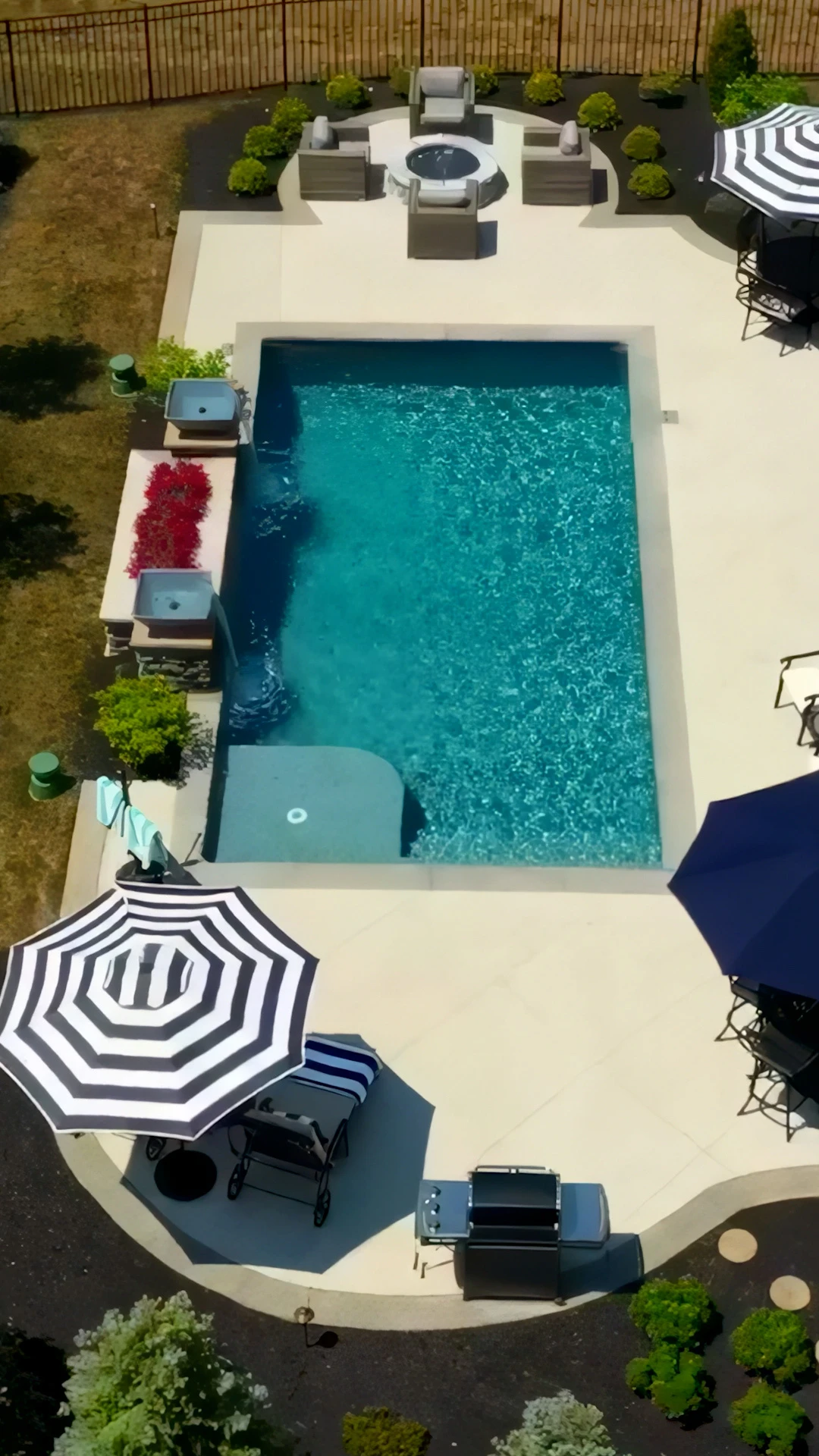
The 20-year horizon is what really sold this project. A resurfacing-only approach would have put her on an 8-year clock before the underlying hydraulics, equipment, and deck issues forced another $40,000 to $55,000 of work. Modernization buys 20 years of stable operation — Pebble Tec Aruba Blue has a 15–20 year life, the IntelliFlo3 runs 10–12 years at residential duty cycle, travertine coping will outlive both, and the rebuilt bond beam and VGB drains are essentially permanent.
If she sells in year 10, she sells with a modern pool. If she keeps it through her grandkids’ teenage years, she never has to think about the pool as anything other than a place to swim.
We have built variations of this same project across Hamilton Mill, Providence Club, Ivey Chase, and Chandler Ridge — the housing stock rhymes, the original pool plans rhyme, and the end-of-life timing is rhyming across Dacula right now. If your pool was built between 1995 and 2005, you are somewhere on this same timeline, whether you have noticed yet or not.
The Providence Club Drive homeowner started with a $21,800 resurfacing question and ended up with a $78,400 modernization that will outlast her ownership of the house. She did not regret a single line item. The only thing she said she would have done differently, eight months in, was the spa — she had deferred it during scope to “keep costs down,” but the heater was already sized for it, the gas was already sized for it, and the pad was already plumbed for it. Adding the spa now costs her roughly $22,000 more than it would have as part of the original scope. That is the other lesson from this job: when you are already in a pool to that depth, do the things you are going to do anyway.
Pool modernization and remodeling across 20+ cities within 30 miles of Winder, GA
If your Hamilton Mill, Ivey Chase, Providence Club, or Chandler Ridge pool is approaching its 25th birthday, the right conversation is not about resurfacing — it is about what the next 20 years of that backyard should look like.