
82% of the outdoor kitchens we’ve rebuilt in Dacula over the past four years had nothing wrong with the countertop, grill, or stone veneer. The failure was underneath — gas lines buried too shallow, water lines that froze in January, a 20-amp circuit asked to run a 6-burner grill and a beverage fridge off the same run. The kitchen itself was fine. The utilities were never inspected, never sized, never permitted.
That number comes from our project log — 38 kitchen remodels between 2022 and 2026 across Hamilton Mill, Sycamore Ridge, Providence Club, and Ivey Chase. Thirty-one had a utility defect that required demolishing part of the stone base. Three had active gas leaks when we arrived. Every one had skipped at least one Gwinnett County inspection during the original build.
The reason is simple: the contractor who pours the slab is rarely the same person who runs the gas line, sets the GFCI, and plumbs the water. An outdoor kitchen needs a gas plumber, an electrician, a water plumber, and a mason, sequenced against county inspection windows. When any trade gets skipped, the kitchen fails three to seven years later, and the repair bill runs $8,000 to $22,000 depending on how buried the mistake is.
This is the process we use on every Dacula build — same sequence on a $38,000 grill island and a $112,000 covered kitchen. The utilities care about depth, material, sizing, and inspection sequence.
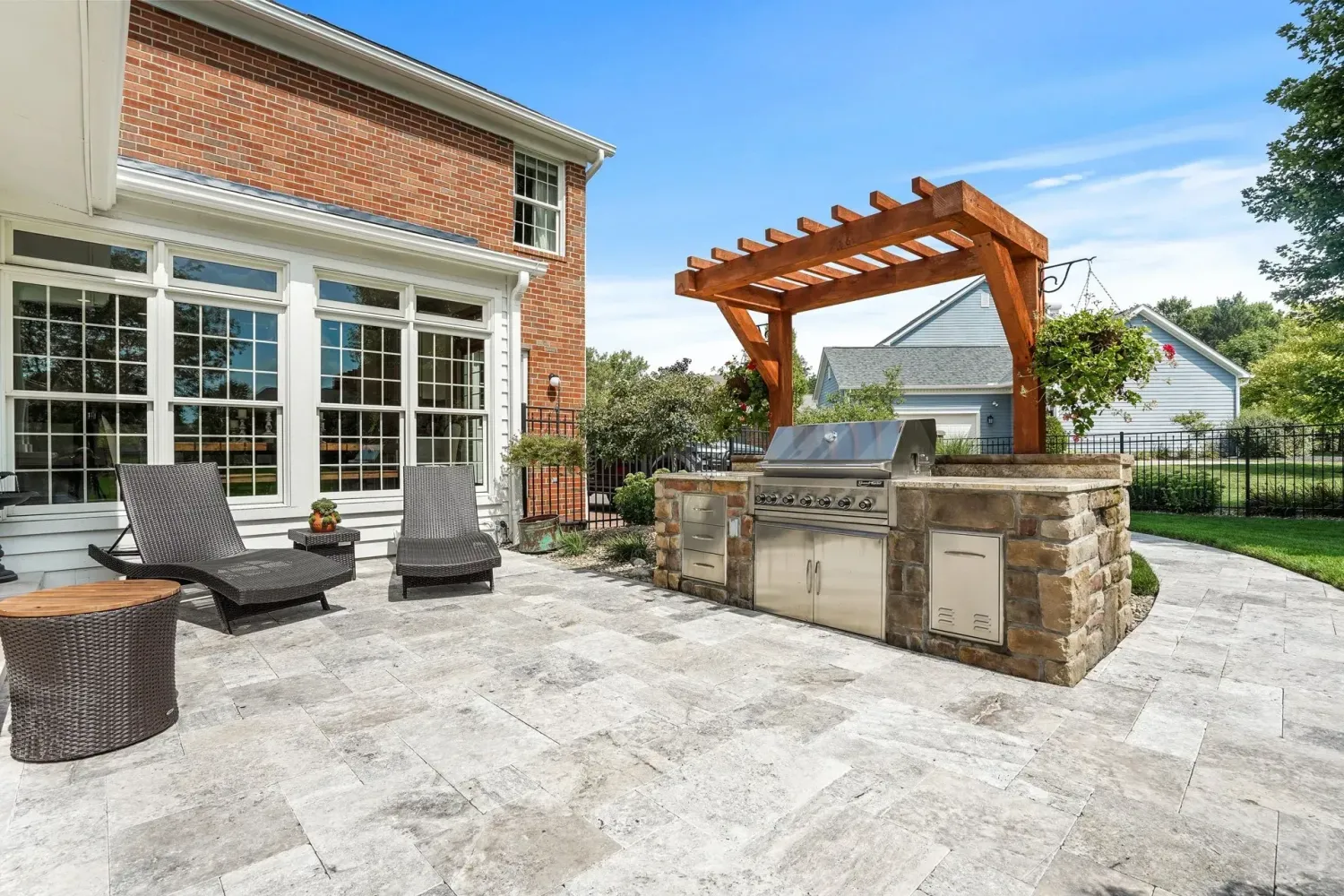
1. Permit Intake and the Inspection Calendar
Every outdoor kitchen in Dacula with a gas line, a dedicated electrical circuit, or a plumbed water supply needs a permit through the Gwinnett County Department of Planning & Development at 446 W. Crogan Street in Lawrenceville. A grill-only island with no utilities doesn’t always require one, but the moment you add gas, a GFCI outlet, or a water supply, you’re in permit territory.
We pull three separate sub-permits on a typical Dacula build: mechanical (gas), electrical, and plumbing (water and drainage). The structural work — block base, slab, stone veneer — may or may not require its own permit depending on size and whether the kitchen ties into an existing roof structure. We still pull it on anything larger than a grill cart because an unpermitted masonry structure is the first thing a future buyer’s home inspector will flag.
Gwinnett’s residential inspectors are generally available within 48 to 72 hours of request — next-day during slower weeks, four-day waits during peak construction season in April through June. Which means the trench we dig on Monday sits open until Thursday at the latest. If Tuesday brings two inches of rain, the trench walls slump and the inspection gets bumped. Build the calendar with slack.
Three mandatory inspection milestones: Rough-in (before any backfill or slab pour, with all gas/water/electrical lines exposed in the trench). Pre-finish (after block base is set, before the stone veneer or skin goes on, so the inspector can verify penetrations and clearances). Final (after all appliances are set, gas pressure-tested, electrical energized, water pressurized — the kitchen is essentially done and being walked through).
Skipping any of these produces the 82% number. The rough-in is the most-skipped — it’s the most inconvenient because everything has to sit visible in an open trench waiting on the inspector, and less experienced builders backfill and move on. Every skipped rough-in is a future demo bill.
2. Gas Line Sizing, Depth, and Material
The gas line is where we see the widest spread of quality in Dacula work. The International Fuel Gas Code (IFGC), which Gwinnett adopts by reference, sets the minimum buried gas line depth at 18 inches below finished grade. We pull 24 inches as our standard — margin against the frost line, against future landscape trenching, and against lawn aeration tines that punch through at 3 to 5 inches.
Material matters more than depth. You’re picking between two systems:
- CSST (corrugated stainless steel tubing): flexible, yellow or black jacketed, installed with specialty fittings. Runs $6 to $8 per foot installed in Dacula labor rates. Faster to route, especially around obstacles like pool equipment pads or existing tree roots.
- Black iron pipe: rigid, threaded joints, requires careful layout and pipe dope at every connection. Runs $12 to $18 per foot installed. Heavier labor, more skilled work, less forgiving of layout mistakes.
We’ll run either, depending on site conditions. Long straight shots from meter to a freestanding island favor black iron. Tight routes around an existing pool deck or under a covered patio favor CSST — you can bend it past obstacles without 40 threaded elbows.
Where CSST gets misused: bonding. CSST must be bonded to the home’s electrical grounding system — a #6 copper conductor clamped to the first rigid section after the meter, tied back to the service ground. This is a lightning-strike safety issue. Unbonded CSST has caused residential fires when nearby lightning strikes induce a current through the flexible tubing and arc a pinhole. We’ve pulled out three Dacula installs since 2023 where CSST was installed and never bonded — a defect that only surfaces at the gas rough-in, if the rough-in happens.
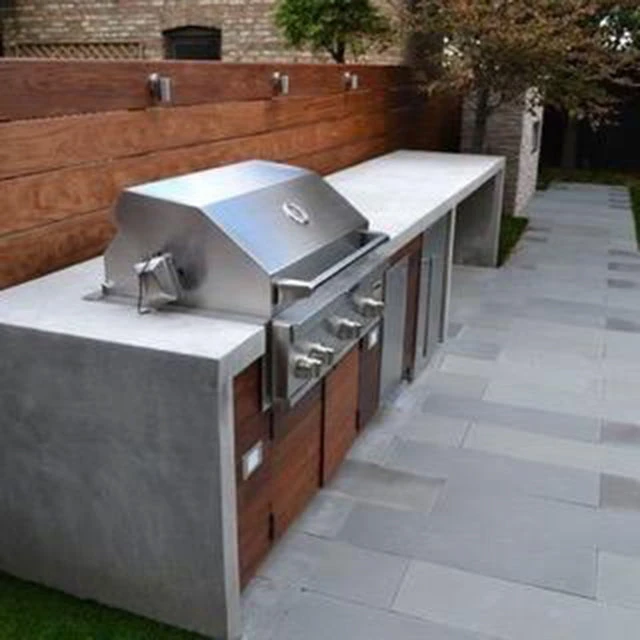
Sizing the line to the appliance load
Gas line size is determined by total BTU load and developed length — the actual pipe distance from meter to appliance. Undersize the pipe and your 85,000-BTU grill starves when the side burner and smoker fire at the same time — flames shrink, regulators cycle, and you wonder why your new grill cooks worse than your old one.
The quick working rule we use for Dacula builds:
- 1/2 inch pipe: one appliance only, under 65,000 BTU, developed length under 50 feet. A basic 4-burner grill and nothing else.
- 3/4 inch pipe: multi-burner grill plus a side burner, or grill plus smoker, or grill plus burner plus pizza oven at reasonable distance. The default for any kitchen with more than one heat source.
- 1 inch pipe: full outdoor kitchen with 6-burner grill, sear station, side burner, smoker, and a second appliance like a pizza oven — total load above 180,000 BTU, or long runs above 100 feet from the meter.
Hamilton Mill lots where the gas meter sits on the side of the house and the outdoor kitchen is at the back of a 90-foot yard routinely hit developed lengths of 120 to 160 feet. That’s almost always a 1-inch supply stepped down to 3/4 inch at the island, with 1/2 inch drops to each appliance. The math is in IFGC Table 402.4 — we run it on every project and include the calculation sheet in the permit submittal.
Pressure test, not sniff test: After the gas line is installed but before any appliance is connected, we cap every branch, pressurize the whole system to 15 PSI with compressed air, and leave it on a gauge for 15 minutes minimum. Any drop = a leak somewhere, and we hunt it with soapy water or an electronic sniffer. This test is the rough-in inspection — the inspector wants to see the gauge holding pressure.
3. Water Supply, Drainage, and Freeze Protection
A water line to an outdoor kitchen sink looks like the simplest utility. It’s the one that freezes and bursts most often in Dacula because nobody installs it to Zone 8a freeze-tolerant specifications.
Gwinnett’s frost depth requirement for buried water lines is 24 inches below grade — the same 24 inches we use for gas. Gas and water run in the same trench on most of our installs, with required separation per code (12 inches horizontal or gas above water on a shelf). The 24-inch depth puts the line below the hardest freeze events we see here, which rarely penetrate past 8 to 10 inches.
Material: Type K soft copper or PEX-A with freeze-resistant fittings. We default to PEX-A on outdoor kitchen runs because it expands under freeze stress without bursting — a hard freeze through copper splits the line longitudinally, and you find out in March when you turn the water back on and flood the inside of your stone island.
The actual freeze point is not the buried line — it’s the riser where water comes up into the island and connects to the faucet. Even with insulation, that riser sees ambient air every winter. Two features are mandatory:
- Shutoff valve inside the house: a dedicated shutoff somewhere accessible (basement, crawlspace, utility room) so the homeowner can isolate and drain the outdoor kitchen line every November.
- Drain-down fitting at the low point of the outdoor riser: a small bleeder valve that lets the homeowner purge the last few inches of standing water after closing the house shutoff. Without this, the standing water freezes, expands, and cracks the riser even with the rest of the line empty.
We’ve pulled out kitchens where neither feature existed, the homeowner forgot to winterize, and the riser cracked inside the island — the leak surfaced three months later as a wet stain on the pavers beside the kitchen, after it had already rotted the cabinet millwork and oxidized the electrical feed. $7,400 repair, avoidable with a $45 drain-down fitting installed at rough-in.
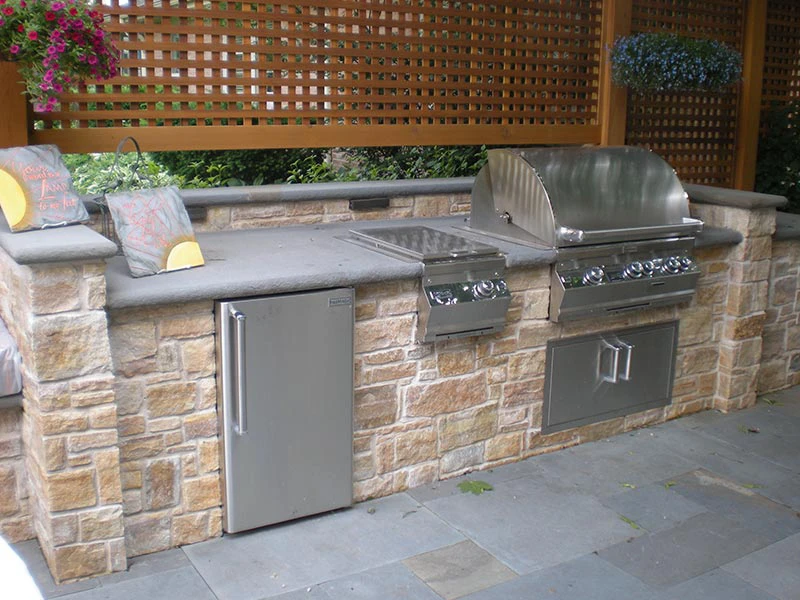
Drainage and the forgotten P-trap
Every plumbed sink needs a drain, and that drain ties into either the home’s sanitary sewer line or a permitted dry well. Gwinnett allows dry wells for outdoor kitchen sinks with plumbing permit sign-off, sized by a percolation test and placed at least 10 feet from any foundation.
Dry well or sewer tie, the drain has to include a P-trap. The trap holds a water seal that prevents sewer gas from venting back into the sink. A P-trap that sits empty all winter (because the homeowner winterized and the trap dried out) releases sewer gas into the kitchen in March when temperatures climb. The fix is either a trap primer — a solenoid that periodically refills the trap — or an outdoor-rated waterless trap.
4. Electrical: Circuits, Amperage, and GFCI
Electrical is where code is most specific and most often ignored on older Dacula installs. The National Electrical Code requires GFCI protection on every 125-volt, 15- and 20-amp receptacle within 6 feet of any outdoor water source — which means every outlet in or near a kitchen with a sink. GFCI detects imbalance in current flow and cuts power within milliseconds of a fault.
The more useful question is how many circuits the kitchen actually needs. Beyond a bare grill-only island, the answer is almost always more than one:
- Grill appliance circuit (if electric ignition or rotisserie): 15 amps dedicated, GFCI protected.
- Refrigerator circuit: 15 amps dedicated. Sharing a fridge circuit with anything else trips the breaker when the compressor kicks on under load.
- Lighting circuit: 20 amps, covers task lighting, overhead pendants, and integrated island lighting.
- General-purpose receptacle circuit: 20 amps, for blenders, radios, phone chargers, and future-use outlets.
- TV / sound system circuit (if included): 15 amps dedicated, often on a surge-protected sub-branch.
That’s five circuits for a fully loaded kitchen. The math rarely fits on the existing house panel, which is why we specify a 50-amp subpanel in a weatherproof enclosure near the outdoor kitchen on almost every build. A 50-amp sub gives working headroom for a 6-burner grill ignition, a 15A fridge, a 20A lighting circuit, and future capacity for a pizza oven or ice maker without re-trenching.
Feeder wire from main panel to outdoor subpanel: for a 50-amp sub-feed over a typical Dacula outdoor-kitchen distance of 60 to 120 feet, we pull 6/3 copper with ground or 4/3 aluminum SER cable in conduit. The feeder is sized for voltage drop, not just breaker trip — long runs need to step up a gauge even though the amp math looks fine on paper. We calculate voltage drop on every subpanel feed at the actual run length.
The subpanel enclosure is rated for outdoor use — NEMA 3R minimum, NEMA 4X in spray zones — and bonded to the outdoor grounding electrode when distance from the main panel exceeds code thresholds. The electrician documents the bond and grounding electrode on the permit card.
Conduit and burial depth for feeders
Underground feeder conduit in Gwinnett runs at 18 inches minimum depth for PVC with wire inside, 24 inches for direct-burial cable. We run rigid PVC — schedule 40 for most of the length, schedule 80 where it emerges at the subpanel and where vehicles might cross — because conduit makes future wire replacements possible without excavation. Electrical conduit runs in a separate trench from gas; if a future contractor hits one line with a shovel, you don’t want both failing at once.
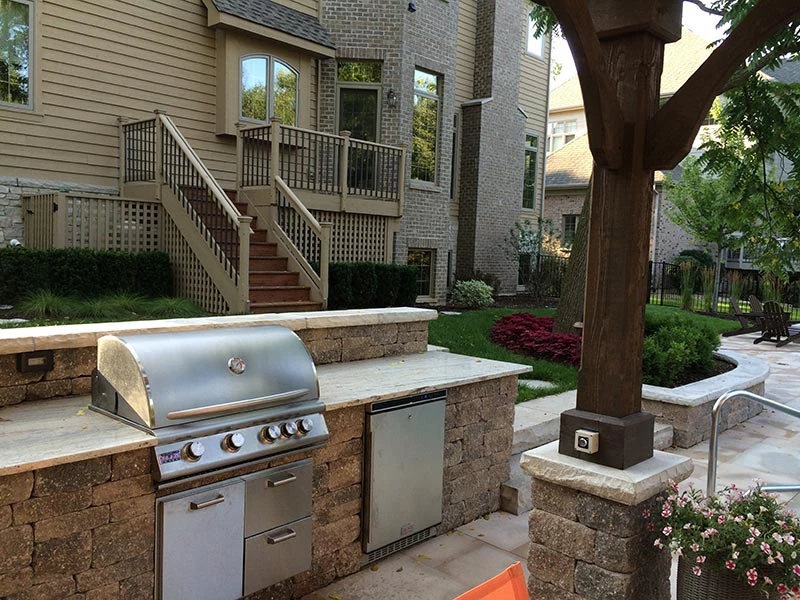
5. Trench Sequencing and the Rough-In Inspection
The hardest part of building an outdoor kitchen correctly in Dacula isn’t the code — it’s the trench sequencing. You’re running three utility systems from three origination points (gas meter, water stub, main electrical panel) to one destination (the kitchen pad). In Piedmont clay that turns to dense plastic when wet, every trench foot is a decision.
Our sequence on a typical Hamilton Mill build:
- Mark utilities: call 811 seven business days before any digging. Hamilton Mill subdivisions have layered utility runs from three decades of expansion. Every trench we dig has a locate on it.
- Excavate primary trench: machine-dig gas + water to 28 inches (we over-dig 4 inches for bedding sand). Electrical gets a parallel trench with 3 to 5 feet of horizontal separation.
- Bed and lay gas line: 2 inches of washed sand, gas on the sand, 6 inches of sand backfill, continuous buried-warning tape at 12 inches above the line. A homeowner landscaping in ten years needs to hit the tape before the shovel reaches the pipe.
- Lay water parallel or above gas on a shelf: same bedding, same warning tape. Water gets a shutoff-valve access box at the pad edge — buried valve, riser tube to grade, lidded, so future service doesn’t require excavation.
- Electrical conduit in separate trench: 18-inch depth for schedule 40 PVC, bedded in sand with warning tape above.
- All three lines emerge at the kitchen pad at rough-in height: stubbed, capped, labeled, sized for final appliance position.
- Call for rough-in inspection: everything exposed, gas and water under test pressure, electrical complete to the subpanel but not energized. Inspector walks the trench, signs the permit card.
- Backfill only after sign-off: 6-inch compacted lifts, tamped, finished grade directing surface runoff away from the pad.
A failed rough-in usually fails for one of three reasons: insufficient depth, missing CSST bonding, or a gas leak on the pressure gauge. Every failed rough-in adds 3 to 5 days to the schedule — fix the defect, request the re-inspection, wait on the 48-72 hour window.
What we do differently on sloped Dacula lots
Dacula’s gently-rolling topography — most pronounced west toward Hamilton Mill Ridge — means many kitchen sites sit on backyards that fall 4 to 12 feet between the house and the pad. Sloped trenches collect groundwater, and groundwater in a utility trench is how gas lines float, water lines freeze deeper than expected, and electrical conduit joints leak moisture into the subpanel.
On any site with more than 3% slope across the trench run, we install a French drain parallel to the utility trench, 18 inches off and 6 inches lower, tied into a daylight outlet or dry well. A kitchen that settles 2 inches five years after installation almost always has water-related trench subsidence at the root.
6. Pre-Finish and Final Inspections — What Gets Caught Last
After rough-in sign-off and backfill, the block base gets laid on the slab, appliances get dry-set for layout confirmation, and the utility stubs extend into the block base to final appliance connection points. This is pre-finish — the kitchen is structurally built but not yet veneered, and all penetrations are visible.
The pre-finish inspection catches:
- Appliance clearance from combustible materials: every grill manufacturer publishes required clearances from wood, vinyl, cedar trim, and pergola posts. A 6-burner grill typically needs 8 to 12 inches of clearance per side and sometimes a non-combustible hood overhead.
- Ventilation cutouts in the block base: outdoor gas appliances need airflow — stagnant LP pooling inside a sealed base is an ignition risk. Manufacturers specify square inches of vent area; the inspector verifies them.
- GFCI placement and height: outlets within 6 feet of the sink are GFCI, outlets at counter height follow the appliance spec, all outdoor outlets are weather-rated with in-use covers.
- Water shutoff accessibility: the valve is reachable without demolition. Buried under stone veneer = fails.
Pre-finish is the last moment before the skin goes on. Anything wrong here gets fixed by cutting block, not demolishing stone. A failed final three weeks later — after veneer is set and countertops installed — is a five-figure mistake. We’ve seen homeowners call us to diagnose a fridge circuit that won’t hold, and the fix required pulling three square feet of travertine off the front of the island to reach the outlet box the original builder buried behind it.
The final inspection and the handoff documents
Final is the walk-through with all appliances installed, connected, and operating. The inspector lights the grill, runs the side burner, tests the fridge under load, trips every GFCI, runs water, checks the drain. Anything that doesn’t meet code gets corrected; the permit card gets signed when everything passes.
At handoff we give the homeowner a utility binder: gas line pressure test certificate, gas sizing calculations, subpanel schedule with every circuit labeled, GFCI locations, shutoff location, drain-down location, winterization procedure, and the signed permit card. That binder is what a future home inspector, insurance adjuster, or buyer will ask for. An outdoor kitchen without documentation is an asset that lives on trust — every future service call starts with guessing.
The homeowner walks away knowing where the shutoffs are, how to winterize in November, and what the subpanel is sized for. That’s what the 82% of rebuilds were missing — not better stone, not fancier grills, just the documentation and the depth and the sizing and the inspection sequence that turns a backyard grill island into a kitchen that lasts 25 years instead of 5.
What a properly-built Dacula outdoor kitchen costs on the utilities alone: gas line and CSST bonding, $1,800 to $4,200 depending on run length. Water supply with shutoff, drain-down, and drain tie, $1,400 to $3,100. Electrical 50-amp subpanel feed with 4 to 5 circuits and GFCI protection, $2,800 to $5,400. Permits and inspections, $450 to $900. That’s $6,450 to $13,600 for the utilities — typically 18% to 28% of total outdoor kitchen project cost, and the percentage we will not negotiate down on.
Outdoor Kitchens built to Gwinnett County code across 20+ cities within 30 miles of Winder, GA
Gas sized and bonded to IFGC spec. Water lines at 24-inch depth with drain-downs. Electrical sequenced from the feeder to the GFCI. Three inspections, one binder, one kitchen that lasts.