
A Bethelview homeowner called us after a Forsyth County inspector red-tagged their brand-new outdoor fireplace — chimney 14 inches shy of code, refractory liner omitted, spark arrestor mesh too wide. The rebuild came to $4,200. None of it was the homeowner’s fault. It was the contractor’s. This is the walk-through we wish they’d had before the first block was set.
Forsyth County approves more than 200 pool permits a year across 247 square miles of unincorporated Coal Mountain, Shady Grove, Ducktown, Big Creek, Shiloh, and the Lake Lanier south-shore corridor. Tucked inside those permits — on the plans that include a masonry fireplace — sits a quiet trap: NFPA 211, the National Fire Protection Association standard that governs chimney geometry, liner composition, and spark-arrestor spec. Inspectors here know it cold. Plenty of contractors don’t.
When an inspector catches a missed NFPA 211 spec after the veneer goes on, the fix is almost never a tweak. It’s a tear-down. This piece is the compliance walk we give Forsyth homeowners before we pour a footing — in the exact order the inspector is going to check it.
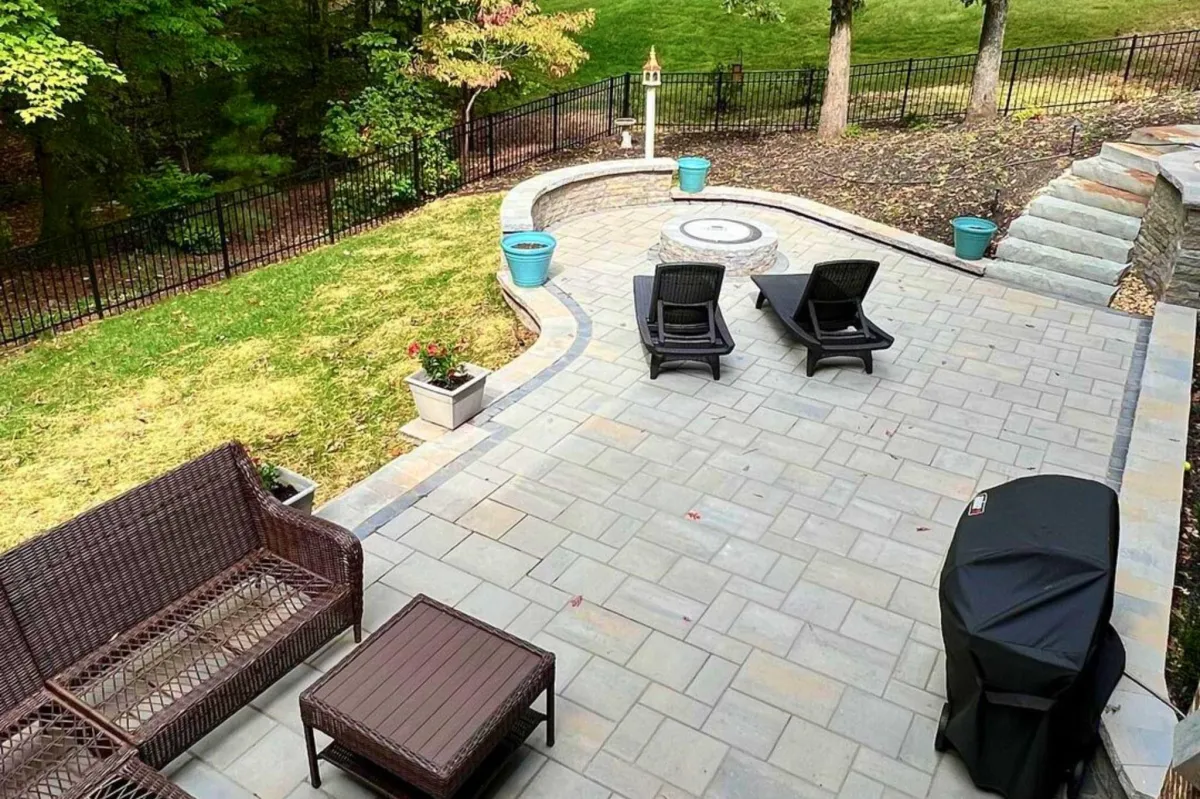
The NFPA 211 Chimney Geometry Rule — Why Height Is Never Negotiable
The single most common Forsyth red-tag we see is the 2-10-3 rule. Written out: the chimney must terminate at least 3 feet above the highest point where it passes through the roof — which, for a freestanding outdoor fireplace, means 3 feet above the top of the firebox structure itself. It must also terminate 2 feet higher than any structure within a 10-foot horizontal radius, measured from the chimney’s centerline.
In a real Forsyth backyard, that “any structure within 10 feet” language bites harder than it reads. A pergola crossbeam. A screened porch fascia. A neighbor’s dormer if you’re lot-line close. The inspector walks with a tape. If you’re on a 30040 lot in the Bethelview corridor where subdivisions tuck tightly in, that 10-foot radius almost always catches something. We’ve had to re-bid projects in Shoal Creek three times because the original contractor measured chimney height off-the-cuff and hadn’t accounted for the arbor the client wanted 8 feet away.
The math works like this: find the tallest thing within a 10-foot radius of your chimney centerline. Add 2 feet. Compare that to the chimney top. Compare your chimney top to the firebox-top-plus-3-feet. Take the higher of the two. That’s the minimum terminal height. Build it an inch short and the inspector kicks the permit. We build every Forsyth chimney to a minimum 12-foot flue height above grade for a 6-foot firebox — it gives us headroom against pergolas and neighbor eaves without re-measuring per site.
The 2-10-3 rule, plain English: Chimney must be 3 ft above the roof/firebox top AND 2 ft above anything within a 10-ft horizontal radius. Forsyth inspectors measure this with a tape on final — not plan-check. They will red-tag a half-inch short.
Refractory Firebrick and the Clay-Flue-vs-Stainless Debate
The firebox interior is where homeowners get sold a lie that sounds reasonable. “We’ll line it with standard brick and it’ll be fine.” It won’t be. NFPA 211 mandates a refractory firebrick liner — brick rated to withstand sustained temperatures of 2,000°F — laid in refractory mortar (not standard Type N or Type S mortar). The refractory mortar is non-negotiable because standard cement mortars start to lose integrity around 1,000°F, well below the operating temperature of a hot hardwood fire.
The firebrick we spec in every Forsyth build is 2.5-inch-thick medium-duty K-23 insulating firebrick for the rear wall and sides, bedded in Rutland refractory cement. The floor gets a solid firebrick hearth over a cast-concrete base with an air gap for thermal break. Skip the thermal break and the concrete base spalls inside two winters — we’ve rebuilt three firepits in Shady Grove that failed exactly this way, all built by a contractor who poured directly onto the footing.
Above the firebox, the flue itself is where Forsyth inspectors give you a choice: clay tile flue or stainless steel liner. Both are code-legal. We default to clay flue for wood-burning builds — a stacked run of 13×13 rectangular clay flue tiles from Superior Clay, each 24 inches tall, mortared on a slope-compatible bed of refractory mortar with the joints struck flush inside the flue (inspector will stick a mirror up the smoke chamber to check this). For gas-only fireplaces we use a double-wall stainless B-vent because the condensate profile is different and clay tends to crack from flue-gas acidity in low-temperature gas appliances.
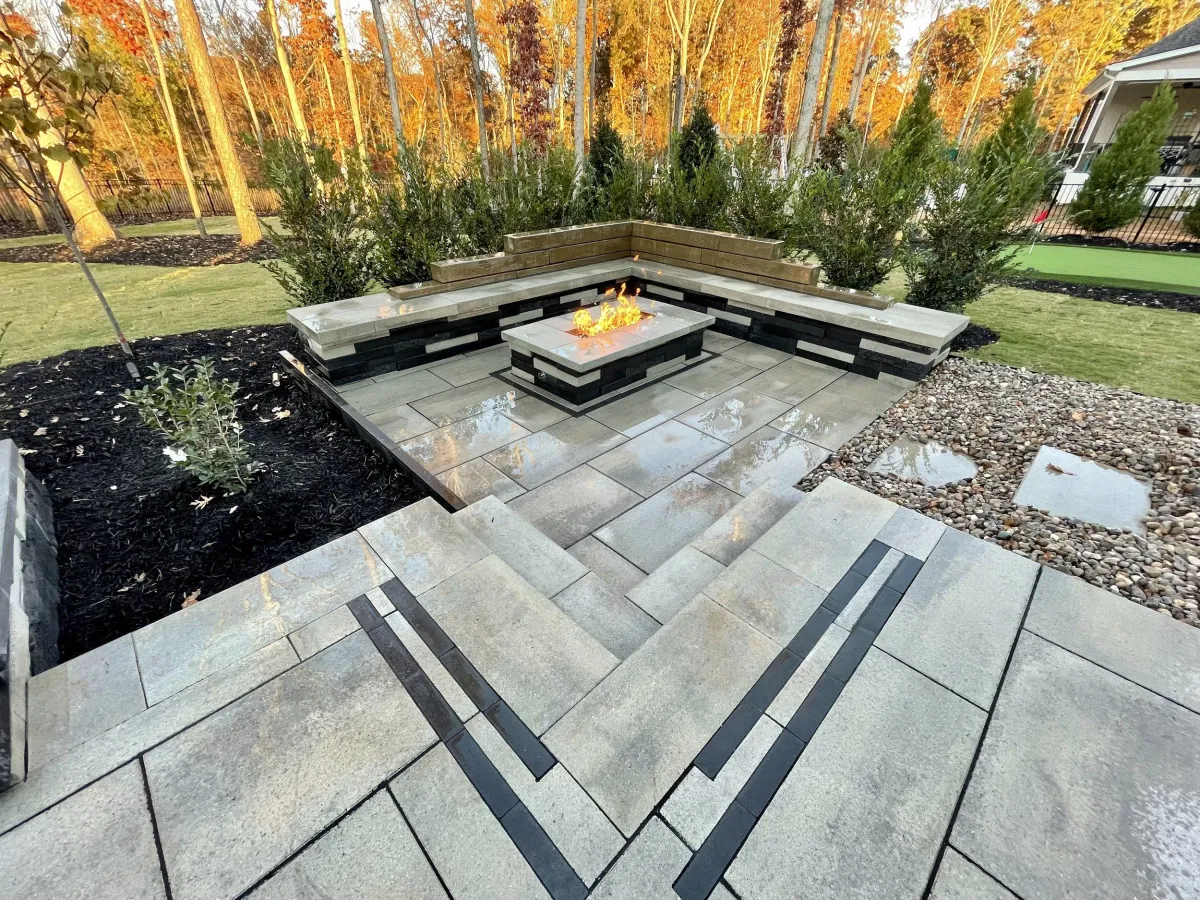
The Spark Arrestor, Cap, and Crown — The Details That Fail Inspections
Once the chimney is up and the flue is set, three finish details stop most failed builds: the crown, the cap, and the spark arrestor. All three are in NFPA 211 Chapter 14 and the Forsyth inspector checks them in exactly that order.
The crown is the sloped cement topper that sheds water off the chimney structure. It is not a thin skim coat. Code requires a minimum 2-inch-thick cement crown with a drip edge overhang of at least 1 inch past the chimney face, sloped to drain. We pour crowns using a 2:1 sand-cement mix with fiber reinforcement, fabricated over a sheet-metal form, and we leave a 3/8-inch expansion gap between the crown and the flue tile — sealed with Polyseamseal high-temp caulk — so thermal cycling doesn’t crack the crown at the flue.
The cap sits on top of the flue and keeps rain, debris, and animals out of the chimney. Inspector doesn’t technically require a cap under NFPA 211, but Forsyth County enforces it through the separate International Residential Code reference — a capless flue is an open invitation for a squirrel chimney fire. We install a stainless cap with a welded top plate and mesh sides, sized to the flue.
The spark arrestor is where the most inspections fail. Code: mesh openings no smaller than 3/8 inch and no larger than 5/8 inch. Most off-the-shelf caps use 3/4-inch mesh — that’s a red tag. We order spark arrestors with verified 5/8-inch woven stainless mesh, welded to the cap frame (not crimped — crimped mesh unravels after a year of thermal expansion). It’s a $40 part that fails more projects than anything else.
Spark arrestor spec, by the numbers: Mesh opening 3/8″ minimum, 5/8″ maximum. Welded construction, not crimped. Stainless steel 304 or better. If you can see daylight through a gap wider than a dime, it’s a fail.
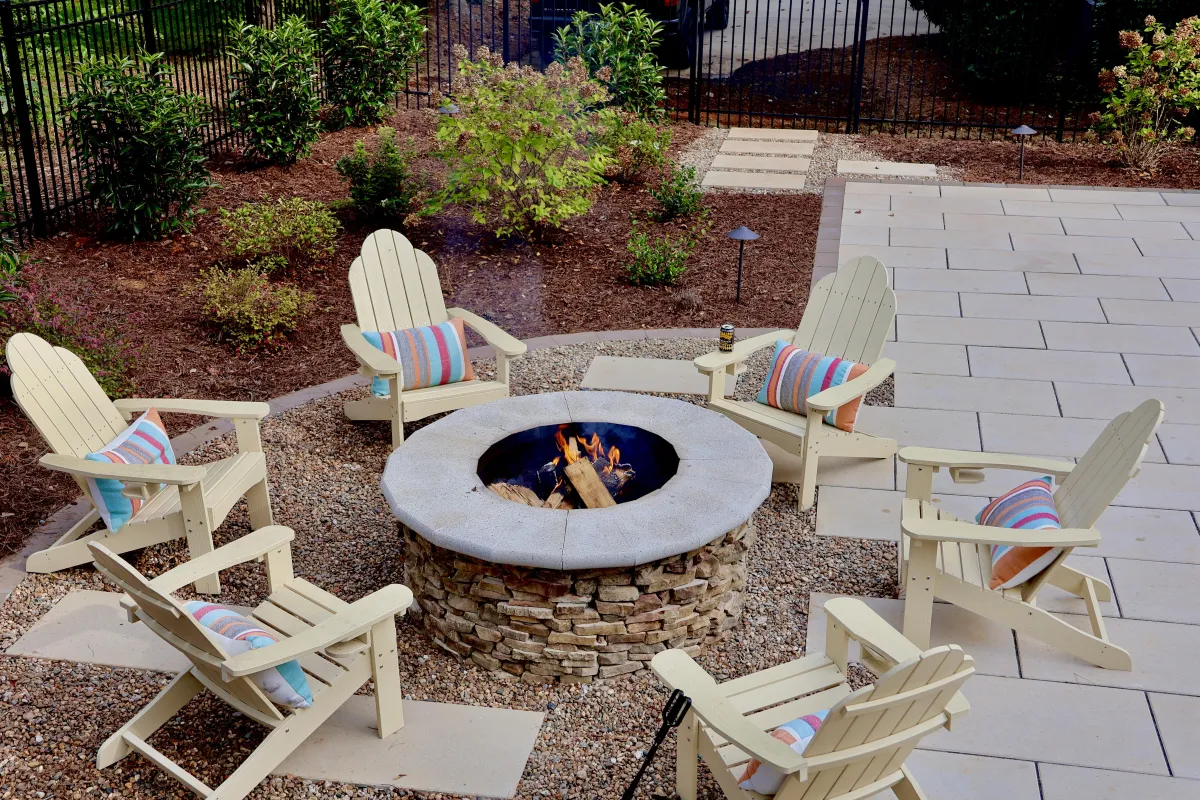
Clearances, Hearth Extension, and the Footprint You Can’t See
Forsyth County enforces NFPA 211 clearance rules even on outdoor masonry because of the fire-propagation risk on wooded lots backing to greenspace — and 60 percent of Forsyth lots north of Hwy 369 back to some kind of wooded buffer. The clearance rules have two parts: clearance to combustibles (the firebox can’t be closer than 6 inches to any framed structure unless that structure is rated non-combustible), and hearth extension (a non-combustible pad must extend 16 inches in front of the firebox opening and 8 inches to each side).
The hearth extension trips up homeowners on a tight paver layout. We’ve redesigned two patios in the Brookwood subdivisions because the fireplace opening was positioned with the hearth extension falling onto existing turf rather than masonry. Inspector won’t sign — the hearth has to be integrated paver or slab, not grass, not gravel, not mulch. For paver patios, that means the fireplace centerline needs to be planned backward from the hearth-extension requirement, not the other way around.
Footing depth is the other silent killer. Forsyth County’s frost depth is 12 inches, but NFPA 211 requires footing below frost line AND a footing thickness of at least 8 inches of reinforced concrete, with the footing extending at least 6 inches past the firebox perimeter on all sides. For a 6-foot firebox with an 8-foot chimney, that’s a footing around 7 feet wide, 4 feet deep, and 8 inches thick — roughly 7 cubic yards of concrete and #4 rebar on 12-inch centers. It’s invisible when the project is done. It’s the entire reason the chimney doesn’t tilt in year five.
What It Costs — And What Getting It Wrong Costs
A compliant outdoor masonry fireplace in Forsyth County — 6-foot firebox plus 12-foot chimney, refractory-lined, clay flue, proper footing, stainless spark-arrestor cap, full crown with drip edge — runs between $8,400 and $14,800 depending on veneer selection and site access. The low end is a smooth-faced concrete block firebox with a stone veneer from a pallet supplier (think Eldorado Stone or Cultured Stone veneer). The high end is full natural ashlar stone with custom-cut bluestone hearth and a hand-formed cement crown.
Gas-only fireplaces land $6,200 to $9,800 because the flue spec simplifies to a stainless B-vent and the firebox can be a pre-fab Isokern modular. A linear gas firepit — no chimney, no flue — drops the envelope further, typically $3,400 to $6,800 with a stacked-stone base, bluestone cap, and a Warming Trends stainless burner. These last two are where a lot of Forsyth homeowners end up after they see what a full NFPA 211 wood-burning build actually requires.
The cost of getting it wrong? The red-tag rebuild we opened this piece with — the Bethelview homeowner’s 14-inch chimney extension, refractory liner retrofit, and spark-arrestor cap replacement — was $4,200. That’s the straightforward fix. Two years ago we met a client in Shiloh whose original contractor built the firebox with standard red brick, no refractory. Six months of use cracked the rear wall clean through. The full rebuild — tear down to footing, new firebox, new liner, re-veneer — came to $11,600, almost the cost of the original project. He’d paid the first contractor $9,000. Net cost of cheap: $20,600.
The Forsyth permit office — the desk is at the county administration building on Dahlonega Highway in Cumming — will review your fireplace plans before you break ground. We recommend a pre-submit meeting for any wood-burning build, especially if the chimney will be within 10 feet of a pergola, porch, or neighbor’s structure. Ten minutes at the counter has saved more than one of our clients from a five-figure rebuild.
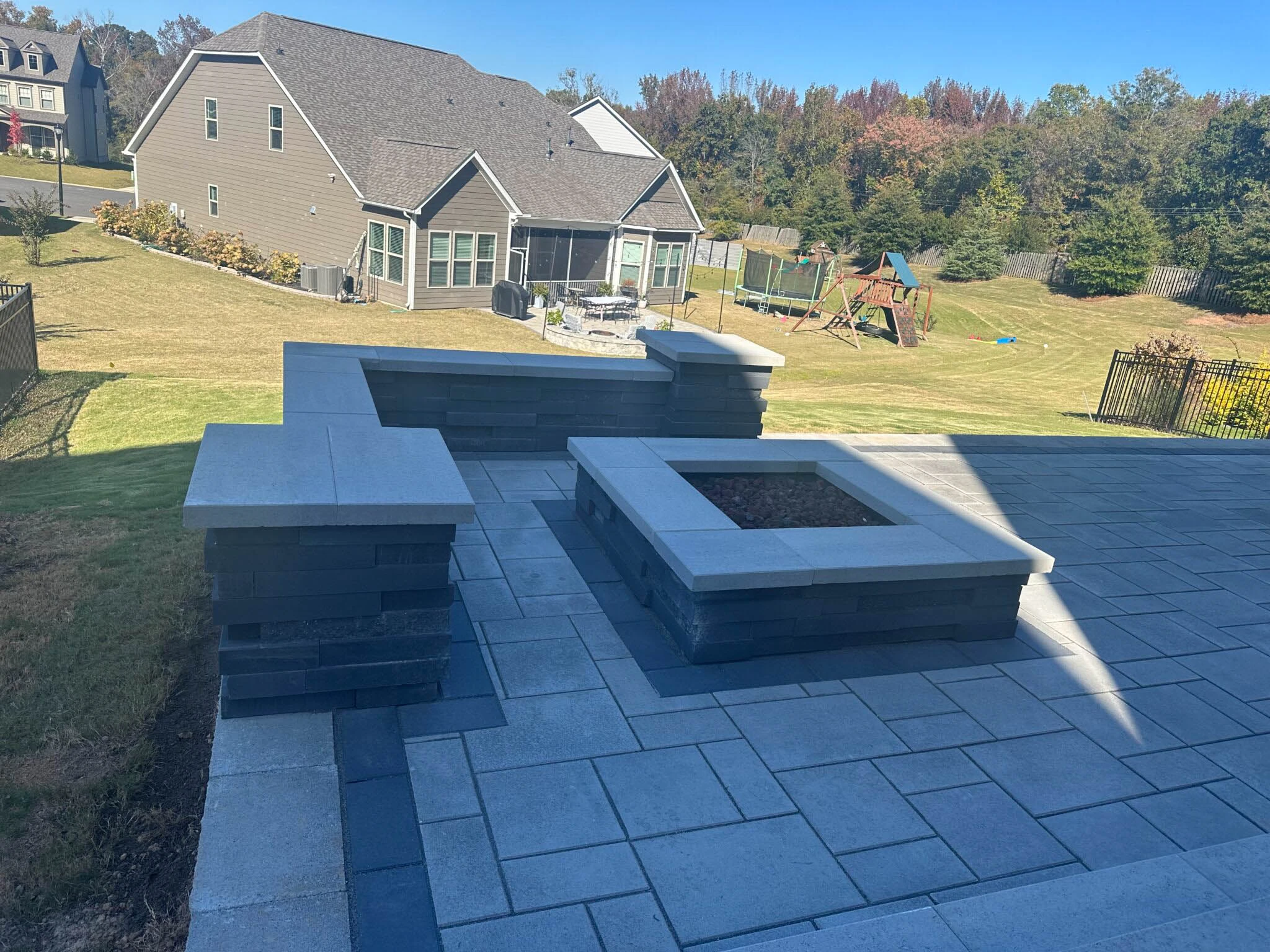
Outdoor fireplace and firepit construction across 20+ cities within 30 miles of Winder, GA
Every Forsyth County fireplace we build meets NFPA 211 on geometry, liner, crown, and spark arrestor — drawn up before the footing is poured, checked against the inspector’s tape on final.