
The call came from a homeowner in Etowah River Club staring at a 14-foot grade drop behind his back porch. He had been quoted by two other builders for a conventional rectangular pool tucked against the high side — a $165,000 build that would have buried the best view in Dawson County behind a wall of concrete. We walked the lot, measured the fall at 12.3% average grade with pockets hitting 18%, and told him the honest answer: build it as a negative edge or do not build it at all.
He hired us three weeks later. This is the full engineering record of that project — a $342,000 vanishing-edge pool at 1,270 ft elevation on saprolite subsoil, designed to read the Amicalola foothills like a mirror and survive 30 freeze events per year without a hairline of movement at the weir. Every spec below came from actual stamped plans and actual field measurements, not a marketing deck.
Why a 12-Percent Grade Demands a Negative Edge, Not a Retaining Battle
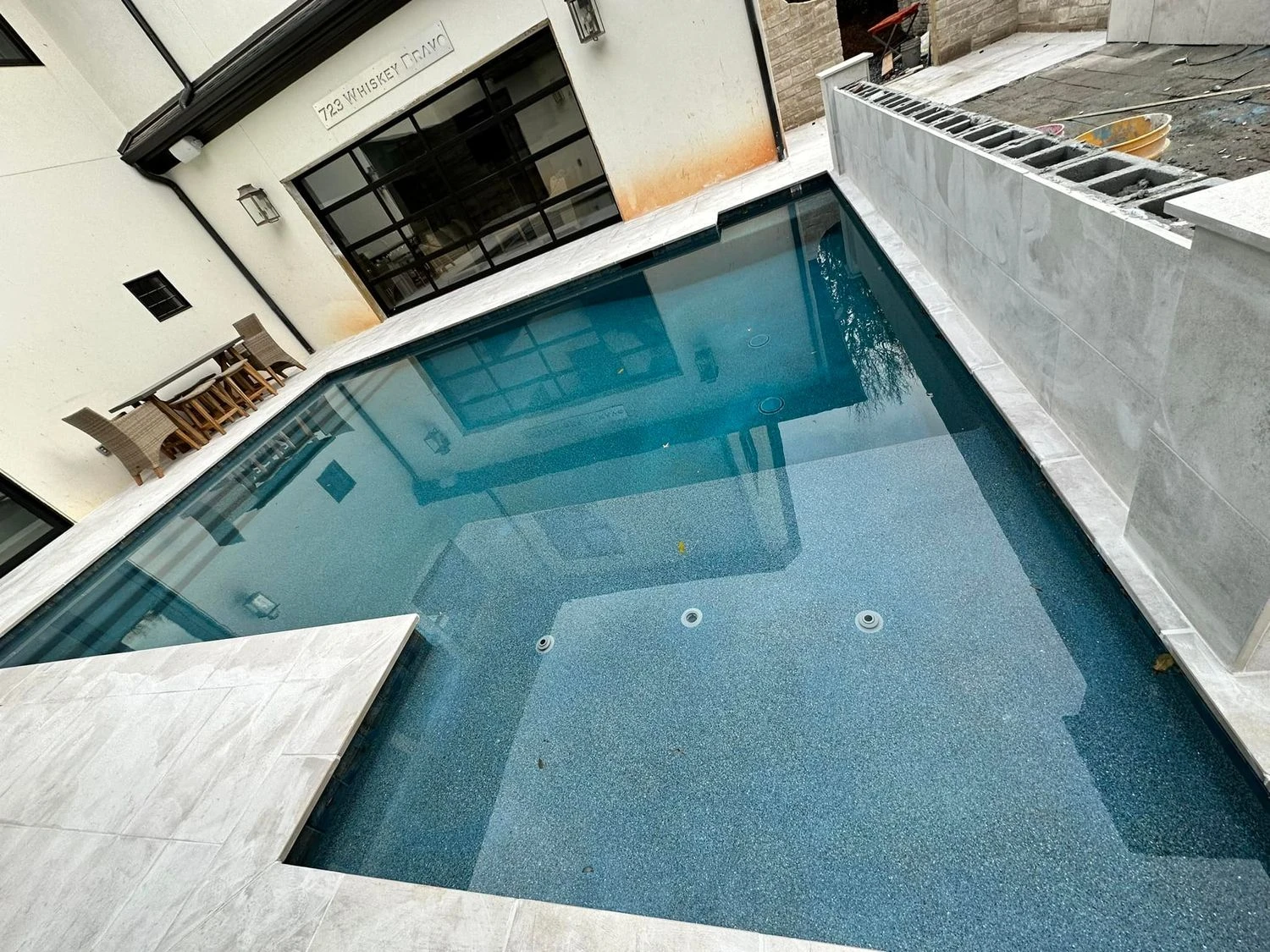
Most builders treat slope as a problem to flatten. On a Dawsonville lot with a 10-to-14-foot drop, flattening means a retaining wall that costs as much as a second pool and still leaves you looking at the wall instead of the view. A negative-edge design inverts the math. You put the pool on the highest useable bench, let the water disappear over the downhill face, and let the grade do the work of the visual.
On this particular Etowah River Club lot, the contour lines dropped from finished floor elevation at 1,270 ft to the creek bench at 1,256 ft across 115 horizontal feet. That is textbook negative-edge geometry. A standard build would have required 4,800 cubic yards of fill and a 9-foot tiered retaining system just to level the pad. Our build moved 2,100 cubic yards — all of it cut, none of it imported — and put the pool where the land wanted it.
The engineering principle is simple. Gravity is free. Fighting it is expensive. You design with it.
Dawson County Code: Any retaining wall over 4 feet tall that supports hydrostatic water load requires a Georgia-registered PE stamp on the structural drawings, submitted to the Dawson County Dept. of Planning & Development at 25 Justice Way before permit issuance. Our PE stamp for this build was dated 14 days before excavation.
The Saprolite Problem Nobody in Metro Atlanta Warns You About
Dacula clay is predictable. Cherokee County clay is predictable. Dawsonville subsoil is not. At 1,270 ft elevation you are on the weathered fringe of the Blue Ridge — thin Cecil topsoil over decomposed saprolite and weathered granite, with intact granite outcrops showing up at depths as shallow as 3 feet. On this build, the excavator hit a 14-ton granite shelf at the deep-end shotcrete line. We had to bring in a licensed blaster with ANFO charges priced at $11 per cubic yard of rock removed — a $9,400 line item that did not exist in the original contract.
Every Dawsonville pool quote should carry a rock contingency. We write ours at 8% of excavation scope, refundable if no rock is hit. Builders who do not include it are either hiding the risk or have never built above 1,100 feet in North Georgia.
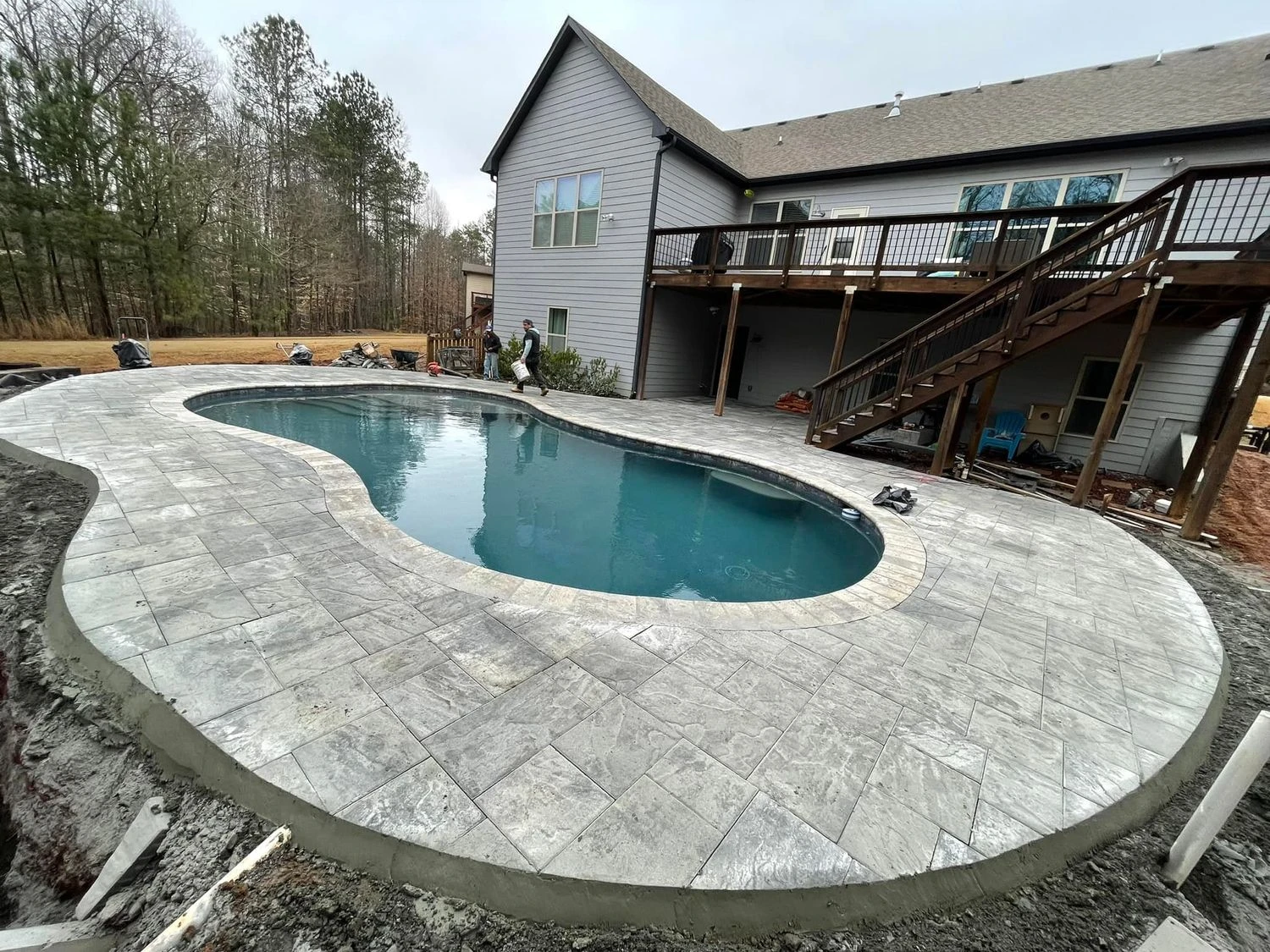
Saprolite also drains aggressively. That is good news for hydrostatic pressure against pool walls — far less than the clay headache we fight in Dacula or Loganville. It is bad news for lateral stability on a sloped cut, because dry saprolite sloughs under vibration. We stabilized the downhill excavation face with a geogrid-reinforced soil nail wall at 8-foot centers, driven 14 feet back into competent rock. The detail added $18,400 to the job. It is also the reason the deep-end wall will still be plumb in 40 years.
Why 40% More Rebar on a Mountain-Elevation Bond Beam
Standard Georgia pool spec calls for #4 rebar on 12-inch centers in the bond beam. At Snellville elevation (~1,000 ft) with 18–22 freeze events per year, that spec is fine. At Dawsonville elevation (1,270 ft) with 30 freeze events annually, it is not.
Freeze-thaw cycling on saprolite subsoil expands and contracts the perimeter of a pool shell more than the same shell would move on Piedmont clay. Clay has high elasticity — it deforms and recovers. Saprolite is stiffer and more brittle. When the subsoil under a perimeter footing flexes 30 times a winter instead of 20, the bond beam takes 50% more cyclic load at the corners. The beam does not fail. The tile on the beam fails, the coping joints fail, and three winters in you have a 1/4-inch frost heave at the weir.
Our Dawsonville spec increases rebar density in the bond beam to #5 bar on 8-inch centers, which delivers 40% more steel cross-section in the cap. It also increases the concrete cover to 2.5 inches — extra margin for the freeze-thaw microfracturing that eats at poorly-covered rebar over a 20-year horizon. The material upcharge is $2,600. The reason to do it is that a weir face is the most visible, most unforgiving detail on a negative-edge pool. If it moves a quarter inch, the illusion breaks.
Sizing the Catch Trough for Cold-Water Viscosity
This is the spec that separates a mountain-elevation negative edge from a metro negative edge. Water at 52°F (normal winter Dawsonville pool temperature if not heated) is 15% more viscous than water at 78°F. It flows slower over the weir. It also sheets differently — thicker, slower, more prone to stalling at the edge if the weir is not perfectly level.
Standard trough sizing is 100% of calculated weir flow. We size Dawsonville negative-edge troughs at 125% of peak weir flow to account for cold-water thickening and for the momentary surge that happens when a swimmer pushes off the weir-side wall. The trough on this build is 18 inches wide, 22 inches deep, and runs the full 32-foot weir length. That is 44 cubic feet of reservoir capacity — enough to catch a full 90-second surge event without ever letting the weir go dry.
A dry weir on a negative-edge pool is the loudest aesthetic failure possible. The water sheet breaks, you see exposed tile and mortar, and the mirror effect that justifies the whole build evaporates in front of guests. Oversizing the trough is cheap insurance. The extra concrete on this build was $1,800.
The Dedicated Booster Pump That Runs 14 Hours a Day
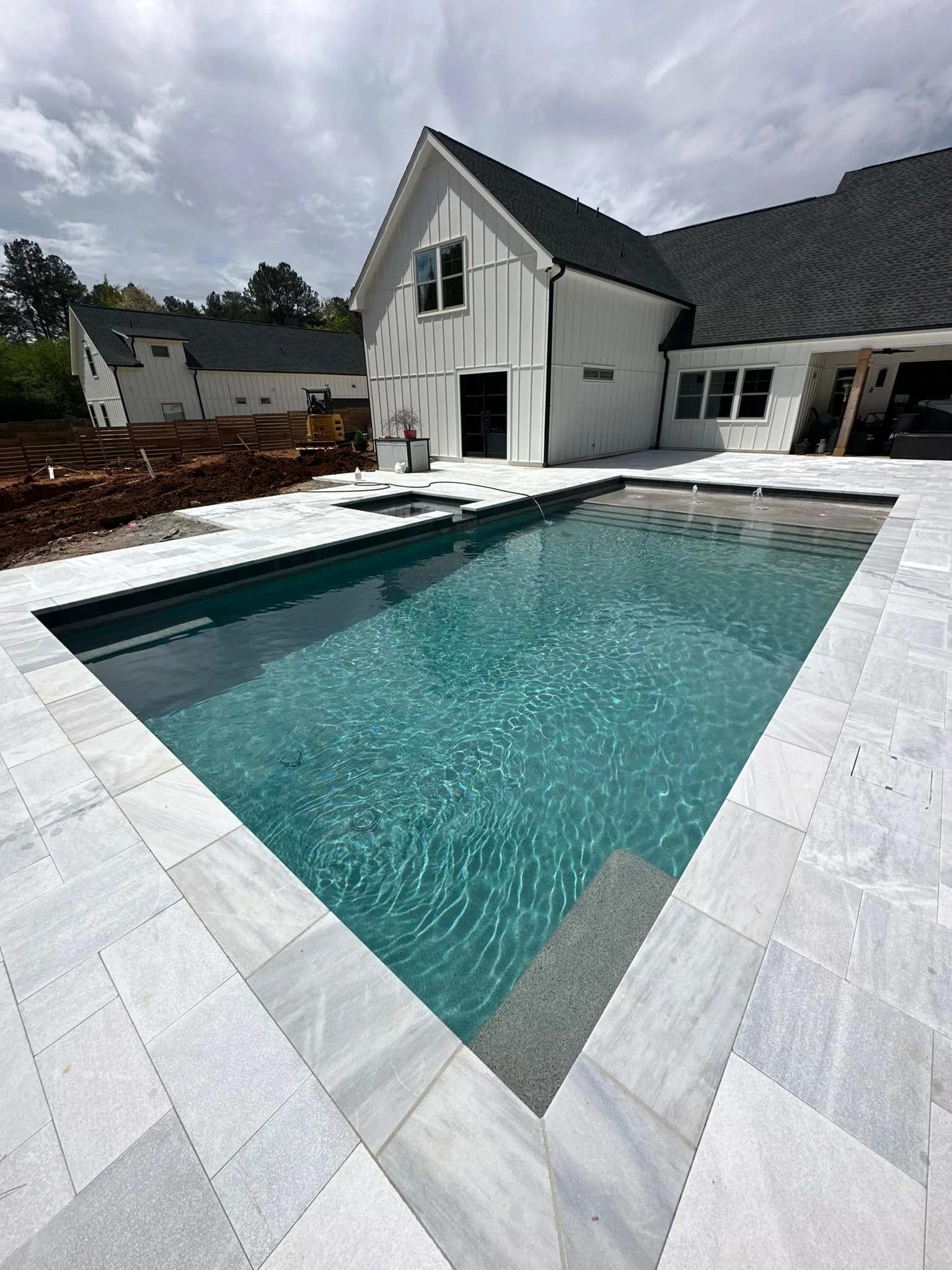
A negative-edge pool is not a feature on a main pool pump. It is its own hydraulic system. The pool pump handles skimmers, main drain, and return jets. The edge pump lifts water from the catch trough back over the weir. These cannot share a pump without both compromising.
Our spec on this build is a Pentair IntelliFlo3 VSF 3 HP variable-speed booster, dedicated entirely to the weir circuit, plumbed in 2.5-inch Schedule 40 PVC from the trough skimmer to the pad and back to the weir manifold. It runs on a programmed schedule of 14 hours per day minimum, ramping to 18 hours during party-use days via the IntelliCenter automation.
Why so many hours? A negative-edge pool is designed to be beautiful, and it is beautiful only when the weir is wet. A dark weir reads as a wall. A flowing weir reads as the horizon. Undersizing the runtime to save on Amicalola EMC power bills is penny-wise and pound-foolish — at current $0.137/kWh Amicalola EMC rates, a 3 HP VSF pump running 14 hours at 60% speed consumes roughly $52 per month. On a $342,000 build, that is not a negotiable line.
Equipment pad sizing: Dawsonville builds at this price point run a 16×8-ft insulated pad with the booster, the main pump, the heater (we spec Pentair MasterTemp 400k BTU at this elevation because 5 more cold months per year), the filter, and automation. Amicalola EMC service drops to the pad run 200A dedicated on most of our Dawsonville builds.
The PE-Stamped Retaining Wall That Makes the Whole Site Possible
Behind every good negative-edge pool on a grade lot is a retaining wall that does the real structural work. On this build, the downhill side of the pool pad is supported by a 62-foot-long, 7-foot-tall engineered modular block wall set 40 inches below grade with a geogrid reinforcement pattern extending 10 feet back into the hillside.
Dawson County requires a PE stamp on any retaining wall over 4 feet tall, and they require an additional structural review when the wall supports a water feature above it. Our PE delivered stamped plans showing a 1.5 safety factor on overturning, 2.0 on sliding, and a bearing pressure under allowable for the saprolite residuum tested on-site. The wall construction was $41,600 of the $342,000 total — roughly 12% of project cost going to the structure that makes the visual possible.
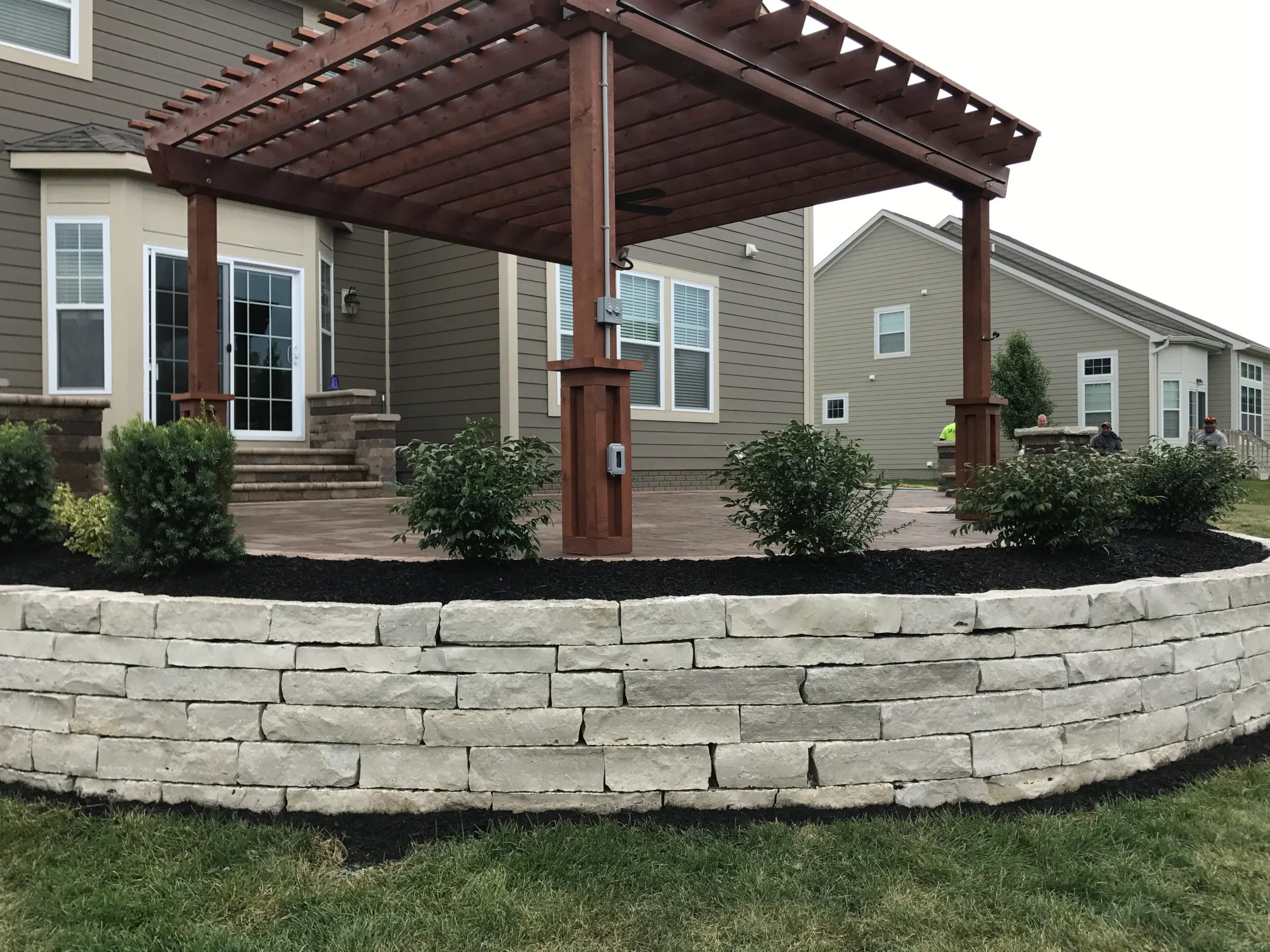
Homeowners often balk at the wall cost line-item. The honest framing: the wall is not a cost added to the pool. The wall is part of the pool. A negative-edge pool without a competent retaining system is a pool that will tilt 2 degrees in 15 years and ruin the weir forever. Pay for the wall. Get the PE stamp. Never negotiate this line.
What $342,000 Actually Buys, and Why the Range Runs $285K–$425K
Here is the line-item breakdown for this specific build, rounded to the nearest $500, because homeowners researching Dawsonville builds deserve real numbers:
- Excavation, rock allowance, spoil haul: $38,500
- Engineered retaining wall with PE stamp: $41,600
- Soil nail stabilization of downhill cut: $18,400
- Shotcrete shell with upgraded bond-beam rebar: $64,200
- Pebble-finish interior and waterline tile: $28,900
- Negative-edge weir, travertine coping, catch trough: $34,800
- Plumbing and equipment pad (IntelliFlo3 VSF, IntelliCenter, heater): $42,700
- Amicalola EMC 200A service drop and bonding: $4,800
- Travertine pool deck (1,400 sq ft): $33,600
- Landscape restoration, drainage, irrigation repair: $12,400
- Dawson County permit fees, engineering review, inspections: $4,600
- Warranty reserve, sales tax, overhead: $17,500
The $285K–$425K band reflects real variance we see across Dawsonville builds. A lot with less grade (8% instead of 12%) and no rock blast drops the price $40–60K. A lot with full Amicalola foothills rock exposure and a longer wall run pushes it past $400K. Anyone quoting a negative-edge pool on a Dawsonville grade lot for under $260K either does not understand the engineering or is planning to hit you with change orders at week six.
On this project the homeowner signed a fixed-price contract with a defined rock contingency. Nothing in the final invoice surprised him. That is the only way we quote mountain-elevation pools.
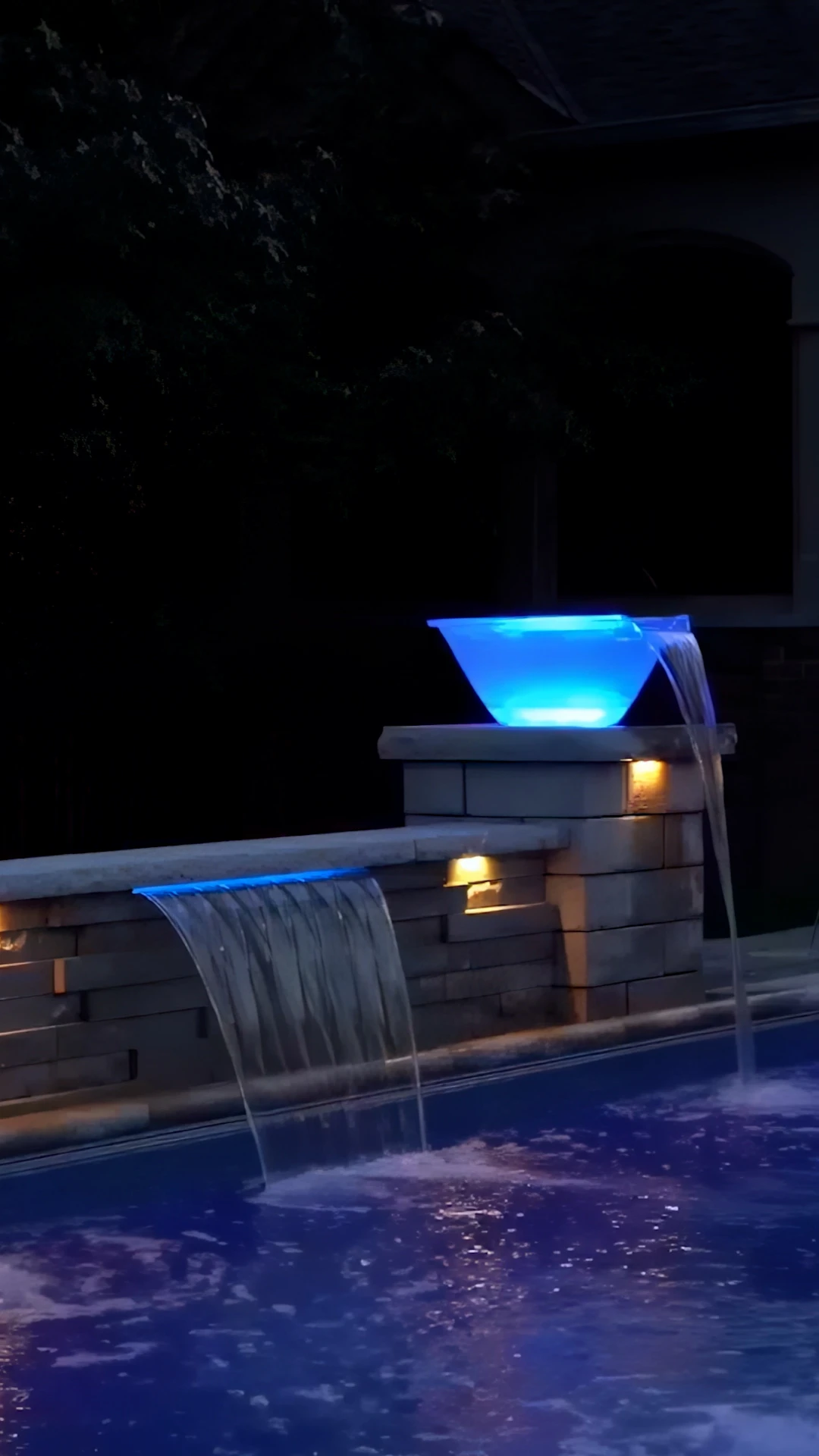
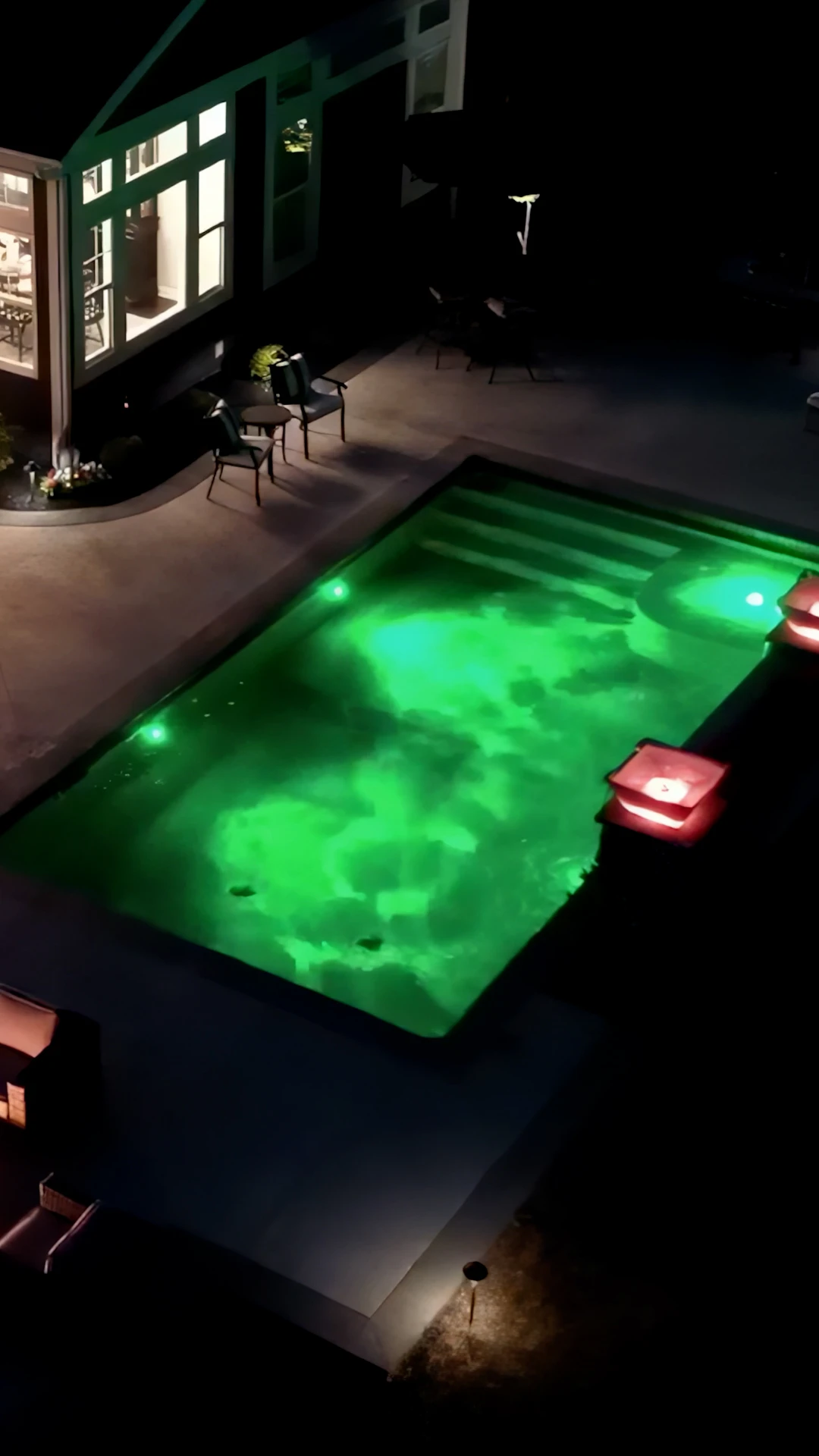
A negative-edge pool on a Dawsonville grade lot is not an upgrade to a standard pool. It is a fundamentally different structure, with a fundamentally different engineering standard, and a price that reflects both. Build it correctly once. Or build it twice, because the wrong version will move at the weir by year four and there is no meaningful way to fix a moving weir after the fact. This is the spec we commit to on every mountain-elevation job in Foxcreek, Riverbend, Etowah River Club, Kensington Ridge, and Chestatee.
Custom Pool Construction across 20+ cities within 30 miles of Winder, GA
Negative-edge and mountain-elevation builds are a Primetime specialty. If your Dawsonville or Forsyth lot has the grade for it, we will tell you honestly — and engineer it to outlast the house.