
It’s a Tuesday morning in late March. A homeowner off Dawson Forest Rd walks us around the back of the house and points at a hillside that drops 14% across 90 feet — pine straw, exposed granite, a rusting swing set at the bottom. “Can you build anything here?” Six weeks later, they’re hosting a birthday party on three tiered paver levels with a seat wall, fire pit, and grill station anchored into the slope.
This post walks through that exact build — 2,400 square feet of multi-level hardscape on a steep, rocky lot in the Foxcreek area of Dawsonville. We’ll show what happens on the ground, week by week, from the first geotechnical visit through final paver sand sweep. If you’re planning a hardscape on a sloped North Georgia lot, this is the realistic schedule — not the three-week fantasy some contractors pitch before they see the site.
Sloped lots in Dawson County are different from the flatter clay pads down in Gwinnett and DeKalb. At ~1,270 ft elevation — the highest residential ground in our service area — the subsoil is residuum: stony, saprolite-rich, with weathered granite you can hit at 2 to 6 feet deep. Drainage is better than Dacula clay. But the engineering is tighter. The walls are taller. The weather buffer is longer. And the permit path through the Dawson County Department of Planning & Development at 25 Justice Way doesn’t move any faster than anywhere else.
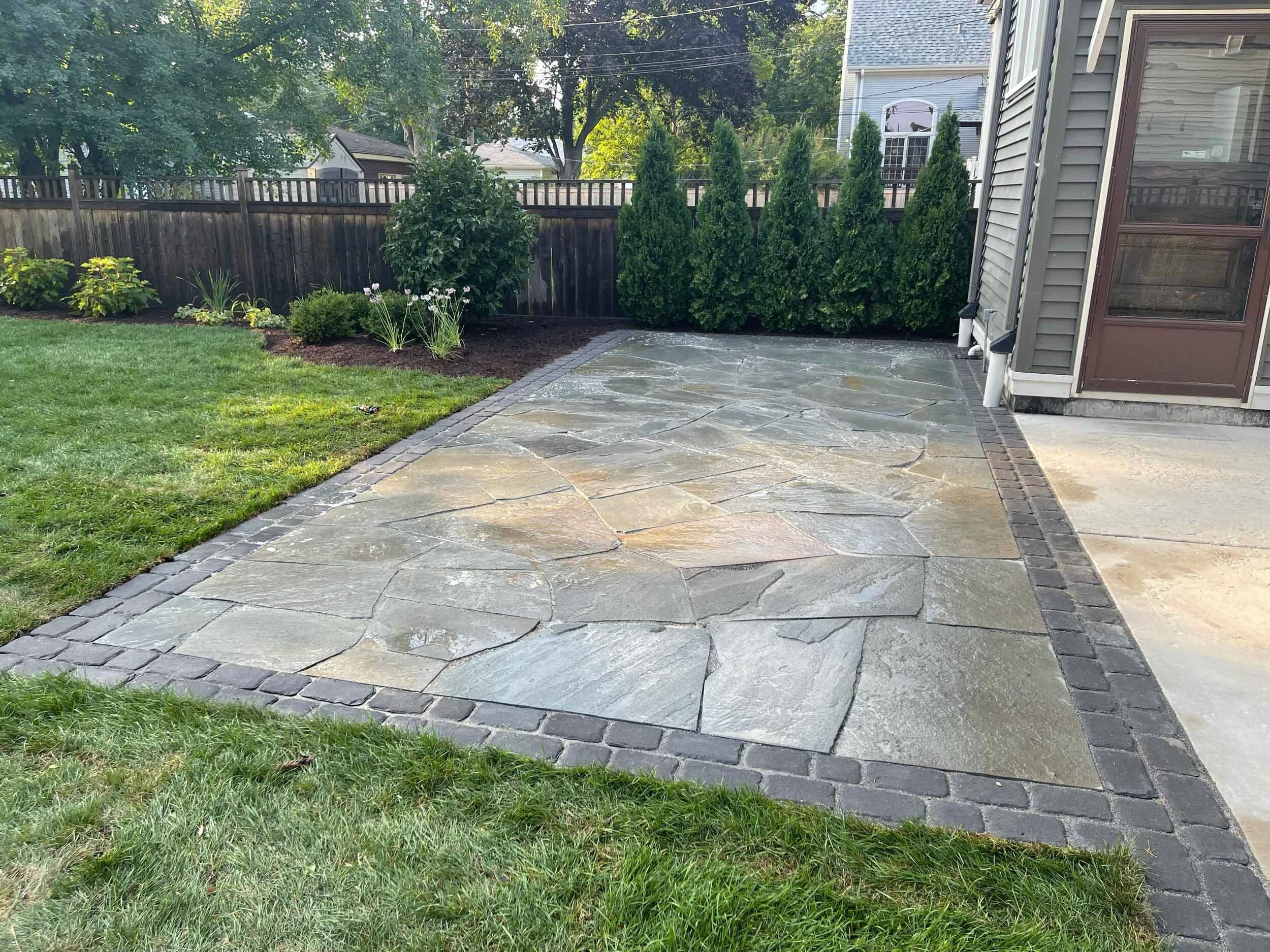
Week 1 — Site Walk, Geotechnical, and the $1,800–$3,200 PE Stamp
The first week is almost entirely paperwork and dirt probing. No one is laying pavers. A homeowner who doesn’t understand this is already mentally behind schedule by Friday, which is why we walk through it out loud on day one.
Day one is the measured site walk. Two of us, a total station, a drone for overhead mapping, and a soil probe bar. We mark existing grade, shoot elevations every 10 feet across the build zone, and locate the utility drops from Amicalola EMC. On this build, the EMC drop came in on the east side of the house, which dictated where the grill-station gas run had to route around.
Day two or three, a licensed geotechnical engineer walks the site. This is non-negotiable on any lot above roughly 10% grade with proposed retaining walls over 4 feet. In Dawson County, a retaining wall that exceeds 4 feet of exposed height (measured from finished grade at the bottom to top of wall) requires a PE stamp on the engineering drawings before permits issue. On this job, the tallest tier wall came in at 5 feet 6 inches, so the stamp was mandatory.
The engineer’s report costs homeowners $1,800 to $3,200 depending on the complexity of the wall layout and the number of cores. It includes soil classification, bearing capacity, drainage recommendations, reinforcement geogrid spec, and a stamped wall section detail. It is not an upsell. It’s the document that keeps your wall standing in year 12, and it’s the document the Dawson County inspector asks for before pouring any concrete.
Dawsonville permit fact: Dawson County Department of Planning & Development, 25 Justice Way, issues hardscape and retaining wall permits. Expect 7–14 business days from complete submittal. Walls over 4 ft exposed height require a stamped PE drawing. Budget the engineering stamp as a line item — don’t try to find it out of “contingency.”
End of week one, we have a topographic survey, soil classification, stamped drawings, and a submitted permit application. We don’t pick up a shovel.
Week 2 — Tiered Excavation and the Rock-Hammer Day
Permit in hand (or expected mid-week), the mini-excavator rolls in Monday morning. On a typical 2,400 sqft multi-level layout we move somewhere between 180 and 260 cubic yards of material over three to four days. The grade gets cut in reverse — top tier first, then middle, then lower — so each level can be benched and graded clean before the next cut.
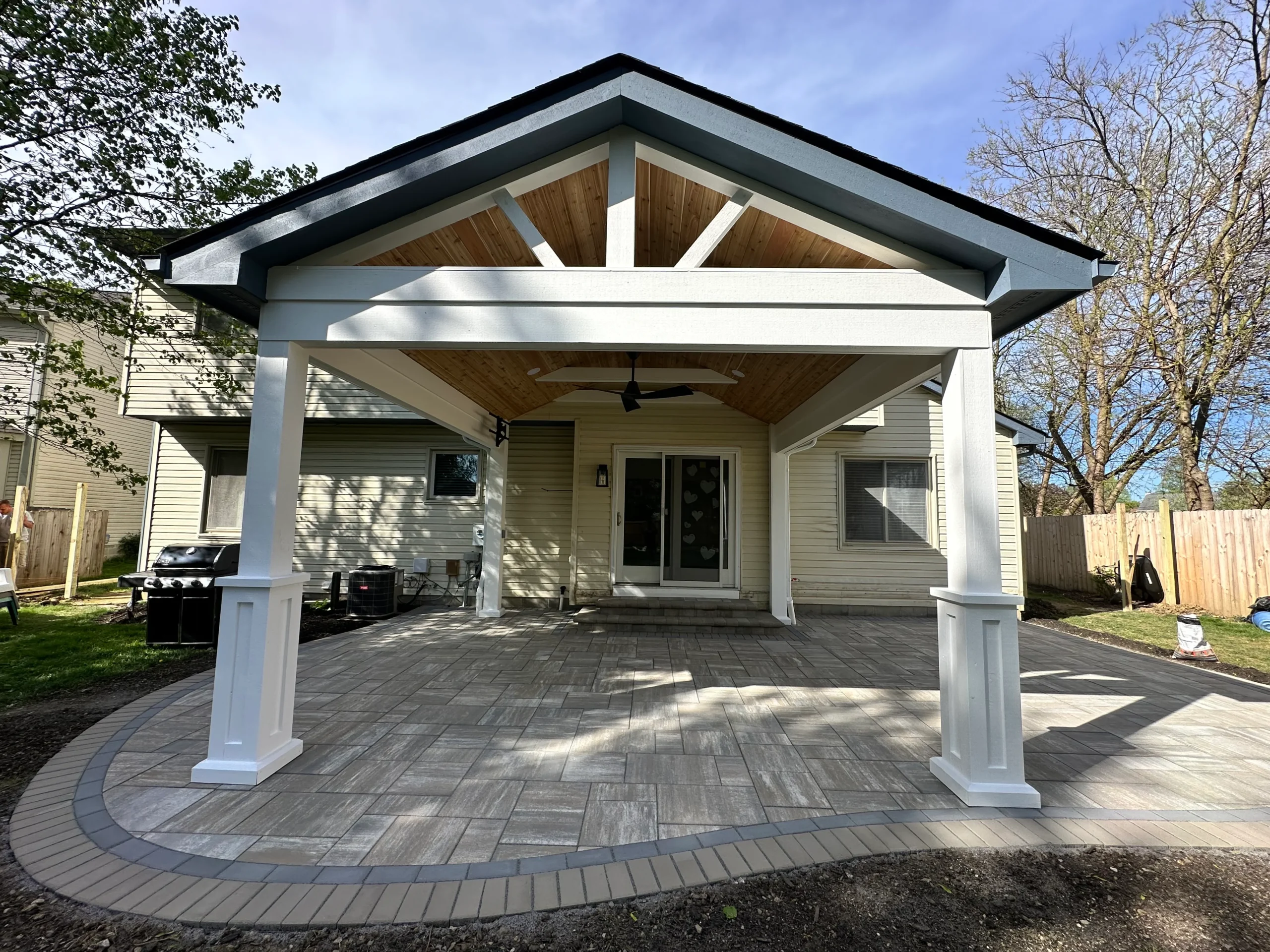
On every Dawsonville build we’ve done, there’s a rock day. It doesn’t happen in Dacula. In the Piedmont south of here, you dig through clay for 6 feet and hit nothing. Up here in the foothills, you hit weathered granite, quartz seams, or solid boulders at unpredictable depths. On this build, we hit a three-foot granite shelf at 38 inches on the middle tier, about where the fire pit footing needed to go.
A hydraulic rock hammer attachment comes in on a trailer the same day. Rock-hammer time runs Primetime $8 to $14 per cubic yard in additional labor and equipment cost over a standard dig. On this job the delta was $2,840 — and we’d priced $2,500 of it into the original quote as a “rock allowance” line item because we’d already seen the exposed granite on the survey walk. That’s the kind of allowance a homeowner wants to see in writing, not a surprise invoice.
By Friday of week two, all three tiers are benched, the lower grade is pulled back to the drip line of the largest oak (roots preserved, trunk protected), and we’ve trucked ~200 cubic yards of spoil off-site via Hwy 53 to a licensed fill site closer to GA-400. Living 12 minutes from the highway is one of the underrated advantages of building in Dawsonville — trucking costs are lower than on deep-Forsyth or north-Hall jobs where the haul route adds an hour.
Week 3 — Retaining Wall Foundations and the Drainage You Can’t See
Week three is when the job starts to look like something. It’s also the week where 80% of a wall’s 30-year performance gets locked in — below grade, where the homeowner will never see it.
We dig the wall trenches to the engineer’s spec, typically 24 inches below finished grade for the bottom of the base course on a 5-6 foot tall wall. The trench gets lined with non-woven geotextile fabric. Then comes the base: 8 inches of compacted #57 stone, placed in 4-inch lifts and compacted with a reversible plate compactor between each lift. Each lift is spec’d, tracked, and photographed. If you ever want to know whether your contractor compacted in lifts, ask for the photos. If there are no photos, the answer is probably “not really.”
The wall drainage stack nobody sees: 4″ perforated drain pipe wrapped in sock fabric, bedded in #57 washed stone, pitched at 1/8″ per foot minimum, daylighted at the low corner. On this job, the daylight outlet ran 62 feet across the back property line to a rocky drainage swale. Without the drain, hydrostatic pressure builds up behind the wall during Dawsonville’s 55 inches of annual rainfall — and a 5-foot wall with a clogged drain becomes a 5-foot lean in year 6.
The first course of block goes down on a leveled 1-inch sand setting bed over the compacted base. On this build we used Techo-Bloc Mini-Creta for the tier walls — a beveled-face segmental unit that reads warmer than a straight-cut wall block and pairs visually with mountain-style architecture. Every wall unit is backfilled with clean #57 stone within 12 inches of the back face, not the native saprolite. Saprolite holds water and rots pins. #57 stone doesn’t.
Geogrid goes in between courses 2-3 and 4-5 on the tall wall. It extends 6 feet back into the hillside per the engineer’s drawing, stapled, and backfilled with compacted structural material. This is the reinforcement layer that keeps a tall segmental wall from rotating forward over time. It’s invisible 30 days from now. It’s structural for 30 years.
By end of week three, the two primary tier walls are up to finish height, capped stones staged but not yet adhered, and drainage is live-tested with a hose. We flood the backfill, watch the daylight outlet, and confirm flow before we move on. If you don’t test drainage now, you find the problem in November when a 3-inch storm backs water up against the wall.
Week 4 — Base Prep for the Paver Levels
Week four is the quietest-looking week of the build and the most mechanically important. Walls are up. Nothing dramatic happens above grade. But underneath, we’re building the pad that either makes your paver surface last 25 years or buckle in year 4.
Excavate each paver zone to 12 inches below finished surface elevation. Woven geotextile goes down on the subgrade. Then we place and compact #57 stone in 3-inch lifts until we have a solid 8-inch compacted open-graded base. The top inch is choker stone — typically ASTM #8 — leveled flat. A laser level runs the whole zone. No soft spots. No organic material in the base. No short-cuts from “it looked level, so we kept going.”
Drainage continues through this layer. The open-graded #57 base means water moves downward through the paver joints, through the base, and exits via the drain tiles we set at the toe of each tier. On a sloped lot like this one, cross-pitch between 1/8″ and 1/4″ per foot keeps surface water moving without being noticeable to someone standing on it. We set pitch directions away from the house, away from the fire pit area, and toward the lower tier’s French drain terminus.
Edge restraints get set this week too — aluminum spike-down edging along every free paver edge, buried 1/2″ below finished paver height so it won’t trip a bare foot. Without edge restraint, the perimeter pavers walk outward over 2-3 freeze cycles and the whole field starts to drift. In Dawsonville that matters more than it does in Atlanta metro because we see roughly 30 freeze events per year vs. 20 in Dacula. Every freeze event is a tiny lift-and-settle cycle working against your edges.
Freeze-thaw math for Dawsonville: At ~1,270 ft elevation and the USDA Zone 7b/8a border, expect 28–34 freeze events between November and March. Each cycle expands water in the base by ~9%. If your base drains, you’re fine. If it holds water, it lifts pavers. The entire open-graded base design exists to make the freeze-thaw water a non-event.
Week 5 — Pavers, Seat Wall, Fire Pit, and the Built-In Grill Surround
Week five is paver week — and the week the homeowner starts to believe it’s real. The middle tier pavers typically go down first because it’s the reference plane for the upper and lower tiers’ transitions.
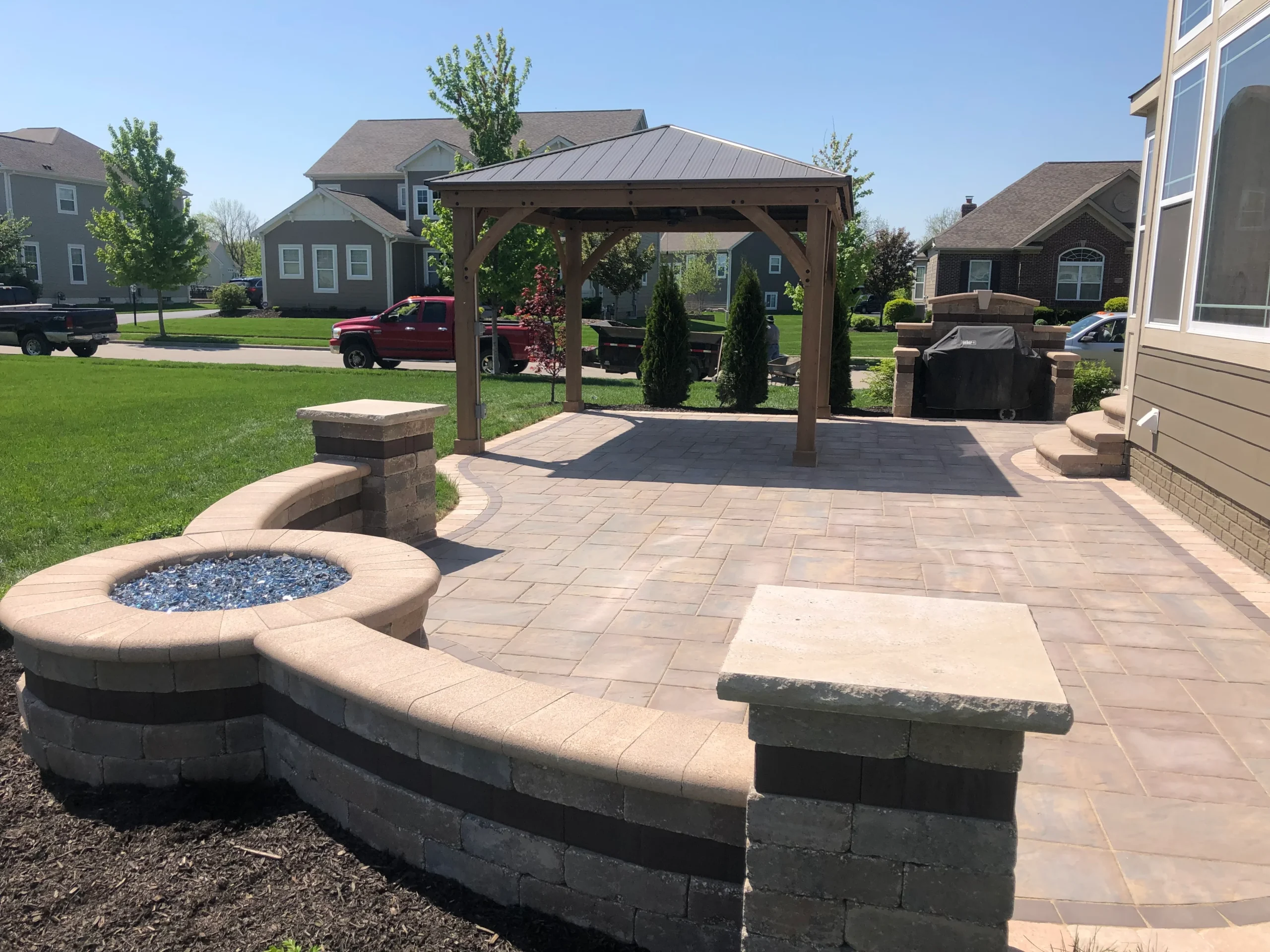
On this build the pavers were Belgard Mega-Arbel in Bavarian — a large-format slab with a natural stone texture that reads well with mountain-style brick and stucco houses. Laid in a random ashlar pattern. Running bond, for anyone counting: no, random ashlar is not running bond; it’s a specific multi-size pattern that requires planning 4–6 feet ahead of the setter to avoid vertical joint alignment across more than two pieces.
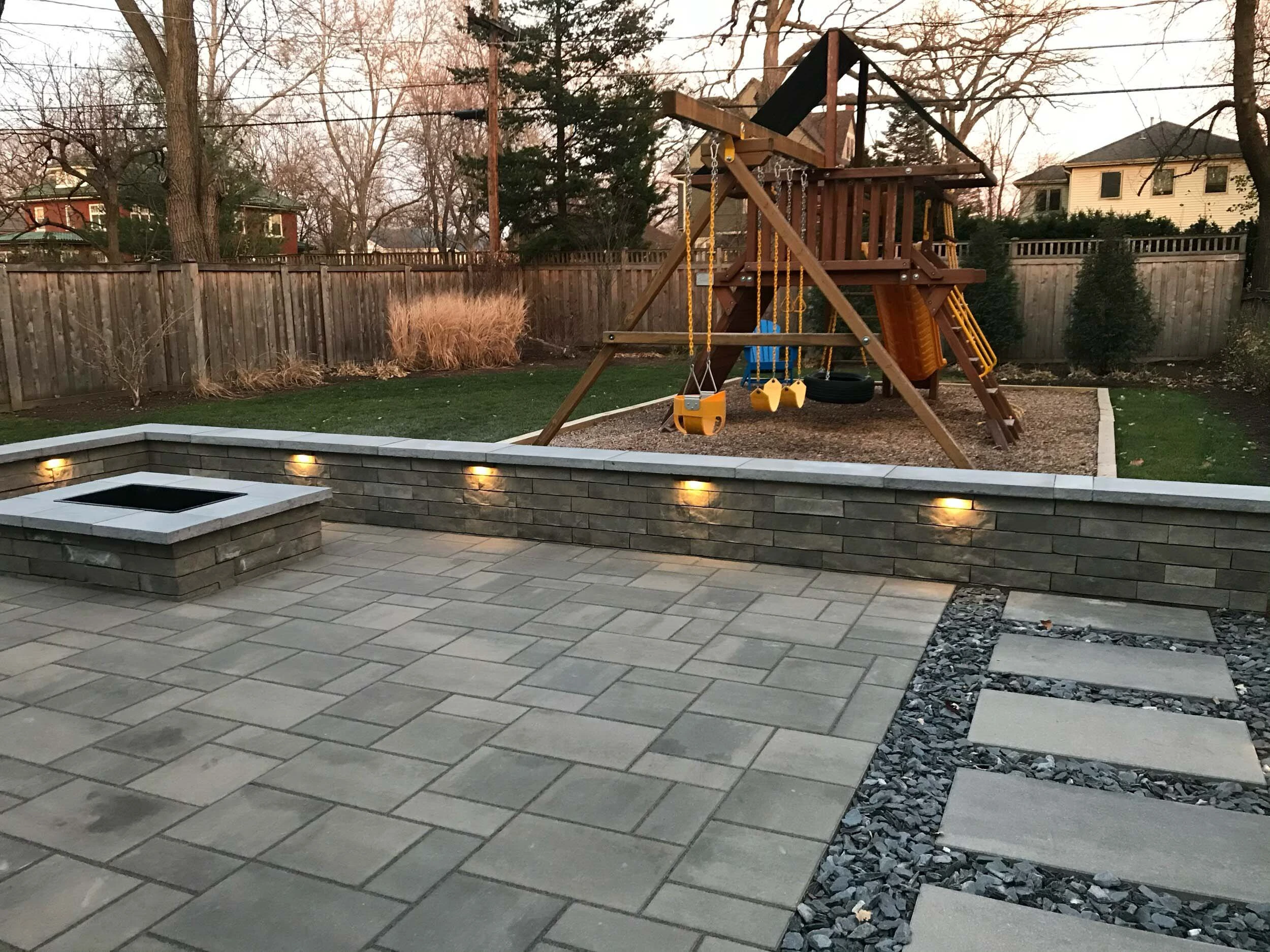
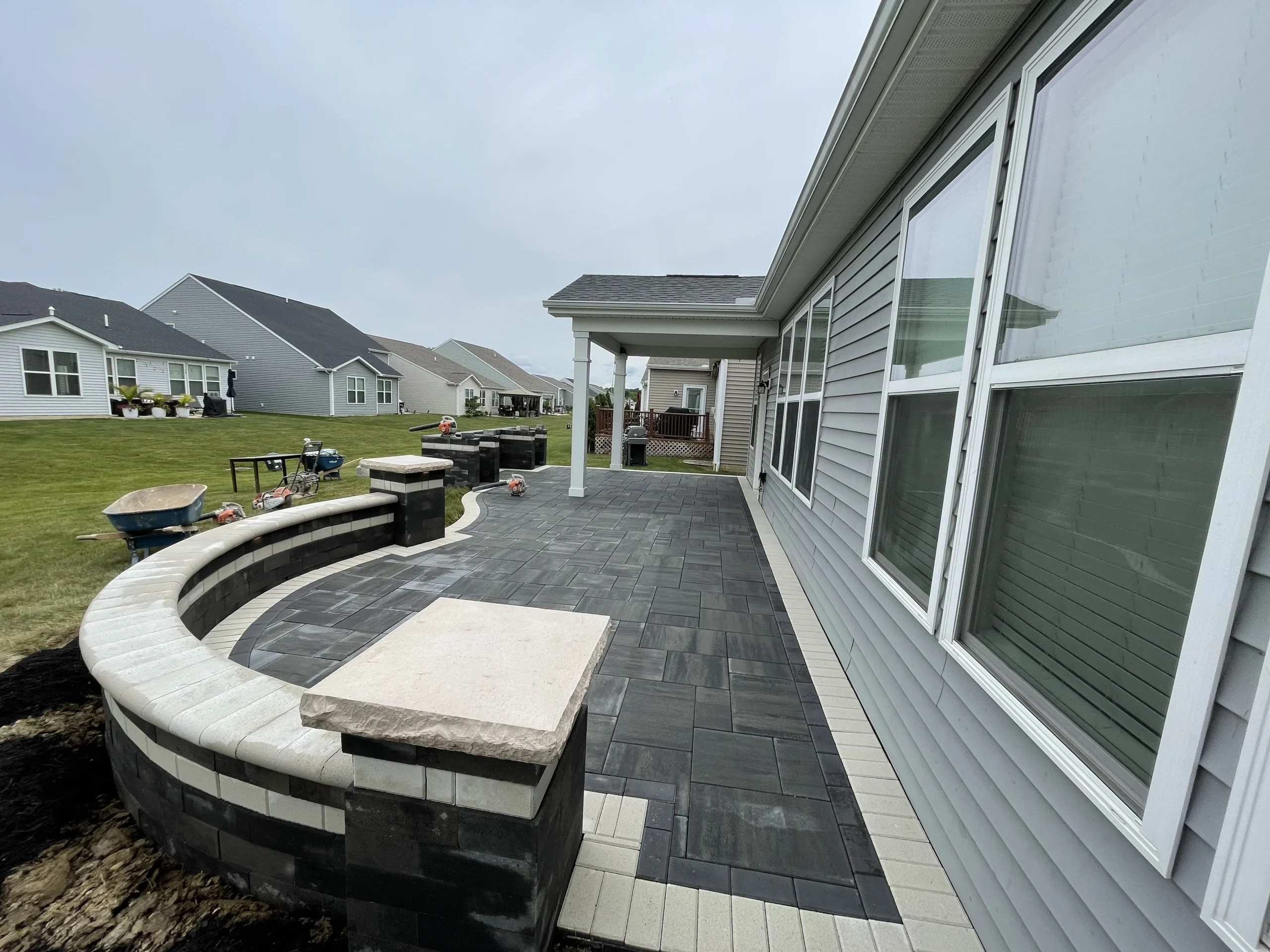
Mid-week the seat wall comes up along the lower tier — a 20-inch-tall segmental wall that doubles as perimeter seating and the visual border between the upper lawn and the paver patio. Seat walls get capped with a flat 24″ x 12″ natural bluestone cap, adhered with polymer-modified construction adhesive, overhanging the block face by 1.5″ on both sides. Built right, a seat wall doesn’t need cushions for guests to use it. It gets used.
The gas fire pit goes in mid-week five. We’re pulling gas from the house meter, running a 3/4″ CSST line through a buried PVC sleeve under the paver field, and terminating at a brass shutoff key inside a buried valve box 18 inches from the fire pit. The burner is a stainless round 36″ ring feeding a glass-bead media fill. Nothing about this is decorative — the gas run has to meet NFPA 54 fuel gas code and the pit has to clear the house by 10 feet horizontally and 20 feet from any roof overhang.
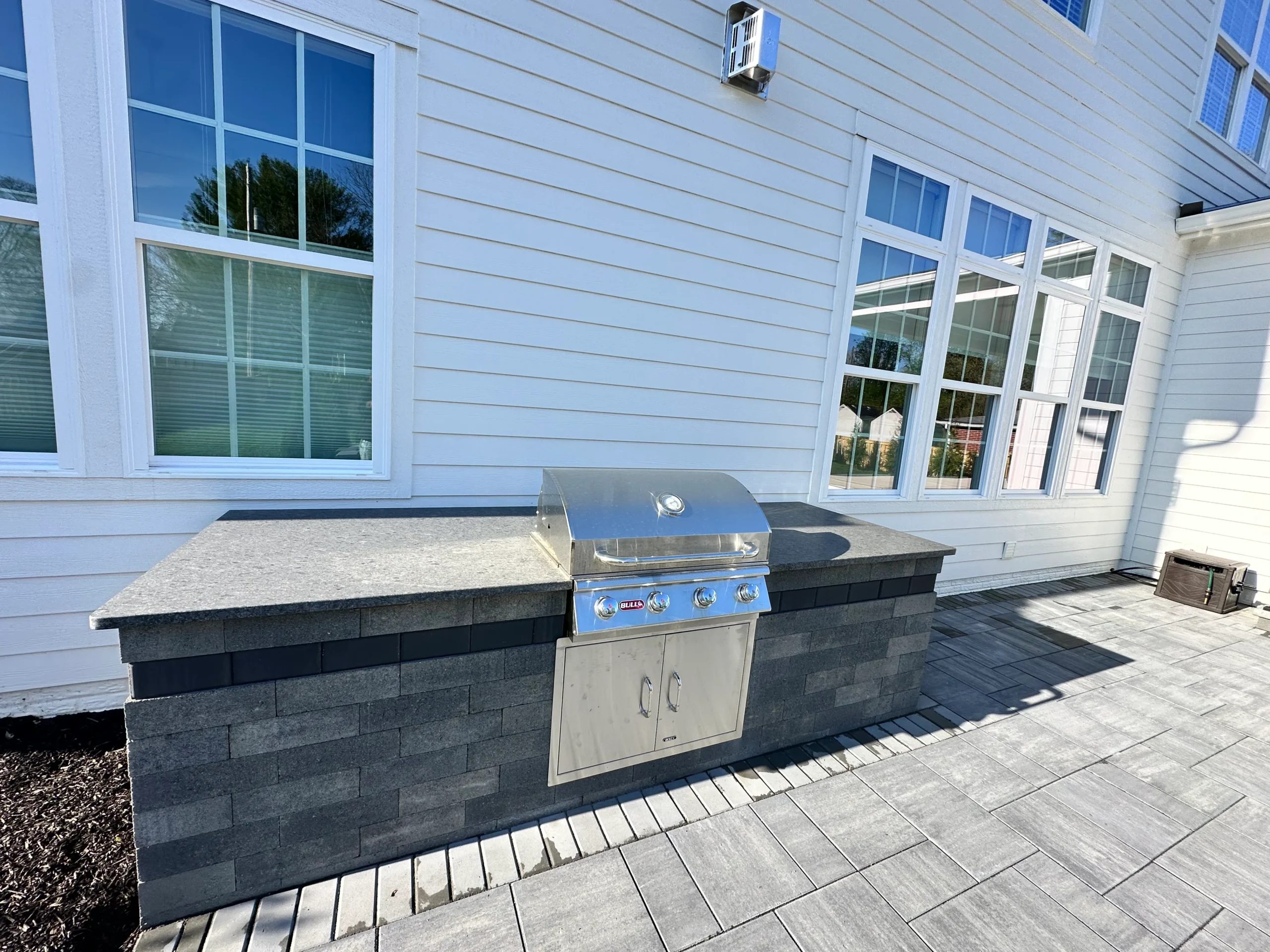
Grill surround at the corner gets framed in concrete block, clad in Techo-Bloc Mini-Creta to match the tier walls, and topped with a 2cm granite counter cut on-site. Rough-in for gas, power (via a dedicated Amicalola EMC sub-feed with a GFCI at the grill), and a side-burner supply line all get completed before the cladding goes up.
Week 6 — Joint Sand, Polymer Sweep, Final Grade, and the Punch List
Week six is finish week. The camera-ready stuff. But it’s also the week where skipped steps show up three winters from now.

Polymeric joint sand goes in dry, broom-swept across the paver surface, vibrated in with a plate compactor (protected with a neoprene mat so the plate doesn’t scuff the pavers), topped off, and then mist-activated with water in a specific wet-dry-wet cycle the sand manufacturer spec’d. Too much water the first pass and the polymer washes to the surface as white haze. Too little water and it never sets. The best polymeric sand on the market won’t survive a bad install.
Wall caps get adhered with polyurethane construction adhesive — not masonry mortar. Caps expand and contract differently than the block course below, so a rigid mortar joint cracks. Polyurethane moves. We run a 3/8″ bead, press the cap in place, and tap it flush.
Final grade and landscape transitions take the rest of week six. We backfill behind the tall wall with topsoil over the drainage stone, feather the lawn line into the upper tier, and plant the slope above the wall with native mountain laurel, oakleaf hydrangea, and Itea virginica — species that hold a slope with fibrous root systems and thrive in the slightly rockier, slightly cooler microclimate of 1,270 ft elevation. We’re not putting Knock Out roses in a Dawsonville mountain hardscape. Wrong plant, wrong place.
Punch list walk-through with the homeowner happens Thursday of week six. We walk the entire hardscape, note any joint sand that settled short, any cap alignment issues, any grade transitions that need cleaning up. Those items get fixed Friday. Final invoice goes out the following Monday.
Weather Buffer Math, Rock Risk, and What the Full Build Actually Costs in 2026
A six-week timeline assumes April-through-September weather. Build the same project November through February and plan for 8 to 9 weeks. Here’s the math.
Dawsonville sees approximately 30 freeze events per year concentrated between Thanksgiving and mid-March. Concrete doesn’t set below 40°F without accelerator, and our engineer won’t certify wall footings poured below freezing without documented heated blankets. Polymeric joint sand doesn’t activate below 50°F ambient — it just sits there as loose sand, which means the final install step gets pushed to the next warm week.
Rain adds time too. A 2-inch rainfall dumps into a partially excavated hillside and the bottom of the hole turns into soup. You can’t compact saturated base. You can’t set pavers on soft subgrade. We’ve had a Dawsonville build where Sunday rain pushed us back three days on each of two different weeks — a full six-day slip.
The honest off-season promise: If you sign a November build contract and the contractor tells you it’ll finish by Christmas, either they’re ignoring weather risk or they’re padding the original schedule. We tell Dawsonville off-season clients 2-3 additional weeks of buffer and write it into the contract. Nobody’s ever complained about a project finishing early. Plenty of people complain about a project running late “because of weather.”
If timing flexibility matters to you, April through September is the right window in Dawson County. The Foxcreek, Kensington Ridge, and Etowah River Club neighborhoods we work in most often all have HOA restrictions on construction during December holidays anyway, so you’d be stuck waiting until January at the earliest.
On cost: the project we’ve walked through in this post — 2,400 sqft of multi-level paver with two engineered tier walls, a seat wall, gas fire pit, grill surround, and slope landscaping — prices between $78,000 and $118,000 in 2026 dollars depending on stone selection, wall heights, and rock-hammer days.
That range assumes Techo-Bloc or Belgard premium lines, real engineering with a stamped PE drawing, a genuine 8-inch compacted open-graded base, and licensed gas and electrical subs on the fire pit and grill. It does not include blasting if the geotech report calls for it — blasting on a residential lot is rare, but on one in five Dawsonville sites above 1,300 ft we’ve had to bring in a licensed blaster for a single day at roughly $4,500 to $7,200.
A 2,400 sqft flat-lot hardscape in Gwinnett without tier walls, without engineering, without rock, on standard Cecil clay, prices $42,000 to $68,000. So yes — a Dawsonville mountain-style build is often 60-80% more expensive per square foot than the same square footage on a flat Dacula lot. The reason is written into every paragraph above. Walls. Engineering. Rock. Drainage. Freeze-thaw. Weather buffer. Amicalola EMC service coordination. Topography-driven staging costs.
What Separates a Dawsonville-Ready Contractor from a Transplanted Metro Crew
A lot of metro-Atlanta hardscape crews will drive up GA-400 to bid Dawsonville work. Some of them are excellent. A lot more of them are pricing the job like it’s a flat lot in Cumming, and they find out on day three that it isn’t. Here’s what separates a crew that finishes in six weeks from a crew that disappears in week four.
- They expect rock. Every quote has a rock allowance line item. They own or subcontract a rock hammer. They’ve pulled permits from Dawson County Planning at 25 Justice Way before.
- They don’t argue about PE stamps. Walls over 4 feet exposed height get engineering. Period. A contractor who tells you “we’ve done plenty of 5-foot walls without a stamp” is telling you they’ve built liabilities, not walls.
- They specify base in writing. 8-inch compacted open-graded base, placed in 2-inch lifts over non-woven geotextile. If it’s not in your contract in those words, it’s not happening on your site.
- They understand Amicalola EMC service coordination. Getting a grill sub-panel energized requires coordination with the EMC rep, not just your electrician. Metro-Atlanta crews used to Georgia Power don’t always know the EMC workflow and lose a week finding out.
- They price the weather buffer honestly. October-to-March builds cost more in labor because they take longer. A crew that quotes the same price year-round is either absorbing that cost (and cutting corners to recover) or quoting November builds like they’re April builds and letting the client discover the truth at week 7.
Primetime has built on 14 lots across Foxcreek, Kensington Ridge, Mountain Laurel, Applewood, Chestatee, and Riverbend between 2022 and 2026. Every one of them taught us something about Dawson County slope work that a Dacula or Snellville build wouldn’t. That local-specific experience shows up in our quotes and in our schedules before it ever shows up on a paver surface.
Hardscape Design & Construction across 20+ cities within 30 miles of Winder, GA
From flat clay lots in Dacula to 14% grade sites off Dawson Forest Rd, we build hardscapes engineered for the specific soil, slope, and climate of your neighborhood.