
A 1998 gunite pool on a 12% grade off Dawson Forest Road looks fine in the listing photos. Then the first real storm hits, water sheets toward the house, and the homeowner figures out why the previous owner priced the place $40K under comps.
The Foxcreek job came to us the same way most of our Dawsonville remodels do. A family bought a split-level built in 1997, inherited a pool that had been limped along for twenty-seven years, and called after their second pool-equipment failure in eighteen months. The patio was pitched the wrong way. The equipment pad was mounted above the pool elevation, which meant the pump was fighting gravity every time it primed. The plaster was original. The light niche was a corroded 120V incandescent fixture held in with silicone and hope.
The scope we wrote ended up at $68,400 — mid-range for a full mountain-lot modernization. It covered retaining-wall reinforcement, a regrade of the entire deck plane, a new lower-elevation equipment pad, LED retrofit, saltwater conversion, and a replaster. It did not cover the pavilion the owners later asked about, which is the post after this one.
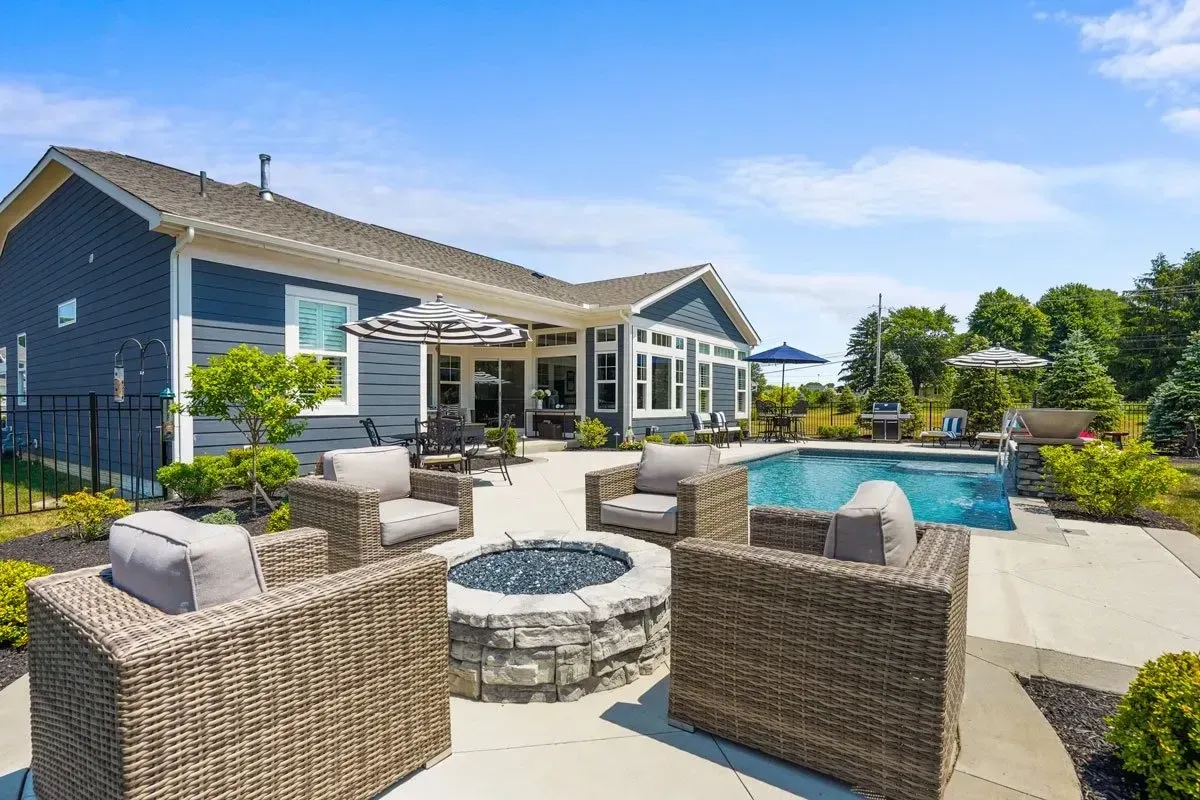
This piece stays on that one job, because the engineering choices we made there apply directly to every 1990s pool we see in Dawson County. The split-level housing stock up here — Foxcreek, Riverbend, Mountain Laurel, Applewood, Kensington Ridge — was built during the same decade under the same code revisions, by the same handful of regional pool subs, on the same saprolite-over-granite subsoil. The failure patterns line up. The fixes do too.
Why 1990s Pools in Dawsonville Age Differently Than Piedmont Pools
A gunite pool in a flat Gwinnett subdivision is sitting in Piedmont red clay. It expands when wet, contracts when dry, and puts a predictable, roughly uniform seasonal load on the shell. A gunite pool in Dawsonville is sitting in stony residuum — weathered granite and saprolite mixed with thin Cecil-series topsoil, on a slope that’s often 8% to 15%. That’s a fundamentally different loading condition.
Three things age these mountain-lot pools faster than their Piedmont cousins. First, 30 freeze events per year versus roughly 20 in Dacula. Every freeze-thaw cycle works on cracks in the coping, the skimmer throat, and the bond beam. Second, the slope concentrates water — rainfall that would dissipate across a flat Loganville lot runs laterally into the retaining wall behind a mountain pool. Third, the original 1990s equipment pads were almost always placed at the upper elevation because that was closer to the house, which means the pump has been cavitating on priming for two decades.
We also see a different wear pattern on the 1990s decking itself. The broom-finish concrete up here gets more freeze damage than equivalent decks in Lawrenceville — spalling on the pool-side edge where splashout keeps it saturated, then hits a 22°F February night. By year twenty, those decks are loose at the expansion joint and pitching the wrong way.
The subdivision pattern matters too. The 1990s Dawsonville pool market was a small handful of regional installers who subbed to three or four Gainesville gunite crews, none of whom engineered for mountain soil differently than they did for flat Hall County lots. So across Foxcreek, Riverbend, and Applewood, you’ll see the same wall details, the same equipment-pad heights, and the same undersized French drains repeated fifty times. That consistency is useful — if you know what one 1998 pool needed, you know what most of its neighbors need too.
One more thing that separates this market from Dacula or Lawrenceville: the houses themselves are typically farther apart. Half-acre to two-acre lots mean the pool-to-property-line setbacks are rarely the binding constraint. Dawson County code requires five feet to any pool structure and ten feet to the house, but most of these backyards have twenty-plus feet on every side. That gives us room to relocate equipment pads and regrade decks without the setback battles we fight in closer-in subdivisions.
The Foxcreek Job: What the First Site Visit Revealed
The house sat on a 1.1-acre lot off Dawson Forest Road. Driveway on the uphill side, pool terraced into the downhill backyard with a segmental block retaining wall along the long side. That wall was the headline problem. Twenty-six years of hydrostatic pressure had bowed it outward about 1.75 inches at the midpoint, and the original French drain behind it had silted closed by roughly 2010.
The pool itself was a 14×28 rectangle with a rounded deep-end corner, classic late-90s freeform-lite. Shell was structurally fine — gunite this old usually is, assuming the original shooter didn’t skimp. Tile was sun-bleached. Coping had spalled along the three edges that got direct afternoon sun. The skimmer throat had a stress crack running down into the shell that had been injection-grouted at some point, probably fifteen years ago.
The equipment pad was exactly where we expected: a 4×6 concrete slab about four feet above pool elevation, behind a latticework screen, serving an Amicalola EMC drop that came in overhead rather than through the underground service we’d now spec. Pump was a single-speed Hayward from the original build. Filter was a DE unit that had been converted to cartridge by somebody in the 2000s. Heater had been disconnected.
What a 1990s Dawsonville equipment pad typically costs to relocate: $4,800 to $7,200 for trenching, conduit, bonding, and a new concrete pad at the correct lower elevation. Budget another $1,600 to $2,400 for Amicalola EMC service upgrade if the existing drop is undersized for modern variable-speed equipment. We spec a dedicated 60A subpanel, not a shared circuit.
Retaining-Wall Reinforcement: The Expensive Line Item Nobody Budgets For
The segmental block wall holding the pool terrace had to come apart before anything else could happen. We priced the reinforcement at $18,900, which landed in the middle of our typical $14,000 to $24,000 Dawsonville range. That number scared the homeowners until we walked them through what failure of that wall would actually cost — which is the pool.
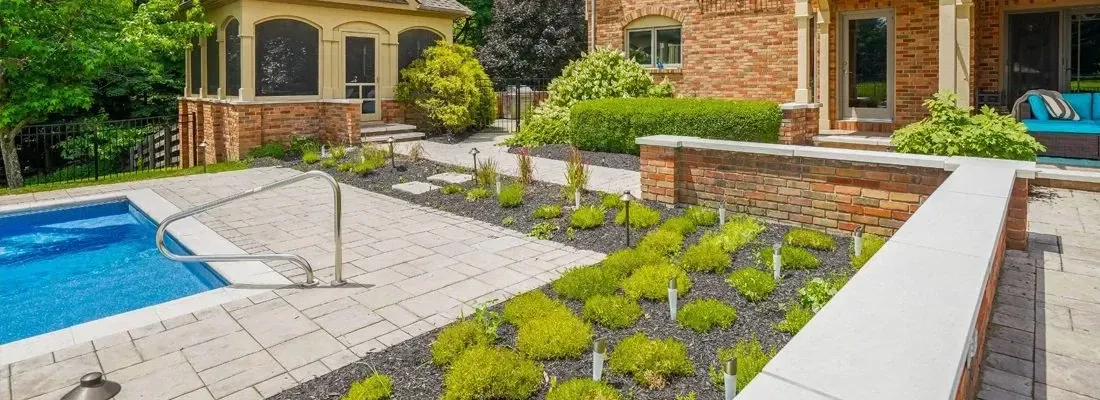
Our spec for a pool-adjacent mountain retaining wall on this kind of slope: excavate back eighteen inches past the original wall line, install a 6-inch perforated drain tile in #57 washed stone behind a non-woven geotextile fabric, reset the block on a re-compacted base, and backfill in 8-inch lifts with mechanical compaction between each lift. Geogrid reinforcement every second course for any wall over 30 inches tall. On this job the wall was 44 inches at the high end, so we specified geogrid at courses two, four, and six.
The mountain-origin soil adds cost vs Piedmont clay in two specific places. Excavation is harder — we hit weathered granite ledge at 28 inches on the uphill side of this wall, which required a rock-hammer attachment and added two days to the schedule. And the backfill has to be imported rather than site-reused, because the native saprolite won’t compact to the 95% standard Proctor density we want behind a structural wall. That’s another $3,000 to $6,000 over an equivalent Gwinnett project.
Blast charges are rare but real up here. On a pool remodel we almost never need them because the existing shell already took the hit in 1998. But if a retaining-wall footing excavation hits intact granite — which happens maybe one job in eight near the Etowah River drainage — we’re looking at an $8 to $14 per cubic yard premium to bring in a controlled-energetic contractor out of Dahlonega. On the Foxcreek job we avoided that by stepping the footing around the ledge rather than cutting through it. Engineering decisions up here are as much about reading the site as they are about the structure.
Regrading the Deck Plane to Move Water Away From the Home
The original 1998 deck pitched 1/8 inch per foot toward the home on the uphill side of the pool. That was fine when the downspouts and the French drain were both working. By 2024 the drain was gone and the downspouts were overwhelmed on any storm over about three-quarters of an inch. In a Dawsonville year with 55 inches of rainfall concentrated in mountain-pattern summer thunderstorms, that geometry gets water into the crawlspace.
We tore the entire deck and rebuilt it pitching 3/16 inch per foot away from the home in every direction. That’s steeper than the 1/8 inch minimum most pool contractors default to, and it matters on a mountain lot because the rain intensity is higher than flatland code assumes. The new deck also included a 4-inch linear drain along the uphill side, cast into the concrete, routed to daylight thirty feet downhill through a 4-inch PVC run.
Deck material choice mattered here too. The original broom-finish concrete was spalled and failing at twenty-six years. We could have replaced in kind — $9 to $12 per square foot for 580 square feet of new concrete. The homeowners chose a tumbled paver overlay instead at $22 to $28 per square foot, which gets them joint-permeability that helps with stormwater management on the slope and doubles the expected service life before the next resurfacing.
The Equipment Pad Relocation Is the Single Highest-ROI Change
If you do one thing on a 1990s Dawsonville pool remodel, move the equipment pad to the correct elevation. We placed the Foxcreek pad at 18 inches below pool water level, which means the pump primes by gravity instead of by suction lift. That single geometry change extends pump life from the 4-6 years we typically see on high-mounted pads to 10-12 years on correctly-mounted ones.
The new pad got a Pentair IntelliFlo3 VSF variable-speed pump, a Pentair CCP420 cartridge filter rated for 420 square feet of media, a Pentair MasterTemp 400 natural-gas heater (the property had an existing gas run from a prior generator install), and an IntelliCenter automation hub. The whole package ran $11,800 installed, which is roughly where we land on a modernization of this scale.
We also rebuilt the service from Amicalola EMC underground. The original overhead drop was undersized for the new equipment and sat in a tree-line corridor that dropped limbs every ice storm. Going underground was an extra $2,200 and eliminates the most common winter outage mode we see up here. Worth every dollar.
Automation is the piece the 1998 installation couldn’t even conceive of. The IntelliCenter hub ties the variable-speed pump, the heater, the salt cell, and the two LEDs into a single phone-app interface. From the homeowner’s standpoint, that means a “pool day” preset fires the heater and the colored lights at 10am and drops the pump to cleaning speed at sundown — without any of the rotary-knob cycling the original equipment pad required. From our standpoint, it means remote diagnostics. When a Foxcreek pump started pulling slightly elevated amperage in month nine, we saw it before the homeowner did and scheduled the filter-clean service in the same week.
LED, Saltwater, Plaster, and the Visible Transformation
With the equipment pad relocated and the deck rebuilt, the pool-side upgrades moved fast. We cut the old 120V niche, installed a bonded Pentair IntelliBrite 5G color-changing LED on low voltage, and added a second LED in the deep end. The bond wire got replaced from the light niche back to the new equipment pad, because the 1998 installation used bare copper that had corroded through in two places.
Saltwater conversion is standard on every Dawsonville remodel we do now. A Pentair IC40 chlorine generator handles up to 40,000 gallons — comfortable headroom on a 14×28. The upfront add is about $2,400 installed, and the homeowner saves roughly $550 to $700 per year on chemicals starting in year one. Cell replacement runs every 5-7 years at around $1,100. Net positive by year four in almost every case.
One Dawsonville-specific note on salt: the harder tap water up here (typical 7-12 grains per gallon hardness from Etowah-fed wells and from Dawson County municipal) does scale the cell faster than soft-water regions. We spec a weekly flow-cell inspection for the first ninety days and an acid wash schedule tied to cell output rather than to calendar time.
The original white marcite plaster was twenty-six years past its 8-12 year service life. We chipped out the bond coat, re-primed, and shot new plaster using Pebble Sheen midnight-blue aggregate. That finish runs about $7 per square foot installed versus $4 for conventional plaster, and lifespan roughly triples — we expect 20-25 years out of it versus 8-12 for the 1998 marcite. On a mountain lot with higher freeze-thaw cycling, that durability math matters more than it would on a flatland pool.
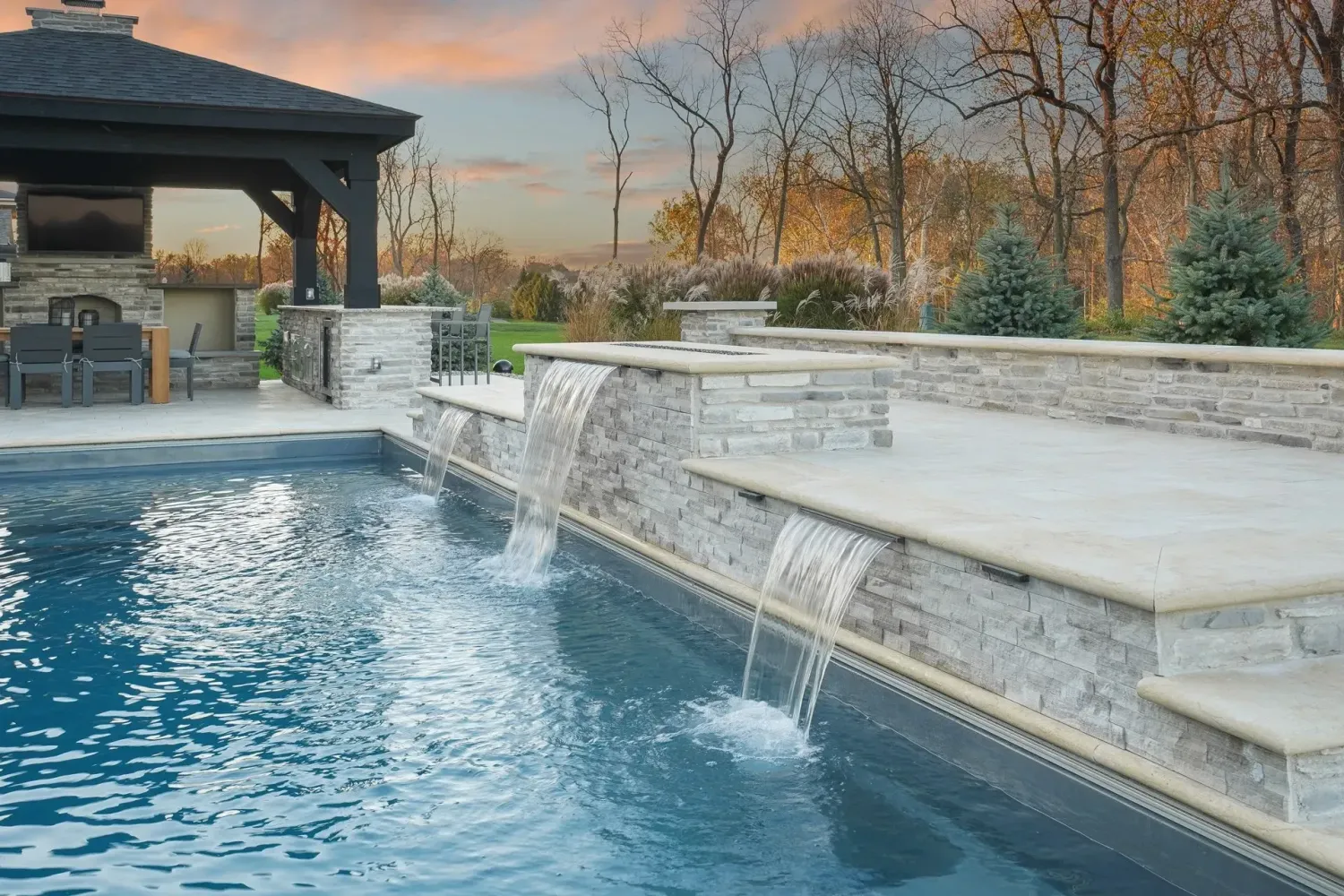
Waterline tile was a 6×6 bright Mediterranean blue from 1998. It got replaced with a 1×2 glass mosaic in a deeper blue-gray, which both looks 2025 and hides the waterline ring that builds on any pool with consistent hard-water makeup like Dawsonville’s. Coping was a direct swap to a cream-tan travertine bullnose that picked up the color of the new paver deck overlay.
What the full scope cost, itemized: Retaining wall reinforcement $18,900 · Deck demo + regrade + paver overlay $17,400 · Equipment pad relocation + new equipment $14,200 · LED retrofit + bond repair $3,200 · Saltwater conversion $2,400 · Replaster (Pebble Sheen) $6,100 · Tile + coping swap $4,800 · Permits + inspections (Dawson County P&D) $1,400 = $68,400 total. Project duration: 6.5 weeks, scheduled April to May to stay ahead of summer use.
Dawson County Permitting: What’s Actually Required
Permits for pool remodels run through the Dawson County Department of Planning & Development at 25 Justice Way. For a scope like Foxcreek’s — structural retaining-wall work, electrical service upgrade, gas heater connection, equipment relocation — we typically pull three separate permits: building, electrical, and plumbing/gas. Fees came in at $1,420 on this job, which is in line with the $900 to $1,800 range we see on mountain-lot modernizations.
Inspection sequence matters. The retaining-wall footing inspection happens before backfill — miss it and you’re excavating the wall you just set. The electrical rough-in happens after conduit and bonding are in but before the deck pour. Final is after fill and chemical balance. We’ve never had a Dawson County inspector push back unreasonably, but they enforce the code as written. NEC §680 bonding and IBC 2021 retaining-wall reinforcement get checked line by line.
For anyone doing this themselves — we don’t recommend it for scope this size, but some homeowners try — be aware that Dawson County requires a licensed pool contractor of record for any work touching the shell, the equipment, or the bonding grid. A homeowner can pull permits for deck and cosmetic work. Structural and electrical get signed off by the license holder.
What the Foxcreek Project Looks Like Today
Eleven months after completion, the retaining wall is plumb and the French drain is flowing. The deck sheds water away from the house. The equipment pad is running the Pentair IntelliFlo3 at 1,200 RPM for eighteen hours a day — down from the single-speed’s 2,400 RPM for eight hours — and the homeowner’s Amicalola EMC bill is $38 lower per month year-round. Saltwater chemistry has held within spec with no cell service calls.
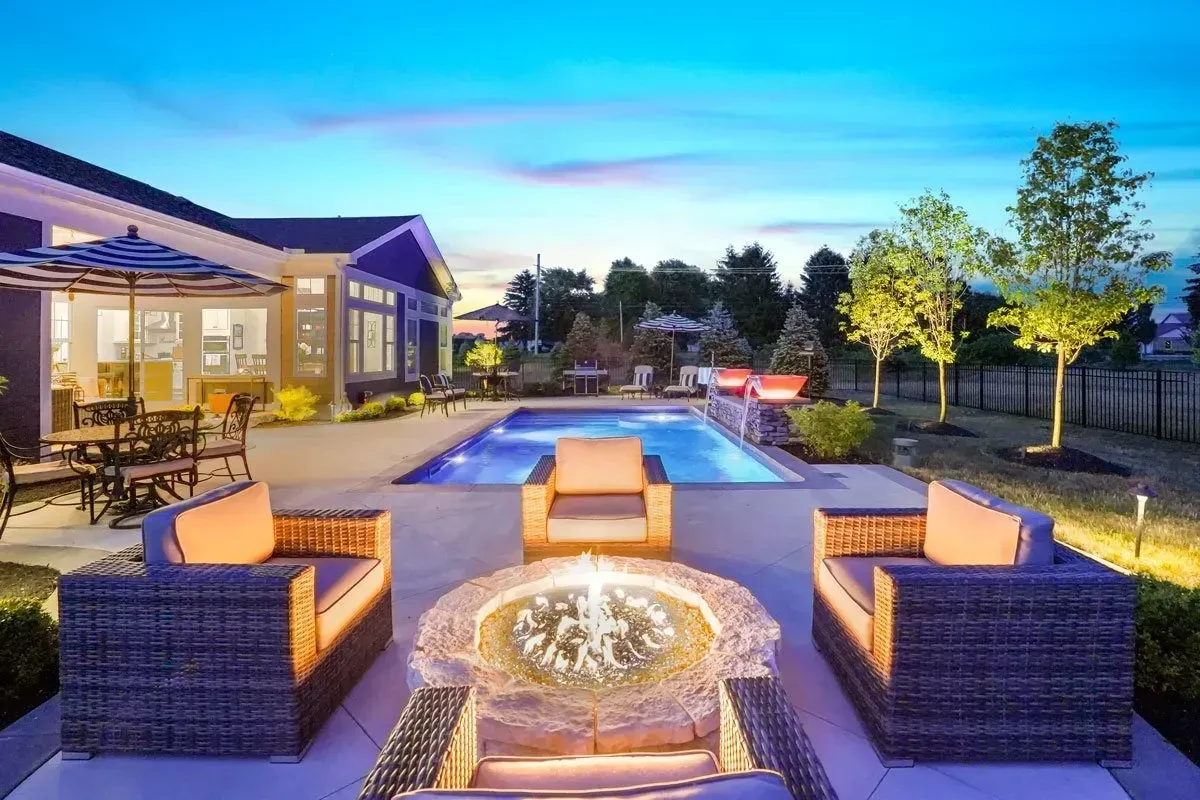
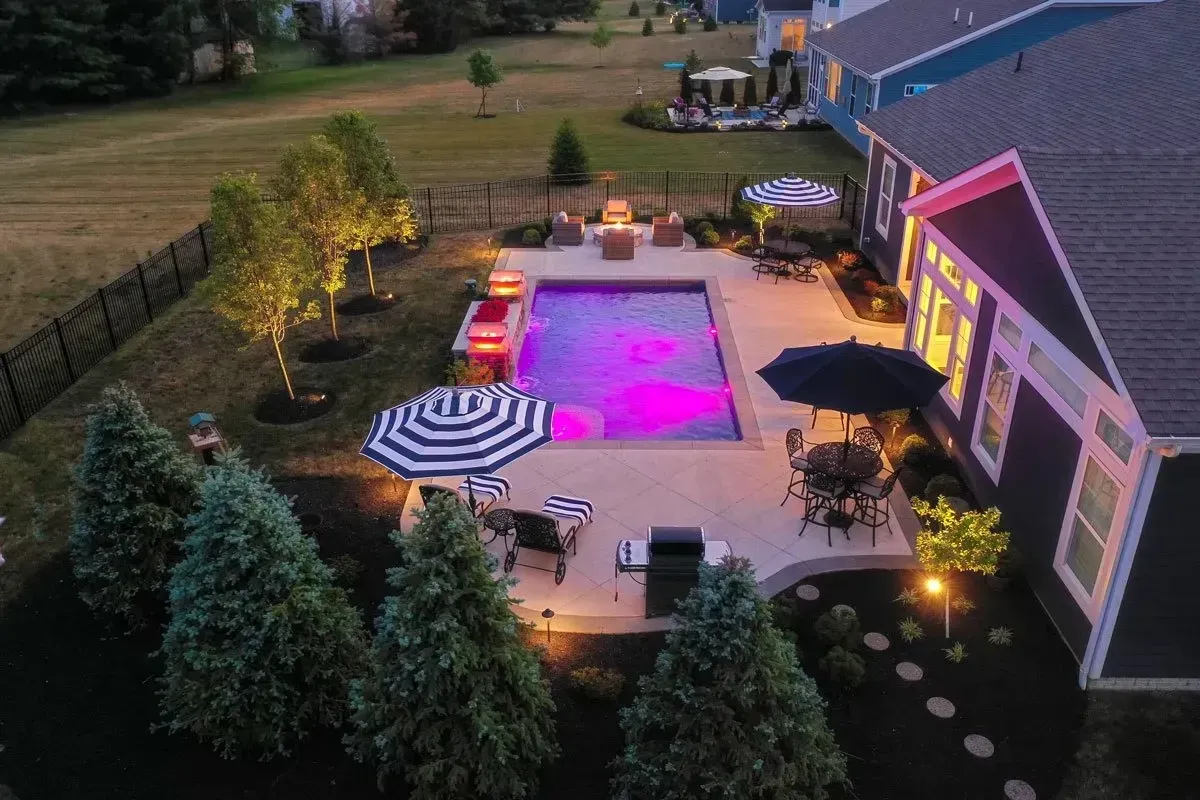
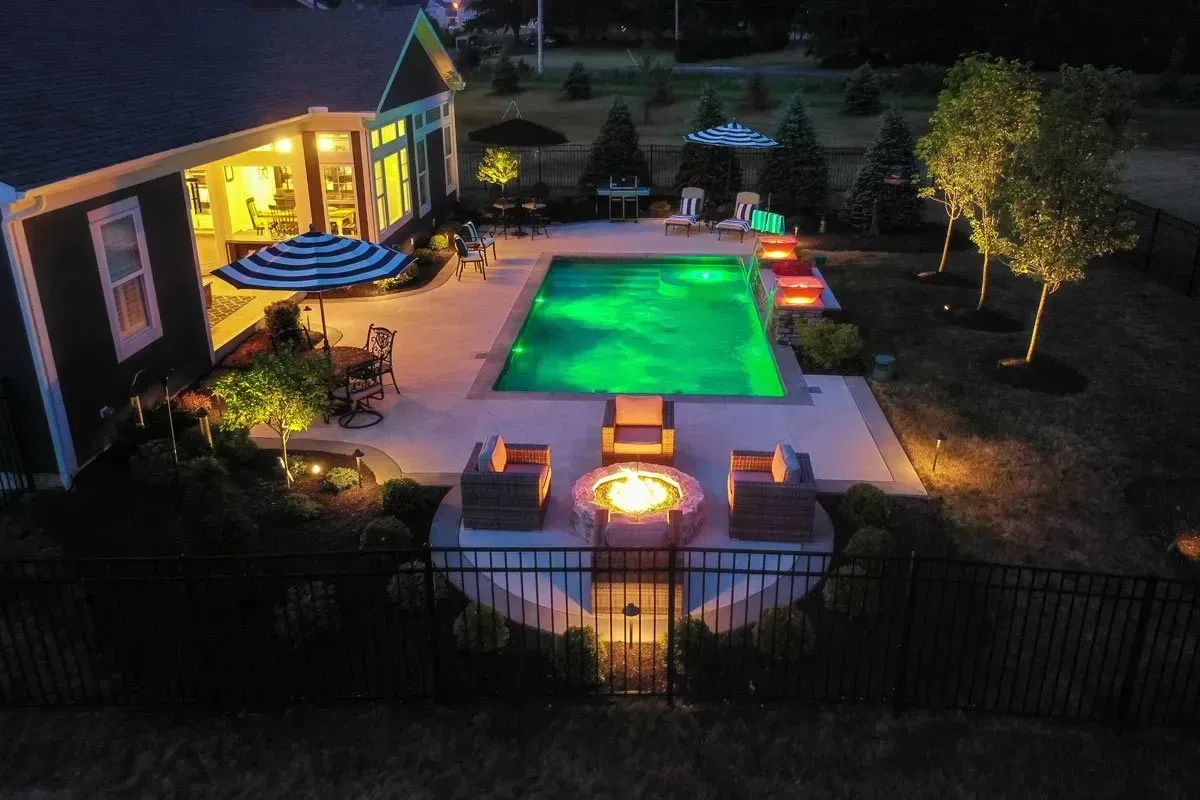
The owners added a gas firepit conversation ring the following spring, which is the photo you’ve been scrolling past in this piece. That wasn’t in the original scope but the lower-elevation equipment pad left plenty of gas capacity on the new 1.5-inch underground run, so the add was $4,200 for the firepit itself and the short lateral tap. Classic sequence — get the engineering right first, then layer on lifestyle.
A few patterns are worth calling out for anyone considering the same kind of project up here. Budget the retaining wall first and the cosmetics last, not the other way around. Insist on the equipment pad being at or below pool elevation even if the contractor tells you it can be made to work at the upper pad — “made to work” means the pump is cavitating and you’ll replace it every five years. Pay for the rock-hammer excavation rather than shortcutting the wall drainage, because the $3,000 to $6,000 premium over a flatland dig is cheaper than the retaining-wall rebuild you’ll do at year ten. And go saltwater on conversion. The hard-water math is slightly worse here than in Dacula, but it’s still positive ROI by year four.
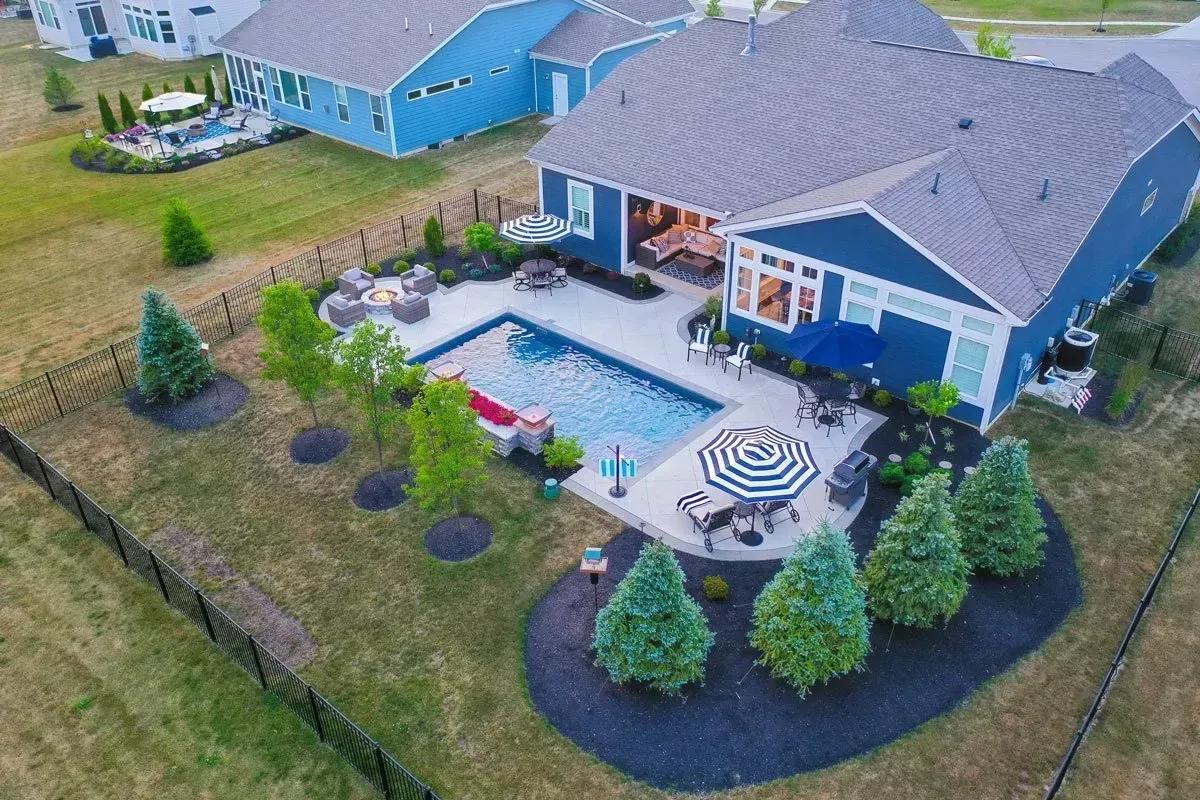
The total number for a full mountain-lot 1990s modernization lands between $48,000 and $82,000 depending on retaining-wall severity, equipment pad relocation distance, and whether the deck gets a paver overlay or stays broom-finish. Foxcreek at $68,400 sat comfortably in the middle. Projects we’ve done in Riverbend and Mountain Laurel with less severe retaining walls have come in closer to $52,000. A project in Etowah River Club with a full slope redesign and an expanded deck footprint crossed $90,000, which is the ceiling of what a modernization rather than a rebuild should cost.
If you’re weighing modernize versus rebuild — we’ll tell you straight. Anything under about $90,000 in remodel scope on a structurally sound 1990s shell is cheaper than rebuilding. Anything over that, and you should price a demolish-and-rebuild on the same footprint. We’ll write both proposals for you and lay the numbers side by side.
Pool remodeling across 20+ cities within 30 miles of Winder, GA
Mountain-lot modernizations in Dawsonville, Cumming, and Gainesville get engineered around the retaining wall and the equipment pad first. Every scope we quote names the wall budget, the grade plane, and the pad elevation before we talk tile.