
Everyone wants to talk about color-changing shows and synchronized waterfalls. Almost nobody wants to talk about the $280 surge controller sitting between a $1,950 Pentair IntelliBrite 5G fixture and the Sawnee EMC transformer humming at the end of the driveway. That’s the wrong emphasis — and Forsyth County homeowners pay for it every July.
Here is the contrarian take: the single most important decision you’ll make about your Forsyth County pool lighting system has nothing to do with brightness, color mixing, or app control. It has to do with what happens the first time a thunderhead rolls off Sawnee Mountain at 4:47 p.m. on a Tuesday in July and dumps a Class 2 strike within a half-mile of your transformer pad. If your low-voltage pool circuit isn’t isolated by a proper whole-pad surge device with a clamping response under 25 nanoseconds, the Pentair driver inside that fixture becomes a paperweight — and the $1,400 to $2,200 replacement bill shows up two weeks later because you can’t find a tech who’ll wade shoulder-deep to pull a 10-lb niche-bolted fixture in 82-degree water.
We’ve built pools across 30040, 30041, and 30028 for long enough that we can map the damage by zip code. South Forsyth — the commuter belt along Bethelview and Post Road — loses fewer fixtures, because most of those homes sit inside subdivisions with newer 200-amp panels and composite ground rods. North Forsyth — Coal Mountain, Ducktown, Shady Grove, the Lake Lanier south-shore estates off Browns Bridge Road — is where we see the bodies. Ridgeline properties, older transformers, long service runs, and a lake that acts like a lightning magnet. When people ask us why we push Sawnee EMC surge protection so hard on every build in that corridor, the answer is: because we’ve replaced the fixtures that skipped it.
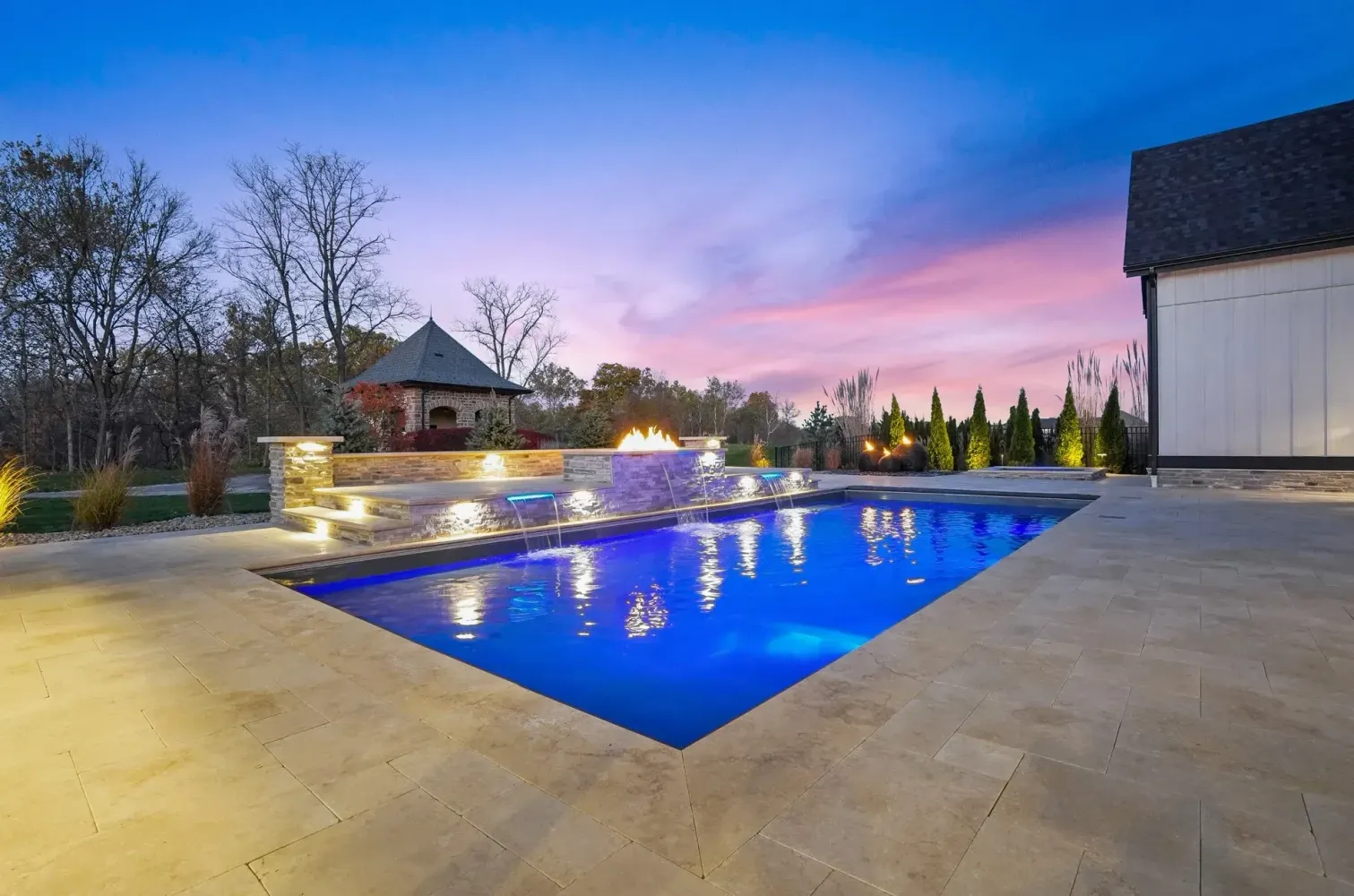
This piece is not an overview of pool lighting. It’s a deep-technical walk through four decisions that actually matter once you get past the marketing pages: which fixture platform to pick, why the surge controller is the real product, how to size the low-voltage transformer, and how to integrate the astronomical timer so the system stops wasting electricity and actually lasts fifteen years instead of four. Forsyth County’s ~260,000 residents across 247 square miles sit in one of the most thunderstorm-dense corridors in the state — roughly 54 thunderstorm days per year according to NOAA’s local climate averages. That number, not the lumen rating on the box, is what dictates how we wire pool lights here.
Fixture Platform: Pentair IntelliBrite 5G vs. Hayward ColorLogic 4.0
We install two fixture platforms as a baseline: Pentair IntelliBrite 5G and Hayward ColorLogic 4.0. Either one is a competent piece of engineering. They use different driver architectures and different niche geometries, and choosing between them comes down to three things — the equipment pad you already have (or are about to have), the automation system you want to talk to, and whether you prefer pure color mixing or a specific warm-white floor.
Pentair’s 5G runs on a sealed 12V DC platform with a proprietary connector and an internal microprocessor that handles color sequencing on the fixture itself. That matters for one reason: when the fixture is the brain, the cable run back to the transformer can be longer and smaller-gauge without losing color fidelity. On a typical Forsyth build where the equipment pad sits 35–60 feet from the pool wall — common on the 3-to-5-acre estate lots north of Highway 20 — the 5G’s onboard logic forgives voltage drop that the older Hayward CL4.0 can’t. You’ll see a noticeable color shift on a CL4.0 at 60 feet of 12/2 landscape wire; a 5G at the same distance still reads clean.
Hayward ColorLogic 4.0 wins in one specific scenario: when the owner already has an OmniLogic or OmniHub automation panel, and when the pool carries more than two bubbler or fountain light fixtures that need synchronous color-show control. The ColorLogic network sync is tighter across multiple low-voltage fixtures than Pentair’s IntelliBrite + SALt (Pentair’s sync protocol) in our experience, especially on runs of four or more fixtures. Big Creek, Bethelview, and the Shoal Creek builds where we’re lighting a main pool, spa, three deck-mounted bubblers, and two sheer-descent water features — that’s where the Hayward ecosystem earns its keep.
Rule of thumb: Two-fixture builds (pool + spa) — either platform works. Four-plus fixture builds with synchronized water features — Hayward ColorLogic 4.0 with an OmniLogic hub, or Pentair IntelliBrite 5G with a full IntelliCenter and the newer SALt protocol. Do not mix brands on the same low-voltage transformer.
What we won’t install anymore: knockoff LED retrofits from unnamed Amazon storefronts. We’ve pulled three of them out of Ducktown pools in the last eighteen months — every one had water intrusion at the cord grip within 30 months, and every one had burned a $600 GFCI breaker on the way out. That’s not conservatism, that’s pattern recognition. Pentair and Hayward carry the warranty paperwork their driver boards can actually stand behind.
The Sawnee EMC Surge Controller — The Real Product in the Lighting Package
Here’s the math nobody puts in front of a homeowner at the sales table. A transient voltage spike on the Sawnee EMC line — the kind that comes from a cloud-to-ground strike anywhere within roughly a half-mile of your pad — can hit the service entrance at 6,000 volts peak for about 20 microseconds before the utility-side protection cuts it. That pulse travels downstream through your 200-amp panel, through the 20-amp GFCI-protected circuit that feeds the pool transformer, and lands on the 12V secondary side of the transformer — where your Pentair or Hayward driver is sitting. Driver boards are designed to tolerate maybe 800V of peak transient. After that, they cook.
A properly specified whole-pad surge protection device — we default to an Eaton CHSPT2ULTRA or an Intermatic PS3000 on Forsyth builds, depending on the main panel architecture — clamps that transient down to 330–400V within 25 nanoseconds. The install cost, including the device, the dedicated ground, and the labor to tie into the existing panel, runs $280 to $420 on a new build and $540 to $720 as a retrofit. That one decision prevents the $1,400 to $2,200 fixture-and-driver replacement that Sawnee EMC’s own claim data confirms is the single most common pool-equipment insurance claim in Zones 30028, 30040, and 30041 during June through August.
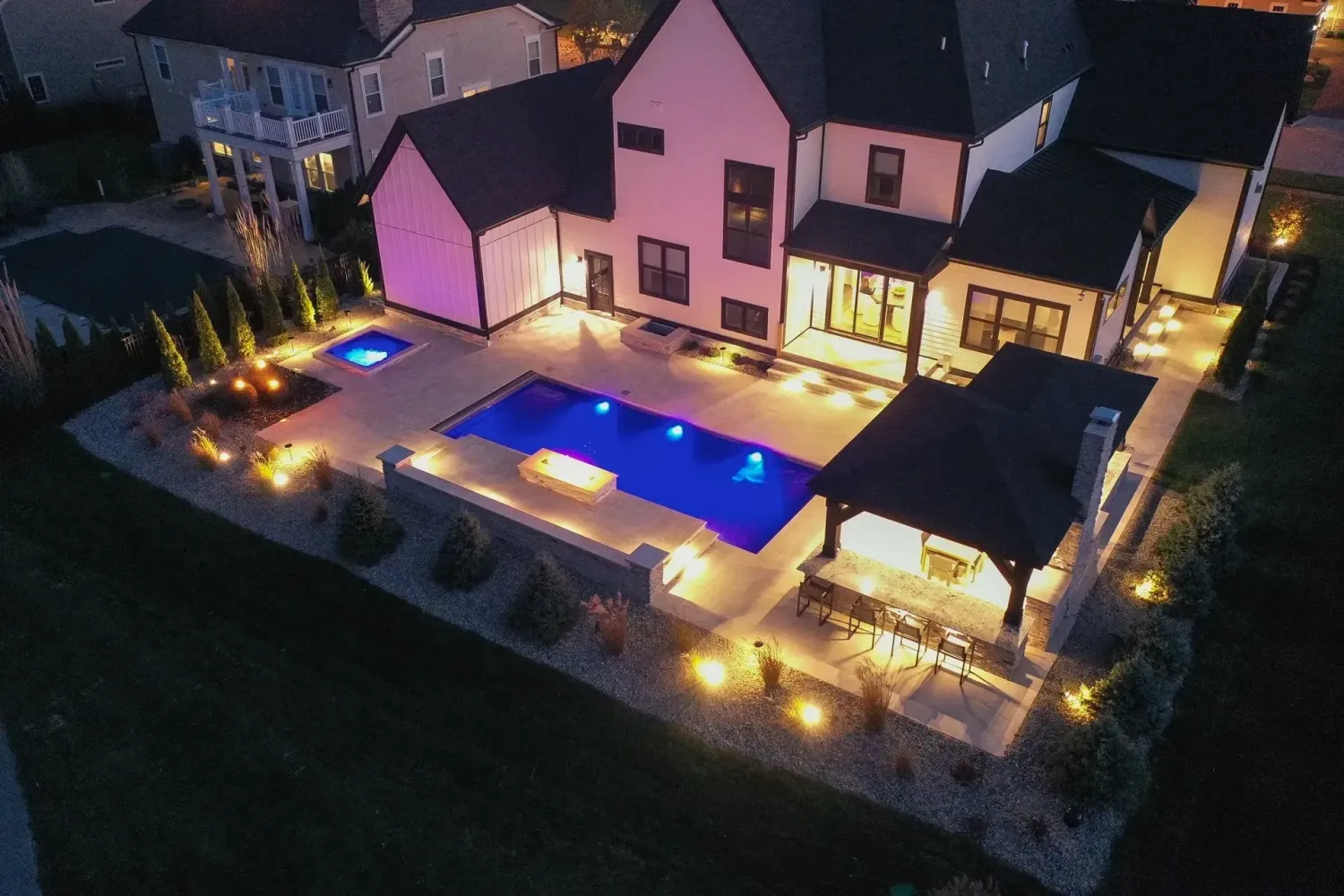
Two technical notes that matter here, because they trip up inexperienced installers constantly. First, the SPD must sit upstream of the pool GFCI, not downstream — we see DIYers and weekend installers put a plug-in surge strip at the equipment pad thinking that solves the problem. It does not. A plug-in SPD is working against the pool GFCI in a downstream loop; the actual transient arrives through the service entrance and has already reached the pad-level wiring before any plug-strip can react. The whole-pad SPD mounts at the subpanel or at a dedicated surge-panel tap ahead of the GFCI breaker.
Second, the SPD needs its own 6-AWG copper ground to a supplementary ground rod — not a chassis ground, not a bond to the pool bonding grid. Supplementary. We drive an 8-foot copper-clad rod at least six feet from any existing rod, and we verify resistance to earth under 10 ohms with a clamp meter before we close the panel. On Forsyth’s Cecil clay soils, that’s usually achievable in a single rod; on the rockier north-county ridgelines toward Coal Mountain and the Sawnee Mountain Preserve foothills, we sometimes have to go to a pair of rods in parallel.
Low-Voltage Transformer Sizing: 150W, 300W, or 600W
This is where pool builders get lazy and homeowners pay for it three years later. The transformer is the device that steps your 120V service down to the 12V the fixture needs. It has to be sized to the connected load plus a 20% safety margin — not to the pool size, not to what was on the truck that day, and not to “whatever the last builder used.”
Three scenarios we see constantly on Forsyth builds:
- 150W transformer: Correct for a single Pentair 5G large niche light (roughly 70W draw) plus a single spa light. Common on smaller 16×32 rectangular builds in Shiloh and Brookwood subdivisions. Margin: adequate.
- 300W transformer: Correct for a two-fixture main pool plus spa plus one or two deck-level bubblers. This is our default for the typical Forsyth build — 18×36 freeform pool, raised spa, pair of bubblers. Margin: healthy.
- 600W transformer: Required for the big Lake Lanier south-shore estates we do around Browns Bridge Road — main pool (2 fixtures), raised spa (1 fixture), sheer-descent water wall (2 fixtures), deck landscape integration (4–6 fixtures), pergola uplighting tied into the same astronomical timer (6–10 fixtures). Typical connected load on that build: 480–520W. A 300W transformer on that load isn’t under-sized — it’s a fire waiting for a hot August afternoon.
The 20% safety rule: Sum the nameplate wattage of every fixture on the circuit, then multiply by 1.20. That’s your minimum transformer capacity. Running a transformer at 95% of rated load in Georgia’s summer heat is how magnetic transformers die — they’re rated for 40°C ambient, and a south-facing equipment enclosure in 30028 hits 52°C by 3 p.m. in August.
We use magnetic stainless-steel transformers on every Primetime build — not the cheaper electronic units sold through discount landscape supply. The magnetic units are roughly $180 to $240 more per unit, but they tolerate surge events the electronics can’t, and they carry a 15-year warranty against a 3-year warranty on the cheap side. Over a pool’s first decade, the magnetic transformer saves at least one replacement cycle — and in Forsyth’s thunderstorm density, usually two.
Astronomical Timer Integration — Where the System Stops Wasting Your Money
Ninety percent of the pool lights we inspect on Forsyth service calls are being run on dumb mechanical timers set to “on at 7, off at 11” year-round. In June that’s fine. In December the lights are firing at 7 p.m. — a full hour after sunset — and burning through a full hour of unnecessary drive time every single night for six months. Across a 300W connected load, that’s roughly 54 kWh per year at Sawnee EMC’s current residential rate of about $0.1085 per kWh — not catastrophic, but it’s also burning driver hours that shorten the life of the whole system.
An astronomical timer — integrated through IntelliCenter, OmniLogic, or as a standalone Intermatic PE153 — reads the local latitude-longitude and computes true sunset every single day. The lights come on at actual dusk in Forsyth County (which ranges from 5:22 p.m. in late December to 8:52 p.m. in late June), hold for the programmed duration, and shut off. We program most Forsyth builds for sunset + 15 minutes ON, 11:00 p.m. OFF as the weeknight default, with a Friday/Saturday override that extends to midnight.
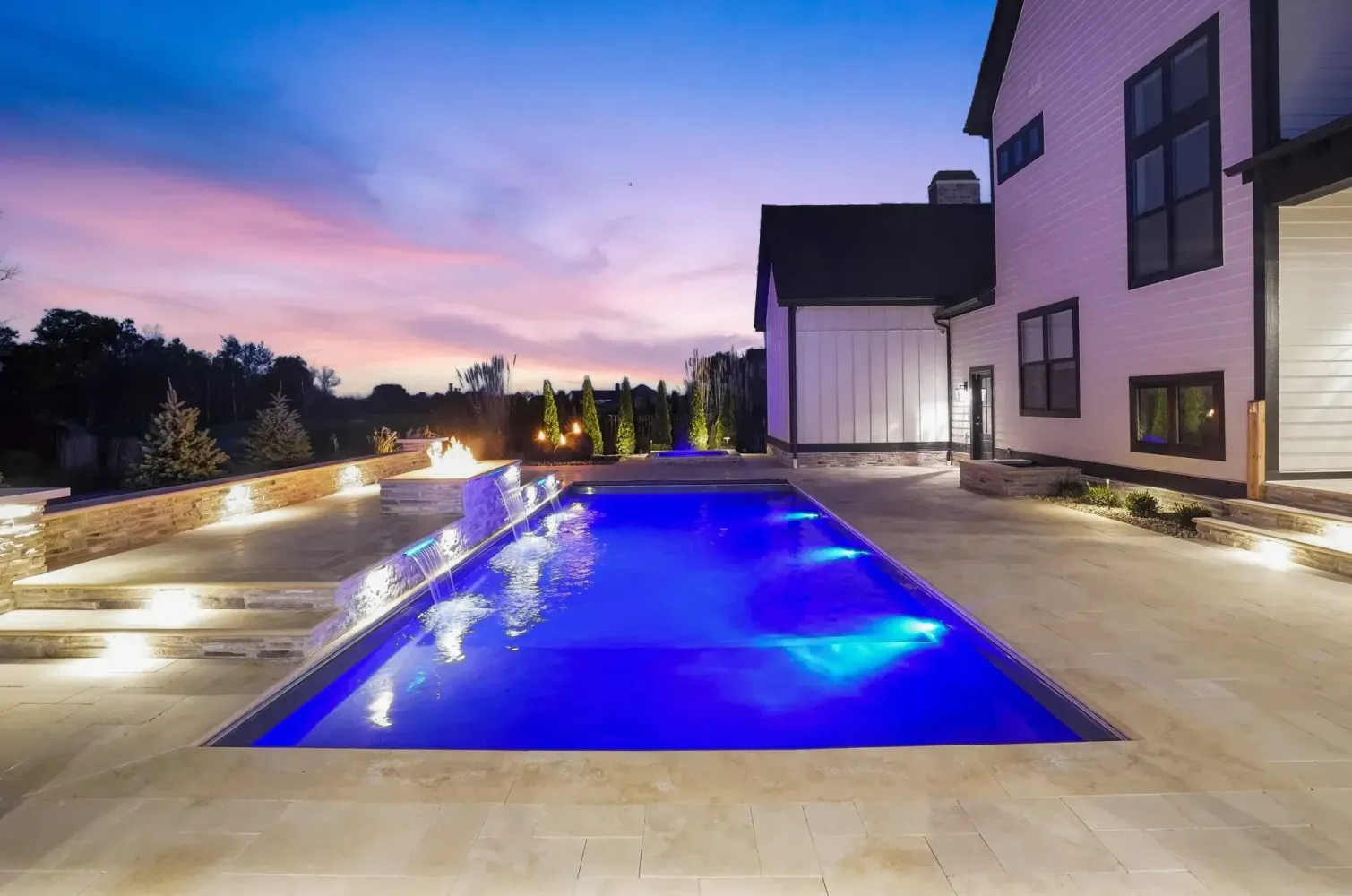
Integrating the timer with the surge controller is where the build gets tight. The timer signal runs through a low-voltage contactor — typically an Intermatic T104 or the automation hub’s internal relay — which means the SPD has to protect both the 120V side feeding the contactor and the 12V secondary feeding the fixtures. That’s two surge paths, and a lot of installers only protect one. We install a primary SPD at the main service entrance and a secondary lightning-surge arrestor at the equipment sub-panel on every Forsyth build, because a single-stage surge protection scheme is what lets a Class 1 strike walk right past the first device and cook the automation hub.
For homeowners running IntelliCenter or OmniLogic, there’s also the question of what the Wi-Fi bridge and the cellular backup do during a lightning event. The answer: they should be on a separate SPD with its own cat-6 surge protector in-line with the Ethernet run. We install those as standard, because replacing an OmniLogic panel on a Shady Grove estate after a July strike is a $3,200 part plus another full day of automation reprogramming.
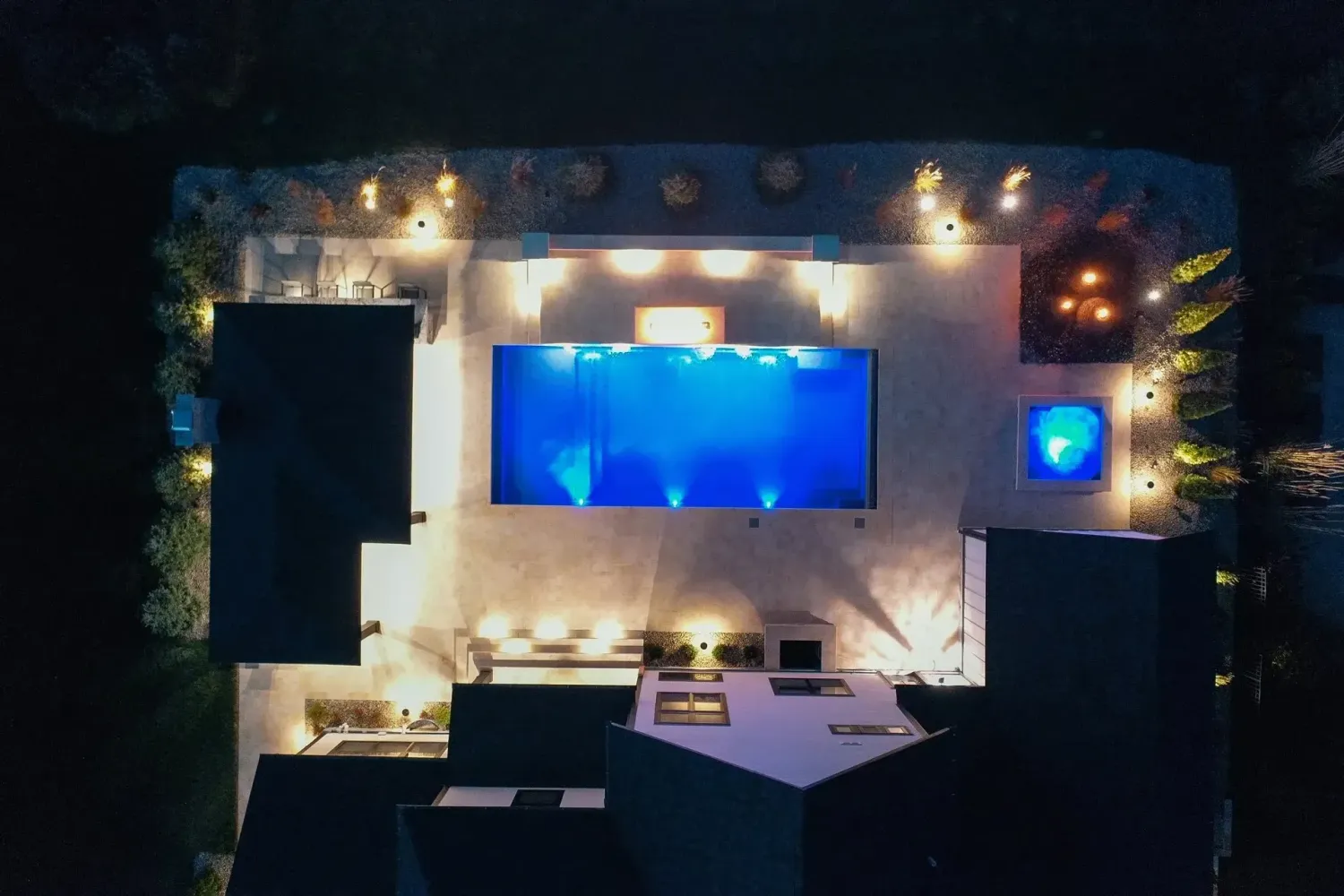
The Forsyth-Specific Build Spec We Actually Use
Because every Forsyth build we do goes through the same engineering checklist, here’s the exact lighting package we’d specify on a representative 18×36 freeform pool with raised spa in the 30041 corridor — the kind of build we do constantly off Post Road, McGinnis Ferry, or the outlying subdivisions south of Cumming:
- Two Pentair IntelliBrite 5G large niche fixtures (pool + spa) — $1,950 per fixture installed.
- One 300W stainless-steel magnetic low-voltage transformer with 20% margin — roughly $485 installed.
- Eaton CHSPT2ULTRA whole-pad SPD with supplementary 8-foot ground rod and 6-AWG copper bond — $340 installed on a new build.
- Intermatic PE153 astronomical timer, programmed to local Forsyth lat-long, weeknight/weekend schedule — $220 installed, or rolled into the IntelliCenter panel if present.
- Secondary Cat-6 surge arrestor on the automation hub — $95 installed.
Total package: roughly $5,040 on top of the base pool build — with a useful life of 15 years on the transformer, 8–12 years on the fixtures, and measurable surge protection that Sawnee EMC’s grid data says will pay for itself within the first 24 months on any property in the 30028 or 30041 zip codes.
Is that more than the cheapest LED package a competing builder will quote? Absolutely. Is it also a system that is still working after the fourth thunderstorm season, when the cheap system has been rebuilt twice? Also yes. That is the actual decision on the table — not “which color does my pool glow at night,” but “which system is still running in 2039.” In Forsyth County, with the thunderstorm density we have and the volume of new builds Sawnee EMC’s grid is absorbing (Forsyth approves 200+ pool permits per year, the highest per-capita rate in North Georgia), that’s the only question that matters.
LED pool lighting engineered for Forsyth County’s grid, not a generic spec sheet
Every lighting package we build in Forsyth is sized to the Sawnee EMC service profile on that specific property — surge protection, transformer, fixtures, and astronomical timer quoted as a single integrated system, not upsold piece by piece after the pool is already in the ground.