
Why does nearly every new pool we build inside Laurel Springs land on a linear gas trough instead of a traditional round firepit? Because the ARB, the architecture, and the budget math all point the same direction — and the pool looks better for it.
We get the question from almost every Suwanee homeowner who calls us after their first design meeting with another builder: “Do I really want a firepit, or should I do one of those long gas channel things?” Short answer — if the house is in Laurel Springs, The River Club, or Bear’s Best Atlanta, the linear gas trough wins nine times out of ten. If the house is a 1990s traditional over by Settles Bridge Road, a circular firepit with stone veneer still makes sense. The angle changes with the architecture.
This post is not a general fire-feature explainer. It is the specific playbook we run when a Suwanee client on a modern or transitional home asks us to design a pool-adjacent fire feature that will (a) pass Laurel Springs ARB on the first submission, (b) survive Gwinnett County permitting without re-engineering, and (c) actually get used after the project turns over. The answer, for that exact client, is almost always a 72″ linear gas trough — and below we explain why, what it costs, how it compares to a fire bowl, and what happens when Jackson EMC’s grid hiccups mid-ignition.
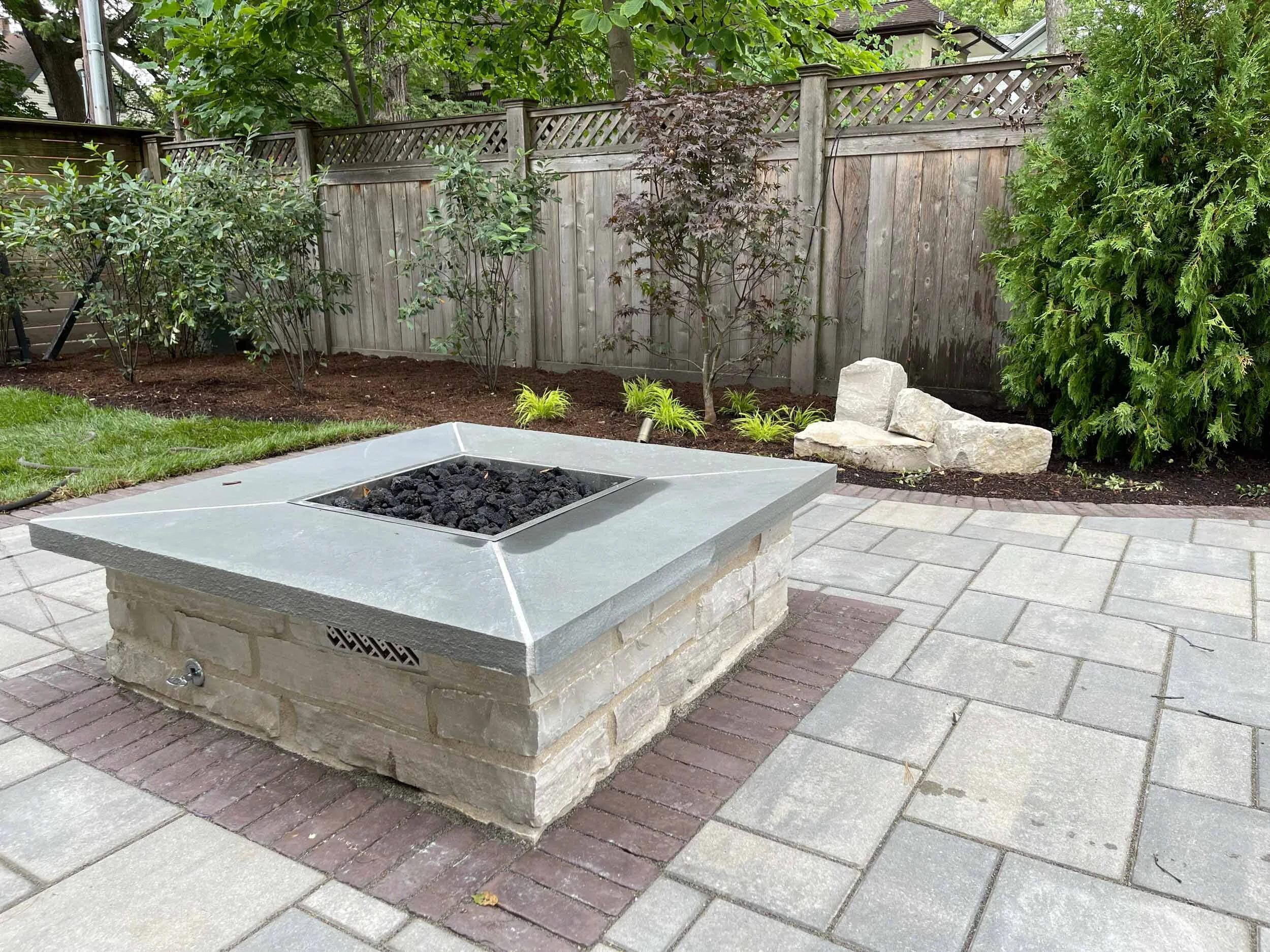
Why Laurel Springs Homes End Up on Linear Gas Troughs
Laurel Springs is Gwinnett County’s premier golf-and-gated community, and its Architectural Review Board (ARB) is one of the strictest we work under. Typical turnaround is three to four weeks for a pool-plus-fire-feature submission, and the reviewers look hard at three things: scale, materiality, and silhouette from the golf course. A circular stone firepit on a raised island reads “1998 resort” from the fairway. A 60–84″ linear gas trough tucked into a tabby-stucco or limestone-veneer wall reads “2023 custom.” The ARB rewards the second one.
Beyond aesthetics, most Laurel Springs lots are one to three acres and the pool tends to sit on-axis with the rear elevation. The homes are large — a round fire element 42″ across gets swallowed. A linear trough matches the horizontal geometry of the rear facade, runs parallel to the pool coping, and gives you a third horizontal line (house roof, pool coping, fire-feature wall) that professional landscape architects design for on purpose.
The same logic holds in The River Club at Suwanee and the estates inside Bear’s Best Atlanta. These are not neighborhoods where a homeowner wants to “build a firepit.” They want an integrated fire element that reads as part of the architecture.
The Price Reality — $9,400 to $14,800 Installed
Here is the budget range you should plan on for a Suwanee-area linear gas trough built into a hardscape wall, natural-gas fed, with a proper igniter and remote:
- 48″ trough, basic: $7,600 – $9,200 installed (uncommon in Laurel Springs — too small for the scale)
- 60″ trough, standard: $8,800 – $11,400 installed
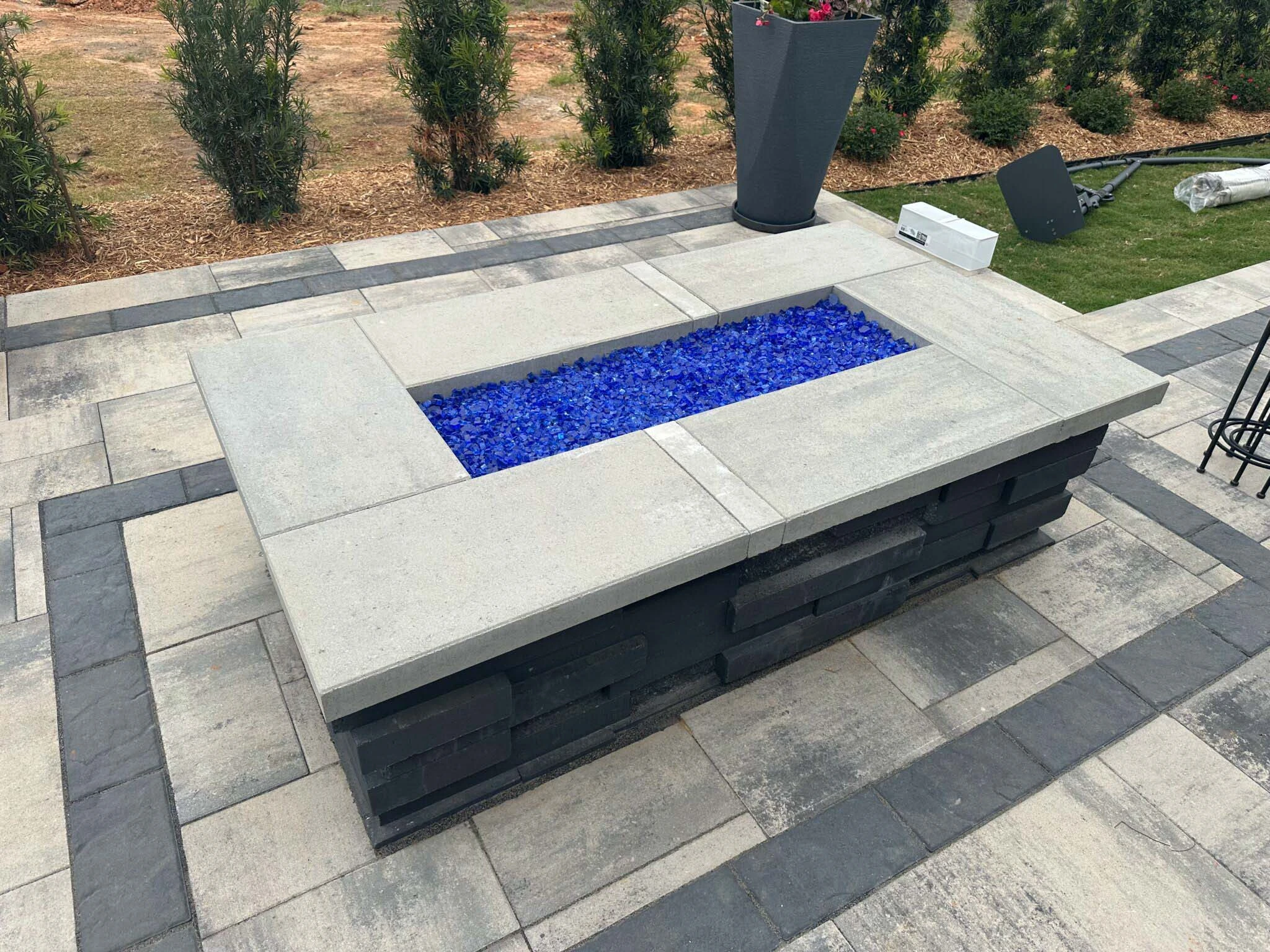
- 72″ trough, standard: $9,400 – $14,800 installed — this is the Laurel Springs default
- 84″ trough, estate-scale: $12,800 – $18,600 installed (used in River Club and the larger Laurel Springs lots)
- 96″+ custom trough: $17,200 – $26,000+ installed (rare — usually tied to a reflecting-pool design)
Those numbers include the burner assembly, fire-rated media (black lava rock or tempered glass), the 24V electronic ignition with transformer, the gas line run from the meter (usually 40–80 feet on a typical Laurel Springs lot), a dedicated shutoff, and the masonry surround. They do not include the pool deck, the pool itself, or any structural wall that the trough sits inside.
Signature budget fact: On a typical Laurel Springs pool project, the linear trough comes in around 4–7% of the total hardscape-plus-pool budget. On the estate side of the neighborhood — pool budgets north of $280,000 — the trough is closer to 3%. That is why clients stop flinching at the number once the full scope is in front of them.
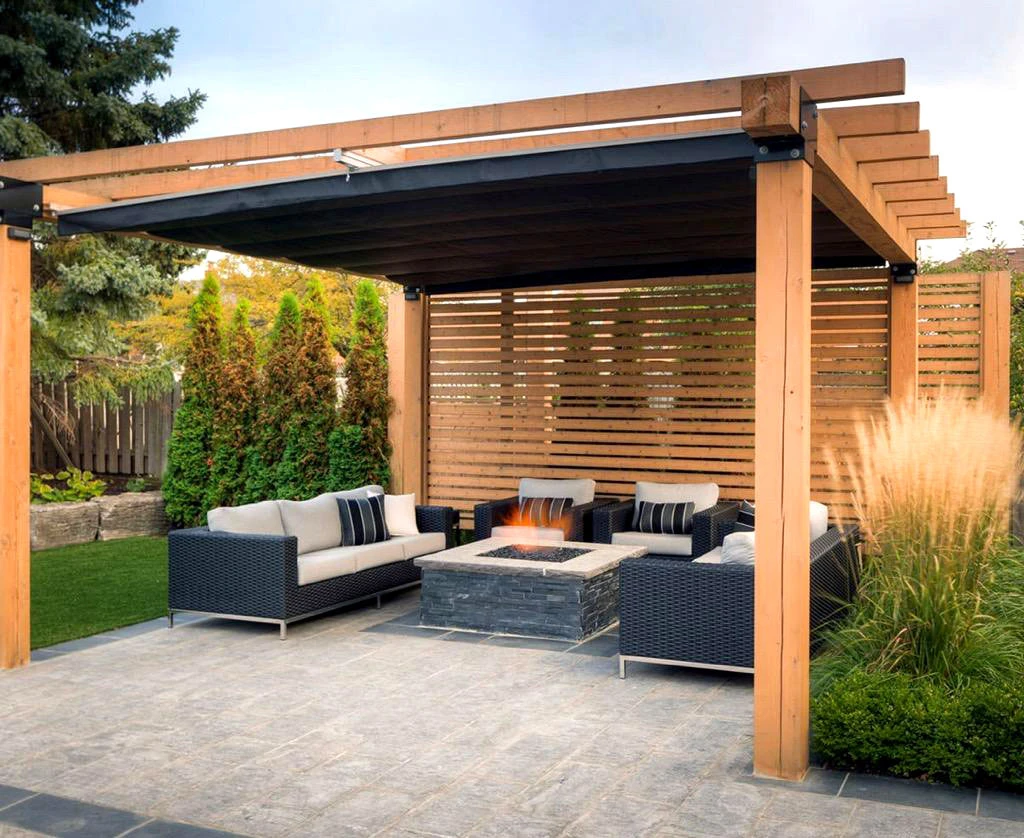
Linear Gas Trough vs Circular Fire Bowl — The Comparison You Actually Need
The trade we run through with every Suwanee client is not trough-vs-round-firepit. That one is obvious. The real comparison is linear gas trough vs raised fire bowl — because both show up in the modern-pool playbook, both cost roughly the same, and the decision comes down to how you’ll actually use the feature.
Heat Output and Perceived Warmth
A 72″ linear trough running a standard 90,000 BTU/hr burner throws roughly 12–14 linear feet of radiant heat — but the flame is spread thin across the length of the burner pan, so the perceived warmth at any given seat is moderate. A 30–36″ fire bowl running the same BTU load concentrates the flame in one column. You feel more heat per square inch of skin at the bowl than at the trough.
In practical Suwanee terms: if you plan to sit around the fire on a 45°F November evening (we get roughly 20 freeze events per year here), the bowl wins. If the fire is mostly a visual element that runs for 45 minutes at the start of a pool party in June, the trough wins — and that is what 80% of Laurel Springs clients actually do with it.
Visual Weight and Sight Lines
Linear trough is horizontal. It elongates the pool deck, mirrors the coping, and virtually disappears when it is not lit because the burner sits flush with the wall top. Fire bowl is vertical. It creates a focal point, announces itself even when cold, and looks intentional from inside the house. Modern architecture (flat roofs, big glass, clean horizontals) wants the trough. Transitional architecture (gabled roofs, brick and stone, shingle) can handle a bowl or a pair of bowls flanking the spa without fighting the building.
Wind Behavior
Suwanee’s rolling Piedmont topography — and the proximity of the Chattahoochee River floodplain to the southwest — produces consistent evening breezes along the river bluff. A linear trough is more forgiving in wind than a fire bowl because the burner pan has multiple ignition points along its length; if a gust kills the flame at one end, the safety sensor at the other end keeps the gas-valve solenoid open long enough to reignite. A single-point bowl burner will simply shut down.
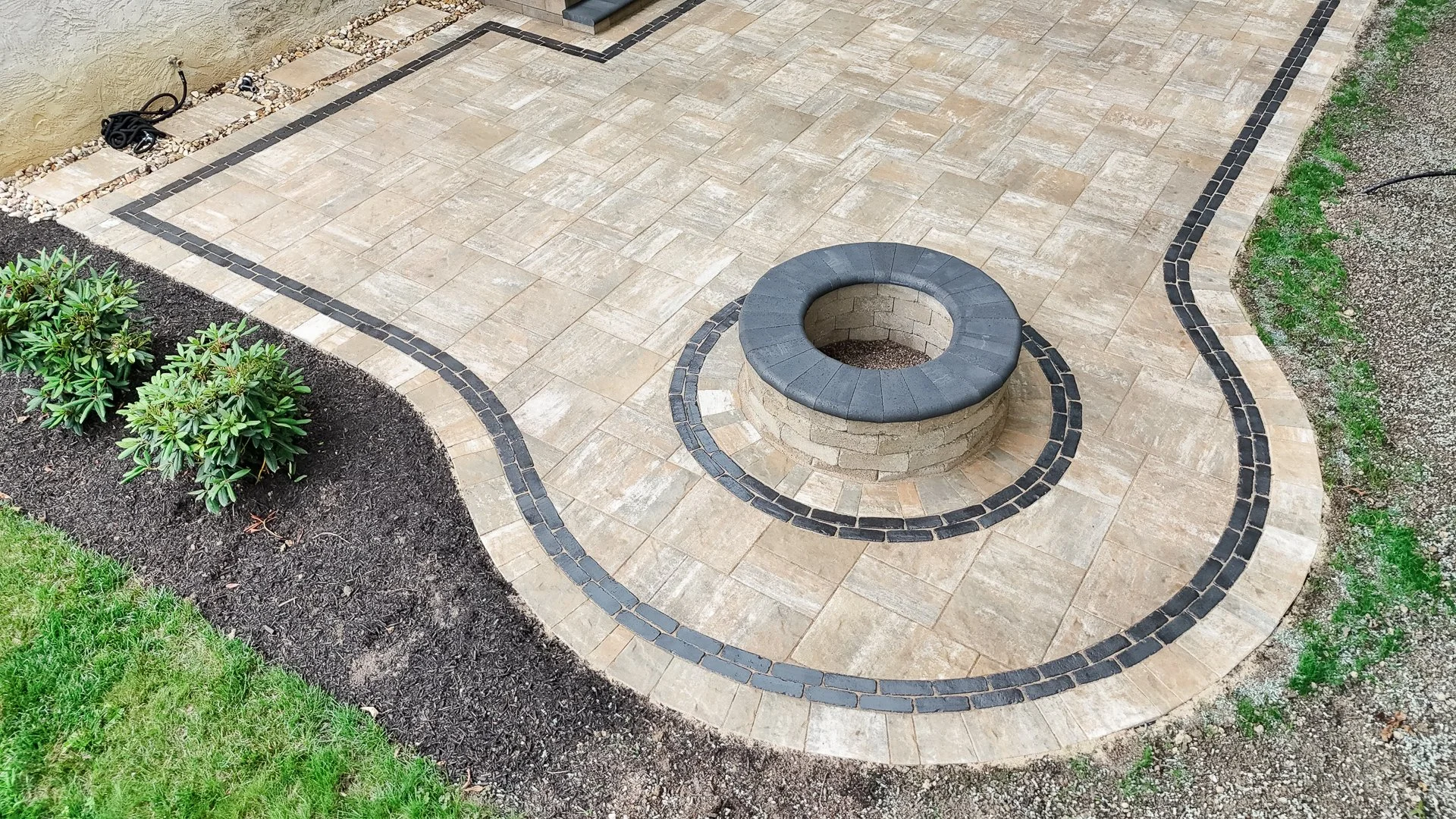
The Laurel Springs ARB Submission — What Gets Approved, What Gets Kicked Back
We have run enough submissions through the Laurel Springs ARB to know the pattern. Here is what sails through on the first review, and what gets a redline letter two weeks later.
What Gets Approved First-Pass
- Linear trough integrated into a seat-wall or planter wall — tabby-stucco finish, limestone cap, no more than 18″ of wall showing above the pool deck
- Burner media in black lava rock or charcoal tempered glass — no reflective glass, no amber or orange media
- Natural gas fuel source — propane tanks must be buried; surface tanks are a hard denial in Laurel Springs
- Remote-actuated 24V electronic ignition — no constant pilot, no match-lit systems
- Wall finish that matches the house — Indiana limestone, tabby stucco, or brick veneer pulled from the home’s existing palette
What Gets Kicked Back
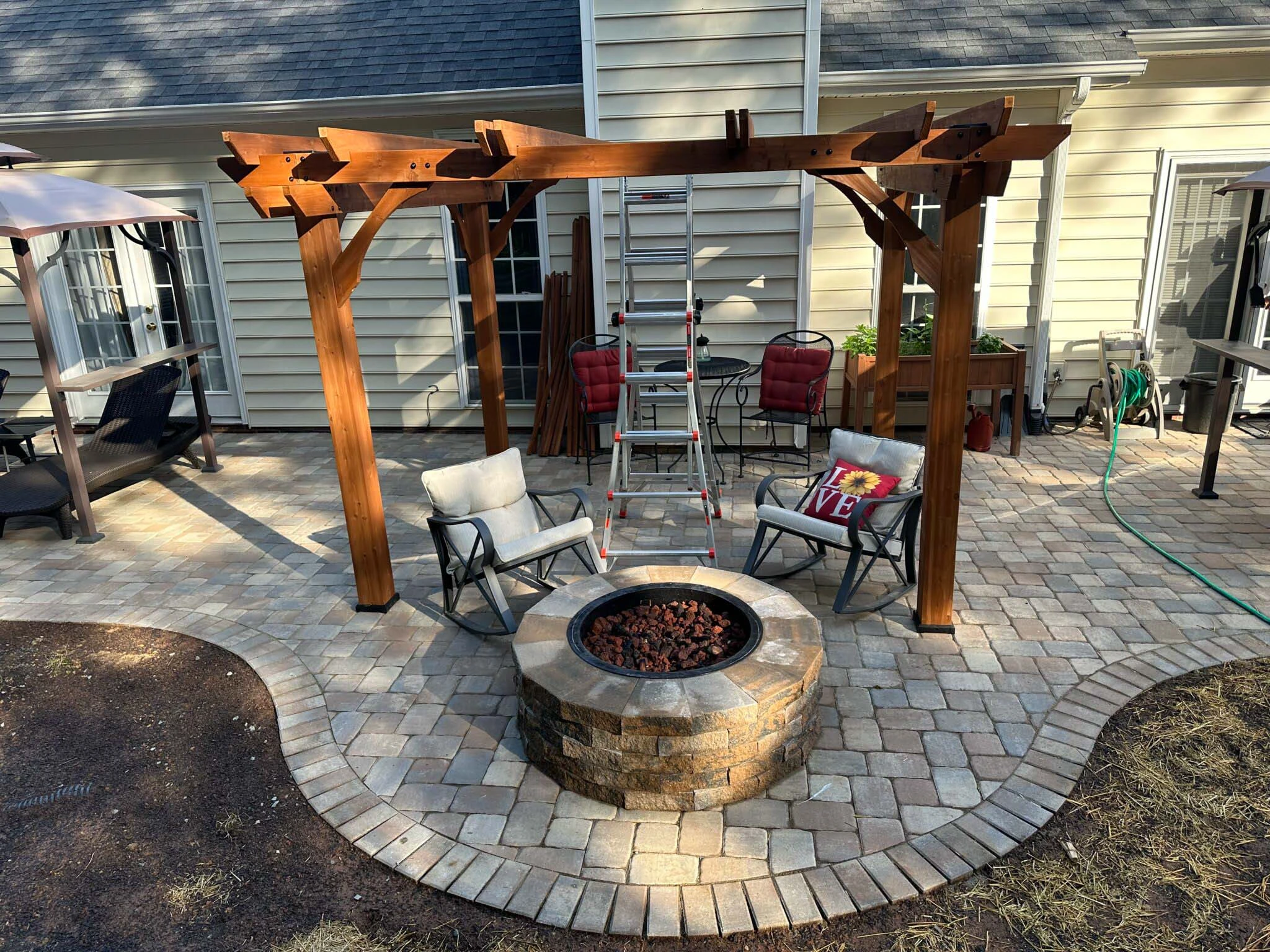
- Circular firepits on raised deck islands — reads as dated; the ARB has declined these repeatedly since roughly 2021
- Cultured stone or “faux ledger” veneer — must be real stone or real stucco
- Above-grade propane tanks visible from the golf course or adjacent lots
- Gas troughs longer than 96″ on lots under one acre — scale issue
- Any fire element with an exposed burner pan rim above the media line
Permit path after ARB: Gwinnett County Department of Planning & Development at 446 W. Crogan Street, Lawrenceville. The gas line requires a mechanical permit in addition to the pool permit, and the inspector will check the dedicated shutoff is within 6 feet of the feature and reachable without climbing into the planter.
ARB timing: Budget 3–4 weeks for Laurel Springs review after a complete submittal. Incomplete submittals (missing elevation drawings, missing material samples) reset the clock. We send physical material samples with every fire-feature ARB package because email-only reviews get kicked back more often.
Jackson EMC, Surge Protection, and the Igniter Problem
One detail that trips up clients switching from a Georgia Power service territory into Suwanee: the power in Laurel Springs, The River Club, and most of the neighborhoods between Peachtree Industrial Blvd and the Chattahoochee is served by Jackson EMC, not Georgia Power. Different utility, different reliability profile, different surge behavior.
Jackson EMC runs a solid grid, but the rural-leaning feeders that serve the Laurel Springs area see more transient voltage events than a tight urban grid — typically summer afternoon thunderstorms and the occasional ice-event trip in January. The 24V transformer that steps line voltage down to your fire-feature igniter is a sensitive component. A direct surge kills it. A series of smaller sags and swells shortens its life from 8–10 years to 2–3.
Our standard spec on every Laurel Springs linear trough now includes a Type 2 surge-protective device (SPD) installed at the sub-panel feeding the fire feature, plus a point-of-use surge strip at the transformer enclosure. Adds about $280–$420 to the electrical line item. Saves a service call three years in when the igniter finally gives up during Thanksgiving weekend.
If the house has a whole-home surge protector (most Laurel Springs builds from 2008 onward do — the Cutler-Hammer CHSPT2ULTRA is common), we still add the point-of-use strip. The whole-home unit clips the big hits; the point-of-use catches the small repetitive ones that degrade the transformer over time.
Gas Line Sizing, Meter Upgrades, and the Peachtree Industrial Delivery Route
Suwanee homes built between 2000 and 2015 — which is most of Laurel Springs and nearly all of The River Club — were plumbed with gas service sized for the house as originally built. Adding a 90,000 BTU/hr linear trough, a 120,000 BTU/hr pool heater, and often a 30,000 BTU/hr outdoor grill pushes the total connected load past what the existing meter and riser can deliver at spec pressure.
Before we finalize any Laurel Springs design, we pull the meter badge and call Atlanta Gas Light for a demand check. Roughly 40% of the time we need a meter upgrade — typically from an AC-250 to an AC-630 — plus a riser and regulator swap. AGL does this at no cost to the homeowner on residential services, but the lead time is 3–8 weeks and it is the single biggest schedule risk on a Suwanee fire-feature project.
Equipment delivery is the other operational detail. Most Laurel Springs HOA rules require contractor deliveries off of Peachtree Industrial Blvd (Highway 141) and through the neighborhood’s main gate before 8:30 AM, with any crane set or masonry pallet drop pre-cleared with the gate attendant 48 hours ahead. We handle the paperwork but the homeowner needs to sign the access request.
Signature spec: Minimum gas-line size for a 72″ trough at the standard 90,000 BTU/hr burner is 3/4″ CSST from the meter for runs up to 60 feet; anything longer steps up to 1″ black iron. Short-cycling and a weak flame on the far end of the burner pan almost always traces back to an undersized supply line, not the burner.
Materials That Match a Laurel Springs House — And The Ones That Don’t
The fastest way to lose an ARB review is to pick a surround material that doesn’t exist on the house. The reviewers cross-reference your fire-feature elevation against the approved house-elevation file. Mismatched stone gets a redline.
Here is the short list of materials that pair cleanly with the Laurel Springs housing stock (mostly traditional-to-transitional 2000–2015 builds with brick or stone veneer):
- Indiana limestone cap + brick veneer surround — the safest combination for a brick home; ARB almost never questions it
- Tabby stucco + limestone cap — the modern move for transitional homes; requires a hand-troweled finish, not spray
- Pennsylvania bluestone cap + fieldstone veneer — for the stone-front homes near the 12th hole
- Honed travertine cap + stucco surround — for the Mediterranean-leaning builds on the north side of the community
Materials that do not work and will cost you a review cycle:
- Any cultured stone product (ProVia, Cultured Stone by Boral, Eldorado) — real veneer only in this ARB
- Concrete block left raw or painted — must be clad
- Flagstone caps with irregular thickness — must be cut-stone caps for consistent coping lines
- Any tile veneer — porcelain pool waterline tile does not extend to fire-feature surrounds in this neighborhood
Cecil-series Piedmont clay underlies most of Suwanee — same as Dacula — but the properties closer to the Chattahoochee floodplain along Settles Bridge Road get a sandy-loam component that actually drains better. That matters for the footing under a fire-feature wall: in pure Cecil clay we pour a 12″ x 18″ continuous footing with #4 rebar at 16″ on center; in the sandy-loam pockets we can get away with 10″ x 16″. Your masonry contractor should know the difference. Ask us before you sign.
The Five-Year Reality — What Actually Goes Wrong and What Doesn’t
We have linear gas troughs in the ground across Suwanee that date back to 2018. Here is the honest five-year maintenance picture, ranked by how often we get the service call:
- Igniter transformer failure — happens on roughly 1 in 4 un-surge-protected units within 4 years. Fix: $280 part, $180 labor. With proper surge protection, we have not replaced one yet.
- Burner pan corrosion — Suwanee’s Zone 8a humidity plus Chattahoochee river fog on fall mornings accelerates oxidation on cheap stamped-steel burner pans. Spec a 304 stainless pan, not aluminized. Adds $140. Lasts the life of the pool.
- Media discoloration — black lava rock fades to gray after 3–4 years of use. Replacement: $60 in material, 20 minutes of labor. Not a defect, just a wear item.
- Solenoid valve sticking — happens when debris gets past the strainer. Prevention: install an inline sediment filter on the dedicated gas feed. Adds $80 at install, never a problem after.
- Gas line leak at a connection — rare, usually points to a sloppy install. Zero tolerance here: soap-test every joint at 10 psi before sealing the wall.
Items we have not had a service call on, across 40+ Suwanee installs: wall cracking, footing settlement, masonry cap displacement, ignition-control board failure on surge-protected units, or ARB complaints after installation. The design holds up.
Linear Gas Troughs & Fire Features Across 20+ Cities Within 30 Miles of Winder, GA
If your Suwanee, Laurel Springs, or River Club project needs an ARB-ready fire feature sized, specified, and engineered to pass the first review — we build them week in and week out. Start with the design conversation, not the catalog.