
The homeowners were quoted $223,000 by a general contractor who was going to bring in three separate subs — pool, hardscape, and a carpenter for the pavilion. We built the same scope on the same St. Marlo lot for $185,000, finished eleven days faster, and never had a trade argue with another trade on site.
This is the story of that build. One integrated contract. One permit package. One rolling crew that moved between shell, deck, stone, cabinetry, and plant material without ever handing the site off. The client is a relocation family out of Naperville who bought an existing 2012 build on Forsyth Golf Club Drive — roughly 0.62 acres, 5-foot grade drop to the back property line, standard Cumming red clay underneath. They wanted a pool, a covered kitchen, and a pavilion big enough for a dinner for ten. They wanted it to look like it was drawn by one hand, not three.
We drew it as one thing. Priced it as one thing. Built it as one thing. What follows is how that played out — line items, ARB decisions, utility coordination, and every piece of equipment that rolled through the side yard.
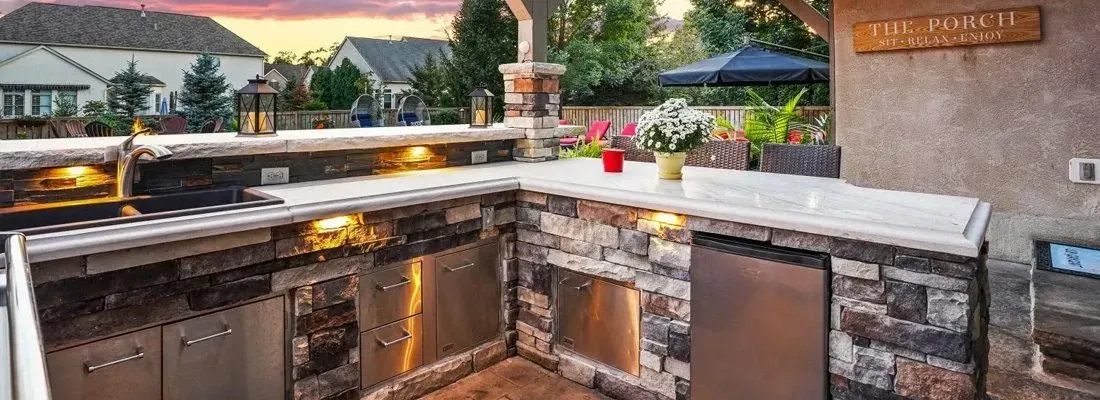
The Scope, Priced as One Contract
Here’s the line item breakdown. I’m going to name every number, because the reason single-contractor integrated builds work is transparency — when you can see where the money is going, the decisions make sense.
- Pool shell: $78,000 — 18×40 rectangle with 8×8 attached spa, full-length tanning ledge, gunite construction, 3M Diamond Brite interior in Caribbean Blue.
- Travertine deck and coping: $24,000 — 1,340 sq ft of French-pattern 1.25″ Ivory travertine with matching bullnose coping, sand-set on compacted base with polymeric sand joints.
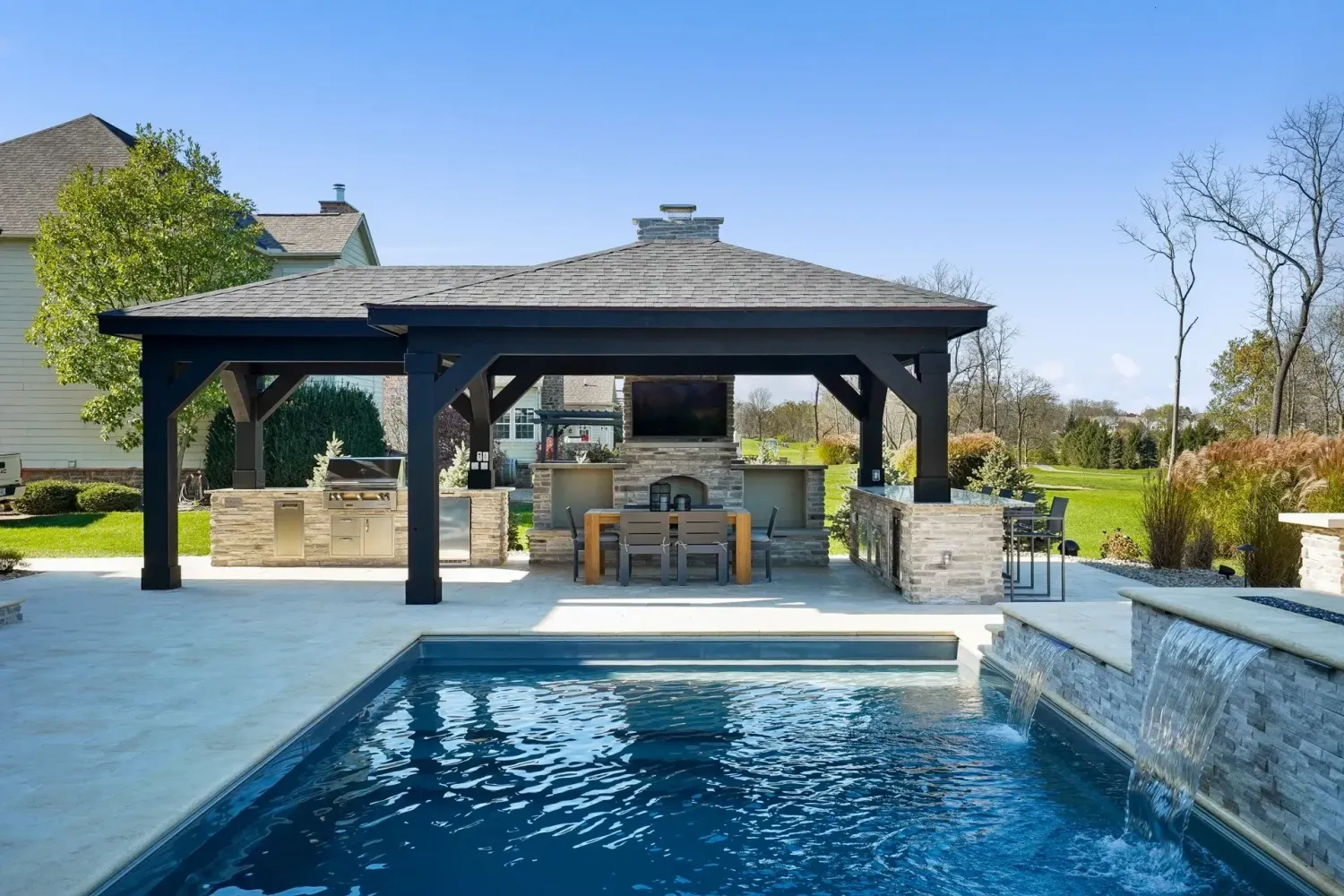
- Pavilion with integrated kitchen zone: $42,000 — 20×18 timber-frame, cedar T&G ceiling, standing-seam metal hip roof, full kitchen buildout underneath.
- Landscape lighting: $12,000 — 42 fixtures across pool, pavilion, path, and specimen trees; FX Luminaire LED transformer.
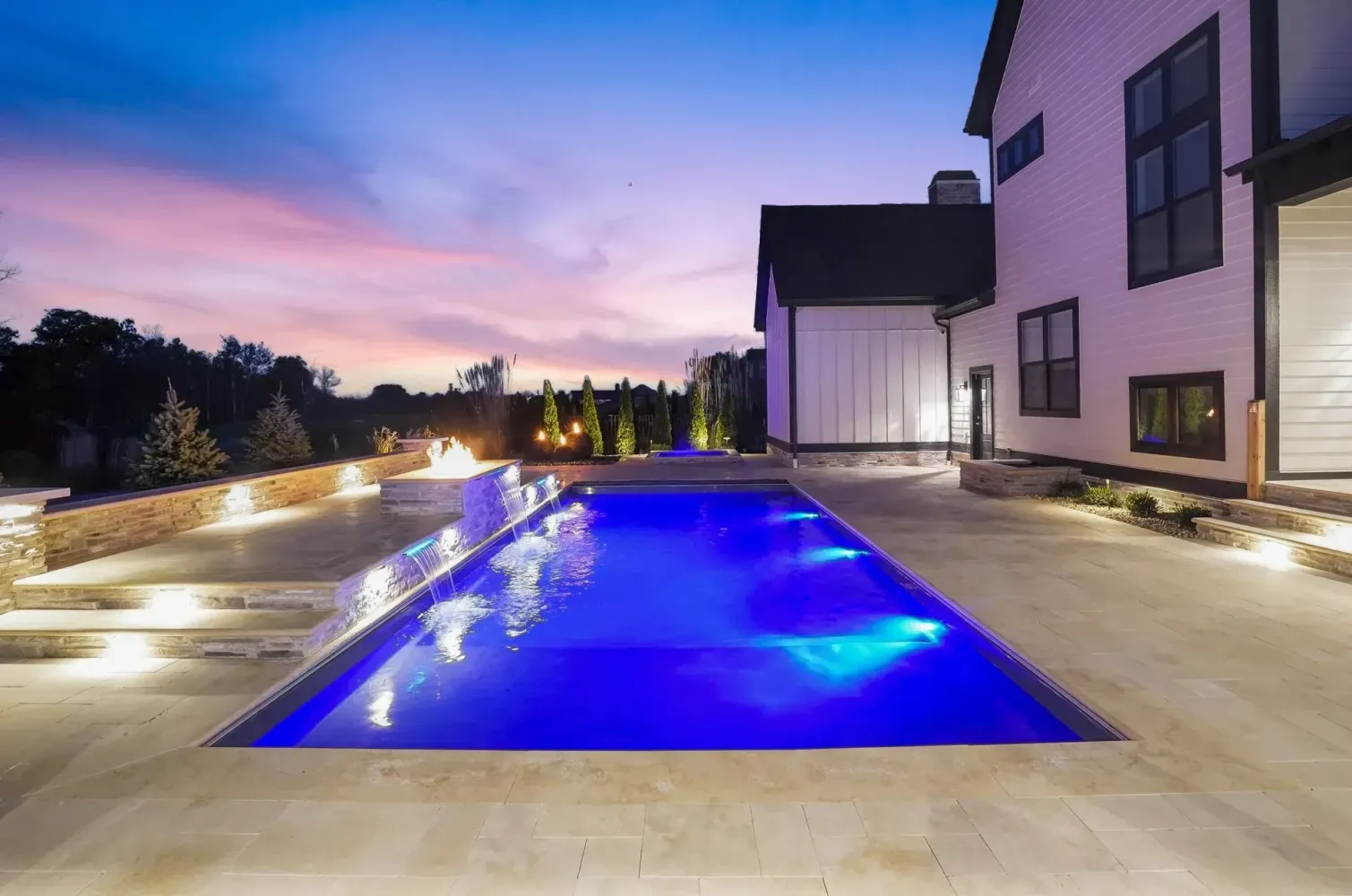
- Water features: $18,000 — twin sheer-descent spillways into pool from raised spa wall, plus a single scupper bowl on the kitchen-side pilaster.
- Landscape installation: $11,000 — 14 mature specimens, 600 sq ft of sod, bed prep, mulch, drip irrigation tie-in.
Total: $185,000. The competing three-trade bid was $223,000, and change orders would have pushed it toward $240,000 once the carpenter realized the pavilion slab needed to be thicker where the kitchen base lands. We caught that in design because the slab was on our scope. A carpenter arriving after concrete is cured doesn’t catch it — they pour a second slab, or put the kitchen where the structure is weakest, and you find out in year five.
Single-contractor savings on this build: $38,000 delta against the general contractor bid, driven primarily by (1) eliminating GC markup on each sub, (2) eliminating duplicated mobilization charges, and (3) catching structural conflicts in the design phase instead of in the field.
Why a St. Marlo Lot Is the Right Shape for This Approach
St. Marlo is a 775-home Greg Norman golf-course community off McGinnis Ferry Road, gated, with an active architectural review board. The ARB matters here more than almost anywhere else in Forsyth County. Lots are generous (most between 0.5 and 0.9 acres), but the covenants are strict about roofline consistency, visible material palettes from adjacent lots, and the required harmony between new outdoor structures and the original home architecture.
The harmony requirement is where three-trade projects fall apart here. A pool contractor designs a pool, a carpenter designs a pavilion, a hardscape guy picks stone. Nobody is checking whether the pavilion’s roof pitch mirrors the home’s main gable (ARB requires within 2 degrees on secondary structures). Nobody is cross-referencing travertine color against the dry-stack pilasters. Nobody is making sure the copper scuppers match the kitchen-wall lanterns.
When we submitted this package to the ARB, the full design set — site plan, elevations, material board, lighting plan, plant schedule — was one cohesive document signed by one firm. Approved in 18 days. The typical St. Marlo ARB turnaround for a pool-plus-structures project reviewed as separate packages runs 4 to 6 weeks, often with revision cycles, because the ARB sends comments back that require one trade to adjust something another trade already committed to.
Permit Parallelism — Where the Schedule Actually Gets Compressed
The permits for this kind of build are issued out of the Forsyth County Department of Planning & Community Development at 110 E. Main Street in Cumming. Three permits are in play: pool (electrical, gas, plumbing subs included), structural (pavilion), and grading/erosion (anything over 500 sq ft of disturbance, which this project was going to blow past easily).
Three-trade builds pull permits in sequence: pool guy starts, hardscape waits for backfill, carpenter waits for the deck pour because his post anchors depend on finished deck elevation. That’s sequential permitting — how a 10-week build becomes an 18-week build.
We pulled all three permits the same week as a coordinated package, with all three scopes on one site plan. That’s parallel permitting. The structural engineer reviewing the pavilion anchor plan had the deck plan in hand and sized the anchor embedment to the actual finished grade instead of guessing.
Build start to substantial completion: 67 days. A comparable three-trade build in Hampton Park last summer ran 94 days. That’s 27 days the homeowner was living with construction they didn’t have to.
The Three Structures, Drawn as One
The Pool Shell — Specs the Integration Drove
The pool itself is a straightforward 18×40 rectangle with a 7×12 tanning ledge on the shallow end and an 8×8 attached square spa on the far end with spillway into the pool. Gunite shell, 10-inch steel-reinforced walls, perimeter bond beam at 6 inches below finished deck elevation. Depth transitions from 3’6″ at the shallow end (across the tanning ledge) to 5’8″ at the deep end.
What made this a design integration and not just a pool-plus-stuff build was where the spa went. The default placement — spa in a corner, spillway toward the pool, deck wrapping around both — would have put the spa 14 feet from the pavilion. That means the pavilion kitchen looks at pool water and the side of a spa. Visually, okay. Functionally, nobody in the spa is in the conversation happening at the kitchen bar.
We rotated the spa 90 degrees and pulled it in tight to the pavilion corner. Now the spa is 4 feet from the pavilion step-down, which means whoever is in the spa is inside the social zone. The spillway into the pool became the visual divider between the kitchen deck and the pool deck. The copper scupper on the kitchen-side pilaster (one of the two water features, $4,200 of the $18,000 allocation) throws sound and motion exactly where the kitchen seating looks.
A pool contractor working alone wouldn’t have made that rotation. The stock answer is “spa in the corner” because it’s where the heater/blower utility bundle drops in cleanest. We ran those utilities under the pavilion slab instead, which cost $1,800 more in conduit and trenching and saved the entire experience of the yard.
The Kitchen Zone — A Build-Under, Not a Build-Next-To
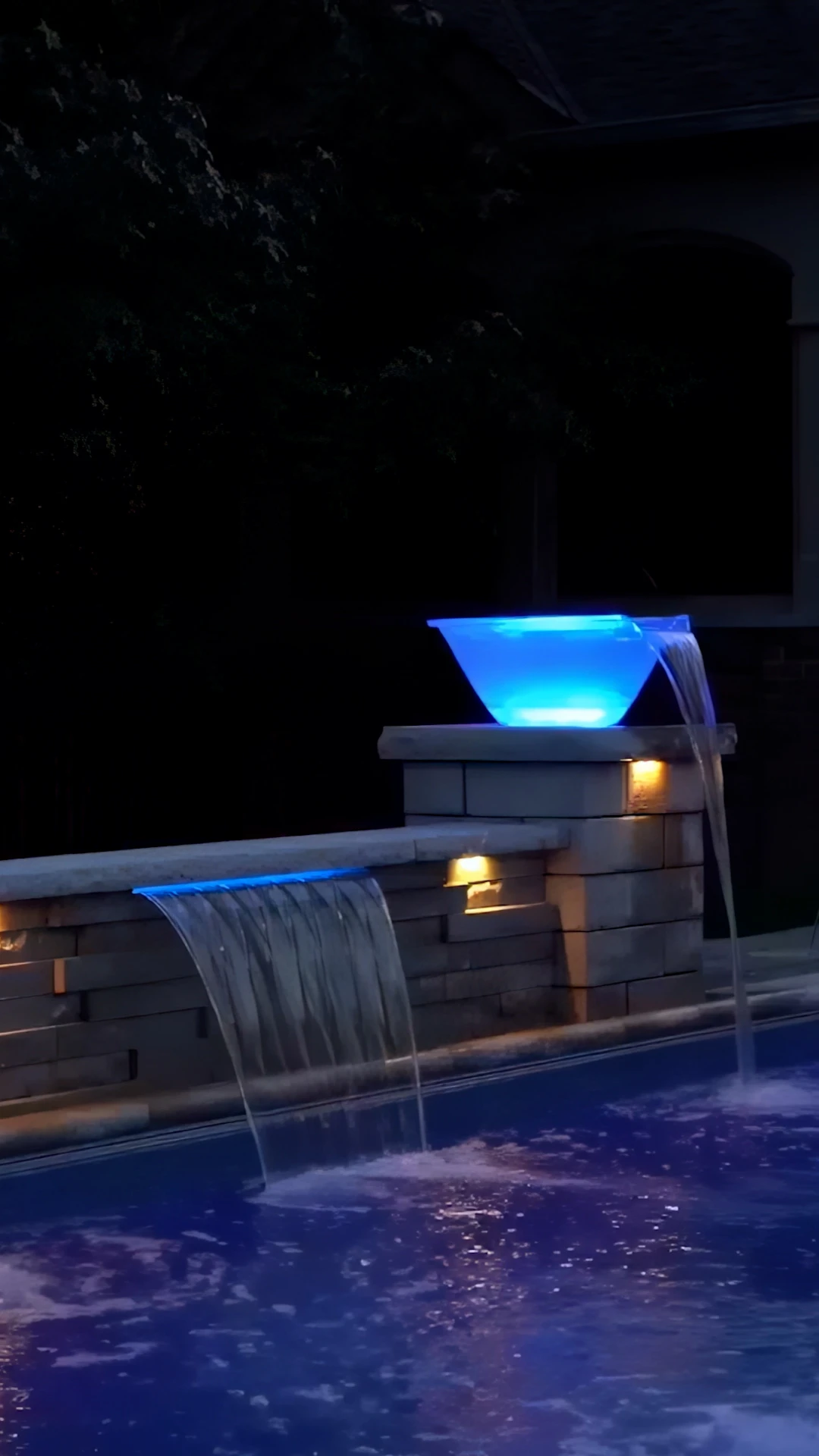
A lot of Cumming outdoor kitchens are their own freestanding object — a stone-wrapped rectangle, a grill, maybe a side burner, sitting on the deck. This one is integrated into the pavilion’s south wall. The counter runs 16 feet along that wall, L-returns 6 feet out, terminates in a bar overhang with four counter stools facing the pool.
Equipment list, all of it 240V-wired on a dedicated subpanel we ran under the pavilion slab:
- Blaze Professional LUX 32″ 4-burner built-in grill with infrared rear burner
- Blaze 24″ double-drawer refrigerator, outdoor-rated stainless
- Big Green Egg Large in a custom fieldstone bay we cut into the counter (flush-set, 1″ clearance on all sides for thermal expansion)
- Blaze single-basin sink with Krausel gooseneck spring-neck faucet, hot and cold lines
- Blaze 28″ double access door for propane tank storage (yes, propane — Sawnee EMC doesn’t run gas and the nearest Atlanta Gas Light main is too far to bring in)
- Undercounter LED strip lighting on a separate 12V transformer, dimmable
The subpanel matters because Sawnee EMC 240V service in this part of Forsyth County runs on a standard 200A residential panel at the house, and adding this much outdoor load meant either upgrading to 320A (expensive, requires utility coordination that can take 6+ weeks) or splitting out a subpanel for the pavilion on its own 100A feeder. We did the subpanel. $2,400 total for panel, feeder conduit, and permit — a two-day pull with the electrician. The utility coordination we dodged would have added 6 weeks to the schedule and roughly $7,000 in service-entrance upgrades nobody needed.
Outdoor kitchen electrical spec we wrote into this contract: dedicated 100A subpanel under pavilion slab, 6 AWG copper feeder in Schedule 40 PVC conduit, GFCI protection on every 120V circuit, dedicated 20A circuit for refrigerator, separate 20A for lighting, NEC §680.26-compliant equipotential bonding at pool perimeter.
The Pavilion — Why Timber Frame and Not Stick-Built
The pavilion is a 20×18 timber frame in cedar, stained warm brown, with a standing-seam metal hip roof and a T&G cedar ceiling visible from below. Stick-framed carpentry would have come in around $6,000 to $9,000 cheaper. We didn’t do that. Here’s why.
A timber-frame pavilion with 8×8 cedar posts and exposed cross-braces reads as a permanent outdoor room at the scale of a traditional Cumming brick home. Stick-framing wrapped in trim board reads as a structure you’ll replace in fifteen years — the ARB reviewers know this, the appraiser doing the next refinance knows this, and the next buyer’s agent knows this.
The 8×8 post anchors to the deck slab with a Simpson CPT88 concealed post base, through-bolted into an embedded hot-dip galvanized U-bracket cast into the slab during pour. No visible bolts, no rotting bottom plate, no sloppy caulk line. At year 20, the posts look like they did at year 1 because the end grain never touches moisture.
Roof pitch came in at 6:12 to match the home’s main gable (within the ARB’s 2-degree tolerance). Standing-seam charcoal metal, 24-gauge, snap-lock. Metal because Cumming gets ~52″ of rain a year and shingle roofs on outdoor structures in high-humidity Lake Lanier-influenced air fail at the valley flashings in 8 to 12 years. The metal roof carries a 40-year finish warranty and a 50-year structural warranty. Added cost over shingle: $3,600. Added lifespan: two to three roof replacements avoided.
Water Features and Lighting — The Compound Effect
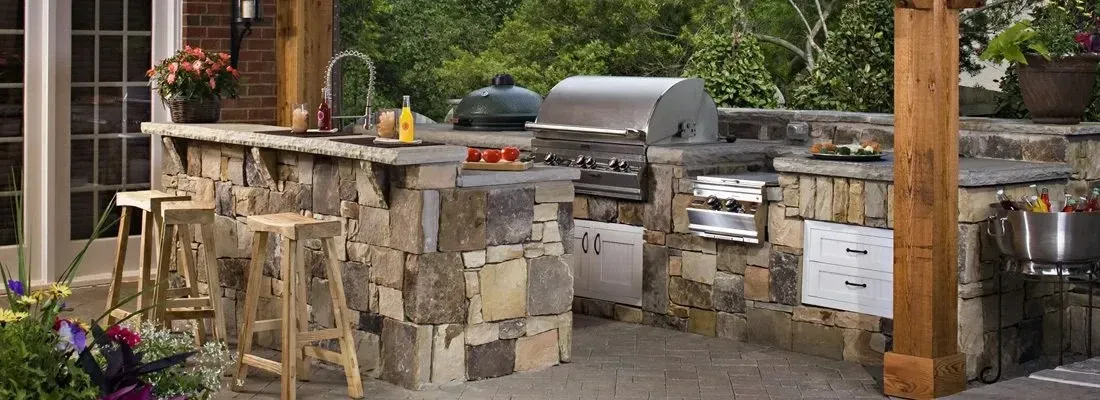
The $18,000 water feature allocation broke down as follows: $9,600 for the twin stainless sheer-descent spillways from the raised spa wall into the pool (Atlantic Water Gardens, 24″ width, copper-finished faceplates to match the scupper bowl), $4,200 for the copper scupper bowl on the kitchen-side pilaster with its own dedicated 1/6 HP recirc pump, and $4,200 for pumps, plumbing, valves, and the electrical tie-in for all of it.
The twin sheer descents run off the pool’s main filtration return — zero incremental operating cost when the pump is running. Scupper bowl runs on its own 1/6 HP pump, ~4 hours a day in-season, roughly $11/month in Sawnee EMC power. Total in-season operating cost: under $15/month.
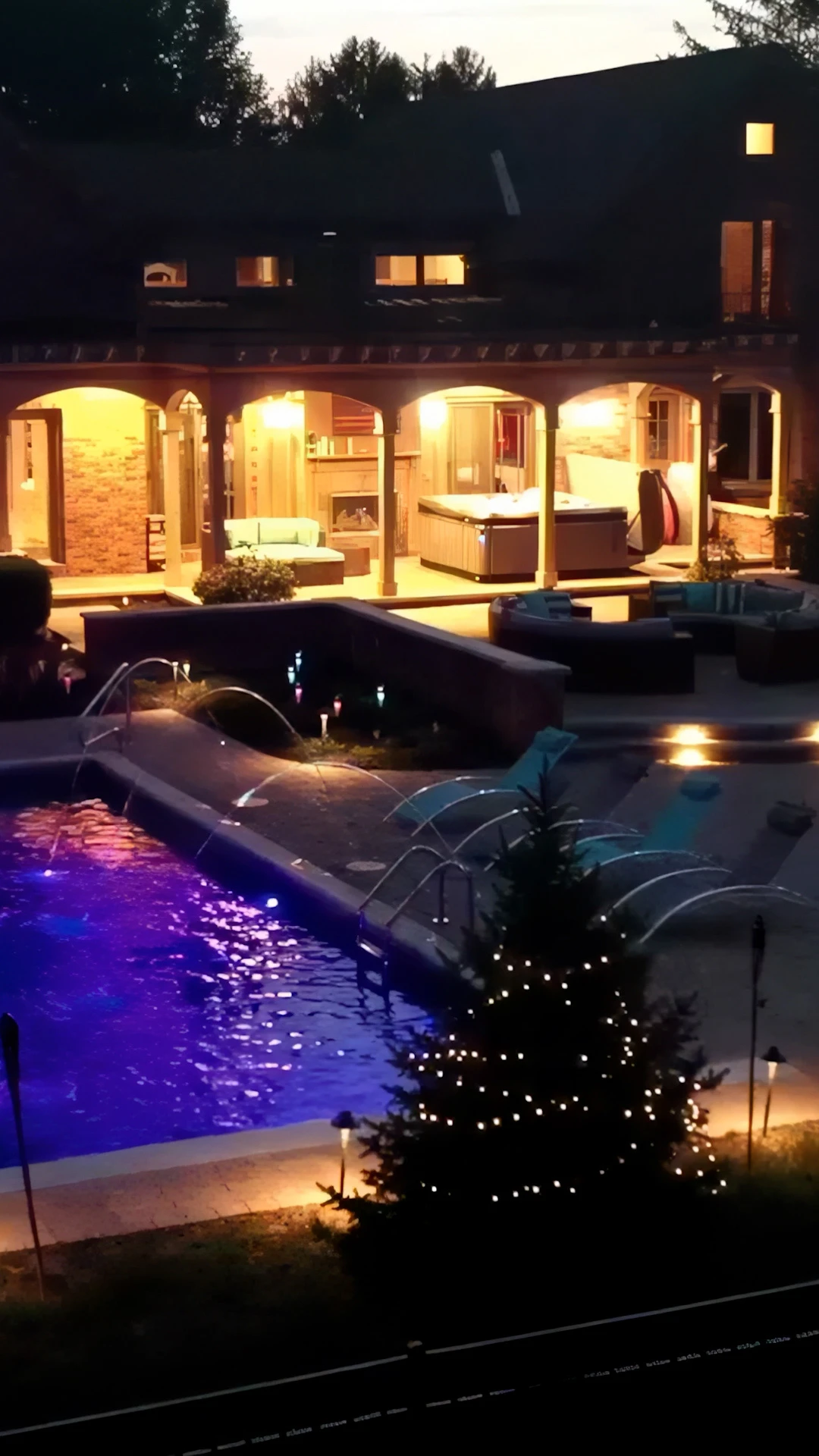
The lighting plan — 42 fixtures at $12,000 — is where the visual argument gets made at night:
- Pool: 4 pool-wall LED niche lights (Pentair IntelliBrite 5G, color-changing, each on its own circuit so zones can be programmed)
- Spa: 1 LED niche light + 2 submerged bench lights
- Pavilion: 6 recessed can lights in cedar T&G ceiling + 4 timber-beam-mounted downlights + 2 ceiling-fan-integrated uplights
- Kitchen: 1 task light over the grill, 3 undercounter LED strips, 2 carriage-lantern sconces on pilasters
- Path/deck: 12 bullet lights uplighting specimen trees, 7 path lights along the primary walk
All of it runs on an FX Luminaire ZDC transformer with zone control — pool zone, pavilion zone, path zone, accent zone all controllable separately from a phone. Total installed LED wattage: roughly 380 watts. A comparable halogen lighting package would have pulled 2,100 watts and cost about $6,000 more over 10 years in Sawnee EMC power.
Grade, Drainage, and the Lake Lanier Moisture Problem
Cumming sits at ~1,275 ft elevation on the gently rolling Piedmont foothills that climb toward Sawnee Mountain at 1,963 ft. But it also sits 8 to 12 miles from the southern arm of Lake Lanier, and anyone who’s lived here knows the air is measurably more humid than Dacula or Grayson. For pool construction, that humidity drives three things: (1) evaporation rates slightly higher than the Gwinnett average, (2) chemistry needing more frequent adjustment because dew point regularly crosses the pool surface temperature, and (3) hardscape materials weathering differently — travertine holds up fine, limestone yellows faster, and any wood not properly detailed at end-grain rots in 6 to 9 years.
This specific St. Marlo lot had a 5-foot drop from the house rear elevation to the back property line, toward a minor tributary of the South Forsyth drainage basin. That drainage drop is actually a gift on a project like this because it means surface water moves away from the house naturally. But it also means the pool deck had to be graded with 2% minimum slope away from the spa pavilion (because the pavilion is the uphill side), and the pavilion slab itself had to be pitched 0.5% toward the deck edge so water off the roof never pools at the post bases.
The soil underneath is the dominant Cecil series Piedmont red clay across most of Forsyth County. High-density clay holds water, which means our pool shell excavation had to handle hydrostatic pressure during backfill. We installed perimeter drain tile at the bond beam base tied into a daylighted 4″ SDR-35 pipe that runs 60 feet to the property line. Without that drain, the clay pushes inward and cracks the shell at year 8 to 12.
What Three Separate Contractors Can’t Coordinate
Beyond the money and the timeline, there’s a quality-of-outcome argument for integrated builds that’s harder to put a number on. Let me list the specific coordination decisions on this St. Marlo build that only happened because one firm held the whole scope:
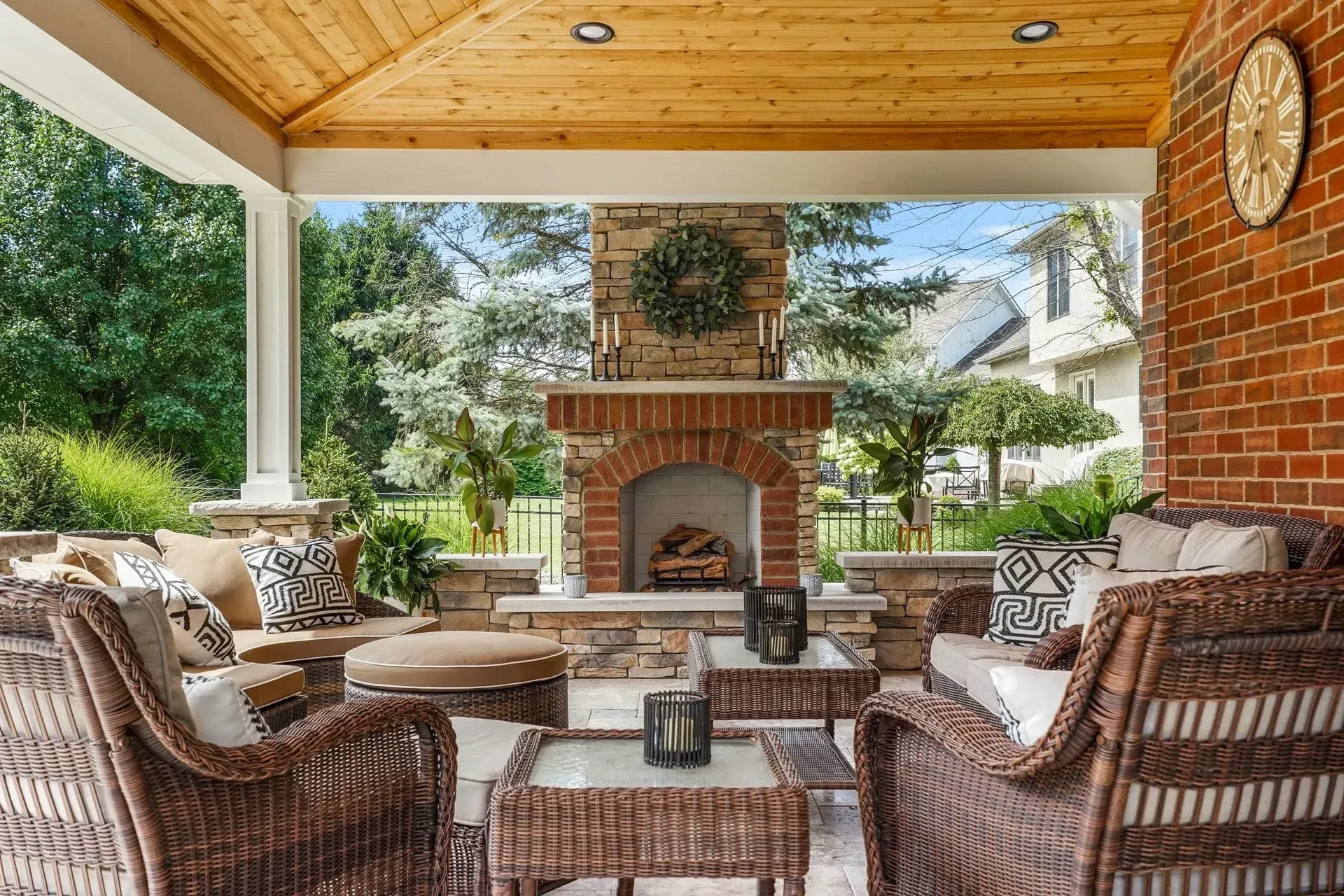
- The travertine deck pattern runs continuous under the pavilion, flowing from pool deck into covered kitchen as one surface. Separate trades stop at the pavilion edge.
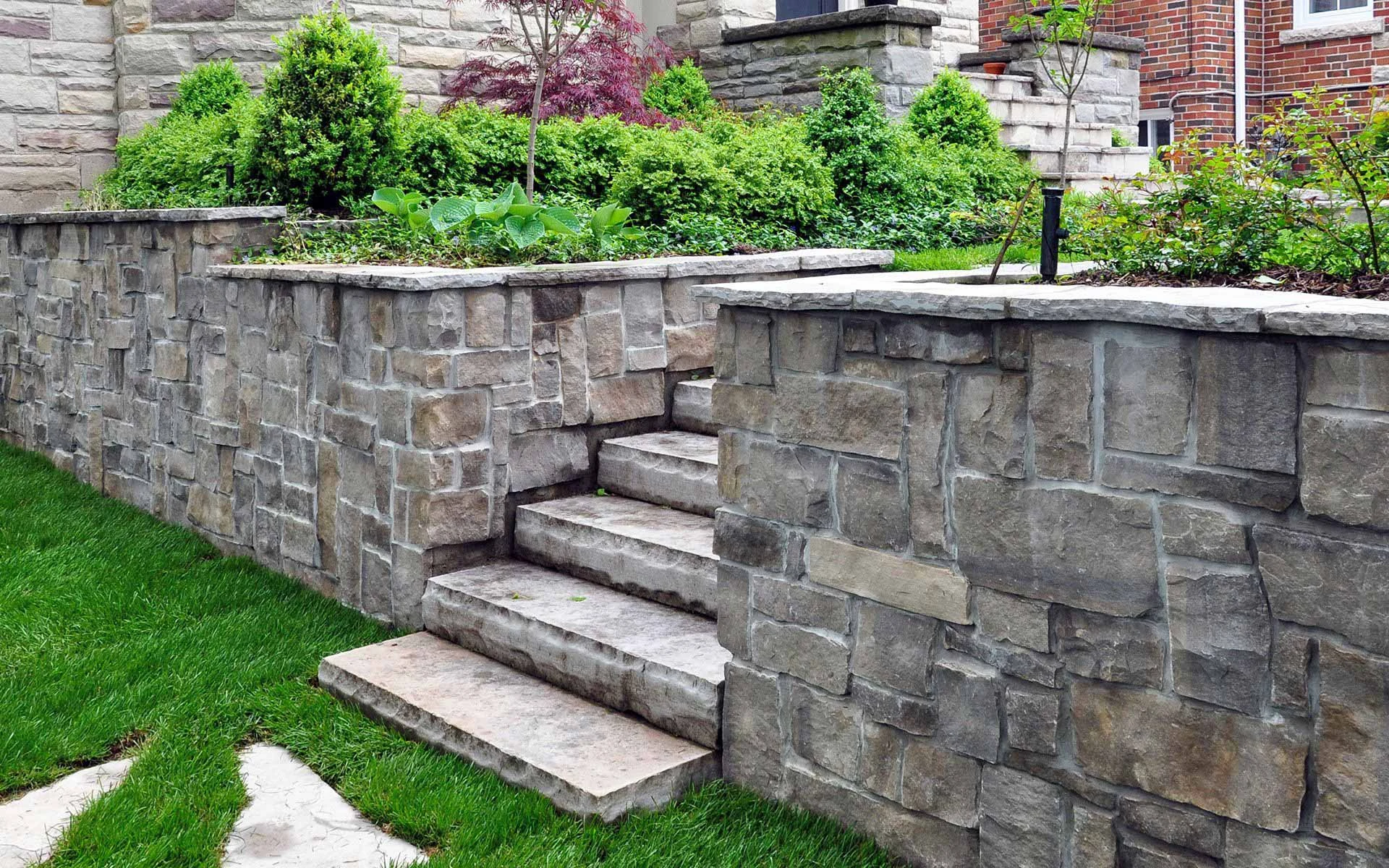
- The kitchen base stone matches the raised spa wall stone exactly — same ashlar-cut Tennessee fieldstone from the same quarry lot. Separate trades end up with three stone lots and a visible color mismatch.
- The pavilion post alignment was shifted 14 inches during design so the kitchen-side pilaster lines up with the pool’s sheer descent for a clean vertical sight line from the master bedroom window.
- Irrigation drip lines for kitchen planters were run through conduit in the pavilion slab pour, terminating in planter beds without a single surface cut later.
- The lighting transformer sits inside the pavilion’s utility cabinet, wired into the kitchen subpanel — no fishing wire through finished walls at the end.
Individually, those are small decisions. Collectively, they’re the difference between an outdoor space that photographs well and an outdoor space that stays cohesive through year 10, year 15, year 20.
What This Costs Elsewhere — and Whether You Should Do It
St. Marlo is on the higher end of the Cumming market. Comparable integrated builds we’ve done in other Forsyth neighborhoods track roughly like this, before the three-trade markup:
- Vickery: similar lot size, similar ARB strictness — budget within 5% of St. Marlo pricing for a comparable scope.
- Hampton Park: smaller lots (often 0.35 acres), less backyard room means tighter pavilion footprint and smaller pool — total project typically lands $145,000 to $165,000 for the same level of finish.
- Polo Fields: equestrian community, 1-2 acre lots, more elaborate landscape buffer integration — total often pushes past $210,000 because the plant material scope is bigger.
- Mashburn Plantation: mid-range established neighborhood, less HOA friction, faster ARB — integrated builds here typically land $135,000 to $155,000 at mid-spec.
The integrated-contract savings scale roughly proportional to the project size. On a $150K build, single-contractor delta versus three trades is usually $18K to $26K. On a $250K build it can be $45K to $55K. The bigger the project, the more coordination mistakes that multi-trade builds make, and the more margin that gets eaten up by mobilization duplication, re-pulls, and finger-pointing warranty calls.
Signature detail from this build worth writing down: the master bedroom window aligns exactly with the kitchen-side pilaster’s copper scupper bowl. At night, that sight line is 72 linear feet of uninterrupted water motion — pool surface, sheer descents, scupper bowl — from the homeowner’s pillow. That wasn’t an accident. That was drawn.
Should You Do This, or Just a Pool?
On a St. Marlo, Vickery, Polo Fields, Lake Windward, or Windermere lot with a $150K-$250K total outdoor-living budget, the integrated approach almost always wins on cost, schedule, and outcome. On a tight $85K-$110K pool-only budget, a pool-only build makes sense — though phase-two pavilion work later usually costs more than bundling now.
In any HOA with an ARB, the integrated approach isn’t optional — it’s the only way to move through review on a reasonable timeline. We’ve seen three-trade projects in Hampton Park and St. Marlo sit in ARB revision hell for 7-9 weeks because the submitted packages didn’t agree with each other.
The question to ask any contractor quoting a project like this: “Are you pricing the pool, the pavilion, and the hardscape, or are you pricing one outdoor living environment?” If they pause, you’re looking at three trades wearing one hat.
Integrated pool, hardscape, and pavilion builds across 20+ cities within 30 miles of Winder, GA
If you’re in Cumming, St. Marlo, Vickery, Polo Fields, or anywhere else in Forsyth County thinking about a pool plus pavilion plus kitchen as one project, we’d rather price it together than as three separate bids. One contract. One schedule. One finished environment.