
Every pool lighting article tells you color-changing LED is the answer. In a Marietta backyard shaded by 60-year-old white oaks and tulip poplars, it isn’t. Lumen output is. Color is a party trick. Brightness is the reason your family can actually use the pool after 9 p.m.
The standard advice you’ll read about pool lighting was written for open suburban lots in Arizona, Florida, or coastal Texas — places where twilight bleeds into usable evening light for another hour after sunset. East Cobb is not one of those places. Step into an Indian Hills or Atlanta Country Club backyard at 8:45 p.m. in August and the ambient light level is effectively zero. Not dim. Zero. The canopy of mature oaks, poplars, and hickories — the same canopy that made those neighborhoods desirable in 1978 — shuts out moon, porch light, and neighboring glow alike.
That changes what a pool light is for. In an open lot, the light is decorative — it makes the water glow. In a canopied Marietta yard, the pool light is the primary illumination source for the entire rear of the property. It’s not mood lighting. It’s the difference between a pool your kids can swim in after dinner and a black hole you walk around carefully holding a phone flashlight.
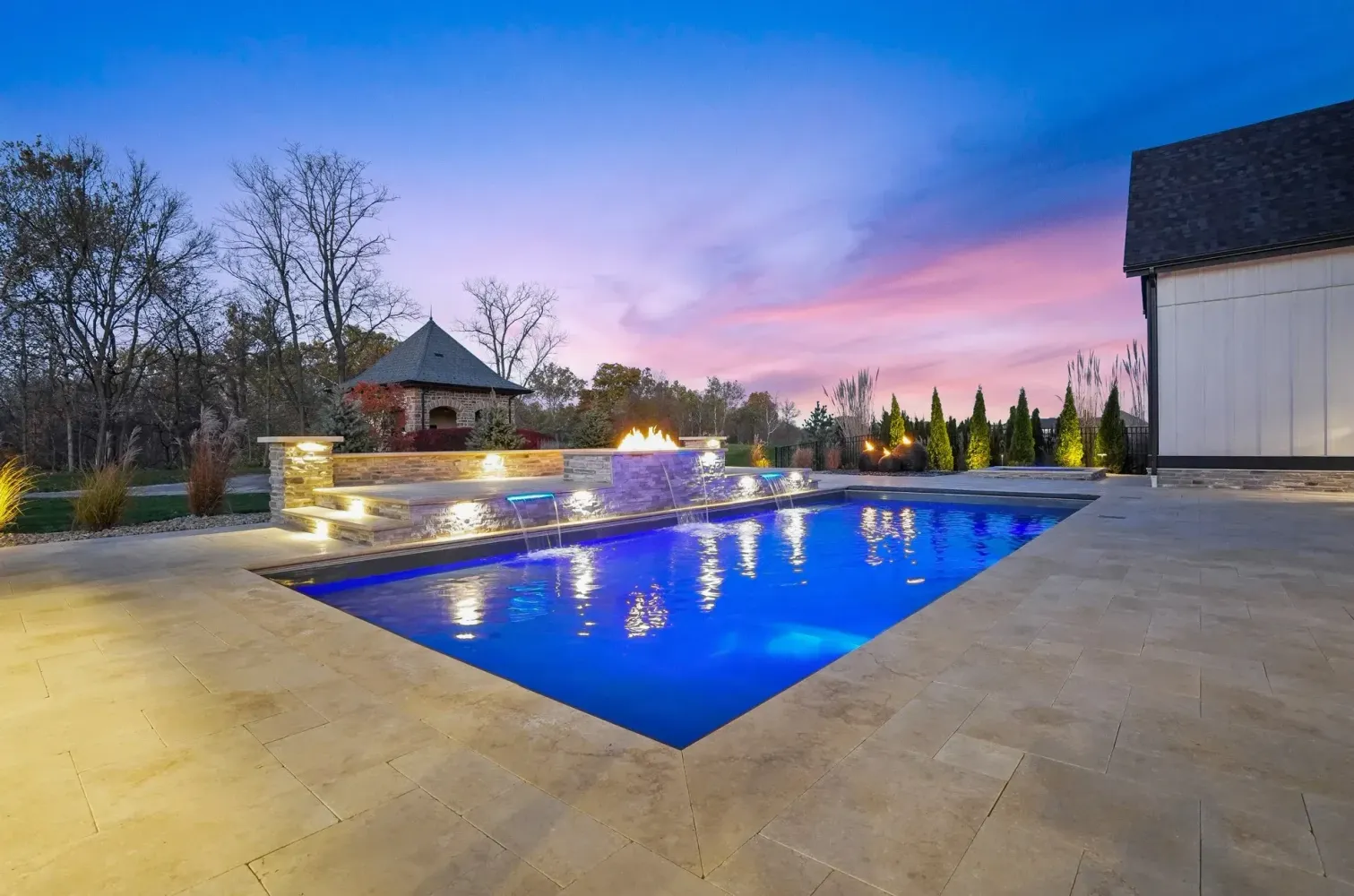
Once you accept that framing, the spec sheet stops being a preference exercise and becomes an engineering decision. And the single number that dictates whether your pool will actually be usable after dark is lumen output — not color count, not app connectivity, not warranty years. Lumens. Specifically, whether you’re installing a light that throws enough photons through the water column to bounce off the far wall and light the deck.
The 1,800 vs 4,000 Lumen Gap Nobody Explains
Here’s the number that should be at the top of every lighting quote you ever receive in Marietta, and almost never is. A legacy Pentair AquaLight or mid-tier Hayward Astrolite outputs roughly 1,800 lumens. A Pentair IntelliBrite 5G in the large housing, at full white, outputs approximately 4,000 lumens. Same 120V or 12V drop. Same junction box. Same installer labor. Roughly $500 difference at the fixture level.
That’s a 2.2x brightness multiplier for what amounts to a rounding error on a custom pool budget. In a sun-drenched open lot, the upgrade is marginal — your eye adjusts fast, and ambient evening light fills the deck. In a dense-canopy East Cobb yard off Lower Roswell Rd or up in Burnt Hickory, the difference is binary: the yard either works at night or it doesn’t.
The lumen math for a 14×28 pool: One 1,800-lumen fixture lights roughly the near third of the pool well and drops off sharply past 14 feet. One 4,000-lumen fixture lights the full 28-foot length with usable throw to the far end wall and enough bounce to softly illuminate a 15-foot perimeter of deck.
Water absorbs light faster than air, and dark plaster or dark pebble interiors absorb it faster still. The popular Midnight Blue and French Gray Pebble Sheen finishes we install in Walton Woods and Chestnut Hill look stunning in the daytime and swallow 20-30% more light than a standard white plaster pool. If you’re specing a dark interior in a canopied lot, you are compounding a lighting problem — and the fix is not “add a wall sconce on the house.” The fix is lumen output at the fixture.
Why the Right Answer for a 14×28 Is Two 4,000-Lumen Lights, Not One
Industry standard on a 14×28 rectangle is a single large-format light on the long wall opposite the shallow end. That’s the default plan your pool builder will draw, and in a sunny Smyrna infill lot with a half-acre of sky overhead, it’s defensible. In a canopied Marietta lot it falls apart.
The problem is not total light in the water — it’s uniformity. A single 4,000-lumen fixture on a 28-foot pool creates a bright cone near the emitter and a shadow band at the opposite end. Your kids jumping in from the far coping land in the dark third of the pool. For a freeform shape — the raised-beam designs we build in Atlanta Country Club and Seven Oaks — a single fixture leaves entire lobes of the pool unlit.
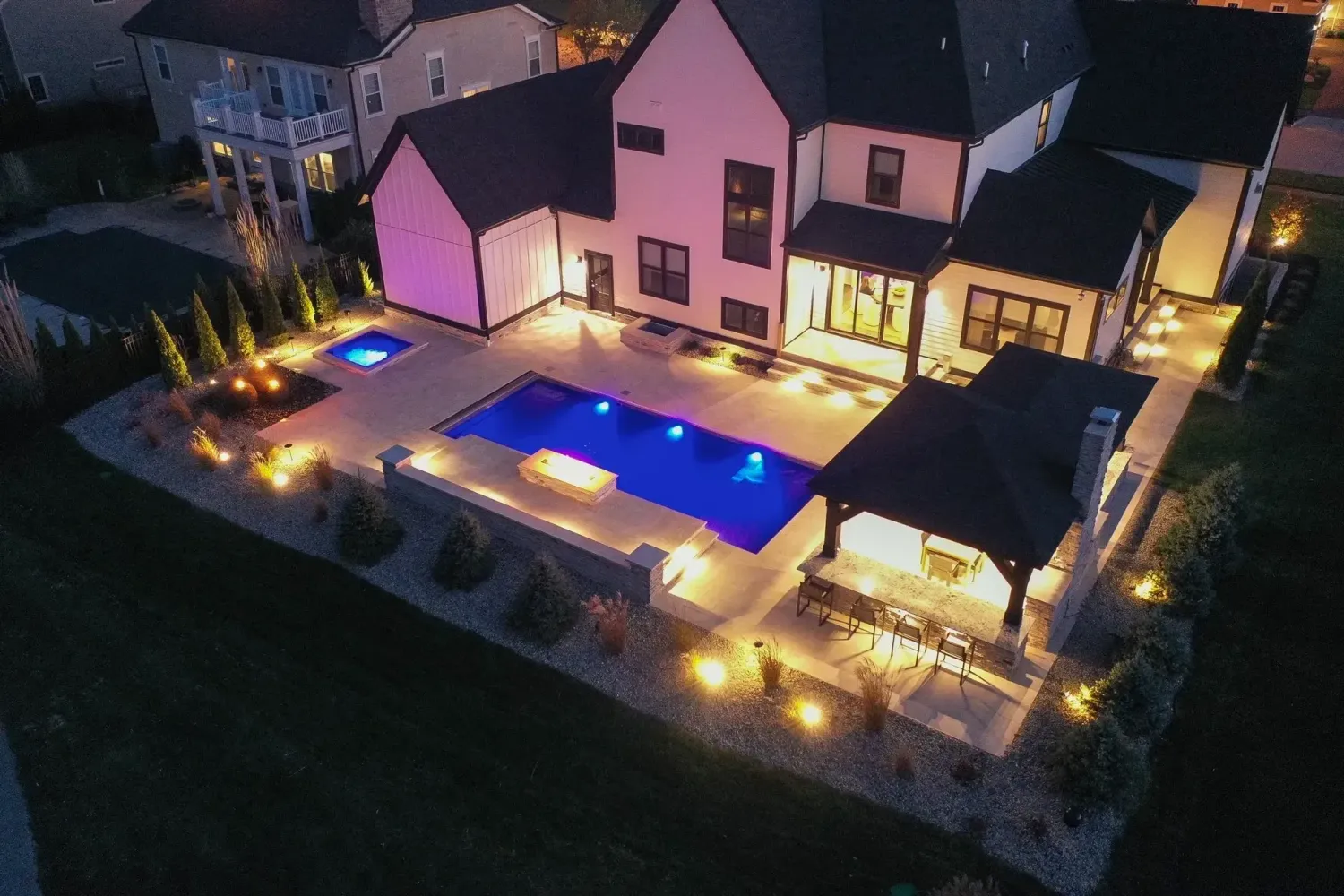
For a 14×28 in a canopied East Cobb yard, the right spec is two 4,000-lumen fixtures on opposing long walls, wired on separate circuits so the owner can run one for ambient evening, two for active swimming. The cost delta against the single-light plan is roughly $1,100-$1,400 installed, including the second niche, second conduit run, and the additional 20-amp GFCI leg. On a $120,000 custom pool build, that’s rounding error. On user experience after 8 p.m. in October, it’s the entire reason the pool gets used.
The bigger-pool multiplier
Scale the pool up to an 18×36 or a 20×40, and the math changes again. Two fixtures isn’t enough. Our standard spec on pools over 500 square feet of surface area in canopied lots is four niches — two per long wall, spaced at roughly quarter points. This is the spec we run on the larger builds in Marietta Country Club and Brookstone, where lots back up to wooded HOA greenspace and the rear property line delivers no ambient light of any kind.
Four 4,000-lumen fixtures on a 20×40 pool put roughly 16,000 total lumens into the water. That’s equivalent to a 160-watt incandescent spotlight per 125 square feet of pool — enough that the deck and perimeter plantings read clearly without any dedicated landscape lighting. One pool, lighting the whole backyard. That’s the engineering goal in a canopied lot.
What Cobb EMC and Marietta Power Mean for Your Lighting Spec
This is where Marietta diverges from the rest of Metro Atlanta, and it’s a detail your pool builder either understands or doesn’t. Cobb EMC serves most unincorporated Cobb County, including the bulk of East Cobb, while Marietta Power (Marietta Board of Lights and Water) serves homes inside the Marietta city limits. Two different utilities. Two different service drop specs. Two different permit-adjacent processes when you add significant 240V pool equipment load.
For lighting specifically, both utilities deliver clean 240V single-phase service that easily supports the 120V transformers that drive LED niche lights. The permit path runs through Cobb County Community Development at 1150 Powder Springs St. for all pool work, regardless of which utility serves the house. But here’s where most lighting mistakes happen: the heat pump, variable-speed pump, salt system, and lighting often get sized against each other on the same 100-amp pool sub-panel, and in older East Cobb homes with 1970s 200-amp main panels, the capacity math gets tight.
The real-world constraint: A standard pool sub-panel for a modern build needs roughly 60-80A of headroom. Older homes in Indian Hills, Sope Creek, and Willeo Creek with 200A main service and existing HVAC/kitchen loads often can’t absorb that without a main panel upgrade — typically $1,800-$3,200 added to the project.
If your electrician specs LED lighting on its own dedicated 20A GFCI circuit — as we do on every Primetime build — the lights stay online even when the heater or pump trips, and you avoid any capacity fight with the rest of the pool equipment. On a canopied lot, that matters more than you’d think. It means the backup you’re counting on for after-dark yard illumination can’t be knocked offline by a pump issue.
Why the wind off Kennesaw Mountain shows up in your lighting plan
Homes on the north side of Marietta, especially along the slopes facing Kennesaw Mountain (1,808 ft), pick up markedly higher wind loads than flatter lots further south. That matters for lighting two ways. First, the leaf-drop load into the skimmers during October-November is 2-3x what a comparable home in Snellville or Lawrenceville sees — meaning the water itself picks up more tannin tint between service visits, which subtly reduces light transmission. Second, storm events at the mountainside elevations knock limbs down more frequently, which means niche placement has to account for branch-drop risk over the pool.
We’ve swapped light fixtures twice in the last three years where a homeowner-trimmed oak limb came through the water surface and cracked a non-niched deck-mount floodlight. Every light we install is a niched Pentair or Hayward fixture set into the pool wall, protected by the water column itself — not a surface-mount on the deck that a falling branch can destroy.
Color Temperature, the 2,700K Canopy Read, and Why Most Installers Get It Wrong
Here’s where the lighting industry’s marketing and the canopied-lot reality diverge sharply. Every color-changing LED pool light markets its 1,000+ color show modes — beach party, Caribbean lagoon, patriotic cycle. In ten years of installing pools across Cobb, Gwinnett, and North Fulton, we’ve watched roughly 80% of owners settle permanently on the white setting within their first summer and never touch the color modes again.
But white LED has its own spectrum, and the default “daylight white” on a Pentair IntelliBrite 5G runs around 6,500K — a cool, blue-heavy white that reads as clinical and harsh under a canopy of warm-toned oak foliage. The light fights the landscape. What works in a canopied Marietta lot is the warmer 2,700K-3,000K white setting, which reads closer to incandescent and integrates visually with landscape lighting, interior warm LEDs, and the natural tone of autumn oak leaves.
The Pentair IntelliBrite 5G offers this as a fixed white mode. The Jandy WaterColors and Hayward ColorLogic 4.0 offer equivalent warm-white profiles. Specifying this at build time costs nothing. Retrofitting it means swapping fixtures — $400-$700 per light in labor plus the new fixture cost. Name the color temperature you want when you sign the contract, not after.
Waterline tile as a secondary reflector
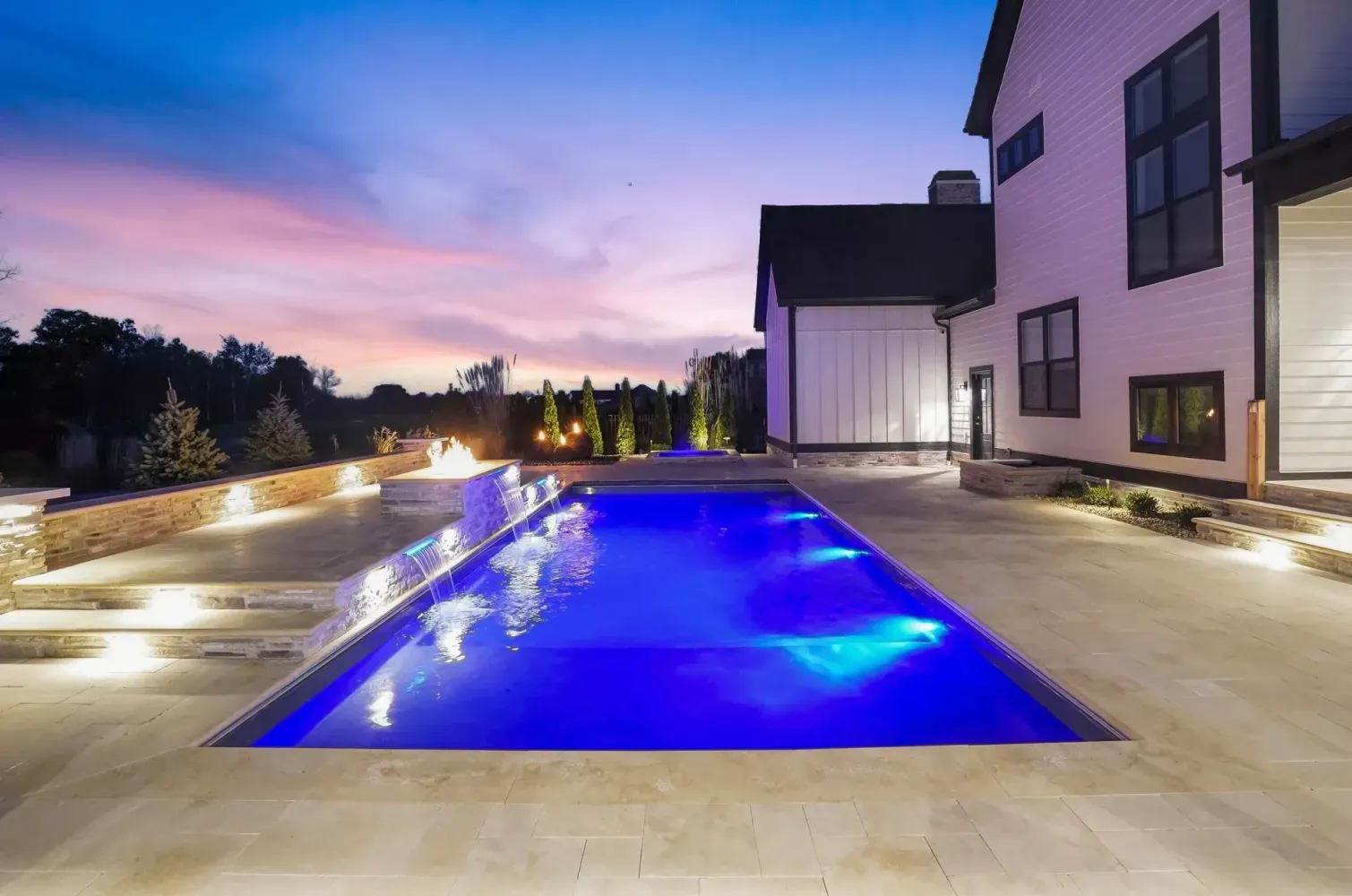
One under-discussed trick that matters enormously in canopied yards: the waterline tile choice directly impacts how much of your fixture’s output actually leaves the pool and illuminates the deck and surrounding landscape. Dark-toned glass tile — the popular charcoal and navy selections we install frequently in Atlanta Country Club — absorbs light. Light-toned iridescent glass tile or warm-beige travertine tile reflects it, throwing additional glow up onto the coping, deck, and overhanging foliage.
For a canopied Marietta lot where the owner wants nighttime yard illumination from the pool alone, we typically spec a light-to-mid tone waterline tile with either iridescent or travertine finish. That choice, combined with two or four high-lumen fixtures, turns the pool into a lantern for the whole rear yard — not just a lit rectangle in the middle of a black lawn.
Full lighting spec we run on a canopied East Cobb 14×28: 2x Pentair IntelliBrite 5G large niches (4,000 lm each), 2,700K warm white default, iridescent light-toned glass waterline tile, dedicated 20A GFCI circuit off the pool sub-panel, independent on/off control via the Pentair IntelliCenter app, medium-tone Pebble Sheen interior (not the darkest option). Total lighting-specific upcharge above base plan: $2,400-$3,200.
The automation layer that makes it usable
One last spec that matters: pair the lights with Pentair IntelliCenter or Jandy iAquaLink so the owner can turn the pool on from inside the house. In a canopied lot, you don’t want to walk across a dark deck to flip a switch — you want the lights on before you step outside. Schedule them to come on at civil twilight automatically, roughly 30 minutes after sunset. The pool is on whenever it’s dark, ready to be used, and the rear of the yard is never pitch black.
That automation layer typically adds $900-$1,400 at build time. It’s the single highest-ROI spec on the lighting side because it removes the friction between “pool exists” and “we use the pool after dinner.” In ten years we’ve never had a homeowner tell us they regret automating their lighting. We’ve had many tell us they wish they’d done it during the build instead of as a retrofit.
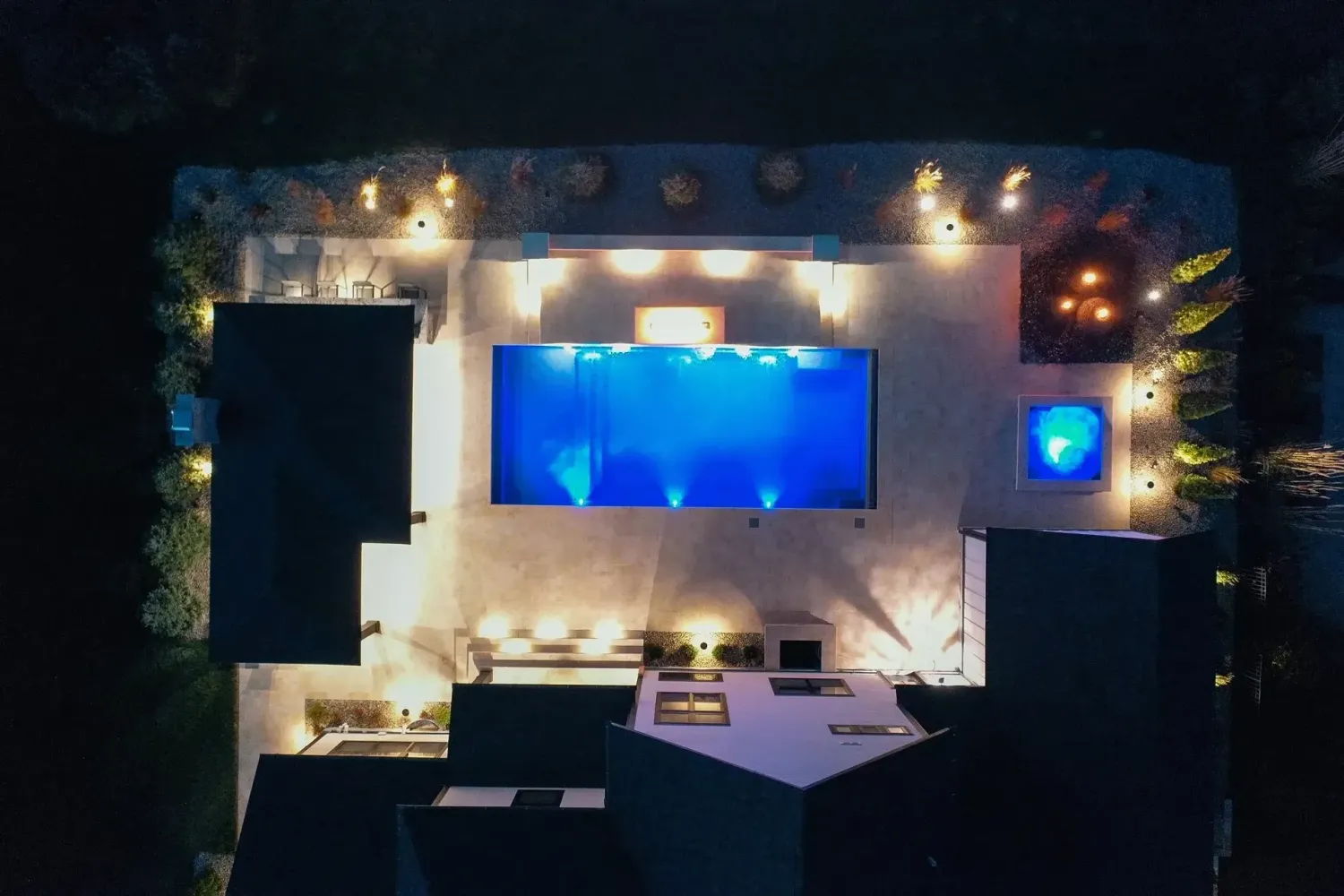
Lighting is the spec where the smallest dollar figures produce the biggest day-to-day usability swings, and on a canopied Marietta lot under the oaks of East Cobb, it’s also the spec where your installer’s experience either shows or doesn’t. Ask for lumen numbers at the fixture. Ask how many niches your plan calls for. Ask what color temperature the default white is. Those three answers tell you whether you’re getting a pool you can use after dark — or a pretty rectangle you’ll walk around carefully from July through October.
The seasonal drift that changes everything by November
The lumen calculation you do in July is not the lumen calculation you need in November. Marietta’s canopy shifts dramatically across the year. Under full leaf from mid-April through late October, the backyard is effectively a green-roofed room. From November through early April, the oaks and poplars drop their leaves and the yard becomes dramatically more open — you pick up substantial moonlight and neighboring ambient light.
This matters for lighting spec because it means the hardest-case design condition is August at 9:30 p.m., not January. Design for August. If the light plan works at peak canopy density with high humidity (which scatters and absorbs more light than dry air), it works every other night of the year. This is why we almost never see Marietta homeowners complain about pools being “too bright” after install — in shoulder seasons the canopy thins and the perceived brightness actually decreases slightly, balancing out the seasonal change.
It also matters for pollen. Peak spring pollen drop in late March through mid-April is the dirtiest water condition of the year for Metro Atlanta pools, and suspended yellow pine pollen physically scatters and absorbs light in the water column. For roughly two weeks of the year, your pool lights are throwing light through pollen-tinted water. Higher-lumen fixtures handle this drift gracefully — low-lumen ones simply disappear.
Niche placement, depth, and the code minimums most builders shortcut
Light output is half the story. Where the niches are located in the wall is the other half, and this is the area where cheaper builders cut corners most aggressively. The National Electrical Code (NEC Article 680) sets minimum placement rules for pool lighting — niches must be at least 18 inches below the normal water surface for 120V fixtures, though most quality installers go to 24 inches for visual reasons and wall-section stability.
Cobb County inspections out of 1150 Powder Springs St. generally enforce the 18-inch minimum strictly, but plenty of builders still attempt shallower placement to save a dollar on excavation at the pour or to simplify conduit routing. The result is a niche that sits close enough to the waterline that surface chop breaks the fixture’s beam and causes visible flicker on the deck. It also creates glare directly into the eyes of anyone sitting on the coping.
Our standard is 30 inches below waterline, centered on the long wall height. That depth puts the fixture well below any wave action, below the visual plane of someone sitting on the pool edge, and positions the light to throw upward and outward — exactly the trajectory you want for illuminating deck and landscape. The additional $180-$240 in labor for the deeper niche cut is not a line item worth arguing over.
NEC 680 quick reference for lighting: 18-inch minimum niche depth below normal water level for 120V wet-niche lights; 4-inch minimum for 12V low-voltage. GFCI protection required on every lighting circuit. Bonding grid must be continuous through the niche housing. These are minimums, not targets.
The bonding detail that fails inspections
Every metal component within 5 feet of the pool must be tied into a continuous #8 solid copper bonding grid — including light niches, ladders, handrails, heater chassis, and pump housings. This is the single most-failed item on a Cobb County final inspection for pool work. Builders rushing to close out a project routinely miss the bonding lug on the niche, or use a stranded wire instead of solid copper, or terminate the grid incorrectly at the equipment pad.
We run every bonding lead as one continuous #8 solid copper conductor from the equipment pad, around the entire pool perimeter within 3 feet of the shell, and into every niche and metal fitting. The permit inspector in Marietta will check this. They should — it’s the only thing standing between a minor ground fault and a swimmer getting shocked. The 2011 NEC update tightened these requirements substantially, and any builder still operating under pre-2011 habits will fail inspections in Cobb County routinely.
Four lighting questions that separate contractors before you sign
If you’re talking to multiple pool builders for a Marietta project and you want to know quickly who understands canopied-yard lighting, ask these four questions. The answers will tell you whether you’re working with a crew that builds for East Cobb conditions or one that runs a generic lighting plan on every pool.
One: what is the lumen output of the fixture you’re specifying, and what model number? The answer should be a specific number — 4,000 lumens, 3,500 lumens, 5,000 lumens — tied to a specific model like the Pentair IntelliBrite 5G large or the Jandy HydroCool. “LED” is not an answer. “Color-changing” is not an answer. If the builder cannot name lumens and model in one sentence, they have not thought about it.
Two: how many fixtures are on my plan, and why that number? For a 14×28 rectangle in a canopied lot, the right answer is two. For a freeform or anything over 16 feet wide, two minimum and likely three or four. “One” is the wrong answer unless the pool is under 280 square feet and the lot has genuinely open sky overhead. Make the builder defend the count.
Three: what color temperature is the default white setting, and can I change it? The answer should identify 2,700K, 3,000K, or 6,500K and whether the fixture allows the owner to pick. A builder who doesn’t know this has never actually lived with the product they’re selling you.
Four: is the lighting circuit dedicated, and what amperage? The answer should be “yes, dedicated 20A GFCI off the pool sub-panel, independent of pump and heater loads.” Shared lighting circuits create capacity fights and trip risks. On a canopied lot where lighting is primary illumination, that’s not a spec you compromise on.
These four questions take about ninety seconds to ask. The builders who pass them are the ones you want installing a pool in Indian Hills, Walton Woods, or Marietta Country Club. The ones who stumble are the ones who will hand you a beautiful pool that you cannot use after 9 p.m. in August.
Retrofit paths if you already have the wrong spec
If you’re reading this because your existing Marietta pool is dim and you’re weighing a retrofit, the news is reasonably good. A wet-niche light replacement on an existing niche is an 80-minute job — drain to just below waterline, pull the existing fixture through the face, disconnect conductors in the deck-level junction box, feed the new conductor cable, set the new fixture, reseal the gasket, refill. Labor runs $350-$500 plus the cost of the new fixture ($650-$900 for an IntelliBrite 5G large).
Adding a second niche to a pool that only has one is harder — it requires cutting the shell, installing a new conduit, pouring a new niche, re-plastering that section of wall, and running new conductor through fresh trench from the equipment pad. That project runs $3,200-$4,800 typically, done during a scheduled plaster refresh so the shell cut blends into the overall refinish. If you’re already inside a 10-year plaster replacement window, adding the second niche adds minimal incremental time.
We do a notable volume of these retrofits across East Cobb every winter — homeowners who bought pools from builders who specced for sunny open lots and now live with the consequences. The fix works. It’s not cheap. It’s significantly cheaper than tolerating a dark backyard for another fifteen years.
Custom pool lighting design across 20+ cities within 30 miles of Winder, GA
From the canopied oak streets of East Cobb to the open lots of Forsyth, we spec pool lighting around the yard you actually have — not a stock plan drawn for a different climate.