
Q: You’ve been told an infinity-edge, a negative-edge, and a vanishing-edge are three different pools. True? A: No — it’s one piece of engineering with three sales names, and in East Cobb the only thing that actually differs is the weir length, the bedrock depth, and the $45K to $95K premium written on your estimate.
We build these pools every season in Indian Hills, Atlanta Country Club, and Walton Woods, and every season we sit in a backyard next to a homeowner holding three quotes from three builders, each using a different word for the exact same detail. One says “infinity.” One says “negative.” One says “vanishing.” The prices are spread over nearly fifty thousand dollars and nobody has explained why.
This post is the explanation. We’ll walk the terminology, the actual engineering that sits underneath all three terms, the Cobb County permit pieces that don’t care what you call it, and the real number spread tied to weir length on a Marietta hillside. By the end you’ll know what’s being sold, what’s being built, and which number on the quote is real money versus which number is a word choice.
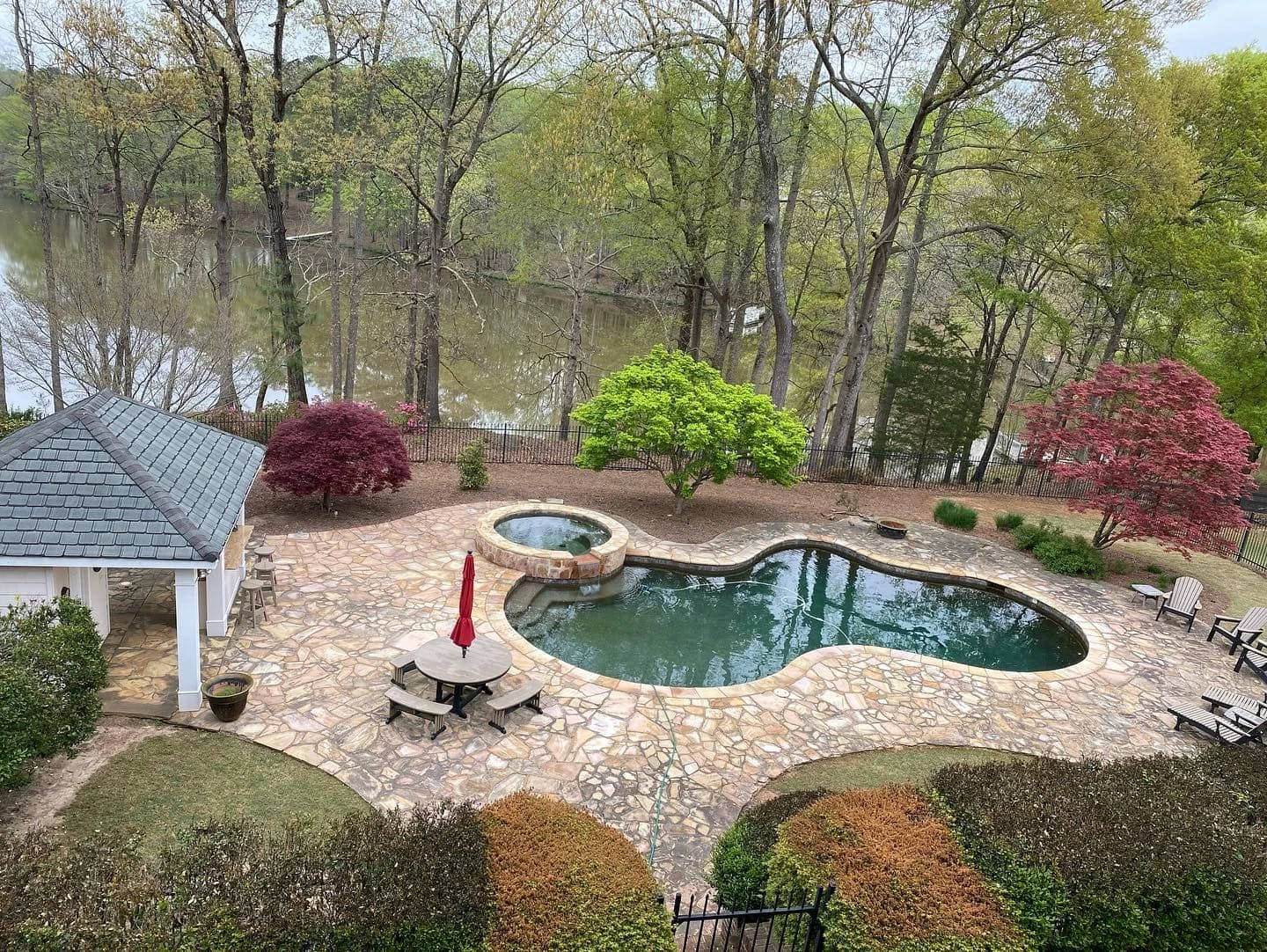
Q: Are infinity, negative, and vanishing actually different pools?
Short answer: no. The three words describe the same detail — a pool wall built one course lower than the rest of the perimeter, called a weir, where water continuously overflows into a hidden catch basin below. A pump lifts it back into the pool. The sheet of moving water on that low wall is what makes the pool look like it runs straight into the sky, the trees, or the horizon.
Three words, one mechanism. Here is where the language came from:
- Infinity edge — the term most East Coast and Southeast builders use. “Infinity” refers to the visual: the water meets the horizon and the eye can’t find where one ends and the other begins.
- Negative edge — the preferred term among California and Arizona builders, where the style originated on canyon lots. “Negative” describes the engineering: the edge wall sits below the waterline instead of at or above it.
- Vanishing edge — a trademark-adjacent label used by some national design-build firms for the same detail. “Vanishing” is the marketing story the client sees on a rendering.
If you asked a PE-stamped structural engineer to draw the three on a napkin, you’d get one drawing. What varies between $45K and $95K in Marietta isn’t the name on the contract — it’s the length of the weir, the structural work underneath it, and the caliber of finishes on the catch-basin face.
The one-sentence rule: If a builder tells you their “infinity edge” is a different product from someone else’s “negative edge,” ask which hydraulic spec is different. The honest answer is “none.” The value conversation is about weir length, finishes, and PE design, not vocabulary.
Q: What is actually being built underneath the pretty sheet of water?
The moving part is a weir wall — typically a reinforced-concrete pool wall built 1 to 1.5 inches lower than the surrounding bond beam so that under load the entire wall continuously overflows. Every custom vanishing edge we build on the East Cobb grade is still, structurally, the same four pieces. Let’s walk them by material, because this is where the pricing spread comes from.
Piece 1: The weir wall
Poured-in-place reinforced concrete, tied into the pool shell as a single monolithic element. Reinforcement is typically #4 rebar at 12 inches on center both ways, minimum. The weir top is screeded to a flatness tolerance tighter than any other surface on the pool — we’re looking for under 1/16″ over a 24-ft run, otherwise the sheet of water becomes lopsided and the optical illusion breaks. On Atlanta Country Club lots where the weir sits 42 ft long, the concrete pour is done in one continuous truck load, no cold joints.
Piece 2: The catch basin (or “catchment”)
A second reinforced-concrete vessel built directly below the weir, hidden from the main viewing angle. Industry standard sizes the basin volume to 110% of the weir flow at peak — meaning when every pump is running and wind is pushing water across the pool, the catch basin can briefly hold the overflow plus some buffer before it drains back. Trough is typically 18 inches wide and deep enough to contain a skimmer, a return, an auto-fill, and inspection access.
Piece 3: The booster pump
The main filter pump can’t do this job. A vanishing edge needs a dedicated VSF booster — a variable-speed flow pump whose only responsibility is pulling water out of the catch basin and pushing it back over the weir. We typically spec Pentair IntelliFlo3 VSF or Jandy FloPro VSFHP in the 2.7 HP class for weirs between 24 and 42 ft. That pump runs whenever the edge is “on,” which is typically any time the homeowner is looking at the pool.
Piece 4: The finish face
The weir’s outer face — the side guests see the water pouring down — is the finish surface the whole effect is built around. This is where the three terms start to feel different even though the engineering doesn’t: a builder doing a $45K edge might face the weir in standard pool plaster. A $95K edge in Atlanta Country Club faces it in glass tile, honed travertine, or a custom stacked-stone veneer with flush-cut joints. Same wall, same pump, very different finish.
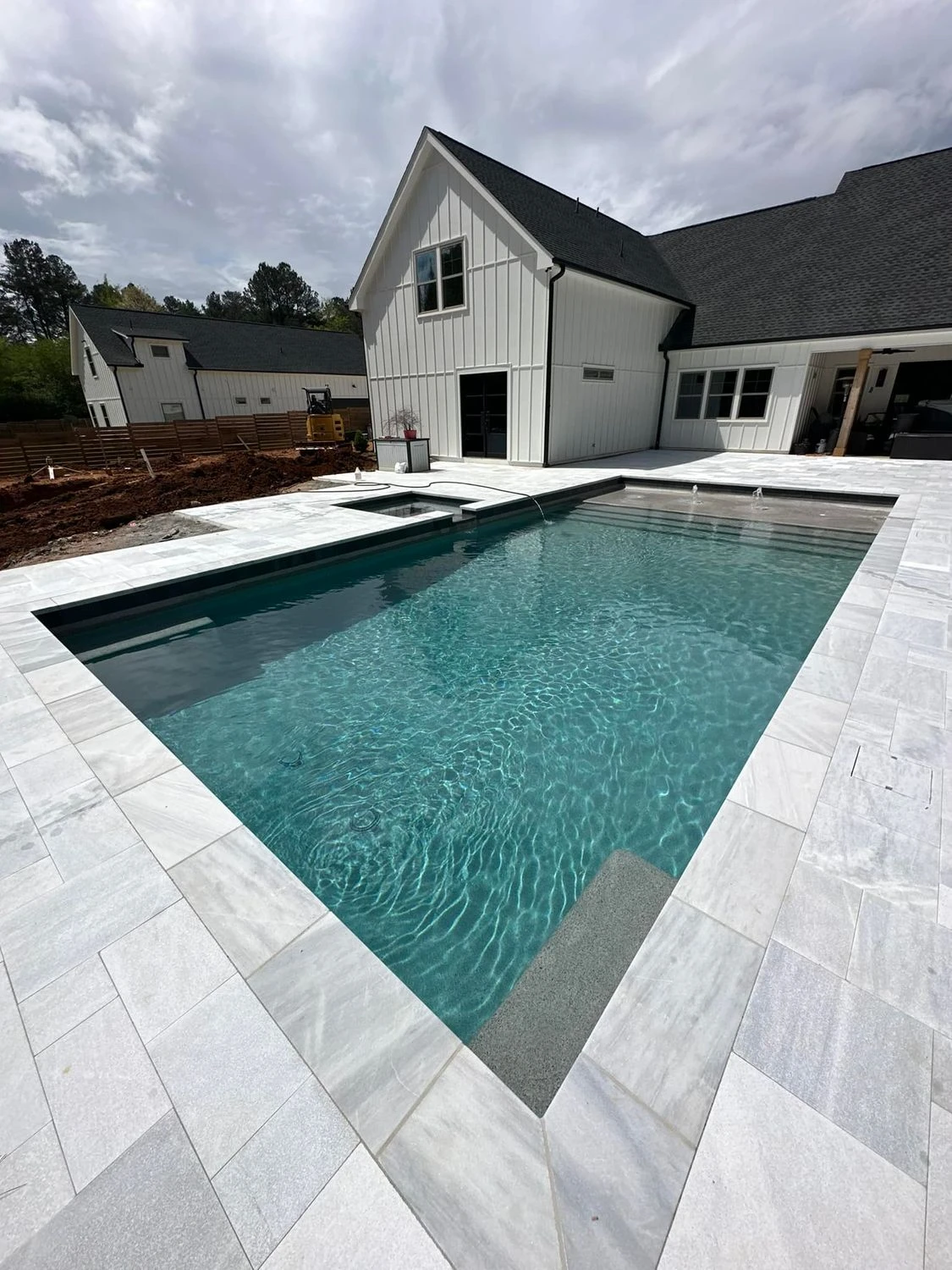
Q: Why does weir length decide most of the price?
Because almost every cost in the system scales with how long that wall is. A 24-ft weir versus a 42-ft weir is not 1.75x the price — it’s closer to 2.1x once you run every line item. Here’s the cost stack by material, working left to right across the estimate.
Concrete and steel for the weir itself
Straight linear cost. More wall, more rebar, more yards of 4,000-psi concrete in the pour, more screeding labor to hit that 1/16″ flatness. A 24-ft pour runs roughly 8 to 10 yards with ancillary; a 42-ft pour pushes 14 to 16 yards. Call it $90 to $120 per linear foot just for the wall element, excluding shell work.
Catch-basin volume
Since the basin is sized at 110% of weir flow, it grows with weir length. A 24-ft weir typically needs a trough holding 180 to 220 gallons of surge capacity. A 42-ft weir needs closer to 380. That’s another concrete vessel, another waterproofing pass, another set of drains and returns. On hillside lots in Burnt Hickory and Brookstone it’s also another retaining-wall problem, because the basin effectively doubles the depth of the excavation along that pool edge.
Pump sizing and electrical
A 24-ft weir at a conservative flow rate of 8 gpm per linear foot needs about 192 gpm of dedicated edge flow. A 42-ft weir at the same rate needs 336 gpm. That’s the difference between a 2.2 HP VSF booster on a 30-amp circuit and a 3.0 HP booster on a 50-amp circuit. Marietta is also a Cobb EMC service territory for most of East Cobb (different from Georgia Power), and incorporated-Marietta addresses inside the city ring are served by Marietta Power — both utilities have slightly different permitting and inspection cadences for equipment-pad subpanels, which we walk through with Cobb County inspectors before the pour.
Finish face material
This is the single biggest swing in the whole budget. Plaster face adds almost nothing. A glass-tile face from a Lightstreams or Oceanside palette, set tight with flush grout, runs $85 to $180 per square foot installed across the full weir face plus return wall. A 42-ft weir with a 4-ft drop in exposed glass face is 168 square feet of premium finish, which is where the back half of a $95K edge disappears.
Q: Does the Marietta terrain help or hurt a vanishing-edge build?
It helps the effect and punishes the budget in one direction. Vanishing edges need a drop — a view that falls away from the far edge of the pool. Marietta’s Piedmont terrain is rolling, with most East Cobb backyards sitting on 3 to 6 ft grade changes across the building pad, and properties running up the south face of Kennesaw Mountain reaching elevation differentials of 15 ft or more in the backyard alone. That’s excellent for the optical illusion. It’s expensive for the structural engineer.
Here is what drives cost on a Marietta hillside that a Dawsonville flat lot wouldn’t carry:
- Variable bedrock depth. Cobb County sits on Piedmont red clay over granite bedrock, with the rock table ranging anywhere from 3 ft to 15 ft below grade. On Indian Hills lots we’ve hit granite at 5 ft; on Sope Creek lots we’ve hit it at 14 ft. The catch-basin excavation has to reach competent bearing on both sides, which sometimes means rock saw and blast permits from the county.
- Retaining walls behind the weir. The downhill face of a vanishing edge is already a structural drop. If the grade continues falling behind that wall, you need a secondary retaining element to hold the cut. On steeper Kennesaw-facing lots we’ve specified 24-inch reinforced CMU walls behind the catch basin, essentially doubling the excavation cost on that edge.
- Cobb EMC 240V service. Rural-flavored Cobb EMC territory runs a different service panel rating schedule than Georgia Power. On larger edge pools we’ve specified 400-amp service upgrades to carry the VSF booster, the main pump, a heater, LED perimeter lighting, and a spa blower on the same pad.
The reward for paying those line items is the view that made the homeowner want the pool in the first place — the weir “disappears” into the treeline on an Atlanta Country Club fairway lot, or into the Chattahoochee River valley from a high Sope Creek bluff, or into the mature East Cobb oak canopy that’s older than most of the subdivisions around it.
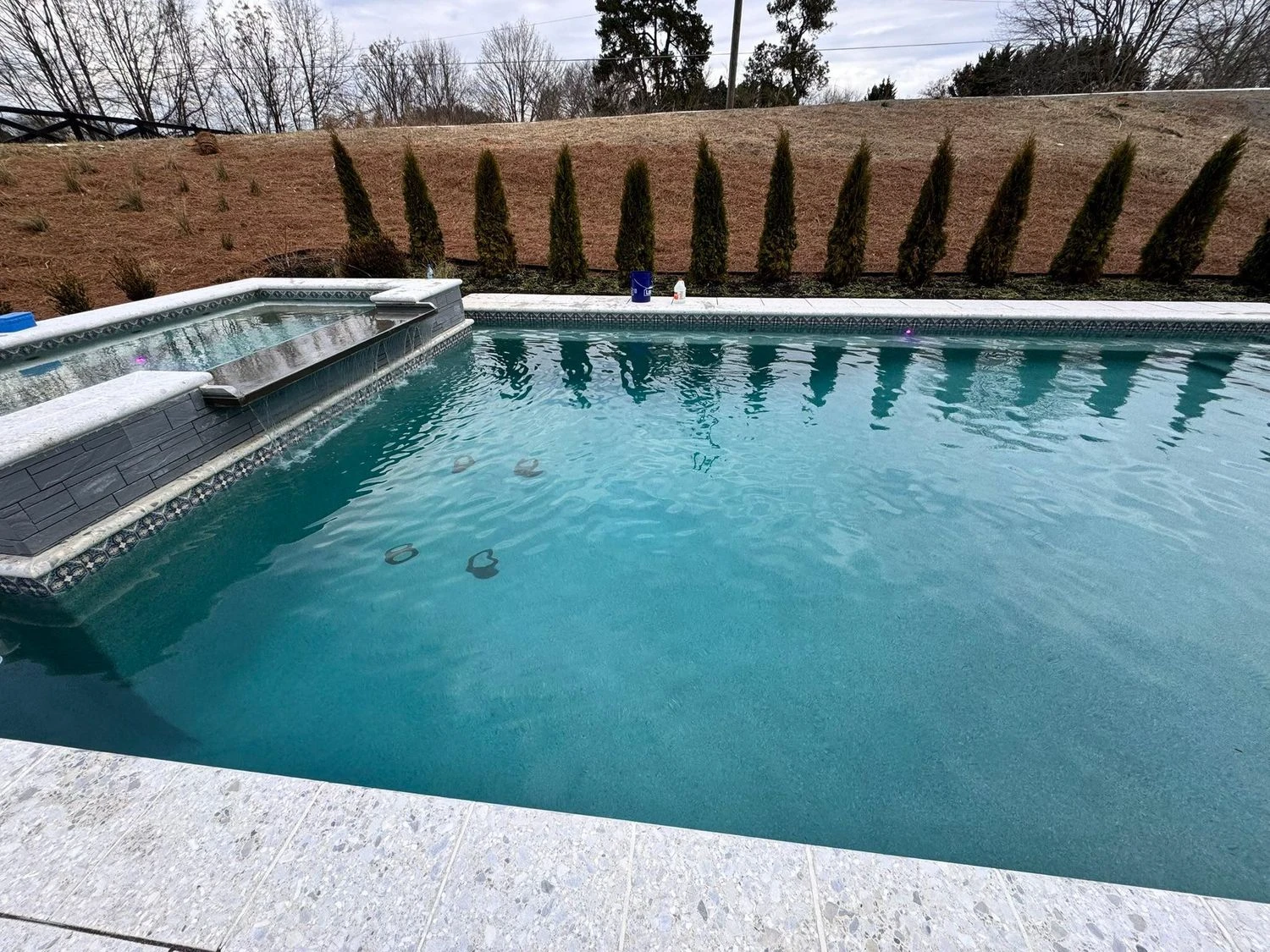
Q: What does Cobb County actually require at permit?
The permitting reality is the piece most builders skim past in the sales meeting. A vanishing-edge pool is not a standard pool permit in Marietta. It’s submitted through Cobb County Community Development at 1150 Powder Springs Street, and because the edge wall is a load-bearing retaining element integrated into the pool shell, the county requires a Georgia-licensed Professional Engineer to stamp the structural drawings before the permit is issued.
Here is what the PE package actually covers, piece by piece:
The weir wall structural spec
The PE calculates the hydrostatic load on the weir, the dead load of the finish face, any live load from people standing on an adjacent deck, and the bending moment where the weir meets the pool floor. The rebar schedule, the concrete strength, and the backfill requirements come back as a stamped drawing the plan reviewer can sign without guessing.
The catch-basin structural spec
Because the basin sits below the main pool shell and often below surrounding grade, it gets treated as its own retaining structure. On hillside lots the PE will also call out the need for weep drains behind the basin, a gravel backfill envelope, and a geotextile wrap to prevent clay migration into the drains. Piedmont red clay can pack so tightly around concrete that without weep drains you end up with hydrostatic pressure pushing the basin wall inward during Marietta’s 52-inch annual rainfall.
The equipment-pad spec
Pump sizing, circuit sizing, and overflow routing are all stamped. Inspectors want to see that the VSF booster is correctly matched to the weir flow, not just named on a cut sheet. Electrical has to comply with NEC §680 for pool equipment, with bonding grid, GFCI protection, and equipotential plane. Cobb inspectors are consistent and sharp — they check.
The HOA approval layer
Country club neighborhoods in Marietta carry real HOA teeth. Atlanta Country Club and Indian Hills in particular have architectural review committees that pre-approve pool shape, coping color, and equipment-pad screening before the county permit is even pulled. We front-load a complete package — renderings, material boards, equipment-pad elevation — so approval happens once, not three times.
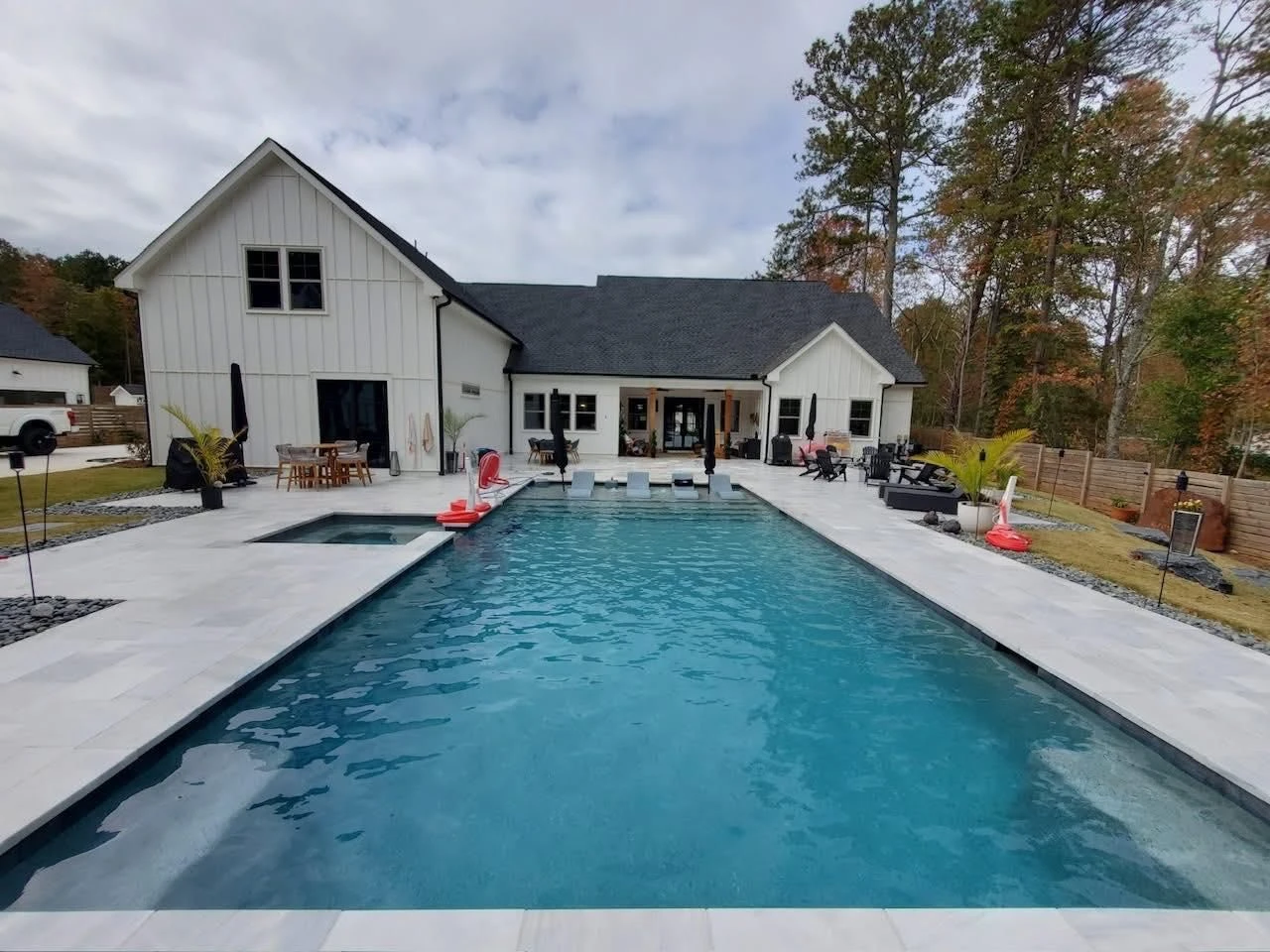
Q: What’s the real East Cobb price spread — and why?
We’ve quoted enough of these in Cobb County over the past five seasons to give a tight range. The premium over a comparable flat-edge pool — same shape, same size, same deck material, just without the edge — runs $45K to $95K depending on the specs below. This is a true apples-to-apples added cost, not a total pool budget.
$45K-$55K: the entry vanishing edge
Weir length 22 to 26 ft. Catch-basin volume around 200 gallons. VSF booster in the 2.2 HP class. Finish face in plaster or standard 1-inch porcelain tile. Suitable for a modest East Cobb downslope, a single-family yard, and a homeowner who wants the effect without the top-shelf finish. Indian Hills interior-street lots often land here.
$60K-$75K: the mid-range build
Weir length 30 to 36 ft. Catch-basin volume around 280 gallons. VSF booster in the 2.7 HP class. Finish face in honed travertine or mid-tier glass tile. One retaining element behind the basin. This is the most common band in Walton Woods and upper Indian Hills. It’s also where most out-of-state buyers moving into Marietta end up after seeing a few quotes.
$80K-$95K: the Atlanta Country Club build
Weir length 38 to 42 ft. Catch-basin volume 380+ gallons. VSF booster in the 3.0 HP class with backup redundancy. Premium Lightstreams or Oceanside glass tile on the weir face, flush-jointed. Two or three retaining elements on the downhill side. HOA pre-approval built into the bid. This is the ceiling for most backyards — beyond $95K you’re usually into multi-weir configurations or perimeter-overflow pools, a different conversation.
Appraisal reality in East Cobb: A well-built vanishing edge in Atlanta Country Club, Indian Hills, or Walton Woods contributes $80,000 to $150,000 at resale appraisal — roughly 75% to 140% cost recovery depending on the builder, finish, and how the photography reads in the MLS listing. It is one of the few pool upgrades that consistently pencils on a Marietta resale.
Three things separate a quote you can trust from a quote that’s going to cost you $40K in change orders. First, ask for weir length, catch-basin volume, and booster HP in writing — these three numbers are the entire engineering spine of the edge. If a builder can’t put them in the contract before signing, they haven’t designed the pool yet; they’ve sold a render. We hand every Marietta client a one-page spec sheet with those three numbers, the finish face material, the PE firm’s name, and the catch-basin concrete yardage before deposit. If a quote can’t match that, walk.
Second, confirm the PE stamp and the Cobb County submittal path. No PE stamp, no permit. We’ve seen homeowners try to save $8K by going with a builder who “usually just submits without engineering” — it gets red-tagged, the pool sits with a shell, and the homeowner pays for the PE package after the fact, out of pocket, at emergency rates. Include engineering in the contract or expect to pay twice.
Third, match the finish face to the rest of the backyard. A $95K edge with a mismatched deck is wasted money. If the deck is French-pattern ivory travertine, the weir face should land in a complementary honed limestone or a cream-field glass tile — not a cold gray modern tile that fights the surroundings. Indian Hills traditional lots and Atlanta Country Club lots tend to want warm-stone finishes; modern farmhouse new-builds in Brookstone or along the Chattahoochee corridor pull toward dark-glass faces with black coping.
The short version: stop arguing about the word. Infinity, negative, vanishing — it’s one detail with three marketing names. Argue about the weir length, the catch-basin volume, the booster HP, the PE firm, and the finish face. Those five things are the entire difference between a $45K edge that looks thin and a $95K edge that an appraiser adds $150K to on resale day.
If you’re in Marietta and sitting on three quotes with three different words on them, bring the quotes to us. We’ll decode them line by line, tell you which number is real engineering and which number is sales vocabulary, and give you the weir length and finish face your specific East Cobb lot can actually carry.
Custom Pool Construction across 20+ cities within 30 miles of Winder, GA
Infinity, negative, or vanishing — if your Marietta backyard has a drop, we’ll engineer the weir, size the catch basin, and finish the face so the appraiser sees the upside, not the cost.