
It is a Tuesday in March. Three homeowners — one in Hampton Park off Post Road, one in downtown Cumming two blocks off Main, and one on five acres near Coal Mountain — all sign a hardscape contract on the same day. Three months later, two of them are grilling on finished patios. The third is still waiting for a board review. The material list is nearly identical. The weather was the same. Only the zone was different.
That is the story of building hardscape in Forsyth County. The schedule you get has less to do with the crew and more to do with which side of GA-400 your driveway sits on. South Forsyth subdivisions (Hampton Park, Old Atlanta Village, Vickery) are HOA-heavy and permit-fast. Central Forsyth — everything tight around Cumming proper in the 30040 corridor — is a mixed bag. North Forsyth, from Bethelview up through Coal Mountain, Ducktown, and Shady Grove, is the opposite: rural density, fewer boards, longer driveway gravel tracks, and crews that can pour footings the same week we pull a permit.
We build across all three zones. Forsyth County issued north of 200 pool-related permits in the last 12-month window we can track, and the hardscape volume riding alongside those permits is higher still. The lesson we have learned — filtering that volume through the inspector schedule, the HOA schedule, and the clay underneath — is that the realistic timeline varies by 2 to 3 weeks depending on which unincorporated community sits on the driveway sign. This is that timeline, worked week by week, zone by zone, from contract signature to final punch list.
One note before we start. The framework below is built around a “mid-complexity” Forsyth project: roughly 500 to 900 square feet of paver or flagstone patio, a seat wall or low retaining wall, one fire feature (gas firepit or built-in masonry fireplace), and often either a small pavilion or a compact outdoor kitchen. Everything smaller compresses on the short end of each zone’s range. Everything larger — a full pool deck plus detached pavilion plus kitchen plus waterfall — typically adds 2 to 4 weeks on the back half of construction rather than at the permit stage. The zone factor still dominates either way.
Week 0 — Contract, Survey, and the Forsyth Zone Triage
Before any shovel leaves the trailer, we run every new Forsyth contract through a three-question triage. Which zip code? Which HOA (if any)? Is the lot inside a platted subdivision or on acreage with a driveway number? Those three answers drive the critical path for the next 60 days.
South Forsyth (zip 30041, Bethelview, Old Atlanta, Hampton Park, Vickery, Polo Fields) means HOA. Almost every neighborhood south of Highway 20 has an active architectural review board, and most of them meet only once or twice a month. Central Forsyth (30040, inside Cumming city limits plus the immediate ring) mixes small HOAs with a handful of older unincorporated cut-throughs where the county alone signs off. North Forsyth (30028 — Coal Mountain, Ducktown, Shiloh, Shady Grove, the Sawnee Mountain side) is largely acreage. If there is an HOA at all, it is usually a one-page covenant, not a 40-page design guideline.
We spend Week 0 ordering a plat, walking the yard with a locator for irrigation and low-voltage, and (critically) submitting the HOA package the same day the contract is signed. On a $62,000 paver and pavilion package, losing 14 days waiting to mail the HOA form is not a small cost — it is the difference between finishing before the Fourth of July cookout and finishing after.
Forsyth Permit Volume: The county processes 200+ pool-related building permits each year, plus several times that number of standalone hardscape and structure permits. Mid-spring (March–May) is the peak submission window. Submit in that window and expect 2–3 extra business days on plan review.
Weeks 1–2 — HOA Review (Where the Zones Split Hardest)
This is the stage where the three zones diverge, and it is the single biggest lever on your total project length.
South Forsyth (HOA-heavy). Hampton Park, Vickery, The Manor, Polo Fields, Windermere, and the ring of big subdivisions between Post Road and McFarland Parkway all run modified ARC processes. Submittal deadlines are typically 10 days before the monthly meeting, and packages must include a to-scale site plan, elevation drawings for any vertical structure (pavilion, pergola, wall over 30 inches), a material sample board, and in several communities a drainage narrative. If you submit on the 11th and the board meets on the 20th, you are waiting five weeks for the next cycle. We have watched this cost families an entire spring.
Central Forsyth. Inside Cumming city limits and the immediate unincorporated ring, about half our projects have an HOA and half do not. The HOAs that exist here tend to be older and faster — often just an email to a management company, a 7–10 day turn, and written approval.
North Forsyth. Coal Mountain, Ducktown, Shady Grove, Big Creek, Shiloh — the acreage side. A large share of these lots carry no active HOA at all. Where one exists it is usually a neighborhood covenant rather than a design review. This zone routinely saves 2–3 weeks right here in Weeks 1–2.
There is one catch in the North zone worth flagging. Lots inside the newer large-parcel subdivisions off Highway 369 — the ones built out in the last 8 to 10 years on 3 to 5 acre sites — sometimes carry surprisingly strict covenants written by the original developer. Those are not always obvious from the road. We ask for a copy of the recorded covenant during the Week 0 walkthrough, even on what looks like pure acreage, because a single setback or material restriction we miss at contract becomes a rebuild later.
Weeks 2–4 — County Permitting and the Plan Review Lane
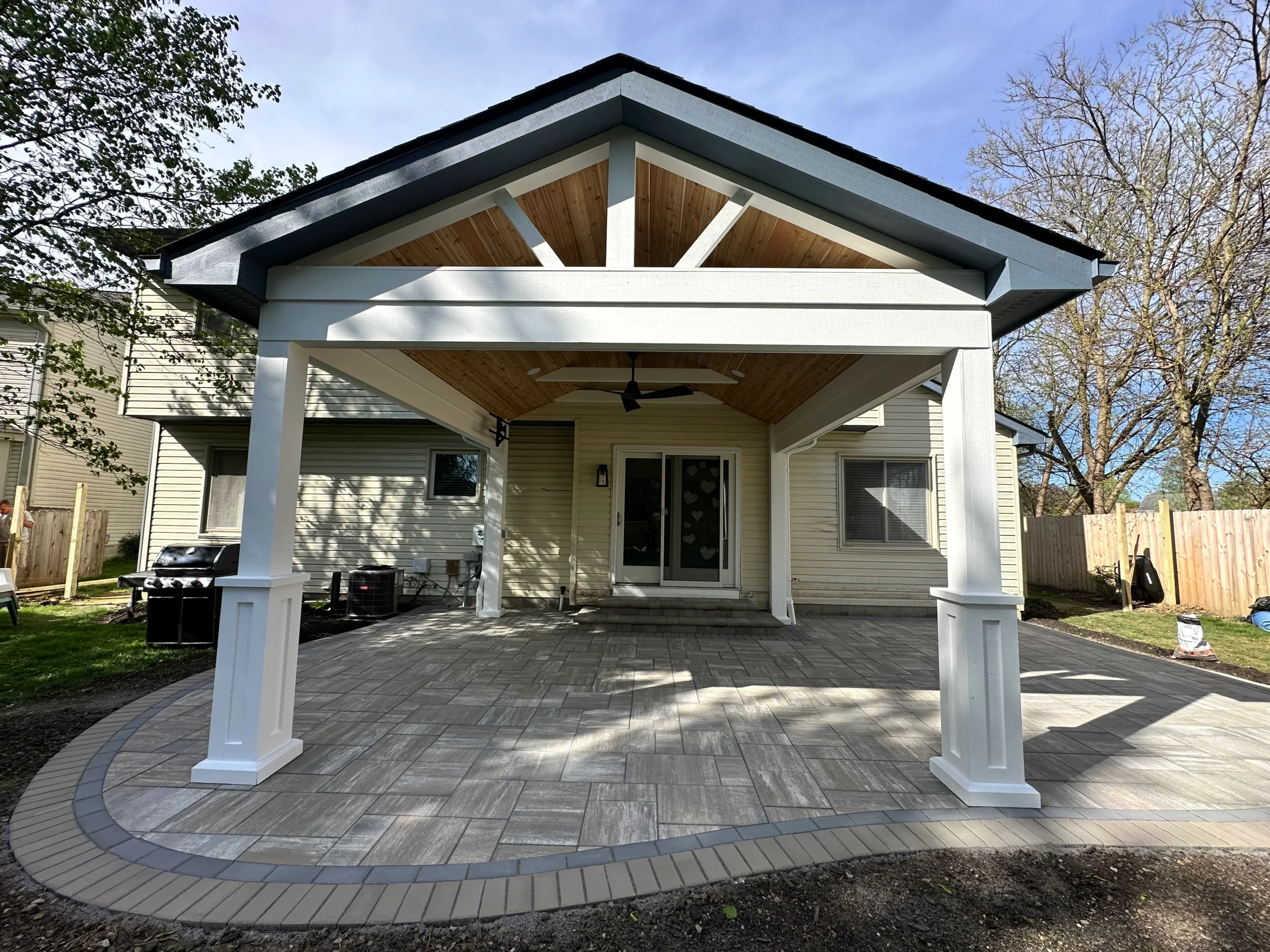
Forsyth County plan review runs through the Department of Planning & Community Development out of the Cumming office. For a standalone paver patio, you do not need a building permit. The moment you add a roofed structure over 120 square feet, a fire feature with a gas line, a retaining wall over 3 feet, or any structural column carrying roof load, you are in the plan review lane.
A typical Forsyth hardscape permit with a pavilion or covered outdoor kitchen takes 10 to 15 business days from submission to issued permit during normal volume, and 15 to 25 business days during the March through May peak. The reviewers are thorough. They will kick back packages that miss footing details, gas line schematics, or engineered truss drawings on anything bigger than a simple gable.
The zone effect here is narrower than at the HOA stage but still real. South Forsyth lots, because they sit in denser subdivisions, more often require a sediment and erosion control plan attached to the permit. North Forsyth lots on acreage with gravel driveways sometimes require a culvert or driveway access detail if the hardscape changes grade near the county right-of-way — we have added five business days to two different Coal Mountain projects waiting on GDOT-adjacent access approvals that do not come up at all on a tight Cumming lot.
Weeks 3–4 — Layout, Excavation, and the Piedmont Clay Problem
The moment the permit prints, we layout the footprint with spray paint and stakes and hand the customer a walk-through. This is the single most valuable 30 minutes of the project. We have seen homeowners realize at layout that the patio extends 18 inches farther than they pictured, or that the pavilion column lands squarely on the sightline from the kitchen window. Fixing either of those is free at this stage. It is not free once footings are poured.
Excavation in Forsyth is a Cecil-series Piedmont clay story almost everywhere south of Highway 369. Cecil clay swells when wet and shrinks when dry, which is why a builder who dug 4 inches and dropped pavers on it in 2019 is replacing that patio now. Our standard dig is 10 to 12 inches below finished paver grade, carrying 8 inches of compacted GAB #57 stone base under every square foot of patio and walkway, plus an additional lift under pavilion footings.
North Forsyth excavation runs a different playbook. Around Coal Mountain and the upper Ducktown ridge, we hit decomposed granite and actual rock shelves at 18 to 30 inches in about one of every three jobs. That slows excavation but speeds long-term performance — rock makes a fantastic base course. Budget an extra day for mini-ex work on rocky lots and, rarely, a hammer attachment rental.
A quick word on irrigation and low-voltage lines. Subdivisions built after 2010 in South Forsyth almost always have a buried irrigation mainline running the rear-yard perimeter, plus landscape lighting daisy-chained off a transformer by the house. We locate, mark, and cap both before excavation — on a full-perimeter patio expansion the irrigation redesign is a half-day of its own, and cutting a line in the middle of a 20-yard stone delivery is the kind of problem that eats an afternoon and a bag of fittings.
Base depth spec: 8″ compacted Graded Aggregate Base (#57 stone then #8/9 bedding) on all paver fields. 12″ minimum under vehicular-load sections. Pavilion and kitchen footings dig to frost depth plus 6″ — in Forsyth County, that lands at 18″ to 24″ below finished grade.
Weeks 4–5 — Base, Drainage, and the Lake Lanier Moisture Effect
Base installation is the week where you separate a hardscape that lasts 25 years from one that heaves in year three. We install in 2-inch lifts, compact each lift to 95% modified Proctor density with a Bomag 120-class plate compactor, and verify the final grade with a laser level across the field before bedding sand goes down.
Drainage in Forsyth has a quirk worth naming. The south shore of Lake Lanier sits entirely inside the county, and the moisture effect is real on any lot within a mile or two of Browns Bridge Road (Hwy 369) or the lake coves around Shady Grove and the Six Mile area. Dew lasts longer, soils drain slower, and overnight humidity fogs sealer cure. We schedule sealer application on lake-adjacent jobs strictly in the morning window, 10 AM to 2 PM, rather than the all-day window we will use on a dry ridge lot in Polo Fields.
Every patio over 400 square feet gets a pitched drainage plan — minimum 1/8″ per foot away from the house, often routed to a pop-up emitter 12 feet past the patio edge. Forsyth’s USDA Zone 8a and roughly 22 freeze events per year mean standing water in a paver joint will crack a neighbor joint within two winters. We do not negotiate on pitch.
Weeks 5–6 — Paver and Stone Laydown by Zone and Material
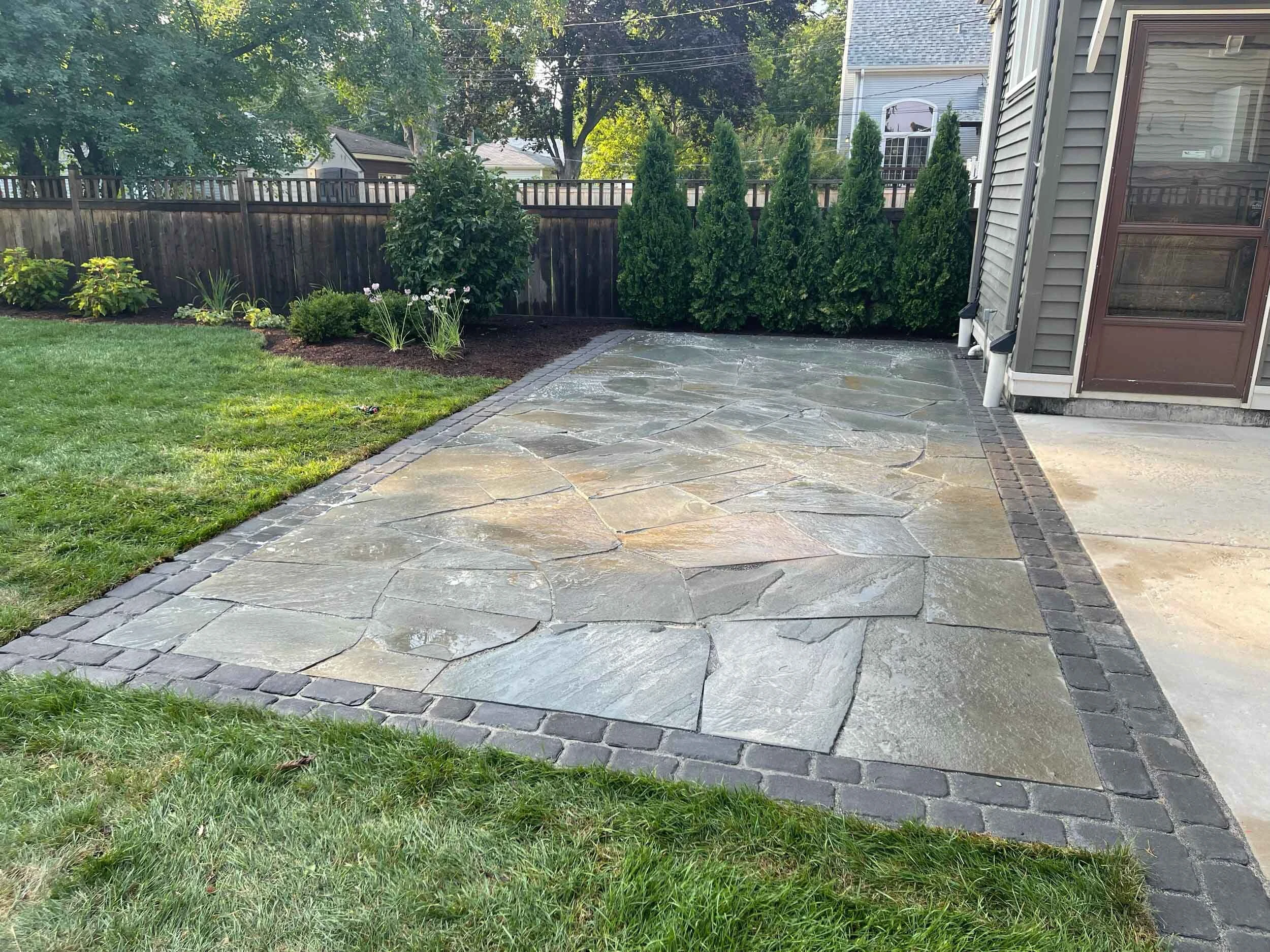
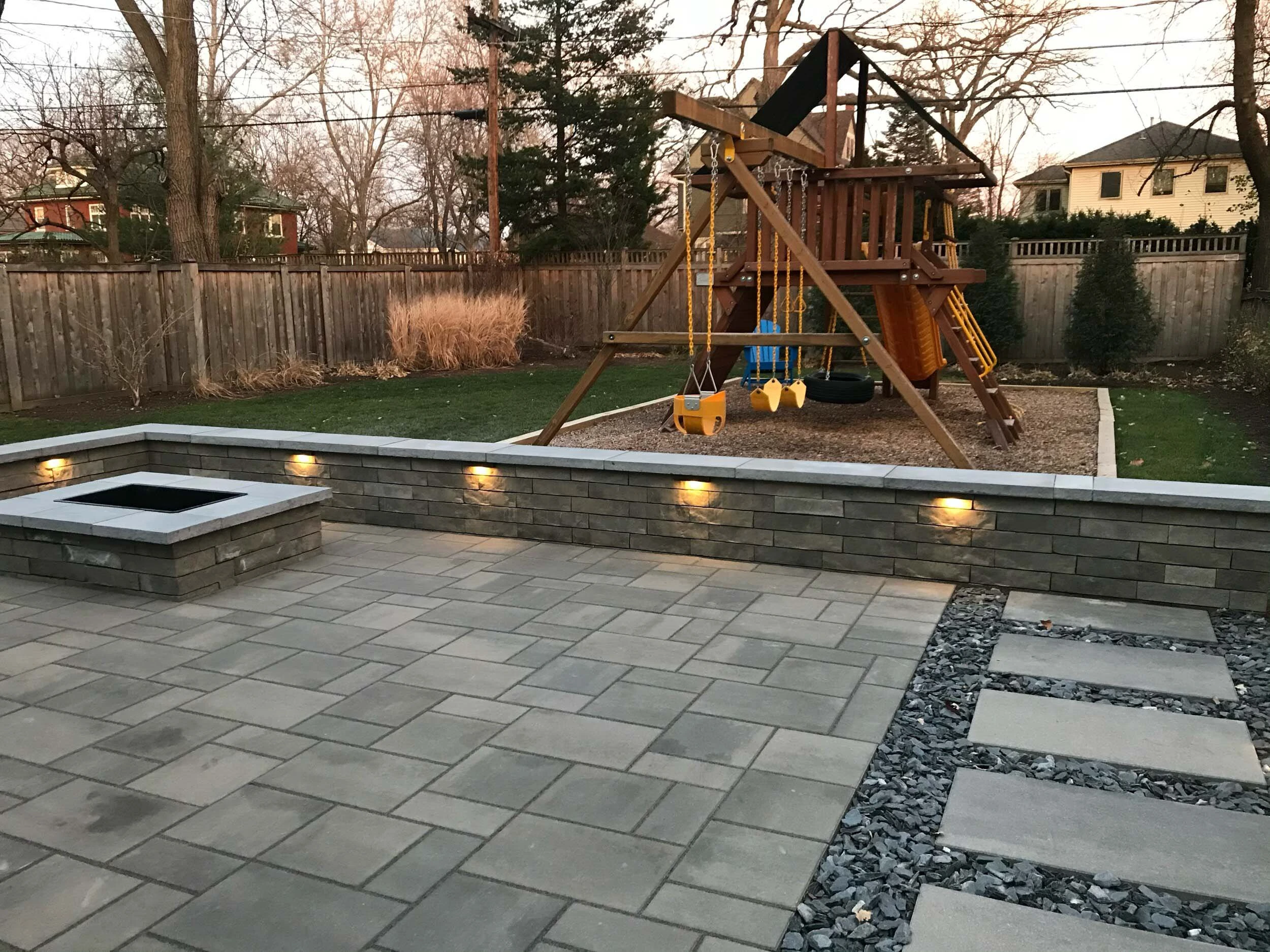
Laydown is where material choice starts to influence the schedule more than zone does. A Techo-Bloc Industria Smooth plank paver field goes faster than an irregular flagstone patio because the cuts are fewer and the pattern is repeatable. A bluestone flagstone field with tight mortared joints along a clay brick soldier border moves at about half the daily square footage of a modular paver field.
Typical Forsyth laydown pace on a two-crew install:
- Plank / modular paver field — 300 to 400 sq ft per day, including cuts and border work.
- Multi-tone tumbled paver with soldier border — 250 to 320 sq ft per day.
- Irregular flagstone (bluestone) with tight joints — 120 to 180 sq ft per day.
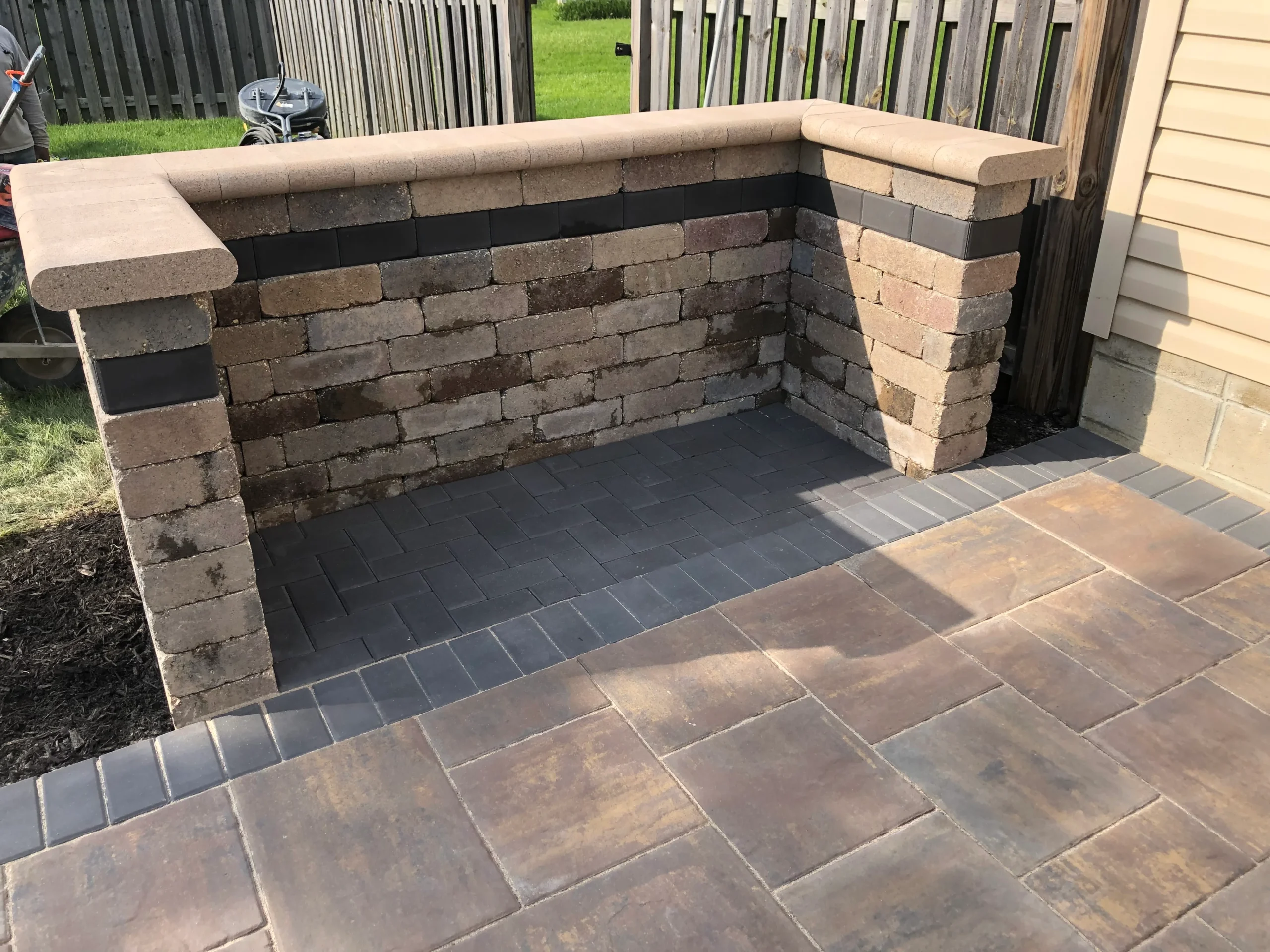
- Dry-stack stone bar or seat wall — 6 to 10 linear feet of wall per crew-day.
Our plant ledger pulls from Forsyth-accessible suppliers — Oldcastle out of Buford, ACME Brick for soldier courses, and regional Techo-Bloc stock through the Dacula and Cumming yards. Being one county south of an active distributor matters. It means a broken pallet on Wednesday becomes a re-deliver on Thursday instead of a lost week.
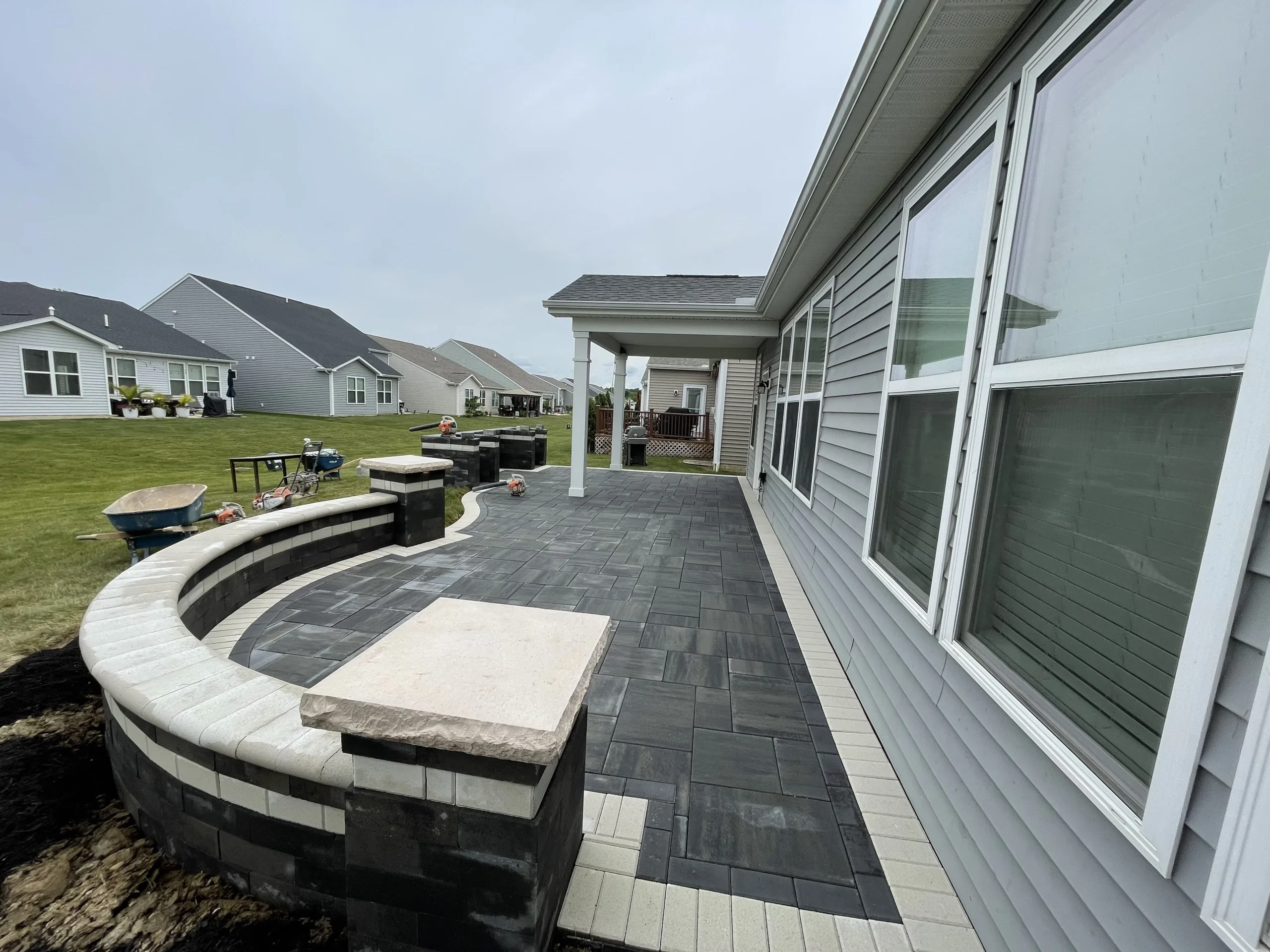
Pattern complexity also bends the laydown pace. A running-bond field with a single soldier border laid off a 90-degree house wall finishes fast. A Herringbone 45 field with a picture-frame double border around a curved patio edge cuts the pace by roughly 30%. And a blended paver design — say a gray plank field transitioning into a cream accent stripe along the pool coping — costs a full extra day of measuring, dry-laying, and re-cutting. We quote laydown duration based on pattern, not square footage, and customers who have never built a patio before are sometimes surprised by that breakdown. It is usually the right call anyway.
Weeks 6–7 — Vertical Structures, Kitchens, and Inspection #1
If the project includes a pavilion, pergola, built-in kitchen, or fire feature, this is the stretch where the inspector re-enters the frame. Forsyth requires a footing inspection before pour on anything structural (pavilion post, kitchen column, wall over 3 feet), a framing inspection once the structure is up and before any electrical or gas is concealed, and a final inspection after all finishes are installed.
Inspector availability in Forsyth is real-world tight. The county runs a standard 24 to 48 hour request-to-arrival window in off-peak months and a 3 to 5 business day window in peak. We have learned to schedule the footing inspection request the morning we set forms, not the afternoon we are ready to pour. Losing a Friday pour because the inspector cannot arrive until Monday costs a weekend and a heat-cycle cure window.
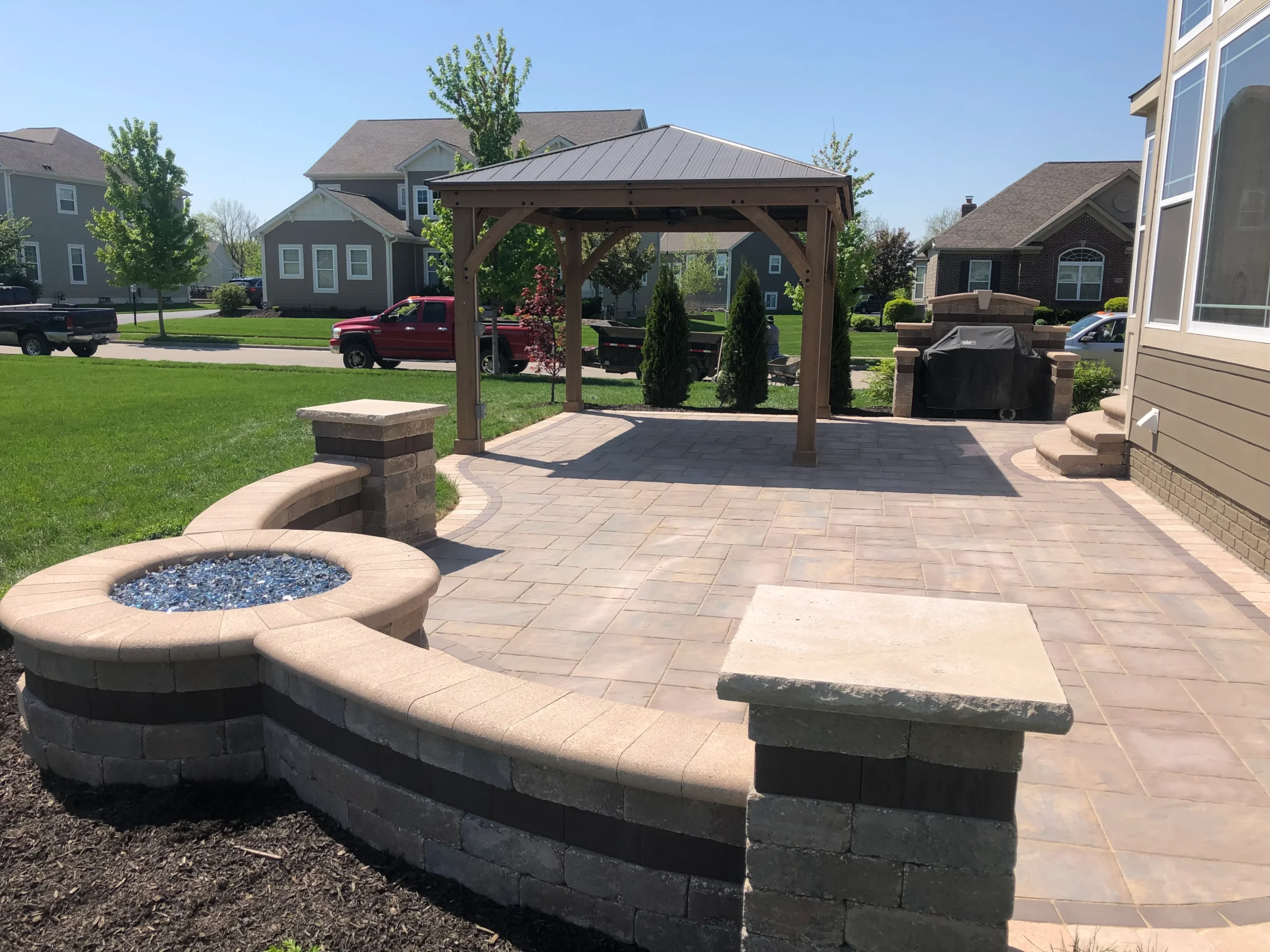
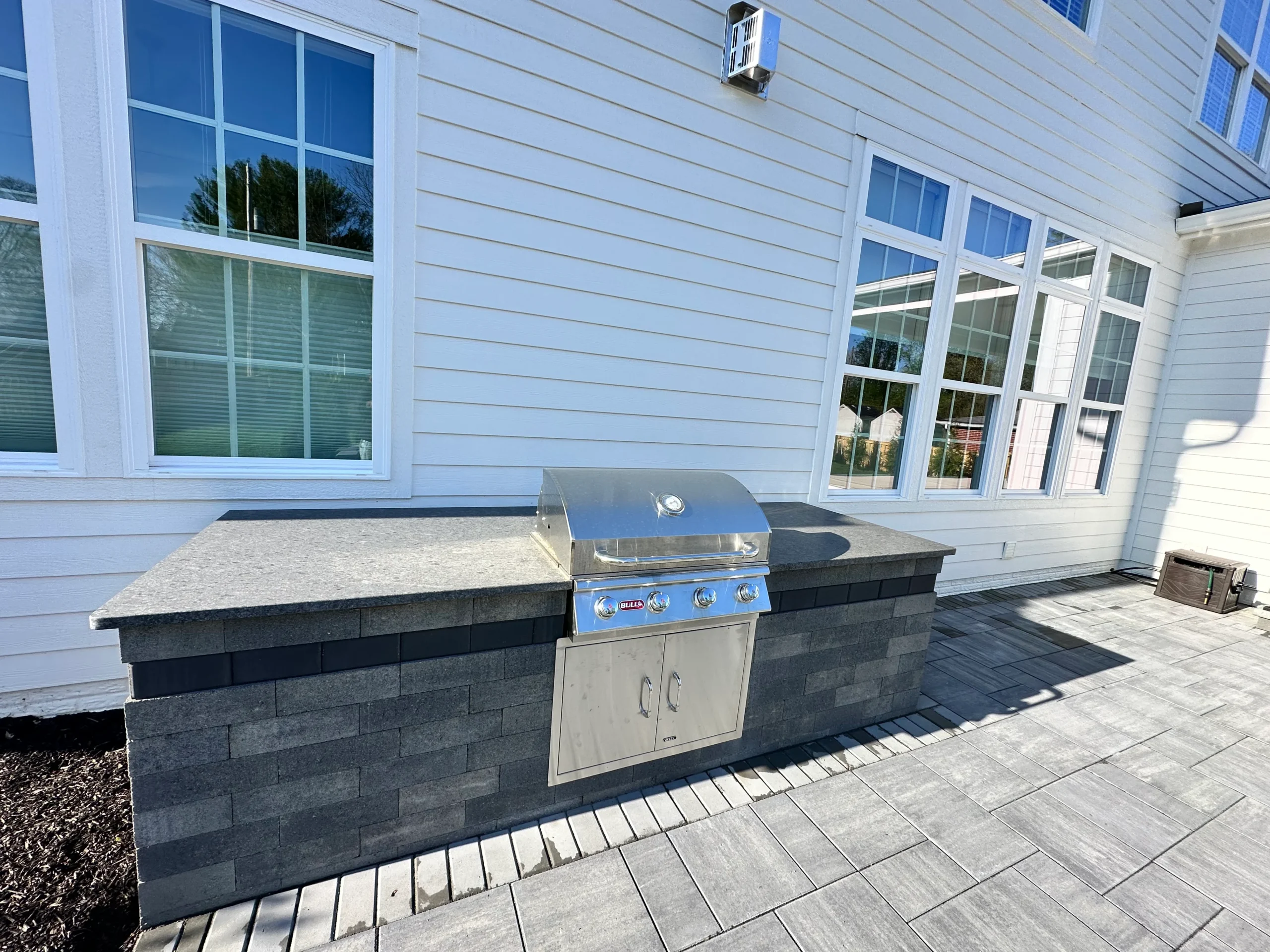
Built-in kitchens pull a second trade stack. On a compact single-bay kitchen with a Bull brand 4-burner built-in gas grill over a charcoal-block base and a flamed bluestone counter slab, we usually run: plumber for the gas line drop (half day), electrician for the outlet and low-voltage circuit (half day), kitchen trim install (one day), countertop template and set (two trips spaced a week apart). All of that compresses into a five-business-day window if the inspector cycle cooperates, and stretches to eight days if it does not.
Weeks 7–Final — Lighting, Sealer, Punch List, and Zone-Specific Finishes
The last 5 to 10 days of any Forsyth hardscape are finish work — and this is the week the homeowner walks outside with coffee at 7 AM to watch the transformation finalize. Low-voltage lighting goes in: pathway stakes, seat-wall LED strips under the bluestone cap, step-riser lights on any grade change, downlights inside a pavilion ceiling. We use Kichler and FX Luminaire transformers rated to the actual load, plus 20% spare capacity for future additions.
Sealer is the weather gate. A film-forming polyurethane sealer wants 48 hours without rain after application and cures hard in roughly 7 days. We watch the radar and push sealer to the last dry window we can find. On lake-adjacent lots near Six Mile or the Shady Grove coves we will skip sealer entirely in the fall and return in April — the morning dew just will not clear in time on a shoulder-season lake lot.
Zone-specific finish notes worth stating plainly:
- South Forsyth subdivision lots — more turf restoration, because the HOA yard is tight and we have usually pulled up sod to stage materials. Add a day of sod reinstall.
- Central Forsyth in-town lots — tighter access. If the backyard gate is 42 inches wide and the mini-ex is 36, we can still get in. If it is 36 and the mini-ex is 42, we are hand-hauling base stone and adding a full day.
- North Forsyth acreage — longer equipment travel, but we can stage a dumpster, a stone pile, and the mini-ex on the lot itself. Cleanup is simpler. Turf is often naturalized rather than sodded, which saves time.
Realistic Zone-by-Zone Total Timelines (Contract to Punch List)
Pull all of the above together and the total project duration lands in three distinct bands. These assume a mid-complexity scope (paver patio, seat wall, fire feature, small pavilion or covered kitchen — the most common Forsyth package) and normal-volume spring-through-fall construction.
South Forsyth — 5 to 7 weeks total. HOA submission through the Hampton Park, Vickery, or Old Atlanta boards will usually burn 2 to 3 weeks before the permit can even go in. Once we are building, the subdivision-tight access and tighter sod restoration typically add a half-day of finish work. This is the slowest zone on paper, but the most predictable — you know the HOA cycle in advance and can plan around it. Families on Post Road or Kelly Mill Road should target a February or early-March contract to finish before Memorial Day.
Central Forsyth (Cumming and immediate ring, 30040) — 5 to 7 weeks total. The HOA timeline here swings the widest. Roughly half our Cumming projects have no ARC process at all, which puts them on a 4 to 5 week schedule. The other half sit inside an older HOA with a faster email-based review and land at 5 to 6 weeks. The swing factor is the driveway sign, not the crew.
North Forsyth (30028 — Coal Mountain, Ducktown, Shiloh, Shady Grove, Big Creek) — 3 to 5 weeks total. Fewer HOAs, more acreage, easier staging. The only schedule risk up here is rock excavation adding a half-day to one-day, and the occasional county driveway-access review adding a week. Both are rare. North Forsyth is where we have built a full paver patio, curved seat wall, and rectangular gas firepit from signed contract to family dinner in 25 calendar days.
Critical-Path Risks Specific to Forsyth (Know These Before You Sign)
Every timeline above assumes the usual obstacles. The items below are the ones that have blown up Forsyth schedules for us and our competitors in the last 24 months, and the specific mitigations we now bake into every contract.
- Missing the HOA meeting cycle by one day. The most expensive mistake anyone can make in South Forsyth. Mitigation: we confirm the next meeting date before sending the contract, not after.
- Spring peak review delay. March through May plan review stretches 5 to 10 extra business days in Forsyth. Mitigation: sign in December or January for a May finish.
- Rain weeks. A wet week in Forsyth — especially April and the late-summer afternoon pop-up pattern — costs 3 to 7 calendar days because base stone will not compact on saturated Piedmont clay. Mitigation: build an explicit weather buffer into the schedule.
- Inspector availability in peak. 3 to 5 business day request windows are common April through June. Mitigation: request the next inspection the moment we pour footings or close a framing wall, not the morning after.
- Gas line permit routing. Any kitchen or firepit with a new gas line routes through a separate Sawnee EMC-adjacent utility review if the service panel needs an upgrade. Mitigation: verify existing gas capacity during the Week 0 walkthrough.
- Material backorder (rare but real). A specific Techo-Bloc color or a specialty bluestone thickness can be 3 weeks out in the spring. Mitigation: we order all hard goods at permit submission, not at layout day.
None of these are zone-specific in the HOA sense — any Forsyth project can hit any of them. But the compounding effect of an HOA cycle plus a rain week plus a peak-review delay is the reason one South Forsyth project stretches to 8 weeks while a neighbor ten miles north finishes in 4. The mitigations matter more than the averages.
Hardscape design and construction across 20+ cities within 30 miles of Winder, GA
From South Forsyth HOA subdivisions to North Forsyth acreage, we build pavilion, patio, kitchen, and fire-feature projects on a zone-aware schedule you can plan around.